Transportation Management System Market (2026-2036)
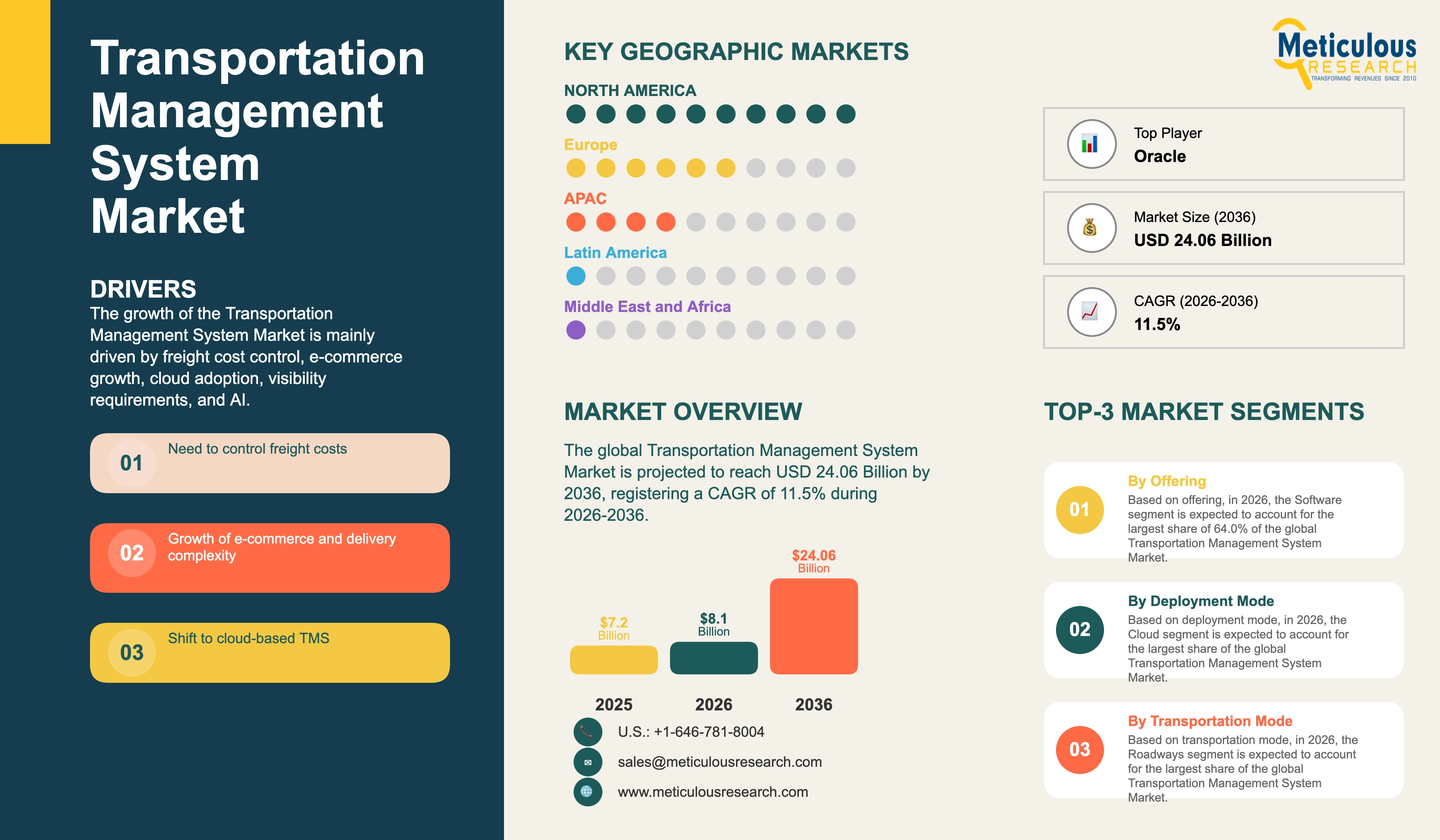
The global transportation management system market was valued at USD 7.20 billion in 2025. This market is expected to reach USD 24.06 billion by 2036 from an estimated USD 8.10 billion in 2026, registering a CAGR of 11.5% during the forecast period (2026-2036).
- Published
- Nov 2026
- Pages
- 239
- Format
- PDF + Excel
- Report ID
- MRICT - 1042641
- Base year
- 2025
- 2025 · BASELINE
- $7.20B
- 2036
- $24.06B
- CAGR 2026–2036
- 11.5%
2025 baseline · 2026–2036 forecast at 11.5% CAGR · hover a bar for the value
Key highlights
Descartes Systems Group, a leading provider of logistics and transportation software, reported record fiscal 2026 revenue of USD 729 million for the year ended January 31, 2026, up 12% from USD 651 million in the previous year, with services revenue of USD 677.2 million, according to its March 2026 results. Descartes reported record annual adjusted EBITDA of USD 329.5 million, equal to 45.2% of revenue, and operating cash flow of USD 266.2 million for the year.
On March 24, 2025, Descartes acquired 3GTMS, a leading provider of transportation management solutions, for approximately USD 112.7 million, and during fiscal 2026 it deployed about USD 152 million on three acquisitions, which also included PackageRoute, a provider of final-mile carrier solutions. Descartes also acquired Finale, a provider of cloud-based inventory management solutions for e-commerce businesses, in August 2025, extending its portfolio beyond transportation into e-commerce operations.
Descartes said in its fourth-quarter fiscal 2026 results that services revenue represented 93% of total revenue, reflecting the shift of transportation and logistics software toward recurring, cloud-based subscriptions and network services. Descartes estimated organic services revenue growth of about 8% in the quarter, excluding acquisitions and foreign exchange.
Manhattan Associates, which offers transportation management as part of its Manhattan Active supply chain platform, reported full-year 2025 cloud subscription revenue of USD 408.1 million, up 21%, and released new AI agents for its Active customer community, according to its January 2026 results. Manhattan Associates guided cloud revenue of about USD 492 million for 2026, an increase of about 21%. Its remaining performance obligations reached about USD 2.2 billion.
Descartes management said during its March 2026 earnings call that it is using AI to automate shipment processes and that AI will strengthen the value of its Global Logistics Network, reflecting the growing role of AI in transportation planning and execution software. Shippers are also using transportation management systems to measure and report transportation emissions, which is becoming important as more companies set climate targets and face reporting requirements in Europe and other regions.
By offering, software accounts for the larger share of 64.0% in 2026 and also registers the higher CAGR.
By deployment mode, cloud accounts for the larger share in 2026 and also registers the higher CAGR.
By transportation mode, roadways account for the largest share in 2026, while maritime registers the highest CAGR.
By end user, manufacturing accounts for the largest share of 26.0% in 2026, while third-party logistics and freight forwarders register the highest CAGR.
By geography, North America accounts for the largest share of 45.0% in 2026, while Asia-Pacific registers the highest CAGR of 14.0%.
Report summary
| Particulars | Details |
|---|---|
| Forecast Period | 2026-2036 |
| Base Year | 2025 |
| Estimated Year | 2026 |
| CAGR (Value) | 11.5% |
| Format | PDF, Excel & Cloud Portal · 239 pages |
| Market Size (Value) in 2025 | USD 7.20 billion |
| Market Size (Value) in 2026 | USD 8.10 billion |
| Market Size (Value) by 2036 | USD 24.06 billion |
| Largest Segment by Offering (2026) | Software (64.0%) |
| Largest Segment by End User (2026) | Manufacturing (26.0%) |
| Largest Region (2026) | North America (45.0%) |
| Fastest-Growing Region | Asia-Pacific (CAGR 14.0%) |
| Segments Covered | Offering, Deployment Mode, Transportation Mode, End User, Geography |
| Countries Covered | U.S., Canada, Rest of North America, Germany, U.K., France, Netherlands, Italy, Spain, Poland, Belgium, Switzerland, Sweden, Denmark, Norway, Finland, Austria, Ireland, Rest of Europe, China, India, Japan, South Korea, Australia, Singapore, Indonesia, Vietnam, Thailand, Malaysia, Philippines, Taiwan, New Zealand, Rest of Asia-Pacific, Mexico, Brazil, Chile, Argentina, Colombia, Peru, Rest of Latin America, Saudi Arabia, U.A.E., South Africa, Israel, Turkey, Egypt, Rest of Middle East & Africa |
| Key Companies | 14 companies and other companies |
Report overview
Segments covered: offering, deployment mode, transportation mode, end user.
The growth of this market is mainly driven by the need for shippers and logistics providers to control rising and volatile freight costs, the growth of e-commerce and the resulting increase in shipment volumes and delivery complexity, the shift from on-premise and spreadsheet-based freight management to cloud-based transportation management systems, growing demand for real-time visibility and accurate delivery estimates, the adoption of artificial intelligence and automation in freight planning, procurement, and execution, and increasing requirements to measure and reduce transportation emissions. However, factors such as the cost and complexity of integrating transportation management systems with enterprise, warehouse, and carrier systems, the limited adoption among small and mid-sized shippers, data quality problems across fragmented carrier networks, and cybersecurity risks are expected to restrain the growth of this market to some extent.
A transportation management system is software that helps shippers, logistics service providers, and freight forwarders plan, execute, and optimize the movement of goods. It typically includes order consolidation, load planning, route optimization, carrier selection and tendering, freight rate management, appointment scheduling, shipment tracking, freight audit and payment, claims management, and analytics. Transportation management systems connect with enterprise resource planning, order management, and warehouse management systems on the shipper side and with carriers, brokers, and visibility platforms through electronic data interchange, application programming interfaces, and portals. They support multiple transportation modes, including truckload, less-than-truckload, parcel, intermodal, ocean, air, and rail.
This report covers the global transportation management system market, including transportation management software delivered through cloud subscriptions or on-premise licenses and related services such as implementation, integration, consulting, training, support, and managed transportation technology services. The market is analyzed by offering, deployment mode, transportation mode, end user, and geography. Freight brokerage revenue, standalone fleet telematics, yard management systems, warehouse management systems, and standalone visibility platforms are analyzed in separate reports. The market is measured on a revenue basis.
Transportation is one of the largest logistics costs for most companies, and freight markets have been highly volatile in recent years. Rates rose sharply during the pandemic, fell during the freight recession from 2022 to 2025, and are now recovering. This volatility has shown shippers the value of transportation management systems that can benchmark rates, run procurement events, select carriers dynamically, and shift freight between modes and providers. At the same time, the growth of e-commerce, omnichannel retail, and direct-to-consumer delivery has increased the number of shipments and the complexity of delivery networks, which makes manual freight management increasingly impractical.
The transportation management system market has moved strongly toward cloud deployment in recent years. Leading vendors such as Oracle, SAP, Manhattan Associates, Blue Yonder, Descartes, e2open, and Trimble now deliver transportation management systems as cloud services that connect shippers to large networks of carriers and partners. Network effects are an important feature of the market, since the value of a cloud transportation management system increases with the number of carriers, brokers, and partners connected to it. Descartes, for example, operates its Global Logistics Network, and Trimble expanded its freight network capabilities through its acquisition of Transporeon.
Consolidation among logistics software vendors is reshaping the competitive landscape of the market. Descartes acquired 3GTMS in March 2025 to strengthen its transportation management offering for shippers and logistics providers, and it completed several other acquisitions during fiscal 2026. Large logistics software groups are acquiring specialist providers to build broader platforms that combine transportation management, visibility, customs, and trade compliance, and freight brokers such as Uber Freight and C.H. Robinson also offer transportation management technology and managed transportation services.
Artificial intelligence is becoming a central part of transportation management systems across all customer segments. Vendors are using AI and machine learning to predict transit times and delivery estimates, recommend carriers and rates, automate tendering and exception management, process documents, and optimize networks. Descartes has said it is using AI to automate shipment processes, and Manhattan Associates released AI agents for its Active platform customers in 2025. Sustainability is another important theme, since companies increasingly need to measure and report transportation emissions and optimize their networks to reduce them.
Software accounts for the largest share of the market by offering and is also growing fastest, while cloud is the largest and fastest-growing deployment mode. Roadways account for the largest share by transportation mode, while maritime is the fastest-growing mode. Manufacturing is the largest end user, while third-party logistics providers and freight forwarders are the fastest-growing end user. North America accounts for the largest share of the market, while Asia-Pacific is the fastest-growing region.
Over the forecast period, the transportation management system market is expected to grow steadily, supported by freight cost pressures, e-commerce, cloud adoption, visibility requirements, AI, and sustainability reporting. At the same time, the market's growth will depend on simplifying integration, reaching small and mid-sized shippers, and improving data quality across fragmented carrier networks. Transportation management systems are also increasingly connected to visibility platforms, carrier networks, and freight audit and payment services, which gives shippers a more complete view of their transportation operations and costs.
Cloud deployment is expected to account for the largest share of the market in 2026 and is also projected to register the highest CAGR.
Roadways are expected to account for the largest share of the market in 2026, while maritime is projected to register the highest CAGR.
North America is expected to account for the largest share of 45.0% of the market in 2026, mainly due to the large U.S. freight market, fragmented trucking, widespread adoption by shippers and logistics providers, and the presence of leading vendors.
Asia-Pacific is projected to register the highest CAGR of 14.0% during the forecast period, driven by manufacturing and e-commerce growth, supply chain diversification, logistics infrastructure development, the expansion of logistics providers, and low current adoption.
The report profiles 14 companies, including Oracle, SAP, Manhattan Associates, Blue Yonder, Descartes, WiseTech Global (e2open), Trimble, Uber Freight, Infor, Alpega, Generix, Shipwell, Turvo, and C.H. Robinson.
AI is enabling transportation management systems to predict transit times, recommend carriers and rates, automate tendering, scheduling, and document processing, manage exceptions, and support users through AI agents and natural language interfaces, which improves productivity and service.
Report infographic
Market dynamics
18 factors across 5 forcesNeed to control rising and volatile freight costs
Freight costs represent a significant share of total logistics costs for most shippers, and freight rate volatility has made cost control a priority for supply chain leaders. Transportation management systems help companies reduce freight costs by consolidating orders into fewer shipments, optimizing loads and routes, selecting the lowest-cost carriers that meet service requirements, managing contract rates and accessorial charges, and auditing freight invoices to identify errors and overcharges. Many companies report that these capabilities reduce freight spend significantly, which provides a clear return on investment.
Transportation management systems also help companies respond to changes in freight markets by running procurement events, comparing contract and spot rates, and shifting freight between carriers and modes. As freight markets recover from the 2022 to 2025 downturn and rates rise, demand for tools that help control costs is expected to increase. Shippers that implemented transportation management systems during the downturn are now using them to manage rising rates and tighter capacity more effectively.
Freight audit and payment capabilities are also important, since errors in freight invoices are common and can represent a meaningful share of freight spend. Automated audit within transportation management systems helps companies recover these costs and improve accuracy.
Growth of e-commerce and delivery complexity
The growth of e-commerce and omnichannel retail has increased the number of shipments, the variety of delivery options, and the speed required for delivery. Shippers must manage parcel, less-than-truckload, truckload, and final-mile deliveries across many carriers, often with tight delivery windows and high customer expectations. Transportation management systems help companies select the best carrier and service for each shipment, manage multi-carrier parcel shipping, and coordinate final-mile delivery.
E-commerce also increases the importance of accurate delivery estimates and proactive communication with customers, which requires integration between transportation management systems, visibility platforms, and order management systems. Retailers increasingly use transportation management data to promise accurate delivery dates at checkout, which links transportation planning directly to sales. Descartes' acquisition of PackageRoute, a provider of final-mile carrier solutions, reflects the growing importance of final-mile capabilities in transportation software.
Shift to cloud-based transportation management systems
Cloud-based transportation management systems offer lower upfront costs, faster deployment, continuous updates, and access to pre-connected carrier networks, which reduces the time and cost of onboarding carriers. They also make it easier for companies to standardize processes across business units and regions and to scale with changes in shipment volumes. The shift to cloud subscriptions is visible in vendor results, with Descartes reporting that services revenue accounted for 93% of its total revenue in the fourth quarter of fiscal 2026.
Cloud deployment also makes transportation management systems accessible to mid-sized shippers that could not previously justify the cost of on-premise systems. As vendors focus their development on cloud platforms, on-premise customers are expected to migrate over the forecast period. Many vendors now release new capabilities only for their cloud products, which further encourages migration.
Demand for real-time visibility and accurate delivery estimates
Shippers and their customers increasingly expect real-time visibility into shipment status and accurate estimated times of arrival. Transportation management systems integrate with carrier systems, electronic logging devices, telematics, and visibility platforms to track shipments, predict delays, and alert users to exceptions. This visibility allows companies to manage problems proactively, communicate with customers, and coordinate warehouse and production operations.
Supply chain disruptions in recent years, including port congestion, extreme weather, and geopolitical events, have increased the importance of visibility and resilience. Companies are investing in transportation management systems that provide a single view of shipments across modes and carriers and support rapid re-planning when disruptions occur. Visibility data also supports better inventory planning, since companies can adjust safety stock based on reliable transit time information.
Adoption of AI and automation in freight management
Artificial intelligence and automation are making transportation management systems more powerful and easier to use. AI can predict transit times, recommend carriers and rates, automate tendering and appointment scheduling, process freight documents, detect invoice errors, and manage exceptions with less manual work. Generative AI and AI agents are also being introduced to help users query data, create reports, and execute tasks through natural language.
These capabilities improve productivity for transportation teams, which often face staff shortages, and increase the value of transportation management systems. Vendors that deliver practical AI capabilities are expected to gain share, and AI is becoming an important factor in vendor selection. Transportation teams that adopt AI tools can handle growing shipment volumes without proportional increases in staff.
Table of contents
12 chapters · 168 sections · 239 pages · click to expandSegmental analysis
| Segment | Largest share (2026) | Fastest growth (2026–2036) |
|---|---|---|
| By Offering | Manufacturing | Third-party logistics and freight forwarders |
By Offering
- The software segment is expected to account for the larger share of 64.0% of the transportation management system market, and it is also projected to register the higher CAGR during the forecast period.
- The manufacturing segment is expected to account for the largest share of 26.0% of the transportation management system market, while the third-party logistics and freight forwarders segment is projected to register the highest CAGR during the forecast period.
Geographic analysis
North America
Largest shareIn 2026, North America is expected to account for the largest share of 45.0% of the global transportation management system market. The large share of this region is mainly due to the large size of the U.S. freight market, the high fragmentation of U.S. trucking, which increases the value of carrier management and tendering, the early and widespread adoption of transportation management systems by large shippers and logistics providers, the strong presence of leading vendors such as Oracle, Manhattan Associates, Blue Yonder, Descartes, e2open, Trimble, Uber Freight, and C.H. Robinson, and high adoption of cloud software. Canada also has significant demand, and cross-border trade with Mexico under the United States-Mexico-Canada Agreement increases the need for transportation management across North America.
Asia-Pacific
Fastest growthAsia-Pacific is projected to register the highest CAGR of 14.0% during the forecast period. The rapid growth of this region is mainly driven by the growth of manufacturing and e-commerce in China, India, Southeast Asia, Japan, South Korea, and Australia, the diversification of manufacturing supply chains across the region, the development of logistics infrastructure, the expansion of third-party logistics providers, and the relatively low current adoption of transportation management systems among mid-sized shippers. India's investment in logistics infrastructure and its national logistics policy, along with the growth of e-commerce, are expected to support demand, while Japan's truck driver shortages are encouraging companies to optimize transportation.
Europe
Europe accounts for a significant share of the market, supported by large manufacturing, retail, and logistics sectors in Germany, France, the U.K., the Netherlands, Italy, Spain, and Poland, the fragmentation of European road freight across many countries, strong focus on sustainability and emissions reporting, and the presence of vendors such as SAP, Alpega, Generix, and Trimble's Transporeon.
Latin America
Latin America accounts for a smaller share of the market, with growth supported by nearshoring and cross-border trade in Mexico and e-commerce in Brazil, while the Middle East & Africa accounts for the smallest share, with growing investment in logistics hubs in Saudi Arabia and the U.A.E. Regional differences in freight market structure, digital maturity, and regulatory requirements shape the adoption of transportation management systems. Regions with growing manufacturing and e-commerce and fragmented carrier networks are expected to see the fastest growth over the forecast period. The availability of local carrier integrations and regional cloud data centers will also influence vendor selection in emerging markets. Latin America and the Middle East & Africa account for smaller shares of the market, but adoption is growing as companies in Brazil, Mexico, Chile, Colombia, Saudi Arabia, the U.A.E., Egypt, and South Africa modernize logistics operations. Nearshoring to Mexico is increasing cross-border freight with the U.S., which requires systems that support multi-country carriers, customs documentation, and real-time tracking. Large logistics and infrastructure investments in Saudi Arabia and the U.A.E. are also supporting demand for transportation management systems among manufacturers, retailers, and logistics providers. Regions with growing cross-border trade and e-commerce are expected to see the fastest adoption.
Competitive landscape
The global transportation management system market is moderately fragmented, with the top five players estimated to account for about 40% of the market in 2025. The market includes enterprise software vendors, supply chain software vendors, logistics software specialists, cloud-native providers, and freight brokers and logistics providers that offer transportation management technology.
Oracle, with Oracle Transportation Management, and SAP, with SAP Transportation Management, serve large enterprises with comprehensive transportation management capabilities integrated with their enterprise software. Manhattan Associates and Blue Yonder offer transportation management as part of broader supply chain execution platforms, and Infor offers transportation capabilities through its supply chain portfolio. Descartes offers transportation management, routing, visibility, and customs solutions through its Global Logistics Network and acquired 3GTMS in 2025. e2open, now part of WiseTech Global, and Trimble, through Transporeon and Kuebix, operate large transportation networks. Alpega and Generix are strong in Europe, Shipwell and Turvo offer cloud-native platforms, and Uber Freight and C.H. Robinson provide transportation management technology alongside managed transportation and brokerage services.
Companies in this market compete on functionality, carrier network size, ease of integration, cloud architecture, AI capabilities, multimodal and global coverage, industry expertise, total cost of ownership, and implementation quality. Key strategies include acquisitions, investment in AI and visibility, expansion of carrier networks, integration of transportation with warehouse and trade management, development of solutions for mid-sized shippers, and geographic expansion.
We expect consolidation to continue as larger vendors acquire specialist providers to build comprehensive logistics platforms. Network size and AI capabilities are likely to become the most important competitive factors, since they determine the value that customers receive from their systems. Vendors that combine transportation management with visibility, global trade, and sustainability capabilities will be best positioned to serve large shippers, while simple and affordable cloud solutions will be key to winning mid-sized customers. Freight brokers and logistics providers offering technology alongside services will also remain important competitors. Implementation quality and customer references will remain important factors in vendor selection. Partnerships with system integrators will also matter for large deployments. Vendors with strong carrier networks in specific regions, such as Alpega in Europe, will continue to compete effectively against larger global providers in their home markets.
Some of the key players operating in the transportation management system market are Oracle Corporation, SAP SE, Manhattan Associates, Inc., Blue Yonder Group, Inc., The Descartes Systems Group Inc., WiseTech Global Limited (e2open), Trimble Inc., Uber Freight LLC, Infor, Inc., Alpega Group, Generix Group, Shipwell, Inc., Turvo, Inc., and C.H. Robinson Worldwide, Inc., among others.
- —
Descartes reported record fiscal 2026 revenue of USD 729 million and acquired 3GTMS and PackageRoute in 2025, and Manhattan Associates reported 21% growth in cloud revenue in 2025 and released AI agents for its Active platform.
- Oracle Corporation
- SAP SE
- Manhattan Associates, Inc.
- Blue Yonder Group, Inc.
- Descartes Systems Group Inc.
- WiseTech Global Limited (e2open)
- Trimble Inc.
- Uber Freight LLC
- Infor, Inc.
- Alpega Group
- Generix Group
- Shipwell, Inc.
- Turvo, Inc.
- C.H. Robinson Worldwide, Inc.
Expert perspectives
Transportation management systems have become essential tools for companies seeking to control freight costs, improve service, and build resilient supply chains. The volatility of freight markets, the growth of e-commerce, and recent supply chain disruptions have shown the value of systems that can plan, execute, and monitor freight across carriers and modes.
Over the forecast period, the market is expected to grow at a CAGR of 11.5%, from USD 8.10 billion in 2026 to USD 24.06 billion in 2036. Growth will be supported by freight cost pressures, e-commerce, cloud adoption, visibility requirements, AI, and sustainability reporting.
Among the market segments, software is the largest and fastest-growing offering, and cloud is the largest and fastest-growing deployment mode. Roadways are the largest transportation mode, while maritime grows fastest, and manufacturing is the largest end user, while third-party logistics providers and freight forwarders grow fastest. North America is the largest region, and Asia-Pacific is the fastest-growing region at a CAGR of 14.0%.
In our view, the most important development in the market over the forecast period will be the combination of network effects and AI. Vendors with large networks of connected carriers and partners have access to rich data on rates, capacity, and transit times, which they can use to train AI models that recommend carriers, predict delays, and automate decisions. This will widen the gap between vendors with large networks and smaller providers, and it is likely to drive further consolidation.
We also expect transportation management to become more closely integrated with warehouse management, yard management, visibility, and global trade management on unified supply chain execution platforms. Sustainability reporting will become a standard requirement, particularly in Europe, and vendors that provide accurate emissions data will have an advantage. Mid-sized shippers will be an important source of new customers, supported by affordable cloud solutions. Freight forwarders and third-party logistics providers will also continue to increase their technology investment. Europe will remain an important market for sustainability-focused capabilities. Network scale will be a lasting advantage for leading vendors.
Overall, we believe the transportation management system market will grow steadily over the forecast period, with value shifting toward cloud platforms with large networks and strong AI capabilities, and with Asia-Pacific and mid-sized shippers providing the fastest growth. Companies that invest in modern transportation management systems will be better positioned to manage freight volatility and meet rising service and sustainability expectations. Vendors that simplify implementation and integration will be best placed to capture growth. AI and network scale will separate leaders from smaller providers. Vendors that combine planning, execution, visibility, and analytics are expected to gain share.
Customer perspectives
Director of Transportation - Consumer goods manufacturer, U.S.
Our cloud transportation management system connects us to hundreds of carriers, helps us choose the best rate for every load, and audits every invoice. The savings paid for the system in the first year.
“We need one system for road, ocean, and air, with emissions data for our sustainability reports. Our current tools are spread across several systems. Visibility across all modes has become essential after the disruptions of recent years.”
“We manage freight for many clients with thousands of small trucking companies. A cloud system helps us plan loads, track trucks, and give clients real-time updates.”
Frequently asked questions
The global transportation management system market was valued at USD 7.20 billion in 2025, up from USD 6.50 billion in 2024, and is estimated at USD 8.10 billion in 2026. The market includes transportation management software delivered through cloud subscriptions or on-premise licenses and related implementation, integration, consulting, support, and managed technology services.
The global transportation management system market is expected to reach USD 24.06 billion by 2036, supported by freight cost pressures, e-commerce growth, cloud adoption, demand for real-time visibility, AI and automation, and sustainability reporting requirements.
The market is expected to register a CAGR of 11.5% from 2026 to 2036.
A transportation management system is software that helps shippers and logistics providers plan, execute, and optimize freight movements, including load planning, routing, carrier selection and tendering, rate management, tracking, freight audit and payment, and analytics across road, ocean, air, and rail.
Market growth is mainly driven by the need to control rising and volatile freight costs, the growth of e-commerce and delivery complexity, the shift to cloud-based systems, demand for real-time visibility and accurate delivery estimates, and the adoption of AI and automation in freight management.
Integration complexity with enterprise and carrier systems and limited adoption among small and mid-sized shippers restrain growth, while data quality and fragmentation across carrier networks and cybersecurity risks and vendor consolidation are key challenges.
Key growth opportunities include AI agents and autonomous freight planning and execution, transportation emissions measurement and sustainable logistics, multimodal, ocean, and global trade capabilities, and expansion in Asia-Pacific, Latin America, and among mid-sized shippers.
In 2026, the software segment is expected to account for the larger share of 64.0% of the transportation management system market, and it is also projected to register the higher CAGR during the forecast period.
Cloud deployment is expected to account for the largest share of the market in 2026 and is also projected to register the highest CAGR.
Roadways are expected to account for the largest share of the market in 2026, while maritime is projected to register the highest CAGR.
In 2026, the manufacturing segment is expected to account for the largest share of 26.0% of the transportation management system market, while the third-party logistics and freight forwarders segment is projected to register the highest CAGR during the forecast period.
North America is expected to account for the largest share of 45.0% of the market in 2026, mainly due to the large U.S. freight market, fragmented trucking, widespread adoption by shippers and logistics providers, and the presence of leading vendors.
Asia-Pacific is projected to register the highest CAGR of 14.0% during the forecast period, driven by manufacturing and e-commerce growth, supply chain diversification, logistics infrastructure development, the expansion of logistics providers, and low current adoption.
The report profiles 14 companies, including Oracle, SAP, Manhattan Associates, Blue Yonder, Descartes, WiseTech Global (e2open), Trimble, Uber Freight, Infor, Alpega, Generix, Shipwell, Turvo, and C.H. Robinson.
Descartes reported record fiscal 2026 revenue of USD 729 million and acquired 3GTMS and PackageRoute in 2025, and Manhattan Associates reported 21% growth in cloud revenue in 2025 and released AI agents for its Active platform.
AI is enabling transportation management systems to predict transit times, recommend carriers and rates, automate tendering, scheduling, and document processing, manage exceptions, and support users through AI agents and natural language interfaces, which improves productivity and service.
Cite this report
Meticulous Research. (2026). Transportation Management System Market - Global Opportunity Analysis and Industry Forecast (2026-2036) (Report No. MRICT - 1042641). Meticulous Market Research Pvt. Ltd. https://www.meticulousresearch.com/product/transportation-management-system-market-7324