Wi-Fi 7 Market (2026-2036)
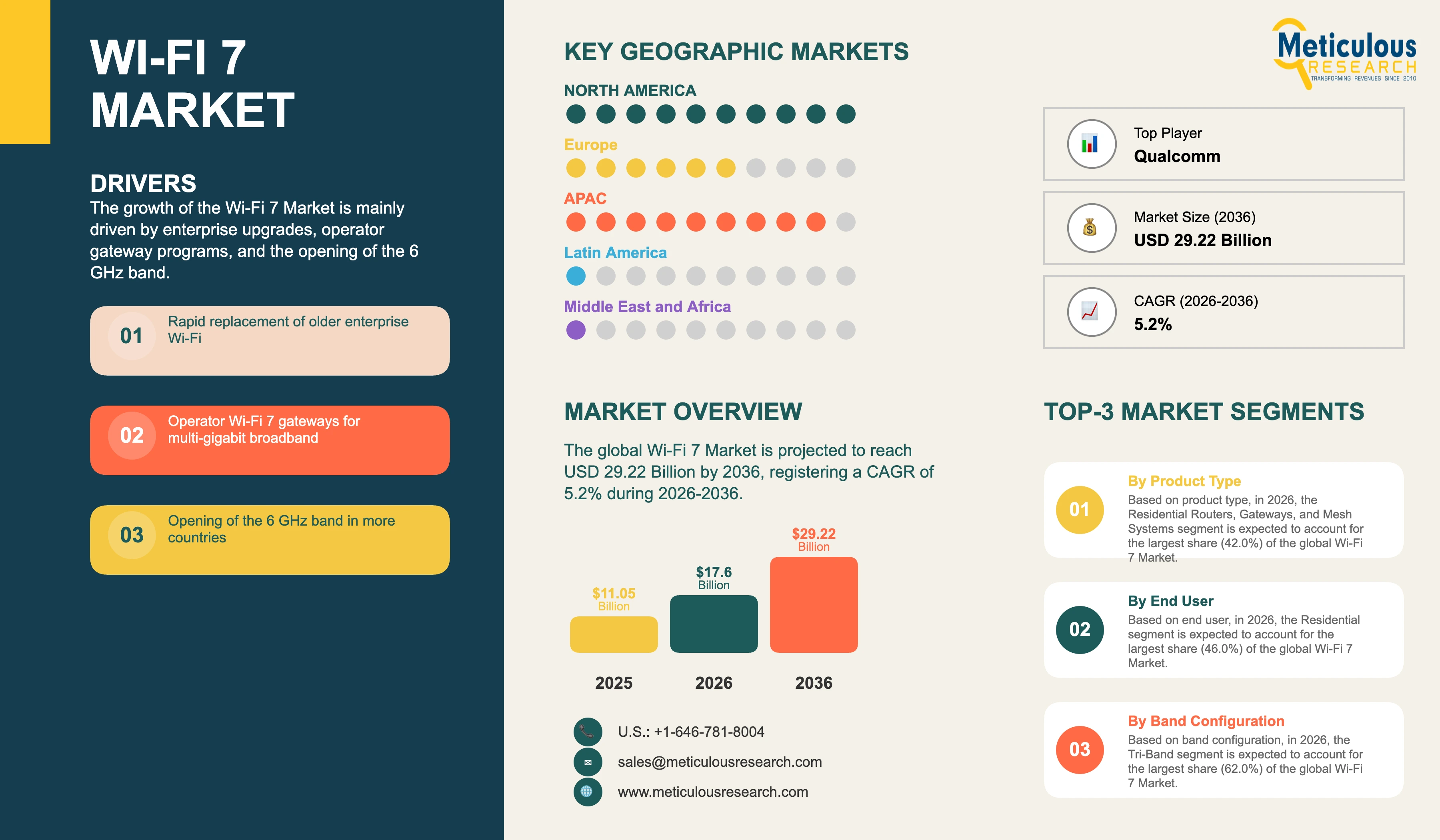
The global Wi-Fi 7 market was valued at USD 11.05 billion in 2025. This market is expected to reach USD 29.22 billion by 2036 from an estimated USD 17.60 billion in 2026, registering a CAGR of 5.2% during the forecast period (2026-2036).
- Published
- Nov 2026
- Pages
- 260
- Format
- PDF + Excel
- Report ID
- MRICT - 1042611
- Base year
- 2025
- 2025 · BASELINE
- $11.05B
- 2036
- $29.22B
- CAGR 2026–2036
- 5.2%
2025 baseline · 2026–2036 forecast at 5.2% CAGR · hover a bar for the value
Key highlights
Vendors sold more than 10 million enterprise access points in the second quarter of 2026, a record for the industry, and Wi-Fi 7 accounted for more than half of the market, according to Dell'Oro Group. Dell'Oro expects some Wi-Fi 8 revenue as early as 2027 but expects Wi-Fi 7 adoption to continue rising into 2028.
Wi-Fi 7 grew from less than 1% of enterprise WLAN revenue in the first quarter of 2024 to nearly half of the market by the first quarter of 2026, according to IDC. Cisco led the enterprise WLAN market with USD 1.0 billion in revenue and a 38.9% share in the first quarter of 2026, followed by HPE with a 19.9% share.
Dell'Oro Group expects triple-digit growth in Wi-Fi 7 revenue in 2026, with prices rising due to memory component shortages, and expects enterprise Wi-Fi 7 to generate more revenue in its peak year than Wi-Fi 6E did across its entire lifecycle, according to its July 2026 forecast report.
Shipments of Wi-Fi 7 access points rose from 26.3 million in 2024 to a projected 66.5 million in 2025, and ABI Research forecasts 117.9 million Wi-Fi 7 access point shipments in 2026, according to the Wireless Broadband Alliance.
India's Department of Telecommunications delicensed the lower 6 GHz band (5925-6425 MHz) for Wi-Fi in January 2026, allowing the use of Wi-Fi 6E and Wi-Fi 7 equipment. The lower 6 GHz band has now been opened for Wi-Fi in more than 100 countries, according to Ookla.
In July 2026, SoftAtHome announced that its Wi-Fi 7 repeater software was deployed commercially across Orange in Europe, and in May 2026, Adtran expanded its SDG 8700 Series with new Wi-Fi 7 gateways for residential, small business, and multi-dwelling unit deployments, according to Advanced Television and Converge Digest. Adtran said its updated portfolio reflects growing operator demand to standardize Wi-Fi 7 beyond premium broadband tiers. These developments show that Wi-Fi 7 is moving from premium products into mainstream equipment for homes and businesses.
By product type, residential routers, gateways, and mesh systems account for the largest share of 42.0% in 2026, while software and services register the highest CAGR.
By band configuration, tri-band accounts for the larger share in 2026 and also registers the higher CAGR.
By location type, indoor accounts for the larger share in 2026, while outdoor registers the higher CAGR.
By end user, residential accounts for the largest share of 46.0% in 2026, while industrial and manufacturing registers the highest CAGR.
By geography, North America accounts for the largest share of 36.0% in 2026, while Asia-Pacific registers the highest CAGR of 6.7%.
Report summary
| Particulars | Details |
|---|---|
| Forecast Period | 2026-2036 |
| Base Year | 2025 |
| Estimated Year | 2026 |
| CAGR (Value) | 5.2% |
| Format | PDF, Excel & Cloud Portal · 260 pages |
| Market Size in 2025 | USD 11.05 billion |
| Market Size in 2026 | USD 17.60 billion |
| Market Size by 2036 | USD 29.22 billion |
| Largest Segment by Product Type (2026) | Residential Routers, Gateways, and Mesh Systems (42.0%) |
| Largest Segment by End User (2026) | Residential (46.0%) |
| Largest Region (2026) | North America (36.0%) |
| Fastest-Growing Region | Asia-Pacific (CAGR 6.7%) |
| Key Companies | 16 companies and other companies |
| Segments Covered | Product Type, Band Configuration, Location Type, End User, Geography |
| Countries Covered | U.S., Canada, China, Japan, India, South Korea, Australia, Singapore, Indonesia, Thailand, Malaysia, Vietnam, Philippines, Taiwan, New Zealand, Rest of Asia-Pacific, Germany, U.K., France, Italy, Spain, Netherlands, Switzerland, Belgium, Sweden, Denmark, Norway, Finland, Austria, Poland, Ireland, Rest of Europe, Brazil, Mexico, Argentina, Colombia, Chile, Peru, Rest of Latin America, Saudi Arabia, U.A.E., Qatar, Israel, South Africa, Turkey, Rest of Middle East & Africa |
Report overview
Segments covered: product type, band configuration, location type, end user.
The growth of this market is mainly driven by the rapid replacement of Wi-Fi 6 and Wi-Fi 6E equipment in enterprises, the launch of Wi-Fi 7 gateways by broadband operators to deliver multi-gigabit fiber and cable speeds inside the home, the opening of the 6 GHz band for Wi-Fi in more countries, including India in January 2026, the rising number of connected devices in homes and offices, and the small price difference between Wi-Fi 7 and earlier equipment. In addition, demand from industrial, education, healthcare, and public venue users and the growing use of outdoor Wi-Fi are creating new opportunities. However, rising component and memory costs, limited 6 GHz access in some countries, and the arrival of Wi-Fi 8 later in the decade are expected to restrain the growth of this market to some extent. The market is expected to grow fastest in the first half of the forecast period, with growth slowing after Wi-Fi 7 adoption peaks and Wi-Fi 8 equipment begins to take share.
Wi-Fi 7, based on the IEEE 802.11be standard, is the latest generation of Wi-Fi technology. It offers much higher speeds and lower delay than earlier generations through wider 320 MHz channels in the 6 GHz band, a more efficient signal format known as 4K-QAM, and multi-link operation (MLO), which allows devices to send and receive data over more than one band at the same time. These features make Wi-Fi 7 well suited for multi-gigabit broadband, video streaming, video calls, online gaming, augmented and virtual reality, and environments with many connected devices. The Wi-Fi Alliance launched its Wi-Fi CERTIFIED 7 program in January 2024.
This report covers the global Wi-Fi 7 market, including residential routers, gateways, and mesh systems, enterprise access points for indoor and outdoor use, Wi-Fi 7 chipsets and modules used in network equipment, PCs, smartphones, and other devices, and software and services, such as network management software, cloud management subscriptions, and installation and support services. The market is analyzed by product type, band configuration, location type, end user, and geography. Market size is measured on a revenue basis. Revenue from finished client devices, such as smartphones and laptops, is not included, although the Wi-Fi 7 chipsets and modules used in these devices are included.
Wi-Fi 7 adoption has been faster than any previous Wi-Fi generation, particularly among businesses and institutions. In the enterprise market, Wi-Fi 7 grew from less than 1% of WLAN revenue in early 2024 to more than half of access point sales by the second quarter of 2026, according to IDC and Dell'Oro Group. One reason for this fast adoption is price. Dell'Oro has noted that Wi-Fi 7 prices were unusually close to Wi-Fi 6E prices when the products launched, which removed a common reason for delaying upgrades. Many enterprises are also replacing Wi-Fi 6 and Wi-Fi 6E equipment that was bought several years ago.
In the residential market, adoption is being led by broadband operators that supply Wi-Fi 7 gateways to their customers. Operators such as Comcast, Spectrum, AT&T, Orange, Proximus, EE, and many smaller fiber providers have launched Wi-Fi 7 gateways or mesh systems to make sure that customers can use the full speed of their fiber or cable connection inside the home. Dell'Oro Group reported strong growth in residential Wi-Fi 7 router shipments in 2025 and early 2026. Retail router sales, however, have been weaker, as more households rely on equipment supplied by their broadband provider.
Device support for Wi-Fi 7 is also growing quickly across phones, computers, and consumer electronics. Leading smartphones, laptops, and PCs now include Wi-Fi 7, and the Wi-Fi Alliance has projected that hundreds of millions of Wi-Fi 7 devices would ship in 2025. However, the actual use of Wi-Fi 7 in homes remains low. Ookla reported that Wi-Fi 7 accounted for only 1.8% of Wi-Fi connections it measured globally in the first quarter of 2026, although some markets, such as Singapore, had much higher adoption. This gap between device support and home network equipment represents a large opportunity for equipment vendors and operators.
Spectrum is an important factor in this market because Wi-Fi 7 performs best with access to new airwaves. The full benefit of Wi-Fi 7 requires access to the 6 GHz band, which allows the use of wide 320 MHz channels. The U.S., South Korea, Brazil, Canada, Saudi Arabia, and several other countries have opened the full 6 GHz band for Wi-Fi, while the EU, the U.K., Japan, Australia, and India have opened only the lower part of the band. India opened the lower 6 GHz band in January 2026, but Ookla found that use of the band in India remained at 0.1% or less eight months later, which shows that adoption takes time after spectrum is opened.
In 2026, residential routers, gateways, and mesh systems account for the largest share of the market by product type, while software and services is the fastest-growing product type. Tri-band equipment accounts for the larger share by band configuration and also grows faster. Indoor equipment accounts for most of the market, while outdoor equipment grows faster. Residential users are the largest end user, while industrial and manufacturing users are the fastest-growing end user. North America accounts for the largest share of the market, while Asia-Pacific is the fastest-growing region.
Over the forecast period, the Wi-Fi 7 market is expected to grow strongly until about 2029 as enterprises complete their upgrades and broadband operators replace home gateways. After that, growth is expected to slow as Wi-Fi 8 equipment, based on the IEEE 802.11bn standard, begins to take share, first in the enterprise market. Wi-Fi 7 is expected to remain in wide use in homes, emerging markets, and industrial settings for many years, which will support the market through the end of the forecast period.
Residential users are expected to account for the largest share of 46.0% of the market in 2026, while industrial and manufacturing users are projected to register the highest CAGR.
North America is expected to account for the largest share of 36.0% of the market in 2026, mainly due to the full opening of the 6 GHz band, fast enterprise adoption, operator gateway programs, and the presence of leading Wi-Fi 7 companies.
Asia-Pacific is projected to register the highest CAGR of 6.7% during the forecast period, driven by the opening of the 6 GHz band in India and Southeast Asia, the growth of fiber broadband, and a large base of homes still using older Wi-Fi.
The report profiles 16 companies, including Qualcomm, Broadcom, MediaTek, Intel, Cisco, HPE, Huawei, Ubiquiti, TP-Link, NETGEAR, ASUS, Extreme Networks, Ruckus, H3C, Nokia, and Sagemcom.
Dell'Oro Group expects some enterprise Wi-Fi 8 revenue as early as 2027 and expects Wi-Fi 7 adoption to keep rising into 2028. Wi-Fi 8 is expected to slow Wi-Fi 7 growth in the enterprise market later in the forecast period, while Wi-Fi 7 remains in wide use in homes and emerging markets.
The 6 GHz band provides the wide 320 MHz channels that allow Wi-Fi 7 to deliver its highest speeds. Countries that have opened the full band, such as the U.S., allow the full benefit of Wi-Fi 7, while countries that have opened only the lower part or none of the band see smaller improvements.
In 2026, the tri-band segment is expected to account for the larger share of the Wi-Fi 7 market, and it is also projected to register the higher CAGR during the forecast period.
In 2026, the indoor segment is expected to account for the larger share of the Wi-Fi 7 market, while the outdoor segment is projected to register the higher CAGR during the forecast period.
Report infographic
Market dynamics
18 factors across 5 forcesRapid replacement of wi-fi 6 and wi-fi 6E equipment in enterprises
Enterprises are replacing their Wi-Fi 6 and Wi-Fi 6E access points with Wi-Fi 7 at a faster pace than in any previous upgrade cycle. Wi-Fi 7 grew from less than 1% of enterprise WLAN revenue in the first quarter of 2024 to nearly half by the first quarter of 2026, according to IDC, and accounted for more than half of access point sales in the second quarter of 2026, according to Dell'Oro Group. Enterprise WLAN revenue grew at double-digit rates for several consecutive quarters, and vendors sold a record of more than 10 million access points in the second quarter of 2026.
Several factors explain why enterprises have adopted Wi-Fi 7 so much faster than earlier generations. Wi-Fi 7 prices were close to Wi-Fi 6E prices at launch, many installed access points were due for replacement, and enterprises need more wireless capacity for video calls, cloud applications, and a growing number of devices. Some enterprises also ordered ahead of expected price increases in 2026. Dell'Oro expects Wi-Fi 7 revenue to continue growing for several more years, with enterprise Wi-Fi 7 generating more revenue in its peak year than Wi-Fi 6E did across its whole lifecycle.
Operator wi-fi 7 gateways for multi-gigabit broadband
Broadband operators are upgrading their networks to deliver multi-gigabit speeds through fiber, cable, and fixed wireless access. However, older Wi-Fi equipment inside the home cannot deliver these speeds to devices, which leads to customer complaints and support calls. To solve this problem, operators are supplying Wi-Fi 7 gateways and mesh systems with their premium broadband plans. Comcast's XB10 gateway supports both DOCSIS 4.0 and Wi-Fi 7, Spectrum and AT&T have launched or announced Wi-Fi 7 equipment, and operators such as Orange, Proximus, EE, and Lightning Fibre have introduced Wi-Fi 7 in Europe.
Equipment vendors are responding with lower-cost Wi-Fi 7 gateways that can be used beyond premium plans. Adtran expanded its SDG 8700 Series in May 2026 with dual-band and tri-band Wi-Fi 7 gateways for residential, small business, and multi-dwelling unit deployments, and Nokia, Calix, Sagemcom, and other vendors offer Wi-Fi 7 gateways for operators. Because operators replace gateways in large numbers, their programs are a major source of demand for Wi-Fi 7 equipment and chipsets.
Opening of the 6 GHz band in more countries
The 6 GHz band provides the wide channels that allow Wi-Fi 7 to deliver its highest speeds. More than 100 countries have opened at least the lower part of the 6 GHz band for Wi-Fi, according to Ookla, including the U.S., the U.K., EU member states, Australia, Canada, Brazil, Japan, and South Korea. India delicensed the lower 6 GHz band in January 2026, and Indonesia, Vietnam, and the Philippines opened the band between July 2024 and May 2025.
As more countries open the 6 GHz band, demand for Wi-Fi 7 equipment that can use this spectrum increases. The opening of the band in large markets, such as India, is expected to support strong demand for Wi-Fi 7 in Asia-Pacific during the forecast period. Standard power operation in the 6 GHz band, supported by automated frequency coordination systems, also allows Wi-Fi 7 to be used outdoors in some countries, which creates new uses.
Rising number of connected devices and data-heavy applications
Homes and offices are using more connected devices than ever, including smartphones, laptops, TVs, gaming consoles, smart home devices, security cameras, and wearables. At the same time, applications such as high-definition video streaming, video calls, cloud gaming, and augmented and virtual reality need more capacity and lower delay. Wi-Fi 7's wider channels and multi-link operation allow it to support more devices and deliver more stable performance in crowded environments.
The number of Wi-Fi devices in use worldwide continues to grow, and device makers are adding Wi-Fi 7 to more products each year. As more Wi-Fi 7 devices enter homes and offices, users and businesses have a stronger reason to upgrade their routers and access points. This growing base of devices is expected to support demand throughout the forecast period.
Small price difference between wi-fi 7 and earlier equipment
Wi-Fi 7 equipment entered the market at prices close to those of Wi-Fi 6E equipment, according to Dell'Oro Group, which is unusual for a new Wi-Fi generation. Previous upgrades often came with a significant price premium at launch, which led many buyers to wait. Because Wi-Fi 7 cost little more than the equipment it replaced, enterprises and operators chose to move directly to Wi-Fi 7 when replacing older equipment. Chipset makers, such as Qualcomm, Broadcom, and MediaTek, have also introduced lower-cost Wi-Fi 7 chips for mainstream routers and devices, which has helped bring Wi-Fi 7 to a wider range of products.
Table of contents
12 chapters · 181 sections · 260 pages · click to expandSegmental analysis
| Segment | Largest share (2026) | Fastest growth (2026–2036) |
|---|---|---|
| By Product Type | Residential routers, gateways, and mesh systems | Software and services |
| By Band Configuration | — | — |
| By Location Type | — | Rapid growth of this |
| By End User | Residential | Industrial and manufacturing |
By Product Type
- The residential routers, gateways, and mesh systems segment is expected to account for the largest share of 42.0% of the global Wi-Fi 7 market.
- The large share of this segment is mainly due to the very large number of homes worldwide, the programs of broadband operators that are supplying Wi-Fi 7 gateways with multi-gigabit fiber and cable plans, the growing use of mesh systems to cover larger homes, and the need to replace older Wi-Fi equipment that cannot deliver full broadband speeds.
- Leading suppliers include TP-Link, NETGEAR, ASUS, Huawei, ZTE, Nokia, Sagemcom, Adtran, and Calix, along with operator-branded equipment.
- However, the software and services segment is projected to register the highest CAGR during the forecast period.
- The rapid growth of this segment is driven by the move to cloud-managed enterprise Wi-Fi, the willingness of enterprises to pay for software that automates network operations and improves security, the growing use of cloud platforms by broadband operators to manage home Wi-Fi and reduce support costs, and the shift by vendors toward subscription-based pricing.
- The enterprise access points segment includes indoor and outdoor access points sold to businesses, schools, hospitals, and public venues, and is led by Cisco, HPE, Huawei, Ubiquiti, Extreme Networks, and Ruckus.
- The chipsets and modules segment includes Wi-Fi 7 chips supplied by Qualcomm, Broadcom, MediaTek, and Intel for network equipment, PCs, smartphones, and other devices.
- Pricing in the Wi-Fi 7 market has changed during 2026 because of component shortages.
- Equipment prices were initially close to those of Wi-Fi 6E, but memory shortages have pushed prices higher, according to Dell'Oro Group.
- Higher prices have increased revenue per unit, especially for enterprise access points, while some price-sensitive buyers have delayed purchases.
- Chipset makers have introduced lower-cost Wi-Fi 7 chips to help vendors keep mainstream products affordable.
- Software revenue also tends to be more stable than hardware revenue across upgrade cycles.
By Band Configuration
- Wi-Fi 7 Market Analysis by Band Configuration
- The tri-band segment is expected to account for the larger share of the global Wi-Fi 7 market.
- The large share of this segment is mainly due to the importance of the 6 GHz band for delivering Wi-Fi 7's full benefits, the use of tri-band equipment that supports the 2.4 GHz, 5 GHz, and 6 GHz bands in enterprise access points and premium home gateways, the ability of tri-band equipment to use wide 320 MHz channels and multi-link operation across three bands, and the growing number of countries that have opened the 6 GHz band.
- Tri-band mesh systems are also widely used to provide a dedicated link between mesh nodes.
- The tri-band segment is also projected to register the higher CAGR during the forecast period, driven by the opening of the 6 GHz band in more countries, such as India, the falling cost of tri-band chipsets, and the growing use of 6 GHz-capable devices.
- The dual-band segment includes equipment that supports the 2.4 GHz and 5 GHz bands, which is used in lower-cost home gateways and in countries where the 6 GHz band has not been opened.
- Dual-band Wi-Fi 7 equipment still offers benefits over earlier generations, such as multi-link operation, and vendors such as Adtran offer dual-band Wi-Fi 7 gateways to help operators bring Wi-Fi 7 to more customers at lower cost.
- Tri-band designs are expected to become standard in mid-range home gateways as chip costs fall.
By Location Type
- The indoor segment is expected to account for the larger share of the global Wi-Fi 7 market.
- The large share of this segment is mainly due to the fact that most Wi-Fi use takes place inside homes, offices, schools, hospitals, stores, and factories, the large number of indoor access points and home gateways being installed, and the availability of the 6 GHz band for low-power indoor use in most countries that have opened the band.
- Indoor equipment includes ceiling-mounted access points, wall plates, home gateways, and mesh systems.
- However, the outdoor segment is projected to register the higher CAGR during the forecast period.
- The rapid growth of this segment is driven by the growing need for Wi-Fi in stadiums, campuses, parks, city centers, ports, and industrial yards, the approval of standard power 6 GHz operation with automated frequency coordination in the U.S. and other countries, and the use of outdoor Wi-Fi for logistics, smart city services, and public venues.
- Outdoor access point revenue has grown faster than the overall WLAN market for seven of the last eight quarters, according to Dell'Oro Group.
By End User
- The residential segment is expected to account for the largest share of 46.0% of the global Wi-Fi 7 market.
- The large share of this segment is mainly due to the very large number of homes, the programs of broadband operators that are supplying Wi-Fi 7 gateways and mesh systems, the growing number of connected devices in homes, and the rising demand for fast and stable Wi-Fi for streaming, gaming, video calls, and remote work.
- Residential users also account for a large share of Wi-Fi 7 chipset demand through home gateways and mesh systems.
- However, the industrial and manufacturing segment is projected to register the highest CAGR during the forecast period.
- The rapid growth of this segment is driven by the growing use of wireless connections for robots, automated vehicles, scanners, sensors, and cameras in factories, warehouses, and logistics centers, the need for reliable connections with low delay, and the lower cost of Wi-Fi 7 compared with private cellular networks for many indoor uses.
- The enterprises and offices segment includes businesses of all sizes that are replacing older access points, while the education segment includes schools and universities, which are large users of Wi-Fi.
- The healthcare segment includes hospitals and clinics that use Wi-Fi for medical devices and staff communication, the retail and hospitality segment includes stores, hotels, and restaurants, and the government and public venues segment includes public buildings, airports, stadiums, and city networks.
Geographic analysis
North America
Largest shareIn 2026, North America is expected to account for the largest share of 36.0% of the global Wi-Fi 7 market. The large share of this region is mainly due to the early and full opening of the 6 GHz band for Wi-Fi in the U.S. and Canada, the fast adoption of Wi-Fi 7 by enterprises, the Wi-Fi 7 gateway programs of large broadband operators, such as Comcast, Spectrum, and AT&T, the growth of multi-gigabit fiber and cable broadband, and the presence of leading Wi-Fi 7 chipset and equipment companies, such as Qualcomm, Broadcom, Intel, Cisco, HPE, Ubiquiti, NETGEAR, and Extreme Networks. The approval of standard power 6 GHz operation with automated frequency coordination also supports outdoor Wi-Fi 7 use in the U.S. Canada has also opened the full 6 GHz band, which supports the same range of Wi-Fi 7 uses as in the U.S.
Asia-Pacific
Fastest growthAsia-Pacific is projected to register the highest CAGR of 6.7% during the forecast period. The rapid growth of this region is mainly driven by the opening of the 6 GHz band in India in January 2026 and in Indonesia, Vietnam, and the Philippines between 2024 and 2025, the very large number of homes and the growth of fiber broadband in India, China, and Southeast Asia, the high adoption of Wi-Fi 7 in Singapore, where Ookla reported a 25.1% share of Wi-Fi 7 connections in the first quarter of 2026, and the presence of leading equipment makers, such as Huawei, ZTE, TP-Link, H3C, and ASUS, and chipset maker MediaTek. In China, Wi-Fi 7 is often combined with fiber to the room, which supports demand even without 6 GHz access.
Europe
Europe accounts for a significant share of the market, supported by the opening of the lower 6 GHz band in EU member states and the U.K., the Wi-Fi 7 programs of operators such as Orange, Proximus, EE, and many fiber providers, and the replacement of enterprise access points. Enterprise WLAN revenue in EMEA grew strongly in 2025, according to IDC. European operators are also adopting open software, such as prpl, for their home gateways, and Orange deployed Wi-Fi 7 repeaters across its European markets in 2026.
Latin America
Latin America and the Middle East & Africa account for smaller shares of the market but offer growth opportunities. Brazil and Mexico have opened all or part of the 6 GHz band and are seeing strong growth in fiber broadband, which supports demand for Wi-Fi 7 gateways.
Middle East & Africa
In the Middle East, Saudi Arabia and the U.A.E. have opened all or part of the 6 GHz band, and countries in the region are investing in smart cities, stadiums, airports, and hospitality, which supports demand for enterprise and outdoor Wi-Fi 7. Growth in these regions is expected to increase as equipment prices fall and as fiber broadband expands. Operators in these regions are also beginning to offer Wi-Fi 7 gateways with their fastest fiber plans, which is expected to support residential demand.
Competitive landscape
The global Wi-Fi 7 market is moderately consolidated, with the top five players estimated to account for about 40% of the market in 2025. The market includes chipset makers, enterprise WLAN vendors, operator gateway suppliers, residential router and gateway makers, and companies that offer cloud management software and services.
Qualcomm, Broadcom, MediaTek, and Intel are the leading suppliers of Wi-Fi 7 chipsets. In the enterprise market, Cisco is the market leader with a 38.9% share of WLAN revenue in the first quarter of 2026, according to IDC, followed by HPE, which completed its acquisition of Juniper Networks, as well as Huawei, Ubiquiti, Extreme Networks, Ruckus, and H3C. Dell'Oro Group has reported that Cisco, Ubiquiti, and Huawei are leading the Wi-Fi 7 market, and that Ubiquiti has moved up the ranking of WLAN market share leaders. In the residential market, TP-Link, NETGEAR, ASUS, and Huawei lead retail sales, while Nokia, Sagemcom, Adtran, Calix, ZTE, and Huawei are major suppliers of operator gateways.
Companies in this market compete on product performance, price, supply availability, coverage, ease of management, cloud software features, security, and support. Key strategies include launching lower-cost Wi-Fi 7 products for mainstream customers, managing supply during component shortages, offering cloud management platforms with subscription pricing, forming partnerships with broadband operators, and developing industrial and outdoor products.
Recent competitive activity in the Wi-Fi 7 market has included product launches, operator partnerships, and consolidation. Adtran expanded its Wi-Fi 7 gateway portfolio in May 2026, SoftAtHome and Orange deployed Wi-Fi 7 repeater software across Europe, Lightning Fibre launched Wi-Fi 7 equipment from Genexis in June 2026, and Belden announced its intent to acquire Ruckus Networks in April 2026.
We expect competition to increase as Wi-Fi 7 moves into mainstream and lower-cost products, as Chinese vendors expand outside their home market, and as vendors prepare for Wi-Fi 8. Vendors with strong cloud management software and close relationships with broadband operators are expected to gain share. Chipset makers will also compete to supply the first Wi-Fi 8 platforms, which may shift share among them later in the forecast period.
Some of the key players operating in the Wi-Fi 7 market are Qualcomm Incorporated, Broadcom Inc., MediaTek Inc., Intel Corporation, Cisco Systems, Inc., Hewlett Packard Enterprise Company, Huawei Technologies Co., Ltd., Ubiquiti Inc., TP-Link Systems Inc., NETGEAR, Inc., ASUSTeK Computer Inc., Extreme Networks, Inc., Ruckus Networks (Vistance Networks, Inc.), New H3C Technologies Co., Ltd., Nokia Corporation, and Sagemcom SAS, among others.
- —
Wi-Fi 7 accounted for more than half of enterprise access point sales in the second quarter of 2026, India opened the lower 6 GHz band for Wi-Fi in January 2026, Orange deployed Wi-Fi 7 repeaters across Europe, and Belden announced its intent to acquire Ruckus Networks.
- Qualcomm Incorporated
- Broadcom Inc.
- MediaTek Inc.
- Intel Corporation
- Cisco Systems, Inc.
- Hewlett Packard Enterprise Company
- Huawei Technologies Co., Ltd.
- Ubiquiti Inc.
- TP-Link Systems Inc.
- NETGEAR, Inc.
- ASUSTeK Computer Inc.
- Extreme Networks, Inc.
- Ruckus Networks (Vistance Networks, Inc.)
- New H3C Technologies Co., Ltd.
- Nokia Corporation
- Sagemcom SAS
Expert perspectives
The Wi-Fi 7 market has grown faster than any previous Wi-Fi generation, driven by enterprise upgrades and broadband operator gateway programs. Wi-Fi 7 accounted for more than half of enterprise access point sales by the second quarter of 2026, and operators around the world are supplying Wi-Fi 7 gateways with their multi-gigabit plans.
Over the forecast period, the market is expected to grow at a CAGR of 5.2%, from USD 17.60 billion in 2026 to USD 29.22 billion in 2036. Growth is expected to be strongest until about 2029, when Wi-Fi 7 adoption peaks, and to slow later as Wi-Fi 8 takes share in the enterprise market, where upgrade cycles are shorter than in homes. Residential, industrial, outdoor, and emerging market demand is expected to support the market through the end of the forecast period.
Among the market segments, residential routers, gateways, and mesh systems are the largest product type, while software and services grow fastest. Tri-band equipment is the larger and faster-growing band configuration, indoor equipment accounts for most of the market, while outdoor equipment grows faster, and residential users are the largest end user, while industrial and manufacturing users grow fastest. North America is the largest region, and Asia-Pacific is the fastest-growing region at a CAGR of 6.7%.
In our view, the most important factor for the Wi-Fi 7 market over the next three years will be the pace of operator gateway upgrades in homes. The enterprise market has already moved quickly, but most homes still use older Wi-Fi. Operators that are investing in fiber and multi-gigabit cable need Wi-Fi 7 to deliver those speeds, and their gateway programs will drive a large share of market revenue.
We also see rising component costs and the arrival of Wi-Fi 8 as the main risks for the market. Memory shortages are pushing prices higher in 2026, which may delay some purchases by homes and small businesses, and the early introduction of Wi-Fi 8 could shorten the Wi-Fi 7 cycle in the enterprise market. Vendors that manage supply well and offer a clear upgrade path to Wi-Fi 8 will be in a stronger position to keep their customers through the next upgrade cycle.
Overall, we believe the Wi-Fi 7 market will grow strongly in the near term and more slowly later in the forecast period, with software and services, tri-band equipment, outdoor equipment, industrial users, and Asia-Pacific providing the fastest growth. Companies with strong cloud software, close relationships with broadband operators, reliable supply, and a broad product range will be best positioned to capture this growth.
Customer perspectives
Director of Home Broadband Products - Cable Operator, U.S.
Our customers pay for multi-gigabit speeds, so we have to give them a gateway that can deliver it in every room. Wi-Fi 7 does that.
“We moved straight from Wi-Fi 6 to Wi-Fi 7 because the price difference was small. Cloud management has made the network much easier to run.”
“Our warehouse robots and scanners need a stable wireless connection all the time. Wi-Fi 7 gives us that at a lower cost than a private cellular network.”
Frequently asked questions
The global Wi-Fi 7 market was valued at USD 11.05 billion in 2025, up from USD 4.60 billion in 2024, and is estimated at USD 17.60 billion in 2026, reflecting the very fast adoption of Wi-Fi 7 by enterprises and broadband operators.
Cite this report
Meticulous Research. (2026). Wi-Fi 7 Market - Global Opportunity Analysis and Industry Forecast (2026-2036) (Report No. MRICT - 1042611). Meticulous Market Research Pvt. Ltd. https://www.meticulousresearch.com/product/wi-fi-7-market-7294