Warehouse Management System Market (2026-2036)
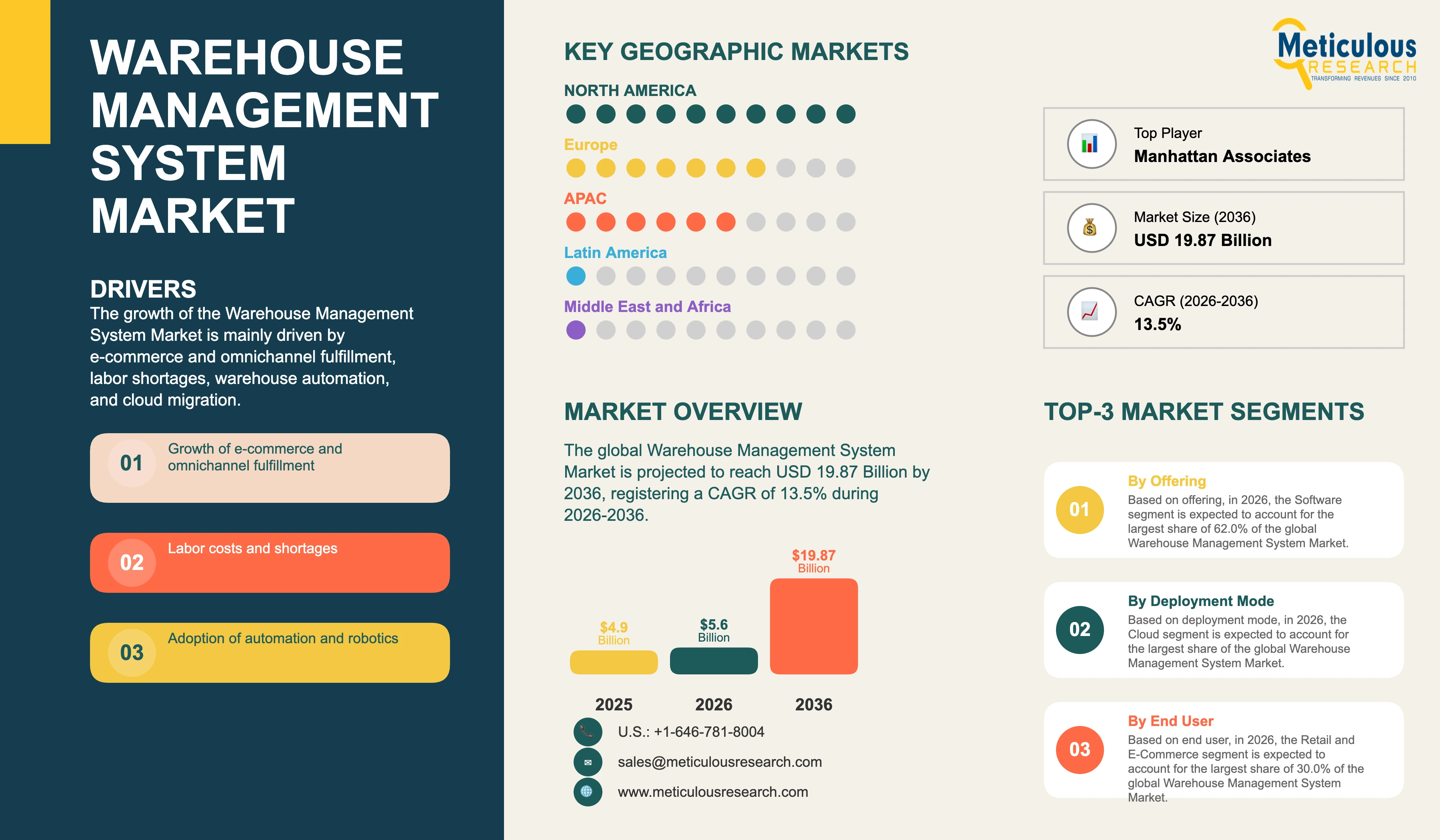
The global warehouse management system market was valued at USD 4.90 billion in 2025. This market is expected to reach USD 19.87 billion by 2036 from an estimated USD 5.60 billion in 2026, registering a CAGR of 13.5% during the forecast period (2026-2036).
- Published
- Nov 2026
- Pages
- 258
- Format
- PDF + Excel
- Report ID
- MRICT - 1042642
- Base year
- 2025
- 2024 · HISTORICAL
- $1.04B
- 2036
- $19.87B
- CAGR 2026–2036
- 13.5%
2024–2025 baseline · 2026–2036 forecast at 13.5% CAGR · hover a bar for the value
Key highlights
Manhattan Associates, one of the leading warehouse management system providers, reported full-year 2025 revenue of USD 1.08 billion, up 4% from USD 1.04 billion in 2024, with cloud subscription revenue rising 21% to USD 408.1 million and remaining performance obligations of about USD 2.2 billion, up 25%, according to its January 2026 results.
Manhattan Associates guided 2026 total revenue of USD 1.133 billion to USD 1.153 billion and cloud revenue of about USD 492 million, an increase of about 21%, and its chief executive said the company was excited for its newly released AI agents to help deliver optimal results for its Active customer community.
Descartes Systems Group reported record fiscal 2026 revenue of USD 729 million, up 12%, for the year ended January 31, 2026, and expanded its e-commerce warehouse capabilities by acquiring Finale, a U.S. provider of cloud-based inventory management solutions for e-commerce businesses, in August 2025 and U.K.-based OrderMine, a partner of its Peoplevox e-commerce warehouse management system, in early 2026.
Manhattan Associates said its average cloud contract duration is about 5.5 to 6 years, and that about 38% of its remaining performance obligations are expected to be recognized as revenue over the next 24 months, which illustrates the long-term, subscription-based nature of modern warehouse management system contracts. Long contract terms give vendors predictable recurring revenue and encourage them to invest continuously in new capabilities for their installed base.
Cloud deployment is becoming the default for new warehouse management system projects. Manhattan Associates' full-year 2025 services revenue declined 4% to USD 503 million while its cloud revenue grew 21%, reflecting the shift of customers from on-premise licenses to cloud subscriptions. Manhattan Associates also reported record cloud bookings in the fourth quarter of 2025 and said its solutions are gaining market share. Warehouse operators are also investing in robotics, such as autonomous mobile robots and automated storage and retrieval systems, which require warehouse management systems that can orchestrate people and machines together in real time. This requirement is shaping the product roadmaps of leading vendors.
By offering, software accounts for the larger share of 62.0% in 2026 and also registers the higher CAGR.
By deployment mode, cloud accounts for the larger share in 2026 and also registers the higher CAGR.
By organization size, large enterprises account for the larger share in 2026, while small and medium-sized enterprises register the higher CAGR.
By end user, retail and e-commerce accounts for the largest share of 30.0% in 2026, while third-party logistics register the highest CAGR.
By geography, North America accounts for the largest share of 40.0% in 2026, while Asia-Pacific registers the highest CAGR of 15.9%.
Report summary
| Particulars | Details |
|---|---|
| Base Year | 2025 |
| Estimated Year | 2026 |
| Forecast Period | 2026-2036 |
| Market Size in 2025 | USD 4.90 billion |
| Market Size in 2026 | USD 5.60 billion |
| Market Size by 2036 | USD 19.87 billion |
| CAGR (2026-2036) | 13.5% |
| Format | PDF, Excel & Cloud Portal · 258 pages |
| Largest Segment by Offering (2026) | Software (62.0%) |
| Largest Segment by End User (2026) | Retail and E-Commerce (30.0%) |
| Largest Region (2026) | North America (40.0%) |
| Fastest-Growing Region | Asia-Pacific (CAGR 15.9%) |
| Companies Profiled | 15 companies and other companies |
| Segments Covered | Offering, Deployment Mode, Organization Size, End User, Geography |
| Countries Covered | U.S., Canada, Rest of North America, Germany, U.K., France, Netherlands, Italy, Spain, Poland, Switzerland, Belgium, Sweden, Denmark, Norway, Finland, Austria, Ireland, Rest of Europe, China, India, Japan, South Korea, Australia, Singapore, Indonesia, Vietnam, Thailand, Malaysia, Philippines, Taiwan, New Zealand, Rest of Asia-Pacific, Mexico, Brazil, Chile, Argentina, Colombia, Peru, Rest of Latin America, Saudi Arabia, U.A.E., South Africa, Israel, Turkey, Egypt, Rest of Middle East & Africa |
Report overview
Segments covered: offering, deployment mode, organization size, end user.
The growth of this market is mainly driven by the growth of e-commerce and omnichannel fulfillment, which has increased order volumes and the complexity of warehouse operations, rising labor costs and persistent shortages of warehouse workers, the rapid adoption of warehouse automation and robotics that must be orchestrated by software, the shift from on-premise systems to cloud-based warehouse management software, the expansion of third-party logistics providers, and the integration of artificial intelligence and AI agents into warehouse planning and execution. However, factors such as the high cost and complexity of warehouse management system implementations, the difficulty of migrating from legacy and customized systems, shortages of skilled implementation resources, and data security concerns about cloud deployment are expected to restrain the growth of this market to some extent.
A warehouse management system is software that controls and optimizes the movement and storage of inventory within a warehouse or distribution center. It manages receiving, put-away, inventory tracking, replenishment, order allocation, picking, packing, shipping, cycle counting, and returns, and it directs the work of warehouse staff through mobile devices, voice systems, and other interfaces. Modern warehouse management systems also include labor management, slotting optimization, wave and waveless order release, and integration with automation equipment such as conveyors, sortation systems, automated storage and retrieval systems, and autonomous mobile robots. They connect with enterprise resource planning, order management, transportation management, and yard management systems to coordinate the flow of goods across the supply chain.
This report covers the global warehouse management system market, including warehouse management software delivered on a cloud subscription or on-premise license basis and related services such as implementation, configuration, integration, consulting, training, support, and maintenance. The market is analyzed by offering, deployment mode, organization size, end user, and geography. Standalone yard management systems, transportation management systems, warehouse execution and control systems sold as part of automation equipment, and the automation hardware itself are analyzed in separate reports. The market is measured on a revenue basis.
The warehouse management system market is being reshaped by the growth of e-commerce and omnichannel retail. Retailers and brands now fulfill orders from distribution centers, stores, and third-party fulfillment networks, and they handle large volumes of small, individual orders alongside traditional pallet and case shipments to stores. This shift has increased the number of order lines, the speed required for fulfillment, and the complexity of warehouse processes, which requires more capable and flexible warehouse management systems. Many companies are replacing older, heavily customized systems with modern platforms that can support omnichannel fulfillment, automation, and real-time inventory visibility.
The move to the cloud is one of the most important changes in the market. Leading vendors such as Manhattan Associates, Blue Yonder, Körber, Oracle, and Infor now offer cloud-native or cloud-delivered warehouse management systems that are updated continuously and can scale with demand. Manhattan Associates reported cloud subscription revenue of USD 408.1 million in 2025, up 21%, while its overall revenue grew 4%, reflecting the transition from license and maintenance revenue to subscription revenue. Cloud deployment lowers upfront costs, shortens implementation times, and makes advanced capabilities available to mid-sized companies.
Automation and robotics are also changing the role of warehouse management systems. As companies deploy autonomous mobile robots, goods-to-person systems, automated storage and retrieval systems, and automated packing equipment to address labor shortages, the warehouse management system must orchestrate work across people and machines. Vendors are adding warehouse execution capabilities and robotics integration to their platforms so that customers can manage mixed human and automated operations from a single system.
Artificial intelligence is the next major development shaping the warehouse management system market. Warehouse management system vendors are introducing AI agents and machine learning capabilities that can forecast labor needs, optimize slotting and replenishment, recommend actions to supervisors, and automate routine decisions. Manhattan Associates released AI agents for its Active platform customers in 2025, and other vendors are developing similar capabilities. These tools are expected to reduce the manual effort required to manage complex warehouses.
Software accounts for the largest share of the market by offering and is also growing fastest, while cloud is the largest and fastest-growing deployment mode. Large enterprises account for the largest share by organization size, while small and medium-sized enterprises are the fastest-growing segment. Retail and e-commerce is the largest end user, while third-party logistics providers are the fastest-growing end user. North America accounts for the largest share of the market, while Asia-Pacific is the fastest-growing region.
Over the forecast period, the warehouse management system market is expected to grow steadily, supported by e-commerce, labor shortages, automation, cloud migration, and AI. At the same time, the pace of growth will depend on implementation capacity, the cost of migrating from legacy systems, and the ability of vendors to serve mid-sized customers efficiently. Vendors are also adding artificial intelligence features for slotting, labor planning, and demand forecasting, which help operators improve productivity and respond faster to changes in order volumes. These tools are improving decision-making for warehouse managers.
Each client has different processes and billing, so we need a system that lets us onboard new clients quickly and give them real-time visibility. That is now a key part of how we win business.
This comment explains why third-party logistics providers are the fastest-growing end user and why software accounts for 62.0% of the market.
As our online orders grew, we outgrew spreadsheets and the basic inventory module in our accounting software. A cloud warehouse system was affordable and we were live in a few weeks. It also connects directly to the marketplaces where we sell.
This comment explains why small and medium-sized enterprises and Asia-Pacific are the fastest-growing segments of the market.
North America is expected to account for the largest share of 40.0% of the market in 2026, mainly due to its large e-commerce and retail sectors, large number of distribution and fulfillment centers, high labor costs, automation adoption, and the presence of leading vendors.
Asia-Pacific is projected to register the highest CAGR of 15.9% during the forecast period, driven by e-commerce growth, investment in modern logistics real estate, the expansion of third-party logistics providers, rising labor costs, and low current adoption.
The report profiles 15 companies, including Manhattan Associates, Blue Yonder, Körber, SAP, Oracle, Infor, Descartes, Tecsys, Made4net, Logiwa, Reply, PSI Software, Increff, Unicommerce, and Vinculum.
AI is enabling warehouse management systems to forecast labor and workload, optimize slotting and replenishment, orchestrate work across people and robots, manage exceptions, and assist supervisors through AI agents, which improves productivity and service levels.
Report infographic
Market dynamics
18 factors across 5 forcesGrowth of e-commerce and omnichannel fulfillment
The growth of e-commerce and omnichannel retail is the most important driver of the warehouse management system market. Online orders typically consist of a small number of items shipped to individual consumers, which requires warehouses to handle many more order lines, picks, and packages than traditional store replenishment. Consumers also expect fast and accurate delivery, which puts pressure on warehouses to process orders quickly and with few errors. Omnichannel retailers must manage inventory across distribution centers, stores, and fulfillment partners and support services such as buy online, pick up in store, ship from store, and easy returns.
These requirements are difficult to meet with older warehouse management systems that were designed for pallet and case operations. Retailers, brands, and fulfillment providers are therefore investing in modern warehouse management systems that support high-volume, small-order fulfillment, real-time inventory visibility, and integration with order management systems. The growth of direct-to-consumer brands and online marketplaces also increases demand for warehouse management systems among smaller companies and fulfillment providers.
Returns processing is another growing requirement, since online orders have higher return rates than store purchases. Warehouse management systems that can efficiently receive, inspect, and restock returned items help companies recover value and reduce costs.
Rising labor costs and warehouse labor shortages
Warehouse labor is one of the largest operating costs for distribution centers, and companies in North America, Europe, and parts of Asia-Pacific face persistent difficulty in hiring and retaining warehouse workers. Rising wages, high turnover, and peak-season demand make labor efficiency a priority. Warehouse management systems help companies use labor more efficiently by optimizing pick paths, balancing workloads, directing tasks to the right workers, and measuring productivity through labor management capabilities.
Labor shortages are also driving investment in automation, which in turn requires more capable warehouse management systems. By optimizing both manual and automated work, warehouse management systems help companies maintain service levels with fewer workers and reduce the cost per order.
Mobile interfaces, voice picking, and guided workflows within warehouse management systems also make it faster to train new and seasonal workers, which is important in operations with high turnover.
Adoption of warehouse automation and robotics
Companies are deploying autonomous mobile robots, goods-to-person systems, automated storage and retrieval systems, shuttle systems, robotic picking arms, and automated packing equipment to increase throughput and reduce labor dependence. These systems must be integrated with and orchestrated by software that assigns work, manages inventory, and synchronizes automated and manual processes. Warehouse management systems with built-in warehouse execution capabilities and pre-built robotics integrations allow companies to add automation more easily.
As automation becomes more common in mid-sized warehouses, not just large distribution centers, demand for warehouse management systems that can manage mixed human and robotic operations is expected to grow. Vendors are partnering with robotics providers to offer certified integrations, which shortens deployment times.
Shift to cloud-based warehouse management systems
Cloud-based warehouse management systems offer lower upfront costs, faster deployment, continuous updates, scalability for peak seasons, and easier integration with other cloud applications. They also eliminate the need for companies to maintain servers and upgrade software periodically, which reduces the burden on IT teams. Manhattan Associates' cloud revenue grew 21% in 2025, and the company expects cloud revenue of about USD 492 million in 2026, reflecting strong demand for cloud deployment.
Cloud deployment also makes it easier for companies to standardize processes across multiple warehouses and to roll out new capabilities, such as AI, quickly. As vendors focus their development on cloud platforms, many on-premise customers are expected to migrate to the cloud over the forecast period, which supports market growth. Vendors are also offering migration programs and incentives to encourage on-premise customers to move to their cloud platforms.
Expansion of third-party logistics providers
Many companies are outsourcing warehousing and fulfillment to third-party logistics providers to gain flexibility, access expertise, and avoid capital investment. Third-party logistics providers manage warehouses for multiple clients with different products, processes, and service requirements, which requires warehouse management systems that support multi-client operations, flexible billing, and rapid onboarding of new clients. As the third-party logistics industry grows, its demand for capable warehouse management systems increases.
Third-party logistics providers also compete on technology, offering clients real-time visibility into inventory and orders through client portals, which further increases the importance of modern warehouse management systems in their operations.
Table of contents
12 chapters · 165 sections · 258 pages · click to expandSegmental analysis
| Segment | Largest share (2026) | Fastest growth (2026–2036) |
|---|---|---|
| By Offering | Retail and e-commerce | Third-party logistics |
By Offering
- The large enterprises segment is expected to account for the larger share of the warehouse management system market, while the small and medium-sized enterprises segment is projected to register the higher CAGR during the forecast period.
- The retail and e-commerce segment is expected to account for the largest share of 30.0% of the warehouse management system market, while the third-party logistics segment is projected to register the highest CAGR during the forecast period.
Geographic analysis
North America
Largest shareIn 2026, North America is expected to account for the largest share of 40.0% of the global warehouse management system market. The large share of this region is mainly due to the large and mature e-commerce and retail sectors in the U.S., the large number of distribution centers, fulfillment centers, and third-party logistics warehouses, high labor costs and persistent labor shortages, rapid adoption of warehouse automation, early adoption of cloud-based warehouse management systems, and the presence of leading vendors such as Manhattan Associates, Blue Yonder, Oracle, Infor, Tecsys, and Made4net. Canada also has significant demand from retailers, grocers, and distributors, while Descartes, headquartered in Canada, serves customers across North America.
Asia-Pacific
Fastest growthAsia-Pacific is projected to register the highest CAGR of 15.9% during the forecast period. The rapid growth of this region is mainly driven by the rapid growth of e-commerce in China, India, Southeast Asia, Japan, South Korea, and Australia, investment in modern logistics real estate and warehousing parks, the expansion of third-party logistics providers, rising labor costs and labor shortages in Japan, South Korea, Australia, and parts of China, and the relatively low current adoption of advanced warehouse management systems among mid-sized companies. India's growth in organized retail, e-commerce, and warehousing is expected to be a particularly important source of demand, supported by local vendors and global providers.
Europe
Europe accounts for a significant share of the market, supported by large retail, grocery, manufacturing, and third-party logistics sectors in Germany, the U.K., France, the Netherlands, Italy, Spain, and the Nordic countries, high labor costs, strong adoption of warehouse automation, and the presence of vendors such as SAP, Körber, Reply, and PSI.
Latin America
Latin America accounts for a smaller share of the market, with growth supported by e-commerce and nearshoring in Mexico and Brazil, while the Middle East & Africa accounts for the smallest share, with growing investment in logistics hubs and e-commerce in Saudi Arabia, the U.A.E., and South Africa. Regional differences in labor costs, e-commerce maturity, automation adoption, and cloud acceptance shape the adoption of warehouse management systems around the world. Regions with fast-growing e-commerce and rising labor costs are expected to see the fastest growth over the forecast period. The availability of regional cloud data centers and local implementation partners will also influence adoption in emerging markets. Government investment in logistics infrastructure in India and Southeast Asia also supports demand. Latin America and the Middle East & Africa account for smaller shares of the market, but they are expected to grow steadily as e-commerce expands and companies modernize logistics operations in Brazil, Mexico, Chile, Colombia, Saudi Arabia, the U.A.E., Egypt, and South Africa. Nearshoring is driving investment in manufacturing and distribution facilities in Mexico, while Saudi Arabia and the U.A.E. are building large logistics hubs as part of economic diversification programs, which creates demand for modern warehouse management systems that support multiple languages, currencies, and regulatory requirements. Overall, regional growth will depend on e-commerce expansion, labor costs, and investment in warehouse automation.
Competitive landscape
The global warehouse management system market is moderately fragmented, with the top five players estimated to account for about 40% of the market in 2025. The market includes large supply chain software vendors, enterprise resource planning vendors with warehouse management modules, specialist warehouse management providers, e-commerce and small business-focused providers, and regional vendors.
Manhattan Associates is one of the market leaders, offering its cloud-native Manhattan Active Warehouse Management platform and reporting 2025 revenue of USD 1.08 billion across its supply chain and omnichannel solutions. Blue Yonder, Körber Supply Chain Software, Oracle, and Infor offer comprehensive warehouse management systems for large enterprises, while SAP offers Extended Warehouse Management within its enterprise software portfolio. Descartes serves e-commerce and mid-sized customers through Peoplevox and its acquisitions of Finale and OrderMine. Tecsys focuses on healthcare and distribution, Made4net and Logiwa serve mid-sized and e-commerce customers, Reply and PSI are strong in Europe, and Increff, Unicommerce, and Vinculum serve customers in India and other emerging markets.
Companies in this market compete on functionality, scalability, cloud architecture, ease of implementation, automation and robotics integration, AI capabilities, industry expertise, total cost of ownership, and the strength of their partner ecosystems. Key strategies include investment in cloud-native platforms and AI, acquisitions of specialist providers, partnerships with robotics and automation vendors and system integrators, expansion into new regions, and the development of industry-specific and mid-market solutions.
We expect the market to remain competitive, with leading vendors gaining share through cloud migration and AI capabilities, while specialist and regional vendors compete on industry expertise, ease of use, and price. Robotics integration and AI are likely to become the most important differentiators over the forecast period. Consolidation is expected to continue as larger vendors acquire specialist and regional providers to expand their capabilities and customer bases. Implementation quality and partner ecosystems will remain critical, since customers judge vendors on the success of their deployments as much as on the features of their software. Vendors with strong customer references in specific industries will also hold an advantage in competitive evaluations. Pricing flexibility will matter for mid-sized customers.
Some of the key players operating in the warehouse management system market are Manhattan Associates, Inc., Blue Yonder Group, Inc., Körber Supply Chain Software, SAP SE, Oracle Corporation, Infor, Inc., The Descartes Systems Group Inc., Tecsys Inc., Made4net LLC, Logiwa, Inc., Reply S.p.A., PSI Software SE, Increff, Unicommerce eSolutions Limited, and Vinculum Solutions Pvt. Ltd., among others. Partnerships between warehouse software vendors and robotics and automation providers are also growing quickly.
- —
Manhattan Associates reported 21% growth in cloud revenue in 2025 and released AI agents for its Active platform, and Descartes reported record fiscal 2026 revenue of USD 729 million and acquired Finale and OrderMine to strengthen its e-commerce warehouse capabilities.
- Increff
- Unicommerce
- Vinculum
Expert perspectives
The warehouse management system market is in the middle of a significant transformation. E-commerce, labor shortages, and automation have made warehouses more complex and more important to customer service, while cloud computing and AI are changing how warehouse management systems are delivered and what they can do. Companies that once viewed warehouse management as a back-office system now see it as a source of competitive advantage.
Over the forecast period, the market is expected to grow at a CAGR of 13.5%, from USD 5.60 billion in 2026 to USD 19.87 billion in 2036. Growth will be supported by e-commerce, labor shortages, automation, cloud migration, third-party logistics, and AI.
Among the market segments, software is the largest and fastest-growing offering, and cloud is the largest and fastest-growing deployment mode. Large enterprises are the largest organization size, while small and medium-sized enterprises grow fastest, and retail and e-commerce is the largest end user, while third-party logistics providers grow fastest. North America is the largest region, and Asia-Pacific is the fastest-growing region at a CAGR of 15.9%.
In our view, the most important change in the market over the forecast period will be the shift from warehouse management systems as systems of record to intelligent orchestration platforms. As warehouses combine people, robots, and automation equipment, the warehouse management system will increasingly decide which resource performs each task and how to respond to changing conditions in real time. AI agents will play a central role in this shift, and vendors that deliver measurable productivity gains through AI will gain share.
We also expect cloud migration to continue to drive vendor revenue growth, as on-premise customers move to subscriptions and mid-sized companies adopt cloud systems for the first time. Implementation capacity will be an important constraint, and vendors that simplify deployment and build strong partner ecosystems will be best positioned to capture demand. Asia-Pacific, particularly India and Southeast Asia, will be the most important source of new customers. Mid-sized companies in North America and Europe will also remain an important source of growth. Integration with automation will be a key requirement.
Overall, we believe the warehouse management system market will grow strongly over the forecast period, with value shifting toward cloud software and AI-enabled orchestration, and with competition intensifying among global leaders, specialists, and regional vendors. Customers that modernize their warehouse systems early will be better prepared to adopt automation and AI and to meet rising service expectations. Vendors that combine cloud delivery, AI, automation integration, and strong implementation partners are likely to lead the market. Cloud migration will remain a central theme for vendors and customers throughout the forecast period.
Customer perspectives
Buyers of warehouse management systems include retailers and e-commerce companies, third-party logistics providers, manufacturers, wholesale distributors, food and beverage companies, healthcare and pharmaceutical distributors, and automotive companies. Their purchase decisions depend mainly on functionality for their specific operations, scalability, support for omnichannel fulfillment, automation and robotics integration, AI capabilities, ease and speed of implementation, total cost of ownership, vendor stability, and the quality of implementation partners. Many buyers also evaluate the vendor's ability to support future automation, peak-season scalability, and multi-site rollouts. Total cost of ownership is also a key factor.
Vice President of Distribution - omnichannel retailer, U.S.
Our old system could not keep up with e-commerce volumes and the robots we added. Moving to a cloud warehouse management system gave us one platform for people and automation and new features every quarter.
This comment explains why North America accounts for 40.0% of the market, why cloud deployment is the leading deployment mode, why retail and e-commerce accounts for 30.0% of the market, and why automation orchestration is a key purchase criterion.
Frequently asked questions
The global warehouse management system market was valued at USD 4.90 billion in 2025, up from USD 4.30 billion in 2024, and is estimated at USD 5.60 billion in 2026. The market includes warehouse management software delivered through cloud subscriptions or on-premise licenses and related implementation, integration, consulting, training, and support services.
The global warehouse management system market is expected to reach USD 19.87 billion by 2036, supported by e-commerce and omnichannel fulfillment, labor shortages, warehouse automation, cloud migration, the expansion of third-party logistics providers, and the adoption of AI.
The market is expected to register a CAGR of 13.5% from 2026 to 2036.
A warehouse management system is software that controls and optimizes receiving, put-away, inventory, replenishment, picking, packing, shipping, and labor within warehouses and distribution centers, and that coordinates manual work with automation equipment and robots.
Market growth is mainly driven by the growth of e-commerce and omnichannel fulfillment, rising labor costs and labor shortages, the adoption of warehouse automation and robotics, the shift to cloud-based systems, and the expansion of third-party logistics providers.
The high cost and complexity of implementations and the difficulty of migrating from legacy and customized systems restrain growth, while shortages of skilled implementation resources and data security, reliability, and integration risks in the cloud are key challenges.
Key growth opportunities include AI agents and intelligent warehouse orchestration, cloud warehouse management systems for mid-sized companies, growth in Asia-Pacific, Latin America, and the Middle East, and industry-specific solutions for regulated and specialized supply chains.
Software is expected to account for the largest share of 62.0% of the market in 2026 and is also projected to register the highest CAGR.
Cloud deployment is expected to account for the largest share of the market in 2026 and is also projected to register the highest CAGR.
In 2026, the large enterprises segment is expected to account for the larger share of the warehouse management system market, while the small and medium-sized enterprises segment is projected to register the higher CAGR during the forecast period.
In 2026, the retail and e-commerce segment is expected to account for the largest share of 30.0% of the warehouse management system market, while the third-party logistics segment is projected to register the highest CAGR during the forecast period.
North America is expected to account for the largest share of 40.0% of the market in 2026, mainly due to its large e-commerce and retail sectors, large number of distribution and fulfillment centers, high labor costs, automation adoption, and the presence of leading vendors.
Asia-Pacific is projected to register the highest CAGR of 15.9% during the forecast period, driven by e-commerce growth, investment in modern logistics real estate, the expansion of third-party logistics providers, rising labor costs, and low current adoption.
The report profiles 15 companies, including Manhattan Associates, Blue Yonder, Körber, SAP, Oracle, Infor, Descartes, Tecsys, Made4net, Logiwa, Reply, PSI Software, Increff, Unicommerce, and Vinculum.
Manhattan Associates reported 21% growth in cloud revenue in 2025 and released AI agents for its Active platform, and Descartes reported record fiscal 2026 revenue of USD 729 million and acquired Finale and OrderMine to strengthen its e-commerce warehouse capabilities.
AI is enabling warehouse management systems to forecast labor and workload, optimize slotting and replenishment, orchestrate work across people and robots, manage exceptions, and assist supervisors through AI agents, which improves productivity and service levels.
Cite this report
Meticulous Research. (2026). Warehouse Management System Market - Global Opportunity Analysis and Industry Forecast (2026-2036) (Report No. MRICT - 1042642). Meticulous Market Research Pvt. Ltd. https://www.meticulousresearch.com/product/warehouse-management-system-market-7325