Yard Management Systems Market (2026-2036)
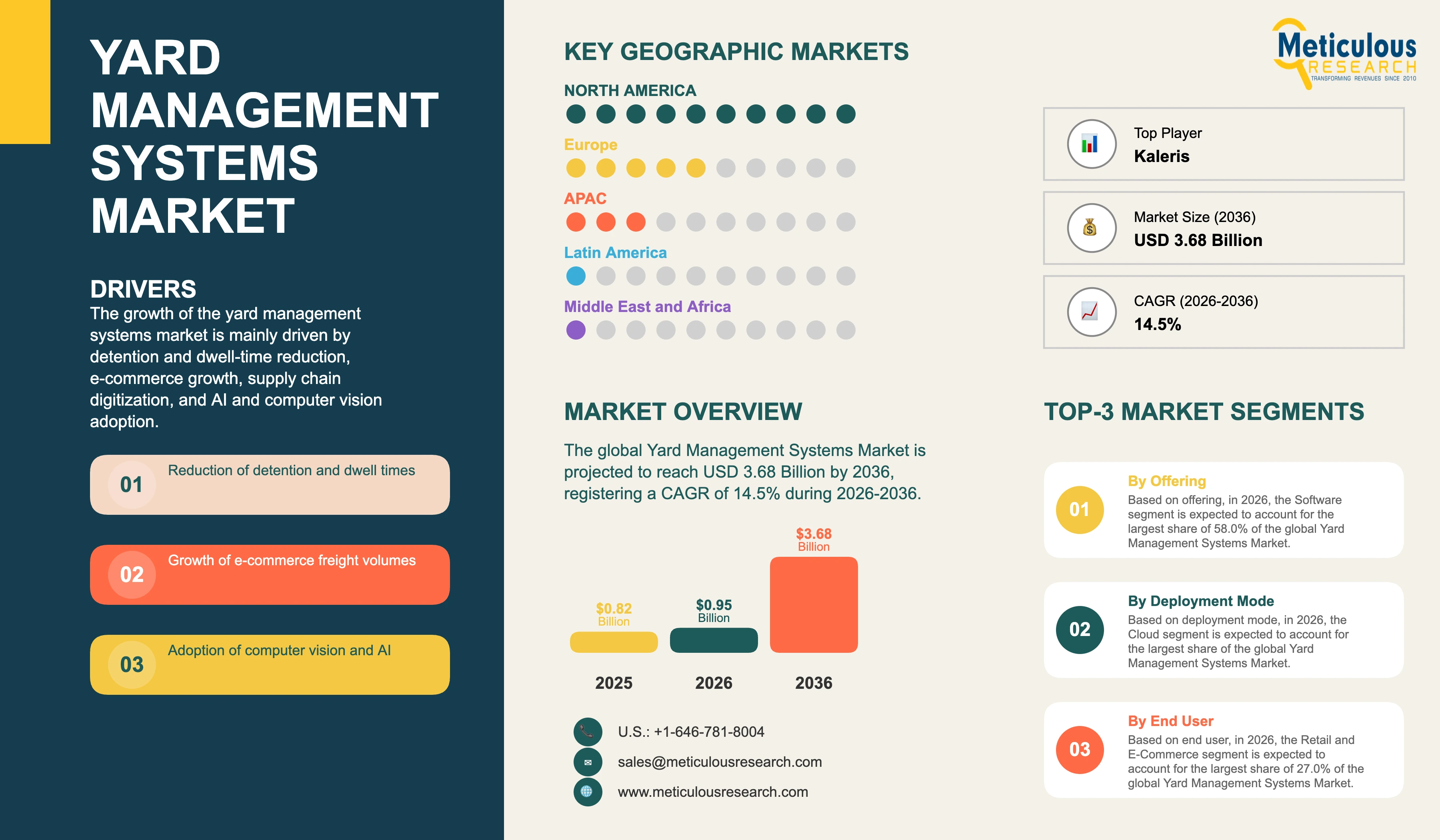
The global yard management systems market was valued at USD 0.82 billion in 2025. This market is expected to reach USD 3.68 billion by 2036 from an estimated USD 0.95 billion in 2026, registering a CAGR of 14.5% during the forecast period (2026-2036).
- Published
- Nov 2026
- Pages
- 260
- Format
- PDF + Excel
- Report ID
- MRICT - 1042643
- Base year
- 2025
- 2025 · BASELINE
- $820.0M
- 2036
- $3.68B
- CAGR 2026–2036
- 14.5%
2025 baseline · 2026–2036 forecast at 14.5% CAGR · hover a bar for the value
Key highlights
According to Terminal Industries, 92% of yards lack technology solutions to eliminate wasted capacity, reduce unforeseen costs, and improve inventory operations, which leads to an estimated USD 146 billion in excess transportation costs, as reported by FreightWaves when the company emerged from stealth with a USD 17 million seed round backed by investors including Prologis Ventures. Terminal Industries later appointed Matt Yearling, former chief executive of yard management and visibility provider PINC, as its president.
In January 2026, logistics workflow platform Vector acquired YardView, a yard management and dock visibility company founded in 1998, to provide continuous data from gate arrival through dock assignment and departure, according to Pulse 2.0 and the IoT M2M Council.
Kaleris, a leading yard management system provider trusted by more than 680 companies in 105 countries, introduced ColdLink at Manifest 2026 in February 2026. ColdLink integrates the Kaleris transportation management system, yard management system, and real-time Internet of Things sensing to maintain chain of custody for temperature-sensitive supply chains.
Kaleris expanded its portfolio by acquiring CAMS Software, combining the CAMS Prospero transportation management system with its yard management system to create an enterprise yard and transportation management suite for grocers and wholesalers, and in 2026 it acquired Newport Systems, a provider of maintenance and repair and depot management software for the intermodal supply chain.
Terminal Industries launched a carrier-ready appointment module at Manifest 2026 in February 2026 and its Missions structured workflow application in April 2026, following its inclusion in the Gartner 2025 Market Guide for Yard Management, reflecting the growing role of AI-native and computer vision-based yard platforms. Terminal Industries says its platform can reduce gate processing times by 85% and asset search times by 90%. These claims reflect the type of efficiency gains that buyers now expect from new yard platforms. Yard operators are also adding automated gate systems with license plate and trailer number recognition, which reduces check-in times and improves the accuracy of yard inventory data. This automation is also improving safety at busy gates.
By offering, software accounts for the largest share of 58.0% in 2026 and also registers the highest CAGR.
By deployment mode, cloud accounts for the larger share in 2026 and also registers the higher CAGR.
By facility type, distribution centers and warehouses account for the largest share in 2026, while cross-docks and trucking terminals register the highest CAGR.
By end user, retail and e-commerce accounts for the largest share of 27.0% in 2026, while third-party logistics register the highest CAGR.
By geography, North America accounts for the largest share of 52.0% in 2026, while Asia-Pacific registers the highest CAGR of 17.8%.
Report summary
| Particulars | Details |
|---|---|
| Base Year | 2025 |
| Estimated Year | 2026 |
| Forecast Period | 2026-2036 |
| Market Size in 2025 | USD 0.82 billion |
| Market Size in 2026 | USD 0.95 billion |
| Market Size by 2036 | USD 3.68 billion |
| CAGR (2026-2036) | 14.5% |
| Format | PDF, Excel & Cloud Portal · 260 pages |
| Largest Segment by Offering (2026) | Software (58.0%) |
| Largest Segment by End User (2026) | Retail and E-Commerce (27.0%) |
| Largest Region (2026) | North America (52.0%) |
| Fastest-Growing Region | Asia-Pacific (CAGR 17.8%) |
| Companies Profiled | 15 companies and other companies |
| Segments Covered | Offering, Deployment Mode, Facility Type, End User, Geography |
| Countries Covered | U.S., Canada, Rest of North America, Germany, U.K., France, Netherlands, Belgium, Italy, Spain, Poland, Switzerland, Sweden, Denmark, Norway, Finland, Austria, Ireland, Rest of Europe, China, Japan, India, South Korea, Australia, Singapore, Southeast Asia, Indonesia, Thailand, Malaysia, Vietnam, Philippines, Taiwan, New Zealand, Rest of Asia-Pacific, Mexico, Brazil, Chile, Argentina, Colombia, Peru, Rest of Latin America, Saudi Arabia, U.A.E., South Africa, Israel, Turkey, Egypt, Rest of Middle East & Africa |
Report overview
Segments covered: offering, deployment mode, facility type, end user.
The growth of this market is mainly driven by the need to reduce truck detention, dwell times, and congestion at distribution centers, warehouses, and manufacturing plants, the growth of e-commerce and higher freight volumes passing through logistics facilities, the digitization of the last remaining manual part of the supply chain, the adoption of computer vision, artificial intelligence, and automation in yard operations, the shift to cloud-based software that is faster and cheaper to deploy, and growing requirements for security, safety, and chain-of-custody compliance. However, factors such as the high cost of integrating yard management systems with warehouse and transportation management systems, the limited awareness and budgets of smaller facilities, the reliance of many operations on manual processes and spreadsheets, and the shortage of skilled staff to implement and manage new systems are expected to restrain the growth of this market to some extent.
A yard management system is software, often combined with hardware such as gate cameras, license plate and container number recognition, radio frequency identification, real-time location systems, and mobile devices, that manages the movement and status of trucks, trailers, and containers in the yard of a distribution center, warehouse, manufacturing plant, port, or terminal. Yard management systems manage gate check-in and check-out, dock appointment scheduling, trailer and container inventory, yard moves by yard trucks or jockeys, dock door assignment, and communication with drivers and carriers. They connect the transportation management system, which plans freight moving between facilities, with the warehouse management system, which manages operations inside the building.
This report covers the global yard management systems market, including yard management software, related hardware such as gate automation, cameras, RFID, real-time location systems, and mobile devices sold as part of yard management solutions, and services such as implementation, integration, training, and support. The market is analyzed by offering, deployment mode, facility type, end user, and geography. Autonomous yard trucks and other yard vehicles, terminal operating systems for container ports, and standalone dock equipment are analyzed in separate reports. The market is measured on a revenue basis.
The yard has long been described as the last manual frontier of the supply chain. While warehouses and transportation networks have been extensively digitized, many yards still rely on paper logs, radios, whiteboards, spreadsheets, and manual yard checks to track trailers and manage gate and dock activity. According to Terminal Industries, 92% of yards lack technology solutions to eliminate wasted capacity and reduce costs, which leads to significant excess transportation costs, truck detention fees, long driver wait times, lost trailers, and inefficient use of dock doors and labor.
Several operational and commercial factors are increasing interest in yard management systems among shippers and logistics providers. The growth of e-commerce and omnichannel retail has increased the volume and complexity of freight passing through distribution centers, while carriers increasingly charge detention fees when drivers wait too long at facilities. Labor shortages make it important to use yard staff efficiently, and shippers and retailers want end-to-end visibility from the road through the yard to the dock. Security and safety requirements, including chain-of-custody controls for food, pharmaceuticals, and high-value goods, also require better yard control.
The yard management market includes specialist yard management providers such as Kaleris, warehouse and supply chain software vendors such as Manhattan Associates, Blue Yonder, Körber, SAP, Oracle, and Infor, which offer yard management modules within their broader suites, visibility platforms such as FourKites and project44, which have added yard capabilities, and newer AI-native and computer vision-based providers such as Terminal Industries. Consolidation is also shaping the market, as shown by Vector's acquisition of YardView in January 2026 and Kaleris' acquisitions of CAMS Software and Newport Systems.
Yard management technology is changing rapidly as new data capture and automation tools become available. Computer vision systems at gates and across the yard can read license plates, container numbers, and trailer identifiers automatically, which speeds gate processing and maintains real-time trailer inventory without manual yard checks. Artificial intelligence is being used to optimize yard moves, dock assignments, and appointment scheduling, and cloud-based software allows faster deployment across multiple facilities. Integration with autonomous yard trucks is also emerging as an important trend.
Software accounts for the largest share of the market by offering and is also growing fastest, while cloud deployment is the largest and fastest-growing deployment mode. Distribution centers and warehouses account for the largest share by facility type, while cross-docks and trucking terminals are the fastest-growing facility type. Retail and e-commerce is the largest end user, while third-party logistics providers are the fastest-growing end user. North America accounts for the largest share of the market, while Asia-Pacific is the fastest-growing region.
Over the forecast period, the yard management systems market is expected to grow rapidly, supported by e-commerce, detention cost pressures, labor shortages, AI and computer vision, and cloud adoption. At the same time, the market's growth will depend on simplifying integration, demonstrating return on investment for smaller facilities, and overcoming reliance on manual processes. Integration with warehouse and transportation management systems is also becoming standard, which allows yard data to support dock scheduling and labor planning.
North America is expected to account for the largest share of 52.0% of the market in 2026, mainly due to the large number of distribution centers and drop-trailer yards in the U.S., high detention costs, early adoption by large retailers and grocers, and the presence of leading providers.
Asia-Pacific is projected to register the highest CAGR of 17.8% during the forecast period, driven by the growth of e-commerce and modern logistics real estate, new distribution centers and plants, labor shortages, and low current adoption.
The report profiles 15 companies, including Kaleris, Manhattan Associates, Blue Yonder, Körber, SAP, Oracle, Infor, Descartes, Terminal Industries, Vector (YardView), Peripass, GoRamp, FourKites, project44, and Outrider.
Yard management systems reduce costs by automating gate check-in, scheduling dock appointments, maintaining real-time trailer inventory, and optimizing yard moves and dock assignments, which reduces truck detention fees, driver wait times, congestion, lost trailers, and yard labor.
Report infographic
Market dynamics
18 factors across 5 forcesNeed to reduce detention, dwell times, and yard congestion
Truck detention and dwell time at shipping and receiving facilities are major sources of cost and inefficiency in the supply chain. When drivers wait for long periods at gates or docks, carriers charge detention fees, drivers lose productive hours under hours-of-service rules, and facilities face congestion that slows operations. Poor yard visibility also leads to lost trailers, unnecessary yard moves, and inefficient use of dock doors. Terminal Industries estimates that the lack of yard technology leads to USD 146 billion in excess transportation costs.
Yard management systems reduce these costs by automating gate check-in, scheduling dock appointments, assigning dock doors efficiently, maintaining real-time trailer inventory, and directing yard moves. These improvements reduce driver wait times, detention fees, and congestion, which provides a clear return on investment for shippers, retailers, and logistics providers. Carriers also prefer to serve facilities with efficient yards, which can improve a shipper's access to capacity and rates.
Better yard performance also improves on-time delivery to stores and customers, since delays in the yard can cascade into missed outbound shipments, which makes yard efficiency important for overall supply chain service levels.
Growth of e-commerce and freight volumes through logistics facilities
The growth of e-commerce and omnichannel retail has increased the number of shipments, trailers, and containers passing through distribution centers and fulfillment centers. Facilities handle more inbound and outbound trailers, more frequent deliveries, and more drop trailers, which increases the complexity of yard operations. Large retailers and e-commerce companies operate high-volume facilities with hundreds of trailers in their yards, which makes manual yard management impractical.
New distribution centers and fulfillment centers are increasingly designed with yard management systems from the start, and existing facilities are adopting them to cope with higher volumes. The growth of large logistics real estate developments, supported by investors such as Prologis, also supports demand for yard technology.
Digitization of the last manual part of the supply chain
Companies have invested heavily in transportation management systems, warehouse management systems, and visibility platforms, but the yard often remains a gap where data is lost and processes are manual. Supply chain leaders increasingly recognize that end-to-end visibility and efficiency require digitizing the yard, so that information flows seamlessly from the road to the gate, yard, and dock. Yard management systems provide this link, allowing companies to track shipments through the facility and coordinate transportation and warehouse operations.
Visibility platforms and transportation management providers are also extending into the yard, and Vector's acquisition of YardView aims to provide continuous data from arrival at the gate through dock assignment and departure. This growing focus on the yard as part of end-to-end supply chain digitization is a key driver of the market.
Adoption of computer vision, AI, and automation
Computer vision, artificial intelligence, and automation are making yard management systems more powerful and easier to deploy. Gate cameras with license plate and container number recognition can automate check-in and check-out, while cameras and sensors across the yard can maintain real-time trailer inventory without manual yard checks. Terminal Industries says its platform can reduce gate processing times by 85% and asset search times by 90%. AI can optimize yard moves, dock door assignments, and appointment schedules based on priorities, labor availability, and real-time conditions.
Automation is also extending to yard trucks, with autonomous yard truck providers such as Outrider developing systems that move trailers without drivers, which requires integration with yard management systems. These technologies increase the value of yard management systems and attract investment from companies seeking to automate logistics operations.
Shift to cloud-based yard management software
Cloud-based yard management software, delivered as software as a service, is faster and less expensive to deploy than traditional on-premise systems, since it does not require servers or extensive IT resources at each site. Cloud software allows companies to deploy yard management systems across many facilities quickly, standardize processes, and access data from a central dashboard. It also enables easier integration with other cloud-based supply chain systems and receives regular updates with new features.
The shift to cloud deployment is making yard management systems accessible to mid-sized companies and smaller facilities that could not previously justify the cost of on-premise systems. Cloud software also supports subscription pricing, which reduces upfront investment and makes it easier for customers to start with a few sites and expand.
Table of contents
12 chapters · 170 sections · 260 pages · click to expandSegmental analysis
| Segment | Largest share (2026) | Fastest growth (2026–2036) |
|---|---|---|
| By Offering | Software | Software |
| By Deployment Mode | Cloud | — |
| By Facility Type | Distribution centers and warehouses | Cross-docks and trucking terminals |
| By End User | Retail and e-commerce | Third-party logistics |
| Other segments | Distribution centers and warehouses | Cross-docks and trucking terminals |
By Offering
- Yard Management Systems Market Analysis by Offering
- The software segment is expected to account for the largest share of 58.0% of the global yard management systems market.
- The large share of this segment is mainly due to the central role of yard management software in managing gate operations, appointment scheduling, trailer and container inventory, yard moves, dock door assignment, and communication with drivers and carriers, the growing adoption of cloud-based software subscriptions, and the addition of AI and analytics capabilities that increase the value of software.
- Software is also the main source of recurring revenue for yard management providers.
- Yard management software is offered by specialist providers such as Kaleris, Terminal Industries, Peripass, GoRamp, and Vector, by warehouse and supply chain software vendors such as Manhattan Associates, Blue Yonder, Körber, SAP, Oracle, and Infor, and by visibility platforms such as FourKites and project44.
- Software capabilities are expanding to include appointment scheduling, driver self-service, analytics, and integration with autonomous yard trucks.
- This segment is also projected to register the highest CAGR during the forecast period, driven by the shift to cloud-based subscriptions, the adoption of AI-native platforms, the expansion of software capabilities, and the growing number of facilities adopting yard management systems.
- The hardware segment, which includes gate cameras, license plate and container number recognition systems, RFID and real-time location systems, kiosks, and mobile devices, forms the second-largest segment and is supported by the adoption of computer vision and gate automation.
- The services segment, which includes implementation, integration, training, and support, accounts for the remaining share and is growing steadily as companies deploy systems across multiple sites.
- Computer vision hardware is becoming an increasingly important part of yard management solutions, since it enables automated data capture at gates and across the yard.
- As camera and processing costs decline, hardware is expected to be deployed more widely, even at smaller facilities.
- Edge processing devices that analyze camera images on site are also reducing network bandwidth requirements.
- Services, including implementation, integration with warehouse and transportation systems, training, and ongoing support, account for an important share of spending because each facility has its own yard layout, gate processes, and carrier relationships.
- Hardware such as RFID tags, cameras, gate kiosks, and sensors is also needed to automate trailer identification and tracking, and many vendors offer hardware as part of a bundled solution.
By Deployment Mode
- Yard Management Systems Market Analysis by Deployment Mode
- The cloud segment is expected to account for the largest share of the global yard management systems market.
- The large share of this segment is mainly due to the faster and less expensive deployment of cloud-based software, the ability to deploy and manage yard management systems across multiple facilities from a central platform, easier integration with other cloud-based supply chain systems, subscription pricing that reduces upfront investment, and regular updates with new features.
- Most new yard management providers, including AI-native platforms, offer cloud-based software.
- This segment is also projected to register the highest CAGR during the forecast period, driven by the migration of existing on-premise systems to the cloud, the adoption of yard management systems by mid-sized companies, and the growth of AI capabilities that rely on cloud computing and data aggregation across sites.
- The on-premise segment accounts for the remaining share of the global yard management systems market.
- On-premise systems are still used by some large companies with existing investments, specific security or data residency requirements, or facilities with limited connectivity, as well as in some manufacturing and port environments.
- However, growth in this segment is expected to be slower as companies migrate to cloud-based solutions over the forecast period.
- Hybrid deployments, in which cloud software is combined with on-site edge computing for computer vision processing at gates and across the yard, are also becoming more common, since they allow real-time processing while retaining the benefits of cloud management.
- This hybrid approach is expected to become standard for computer vision-based platforms.
- It also allows yard operations to continue during temporary network outages.
By Facility Type
- Yard Management Systems Market Analysis by Facility Type
- The distribution centers and warehouses segment is expected to account for the largest share of the global yard management systems market.
- The large share of this segment is mainly due to the large number of distribution centers and warehouses operated by retailers, e-commerce companies, grocers, consumer goods companies, and third-party logistics providers, the high volume of trailers and drop trailers in their yards, the importance of dock scheduling and trailer visibility for warehouse productivity, and the growth of e-commerce fulfillment centers.
- However, the cross-docks and trucking terminals segment is projected to register the highest CAGR during the forecast period.
- The rapid growth of this segment is driven by the fast turnaround required at cross-dock and trucking terminal facilities, the growth of less-than-truckload and parcel networks, the need to coordinate large numbers of inbound and outbound trailers, and the adoption of yard management systems by carriers and logistics providers to improve terminal efficiency.
- Manufacturing plants form the second-largest segment, supported by the need to manage inbound materials and outbound finished goods and to coordinate yard activity with production schedules, followed by ports and intermodal terminals, which use yard management systems for truck gates, container yards, and chassis management alongside terminal operating systems.
- Other facilities, such as hospitals, government facilities, and agricultural processing sites, account for the remaining share.
- Cross-dock operators often handle hundreds of trailer movements per day, which makes automated yard control particularly valuable.
- Manufacturing plants, cross-dock facilities, ports, and intermodal terminals are also adopting yard management systems to coordinate inbound materials, outbound shipments, and container movements.
- Ports and intermodal terminals have particularly complex yard operations with large numbers of containers and chassis, which creates demand for advanced tracking and scheduling capabilities.
By End User
- Yard Management Systems Market Analysis by End User
- The retail and e-commerce segment is expected to account for the largest share of 27.0% of the global yard management systems market.
- The large share of this segment is mainly due to the large number of high-volume distribution and fulfillment centers operated by retailers and e-commerce companies, the large number of trailers and drop trailers in their yards, the importance of on-time replenishment of stores and fulfillment of online orders, and the early adoption of yard management systems by large retailers.
- However, the third-party logistics segment is projected to register the highest CAGR during the forecast period.
- The rapid growth of this segment is driven by the growth of outsourced warehousing and distribution, the need for third-party logistics providers to manage yards for multiple clients efficiently and provide visibility to customers, and the use of yard technology as a competitive differentiator.
- Food, beverage, and grocery forms the third-largest segment, supported by high volumes of refrigerated trailers and food safety requirements, as shown by Kaleris' acquisition of CAMS Software to serve grocers and wholesalers, followed by manufacturing and automotive, healthcare and pharmaceuticals, and other end users.
- Healthcare and pharmaceutical companies are adopting yard systems to meet chain-of-custody and temperature control requirements.
- Third-party logistics providers are the fastest-growing end user because they manage yards for many customers and need tools to allocate dock doors, track trailers, and bill customers for yard services accurately.
- Food and beverage, manufacturing, and automotive companies also invest in yard management to reduce detention fees and improve the flow of inbound and outbound freight.
Other segments
- The distribution centers and warehouses segment is expected to account for the largest share of the yard management systems market, while the cross-docks and trucking terminals segment is projected to register the highest CAGR during the forecast period.
- The retail and e-commerce segment is expected to account for the largest share of 27.0% of the yard management systems market, while the third-party logistics segment is projected to register the highest CAGR during the forecast period.
Geographic analysis
North America
Largest shareIn 2026, North America is expected to account for the largest share of 52.0% of the global yard management systems market. The large share of this region is mainly due to the large number of distribution centers, warehouses, and manufacturing plants in the U.S., the widespread use of drop trailers and large yards, high truck detention costs and driver shortages, the early adoption of yard management systems by large retailers, grocers, and consumer goods companies, and the presence of leading providers such as Kaleris, Manhattan Associates, Blue Yonder, Terminal Industries, Vector, FourKites, and project44. The growth of e-commerce and investment in logistics real estate by companies such as Prologis further support demand. Canada also has significant adoption among retailers and grocers.
Asia-Pacific
Fastest growthAsia-Pacific is projected to register the highest CAGR of 17.8% during the forecast period. The rapid growth of this region is mainly driven by the rapid growth of e-commerce and modern logistics real estate in China, India, Southeast Asia, Japan, South Korea, and Australia, the construction of large distribution centers and manufacturing plants, government initiatives to improve logistics efficiency, labor shortages in Japan, South Korea, and Australia, and the relatively low current adoption of yard management systems, which leaves significant room for growth. India's investment in warehousing and logistics parks and China's large e-commerce and manufacturing logistics networks are expected to be important sources of demand.
Europe
Europe accounts for a significant share of the market, supported by large retail, grocery, and manufacturing logistics networks in Germany, the U.K., France, the Netherlands, Belgium, and the Nordic countries, labor shortages, sustainability goals related to reducing truck idling and emissions, and the presence of providers such as Peripass, GoRamp, Körber, and SAP.
Latin America
Latin America accounts for a smaller share of the market, with growing adoption in Mexico, supported by nearshoring and cross-border logistics, and Brazil, while the Middle East & Africa accounts for the smallest share, with growing investment in logistics hubs in Saudi Arabia and the U.A.E. Regional differences in logistics infrastructure, labor costs, and e-commerce maturity shape the adoption of yard management systems. Regions with fast-growing logistics real estate and rising labor costs are expected to see the fastest growth. Local partners and system integrators will play an important role in implementing yard systems in these regions. Cloud delivery will also make it easier for global providers to serve these markets. Latin America and the Middle East & Africa account for smaller shares of the market, but large distribution and manufacturing investments in Brazil, Mexico, Chile, Saudi Arabia, the U.A.E., and South Africa are creating demand for yard management systems. Nearshoring of manufacturing to Mexico is increasing cross-border truck traffic and the need for efficient yard operations at plants and distribution centers near the U.S. border. Logistics hubs in the U.A.E. and Saudi Arabia are investing in automated gate and yard systems as part of broader logistics modernization and trade diversification programs.
Competitive landscape
The global yard management systems market is fragmented, with the top five players estimated to account for about 40% of the market in 2025. The market includes specialist yard management providers, warehouse and supply chain software vendors that offer yard management modules, visibility platforms with yard capabilities, AI-native and computer vision-based start-ups, and hardware and automation providers.
Kaleris is one of the leading specialist providers, offering yard management, transportation management, and related solutions to more than 680 companies in 105 countries, and has expanded through acquisitions such as CAMS Software and Newport Systems. Manhattan Associates, Blue Yonder, Körber Supply Chain Software, SAP, Oracle, and Infor offer yard management capabilities within their warehouse and supply chain suites. Descartes Systems Group offers dock appointment scheduling and logistics solutions. Terminal Industries offers an AI-native, computer vision-based Yard Operating System, Vector expanded into yard management through its acquisition of YardView, Peripass and GoRamp serve European customers, FourKites and project44 offer yard visibility as part of their platforms, and Outrider develops autonomous yard operations.
Companies in this market compete on functionality, ease of use, integration with warehouse and transportation systems, computer vision and AI capabilities, deployment speed, scalability across multiple sites, implementation support, and total cost of ownership. Key strategies include acquisitions, the development of AI and computer vision capabilities, integration of yard, transportation, and visibility solutions, the launch of cloud-based offerings, partnerships with hardware and autonomous vehicle providers, and expansion into new regions and industries.
We expect the market to continue consolidating as larger supply chain software companies and visibility platforms acquire specialist yard providers. AI-native and computer vision-based platforms are likely to gain share by delivering fast and measurable results, while established vendors will add similar capabilities. Integration and ease of deployment will be critical for winning mid-sized customers, and the ability to orchestrate autonomous yard operations will become an important differentiator in the second half of the forecast period. Strong partner ecosystems will also become an important source of advantage. Providers with strong customer references in specific industries will also have an advantage. Pricing flexibility will matter for mid-sized customers. Hardware partnerships for gate cameras and sensors will also remain important.
Some of the key players operating in the yard management systems market are Kaleris, Manhattan Associates, Inc., Blue Yonder Group, Inc., Körber Supply Chain Software, SAP SE, Oracle Corporation, Infor, Inc., The Descartes Systems Group Inc., Terminal Industries, Inc., Vector (YardView), Peripass, GoRamp, FourKites, Inc., project44, and Outrider, among others.
- —
Vector acquired YardView in January 2026, Kaleris launched ColdLink in February 2026 and acquired Newport Systems in 2026, and Terminal Industries launched a carrier-ready appointment module in February 2026 and its Missions workflows in April 2026.
- CAMS Software and Newport Systems. Manhattan Associates
- Blue Yonder
- Körber Supply Chain Software
- SAP
- Oracle
- Infor
Expert perspectives
The yard has become one of the most important remaining opportunities for supply chain digitization. While warehouses and transportation networks have been digitized extensively, many yards still rely on manual processes, which leads to detention costs, congestion, lost trailers, and wasted labor. Yard management systems address these problems and provide a missing link between transportation and warehouse operations.
Over the forecast period, the market is expected to grow at a CAGR of 14.5%, from USD 0.95 billion in 2026 to USD 3.68 billion in 2036. Growth will be supported by detention cost pressures, e-commerce, supply chain digitization, AI and computer vision, and cloud adoption.
Among the market segments, software is the largest offering and is also projected to register the highest growth rate. Cloud is the largest and fastest-growing deployment mode, distribution centers and warehouses are the largest facility type, while cross-docks and trucking terminals grow fastest, and retail and e-commerce is the largest end user, while third-party logistics providers grow fastest. North America is the largest region, and Asia-Pacific is the fastest-growing region at a CAGR of 17.8%.
In our view, the most important development in the market over the forecast period will be the adoption of computer vision and AI. By automating data capture at the gate and across the yard and optimizing decisions in real time, these technologies can deliver measurable savings quickly and reduce dependence on manual processes. This will make yard management systems more attractive to companies that have not previously adopted them, including mid-sized companies and facilities in emerging markets. We expect these technologies to become standard features of yard management systems within the forecast period.
We also expect the yard to become more closely integrated with transportation, warehouse, and visibility systems, as vendors consolidate and build end-to-end solutions. Autonomous yard trucks and automated gates will gradually increase the importance of yard management systems as orchestration platforms. Companies that combine strong software, computer vision, integration capabilities, and implementation support will be best positioned. Vendors with strong data and analytics capabilities will also be able to benchmark yard performance across facilities and help customers continuously improve operations.
Overall, we believe the yard management systems market will grow rapidly over the forecast period, with cloud software and AI-native platforms driving adoption across North America, Europe, and Asia-Pacific, and with consolidation creating larger and more integrated providers. Customers that invest early in yard digitization are likely to gain lasting cost and service advantages. Growth is expected to be strongest among third-party logistics providers and in Asia-Pacific. Vendors with strong integration capabilities and proven multi-site deployments will be best positioned to win large enterprise accounts.
Customer perspectives
Buyers of yard management systems include retailers and e-commerce companies, grocers and food and beverage companies, consumer goods and manufacturing companies, automotive manufacturers, third-party logistics providers, carriers, pharmaceutical distributors, and port and terminal operators. Their purchase decisions depend mainly on the expected reduction in detention and dwell time, ease of integration with warehouse and transportation systems, deployment speed, usability for yard staff and drivers, computer vision and AI capabilities, scalability across multiple sites, and total cost of ownership. Many buyers also prefer vendors that can deploy quickly across multiple sites.
Vice President of Distribution - National grocer, U.S.
Our yards hold hundreds of refrigerated trailers, and we used to spend hours searching for them. With a yard management system and gate cameras, we know where every trailer is and can unload the most urgent loads first.
This comment explains why North America accounts for 52.0% of the market, why software accounts for 58.0% of the market, and why food and grocery companies are investing in yard management.
This comment explains why cloud deployment is the leading deployment mode, why retail and e-commerce accounts for 27.0% of the market as the largest end user, and why third-party logistics providers are the fastest-growing end user.
This comment explains why Asia-Pacific is the fastest-growing region and why gate automation is an important driver of adoption in new facilities.
“We manage yards at several sites for different clients, and all of them want real-time visibility. A cloud system lets us standardize operations across our sites and share data with customers.”
“Our new plant handles many more trucks than before, and manual gate entries were causing long queues. We are now evaluating yard systems with automated gate check-in.”
Frequently asked questions
The global yard management systems market was valued at USD 0.82 billion in 2025, up from USD 0.72 billion in 2024, and is estimated at USD 0.95 billion in 2026. The market includes yard management software, related hardware such as gate cameras, RFID, and real-time location systems, and implementation, integration, and support services.
The global yard management systems market is expected to reach USD 3.68 billion by 2036, supported by the need to reduce detention and dwell times, e-commerce growth, supply chain digitization, the adoption of computer vision and AI, and the shift to cloud-based software.
The market is expected to register a CAGR of 14.5% from 2026 to 2036.
A yard management system is software, often combined with gate automation, cameras, RFID, and mobile devices, that manages gate check-in, dock appointments, trailer and container inventory, yard moves, and dock door assignment at distribution centers, warehouses, plants, ports, and terminals.
Market growth is mainly driven by the need to reduce detention, dwell times, and yard congestion, the growth of e-commerce and freight volumes, the digitization of the last manual part of the supply chain, the adoption of computer vision, AI, and automation, and the shift to cloud-based software.
Integration complexity with warehouse and transportation systems and limited awareness and budgets at smaller facilities restrain growth, while reliance on manual processes and change management and the shortage of skilled staff and fragmented vendor landscape are key challenges.
Key growth opportunities include AI-native and computer vision-based yard platforms, integration with autonomous yard trucks and robotics, cold chain, pharmaceutical, and chain-of-custody applications, and expansion in Asia-Pacific, Latin America, and among mid-sized companies.
Software is expected to account for the largest share of 58.0% of the market in 2026 and is also projected to register the highest CAGR.
Cloud deployment is expected to account for the largest share of the market in 2026 and is also projected to register the highest CAGR.
In 2026, the distribution centers and warehouses segment is expected to account for the largest share of the yard management systems market, while the cross-docks and trucking terminals segment is projected to register the highest CAGR during the forecast period.
In 2026, the retail and e-commerce segment is expected to account for the largest share of 27.0% of the yard management systems market, while the third-party logistics segment is projected to register the highest CAGR during the forecast period.
North America is expected to account for the largest share of 52.0% of the market in 2026, mainly due to the large number of distribution centers and drop-trailer yards in the U.S., high detention costs, early adoption by large retailers and grocers, and the presence of leading providers.
Asia-Pacific is projected to register the highest CAGR of 17.8% during the forecast period, driven by the growth of e-commerce and modern logistics real estate, new distribution centers and plants, labor shortages, and low current adoption.
The report profiles 15 companies, including Kaleris, Manhattan Associates, Blue Yonder, Körber, SAP, Oracle, Infor, Descartes, Terminal Industries, Vector (YardView), Peripass, GoRamp, FourKites, project44, and Outrider.
Vector acquired YardView in January 2026, Kaleris launched ColdLink in February 2026 and acquired Newport Systems in 2026, and Terminal Industries launched a carrier-ready appointment module in February 2026 and its Missions workflows in April 2026.
Yard management systems reduce costs by automating gate check-in, scheduling dock appointments, maintaining real-time trailer inventory, and optimizing yard moves and dock assignments, which reduces truck detention fees, driver wait times, congestion, lost trailers, and yard labor.
Cite this report
Meticulous Research. (2026). Yard Management Systems Market - Global Opportunity Analysis and Industry Forecast (2026-2036) (Report No. MRICT - 1042643). Meticulous Market Research Pvt. Ltd. https://www.meticulousresearch.com/product/yard-management-systems-market-7326