Connected Worker Platform Market (2026-2036)
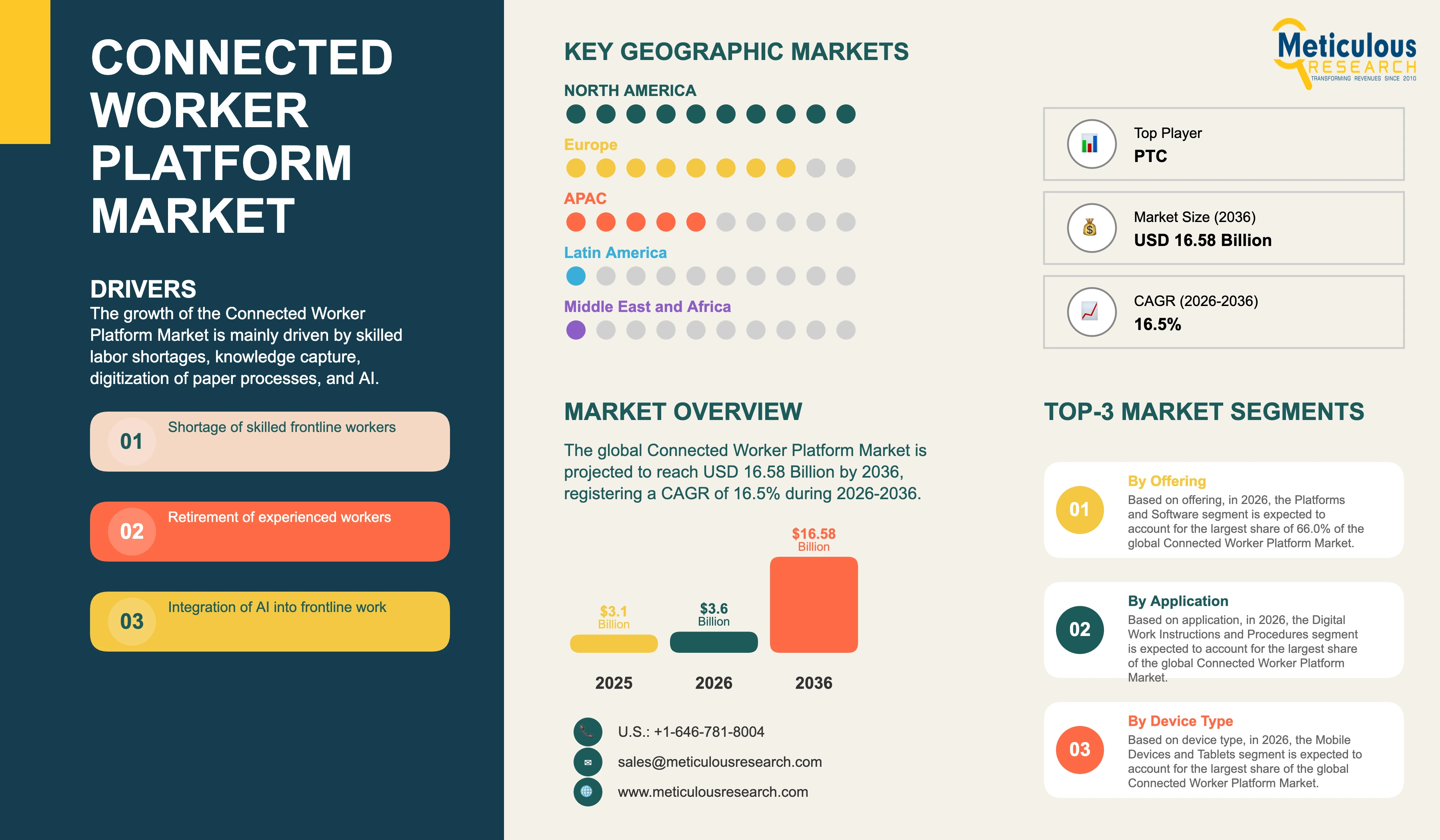
The global connected worker platform market was valued at USD 3.10 billion in 2025. This market is expected to reach USD 16.58 billion by 2036 from an estimated USD 3.60 billion in 2026, registering a CAGR of 16.5% during the forecast period (2026-2036).
- Published
- Nov 2026
- Pages
- 223
- Format
- PDF + Excel
- Report ID
- MRICT - 1042640
- Base year
- 2025
- 2025 · BASELINE
- $3.10B
- 2036
- $16.58B
- CAGR 2026–2036
- 16.5%
2025 baseline · 2026–2036 forecast at 16.5% CAGR · hover a bar for the value
Key highlights
In January 2026, Prometheus Group, a provider of enterprise asset management software, acquired Webalo, an AI-enabled connected worker platform for the frontline workforce, to create a closed-loop digital execution platform that connects plant floor activity directly to planning, execution, compliance, and enterprise decision-making, according to the company's announcement. Webalo describes itself as the connected worker platform for the frontline workforce and digitizes tasks and activities for frontline workers to provide real-time operational visibility.
CAI Software, part of STG, acquired Parsable, a cloud-native connected worker platform used by global tier-1 manufacturers for production, maintenance, quality, safety, and ESG, in September 2024. Lightspeed Venture Partners founding partner Barry Eggers said at the time that Parsable had pioneered the connected worker movement about 10 years earlier. Parsable's platform transforms static, paper-based procedures into mobile and interactive work instructions that support multimedia formats and real-time collaboration.
IFS acquired connected worker platform provider Poka in June 2023, and according to Reliable's October 2026 comparison of connected worker platforms, the product is still sold as the Poka Connected Worker Platform, with an AI layer including Poka AI, AI agents, and an AI Studio added under IFS ownership.
Augmentir's connected worker platform combines Augie, which the company describes as the first industrial generative AI suite, with agentic AI that provides autonomous, context-aware support for frontline operations, and the company has collaborated with Zebra Technologies to bring AI-powered connected work to industrial frontline workers on Zebra mobile computers. Augmentir's platform is designed to digitize and optimize frontline processes, including autonomous and preventive maintenance, quality, safety, and assembly.
Consolidation and rebranding continue across the connected worker platform market as vendors seek scale. According to Reliable's October 2026 update, SafetyCulture is now Mitti, while Tulip offers a no-code platform that lets manufacturers build frontline apps connected to their machines, sensors, and enterprise systems. Many industrial companies are also expanding connected worker deployments from pilot sites to multiple plants, which increases software subscriptions and services revenue.
By offering, platforms and software accounts for the larger share of 66.0% in 2026 and also registers the higher CAGR.
By application, digital work instructions and procedures account for the largest share in 2026, while training and skills management registers the highest CAGR.
By device type, mobile devices and tablets account for the largest share in 2026, while wearables and smart glasses register the highest CAGR.
By industry, discrete manufacturing accounts for the largest share of 30.0% in 2026, while pharmaceuticals and life sciences register the highest CAGR.
By geography, North America accounts for the largest share of 40.0% in 2026, while Asia-Pacific registers the highest CAGR of 19.4%.
Report summary
| Particulars | Details |
|---|---|
| Base Year | 2025 |
| Estimated Year | 2026 |
| Forecast Period | 2026-2036 |
| Market Size in 2025 | USD 3.10 billion |
| Market Size in 2026 | USD 3.60 billion |
| Market Size by 2036 | USD 16.58 billion |
| CAGR (2026-2036) | 16.5% |
| Format | PDF, Excel & Cloud Portal · 223 pages |
| Largest Segment by Offering (2026) | Platforms and Software (66.0%) |
| Largest Segment by Industry (2026) | Discrete Manufacturing (30.0%) |
| Largest Region (2026) | North America (40.0%) |
| Fastest-Growing Region | Asia-Pacific (CAGR 19.4%) |
| Companies Profiled | 15 companies and other companies |
| Segments Covered | Offering, Application, Device Type, Industry, Geography |
| Countries Covered | U.S., Canada, Rest of North America, Germany, France, U.K., Italy, Spain, Netherlands, Poland, Switzerland, Belgium, Sweden, Denmark, Norway, Finland, Austria, Ireland, Rest of Europe, China, Japan, India, South Korea, Australia, Singapore, Indonesia, Vietnam, Thailand, Malaysia, Philippines, Taiwan, New Zealand, Rest of Asia-Pacific, Mexico, Brazil, Chile, Argentina, Colombia, Peru, Rest of Latin America, Saudi Arabia, U.A.E., South Africa, Israel, Turkey, Egypt, Rest of Middle East & Africa |
Report overview
Segments covered: offering, application, device type, industry.
The growth of this market is mainly driven by the persistent shortage of skilled frontline workers in manufacturing, energy, and other industrial sectors, the retirement of experienced workers and the resulting loss of operational knowledge, the replacement of paper-based procedures and checklists with digital workflows, the need to improve productivity, quality, and safety on the shop floor, the integration of artificial intelligence, generative AI, and AI agents into frontline work, and the growing availability of rugged mobile devices, wearables, and augmented reality tools for industrial environments. However, factors such as the difficulty of integrating connected worker platforms with existing enterprise and operational systems, resistance to change among frontline workers and supervisors, connectivity limitations in plants and remote sites, and the difficulty of demonstrating return on investment at scale are expected to restrain the growth of this market to some extent.
A connected worker platform is software that digitally connects frontline industrial workers with the information, people, systems, and equipment they need to perform their work safely and efficiently. Connected worker platforms replace paper-based standard operating procedures, checklists, logbooks, and forms with digital work instructions and workflows that workers access on mobile devices, tablets, wearables, smart glasses, and shop floor terminals. They typically include digital work instructions, inspections and audits, maintenance and asset care workflows, skills and training management, safety and compliance tools, real-time collaboration and remote expert assistance, and analytics that turn frontline activity into operational data. Increasingly, they also include AI capabilities that guide workers, answer questions, and recommend actions.
This report covers the global connected worker platform market, including connected worker platforms and software delivered through cloud subscriptions or on-premise licenses and related services such as implementation, integration, content digitization, consulting, training, and support. The market is analyzed by offering, application, device type, industry, and geography. Hardware such as mobile devices, wearables, and smart glasses sold separately, general-purpose workforce management and communication applications, and manufacturing execution and enterprise asset management systems sold as standalone products are analyzed in separate reports. The market is measured on a revenue basis.
Frontline workers make up the majority of the workforce in manufacturing, energy, utilities, mining, construction, and many other industries, yet their work has historically received far less investment in digital tools than office work. Most frontline work in industrial facilities is still guided by printed or PDF procedures that workers follow and check off manually, which provides little structured data, makes procedures hard to update, and makes it difficult to verify that work was performed correctly. Connected worker platforms address this gap by digitizing frontline processes and capturing data from every task.
Workforce challenges are a major reason for the growth of the market. Industrial companies in North America, Europe, and parts of Asia-Pacific face shortages of skilled workers, high turnover among new hires, and the retirement of experienced employees who hold critical knowledge about equipment and processes. Connected worker platforms help companies onboard and train new workers faster, capture the knowledge of experienced workers in digital procedures and videos, and provide real-time guidance so that less experienced workers can perform complex tasks correctly.
The market includes specialist connected worker providers such as Tulip, Augmentir, Parsable, Poka, Innovapptive, Webalo, Redzone, Dozuki, and L2L, augmented reality and remote assistance providers such as PTC, TeamViewer, Librestream, and Atheer, and industrial software and automation companies such as Honeywell and SymphonyAI that offer connected worker capabilities. Larger enterprise software vendors are acquiring connected worker providers to extend their platforms to the frontline, as shown by IFS's acquisition of Poka in 2023, CAI Software's acquisition of Parsable in 2024, and Prometheus Group's acquisition of Webalo in January 2026. More acquisitions are expected as larger vendors seek frontline capabilities. Independent specialists continue to attract customers with focused products.
Artificial intelligence is rapidly changing the capabilities of connected worker platforms and how frontline workers use them. Vendors are adding generative AI assistants that answer workers' questions in natural language, convert existing documents and videos into digital procedures, translate content, and summarize shift handovers, as well as AI agents that monitor frontline data and trigger actions. Augmentir has introduced its Augie industrial generative AI suite and agentic AI capabilities, and Poka has added AI agents under IFS ownership.
Digital work instructions and procedures account for the largest share of the market by application, while training and skills management is the fastest-growing application. Mobile devices and tablets are the most widely used device type, while wearables and smart glasses are the fastest-growing device type. Discrete manufacturing is the largest industry, while pharmaceuticals and life sciences is the fastest-growing industry. North America accounts for the largest share of the market, while Asia-Pacific is the fastest-growing region.
Over the forecast period, the connected worker platform market is expected to grow rapidly, supported by workforce shortages, knowledge capture, digitization of paper processes, AI, and new devices. At the same time, the market's growth will depend on simplifying integration, driving adoption among frontline workers, and demonstrating clear business value across multiple sites. Vendors are also adding generative AI assistants to their platforms to help workers find information and troubleshoot problems.
Paper records and training files were a constant risk during audits. Digital procedures with electronic sign-offs give us complete records and make compliance much easier.
We are hiring hundreds of new workers for our new plant, and we cannot train all of them in classrooms. Digital instructions and an AI assistant help them learn on the job.
Digital work instructions and procedures are expected to account for the largest share of the market in 2026, while training and skills management is projected to register the highest CAGR.
Discrete manufacturing is expected to account for the largest share of 30.0% of the market in 2026, while pharmaceuticals and life sciences is projected to register the highest CAGR.
North America is expected to account for the largest share of 40.0% of the market in 2026, mainly due to its large manufacturing and energy sectors, skilled labor shortages, worker retirements, early adoption, and the presence of many leading vendors.
Asia-Pacific is projected to register the highest CAGR of 19.4% during the forecast period, driven by industrial growth and new manufacturing capacity, smart manufacturing programs, the need to train large numbers of new workers, and aging workforces in Japan and South Korea.
The report profiles 15 companies, including PTC, Honeywell, TeamViewer, IFS (Poka), CAI Software (Parsable), Prometheus Group (Webalo), Tulip, Augmentir, Innovapptive, Redzone, Librestream, Atheer, Dozuki, SymphonyAI, and L2L.
AI is enabling connected worker platforms to answer workers' questions in natural language, convert documents and videos into digital procedures, translate content, personalize training, guide troubleshooting, and use AI agents to monitor frontline data and trigger actions.
In 2026, the platforms and software segment is expected to account for the larger share of 66.0% of the connected worker platform market, and it is also projected to register the higher CAGR during the forecast period.
Report infographic
Market dynamics
18 factors across 5 forcesShortage of skilled frontline workers
Industrial companies face persistent difficulty in hiring and retaining skilled frontline workers, including operators, technicians, maintenance staff, and quality inspectors. Demographic changes, competition from other sectors, and the perception of industrial jobs among younger workers contribute to these shortages, while high turnover among new hires increases training costs and reduces productivity. These shortages make it critical for companies to get new workers productive quickly and to make the best use of the workers they have.
Connected worker platforms help address these challenges by providing step-by-step digital guidance, videos, and images that help new workers perform tasks correctly, by tracking skills and certifications so that supervisors can assign the right workers to the right tasks, and by enabling remote experts to support workers in real time. These capabilities reduce training time, errors, and dependence on scarce experienced workers, which provides a strong business case for adoption. Companies with multilingual workforces also benefit from platforms that present instructions in each worker's preferred language.
Labor shortages are particularly acute in maintenance, where experienced technicians are difficult to replace, and connected worker platforms that guide inspections and repairs can help companies maintain equipment reliability with fewer specialists.
Retirement of experienced workers and loss of knowledge
Many industrial companies have large numbers of experienced workers approaching retirement, and much of their knowledge about equipment, processes, and troubleshooting has never been documented. When these workers leave, companies risk losing critical knowledge, which can lead to quality problems, downtime, and safety incidents. Connected worker platforms help companies capture this knowledge by recording procedures, videos, tips, and lessons learned from experienced workers and making them available to everyone through digital work instructions and knowledge bases.
Generative AI makes knowledge capture easier by converting existing documents, videos, and recordings into structured digital procedures and by allowing workers to search for knowledge using natural language questions. This capability is becoming one of the most valuable features of connected worker platforms. Capturing knowledge before experienced workers retire is now a board-level concern at many industrial companies.
Digitization of paper-based procedures and processes
Paper-based procedures, checklists, logbooks, and forms remain common in industrial facilities, and they create significant inefficiencies and risks. Paper procedures are difficult to update and distribute, workers may use outdated versions, completed forms must be manually entered or filed, and data from frontline work is rarely analyzed. Paper processes also make it difficult to prove compliance with quality, safety, and regulatory requirements during audits.
Connected worker platforms replace paper with digital workflows that are always up to date, guide workers through each step, capture data automatically, and provide real-time visibility into frontline activities. The resulting data can be analyzed to identify problems, improve processes, and demonstrate compliance, which is particularly important in regulated industries such as pharmaceuticals, food and beverage, and energy.
Need to improve productivity, quality, and safety
Industrial companies are under pressure to improve productivity, reduce quality defects, and prevent safety incidents. Connected worker platforms support these goals by standardizing work, reducing errors, enabling faster problem resolution, and providing data on performance. For example, digital inspections and autonomous maintenance routines help detect equipment problems early, digital quality checks reduce defects, and safety workflows ensure that hazards are identified and controlled.
Connected worker platforms also support continuous improvement programs by providing data on how work is performed, where problems occur, and which procedures need improvement, which helps companies achieve measurable gains in overall equipment effectiveness and operational performance.
Integration of AI and AI agents into frontline work
Artificial intelligence is making connected worker platforms more valuable and easier to use. Generative AI assistants can answer workers' questions, guide troubleshooting, translate content for multilingual workforces, and create procedures from existing documents, while AI agents can monitor data from workers, machines, and systems and trigger actions or alerts. AI can also personalize guidance based on each worker's skills and experience, providing more detailed instructions to new workers and less to experienced ones.
Vendors such as Augmentir, with its Augie generative AI suite and agentic AI capabilities, and Poka, with its AI agents and AI Studio, are leading this trend. As AI capabilities improve, connected worker platforms are expected to become intelligent assistants for frontline workers, which will increase their adoption and value. Rising safety expectations from regulators, insurers, and workers also support adoption.
Table of contents
12 chapters · 170 sections · 223 pages · click to expandSegmental analysis
| Segment | Largest share (2026) | Fastest growth (2026–2036) |
|---|---|---|
| By Offering | Platforms and software | — |
| By Application | Digital work instructions and procedures | Training and skills management |
| By Device Type | Mobile devices and tablets | Wearables and smart glasses |
| By Industry | Discrete manufacturing | Pharmaceuticals and life sciences |
By Offering
- Connected Worker Platform Market Analysis by Offering
- The platforms and software segment is expected to account for the largest share of 66.0% of the global connected worker platform market.
- The large share of this segment is mainly due to the central role of connected worker software in digitizing frontline procedures, workflows, training, and collaboration, the growth of cloud subscriptions that generate recurring revenue, the addition of AI capabilities that increase the value of platforms, and the expansion of deployments from pilots to multiple sites.
- Software subscriptions are typically priced per user, per site, or per application, which allows revenue to grow as deployments expand.
- Vendors increasingly offer modular pricing so that customers can start with one application and add others over time.
- This segment is also projected to register the highest CAGR during the forecast period, driven by the adoption of AI capabilities, the expansion of deployments across sites and use cases, the adoption of no-code platforms by mid-sized manufacturers, and the integration of connected worker platforms with enterprise and operational systems.
- The services segment accounts for the remaining share of the market.
- Services include implementation, integration, content digitization, consulting, training, and support, and they are important for helping companies design digital procedures, integrate systems, and drive adoption.
- Growth in services is expected to be slower than software, since AI and no-code tools reduce the effort required to create content and configure platforms.
- Customer success services, which help companies measure results, expand use cases, and drive adoption across sites, are becoming an important part of vendor offerings, since they directly influence renewals and expansion.
- Content creation services remain important for companies with large libraries of paper procedures that need to be digitized quickly.
- Services, including implementation, content creation, integration with enterprise systems, and training, account for the remaining share of the market and are important for successful deployments, since many companies need help converting paper procedures into digital workflows and connecting connected worker platforms with manufacturing execution, maintenance, and quality systems.
By Application
- Connected Worker Platform Market Analysis by Application
- The digital work instructions and procedures segment is expected to account for the largest share of the global connected worker platform market.
- The large share of this segment is mainly due to the widespread use of paper-based standard operating procedures in industrial facilities, the importance of standardized work for quality and safety, the need to update procedures quickly and ensure that workers use the latest versions, and the role of digital work instructions as the starting point for most connected worker deployments.
- Digital work instructions guide workers through assembly, production, changeover, and other tasks step by step using text, images, and videos.
- Digital work instructions are particularly valuable in operations with frequent product changes, many product variants, or complex assemblies, since they ensure that workers always follow the correct procedure for each product.
- They also provide data on how long each step takes and where errors occur, which supports continuous improvement and process optimization.
- However, the training and skills management segment is projected to register the highest CAGR during the forecast period.
- The rapid growth of this segment is driven by skilled labor shortages, high turnover among new hires, the retirement of experienced workers, the need to track skills and certifications for safety and compliance, and the use of AI to personalize training and provide on-the-job learning.
- Inspection, maintenance, and asset care forms the second-largest segment, supported by digital inspections, autonomous maintenance routines, and integration with enterprise asset management systems, followed by safety and compliance, remote assistance and collaboration, and analytics and other applications.
- Many companies deploy connected worker platforms across several applications, starting with digital work instructions or inspections and expanding to training, safety, and collaboration as they see results.
- Platforms that cover many applications on a single data model allow companies to link training records, procedures, inspections, and quality data, which provides deeper insights into performance.
By Device Type
- Connected Worker Platform Market Analysis by Device Type
- The mobile devices and tablets segment is expected to account for the largest share of the global connected worker platform market.
- The large share of this segment is mainly due to the wide availability and familiarity of smartphones and tablets, their relatively low cost, the availability of rugged models designed for industrial environments, and their versatility for viewing instructions, capturing photos and data, and collaborating with colleagues.
- Most connected worker platforms are designed primarily for mobile devices and tablets.
- However, the wearables and smart glasses segment is projected to register the highest CAGR during the forecast period.
- The rapid growth of this segment is driven by the need for hands-free access to instructions during tasks, the use of smart glasses for remote expert assistance, improvements in device comfort, durability, and cost, and the integration of augmented reality into connected worker platforms.
- The fixed workstations and kiosks segment, which includes shop floor terminals and displays at workstations and production lines, forms the second-largest segment and is used for assembly and production tasks where workers remain at a fixed location.
- Fixed displays are also used for production dashboards and team communication on the shop floor.
- Wearables, smart glasses, and head-mounted devices are growing in applications where workers need hands-free access to information, such as complex assembly, maintenance, and remote expert support, while rugged mobile devices remain the most common tool on the shop floor.
- The mobile devices and tablets segment is expected to account for the largest share of the connected worker platform market, while the wearables and smart glasses segment is projected to register the highest CAGR during the forecast period.
By Industry
- Connected Worker Platform Market Analysis by Industry
- The discrete manufacturing segment is expected to account for the largest share of 30.0% of the global connected worker platform market.
- The large share of this segment is mainly due to the large number of frontline workers in automotive, aerospace, electronics, industrial machinery, and consumer goods manufacturing, the complexity of assembly and production tasks, the importance of standardized work and quality, and the early adoption of connected worker platforms by discrete manufacturers.
- Automotive and aerospace manufacturers, in particular, use digital work instructions to manage complex assemblies and frequent product changes.
- Electronics and industrial machinery manufacturers also rely on connected worker platforms to manage high-mix production and train workers on new product introductions.
- As discrete manufacturers invest in new plants for electric vehicles, batteries, semiconductors, and defense products, demand for tools to train new workforces quickly and standardize processes from the start is expected to increase.
- However, the pharmaceuticals and life sciences segment is projected to register the highest CAGR during the forecast period.
- The rapid growth of this segment is driven by strict regulatory requirements for documented procedures, training records, and electronic records, the high cost of errors and deviations, the adoption of digital batch records and paperless manufacturing, and investment in new pharmaceutical and biologics manufacturing capacity.
- Process manufacturing forms the second-largest segment, supported by chemicals, metals, paper, and other process industries, followed by energy and utilities, food and beverage, mining and construction, and other industries.
- Energy and utilities companies use connected worker platforms for field inspections, maintenance, and safety in power plants, substations, and pipelines, while mining and construction companies use them to manage safety and maintenance in remote and hazardous sites.
- Energy and utilities, oil and gas, chemicals, food and beverage, and construction companies are also adopting connected worker platforms to improve safety, standardize procedures, and capture knowledge from experienced workers before they retire.
- Pharmaceuticals and life sciences is the fastest-growing industry because companies must document procedures and training records carefully to meet strict regulatory requirements.
Geographic analysis
North America
Largest shareIn 2026, North America is expected to account for the largest share of 40.0% of the global connected worker platform market. The large share of this region is mainly due to the large manufacturing, energy, and utilities sectors in the U.S. and Canada, persistent shortages of skilled frontline workers, the retirement of experienced workers, early adoption of connected worker platforms by large manufacturers, and the presence of many leading vendors, including Tulip, Augmentir, Parsable, Innovapptive, Webalo, Redzone, Dozuki, L2L, PTC, and Honeywell. Investment in new manufacturing capacity in the U.S., including semiconductors, batteries, and pharmaceuticals, also creates demand for tools to train new workforces quickly.
Asia-Pacific
Fastest growthAsia-Pacific is projected to register the highest CAGR of 19.4% during the forecast period. The rapid growth of this region is mainly driven by rapid industrial growth and investment in new manufacturing capacity in China, India, Southeast Asia, Japan, South Korea, and Australia, government programs supporting smart manufacturing and digital transformation, the need to train large numbers of new workers in India and Southeast Asia, aging workforces in Japan and South Korea that make knowledge capture a priority, and the relatively low current adoption of connected worker platforms. China's large manufacturing base and its focus on intelligent manufacturing also create significant opportunities. Mining and energy companies in Australia are also adopting connected worker platforms for remote and hazardous operations.
Europe
Europe accounts for a significant share of the market, supported by strong manufacturing sectors in Germany, France, Italy, the U.K., Spain, and the Nordic countries, aging workforces, strict safety and regulatory requirements, and the presence of vendors such as IFS with Poka, TeamViewer, and others.
Latin America
Latin America accounts for a smaller share of the market, with growth supported by manufacturing in Mexico, driven by nearshoring, and mining and energy in Brazil and Chile, while the Middle East & Africa accounts for the smallest share, with demand from oil and gas, utilities, and industrial projects in Saudi Arabia, the U.A.E., and South Africa. Regional differences in workforce demographics, industrial investment, and digital maturity shape the adoption of connected worker platforms. Regions with fast industrial growth, skilled labor shortages, and government support for smart manufacturing are expected to see the fastest growth over the forecast period. Cloud availability and local language support will also influence adoption across regions. Local partners will be important in emerging markets. Latin America and the Middle East & Africa account for smaller shares of the market, but adoption is increasing among manufacturers, mining companies, and energy producers in Brazil, Mexico, Chile, Saudi Arabia, the U.A.E., and South Africa. Mining companies in Chile and South Africa are using connected worker tools to improve safety in hazardous environments, while energy companies in the Middle East are digitizing field operations and maintenance. Nearshoring in Mexico is also creating demand for tools that help train new workers quickly in new manufacturing plants. Local partners will be important in these markets.
Competitive landscape
The global connected worker platform market is highly fragmented, with the top five players estimated to account for about 30% of the market in 2025. The market includes specialist connected worker platform providers, no-code frontline application platforms, augmented reality and remote assistance providers, enterprise asset management and enterprise software vendors that have acquired connected worker capabilities, and industrial automation and software companies.
Tulip offers a no-code frontline operations platform, Augmentir offers an AI-powered connected worker suite with generative and agentic AI, and Parsable, now part of CAI Software, offers a connected worker platform used by global manufacturers. Poka, now part of IFS, focuses on training, skills, and knowledge management, Innovapptive serves asset-intensive industries with connected worker solutions integrated with enterprise systems, and Webalo, now part of Prometheus Group, links frontline work with enterprise asset management. Redzone focuses on frontline productivity in manufacturing, Dozuki and L2L offer work instructions and operations solutions, PTC and TeamViewer offer augmented reality and remote assistance, Librestream and Atheer focus on remote expert and wearable solutions, and Honeywell and SymphonyAI offer connected worker capabilities as part of their industrial software portfolios.
Companies in this market compete on ease of use for frontline workers, AI capabilities, integration with enterprise and operational systems, industry expertise, speed of deployment, support for mobile, wearable, and offline use, scalability across sites, and total cost of ownership. Key strategies include investment in generative AI and AI agents, acquisitions and partnerships, integration with enterprise asset management and enterprise resource planning systems, partnerships with device manufacturers, development of industry-specific solutions, and expansion into new regions.
We expect the market to consolidate as enterprise software and asset management vendors continue to acquire specialist providers to extend their platforms to the frontline. AI capabilities and closed-loop integration with enterprise systems are likely to become the most important competitive factors. Specialist vendors with strong AI, industry expertise, and ease of use will continue to compete effectively, while no-code platforms will appeal to companies that want to build their own solutions. Customer success and proven results across multiple sites will also become increasingly important as customers move from pilots to enterprise-wide deployments.
Some of the key players operating in the connected worker platform market are PTC Inc., Honeywell International Inc., TeamViewer SE, IFS (Poka), CAI Software, LLC (Parsable), Prometheus Group (Webalo), Tulip Interfaces, Inc., Augmentir, Inc., Innovapptive Inc., Redzone Production Systems, Librestream Technologies Inc., Atheer, Inc., Dozuki, SymphonyAI, and L2L, among others. Consolidation among smaller connected worker vendors is also likely as the market matures.
- —
Prometheus Group acquired Webalo in January 2026, CAI Software acquired Parsable in September 2024, IFS has added AI agents to Poka, and Augmentir has introduced generative and agentic AI capabilities and collaborated with Zebra Technologies.
- PTC Inc.
- Honeywell International Inc.
- TeamViewer SE
- IFS · Poka
- CAI Software, LLC · Parsable
- Prometheus Group · Webalo
- Tulip Interfaces, Inc.
- Augmentir, Inc.
- Innovapptive Inc.
- Redzone Production Systems
- Librestream Technologies Inc.
- Atheer, Inc.
- Dozuki
- SymphonyAI
- L2L
Expert perspectives
Connected worker platforms address one of the most pressing challenges facing industrial companies today: how to maintain productivity, quality, and safety with a workforce that is shrinking, aging, and changing rapidly. By digitizing frontline work, capturing knowledge, and providing real-time guidance, these platforms help companies get more from their workers and protect critical knowledge.
Over the forecast period, the market is expected to grow at a CAGR of 16.5%, from USD 3.60 billion in 2026 to USD 16.58 billion in 2036. Growth will be supported by workforce shortages, knowledge capture, digitization of paper processes, productivity and safety goals, AI, and new devices.
Among the market segments, platforms and software are the largest and fastest-growing offering. Digital work instructions and procedures are the largest application, while training and skills management grows fastest, mobile devices and tablets are the largest device type, while wearables and smart glasses grow fastest, and discrete manufacturing is the largest industry, while pharmaceuticals and life sciences grows fastest. North America is the largest region, and Asia-Pacific is the fastest-growing region at a CAGR of 19.4%.
In our view, the most important development in the market over the forecast period will be the integration of generative AI and AI agents. AI can solve two of the biggest barriers to adoption, the cost of creating digital content and the difficulty of finding knowledge, while making connected worker platforms more useful to workers every day. Vendors that deliver reliable, industrial-grade AI that workers trust will gain share, and AI is likely to turn connected worker platforms into intelligent assistants for the frontline.
We also expect consolidation to continue, as enterprise asset management, enterprise resource planning, and industrial software vendors acquire connected worker providers to create closed-loop platforms that connect frontline work with planning and decision-making. This will benefit customers by reducing integration complexity, but it may also reduce the number of independent specialist vendors. Companies that move beyond pilots and deploy connected worker platforms across all sites will see the greatest benefits. Measuring results consistently will be key to securing continued investment.
Overall, we believe the connected worker platform market will grow rapidly over the forecast period, with AI, training and skills management, wearables, regulated industries, and Asia-Pacific providing the fastest growth. Connected worker platforms are likely to become a standard part of the industrial technology stack alongside enterprise resource planning, manufacturing execution, and asset management systems. Vendors that combine AI, ease of use, and closed-loop integration will be best positioned to lead the market. Proven return on investment will be essential for scaling deployments beyond pilots.
Customer perspectives
Vice President of Operations - automotive components manufacturer, U.S.
We lose experienced people every year and new hires do not stay long, so we moved our procedures from paper to tablets with videos and step-by-step guidance. New workers now reach full productivity much faster.
Frequently asked questions
The global connected worker platform market was valued at USD 3.10 billion in 2025, up from USD 2.65 billion in 2024, and is estimated at USD 3.60 billion in 2026. The market includes connected worker platforms and software and related implementation, integration, content digitization, consulting, training, and support services.
The global connected worker platform market is expected to reach USD 16.58 billion by 2036, supported by skilled labor shortages, the retirement of experienced workers, the digitization of paper-based processes, productivity, quality, and safety goals, AI, and new mobile and wearable devices.
The market is expected to register a CAGR of 16.5% from 2026 to 2036.
A connected worker platform is software that digitally connects frontline industrial workers with procedures, knowledge, colleagues, systems, and equipment through mobile devices, wearables, and terminals, replacing paper with digital work instructions, inspections, training, safety workflows, collaboration, and analytics.
Market growth is mainly driven by the shortage of skilled frontline workers, the retirement of experienced workers and loss of knowledge, the digitization of paper-based procedures, the need to improve productivity, quality, and safety, and the integration of AI and AI agents into frontline work.
Integration with enterprise and operational systems and resistance to change among frontline workers restrain growth, while connectivity and device limitations in industrial environments and the difficulty of demonstrating return on investment and scaling across sites are key challenges.
Key growth opportunities include generative AI assistants and agentic AI for frontline workers, wearables, smart glasses, and augmented reality, expansion into pharmaceuticals, food and beverage, and regulated industries, and growth in Asia-Pacific and among mid-sized manufacturers.
In 2026, the platforms and software segment is expected to account for the larger share of 66.0% of the connected worker platform market, and it is also projected to register the higher CAGR during the forecast period.
Digital work instructions and procedures are expected to account for the largest share of the market in 2026, while training and skills management is projected to register the highest CAGR.
In 2026, the mobile devices and tablets segment is expected to account for the largest share of the connected worker platform market, while the wearables and smart glasses segment is projected to register the highest CAGR during the forecast period.
Discrete manufacturing is expected to account for the largest share of 30.0% of the market in 2026, while pharmaceuticals and life sciences is projected to register the highest CAGR.
North America is expected to account for the largest share of 40.0% of the market in 2026, mainly due to its large manufacturing and energy sectors, skilled labor shortages, worker retirements, early adoption, and the presence of many leading vendors.
Asia-Pacific is projected to register the highest CAGR of 19.4% during the forecast period, driven by industrial growth and new manufacturing capacity, smart manufacturing programs, the need to train large numbers of new workers, and aging workforces in Japan and South Korea.
The report profiles 15 companies, including PTC, Honeywell, TeamViewer, IFS (Poka), CAI Software (Parsable), Prometheus Group (Webalo), Tulip, Augmentir, Innovapptive, Redzone, Librestream, Atheer, Dozuki, SymphonyAI, and L2L.
Prometheus Group acquired Webalo in January 2026, CAI Software acquired Parsable in September 2024, IFS has added AI agents to Poka, and Augmentir has introduced generative and agentic AI capabilities and collaborated with Zebra Technologies.
AI is enabling connected worker platforms to answer workers' questions in natural language, convert documents and videos into digital procedures, translate content, personalize training, guide troubleshooting, and use AI agents to monitor frontline data and trigger actions.
Cite this report
Meticulous Research. (2026). Connected Worker Platform Market - Global Opportunity Analysis and Industry Forecast (2026-2036) (Report No. MRICT - 1042640). Meticulous Market Research Pvt. Ltd. https://www.meticulousresearch.com/product/connected-worker-platform-market-7323