EHS Software Market (2026-2036)
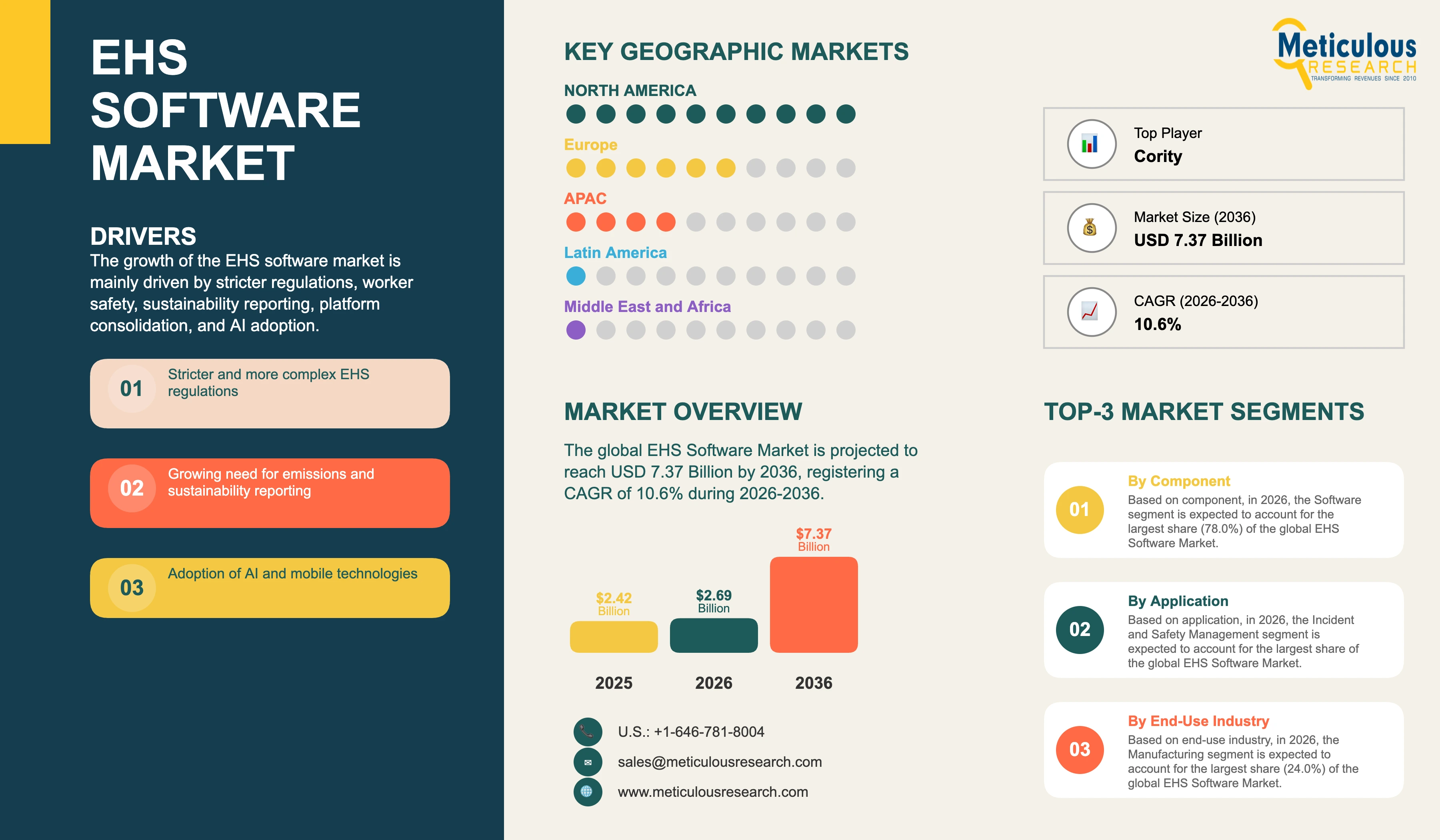
The global EHS software market was valued at USD 2.42 billion in 2025. This market is expected to reach USD 7.37 billion by 2036 from an estimated USD 2.69 billion in 2026, registering a CAGR of 10.6% during the forecast period (2026-2036).
- Published
- Nov 2026
- Pages
- 237
- Format
- PDF + Excel
- Report ID
- MRICT - 1042616
- Base year
- 2025
- 2025 · BASELINE
- $2.42B
- 2036
- $7.37B
- CAGR 2026–2036
- 10.6%
2025 baseline · 2026–2036 forecast at 10.6% CAGR · hover a bar for the value
Key highlights
The Verdantix Green Quadrant: EHS Software (2026), released in September 2026, benchmarked 23 of the most prominent EHS software providers and named 12 as Leaders, including Benchmark Gensuite, Cority, EcoOnline, Evotix, HSI, Ideagen, Intelex, Origami Risk, Quentic, Sphera, VelocityEHS, and Wolters Kluwer Enablon, and found that agentic AI is emerging as the new baseline for EHS software, according to Verdantix.
Verdantix found that AI is moving from a differentiator to a baseline capability in EHS software, pushing vendors to develop agentic AI and AI assistants that execute tasks and interact with EHS systems, and that the rising competitive benchmark contributed to greater downward movement in vendor positioning than in 2025.
In March 2026, Cority demonstrated more than 30 live AI-powered workflows on its CorityOne platform at its Cority Connect 2026 conference to more than 500 global EHS leaders, which the company described as the most extensive real-world deployment of AI in EHS software to date, according to Cority and BriefGlance.
In February 2026, Cority announced that its platform had become the first FedRAMP-authorized EHS platform and partnered with Carahsoft to bring it to U.S. federal, state, and local government agencies, following its December 2025 launch of Cortex AI, a suite of intelligent agents managed through a centralized AI Control Center, according to Cority.
Peak Rock Capital acquired UL Solutions' employee health and safety software business, which now operates as PureEHS, which Verdantix said highlights the growing attractiveness of EHS software as a standalone investment category.
Cority's State of EHS+ Technology 2026 report found that 62% of EHS leaders say the need to apply AI is pushing them toward integrated platforms and IT consolidation, according to Cority. Verdantix noted that the first half of 2026 did not produce a blockbuster EHS software consolidation deal on the scale of earlier private equity waves, and that recent acquisitions, carve-outs, and partnerships instead reflect a pragmatic approach in which vendors extend functionality and experiment with emerging technologies, with Novara's formation and acquisition of AI-native sustainability platform Ensogo illustrating how quickly vendors are moving to strengthen their portfolios.
By component, software accounts for the larger share of 78.0% in 2026 and also registers the higher CAGR.
By application, incident and safety management accounts for the largest share in 2026, while emissions and sustainability reporting registers the highest CAGR.
By deployment mode, cloud accounts for the larger share in 2026 and also registers the higher CAGR.
By end-use industry, manufacturing accounts for the largest share of 24.0% in 2026, while construction registers the highest CAGR.
By geography, North America accounts for the largest share of 45.0% in 2026, while Asia-Pacific registers the highest CAGR of 13.8%.
Report summary
| Particulars | Details |
|---|---|
| Base Year | 2025 |
| Estimated Year | 2026 |
| Forecast Period | 2026-2036 |
| Market Size in 2025 | USD 2.42 billion |
| Market Size in 2026 | USD 2.69 billion |
| Market Size by 2036 | USD 7.37 billion |
| CAGR (2026-2036) | 10.6% |
| Format | PDF, Excel & Cloud Portal · 237 pages |
| Largest Segment by Component (2026) | Software (78.0%) |
| Largest Segment by End-Use Industry (2026) | Manufacturing (24.0%) |
| Largest Region (2026) | North America (45.0%) |
| Fastest-Growing Region | Asia-Pacific (CAGR 13.8%) |
| Companies Profiled | 16 companies and other companies |
| Segments Covered | Component, Application, Deployment Mode, End-Use Industry, Geography |
| Countries Covered | U.S., Canada, Germany, U.K., France, Italy, Spain, Netherlands, Switzerland, Belgium, Sweden, Denmark, Norway, Finland, Austria, Poland, Ireland, Rest of Europe, China, Japan, India, South Korea, Australia, Indonesia, Thailand, Singapore, Malaysia, Vietnam, Philippines, Taiwan, New Zealand, Rest of Asia-Pacific, Brazil, Mexico, Argentina, Colombia, Chile, Peru, Rest of Latin America, Saudi Arabia, U.A.E., Israel, South Africa, Turkey, Egypt, Rest of Middle East & Africa |
Report overview
Segments covered: component, application, deployment mode, end-use industry.
The growth of this market is mainly driven by stricter and more complex environmental, health, and safety regulations around the world, the growing focus of companies on preventing serious injuries and fatalities and protecting workers, the increasing need to measure and report greenhouse gas emissions and other sustainability data, the replacement of spreadsheets and fragmented legacy systems with integrated cloud platforms, and the rapid adoption of artificial intelligence and mobile tools that make EHS programs more efficient and proactive. However, factors such as the high cost and complexity of implementing enterprise EHS platforms, the difficulty of integrating EHS software with other enterprise systems, resistance to change among frontline workers, and shifting sustainability reporting requirements in some regions are expected to restrain the growth of this market to some extent. Nevertheless, the large number of organizations that still manage EHS programs with spreadsheets and paper offers significant room for growth.
Environmental, health, and safety software helps organizations manage their obligations and programs for protecting workers, communities, and the environment. EHS software typically includes applications for incident and safety management, audits and inspections, risk assessments, environmental compliance and permitting, air emissions and greenhouse gas tracking, waste and water management, occupational health and industrial hygiene, chemical and safety data sheet management, training, and regulatory reporting. These applications help organizations comply with regulations, prevent injuries and environmental incidents, and track performance across sites and operations.
This report covers the global EHS software market, including EHS software delivered as cloud services or deployed on-premises, and related services, such as implementation, configuration, data migration, integration, training, and support. The market is analyzed by component, application, deployment mode, end-use industry, and geography. The market is measured on a revenue basis. Standalone quality management, general governance, risk, and compliance, and stand-alone ESG reporting platforms are not included, except for their EHS modules. EHS consulting services that are not related to software implementation are also not included.
The EHS software market has grown as organizations replace spreadsheets, paper forms, and fragmented point solutions with integrated digital platforms. Many organizations still manage EHS programs using a mix of manual processes and separate tools, which makes it difficult to see risks across operations, analyze trends, and report accurately. Integrated EHS platforms provide a single source of data for safety, environmental, and health programs, which improves visibility and decision-making. Cority's State of EHS+ Technology 2026 report found that 88% of EHS leaders report problems with fragmented data, which shows the scale of the challenge.
Artificial intelligence has become the main focus of innovation in the EHS software market. Vendors are adding AI assistants and agents that help users report incidents, analyze root causes, identify hazards in photos and videos, summarize regulations, review permits, and prepare reports. Verdantix found in its 2026 Green Quadrant that AI is moving from a differentiator to a baseline capability, and that vendors are developing agentic AI that can execute tasks and interact with EHS systems. Cority demonstrated more than 30 live AI workflows on its platform in March 2026, and other vendors, such as Intelex, Sphera, VelocityEHS, and Wolters Kluwer Enablon, have also launched AI capabilities.
Sustainability reporting has also become an important driver of demand for EHS software in many industries and regions. Companies need to measure, manage, and report greenhouse gas emissions, energy use, water, and waste to meet regulatory requirements, investor expectations, and customer demands. EHS software vendors have expanded their platforms to include emissions management and sustainability reporting, which builds on their existing environmental data management capabilities. However, changes in sustainability reporting rules in some regions have created uncertainty for some buyers.
The market is moderately fragmented, with established enterprise vendors, such as Cority, Intelex, Sphera, Wolters Kluwer Enablon, VelocityEHS, and Benchmark Gensuite, competing with mid-market specialists, such as EcoOnline, Evotix, Quentic, and HSI, and broad enterprise software vendors, such as SAP and ServiceNow. Private equity firms have been active investors in the market, and Verdantix noted that acquisitions are increasingly becoming a shortcut to AI capability.
In 2026, software accounts for the largest share of the market by component and is also the faster-growing component. Incident and safety management is the largest application, while emissions and sustainability reporting is the fastest-growing application. Cloud deployment accounts for the larger share by deployment mode and is also the faster-growing mode. Manufacturing is the largest end-use industry, while construction is the fastest-growing industry. North America accounts for the largest share of the market, while Asia-Pacific is the fastest-growing region.
Over the forecast period, the EHS software market is expected to grow steadily, supported by regulatory requirements, the focus on worker safety, sustainability reporting, platform consolidation, and AI adoption. Vendors that deliver measurable improvements in safety performance and compliance efficiency, and that make their platforms easy for frontline workers to use, are expected to gain share. Buyers are also changing how they evaluate EHS software as the market matures. Instead of comparing long lists of features, many organizations now focus on the ability of platforms to provide clean, connected data, support AI, engage frontline workers, and deliver measurable improvements in safety and compliance performance. This shift favors vendors with strong platforms, data models, and AI roadmaps.
North America is expected to account for the largest share of 45.0% of the market in 2026, mainly due to strict regulations, a strong focus on worker safety, large industrial sectors, and the presence of leading EHS software vendors.
Asia-Pacific is projected to register the highest CAGR of 13.8% during the forecast period, driven by rapid industrialization, stricter regulations, growing awareness of worker safety, and the expansion of multinational operations in the region.
The report profiles 16 companies, including Cority, Intelex, Sphera, Wolters Kluwer Enablon, VelocityEHS, Benchmark Gensuite, EcoOnline, Evotix, HSI, Ideagen, Origami Risk, Quentic, SAP, ServiceNow, PureEHS, and IsoMetrix.
EHS software helps organizations manage environmental, health, and safety programs, including incident reporting and investigation, audits and inspections, risk assessments, environmental compliance and permits, emissions tracking, occupational health, chemical management, training, and regulatory reporting. It gives organizations a single source of EHS data across their sites and operations.
AI helps EHS teams report incidents, analyze root causes, identify hazards in images, summarize regulations, review permits, and prepare reports. Verdantix found that AI is becoming a baseline capability in EHS software and that vendors are developing agentic AI that can execute tasks within EHS systems.
In 2026, the cloud segment is expected to account for the larger share of the EHS software market, and it is also projected to register the higher CAGR during the forecast period.
Report infographic
Market dynamics
18 factors across 5 forcesStricter and more complex EHS regulations
Organizations face a growing number of environmental, health, and safety regulations at the local, national, and international levels, covering areas such as workplace safety, chemical management, air emissions, water discharges, waste, and process safety. Regulators are increasing enforcement, penalties, and reporting requirements, and multinational companies must comply with different rules in each country where they operate. Managing these obligations with spreadsheets and manual processes is time-consuming and increases the risk of non-compliance.
EHS software helps organizations track regulatory requirements, manage permits and compliance tasks, record and report incidents, and prepare regulatory reports. AI capabilities that summarize regulations and review permits are making compliance work more efficient. Cority received two 2026 E+E Leader Awards for AI tools that cut permit review time and deliver auditable emissions data, according to the company. Regulatory complexity is one of the most important drivers of the EHS software market.
Focus on preventing serious injuries and protecting workers
Organizations are increasingly focused on preventing serious injuries and fatalities, protecting worker health, and building a strong safety culture. Workplace injuries cause human suffering, lost productivity, higher insurance costs, legal liability, and damage to reputation. Boards, investors, and customers expect companies to demonstrate strong safety performance, and many companies have set targets to reduce serious injuries and fatalities.
EHS software helps organizations move from reactive to proactive safety management by capturing near misses and hazards, analyzing leading indicators, managing corrective actions, and identifying high-risk activities. Mobile apps allow frontline workers to report hazards and complete inspections in the field, which increases participation and data quality. VelocityEHS's AI functionality addresses safety, operational, ergonomic, chemical, and contractor risks, according to Verdantix, which reflects the broad scope of modern safety management software.
Growing need for emissions and sustainability reporting
Companies face growing pressure from regulators, investors, customers, and supply chain partners to measure and report greenhouse gas emissions, energy use, and other sustainability data. Sustainability reporting requires accurate, auditable data from operations across many sites, which EHS software is well positioned to provide, as it already manages environmental data, permits, and emissions calculations. Vendors such as Cority, Sphera, Wolters Kluwer Enablon, and Benchmark Gensuite have expanded their platforms to include emissions management and sustainability reporting.
Cority received an award for AI tools that deliver auditable, decision-ready emissions data at scale, and Verdantix recognized Cority's strong carbon data management capabilities. Emissions and sustainability reporting is the fastest-growing application in the EHS software market. Even where reporting rules have been simplified or delayed, many large companies continue to report emissions to meet investor and customer expectations.
Replacement of spreadsheets and fragmented legacy systems
Many organizations still manage EHS programs using spreadsheets, paper forms, and multiple disconnected tools, which makes it difficult to see risks across operations, analyze trends, and report accurately. Cority's State of EHS+ Technology 2026 report found that 88% of EHS leaders report problems related to fragmented data and that 62% say the need to apply AI is pushing them toward integrated platforms and IT consolidation. Organizations are replacing these tools with integrated cloud platforms that provide a single source of data.
Cority has said that enterprises are retiring fragmented systems in favor of unified, AI-ready platforms, and the need for clean, connected data to support AI is accelerating this shift. Platform consolidation is expected to drive strong demand for enterprise EHS software over the forecast period, particularly among large organizations with many sites and legacy systems.
Adoption of AI and mobile technologies
The rapid adoption of artificial intelligence and mobile technologies is making EHS software more valuable and easier to use. AI can analyze incident reports to identify trends and root causes, detect hazards in images and videos, automate data entry, summarize regulations, and recommend corrective actions. Mobile apps and connected devices allow workers to report incidents, complete inspections, and access safety information in the field. Cority demonstrated more than 30 live AI workflows in March 2026, and vendors are building partnerships with technology companies, such as Cority's collaboration with Google Cloud and Intelex's collaboration with COMET, to advance AI capabilities. These technologies help EHS teams do more with limited resources and support the business case for EHS software investment. AI also helps smaller EHS teams manage larger, more complex, and more geographically dispersed operations.
Table of contents
12 chapters · 172 sections · 237 pages · click to expandSegmental analysis
| Segment | Largest share (2026) | Fastest growth (2026–2036) |
|---|---|---|
| By Component | Software | — |
| By Application | Incident and safety management | Emissions and sustainability reporting |
| By Deployment Mode | — | — |
| By End-Use Industry | Manufacturing | Construction |
| Other segments | Manufacturing | Construction |
By Component
- EHS Software Market Analysis by Component
- The software segment is expected to account for the largest share of 78.0% of the global EHS software market.
- The large share of this segment is mainly due to the subscription-based pricing models of EHS software vendors, which generate recurring revenue based on modules, users, and sites, the growing adoption of integrated cloud platforms that replace spreadsheets and point solutions, the expansion of platforms into new applications, such as emissions management, and the addition of AI capabilities that increase the value of software subscriptions.
- The software segment is also projected to register the higher CAGR during the forecast period, driven by platform consolidation, AI adoption, and the expansion of EHS software into mid-sized organizations and emerging regions.
- EHS software platforms include modules for incident management, audits and inspections, risk assessment, environmental compliance, emissions management, occupational health, chemical management, training, and reporting.
- Leading platforms include CorityOne, Intelex, Sphera, Wolters Kluwer Enablon, VelocityEHS, Benchmark Gensuite, EcoOnline, Evotix, Quentic, HSI, Ideagen, Origami Risk, SAP EHS, and ServiceNow.
- Most vendors now offer mobile apps and AI capabilities as part of their platforms, and many sell modules separately so that customers can expand their use of the platform over time.
- The services segment includes implementation, configuration, data migration, integration, training, consulting, and support services provided by vendors and their partners.
- Services are important for enterprise implementations, which require configuring workflows for many EHS processes and integrating with other systems.
- Demand for services is expected to grow steadily, supported by platform consolidation projects and the implementation of AI and sustainability reporting capabilities.
- Managed services, in which vendors or partners operate parts of a customer's EHS program, are also growing among organizations with limited internal resources.
- Vendors are also expected to offer more preconfigured, industry-specific solutions that reduce implementation time and cost.
By Application
- EHS Software Market Analysis by Application
- The incident and safety management segment is expected to account for the largest share of the global EHS software market.
- The large share of this segment is mainly due to the central importance of incident reporting, investigation, and corrective action management in every EHS program, the regulatory requirements to record and report workplace injuries and illnesses, the focus of organizations on preventing serious injuries and fatalities, and the large number of users, including frontline workers, who use incident and safety management applications.
- AI capabilities that help users report incidents, analyze root causes, and identify trends are increasing the value of these applications.
- However, the emissions and sustainability reporting segment is projected to register the highest CAGR during the forecast period.
- The rapid growth of this segment is driven by the growing need for companies to measure and report greenhouse gas emissions, energy, water, and waste data, investor and customer demands for sustainability data, regulatory requirements in some regions, and the expansion of EHS vendors into emissions management and sustainability reporting.
- EHS software is well positioned to support sustainability reporting because it already manages environmental data, and AI tools that deliver auditable emissions data are increasing efficiency.
- The environmental compliance and permitting segment accounts for a significant share of the market and includes applications for managing permits, air and water compliance, waste, and environmental monitoring, which are essential for industries with significant environmental impacts.
- The audit, inspection, and risk management segment includes applications for conducting audits and inspections, assessing risks, and managing controls, while the occupational health management segment includes applications for medical surveillance, industrial hygiene, ergonomics, and case management.
- The chemical and SDS management segment includes applications for managing chemical inventories and safety data sheets, and the training and other applications segment includes training management, contractor management, and management of change.
- AI is expected to increase the value of all applications by automating data entry, analysis, and reporting.
- Contractor management and management of change applications are also expected to grow, as organizations seek to manage risks associated with contractors and operational changes more effectively.
By Deployment Mode
- EHS Software Market Analysis by Deployment Mode
- The cloud segment is expected to account for the larger share of the global EHS software market.
- The large share of this segment is mainly due to the software-as-a-service delivery model of most EHS software vendors, the ability of cloud platforms to support many sites and mobile users, lower upfront costs and IT maintenance requirements, faster access to new features, including AI, and the growing acceptance of cloud software in regulated industries and government agencies, supported by security authorizations such as FedRAMP.
- The cloud segment is also projected to register the higher CAGR during the forecast period, driven by the migration of on-premises systems and the expansion of AI capabilities delivered as cloud services.
- The on-premises segment includes EHS software deployed in customers' own data centers, which remains important for some organizations with strict data security, sovereignty, or integration requirements, such as some government agencies, defense contractors, and energy companies.
- However, its share is expected to decline as more organizations migrate to cloud platforms to access AI and mobile capabilities and reduce IT maintenance costs.
- Some vendors also offer private cloud and dedicated hosting options for customers with specific security needs.
By End-Use Industry
- EHS Software Market Analysis by End-Use Industry
- The manufacturing segment is expected to account for the largest share of 24.0% of the global EHS software market.
- The large share of this segment is mainly due to the large number of manufacturing facilities and workers, the wide range of safety, chemical, environmental, and occupational health risks in manufacturing operations, strict regulatory requirements for workplace safety, air emissions, and waste, and the growing focus of manufacturers on sustainability and emissions reporting.
- Manufacturers in industries such as automotive, electronics, food and beverage, and industrial equipment use EHS software to manage safety and compliance across many plants.
- However, the construction segment is projected to register the highest CAGR during the forecast period.
- The rapid growth of this segment is driven by the high injury and fatality rates in construction, the large number of contractors and subcontractors on construction sites, the growing use of mobile tools for safety inspections and hazard reporting in the field, increasing regulatory and client requirements for safety performance, and large infrastructure investment programs in many countries.
- The oil, gas, and energy segment accounts for a significant share of the market, supported by process safety, environmental, and emissions requirements, while the chemicals segment uses EHS software for chemical management, process safety, and environmental compliance.
- The healthcare and life sciences, utilities, mining and metals, transportation and logistics, and other industries segments are also investing in EHS software to manage workplace safety and regulatory obligations.
Other segments
- The manufacturing segment is expected to account for the largest share of 24.0% of the EHS software market, while the construction segment is projected to register the highest CAGR during the forecast period.
Geographic analysis
North America
Largest shareIn 2026, North America is expected to account for the largest share of 45.0% of the global EHS software market. The large share of this region is mainly due to strict workplace safety and environmental regulations in the U.S. and Canada, the strong focus of companies on preventing serious injuries and fatalities, the large number of manufacturing, energy, chemical, and construction companies, high spending on enterprise software, and the presence of leading EHS software vendors, such as Cority, Intelex, VelocityEHS, Benchmark Gensuite, and Origami Risk. Government adoption is also growing, supported by Cority's FedRAMP authorization in February 2026 and its availability on Carahsoft's GSA Schedule contract. North American companies were also among the earliest adopters of integrated EHS platforms and mobile safety tools.
Asia-Pacific
Fastest growthAsia-Pacific is projected to register the highest CAGR of 13.8% during the forecast period. The rapid growth of this region is mainly driven by rapid industrialization and infrastructure development in China, India, Indonesia, Vietnam, and other countries, stricter workplace safety and environmental regulations, growing awareness of worker safety, the expansion of multinational companies' operations in the region, and increasing investment in digital EHS tools by local companies. Australia has a mature EHS market with strong regulations and high adoption of EHS software, particularly in mining and construction, while Japan and South Korea have large manufacturing sectors with strong safety and environmental requirements. India's growing manufacturing and infrastructure sectors are expected to be an important source of demand.
Europe
Europe accounts for a significant share of the market, supported by strict EU and national regulations on workplace safety, chemicals, and the environment, strong demand from manufacturing, chemical, energy, and pharmaceutical companies in Germany, the U.K., France, Italy, and the Nordic countries, and the presence of vendors such as Sphera, Wolters Kluwer Enablon, EcoOnline, Quentic, Evotix, and Ideagen. Sustainability reporting requirements have also driven demand for emissions and sustainability capabilities in Europe, although changes to some reporting rules have created uncertainty for buyers.
Latin America
Latin America and the Middle East & Africa account for smaller shares of the market but offer growth potential. In Latin America, mining, oil and gas, manufacturing, and agriculture companies in Brazil, Mexico, Chile, Peru, and Colombia are adopting EHS software to meet regulatory requirements and improve safety performance.
Middle East & Africa
In the Middle East & Africa, large energy, petrochemical, construction, and mining sectors in Saudi Arabia, the U.A.E., and South Africa are driving demand, and Cority expanded into Saudi Arabia in January 2026 to support organizations operating in the country. Large infrastructure, energy, and industrial projects in the Gulf region are expected to support strong demand for EHS software over the forecast period. Regional differences in regulation, enforcement, industrial structure, safety culture, and sustainability reporting requirements shape the demand for EHS software around the world. Regions with rapid industrialization and tightening regulations are expected to grow fastest, while mature markets grow through platform consolidation, the replacement of legacy systems, and AI adoption.
Competitive landscape
The global EHS software market is moderately fragmented, with the top five players estimated to account for about 35% of the market in 2025. The market includes enterprise EHS platform vendors, mid-market specialists, and broad enterprise software vendors that offer EHS modules.
Cority, Intelex, Sphera, Wolters Kluwer Enablon, VelocityEHS, and Benchmark Gensuite are leading enterprise EHS software vendors, all named Leaders in the Verdantix Green Quadrant: EHS Software (2026). EcoOnline, Evotix, HSI, Ideagen, Origami Risk, and Quentic were also named Leaders, offering strengths such as chemical management, integration of EHS with claims and risk data, and environmental management expertise. SAP and ServiceNow offer EHS capabilities within their broader enterprise platforms, while PureEHS, formerly UL Solutions' employee health and safety software business, now operates as a standalone company owned by Peak Rock Capital. IsoMetrix, ComplianceQuest, and DNV also offer EHS software solutions.
Companies in this market compete on the breadth and depth of EHS applications, AI capabilities, ease of use for frontline workers, configurability, integration with other enterprise systems, industry expertise, sustainability and emissions capabilities, security certifications, implementation speed, and pricing. Key strategies include developing agentic AI, expanding into sustainability and operational risk, acquiring complementary technologies, building partnerships with technology companies and resellers, and expanding into new regions and the public sector.
Recent competitive activity in the EHS software market has focused mainly on AI product launches, public sector expansion, and investment. Cority launched Cortex AI in December 2025, became the first FedRAMP-authorized EHS platform in February 2026, expanded into Saudi Arabia in January 2026, and demonstrated more than 30 live AI workflows in March 2026. Peak Rock Capital acquired UL Solutions' EHS software business to form PureEHS, and Novara acquired AI-native sustainability platform Ensogo.
We expect competition to intensify as AI becomes a baseline capability and vendors compete to deliver agentic AI that measurably improves safety and compliance outcomes. Consolidation is expected to continue, with private equity firms and strategic buyers acquiring vendors to gain scale and AI capabilities.
Some of the key players operating in the EHS software market are Cority Software Inc., Intelex Technologies ULC, Sphera Solutions, Inc., Wolters Kluwer N.V. (Enablon), VelocityEHS, Benchmark Digital Partners LLC (Benchmark Gensuite), EcoOnline AS, Evotix, HSI, Ideagen plc, Origami Risk LLC, Quentic GmbH, SAP SE, ServiceNow, Inc., PureEHS, and IsoMetrix, among others. Partnerships with consultancies and system integrators also remain important for large implementations, as they provide industry expertise and implementation capacity for complex global rollouts.
- —
Cority demonstrated more than 30 live AI workflows and became the first FedRAMP-authorized EHS platform in 2026, Peak Rock Capital acquired UL Solutions' EHS software business to form PureEHS, and Verdantix named 12 Leaders in its 2026 EHS software Green Quadrant.
- Evotix
- HSI
- Ideagen
- Origami Risk
- Quentic
Expert perspectives
The EHS software market is in a period of significant change, as AI becomes a baseline capability, organizations consolidate fragmented systems onto integrated platforms, and EHS expands to include sustainability, quality, and operational risk. Verdantix's 2026 Green Quadrant showed that AI is no longer a differentiator but an expectation, and vendors are racing to develop agentic AI that can execute EHS tasks.
Over the forecast period, the market is expected to grow at a CAGR of 10.6%, from USD 2.69 billion in 2026 to USD 7.37 billion in 2036. Growth will be supported by regulatory requirements, the focus on preventing serious injuries and fatalities, emissions and sustainability reporting, platform consolidation, AI adoption, and expansion in government and emerging markets.
Among the market segments, software is the largest and faster-growing component, and cloud is the larger and faster-growing deployment mode. Incident and safety management is the largest application, while emissions and sustainability reporting grows fastest, and manufacturing is the largest end-use industry, while construction grows fastest. North America is the largest region, and Asia-Pacific is the fastest-growing region at a CAGR of 13.8%.
In our view, the most important factor for the market over the forecast period will be the ability of vendors to turn AI into measurable improvements in safety and compliance outcomes. Many vendors now offer AI features, but customers will increasingly evaluate AI based on its impact on injury rates, compliance efficiency, and the workload of EHS teams. Trusted, auditable, and well-governed AI will be essential, as EHS decisions have serious consequences for worker safety and regulatory compliance.
We also expect platform consolidation to continue, as organizations replace spreadsheets and point solutions with integrated platforms that provide clean, connected data for AI. Vendors with broad platforms that cover EHS, sustainability, quality, and operational risk will be well positioned, while mid-market specialists will compete on ease of use and speed of implementation. Government agencies and companies in Asia-Pacific and the Middle East are expected to become increasingly important sources of growth.
Overall, we believe the EHS software market will grow steadily over the forecast period, with emissions and sustainability reporting, cloud deployment, construction, and Asia-Pacific providing the fastest growth. Vendors that combine trusted AI, strong usability for frontline workers, and integrated platforms will be best positioned to capture this growth. We also expect vendors to place greater emphasis on outcome-based value, demonstrating how their platforms reduce incidents, avoid fines, and save time for EHS teams. This focus on measurable outcomes is expected to shape purchasing decisions and pricing models across the EHS software market.
Customer perspectives
Global EHS Director - Manufacturing Company, U.S.
We replaced dozens of spreadsheets and three separate tools with one platform, and now we can see risks across all our plants in one place.
“Investors and customers expect accurate emissions data every year, and our EHS platform already holds most of the environmental data we need.”
“Our crews report hazards and complete inspections on their phones, which has greatly increased the number of near misses we capture.”
Frequently asked questions
The global EHS software market was valued at USD 2.42 billion in 2025, up from USD 2.18 billion in 2024, and is estimated at USD 2.69 billion in 2026. The market includes EHS software and related implementation, integration, training, and support services.
The global EHS software market is expected to reach USD 7.37 billion by 2036, supported by regulatory requirements, worker safety, emissions and sustainability reporting, platform consolidation, and AI adoption.
The market is expected to register a CAGR of 10.6% from 2026 to 2036.
Market growth is mainly driven by stricter and more complex EHS regulations, the focus on preventing serious injuries and protecting workers, the growing need for emissions and sustainability reporting, the replacement of spreadsheets and fragmented legacy systems, and the adoption of AI and mobile technologies.
The high cost and complexity of enterprise implementations and resistance to change and low frontline adoption restrain growth, while integration with enterprise systems and data quality and intense competition and shifting sustainability requirements are key challenges.
Key growth opportunities include agentic AI and intelligent EHS assistants, the integration of EHS, quality, and operational risk management, government and public sector adoption, and expansion in Asia-Pacific and the Middle East.
Software is expected to account for the largest share of 78.0% of the market in 2026 and is also projected to register the higher CAGR.
Incident and safety management is expected to account for the largest share of the market in 2026, while emissions and sustainability reporting is projected to register the highest CAGR.
In 2026, the manufacturing segment is expected to account for the largest share of 24.0% of the EHS software market, while the construction segment is projected to register the highest CAGR during the forecast period.
In 2026, the cloud segment is expected to account for the larger share of the EHS software market, and it is also projected to register the higher CAGR during the forecast period.
North America is expected to account for the largest share of 45.0% of the market in 2026, mainly due to strict regulations, a strong focus on worker safety, large industrial sectors, and the presence of leading EHS software vendors.
Asia-Pacific is projected to register the highest CAGR of 13.8% during the forecast period, driven by rapid industrialization, stricter regulations, growing awareness of worker safety, and the expansion of multinational operations in the region.
The report profiles 16 companies, including Cority, Intelex, Sphera, Wolters Kluwer Enablon, VelocityEHS, Benchmark Gensuite, EcoOnline, Evotix, HSI, Ideagen, Origami Risk, Quentic, SAP, ServiceNow, PureEHS, and IsoMetrix.
Cority demonstrated more than 30 live AI workflows and became the first FedRAMP-authorized EHS platform in 2026, Peak Rock Capital acquired UL Solutions' EHS software business to form PureEHS, and Verdantix named 12 Leaders in its 2026 EHS software Green Quadrant.
EHS software helps organizations manage environmental, health, and safety programs, including incident reporting and investigation, audits and inspections, risk assessments, environmental compliance and permits, emissions tracking, occupational health, chemical management, training, and regulatory reporting. It gives organizations a single source of EHS data across their sites and operations.
AI helps EHS teams report incidents, analyze root causes, identify hazards in images, summarize regulations, review permits, and prepare reports. Verdantix found that AI is becoming a baseline capability in EHS software and that vendors are developing agentic AI that can execute tasks within EHS systems.
Cite this report
Meticulous Research. (2026). EHS Software Market - Global Opportunity Analysis and Industry Forecast (2026-2036) (Report No. MRICT - 1042616). Meticulous Market Research Pvt. Ltd. https://www.meticulousresearch.com/product/ehs-software-market-7299