Heat Recovery Steam Generators Market (2026-2036)
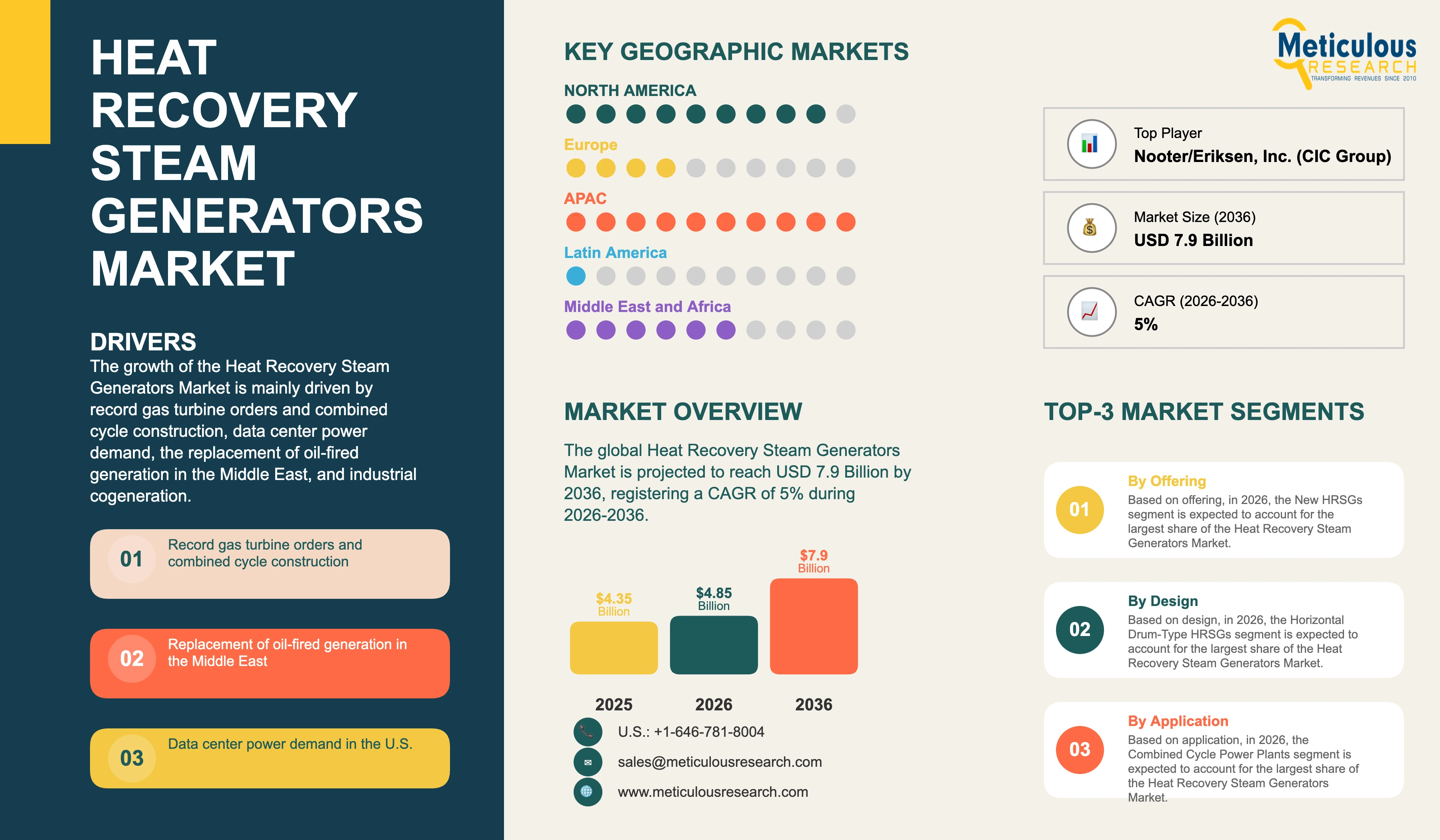
The global heat recovery steam generators market was valued at USD 4.35 billion in 2025. This market is expected to reach USD 7.90 billion by 2036 from an estimated USD 4.85 billion in 2026, registering a CAGR of 5.0% during the forecast period (2026-2036).
- Published
- Nov 2026
- Pages
- 272
- Format
- PDF + Excel
- Report ID
- MREP - 1042713
- Base year
- 2025
- 2025 · BASELINE
- $4.35B
- 2036
- $7.90B
- CAGR 2026–2036
- 5.0%
2025 baseline · 2026–2036 forecast at 5.0% CAGR · hover a bar for the value
Key highlights
GE Vernova reported a gas turbine backlog of 83 GW at the end of 2025, after signing 24 GW of new gas equipment contracts in the fourth quarter of 2025 alone, and it targets a backlog of about 100 GW by the end of 2026, while Siemens Energy and Mitsubishi Heavy Industries also report record gas turbine order books. Most of these large gas turbines will be installed in combined cycle plants, each of which needs one HRSG per gas turbine.
According to MEED, Saudi Arabia had about 35.8 GW of gas-fired capacity under construction in early 2025, much of it in combined cycle plants, and the Saudi Power Procurement Company has awarded several rounds of 3.6 GW combined cycle independent power projects, including Rumah 1 and Nairyah 1 with Mitsubishi M501JAC gas turbines and Rumah 2 and Nairyah 2 with Siemens Energy technology.
The U.S. Energy Information Administration reported in June 2025 that developers planned to add 18.7 GW of combined cycle capacity to the U.S. grid by 2028, after only 98 MW was added in 2024, and the pipeline has continued to grow with new projects for utilities and data centers.
In September 2026, Korea's MiCo Group completed its acquisition of NEM Energy, which ranked first in cumulative global HRSG orders between 1980 and the first quarter of 2026 according to McCoy Power Reports and recently won the HRSG contract for the 1,864 MW Greenlight project in Canada.
John Cockerill won several new HRSG orders in 2026, including two Benson-type triple pressure reheat units for Siemens Energy in Poland and units for Ansaldo Energia projects in Hungary and Greece, along with a retubing order for two HRSGs commissioned in Dubai in 2001, which shows both new build and aftermarket demand.
Nooter/Eriksen, one of the world's leading HRSG suppliers, has supplied units behind the latest J-class and HA-class gas turbines in North America, and HRSG suppliers are investing in fabrication capacity to meet demand from the current wave of combined cycle projects.
By offering, new HRSGs account for the larger share of 80.0% in 2026, while aftermarket services register the higher CAGR.
By design, horizontal drum-type HRSGs account for the largest share in 2026, while once-through (benson-type) HRSGs register the highest CAGR.
By pressure level, triple pressure with reheat accounts for the largest share in 2026 and also registers the highest CAGR.
By gas turbine rating, above 100 MW accounts for the largest share in 2026, while 30 MW to 100 MW registers the highest CAGR.
By firing type, unfired accounts for the larger share in 2026, while supplementary-fired registers the higher CAGR.
By application, combined cycle power plants account for the largest share of 77.0% in 2026 and also register the highest CAGR.
By end user, utilities and independent power producers account for the largest share in 2026, while data centers register the highest CAGR.
By geography, Asia-Pacific accounts for the largest share of 32.0% in 2026, while Middle East & Africa registers the highest CAGR of 6.1%.
Report summary
| Particulars | Details |
|---|---|
| Base Year | 2025 |
| Estimated Year | 2026 |
| Forecast Period | 2026-2036 |
| Market Size in 2025 | USD 4.35 billion |
| Market Size in 2026 | USD 4.85 billion |
| Market Size by 2036 | USD 7.90 billion |
| CAGR (2026-2036) | 5.0% |
| Format | PDF, Excel & Cloud Portal · 272 pages |
| Largest Segment by Offering (2026) | New HRSGs (80.0%) |
| Largest Segment by Application (2026) | Combined Cycle Power Plants (77.0%) |
| Largest Region (2026) | Asia-Pacific (32.0%) |
| Fastest-Growing Region | Middle East & Africa (CAGR 6.1%) |
| Companies Profiled | 16 companies and other companies |
| Segments Covered | Offering, Design, Pressure Level, Gas Turbine Rating, Firing Type, Application, End User, Geography |
| Countries Covered | U.S., Canada, Germany, U.K., Poland, Italy, Spain, Netherlands, Hungary, Greece, Rest of Europe, China, Japan, South Korea, India, Taiwan, Vietnam, Thailand, Malaysia, Philippines, Bangladesh, Australia, Rest of Asia-Pacific, Mexico, Brazil, Argentina, Chile, Rest of Latin America, Saudi Arabia, U.A.E., Qatar, Kuwait, Iraq, Egypt, Algeria, Nigeria, Rest of Middle East & Africa |
Report overview
Segments covered: offering, design, pressure level, gas turbine rating, firing type, application, end user.
The growth of this market is mainly driven by record orders for large gas turbines as utilities and independent power producers build new combined cycle plants to meet rising electricity demand from data centers, industry, and electrification, the very large combined cycle construction programs in Saudi Arabia and other Gulf countries that are replacing oil-fired generation, the use of gas-fired plants to back up growing wind and solar fleets in Asia and Europe, the expansion of industrial cogeneration in oil and gas, LNG, chemicals, and other process industries, and rising demand for HRSG repair, retubing, and upgrades from an aging installed base that is now cycling more often. However, factors such as long-term decarbonization policies that limit new gas-fired capacity in some markets, competition from renewables and battery storage, and constraints in the supply of large gas turbines, skilled labor, and fabrication capacity are expected to restrain the growth of this market to some extent.
Heat recovery steam generators (HRSGs) are heat exchangers that recover heat from the hot exhaust gas of a gas turbine or reciprocating engine and use it to produce steam. In a combined cycle power plant, this steam drives a steam turbine to generate additional electricity, which raises plant efficiency to more than 60%, while in a cogeneration plant the steam is used for industrial processes, district heating, or both. This report covers global revenue from new HRSGs and from aftermarket services, including inspection, repair, retubing, pressure part replacement, and upgrades, across all designs, pressure levels, gas turbine ratings, firing types, applications, and end users.
An HRSG consists of banks of finned tubes arranged as economizers, evaporators, and superheaters, together with steam drums or once-through separators, casings, ductwork, stacks, and, in many units, duct burners for supplementary firing and catalysts for controlling nitrogen oxide and carbon monoxide emissions. Large HRSGs behind the newest H-class and J-class gas turbines are among the largest pieces of equipment in a combined cycle plant, with heights of more than 40 meters and weights of several thousand tonnes.
Demand for HRSGs follows demand for gas turbines in combined cycle and cogeneration plants. After a weak period in the late 2010s and early 2020s, the gas power market has recovered strongly, as rising electricity demand from data centers, manufacturing, and electrification in the U.S., a large program to replace oil-fired plants in Saudi Arabia, growing demand in Southeast Asia, and the need to back up renewables in many countries have led to record gas turbine orders. Most large gas turbines ordered in this cycle will be installed in combined cycle plants, which creates a multi-year pipeline of HRSG orders. Many of these plants also include duct burners and emission control catalysts, which add to the value of each HRSG package.
HRSG technology has evolved steadily over the past two decades to match larger, hotter, and more efficient gas turbines. Modern HRSGs for large combined cycle plants usually have three pressure levels with reheat, and once-through designs, which use a Benson-type evaporator instead of a high-pressure drum, are increasingly used because they allow faster start-ups and better tolerance of frequent cycling. Vertical HRSGs, which take up less space, are common in Europe and Asia and in space-constrained sites, while horizontal designs dominate in North America and the Middle East. Suppliers are also using improved finned tube designs, better alloys for hot sections, and advanced modeling of gas flow and thermal stresses to improve performance and reliability.
The business model is based mainly on project contracts with engineering, procurement, and construction contractors, gas turbine manufacturers, and plant owners. HRSG suppliers often work with gas turbine manufacturers as preferred partners and supply units as part of turnkey power island packages, and many HRSGs are designed in one country and fabricated in modules in lower-cost locations. Aftermarket services are an important additional business, as HRSGs in cycling plants suffer from thermal fatigue, flow-accelerated corrosion, and other damage mechanisms.
The market is moderately concentrated, with a group of specialized HRSG suppliers and large power equipment companies. Leading companies include Nooter/Eriksen, NEM Energy, Vogt Power International, John Cockerill, Doosan Enerbility, Mitsubishi Heavy Industries, GE Vernova, Siemens Energy, Kawasaki Heavy Industries, Xizi Clean Energy (Hangzhou Boiler), Harbin Electric, BHEL, Thermax, AC Boilers, Rentech Boiler Systems, and Victory Energy Operations.
Over the forecast period, the HRSG market is expected to grow steadily, with very strong demand in the second half of this decade as the current gas turbine backlogs are converted into combined cycle plants, followed by more moderate growth in the 2030s as new build activity normalizes and services, upgrades, and replacement of older units become a larger share of revenue. Hydrogen-ready designs, carbon capture-ready plants, and industrial cogeneration are expected to support demand throughout the period, together with replacement of HRSGs that reach the end of their design life.
Report infographic
Market dynamics
15 factors across 5 forcesRecord gas turbine orders and combined cycle construction
The main driver of the HRSG market is the strong revival of combined cycle power plant construction, reflected in record orders and backlogs at the large gas turbine manufacturers. GE Vernova reported a gas turbine backlog of 83 GW at the end of 2025 and expects about 100 GW by the end of 2026, and Siemens Energy and Mitsubishi Heavy Industries report similar strength, with delivery slots for large gas turbines stretching into 2029 and 2030. Each large gas turbine in a combined cycle plant requires its own HRSG, so these backlogs translate directly into demand for HRSGs over the next several years.
Demand for new combined cycle plants is coming from many regions at the same time, which makes the current cycle broader than earlier booms. In the U.S., utilities and independent power producers are building combined cycle plants to meet load growth, and the Energy Information Administration has reported a pipeline of 18.7 GW of combined cycle capacity through 2028 that has continued to grow. In the Middle East, Saudi Arabia, the U.A.E., Qatar, Kuwait, and Iraq are building large combined cycle plants, while in Asia, Vietnam, the Philippines, Malaysia, Thailand, Taiwan, Japan, and South Korea are adding gas-fired capacity, often based on imported LNG. China also continues to build gas-fired plants in its eastern and southern coastal provinces to provide flexible capacity and reduce air pollution.
Data center power demand in the U.S.
The rapid growth of data centers for cloud computing and artificial intelligence is one of the most important new sources of electricity demand in the U.S. Utilities in Texas, the Southeast, the Mid-Atlantic, and the Midwest have announced large new gas-fired plants to serve data center load, and technology companies and data center developers are signing agreements for dedicated generation, including on-site or nearby combined cycle plants.
Combined cycle plants are attractive for these customers because they provide firm, around-the-clock power at a lower fuel cost than simple cycle units, and many projects are designed to add carbon capture in the future. Data center projects are also creating demand for HRSGs behind aeroderivative and industrial gas turbines in the 30 MW to 100 MW range, which can be deployed in modular configurations close to the load. Several utilities in Texas, Georgia, Virginia, and Ohio have filed plans for new combined cycle plants citing data center load growth as a key reason for the new capacity.
Replacement of oil-fired generation in the Middle East
Saudi Arabia has launched one of the largest power plant construction programs in the world to replace oil-fired generation with gas and renewables and to meet growing demand. According to MEED, about 35.8 GW of gas-fired capacity was under construction in the country in early 2025, and the Saudi Power Procurement Company and Saudi Electricity Company continue to award new combined cycle projects, including several 3.6 GW independent power projects with advanced-class gas turbines.
Other countries in the region, including the U.A.E., Qatar, Kuwait, Oman, Iraq, and Egypt, are also building or converting plants to combined cycle operation to improve efficiency and reduce fuel use. Converting existing open cycle plants to combined cycle by adding HRSGs and steam turbines, as in the Bazyan II project in Iraq, is a cost-effective way to add capacity without burning more fuel, and it creates additional HRSG demand.
Growth of industrial cogeneration
Industrial cogeneration plants use gas turbines and HRSGs to produce both electricity and steam for industrial processes, which can reduce energy costs and carbon dioxide emissions compared with separate production. Refineries, petrochemical plants, LNG plants, fertilizer plants, pulp and paper mills, and food processing plants are major users of cogeneration, and new industrial projects in the U.S., the Middle East, China, and India often include cogeneration plants.
LNG export projects in the U.S., Qatar, and other countries, as well as floating LNG units, are also using combined cycle and cogeneration systems with HRSGs to improve efficiency and reduce emissions. Industrial HRSGs, which are smaller and often supplementary-fired, are supplied by companies such as Rentech Boiler Systems, Victory Energy Operations, Thermax, and Vogt Power. Rising electricity prices and carbon costs in many regions also improve the economics of on-site cogeneration for energy-intensive industries.
Table of contents
15 chapters · 169 sections · 272 pages · click to expandSegmental analysis
| Segment | Largest share (2026) | Fastest growth (2026–2036) |
|---|---|---|
| By Offering | — | Rapid growth of this |
| By Design | Horizontal drum-type HRSGs | Once-through (Benson-type) HRSGs |
| By Pressure Level | Triple pressure with reheat | Triple pressure with reheat |
| By Gas Turbine Rating | Above 100 MW | 30 MW |
| By Firing Type | — | Rapid growth of this |
| By Application | Combined cycle power plants | Combined cycle power plants |
| By End User | Utilities and independent power producers | Data centers |
| Other segments | Utilities and independent power producers | Data centers |
By Offering
- Heat Recovery Steam Generators Market Analysis by Offering
- The new HRSGs segment is expected to account for the larger share of 80.0% of the global heat recovery steam generators market.
- The large share of this segment is mainly attributed to the strong wave of combined cycle construction in North America, the Middle East, and Asia, the high value of large HRSGs behind H-class and J-class gas turbines, and the growth of industrial cogeneration projects.
- A single HRSG for a large combined cycle unit can be worth tens of millions of dollars, and the current gas turbine backlogs support a large pipeline of new HRSG orders.
- Suppliers are focusing on larger and more flexible designs, hydrogen-ready features, and modular construction to meet customer requirements.
- However, the aftermarket services segment is projected to register the higher CAGR during the forecast period.
- The rapid growth of this segment is primarily driven by the large installed base of HRSGs from the combined cycle boom of the late 1990s and early 2000s, the increase in tube failures and damage caused by frequent cycling, the need for retubing, harp replacement, and pressure part upgrades, life extension of older combined cycle plants that remain needed for capacity, and the growth of long-term service agreements and digital monitoring.
By Design
- Heat Recovery Steam Generators Market Analysis by Design
- The horizontal drum-type HRSGs segment is expected to account for the largest share of the global heat recovery steam generators market.
- The large share of this segment is mainly attributed to the widespread use of horizontal drum-type designs in large combined cycle plants in North America, the Middle East, and many parts of Asia, their proven reliability, their ease of maintenance and inspection, and the large installed base that needs services and upgrades.
- Horizontal HRSGs use natural circulation in vertical tubes, which provides robust operation without circulation pumps, and they can be designed for very large gas turbines with multiple pressure levels and reheat.
- They need more floor space than vertical units, but this is rarely a constraint at greenfield sites in the U.S. and the Middle East.
- However, the once-through (Benson-type) HRSGs segment is projected to register the highest CAGR during the forecast period.
- The rapid growth of this segment is primarily driven by the need for faster start-ups and better cycling capability as gas plants balance renewables, the use of once-through designs behind the newest high-efficiency gas turbines, the reduced thermal stress achieved by eliminating the high-pressure drum, and the preference of several gas turbine manufacturers and European utilities for these designs.
- Once-through designs also allow higher steam pressures and temperatures, which supports the efficiency targets of new advanced-class combined cycle plants.
- Meanwhile, the vertical drum-type HRSGs segment is expected to witness steady growth, supported by their compact footprint, which suits brownfield, repowering, and space-constrained sites, particularly in Europe and Asia.
By Pressure Level
- Heat Recovery Steam Generators Market Analysis by Pressure Level
- The triple pressure with reheat segment is expected to account for the largest share of the global heat recovery steam generators market.
- The large share of this segment is mainly attributed to the use of triple pressure reheat designs in nearly all large utility combined cycle plants, where they maximize steam production and plant efficiency, and the high value of these large and complex units.
- Triple pressure reheat HRSGs produce steam at high, intermediate, and low pressure levels and reheat steam returning from the high-pressure steam turbine, which allows combined cycle plants to reach the highest efficiencies of any fossil-fueled power plant.
- As new large combined cycle plants are built with the latest gas turbines, this design will remain the standard for utility projects.
- The triple pressure with reheat segment is also projected to register the highest CAGR during the forecast period, driven by the strong growth of large utility combined cycle plants in the U.S., the Middle East, and Asia.
- Each new advanced-class gas turbine in a utility combined cycle plant is typically paired with a triple pressure reheat HRSG, which keeps this design at the center of new project specifications.
- Meanwhile, the single pressure and dual pressure segments are expected to witness steady growth, supported by industrial cogeneration, small combined cycle plants, and applications behind aeroderivative and industrial gas turbines, where simpler and lower-cost designs are preferred.
By Gas Turbine Rating
- Heat Recovery Steam Generators Market Analysis by Gas Turbine Rating
- The above 100 MW segment is expected to account for the largest share of the global heat recovery steam generators market.
- The large share of this segment is mainly attributed to the dominance of large F-class, H-class, and J-class gas turbines in utility combined cycle plants, the high value of HRSGs designed for these turbines, and the strong growth of large combined cycle projects in North America, the Middle East, and Asia.
- HRSGs in this segment are designed for very high exhaust flows and temperatures and are usually triple pressure reheat units.
- Large projects often use multiple gas turbines, each with its own HRSG, which increases the number of units per project, as in the 3.6 GW Saudi projects that use six advanced-class gas turbines.
- However, the 30 MW to 100 MW segment is projected to register the highest CAGR during the forecast period.
- The rapid growth of this segment is primarily driven by the use of aeroderivative and industrial gas turbines in this range for data center power, industrial cogeneration, LNG plants, and distributed generation, the growing interest in modular combined cycle systems that can be deployed quickly, and the conversion of smaller open cycle plants to combined cycle.
- Meanwhile, the up to 30 MW segment is expected to witness steady growth, supported by smaller cogeneration plants at industrial sites, hospitals, universities, and district energy systems.
By Firing Type
- Heat Recovery Steam Generators Market Analysis by Firing Type
- The unfired segment is expected to account for the larger share of the global heat recovery steam generators market.
- The large share of this segment is mainly attributed to the use of unfired HRSGs in many large utility combined cycle plants, where they maximize efficiency, and the simpler design, lower cost, and lower emissions of unfired units compared with supplementary-fired designs.
- Unfired HRSGs rely only on the heat in the gas turbine exhaust, which makes them well suited to plants that are optimized for efficiency rather than peak output.
- They are common in Europe, Asia, and many Middle Eastern projects, where developers focus on fuel efficiency and emissions.
- However, the supplementary-fired segment is projected to register the higher CAGR during the forecast period.
- The rapid growth of this segment is primarily driven by the use of duct burners to increase steam production and peak output in U.S. combined cycle plants, the need for flexible steam supply in industrial cogeneration plants, and the use of supplementary firing to support carbon capture systems and hydrogen co-firing in future plants.
- Duct burners allow plant owners to add capacity during periods of high demand at a relatively low capital cost.
By Application
- Heat Recovery Steam Generators Market Analysis by Application
- The combined cycle power plants segment is expected to account for the largest share of 77.0% of the global heat recovery steam generators market.
- The large share of this segment is mainly attributed to the strong wave of utility combined cycle construction in North America, the Middle East, and Asia, the high value of large HRSGs for utility plants, and the large installed base of combined cycle HRSGs that needs services.
- Combined cycle plants offer the highest efficiency of any fossil fuel power plant and can operate flexibly to support renewables, which makes them attractive in markets with growing demand and limited alternatives for firm power.
- Plants under development in the U.S., Saudi Arabia, the U.A.E., Vietnam, and other countries will drive demand in this segment through the end of the decade.
- The combined cycle power plants segment is also projected to register the highest CAGR during the forecast period, supported by record gas turbine backlogs, data center demand in the U.S., the Saudi power program, and conversions of open cycle plants to combined cycle.
- Each new utility gas turbine requires an HRSG, and the large backlogs reported by leading gas turbine manufacturers point to sustained HRSG orders through the end of the decade.
- Meanwhile, the industrial cogeneration and other applications segments are expected to witness steady growth, supported by new refining, chemical, LNG, and manufacturing projects that use combined heat and power to reduce energy costs and emissions.
By End User
- Heat Recovery Steam Generators Market Analysis by End User
- The utilities and independent power producers segment is expected to account for the largest share of the global heat recovery steam generators market.
- The large share of this segment is mainly attributed to the dominance of utility-scale combined cycle plants in HRSG demand, the large utility installed base that needs services, and the active role of independent power producers in the Middle East, the U.S., and Asia in developing new combined cycle capacity under long-term power purchase agreements.
- Utilities and independent power producers buy most large triple pressure reheat HRSGs and most aftermarket services, and they are increasingly signing long-term service agreements to manage the effects of cycling on HRSG life.
- In the Middle East, independent power producers such as ACWA Power, Taqa, Jera, and Kepco are among the most active developers.
- However, the data centers segment is projected to register the highest CAGR during the forecast period.
- The rapid growth of this segment is primarily driven by the rapid growth of data center electricity demand in the U.S., the shortage of grid capacity in key data center markets, the interest of data center developers and technology companies in dedicated on-site or nearby generation, and the use of combined cycle and cogeneration systems to provide firm power at lower fuel costs.
- Meanwhile, the oil, gas, and LNG, chemicals and petrochemicals, and pulp, paper, and other industries segments are expected to witness steady growth, supported by new refining, LNG, chemical, and pulp and paper projects that use cogeneration to lower energy costs and emissions.
Other segments
- The utilities and independent power producers segment is expected to account for the largest share of the heat recovery steam generators market, while the data centers segment is projected to register the highest CAGR during the forecast period.
Geographic analysis
Asia-Pacific
Largest shareIn 2026, Asia-Pacific is expected to account for the largest share of 32.0% of the global heat recovery steam generators market. The large share of this region is mainly due to the large number of gas-fired plants being built in China, Japan, South Korea, Taiwan, Vietnam, Thailand, Malaysia, and the Philippines, the use of gas plants to back up large wind and solar fleets, the strong position of Asian HRSG and power equipment manufacturers such as Doosan Enerbility, Mitsubishi Heavy Industries, Kawasaki Heavy Industries, Xizi Clean Energy, Harbin Electric, and BHEL, and the region's role as a fabrication base for HRSG modules used around the world. LNG-to-power projects in Southeast Asia and South Asia are also creating new demand.
North America
North America is the second-largest market and one of the fastest-growing, supported by the strong revival of combined cycle construction in the U.S., data center demand, the retirement of coal plants that need replacement capacity, and a large installed base of HRSGs from the early 2000s that now needs major repairs and upgrades. Nooter/Eriksen, Vogt Power, and NEM Energy have strong positions in this market, along with industrial HRSG suppliers such as Rentech Boiler Systems and Victory Energy Operations. Canada is also adding gas-fired capacity, particularly in Alberta and Ontario. Mexico's state utility CFE has launched new combined cycle projects to meet growing demand in industrial regions, and Brazil's capacity auctions have included new gas-fired plants.
Middle East & Africa
Fastest growthThe Middle East & Africa is projected to register the highest CAGR of 6.1% during the forecast period. The rapid growth of this region is mainly driven by Saudi Arabia's very large combined cycle program to replace oil-fired generation, new combined cycle plants in the U.A.E., Qatar, Kuwait, and Oman, the conversion of open cycle plants to combined cycle in Iraq, Algeria, Egypt, and Nigeria, and the growth of industrial cogeneration in the petrochemical and LNG sectors. Saudi Arabia alone had about 35.8 GW of gas-fired capacity under construction in early 2025.
Europe
Europe is a smaller and slower-growing market, with demand coming from new combined cycle plants in Poland, Germany, Italy, Hungary, Greece, the U.K., and the Balkans that replace coal capacity and support renewables, many of them designed to be hydrogen-ready, as well as from services and upgrades for existing plants.
Latin America
Latin America accounts for a smaller share of the market, with demand from combined cycle plants in Mexico, Brazil, Argentina, and Chile and from industrial cogeneration.
Competitive landscape
The global heat recovery steam generators market is moderately concentrated, with the top five players estimated to account for about 45% of the market in 2025. The market includes specialized HRSG suppliers, large power equipment manufacturers that supply HRSGs as part of power islands, industrial boiler companies, and regional fabricators.
Nooter/Eriksen, NEM Energy, Vogt Power International, and John Cockerill are leading specialized HRSG suppliers with strong positions behind large gas turbines in North America, Europe, and the Middle East. Doosan Enerbility, Mitsubishi Heavy Industries, and Kawasaki Heavy Industries are major Asian suppliers, while GE Vernova and Siemens Energy offer HRSG designs as part of their combined cycle plant offerings and work closely with HRSG fabricators. Xizi Clean Energy (Hangzhou Boiler) and Harbin Electric lead in China, and BHEL and Thermax are important in India.
In the industrial segment, Rentech Boiler Systems, Victory Energy Operations, AC Boilers, Thermax, and Vogt Power supply HRSGs for cogeneration, refineries, chemical plants, LNG facilities, and other industrial applications. These companies compete on custom engineering, delivery time, and experience with supplementary firing and special fuels.
Companies compete on thermal performance, cycling capability, reliability, price, delivery time, fabrication capacity, relationships with gas turbine manufacturers and contractors, and service capability. Several suppliers have announced investments in new fabrication facilities or partnerships in Asia and Mexico. Key strategies include preferred supplier agreements with gas turbine manufacturers, expansion of fabrication capacity and partnerships in lower-cost locations, development of once-through and hydrogen-ready designs, and growth of aftermarket services.
The industry has seen significant consolidation, including MiCo Group's acquisition of NEM Energy in 2026 and the integration of several HRSG businesses into larger groups. Further consolidation is possible as companies seek scale and global fabrication networks, and Korean, Chinese, and Indian suppliers are expected to gain share in international markets. Gas turbine manufacturers' choice of preferred HRSG partners will remain a key factor in market share, since many large projects are awarded as complete power islands.
Some of the key players operating in the heat recovery steam generators market are Nooter/Eriksen, Inc. (CIC Group), NEM Energy B.V. (MiCo Group), Vogt Power International Inc. (Babcock Power), John Cockerill Group, Doosan Enerbility Co., Ltd., Mitsubishi Heavy Industries, Ltd., GE Vernova Inc., Siemens Energy AG, Kawasaki Heavy Industries, Ltd., Xizi Clean Energy Equipment Manufacturing Co., Ltd., Harbin Electric Corporation, Bharat Heavy Electricals Limited, Thermax Limited, AC Boilers S.p.A. (Sofinter Group), Rentech Boiler Systems, Inc., and Victory Energy Operations, LLC, among others.
- —
MiCo Group completed its acquisition of NEM Energy in 2026, John Cockerill won new HRSG orders in Poland, Hungary, and Greece and a retubing order in Dubai, Saudi Arabia awarded further 3.6 GW combined cycle projects, and GE Vernova targeted a gas turbine backlog of about 100 GW by the end of 2026.
- Europe
- Middle East. Doosan Enerbility
- Mitsubishi Heavy Industries
- Kawasaki Heavy Industries
Expert perspectives
The heat recovery steam generators market is in one of its strongest periods in two decades, driven by the global revival of gas power for data centers, oil-to-gas switching in the Middle East, and the need for firm capacity alongside renewables. We see the current gas turbine backlogs as a reliable indicator of strong HRSG demand through the end of the decade, while services and upgrades will become more important in the 2030s.
Over the forecast period, the market is expected to grow at a CAGR of 5.0%, from USD 4.85 billion in 2026 to USD 7.90 billion in 2036. Growth will be supported by combined cycle construction in North America, the Middle East, and Asia, industrial cogeneration, conversions of open cycle plants, and services for an aging and cycling installed base, while decarbonization policies and competition from renewables and storage will limit growth in the longer term.
In terms of segments, new HRSGs remain the larger offering throughout the forecast period, while aftermarket services grow faster. Horizontal drum-type HRSGs remain the largest design, while once-through HRSGs grow fastest. Combined cycle power plants remain the largest application, and HRSGs behind gas turbines above 100 MW remain the largest rating segment. Asia-Pacific remains the largest region, and the Middle East & Africa is the fastest-growing region at a CAGR of 6.1%.
For HRSG suppliers, the key priorities are to secure fabrication capacity and skilled labor to meet current demand without overcommitting to a cyclical market, to strengthen relationships with gas turbine manufacturers and contractors, to develop once-through, hydrogen-ready, and carbon capture-ready designs, and to build service businesses that can support customers through the life of their plants.
We expect the market to remain cyclical, and in our view suppliers that use this upturn to invest in services, digital monitoring, and flexible designs will be better positioned for the next downturn than those that focus only on new build volume. The data center segment, though still small, could become an important source of demand for modular combined cycle and cogeneration systems.
Energy policy and natural gas prices will remain the key uncertainties for the HRSG market over the forecast period. Decisions on gas plant approvals, capacity markets, carbon pricing, hydrogen and carbon capture support, and LNG supply will influence how much combined cycle capacity is built in each region, and suppliers will need to remain flexible as these conditions change. Stable gas supply from new LNG export capacity in the U.S. and Qatar should support gas power investment in importing countries.
Customer perspectives
Buyers of heat recovery steam generators include utilities, independent power producers, engineering, procurement, and construction contractors, gas turbine manufacturers supplying power islands, data center developers, and industrial companies in oil and gas, LNG, chemicals, and other process industries. Their decisions depend mainly on thermal performance, cycling capability, reliability, delivery time, price, and service support.
This comment explains why the Middle East & Africa is the fastest-growing region and why combined cycle power plants account for 77.0% of the market. It also shows why new HRSGs account for 80.0% of the market.
Director of Energy Infrastructure - Data center developer, U.S.
The grid cannot deliver the power we need on our timeline, so we are developing our own gas-fired generation. Combined cycle makes sense for us because the plant will run around the clock, and modular units help us move faster.
This comment explains why data centers are the fastest-growing end user and why the 30 MW to 100 MW segment is the fastest-growing gas turbine rating.
Plant Manager - Combined cycle power plant, U.S.
Our plant was built for baseload, but now we start and stop almost every day. We have had more tube leaks in the HRSG, so we are replacing harps and upgrading attemperators during our outages.
This comment shows why aftermarket services are the faster-growing offering and why once-through designs, which handle cycling better, are the fastest-growing design.
“We are building several large combined cycle plants at the same time, so we need HRSG suppliers who can deliver on schedule and perform well in our hot climate. Proven designs and strong project teams are as important as price.”
Frequently asked questions
The global heat recovery steam generators market was valued at USD 4.35 billion in 2025, up from USD 3.95 billion in 2024, and is estimated at USD 4.85 billion in 2026. The market includes new HRSGs for combined cycle and cogeneration plants and aftermarket services such as inspection, repair, retubing, and upgrades.
The global heat recovery steam generators market is expected to reach USD 7.90 billion by 2036, supported by combined cycle construction, industrial cogeneration, conversions of open cycle plants, and services for an aging and cycling installed base.
The market is expected to register a CAGR of 5.0% from 2026 to 2036, with very strong growth in the late 2020s as gas turbine backlogs are delivered and more moderate growth in the 2030s.
Record gas turbine orders placed in 2024 and 2025 for combined cycle plants in the U.S., the Middle East, and Asia are now being converted into HRSG orders and deliveries, which is lifting market value sharply in 2026.
Market growth is mainly driven by record gas turbine orders and combined cycle construction, data center power demand in the U.S., the replacement of oil-fired generation in the Middle East, and the growth of industrial cogeneration.
Decarbonization policies, competition from renewables, and supply chain constraints restrain growth, while cyclical demand, pricing pressure, and thermal fatigue in flexible operation are key challenges.
Key opportunities include hydrogen-ready and carbon capture-ready HRSGs, services, retubing, and upgrades for cycling plants, conversion of open cycle plants to combined cycle, and small and modular HRSGs for distributed generation.
New HRSGs are expected to account for the larger share of 80.0% of the market in 2026, while aftermarket services are projected to register the higher CAGR.
Combined cycle power plants are expected to account for the largest share of 77.0% of the market in 2026 and are also projected to register the highest CAGR.
Once-through (Benson-type) HRSGs are projected to register the highest CAGR during the forecast period, driven by the need for faster start-ups and better cycling capability.
Asia-Pacific is expected to account for the largest share of 32.0% of the market in 2026, mainly due to gas-fired plant construction across East and Southeast Asia and the region's role as a fabrication base.
The Middle East & Africa is projected to register the highest CAGR of 6.1% during the forecast period, driven by Saudi Arabia's combined cycle program and conversions of open cycle plants across the region.
The report profiles 16 companies, including Nooter/Eriksen, Inc. (CIC Group), NEM Energy B.V. (MiCo Group), Vogt Power International Inc. (Babcock Power), John Cockerill Group, Doosan Enerbility Co., Ltd., Mitsubishi Heavy Industries, Ltd., GE Vernova Inc., Siemens Energy AG, Kawasaki Heavy Industries, Ltd., Xizi Clean Energy Equipment Manufacturing Co., Ltd., Harbin Electric Corporation, Bharat Heavy Electricals Limited, Thermax Limited, AC Boilers S.p.A. (Sofinter Group), Rentech Boiler Systems, Inc., and Victory Energy Operations, LLC.
MiCo Group completed its acquisition of NEM Energy in 2026, John Cockerill won new HRSG orders in Poland, Hungary, and Greece and a retubing order in Dubai, Saudi Arabia awarded further 3.6 GW combined cycle projects, and GE Vernova targeted a gas turbine backlog of about 100 GW by the end of 2026.
In 2026, the utilities and independent power producers segment is expected to account for the largest share of the heat recovery steam generators market, while the data centers segment is projected to register the highest CAGR during the forecast period.
Cite this report
Meticulous Research. (2026). Heat Recovery Steam Generators Market - Global Opportunity Analysis and Industry Forecast (2026-2036) (Report No. MREP - 1042713). Meticulous Market Research Pvt. Ltd. https://www.meticulousresearch.com/product/heat-recovery-steam-generators-market-7396