LNG Liquefaction Equipment Market (2026-2036)
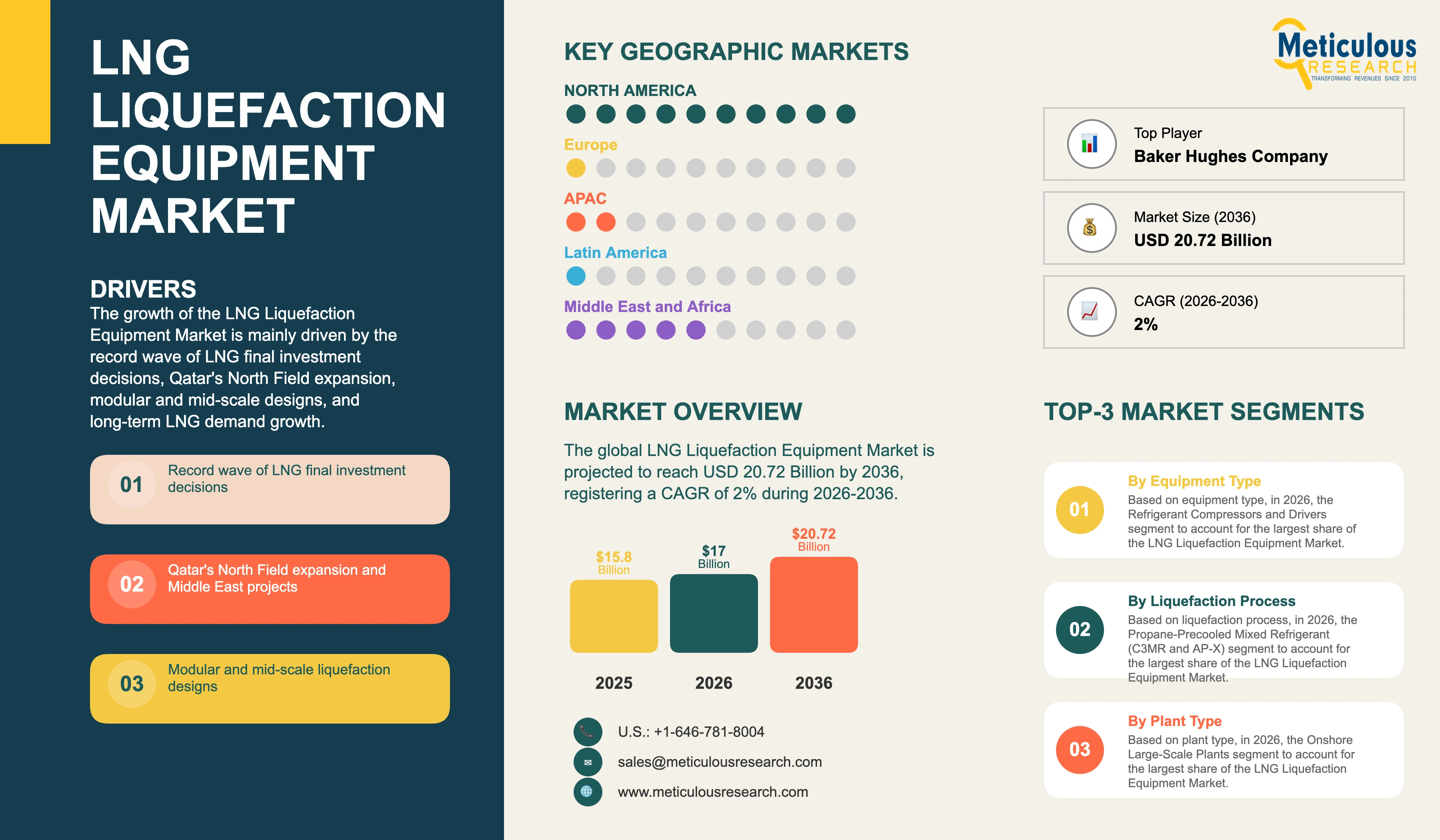
The global LNG liquefaction equipment market was valued at USD 15.80 billion in 2025. This market is expected to reach USD 20.72 billion by 2036 from an estimated USD 17.00 billion in 2026, registering a CAGR of 2.0% during the forecast period (2026-2036).
- Published
- Nov 2026
- Pages
- 264
- Format
- PDF + Excel
- Report ID
- MREP - 1042717
- Base year
- 2025
- 2025 · BASELINE
- $15.80B
- 2036
- $20.72B
- CAGR 2026–2036
- 2.0%
2025 baseline · 2026–2036 forecast at 2.0% CAGR · hover a bar for the value
Key highlights
According to the International Gas Union's 2026 World LNG Report, 68.4 million tonnes per annum (Mtpa) of liquefaction capacity reached final investment decision in 2025, compared with 14.8 Mtpa in 2024, making it the strongest year for project approvals since 2019. Global liquefaction capacity reached 524.5 Mtpa at the end of 2025, and approved liquefaction projects totaled 234.3 Mtpa.
The International Energy Agency estimates that more than 330 billion cubic meters per year of new LNG export capacity will come online between 2025 and 2030 from projects already under construction, the largest wave of capacity additions to date. More than 80 bcm per year of liquefaction capacity reached final investment decisions in the U.S. alone in 2025, a new all-time high.
In July 2026, Baker Hughes announced awards from Bechtel and Cheniere to supply primary liquefaction equipment for Sabine Pass Train 7, including seven PGT25+ G4 gas turbines driving 15 centrifugal compressors, enabling about 6 Mtpa of additional LNG production capacity.
Baker Hughes also secured an order from Venture Global for six liquefaction blocks for the CP2 LNG expansion, bringing its total scope on the project to 12 single mixed-refrigerant liquefaction modules, each block incorporating compression trains, cold boxes, air coolers, and integrated control systems. Its Industrial and Energy Technology segment reported a record remaining performance obligation of USD 37.1 billion in the second quarter of 2026.
Golar LNG awarded Baker Hughes a contract to supply four PGT25 gas turbine-driven refrigerant compressor trains for a 3.5 Mtpa floating LNG facility, marking the fourth Golar vessel to use Baker Hughes liquefaction solutions.
Wood Mackenzie reported that final investment decisions in 2025 totaled 72 million tonnes per year across nine projects, which has shifted industry sentiment toward oversupply concerns and is expected to moderate the pace of new approvals in 2026.
By equipment type, refrigerant compressors and drivers account for the largest share of 34.0% in 2026, while power generation and electrical systems register the highest CAGR.
By liquefaction process, propane-precooled mixed refrigerant (C3MR and AP-X) accounts for the largest share in 2026, while single mixed refrigerant and modular processes register the highest CAGR.
By plant type, onshore large-scale plants account for the largest share of 62.0% in 2026, while floating LNG (FLNG) registers the highest CAGR.
By geography, North America accounts for the largest share of 52.0% in 2026, while Latin America registers the highest CAGR of 5.4%.
Report summary
| Particulars | Details |
|---|---|
| Base Year | 2025 |
| Estimated Year | 2026 |
| Forecast Period | 2026-2036 |
| Market Size in 2025 | USD 15.80 billion |
| Market Size in 2026 | USD 17.00 billion |
| Market Size by 2036 | USD 20.72 billion |
| CAGR (2026-2036) | 2.0% |
| Format | PDF, Excel & Cloud Portal · 264 pages |
| Largest Segment by Equipment Type (2026) | Refrigerant Compressors and Drivers (34.0%) |
| Largest Segment by Plant Type (2026) | Onshore Large-Scale Plants (62.0%) |
| Largest Region (2026) | North America (52.0%) |
| Fastest-Growing Region | Latin America (CAGR 5.4%) |
| Companies Profiled | 14 companies and other companies |
| Segments Covered | Equipment Type, Liquefaction Process, Plant Type, Geography |
| Countries Covered | U.S., Canada, Mexico, Qatar, UAE, Oman, Mozambique, Nigeria, Rest of Middle East & Africa, Australia, Malaysia, Indonesia, Papua New Guinea, China, Rest of Asia-Pacific, Russia, Norway, Rest of Europe, Argentina, Rest of Latin America |
Report overview
Segments covered: equipment type, liquefaction process, plant type.
The growth of this market is mainly driven by the record wave of final investment decisions on new liquefaction capacity in 2025, led by large projects on the U.S. Gulf Coast, Qatar's North Field expansion program, the growth of modular and mid-scale liquefaction designs that shorten construction schedules, the expansion of floating LNG in Africa, Latin America, and Asia, growing long-term LNG demand in Asia and Europe as countries replace coal and pipeline gas, the electrification of liquefaction plants to reduce emissions, and the continued need for debottlenecking, upgrades, and services at existing plants. However, factors such as the risk of LNG oversupply in the late 2020s, which could slow new final investment decisions, rising equipment and construction costs, long lead times for critical equipment, regulatory and permitting uncertainty, and climate policy pressure on long-lived gas infrastructure are expected to restrain the growth of this market to some extent. Because equipment orders are concentrated around project approvals, annual market values can fluctuate significantly during the forecast period.
LNG liquefaction plants cool natural gas to about minus 162 degrees Celsius, turning it into a liquid that occupies about 1/600th of its gaseous volume, so that it can be shipped by sea to markets that are not connected by pipeline. Liquefaction is the most capital-intensive part of the LNG value chain, and it relies on specialized equipment, including gas pretreatment systems that remove acid gases, water, mercury, and heavy hydrocarbons, refrigerant compressors driven by gas turbines or electric motors, main cryogenic heat exchangers and cold boxes, cryogenic pumps and expanders, air coolers or water coolers, and power generation and control systems. Equipment typically accounts for roughly a third of the total cost of a liquefaction plant, with the rest made up of engineering, construction, storage tanks, marine facilities, and owner's costs.
This report covers global revenue from LNG liquefaction equipment for onshore large-scale plants, onshore mid-scale and modular plants, and floating LNG facilities, including refrigerant compressors and drivers, cryogenic heat exchangers and cold boxes, gas pretreatment systems, cryogenic pumps, expanders, and valves, air coolers and heat rejection systems, power generation and electrical systems, control and automation systems, and pre-assembled liquefaction modules and other equipment. Engineering, procurement, and construction services, civil works, LNG storage tanks, marine terminals, and small-scale liquefaction plants below about 0.3 Mtpa are excluded from the scope of this report, as small-scale LNG is covered in a separate study.
The LNG industry is in the middle of its largest-ever wave of capacity additions. The International Gas Union reports that 68.4 Mtpa of liquefaction capacity reached final investment decision in 2025, the strongest year since 2019, and that approved projects totaled 234.3 Mtpa at the end of 2025. Most of this capacity is in the U.S., including Woodside's Louisiana LNG, Venture Global's CP2, Sempra's Port Arthur LNG Phase 2, Cheniere's Corpus Christi and Sabine Pass expansions, and NextDecade's Rio Grande LNG trains, and in Qatar, where QatarEnergy is building the North Field East, North Field South, and North Field West expansions.
Equipment suppliers play a central role in the design, execution, and operation of these liquefaction projects. Large liquefaction trains typically use proprietary processes, such as Air Products' propane-precooled mixed refrigerant (C3MR) and AP-X processes, ConocoPhillips' Optimized Cascade process, Shell's dual mixed refrigerant process, and Linde's mixed fluid cascade, and they rely on large gas turbine-driven or electric motor-driven centrifugal compressors. Modular designs, such as Venture Global's single mixed refrigerant blocks supplied by Baker Hughes and Cheniere's midscale trains, are increasingly used to shorten construction schedules and reduce cost.
Floating LNG has become an important and fast-growing segment of the liquefaction equipment market. Floating LNG vessels, which integrate liquefaction, storage, and offloading on a hull, allow gas from offshore fields or coastal pipelines to be liquefied without large onshore plants. Projects in Mozambique, Cameroon, Congo, Argentina, Malaysia, and other countries use floating liquefaction, and companies such as Golar LNG are expanding their fleets. Floating projects can often be delivered faster than onshore plants because the hull and topsides are built in shipyards and fabrication yards.
The market includes manufacturers of compressors and turbines, cryogenic heat exchangers, cold boxes, pretreatment systems, cryogenic pumps and expanders, power generation equipment, and control systems. Leading companies include Baker Hughes, Siemens Energy, Mitsubishi Heavy Industries, Elliott Group, Air Products, Linde, Chart Industries, Honeywell (UOP), Atlas Copco, Nikkiso, GE Vernova, Kobe Steel, Sumitomo Precision Products, and Fives.
Over the forecast period, the LNG liquefaction equipment market is expected to remain large but cyclical. Equipment orders are expected to remain high in 2026 and 2027 as recently approved projects are executed and additional projects reach final investment decisions, then moderate in the late 2020s as the current wave of capacity comes online and the market absorbs new supply, before recovering in the 2030s as demand growth in Asia and other regions requires new capacity. Services, upgrades, and the electrification of existing plants will provide additional stable demand.
North America is expected to account for the largest share of 52.0% of the market in 2026, mainly due to the record wave of U.S. Gulf Coast final investment decisions in 2025.
Latin America is projected to register the highest CAGR of 5.4% during the forecast period, driven by floating LNG export plans in Argentina, although from a small base.
The report profiles 14 companies, including Baker Hughes Company, Siemens Energy AG, Mitsubishi Heavy Industries, Ltd., Elliott Group (Ebara Corporation), Air Products and Chemicals, Inc., Linde plc, Chart Industries, Inc., Honeywell International Inc. (UOP), Atlas Copco AB, Nikkiso Co., Ltd., GE Vernova Inc., Kobe Steel, Ltd., Sumitomo Precision Products Co., Ltd., and Fives Group.
Report infographic
Market dynamics
16 factors across 5 forcesRecord wave of LNG final investment decisions
The record wave of final investment decisions in 2025 is the single most important driver of the LNG liquefaction equipment market over the next several years. The International Gas Union reports that 68.4 Mtpa of capacity reached final investment decision in 2025, compared with only 14.8 Mtpa in 2024, and that 234.3 Mtpa of approved capacity was under development at the end of 2025. The U.S. Energy Information Administration and the International Energy Agency have both described 2025 as a record year for U.S. liquefaction approvals.
Equipment for these projects is ordered at or soon after final investment decision, and it is manufactured and delivered over the following two to four years. Baker Hughes, for example, reported a record USD 37.1 billion remaining performance obligation in its Industrial and Energy Technology segment in the second quarter of 2026, supported by large LNG orders for Sabine Pass Train 7, Venture Global's CP2 expansion, and floating LNG.
Several additional liquefaction projects are targeting final investment decisions in 2026 and beyond, including projects in the U.S., Canada, Mexico, Africa, and the Middle East, which will add further equipment demand if they proceed. Sempra's Port Arthur LNG Phase 2, Commonwealth LNG, and additional expansions by Cheniere and Venture Global were among the projects advancing toward or reaching final investment decisions in 2026.
Qatar's north field expansion and Middle East projects
QatarEnergy is carrying out the largest LNG expansion program in the world, raising its production capacity from 77 Mtpa to 142 Mtpa through the North Field East, North Field South, and North Field West projects, which use mega trains of about 8 Mtpa each. These projects require very large compressors, gas turbines, cryogenic heat exchangers, and pretreatment systems, and Baker Hughes has been awarded contracts to supply gas turbines and centrifugal compressors for North Field trains.
Other Middle East projects, such as ADNOC's Ruwais LNG project in the UAE, which plans to use electric-driven liquefaction, and Oman LNG expansions, also contribute to demand. The availability of low-cost gas, strong government support, and access to Asian and European markets make the Middle East one of the most important regions for liquefaction equipment. Mega trains of about 8 Mtpa each require some of the largest compressors and heat exchangers ever built for LNG.
Modular and mid-scale liquefaction designs
Developers are increasingly using modular and mid-scale liquefaction designs, in which liquefaction trains are built as standardized, factory-fabricated modules and shipped to site for installation. These designs reduce construction risk, shorten schedules, and allow capacity to be added in smaller increments. Venture Global's projects use single mixed refrigerant blocks supplied by Baker Hughes, with each block incorporating two liquefaction modules, compression trains, cold boxes, air coolers, and controls, and Cheniere's Corpus Christi Stage 3 uses seven midscale trains.
Modular designs increase the value of equipment supplied by vendors, because more of the plant is fabricated and integrated in factories rather than built on site. This trend benefits suppliers that can deliver integrated packages, such as Baker Hughes, Chart Industries, Linde, and Air Products. Factory fabrication also improves quality control and reduces the number of workers needed on site, which is important given labor shortages on the U.S. Gulf Coast.
Long-term LNG demand growth in Asia and Europe
Long-term LNG demand is expected to grow as Asian countries replace coal with gas in power generation and industry, as emerging markets in South and Southeast Asia develop gas infrastructure, and as Europe replaces Russian pipeline gas with LNG. The International Energy Agency expects the U.S. share of the global LNG market to rise from about 25% in 2025 to about 33% by the end of the decade, and buyers in Asia and Europe have signed long-term contracts that support new projects.
Long-term sale and purchase agreements with utilities and other buyers in Japan, South Korea, China, India, Europe, and other markets are essential for financing new liquefaction projects, and the volume of contracts signed in 2025 supports further final investment decisions over the forecast period. Portfolio players and traders are also signing contracts, which adds flexibility to the market. New importing countries in South and Southeast Asia are expected to account for a growing share of demand.
Table of contents
11 chapters · 133 sections · 264 pages · click to expandSegmental analysis
| Segment | Largest share (2026) | Fastest growth (2026–2036) |
|---|---|---|
| By Equipment Type | Refrigerant compressors and drivers | Power generation and electrical systems |
| By Liquefaction Process | Propane-precooled mixed refrigerant (C3MR and AP-X) | Single mixed refrigerant and modular processes |
| By Plant Type | Onshore large-scale plants | Floating LNG (FLNG) |
| Other segments | Propane-precooled mixed refrigerant (C3MR and AP-X) | Single mixed refrigerant and modular processes |
By Equipment Type
- LNG Liquefaction Equipment Market Analysis by Equipment Type
- The refrigerant compressors and drivers segment is expected to account for the largest share of 34.0% of the global LNG liquefaction equipment market.
- The large share of this segment is mainly attributed to the central role of refrigerant compressors in every liquefaction process, the large number and size of compressors required for each train, the high value of the gas turbines and electric motors that drive them, and the very large number of trains under construction in the U.S. and Qatar.
- Each large liquefaction train typically requires several large centrifugal or axial compressors driven by heavy-duty gas turbines, aeroderivative gas turbines, or electric motors.
- Baker Hughes is the leading supplier of compressors and gas turbines for LNG, with major awards for Sabine Pass Train 7, Venture Global's CP2, Qatar's North Field, and floating LNG, while Siemens Energy, Mitsubishi Heavy Industries, Elliott Group, and GE Vernova also supply compressors, turbines, and drivers.
- Compressor and turbine packages for a single large train can be worth several hundred million dollars, and suppliers typically also provide long-term service agreements that generate revenue over the life of the plant.
- However, the power generation and electrical systems segment is projected to register the highest CAGR during the forecast period.
- The rapid growth of this segment is primarily driven by the electrification of liquefaction plants, the use of large electric motors and variable speed drives instead of gas turbines, the need for on-site power generation at remote and floating plants, and the integration of carbon capture and other emissions reduction systems that require additional power.
- Electric-drive designs reduce on-site emissions and allow plants to use grid power or dedicated power plants, which increases the scope of electrical equipment in each project.
- Meanwhile, the cryogenic heat exchangers and cold boxes, gas pretreatment systems, cryogenic pumps, expanders, and valves, air coolers and heat rejection systems, control and automation systems, and liquefaction modules and other equipment segments are expected to witness steady growth, supported by the critical role of main cryogenic heat exchangers, pretreatment systems for feed gas with high impurity levels, cryogenic pumps and expanders, air coolers at U.S. Gulf Coast plants, and digital monitoring and optimization.
By Liquefaction Process
- LNG Liquefaction Equipment Market Analysis by Liquefaction Process
- The propane-precooled mixed refrigerant (C3MR and AP-X) segment is expected to account for the largest share of the global LNG liquefaction equipment market.
- The large share of this segment is mainly attributed to the dominance of Air Products' C3MR and AP-X processes in large-scale liquefaction plants worldwide, including mega trains in Qatar and many trains in the U.S., Australia, and other countries.
- More LNG is produced using Air Products' mixed component refrigerant processes than any other processes.
- These processes require very large main cryogenic heat exchangers and propane precooling compressors, which increase equipment value per train.
- Process selection strongly affects which equipment suppliers are chosen, since licensors often supply or specify key heat exchangers and compressors.
- However, the single mixed refrigerant and modular processes segment is projected to register the highest CAGR during the forecast period.
- The rapid growth of this segment is primarily driven by the adoption of modular liquefaction designs by Venture Global and other developers, the growth of midscale trains, and the use of simpler single mixed refrigerant processes in floating LNG and smaller plants.
- These processes are well suited to factory fabrication and phased construction.
- They also require fewer large pieces of equipment, which simplifies supply chains and allows much faster delivery.
- Meanwhile, the optimized cascade and dual mixed refrigerant and other processes segments are expected to witness steady growth, supported by Cheniere's expansions at Sabine Pass and Corpus Christi, Australian plants, floating LNG projects, and projects in cold climates.
By Plant Type
- LNG Liquefaction Equipment Market Analysis by Plant Type
- The onshore large-scale plants segment is expected to account for the largest share of 62.0% of the global LNG liquefaction equipment market.
- The large share of this segment is mainly attributed to the large number of large-scale trains under construction in the U.S. and Qatar, the economies of scale of large plants, and the high equipment value of mega trains.
- Projects such as Qatar's North Field expansions, Woodside's Louisiana LNG, and Sempra's Port Arthur LNG are among the largest liquefaction projects in the world.
- Large-scale plants typically use trains of 4 to 8 Mtpa each, which require the largest compressors and heat exchangers available.
- Equipment orders for these trains are among the largest single equipment orders in the entire energy industry.
- However, the floating LNG (FLNG) segment is projected to register the highest CAGR during the forecast period.
- The rapid growth of this segment is primarily driven by new floating LNG projects in Africa, Latin America, and Asia, the ability of floating LNG to develop offshore and remote gas resources quickly, and the expansion of Golar LNG's fleet and other floating projects.
- Floating LNG requires compact, lightweight, and robust equipment, which increases the value of equipment per unit of capacity.
- Aeroderivative gas turbines, compact heat exchangers, and integrated topside modules are especially important for floating projects.
- Meanwhile, the onshore mid-scale and modular plants segment is expected to witness steady growth, supported by Venture Global's projects, Cheniere's midscale trains, and the shorter construction times and phased investment profiles that attract developers seeking faster first cargoes.
Other segments
- Single mixed refrigerant and modular processes are projected to register the highest CAGR, driven by modular liquefaction designs, midscale trains, and floating LNG.
- The propane-precooled mixed refrigerant (C3MR and AP-X) segment is expected to account for the largest share of the LNG liquefaction equipment market, while the single mixed refrigerant and modular processes segment is projected to register the highest CAGR during the forecast period.
Geographic analysis
North America
Largest shareIn 2026, North America is expected to account for the largest share of 52.0% of the global LNG liquefaction equipment market. The large share of this region is mainly due to the record wave of final investment decisions on U.S. Gulf Coast projects in 2025, including Woodside's Louisiana LNG, Venture Global's CP2, Sempra's Port Arthur LNG Phase 2, Cheniere's Corpus Christi and Sabine Pass expansions, and NextDecade's Rio Grande LNG trains, together with projects in Canada and Mexico. The International Energy Agency reports that more than 80 bcm per year of liquefaction capacity reached final investment decisions in the U.S. in 2025, a new all-time high, and U.S. export capacity under construction is set to roughly double U.S. capacity by the early 2030s. Canada's west coast projects, such as Woodfibre LNG, Cedar LNG, and the potential second phase of LNG Canada, and Mexico's Pacific coast projects add further demand in the region.
Middle East & Africa
The Middle East & Africa is the second-largest regional market, led by Qatar's North Field expansion program, which will raise Qatar's production capacity to 142 Mtpa, along with projects in the UAE, Oman, Mozambique, Nigeria, and other African countries. Floating LNG projects in West and East Africa are also important. Mozambique's onshore and floating LNG projects represent one of the largest long-term liquefaction equipment opportunities in Africa, although security issues have delayed onshore development.
Latin America
Fastest growthLatin America is projected to register the highest CAGR of 5.4% during the forecast period, although from a small base. The rapid growth of this region is mainly due to plans to export LNG from Argentina's Vaca Muerta gas resources using floating liquefaction, and potential projects in other countries.
Asia-Pacific
Asia-Pacific is also expected to grow quickly over the forecast period, supported by floating and onshore projects in Malaysia, Indonesia, Papua New Guinea, and Australia. China also builds mid-scale liquefaction plants for domestic gas supply and peak shaving, and Chinese suppliers provide much of the equipment for these plants.
Europe
Europe accounts for a small share of the global market, mainly through projects in Russia and Norway and some small and mid-scale plants, and through equipment manufacturing for projects in other regions. Western sanctions have significantly reduced activity on Russian Arctic LNG projects. However, European manufacturers, such as Siemens Energy, Linde, Atlas Copco, and Fives, remain important suppliers to liquefaction projects worldwide.
Competitive landscape
The global LNG liquefaction equipment market is relatively concentrated, with the top five players estimated to account for about 50% of the market in 2025. The market is led by a small number of global suppliers of compressors, gas turbines, and cryogenic heat exchangers, together with suppliers of pretreatment systems, pumps, expanders, valves, power systems, and controls.
Baker Hughes is the leading global supplier of refrigerant compressors, gas turbines, and modular liquefaction systems for LNG, with a large backlog from U.S., Qatari, and floating LNG projects. Siemens Energy, Mitsubishi Heavy Industries, Elliott Group, and GE Vernova also supply compressors, turbines, and electric drive systems.
Air Products is the leading global supplier of main cryogenic heat exchangers and liquefaction process technology, while Linde supplies coil wound heat exchangers and process technology. Chart Industries, which Baker Hughes agreed to acquire in 2025, supplies brazed aluminum heat exchangers, cold boxes, and modular liquefaction systems, and Kobe Steel, Sumitomo Precision Products, and Fives also supply brazed aluminum heat exchangers. Honeywell (UOP) supplies gas pretreatment technology, Atlas Copco supplies turbo-expanders, and Nikkiso supplies cryogenic pumps. Ebara Elliott Energy also supplies cryogenic pumps and expanders for large and floating plants, and several Japanese and Korean companies also supply heat exchangers, pumps, valves, and other equipment for liquefaction plants.
Companies in this market compete on technology performance, reliability, manufacturing capacity, delivery time, references, price, and service capabilities. Key strategies include developing modular and electric-driven liquefaction solutions, investing in low-emission technologies, expanding manufacturing capacity, securing master equipment supply agreements with major developers, and growing aftermarket services and upgrades.
The competitive landscape is expected to evolve as consolidation continues and as suppliers expand capacity to meet current demand. Suppliers with strong references, integrated offerings, and large service businesses will be best positioned to manage the cyclical nature of the market. Chinese suppliers are also expanding their capabilities in compressors and heat exchangers for domestic and international projects. Master equipment supply agreements, such as Baker Hughes' agreement with Venture Global, give suppliers multi-project visibility and strengthen customer relationships.
Some of the key players operating in the LNG liquefaction equipment market are Baker Hughes Company, Siemens Energy AG, Mitsubishi Heavy Industries, Ltd., Elliott Group (Ebara Corporation), Air Products and Chemicals, Inc., Linde plc, Chart Industries, Inc., Honeywell International Inc. (UOP), Atlas Copco AB, Nikkiso Co., Ltd., GE Vernova Inc., Kobe Steel, Ltd., Sumitomo Precision Products Co., Ltd., and Fives Group, among others.
- —
Baker Hughes won liquefaction equipment orders for Sabine Pass Train 7, Venture Global's CP2 expansion, and a Golar floating LNG vessel in 2026, the International Gas Union reported record 2025 final investment decisions of 68.4 Mtpa, and Wood Mackenzie highlighted growing oversupply concerns.
- Baker Hughes Company
- Siemens Energy AG
- Mitsubishi Heavy Industries, Ltd.
- Elliott Group · Ebara Corporation
- Air Products and Chemicals, Inc.
- Linde plc
- Chart Industries, Inc.
- Honeywell International Inc. (UOP)
- Atlas Copco AB
- Nikkiso Co., Ltd.
- GE Vernova Inc.
- Kobe Steel, Ltd.
- Sumitomo Precision Products Co., Ltd.
- Fives Group
Expert perspectives
The LNG liquefaction equipment market is currently at or near the peak of a major investment cycle, driven by record final investment decisions in 2025, especially in the U.S. and Qatar. We expect liquefaction equipment demand to remain strong in 2026 and 2027 as recently approved U.S. and Qatari projects are executed, followed by a period of slower growth as the market absorbs the current wave of new capacity.
Over the full forecast period, the LNG liquefaction equipment market is expected to grow at a CAGR of 2.0%, from USD 17.00 billion in 2026 to USD 20.72 billion in 2036. Growth will be supported by the execution of recently approved projects, Qatar's North Field expansion, modular and mid-scale designs, floating LNG, electrification, and services, while the risk of oversupply, rising costs, supply chain constraints, and climate policy pressures will moderate growth and create cyclicality.
In terms of segments, refrigerant compressors and drivers remain the largest equipment type, while power generation and electrical systems grow fastest. Propane-precooled mixed refrigerant processes remain the largest process segment, while single mixed refrigerant and modular processes grow fastest. Onshore large-scale plants remain the largest plant type, while floating LNG grows fastest. North America remains the largest region, while Latin America grows fastest at a CAGR of 5.4%.
For liquefaction equipment suppliers, the most important priorities over the forecast period are to execute the current backlog on time, to manage manufacturing capacity carefully given the risk of a downturn, to develop electric-driven and low-emission solutions, and to grow services and upgrades that provide stable revenue. Master supply agreements with major developers and standardized modular product platforms will be very important for winning future projects.
We expect the timing of the next wave of LNG final investment decisions to depend heavily on LNG prices and demand growth in Asia after the current supply wave comes online. In our view, rising demand from South and Southeast Asia, the replacement of coal in power generation, and Europe's long-term LNG needs will support a recovery in new project approvals in the 2030s.
We also expect electrification, carbon capture, and methane emission reduction to become standard design features of new LNG projects, which will increase the value of power, electrical, and control equipment in liquefaction plants. Suppliers that can deliver integrated low-emission liquefaction solutions will be best placed for the next investment cycle. In our view, the services business will become increasingly important for suppliers as the global installed base of liquefaction trains grows rapidly.
Customer perspectives
Project Director - LNG developer, U.S. Gulf Coast
Schedule certainty is the single most important factor for our LNG export project. We chose a modular design and secured our compressors and turbines early because lead times are long and our buyers need cargoes on time.
Head of Liquefaction Technology - national oil company, Middle East
Our mega trains rely on proven liquefaction technology and very large compressors and heat exchangers. We are also adding carbon capture and looking at electrification to reduce emissions.
Chief Technical Officer - floating LNG company
Floating LNG lets us bring gas to market quickly from offshore and coastal fields. We need compact, reliable equipment that can perform on a vessel for decades.
Frequently asked questions
The global LNG liquefaction equipment market was valued at USD 15.80 billion in 2025, up from USD 13.90 billion in 2024, and is estimated at USD 17.00 billion in 2026. The market includes compressors and drivers, cryogenic heat exchangers, pretreatment, pumps and expanders, air coolers, power and electrical systems, controls, and modules, and excludes EPC services, storage tanks, and small-scale plants.
The global LNG liquefaction equipment market is expected to reach USD 20.72 billion by 2036, supported by the execution of recently approved projects, Qatar's expansion, floating LNG, electrification, and services.
The market is expected to register a CAGR of 2.0% from 2026 to 2036, with strong demand in the near term followed by a cyclical slowdown in the late 2020s and recovery in the 2030s.
The International Gas Union reports that 68.4 Mtpa of liquefaction capacity reached final investment decision in 2025, the strongest year since 2019, and that approved projects totaled 234.3 Mtpa at the end of 2025.
Market growth is mainly driven by the record wave of LNG final investment decisions, Qatar's North Field expansion and Middle East projects, modular and mid-scale liquefaction designs, and long-term LNG demand growth in Asia and Europe.
The risk of LNG oversupply and slower final investment decisions, rising costs, and long lead times restrain growth, while supply chain constraints, manufacturing capacity, and climate policy and regulatory uncertainty are key challenges.
Key opportunities include the electrification of liquefaction plants, floating LNG growth in Africa, Latin America, and Asia, debottlenecking, upgrades, and services at existing plants, and new supply regions and brownfield expansions.
Refrigerant compressors and drivers are expected to account for the largest share of 34.0% of the market in 2026, while power generation and electrical systems are projected to register the highest CAGR.
Onshore large-scale plants are expected to account for the largest share of 62.0% of the market in 2026, while floating LNG is projected to register the highest CAGR.
Single mixed refrigerant and modular processes are projected to register the highest CAGR, driven by modular liquefaction designs, midscale trains, and floating LNG.
North America is expected to account for the largest share of 52.0% of the market in 2026, mainly due to the record wave of U.S. Gulf Coast final investment decisions in 2025.
Latin America is projected to register the highest CAGR of 5.4% during the forecast period, driven by floating LNG export plans in Argentina, although from a small base.
The report profiles 14 companies, including Baker Hughes Company, Siemens Energy AG, Mitsubishi Heavy Industries, Ltd., Elliott Group (Ebara Corporation), Air Products and Chemicals, Inc., Linde plc, Chart Industries, Inc., Honeywell International Inc. (UOP), Atlas Copco AB, Nikkiso Co., Ltd., GE Vernova Inc., Kobe Steel, Ltd., Sumitomo Precision Products Co., Ltd., and Fives Group.
Baker Hughes won liquefaction equipment orders for Sabine Pass Train 7, Venture Global's CP2 expansion, and a Golar floating LNG vessel in 2026, the International Gas Union reported record 2025 final investment decisions of 68.4 Mtpa, and Wood Mackenzie highlighted growing oversupply concerns.
In 2026, the propane-precooled mixed refrigerant (C3MR and AP-X) segment is expected to account for the largest share of the LNG liquefaction equipment market, while the single mixed refrigerant and modular processes segment is projected to register the highest CAGR during the forecast period.
Cite this report
Meticulous Research. (2026). LNG Liquefaction Equipment Market - Global Opportunity Analysis and Industry Forecast (2026-2036) (Report No. MREP - 1042717). Meticulous Market Research Pvt. Ltd. https://www.meticulousresearch.com/product/lng-liquefaction-equipment-market-7400