LNG Regasification Terminals Market (2026-2036)
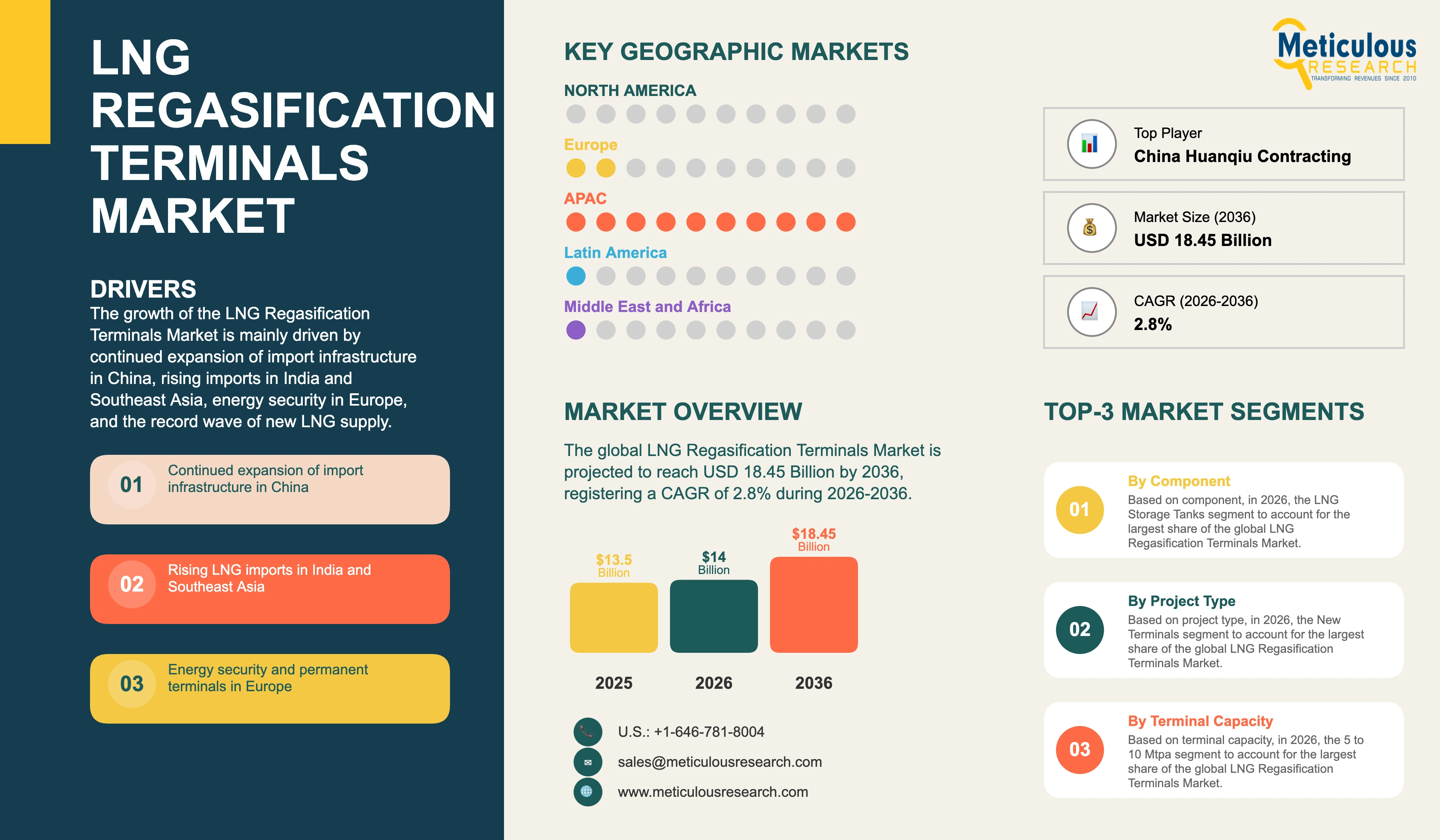
The global LNG regasification terminals market was valued at USD 13.50 billion in 2025. This market is expected to reach USD 18.45 billion by 2036 from an estimated USD 14.00 billion in 2026, registering a CAGR of 2.8% during the forecast period (2026-2036).
- Published
- Nov 2026
- Pages
- 256
- Format
- PDF + Excel
- Report ID
- MREP - 1042718
- Base year
- 2025
- 2025 · BASELINE
- $13.50B
- 2036
- $18.45B
- CAGR 2026–2036
- 2.8%
2025 baseline · 2026–2036 forecast at 2.8% CAGR · hover a bar for the value
Key highlights
According to the International Gas Union's 2026 World LNG Report, global LNG regasification capacity expanded to about 1,113.5 million tonnes per annum (Mtpa) across 50 importing markets by the end of 2025, more than twice the world's liquefaction capacity of 524.5 Mtpa.
India had 52.5 Mtpa of regasification capacity across eight terminals in 2025, overtaking Spain to become the world's fourth-largest regasification market, according to the International Gas Union. During 2025, India commissioned a new 5 Mtpa onshore terminal at Chhara and completed a breakwater at the Dabhol terminal that raised its capacity from 2.9 Mtpa to 5 Mtpa and allowed year-round operation.
China continues to add very large onshore storage and regasification capacity at terminals along its coast. CNOOC completed the main construction of six 270,000 cubic meter tanks at its Binhai LNG terminal in Jiangsu, among the world's largest onshore LNG tanks, and Sinopec put a 270,000 cubic meter tank into operation at its Qingdao terminal, raising its annual unloading capacity to 11 million tonnes, with annual gas supply capacity of 16.5 billion cubic meters.
PipeChina completed mechanical construction of the Longkou LNG terminal in Shandong in 2026, with a first phase that includes six 220,000 cubic meter storage tanks, while PetroChina expanded its Rudong terminal to 6.5 Mtpa with 680,000 cubic meters of storage.
In Germany, Hanseatic Energy Hub took a final investment decision on a land-based, ammonia-ready LNG terminal at the Elbe River port of Stade, costing about EUR 1 billion and targeting operation from 2027, while a land-based terminal at Brunsbuettel is expected to begin regular operation in early 2027, replacing floating terminals installed after 2022.
The European Union's 2024 State of the Energy Union report cited 18 new LNG terminals and expansions since 2022, which boosted EU import capacity by more than 50 Mtpa, according to the International Group of Liquefied Natural Gas Importers.
By component, LNG storage tanks account for the largest share of 40.0% in 2026, while regasification and vaporization systems register the highest CAGR.
By project type, new terminals account for the larger share in 2026, while expansion of existing terminals register the higher CAGR.
By terminal capacity, 5 to 10 Mtpa accounts for the largest share of 42.0% in 2026, while below 5 Mtpa registers the highest CAGR.
By geography, Asia-Pacific accounts for the largest share of 68.0% in 2026, while Middle East & Africa registers the highest CAGR of 4.2%.
Report summary
| Particulars | Details |
|---|---|
| Base Year | 2025 |
| Estimated Year | 2026 |
| Forecast Period | 2026-2036 |
| Market Size in 2025 | USD 13.50 billion |
| Market Size in 2026 | USD 14.00 billion |
| Market Size by 2036 | USD 18.45 billion |
| CAGR (2026-2036) | 2.8% |
| Format | PDF, Excel & Cloud Portal · 256 pages |
| Largest Segment by Component (2026) | LNG Storage Tanks (40.0%) |
| Largest Segment by Terminal Capacity (2026) | 5 to 10 Mtpa |
| Largest Region (2026) | Asia-Pacific (68.0%) |
| Fastest-Growing Region | Middle East & Africa (CAGR 4.2%) |
| Companies Profiled | 15 companies and other companies |
| Segments Covered | Component, Project Type, Terminal Capacity, Geography |
| Countries Covered | China, India, Japan, South Korea, Thailand, Vietnam, Philippines, Bangladesh, Rest of Asia-Pacific, Germany, Italy, France, Spain, Poland, Greece, Netherlands, Rest of Europe, Kuwait, Bahrain, South Africa, Morocco, Rest of Middle East & Africa, Chile, Brazil, Rest of Latin America, Mexico, Canada, U.S. |
Report overview
Segments covered: component, project type, terminal capacity.
The growth of this market is mainly driven by the continued construction and expansion of onshore LNG import terminals in China, rising LNG imports and new terminals in India and Southeast Asia, the replacement of floating import units with permanent onshore terminals in Germany and other parts of Europe, the need for energy security and supply diversification after the loss of Russian pipeline gas, the record wave of new LNG supply coming online from the U.S., Qatar, and other exporters between 2025 and 2030, which requires matching import capacity, and the expansion of terminal services such as truck loading, bunkering, reloading, and cold energy use. However, factors such as the high capital cost and long construction time of onshore terminals, low utilization of existing import capacity in some markets, uncertainty over long-term gas demand in Europe, Japan, and South Korea, and the availability of faster and cheaper floating storage and regasification units are expected to restrain the growth of this market to some extent.
LNG regasification terminals receive liquefied natural gas from ships, store it in cryogenic tanks, and convert it back into gas for delivery into pipeline networks, power plants, and industrial users. A typical onshore terminal includes marine facilities such as jetties, breakwaters, and unloading arms, full-containment storage tanks that hold LNG at about minus 162 degrees Celsius, in-tank and high-pressure send-out pumps, boil-off gas compressors and recondensers, vaporizers such as open rack vaporizers, submerged combustion vaporizers, intermediate fluid vaporizers, or ambient air vaporizers, metering, and control systems. Many terminals also offer truck loading, ship reloading, and bunkering services. Terminals are usually designed for lifetimes of 40 years or more, and their storage tanks are among the largest and most complex structures in the gas industry.
This report covers global revenue from the construction and expansion of onshore LNG regasification terminals, including LNG storage tanks, regasification and vaporization systems, marine facilities and unloading systems, send-out pumps, boil-off gas compressors, and recondensers, and engineering, construction, and balance of plant. Floating storage and regasification units, small-scale LNG import and distribution facilities, LNG carriers, and downstream gas pipelines are excluded from the scope of this report, as they are covered in separate studies. Revenue is measured as annual investment in terminal construction and expansion projects, including major refurbishment and upgrade work at existing terminals.
Regasification capacity is much larger than liquefaction capacity worldwide, because importing countries build spare capacity for energy security, seasonal demand, and flexibility. The International Gas Union reports that regasification capacity reached about 1,113.5 Mtpa across 50 importing markets at the end of 2025, more than twice global liquefaction capacity. Many terminals in Japan, South Korea, and Europe operate well below capacity, while terminals in China and India are expanding rapidly to meet growing demand. Spare capacity is valuable during supply disruptions and cold winters, which is why many governments see it as an insurance policy rather than wasted investment.
China has been the largest builder of onshore regasification terminals for more than a decade. State-owned companies such as CNOOC, PipeChina, Sinopec, and PetroChina, along with provincial and private companies, are building new terminals and expanding existing ones along the coast, and they have pioneered very large storage tanks of 270,000 cubic meters. India is also expanding its import capacity, and Southeast Asian countries such as Vietnam, the Philippines, and Thailand are building new terminals to support gas-fired power generation.
In Europe, the loss of most Russian pipeline gas after 2022 led to a rapid expansion of import capacity, mostly through floating storage and regasification units, which could be deployed quickly. Germany and other countries are now building permanent onshore terminals to replace or complement floating units, including terminals at Stade and Brunsbuettel in Germany, and expansions in Italy, France, Poland, and other countries. Many new European terminals are designed to be ready for future imports of ammonia, bio-LNG, or synthetic natural gas.
The market includes engineering, procurement, and construction contractors, storage tank specialists, and suppliers of vaporizers, pumps, compressors, loading arms, and control systems. Leading companies include China Huanqiu Contracting & Engineering, IHI, CB&I, Technip Energies, Saipem, Daewoo Engineering & Construction, Larsen & Toubro, Toyo Engineering, Tokyo Gas Engineering Solutions, Kobe Steel, Sumitomo Precision Products, Burckhardt Compression, Atlas Copco, Nikkiso, and Ebara. Chinese contractors and equipment suppliers build most terminals in China. Terminal owners include national oil companies, gas utilities, independent terminal operators, and infrastructure investors.
Over the forecast period, the LNG regasification terminals market is expected to grow moderately. Continued investment in China, India, and Southeast Asia, permanent terminals in Europe, and new importers in the Middle East, Africa, and Latin America will support demand, while low utilization in mature markets, competition from floating units, and uncertainty over long-term gas demand will limit growth. Expansions of existing terminals are expected to grow faster than new terminals as operators add tanks, vaporizers, and new services at existing sites.
Asia-Pacific is expected to account for the largest share of 68.0% of the market in 2026, mainly due to China's very large terminal program and India's growing import capacity.
The Middle East & Africa is projected to register the highest CAGR of 4.2% during the forecast period, driven by new importers in Africa and growing gas demand in the Middle East, although from a small base.
The report profiles 15 companies, including China Huanqiu Contracting & Engineering Corporation, IHI Corporation, CB&I, Technip Energies N.V., Saipem S.p.A., Daewoo Engineering & Construction Co., Ltd., Larsen & Toubro Limited, Toyo Engineering Corporation, Tokyo Gas Engineering Solutions Corporation, Kobe Steel, Ltd., Sumitomo Precision Products Co., Ltd., Burckhardt Compression AG, Atlas Copco AB, Nikkiso Co., Ltd., and Ebara Corporation.
In 2026, the new terminals segment is expected to account for the larger share of the LNG regasification terminals market, while the expansion of existing terminals segment is projected to register the higher CAGR during the forecast period.
Report infographic
Market dynamics
16 factors across 5 forcesContinued expansion of import infrastructure in China
China is the largest market for onshore regasification terminals, as the country continues to expand gas use in power generation, industry, residential heating, and transport, and as it builds import capacity for energy security. Chinese companies are building new terminals and expanding existing ones along the entire coast, from Tianjin and Tangshan in the north to Guangdong and Guangxi in the south, and they are building some of the world's largest LNG storage tanks.
CNOOC has completed the main construction of six 270,000 cubic meter tanks at its Binhai terminal in Jiangsu, Sinopec has put a 270,000 cubic meter tank into operation at its Qingdao terminal, raising annual unloading capacity to 11 million tonnes, and PetroChina has expanded its Rudong terminal to 6.5 Mtpa with 680,000 cubic meters of storage. PipeChina has completed the first phase of its Longkou terminal in Shandong with six 220,000 cubic meter tanks and is expanding its Beihai terminal in Guangxi. New terminals such as Zhangzhou in Fujian have also started operations.
China's terminal build-out is also driven by the need for gas storage to meet peak winter demand, since the country's underground gas storage capacity is limited. Large LNG tanks at coastal terminals help provide seasonal and emergency storage, which supports continued investment even when LNG imports fluctuate from year to year.
Rising LNG imports in India and Southeast Asia
India is expanding its LNG import capacity as it seeks to increase the share of natural gas in its energy mix to about 15% and to supply growing city gas distribution networks, fertilizer plants, and industry. According to the International Gas Union, India had 52.5 Mtpa of regasification capacity across eight terminals in 2025, overtaking Spain as the world's fourth-largest regasification market. India commissioned a new 5 Mtpa onshore terminal at Chhara in 2025 and completed a breakwater at Dabhol that raised its capacity to 5 Mtpa and enabled year-round operations, and four projects, including an expansion of the Dahej terminal, are under construction.
Southeast Asian countries such as Vietnam, the Philippines, Thailand, Bangladesh, and Indonesia are building new terminals to supply gas-fired power plants as domestic gas production declines and electricity demand grows. Many of these countries are new or recent LNG importers, and they are developing both onshore terminals and floating units. Thailand's Map Ta Phut terminals and Vietnam's Thi Vai terminal are examples of onshore projects in the region.
Energy security and permanent terminals in Europe
After the loss of most Russian pipeline gas supplies in 2022, European countries rapidly expanded their LNG import capacity, mainly through floating storage and regasification units. The European Union's 2024 State of the Energy Union report cited 18 new terminals and expansions since 2022, which boosted EU import capacity by more than 50 Mtpa. Many countries now see LNG as a permanent part of their supply mix and are building onshore terminals that offer larger storage, lower operating costs, and longer lifetimes than floating units.
In Germany, Hanseatic Energy Hub is building a land-based, ammonia-ready terminal at Stade at a cost of about EUR 1 billion, targeting operation from 2027, and a land-based terminal at Brunsbuettel is expected to begin regular operation in early 2027, while a land-based terminal at Wilhelmshaven is also planned. Italy, France, Poland, Greece, and other countries are expanding existing terminals or adding capacity. These projects support demand for storage tanks, vaporizers, marine facilities, and engineering services in Europe.
Record wave of new LNG supply
The International Energy Agency expects more than 330 billion cubic meters per year of new LNG export capacity to come online between 2025 and 2030 from projects already under construction, the largest wave of supply additions to date. This new supply, mainly from the U.S. and Qatar, will need to be absorbed by importing countries, which will require additional regasification capacity in growing markets such as China, India, Southeast Asia, and new importers in Africa and Latin America.
Lower LNG prices resulting from new supply are expected to stimulate demand in price-sensitive markets in South and Southeast Asia, which could accelerate investment in new terminals. Terminal operators are also investing in reloading and transshipment capabilities to take advantage of trading opportunities as the market becomes more flexible.
Table of contents
11 chapters · 135 sections · 256 pages · click to expandSegmental analysis
| Segment | Largest share (2026) | Fastest growth (2026–2036) |
|---|---|---|
| By Component | LNG storage tanks | Regasification and vaporization systems |
| By Project Type | New terminals | Expansion of existing terminals |
| By Terminal Capacity | 5 to 10 Mtpa | Below 5 Mtpa |
| Other segments | — | Terminals below 5 Mtpa |
By Component
- LNG Regasification Terminals Market Analysis by Component
- The LNG storage tanks segment is expected to account for the largest share of 40.0% of the global LNG regasification terminals market.
- The large share of this segment is mainly attributed to the high cost of full-containment cryogenic storage tanks, which require 9 percent nickel steel inner tanks, prestressed concrete outer tanks, insulation, and long construction periods, the large number of tanks being built at new and expanding terminals in China, India, and Europe, and the trend toward larger tanks of 220,000 to 270,000 cubic meters.
- Storage tanks also provide seasonal and emergency gas storage, which increases their importance in countries such as China with limited underground storage.
- China is the largest market for LNG storage tanks, with CNOOC, Sinopec, PetroChina, and PipeChina building dozens of large tanks at coastal terminals.
- Each large tank can take three years or more to build, and tank construction is often on the critical path for terminal projects.
- However, the regasification and vaporization systems segment is projected to register the highest CAGR during the forecast period.
- The rapid growth of this segment is primarily driven by the addition of vaporizers at expanding terminals to increase send-out capacity, the adoption of more efficient and lower-emission vaporization technologies such as intermediate fluid and ambient air vaporizers, cold energy recovery systems, and the replacement of older vaporizers at existing terminals.
- The choice of vaporizer technology depends mainly on local climate and seawater conditions: open rack vaporizers are widely used where warm seawater is available, while submerged combustion vaporizers are used in colder climates and for peak demand, and ambient air vaporizers are gaining popularity in warm regions because they use no fuel.
- Meanwhile, the marine facilities and unloading systems, send-out pumps, BOG compressors, and recondensers, and engineering, construction, and balance of plant segments are expected to witness steady growth, supported by terminal design and civil works, jetties, berths, and unloading arms at new terminals, and send-out pumps, boil-off gas compressors, and recondensers for terminal expansions and efficiency upgrades.
By Project Type
- LNG Regasification Terminals Market Analysis by Project Type
- The new terminals segment is expected to account for the largest share of the global LNG regasification terminals market.
- The large share of this segment is mainly attributed to the construction of new terminals in China, such as Longkou, Zhangzhou, and others, new terminals in India and Southeast Asia, and permanent onshore terminals in Germany at Stade and Brunsbuettel.
- New terminals require complete marine facilities, storage tanks, regasification systems, and infrastructure, which makes them considerably more expensive than expansions.
- Greenfield terminal projects also require new port infrastructure, access roads, and pipeline connections, which add to costs and construction time.
- In China, new terminals are often developed by provincial energy companies and private firms as well as by the national oil companies, which has increased the number of projects.
- However, the expansion of existing terminals segment is projected to register the highest CAGR during the forecast period.
- The rapid growth of this segment is primarily driven by the addition of storage tanks, vaporizers, and send-out capacity at existing terminals in China, India, Japan, South Korea, and Europe, which is faster and less expensive than building new terminals, and by the addition of new services such as truck loading, bunkering, and reloading.
- Examples include the expansion of Dahej in India, Rudong and Qingdao in China, and the second phase of Beihai.
- Smaller expansions are also common in Japan and South Korea, where operators add tanks and vaporizers to replace aging equipment and improve flexibility.
By Terminal Capacity
- LNG Regasification Terminals Market Analysis by Terminal Capacity
- The 5 to 10 Mtpa segment is expected to account for the largest share of the global LNG regasification terminals market.
- The large share of this segment is mainly attributed to the large number of terminals in this size range in China, India, Europe, and Southeast Asia, which balance economies of scale with demand in individual regions.
- Many Indian terminals have capacities of about 5 Mtpa, and many Chinese terminals have first-phase capacities of about 5 to 6.5 Mtpa.
- Terminals of this size can serve a large city region or industrial cluster and can be expanded later in phases as demand grows.
- However, the below 5 Mtpa segment is projected to register the highest CAGR during the forecast period.
- The rapid growth of this segment is primarily driven by new onshore terminals for emerging importers in Southeast Asia, Africa, and Latin America, regional terminals in China, and smaller terminals designed for specific power plants and industrial clusters.
- Smaller onshore terminals can be built more quickly and better match the demand of smaller markets.
- They are also particularly well suited to island nations and remote regions that cannot justify large terminals, such as parts of Southeast Asia and the Caribbean.
- Meanwhile, the above 10 Mtpa segment is expected to witness steady growth, supported by large expansions at major import hubs such as Dahej in India and the largest terminals in China, Japan, and South Korea, which also serve as regional trading, storage, and reloading centers.
Other segments
- Terminals below 5 Mtpa are projected to register the highest CAGR, driven by new importers and regional terminals that match smaller markets.
Geographic analysis
Asia-Pacific
Largest shareIn 2026, Asia-Pacific is expected to account for the largest share of 68.0% of the global LNG regasification terminals market. The large share of this region is mainly due to China's very large program of new terminals and expansions, which includes some of the world's largest LNG storage tanks, India's growing import capacity, which reached 52.5 Mtpa across eight terminals in 2025, new terminals in Southeast Asian countries such as Vietnam, the Philippines, and Thailand, and ongoing expansions and upgrades in Japan and South Korea. Chinese companies such as CNOOC, Sinopec, PetroChina, and PipeChina account for a large share of global terminal investment. Japan and South Korea, which have the world's largest and most mature LNG import markets, continue to invest in terminal upgrades and replacement equipment, although they add little new capacity.
Europe
Europe is the second-largest regional market, supported by permanent onshore terminals in Germany, expansions in Italy, France, Poland, and Greece, and the need for energy security after the loss of Russian pipeline gas. However, falling gas demand and the availability of floating units are expected to limit growth in Europe. Spain, France, and Italy, which have large existing terminals, focus mainly on upgrades, new services, and small expansions.
Middle East & Africa
Fastest growthThe Middle East & Africa is projected to register the highest CAGR of 4.2% during the forecast period. The rapid growth of this region is mainly due to new LNG import projects in countries such as South Africa, Morocco, and other African markets that are developing gas-fired power generation, the conversion of some floating import facilities in the Middle East to permanent infrastructure, and growing gas demand for power and desalination in countries such as Kuwait and Bahrain, which have built onshore terminals in recent years. Growth starts from a small base, and many of the region's import needs are met by floating units, but permanent terminals are expected to follow as demand grows.
North America
Latin America and North America account for small shares of the global market.
Latin America
Latin America's import capacity relies largely on floating units, while some countries such as Chile and Brazil are considering onshore terminals, and North America's import needs are limited, with some terminals in Mexico, the Caribbean, and Canada. Several U.S. import terminals have been converted into export terminals over the past decade, which reduces the regional market for regasification investment.
Competitive landscape
The global LNG regasification terminals market is moderately concentrated, particularly in storage tank construction, with the top five players estimated to account for about 35% of the market in 2025. The market includes engineering, procurement, and construction contractors, storage tank specialists, and suppliers of vaporizers, pumps, compressors, loading arms, and control systems.
China Huanqiu Contracting & Engineering, part of the CNPC group, and other Chinese contractors build most terminals and storage tanks in China, which is the largest market. IHI, CB&I, Daewoo Engineering & Construction, Toyo Engineering, and Tokyo Gas Engineering Solutions are leading international storage tank and terminal contractors with long track records in Asia and other regions, while Technip Energies, Saipem, and Larsen & Toubro also execute terminal projects worldwide.
Kobe Steel and Sumitomo Precision Products are leading global suppliers of open rack and other vaporizers, Burckhardt Compression and Atlas Copco supply boil-off gas compressors, and Nikkiso and Ebara supply cryogenic pumps. Many other specialized companies supply loading arms, valves, metering systems, and control systems. Chinese equipment suppliers have developed domestic vaporizers, pumps, and compressors, which reduces costs for Chinese terminals and increases competition in export markets. International contractors increasingly partner with local companies to win projects in India, Southeast Asia, and Africa.
Companies in this market compete on experience, technical capabilities, safety record, price, schedule, and local presence. Key strategies include expanding in fast-growing markets in China, India, and Southeast Asia, forming joint ventures with local partners, developing larger and more efficient storage tanks, offering ammonia-ready and multi-fuel terminal designs, and providing integrated solutions that include storage, regasification, and terminal services.
Over the forecast period, the competitive landscape is expected to remain dominated by Chinese contractors in China and by a small number of international contractors and equipment suppliers in other markets. Contractors with strong references in large tank construction and complex marine works will be best positioned to win major projects. Equipment suppliers with low-emission vaporization and cold energy recovery technology are expected to gain share over the forecast period.
Some of the key players operating in the LNG regasification terminals market are China Huanqiu Contracting & Engineering Corporation, IHI Corporation, CB&I, Technip Energies N.V., Saipem S.p.A., Daewoo Engineering & Construction Co., Ltd., Larsen & Toubro Limited, Toyo Engineering Corporation, Tokyo Gas Engineering Solutions Corporation, Kobe Steel, Ltd., Sumitomo Precision Products Co., Ltd., Burckhardt Compression AG, Atlas Copco AB, Nikkiso Co., Ltd., and Ebara Corporation, among others.
- —
PipeChina completed construction of the Longkou terminal in 2026, CNOOC and Sinopec built 270,000 cubic meter tanks, India commissioned the Chhara terminal and expanded Dabhol in 2025, and Germany advanced land-based terminals at Stade and Brunsbuettel.
- China Huanqiu Contracting & Engineering Corporation
- IHI Corporation
- CB&I
- Technip Energies N.V.
- Saipem S.p.A
- Daewoo Engineering & Construction Co., Ltd.
- Larsen & Toubro Limited
- Toyo Engineering Corporation
- Tokyo Gas Engineering Solutions Corporation
- Kobe Steel, Ltd.
- Sumitomo Precision Products Co., Ltd.
- Burckhardt Compression AG
- Atlas Copco AB
- Nikkiso Co., Ltd.
- Ebara Corporation
Expert perspectives
The LNG regasification terminals market is a relatively mature but still growing market, with investment concentrated in China, India, Southeast Asia, and permanent terminals in Europe. We expect moderate but steady market growth over the next decade, supported by the record wave of new LNG supply, energy security needs in importing countries, and expansions of existing terminals.
Over the forecast period, the market is expected to grow at a CAGR of 2.8%, from USD 14.00 billion in 2026 to USD 18.45 billion in 2036. Growth will be supported mainly by China's terminal program, rising imports in India and Southeast Asia, permanent terminals in Europe, new importers, and terminal expansions and services, while high costs, low utilization in mature markets, competition from floating units, and uncertain long-term gas demand will moderate growth.
In terms of segments, LNG storage tanks clearly remain the largest component, while regasification and vaporization systems grow fastest. New terminals remain the largest project type, while expansions grow fastest. Terminals of 5 to 10 Mtpa remain the largest capacity segment, while terminals below 5 Mtpa grow fastest. Asia-Pacific remains the largest region, while the Middle East & Africa grows fastest at a CAGR of 4.2%.
For LNG terminal contractors and equipment suppliers, the most important priorities over the forecast period are to build strong positions in China, India, and Southeast Asia, to offer cost-effective and fast-track terminal designs, to develop ammonia-ready and multi-fuel solutions, and to support terminal expansions and new services. Partnerships with local contractors and national energy companies will be especially important in many emerging markets. Suppliers should also prepare for steadily growing demand for upgrades, refurbishment, and life extension at older terminals in Japan, South Korea, and Europe.
We expect China to remain by far the dominant market for new regasification investment, although concerns about overcapacity could slow new terminal approvals in the second half of the forecast period. In our view, India and Southeast Asia offer the strongest growth potential for onshore terminals outside China, supported by lower LNG prices and growing gas demand. The pace of new terminals in these markets will depend mainly on gas-to-power project development, tariffs, and financing.
We also expect permanent onshore terminals in Europe to remain an important niche, particularly where they can support future fuels, while floating units will continue to dominate import capacity additions in many emerging markets. Over the long term, in our view, terminals that can handle ammonia, bio-LNG, and other low-carbon fuels will be more resilient investments.
Customer perspectives
Head of Infrastructure - gas company, India
India's gas demand is growing steadily, and we need more import capacity and more reliable, all-weather terminals. Expanding existing terminals is often the fastest way to add capacity.
Managing Director - terminal developer, Germany
Our new onshore terminal will replace temporary floating capacity with a long-term solution and is designed to handle ammonia in the future. Flexibility for future fuels was an essential condition for our investors.
“We are adding large storage tanks to meet winter demand and support energy security. Building tanks of 270,000 cubic meters reduces the cost per unit of storage and makes much better use of our site.”
Frequently asked questions
The global LNG regasification terminals market was valued at USD 13.50 billion in 2025, up from USD 12.80 billion in 2024, and is estimated at USD 14.00 billion in 2026. The market covers investment in onshore terminal construction and expansion, including storage tanks, regasification systems, marine facilities, pumps and compressors, and engineering and construction.
The global LNG regasification terminals market is expected to reach USD 18.45 billion by 2036, supported by China's terminal program, rising imports in India and Southeast Asia, permanent terminals in Europe, and terminal expansions.
The market is expected to register a CAGR of 2.8% from 2026 to 2036, reflecting moderate growth as new supply is absorbed and import capacity expands in growing markets.
The International Gas Union reports that global regasification capacity reached about 1,113.5 Mtpa across 50 importing markets at the end of 2025, more than twice global liquefaction capacity of 524.5 Mtpa.
Market growth is mainly driven by continued expansion of import infrastructure in China, rising LNG imports in India and Southeast Asia, energy security and permanent terminals in Europe, and the record wave of new LNG supply.
High capital costs, long construction times, low utilization, and uncertain long-term gas demand restrain growth, while competition from floating units and permitting, local opposition, and site constraints are key challenges.
Key opportunities include terminal expansions and new services, new importers in Asia, Africa, and Latin America, ammonia-ready and future fuel terminals, and cold energy utilization.
LNG storage tanks are expected to account for the largest share of 40.0% of the market in 2026, while regasification and vaporization systems are projected to register the highest CAGR.
Expansion of existing terminals is projected to register the highest CAGR, driven by the addition of tanks, vaporizers, and new services at existing sites in China, India, and other markets.
Terminals below 5 Mtpa are projected to register the highest CAGR, driven by new importers and regional terminals that match smaller markets.
Asia-Pacific is expected to account for the largest share of 68.0% of the market in 2026, mainly due to China's very large terminal program and India's growing import capacity.
The Middle East & Africa is projected to register the highest CAGR of 4.2% during the forecast period, driven by new importers in Africa and growing gas demand in the Middle East, although from a small base.
The report profiles 15 companies, including China Huanqiu Contracting & Engineering Corporation, IHI Corporation, CB&I, Technip Energies N.V., Saipem S.p.A., Daewoo Engineering & Construction Co., Ltd., Larsen & Toubro Limited, Toyo Engineering Corporation, Tokyo Gas Engineering Solutions Corporation, Kobe Steel, Ltd., Sumitomo Precision Products Co., Ltd., Burckhardt Compression AG, Atlas Copco AB, Nikkiso Co., Ltd., and Ebara Corporation.
PipeChina completed construction of the Longkou terminal in 2026, CNOOC and Sinopec built 270,000 cubic meter tanks, India commissioned the Chhara terminal and expanded Dabhol in 2025, and Germany advanced land-based terminals at Stade and Brunsbuettel.
In 2026, the new terminals segment is expected to account for the larger share of the LNG regasification terminals market, while the expansion of existing terminals segment is projected to register the higher CAGR during the forecast period.
Cite this report
Meticulous Research. (2026). LNG Regasification Terminals Market - Global Opportunity Analysis and Industry Forecast (2026-2036) (Report No. MREP - 1042718). Meticulous Market Research Pvt. Ltd. https://www.meticulousresearch.com/product/lng-regasification-terminals-market-7401