Silver Ion Antimicrobial Additives Market (2026-2036)
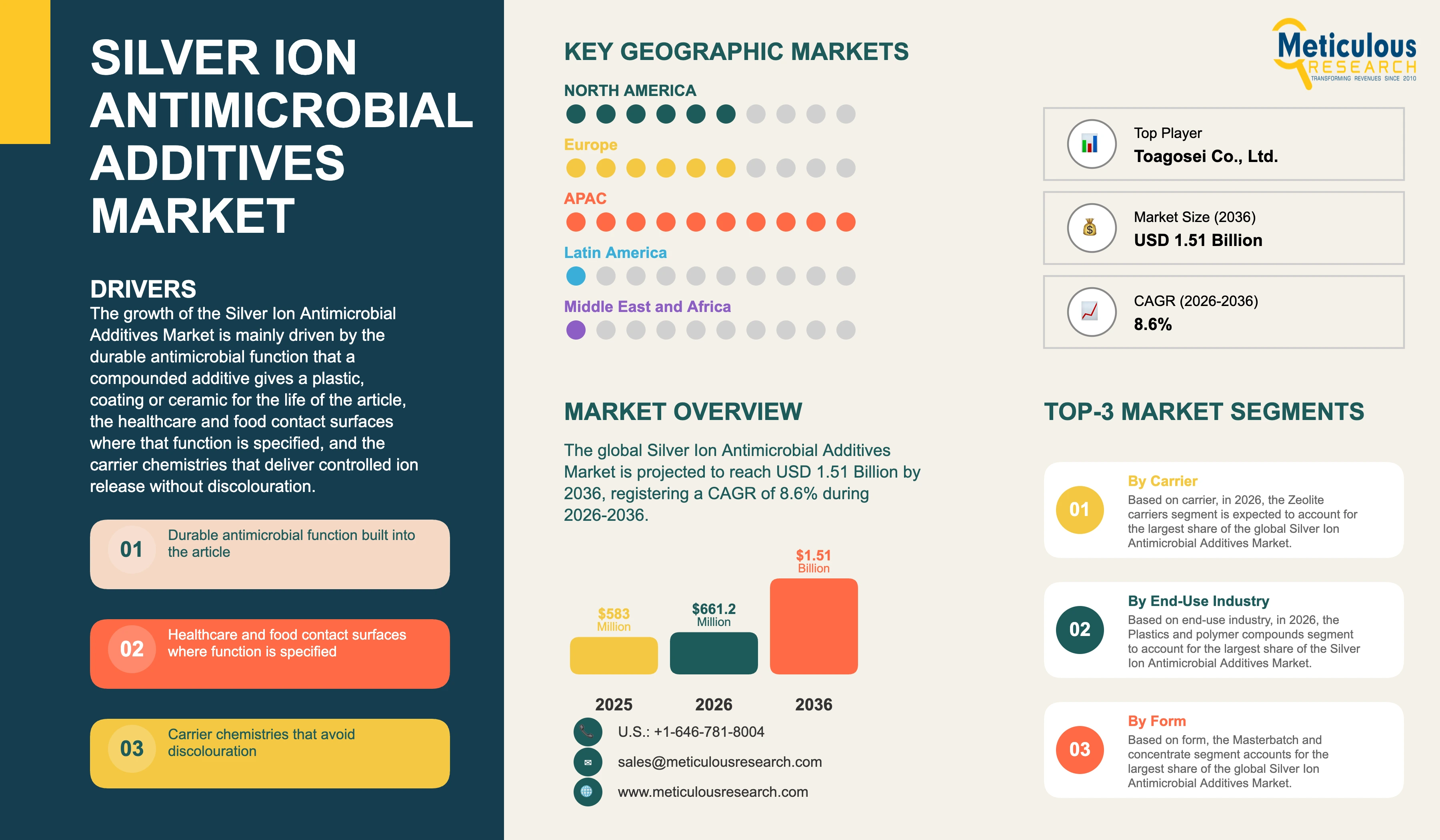
The global silver ion antimicrobial additives market was valued at USD 583.0 million in 2025. This market is expected to reach USD 1.51 billion by 2036 from an estimated USD 661.2 million in 2026, registering a CAGR of 8.6% during the forecast period (2026-2036).
- Published
- Nov 2026
- Pages
- 272
- Format
- PDF + Excel
- Report ID
- MRCHM - 1042829
- Base year
- 2025
- 2025 · BASELINE
- $583.0M
- 2036
- $1.51B
- CAGR 2026–2036
- 8.6%
2025 baseline · 2026–2036 forecast at 8.6% CAGR · hover a bar for the value
Key highlights
The global silver ion antimicrobial additives market is estimated at USD 661.2 million in 2026 and is projected to reach USD 1.51 billion by 2036.
Market volume is estimated at 11.40 kilotons in 2026 and is projected to reach 21.60 kilotons by 2036 at a CAGR of 6.6%, measured as additive product as supplied rather than as silver content.
The average selling price is estimated at USD 58.00 per kg in 2026 and is projected to reach USD 70.00 per kg by 2036 as glass and phosphate carriers take a larger share.
Zeolite carriers are expected to account for the largest carrier share in 2026, while glass and ceramic carriers are projected to register the highest CAGR of 11.0%.
Plastics and polymer compounds are expected to hold the largest end-use share in 2026, while medical devices and healthcare surfaces are projected to grow fastest at a CAGR of 10.6%.
Asia-Pacific is expected to hold the largest regional share in 2026 and is also projected to grow fastest at a CAGR of 9.6%.
Commission Regulation (EU) 2026/78 of 12 January 2026, published on 13 January 2026 and applying from 1 May 2026, replaced the prohibited silver entry in Annex II with silver (nano) at 1 nm to 100 nm and silver (massive) at 1 mm or more, following classification as carcinogenic, mutagenic or toxic for reproduction category 2.
That Regulation permits only the intermediate band, adding silver powder with a diameter between 100 nm and 1 mm to Annex III entry 379 at a maximum of 0.05% and only in toothpaste and mouthwash, with CAS 7440-22-4 and EC 231-131-3.
It also replaced Annex IV entry 142 with silver powder in that same size band as a white colorant permitted in lip products and eye shadow at up to 0.2%.
That treatment rests on the opinion of the Scientific Committee on Consumer Safety of 27 March 2024, finalised 20 June 2024 as SCCS/1665/24, which found micron-sized silver safe under specific conditions, while a request made in May 2023 had covered only micron-sized silver.
Commission Regulation (EU) 2026/909 of 27 April 2026, published on 28 April 2026, moved silver zinc zeolite out of the Annex II prohibition and added it to Annex V entry 61 as a preservative at 1% in deodorant sprays and powder foundations, with silver content in the ingredient not above 2.5%.
Recital 9 of that Regulation gives the shrinking pool of preservatives as part of the reasoning for that move, and recital 43 states that the Annex III and Annex V amendments should apply without delay.
Commission Implementing Regulation (EU) 2024/2635 of 3 October 2024 approved silver zinc zeolite for product types 2, 7 and 9 under the biocidal products regime, entering into force on 24 October 2024.
The Annex to that Implementing Regulation could not be retrieved for this report, so the approval period, the conditions of use, the minimum purity and any candidate for substitution status are not established here.
In Great Britain the non-approval decision of 15 August 2023 covered silver as a nanomaterial in product type 9 and the reaction mass of titanium dioxide and silver chloride in product types 1, 2, 6, 7 and 9, for lack of applicant support rather than on any adverse finding.
Under that decision supply ended on 15 August 2024 and use on 15 February 2025, while new treated articles were barred from the supply chain or from import after 11 February 2024.
The same element therefore receives different answers according to particle size, carrier compound, product type and jurisdiction, which is the defining commercial feature of this market.
Report summary
| Particulars | Details |
|---|---|
| Base Year | 2025 |
| Forecast Period | 2026-2036 |
| Market Size in 2025 | USD 583.0 million |
| Market Size in 2026 | USD 661.2 million |
| Market Size by 2036 | USD 1.51 billion |
| Value CAGR (2026-2036) | 8.6% |
| Format | PDF, Excel & Cloud Portal · 272 pages |
| Volume in 2026 | 11.40 kilotons |
| Volume by 2036 | 21.60 kilotons |
| Volume CAGR (2026-2036) | 6.6% |
| Volume Basis | Additive product as supplied on a mass basis, not silver content |
| Average Selling Price in 2026 | USD 58.00 per kg |
| Average Selling Price by 2036 | USD 70.00 per kg |
| Price Direction | The average selling price rises across the forecast period as the glass, ceramic and phosphate carriers take a larger share of a mix led by the zeolites, rather than through any change in the price of silver passing through |
| Volume Basis Note | Silver is a minor constituent of these additives by mass; Commission Regulation (EU) 2026/909 illustrates the order of magnitude by requiring that silver content in the silver zinc zeolite ingredient not exceed 2.5%, so a figure quoted on a silver content basis would be a small fraction of the one here and would describe the metal rather than the additive business |
| Scope Exclusion Note | The inorganic antimicrobial additive ranges of the leading producers contain substantial zinc-based volume that is not silver; the NOVARON range for resin published by Toagosei is described as a glass-based agent whose active ingredient is zinc, with only the AGZ330 grade described as silver-based and the other listed grades being zinc glass, and only the silver-based grades are counted here; metallic silver, silver-coated textiles and yarns, silver wound dressings, medical colloidal silver, and silver used as a catalyst or conductor are also excluded |
| Measurement Basis | Inorganic carrier compounds holding silver in an exchangeable form for controlled ion release, including zeolite, zirconium and calcium phosphate, glass and ceramic and composite carriers, supplied as powders, masterbatches and dispersions, by carrier, end-use industry, form and geography |
| Relationship to Adjacent Markets | This market is not additive to the biocides markets measured on an active substance basis, since what is counted here is a carrier compound as supplied rather than an active at 100% strength; silver zinc zeolite is counted in this report rather than in the dry film preservatives or preservative boosters reports, where it is identified and reserved to this title |
| Note on Regulatory Divergence | Between August 2023 and April 2026 four decisions reached five different conclusions about silver: Commission Regulation (EU) 2026/78 prohibited silver (nano) at 1 to 100 nm and silver (massive) at 1 mm or more in cosmetics while permitting the intermediate band only in toothpaste and mouthwash at 0.05% and as a colorant at 0.2%; Commission Implementing Regulation (EU) 2024/2635 approved silver zinc zeolite for product types 2, 7 and 9; Commission Regulation (EU) 2026/909 added the same compound to Annex V entry 61 at 1% in two product categories with silver content not above 2.5%; and the Great Britain decision of 15 August 2023 removed product type 9 from silver as a nanomaterial and product types 1, 2, 6, 7 and 9 from the reaction mass of titanium dioxide and silver chloride, for lack of applicant support rather than on any adverse finding |
| Note on Source Limitations | The Annex to Commission Implementing Regulation (EU) 2024/2635 could not be retrieved for this report, so the approval period, conditions of use, minimum purity and any candidate for substitution status for silver zinc zeolite under that approval are not established here; no participant publishes revenue for these additives separately from its wider additives business and the published product literature discloses silver content for no grade, so the sizing is built from application demand and approval coverage |
| Largest Carrier | Zeolite carriers |
| Fastest-Growing Carrier | Glass and ceramic carriers (CAGR 11.0%) |
| Largest End-Use Industry | Plastics and polymer compounds |
| Fastest-Growing End-Use Industry | Medical devices and healthcare surfaces (CAGR 10.6%) |
| Largest Region | Asia-Pacific |
| Fastest-Growing Region | Asia-Pacific (CAGR 9.6%) |
| Segments Covered | Carrier, End-Use Industry, Form, and Geography |
| Geographies Covered | Asia-Pacific, Europe, North America, Latin America, and Middle East & Africa |
| Companies Profiled | 7 companies, including Toagosei Co., Ltd., Sinanen Holdings Co., Ltd., Milliken & Company, Sanitized AG, LANXESS AG, Avient Corporation, and Polygiene Group AB |
Report overview
Segments covered: carrier, end-use industry, form.
In volume terms, this market is estimated at 11.40 kilotons in 2026 and is projected to reach 21.60 kilotons by 2036, registering a CAGR of 6.6% during the same period, measured as additive product as supplied on a mass basis rather than as silver content. The silver in these additives is a small fraction of their mass, and Commission Regulation (EU) 2026/909 illustrates the order of magnitude by requiring that silver content in the silver zinc zeolite ingredient not exceed 2.5%. The average selling price is estimated at USD 58.00 per kg in 2026 and is projected to rise to USD 70.00 per kg by 2036 as glass and phosphate carriers take a larger share.
The growth of this market is mainly driven by the durable antimicrobial function that a compounded additive gives a plastic, coating or ceramic for the life of the article, the healthcare and food contact surfaces where that function is specified rather than optional, the carrier chemistries that deliver controlled ion release without the discolouration that limited earlier grades, and the regulatory approvals that have been secured for specific carrier compounds. However, factors such as the divergence of regulatory treatment by particle size and by carrier, the authorisations lost where no applicant maintained support, the cost of silver against alternative antimicrobial chemistries, and the discolouration and transparency limits that some carriers still impose are expected to restrain the growth of this market to some extent.
Zeolite carriers account for the largest share of this market, while glass and ceramic carriers grow fastest from a smaller base. Asia-Pacific holds the largest regional share and is also the fastest-growing region.
Silver ion antimicrobial additives are inorganic carrier compounds that hold silver in an exchangeable form and release it slowly as ions when moisture is present, giving a plastic, coating, textile or ceramic a durable antimicrobial function. Market sizing in this report is on both a value basis in USD and a volume basis in kilotons measured as additive product as supplied on a mass basis, with average selling price derived from the two. The measurement basis covers zeolite, phosphate, glass and ceramic and composite carriers supplied as powders, masterbatches and dispersions.
Measuring the additive rather than the silver is the right basis and the difference between the two is large. Silver is a minor constituent of these products by mass, and Commission Regulation (EU) 2026/909 gives a published illustration of the order of magnitude by requiring that silver content in the silver zinc zeolite ingredient not exceed 2.5%. A figure quoted on a silver content basis would therefore be a small fraction of the one here and would describe the metal rather than the additive business.
A scope point established in the course of this research is worth stating because it cuts against what the product names suggest. The NOVARON range for resin published by Toagosei is described as a glass-based antimicrobial agent whose active ingredient is zinc, with only the AGZ330 grade described as silver-based, the other listed grades VZ100, VZN300, VZ600 and VZ900 being zinc glass. The inorganic antimicrobial additive ranges sold by the leading producers therefore contain substantial zinc-based volume that is not silver, and only the silver-based grades are counted here.
Commission Regulation (EU) 2026/78 of 12 January 2026, published on 13 January 2026 and applying from 1 May 2026, reorganised the treatment of silver in cosmetics around particle size. It replaced the prohibited silver entry in Annex II with silver (nano) at 1 nm to 100 nm and silver (massive) at 1 mm or more, following classification as carcinogenic, mutagenic or toxic for reproduction category 2 under Delegated Regulation (EU) 2024/2564, and permitted only the intermediate band.
That intermediate band is permitted narrowly. Silver powder with a diameter between 100 nm and 1 mm was added to Annex III entry 379 at a maximum of 0.05% and only in toothpaste and mouthwash, with CAS 7440-22-4 and EC 231-131-3, while Annex IV entry 142 was replaced with silver powder in the same band as a white colorant permitted in lip products and eye shadow at up to 0.2%. The Regulation sets no separate transitional period, its only application date being 1 May 2026.
The reasoning behind that structure is recorded and it explains the shape of the outcome. The opinion of the Scientific Committee on Consumer Safety of 27 March 2024, finalised on 20 June 2024 as SCCS/1665/24, found micron-sized silver safe under specific conditions, while the request submitted in May 2023 had covered only micron-sized silver. The permitted band is therefore the band that was assessed, and the prohibition of the nano and massive forms follows from the absence of an assessment as much as from the classification.
Commission Regulation (EU) 2026/909 of 27 April 2026, published on 28 April 2026, moved in the opposite direction for a specific carrier compound. It removed silver zinc zeolite from the Annex II prohibition and added it to Annex V entry 61 as a preservative at 1% in deodorant sprays and powder foundations with silver content in the ingredient not above 2.5%, following the opinion of the Scientific Committee on Consumer Safety of 21 December 2023. Recital 9 gives the shrinking pool of preservatives as part of the reasoning, and recital 43 states that the Annex III and Annex V amendments should apply without delay.
Under the biocidal products regime the same carrier compound was treated separately again. Commission Implementing Regulation (EU) 2024/2635 of 3 October 2024 approved silver zinc zeolite for product types 2, 7 and 9, entering into force on 24 October 2024. The Annex to that Implementing Regulation could not be retrieved for this report, so the approval period, the conditions of use, the minimum purity and any candidate for substitution status are stated here as not established rather than inferred.
In Great Britain the direction was the reverse and the mechanism was procedural. The non-approval decision of 15 August 2023 covered silver as a nanomaterial in product type 9 and the reaction mass of titanium dioxide and silver chloride in product types 1, 2, 6, 7 and 9, for lack of applicant support rather than on any adverse finding. Supply ended on 15 August 2024 and use on 15 February 2025, while new treated articles were barred from the supply chain or from import after 11 February 2024.
Read together, these four decisions describe one element receiving five different answers. Nano silver is prohibited in European cosmetics and non-approved in Great Britain for one product type; massive silver is prohibited in cosmetics; micron silver is permitted in two oral products and as a colorant; silver zinc zeolite is approved as a biocidal active for three product types and as a cosmetic preservative for two product categories; and the titanium dioxide and silver chloride reaction mass lost five product types in Great Britain.
The commercial consequence is that the carrier rather than the silver is the regulated article, and it is also what is sold. A formulator does not buy silver; it buys a defined compound with its own identity, its own approvals and its own release behaviour, and a supplier position rests on holding those approvals for that compound in that use. Two additives containing the same quantity of the same metal can be separated entirely by the compound carrying it.
Zeolite carriers hold the largest share because they were first and are the cheapest route to ion exchange capacity, and silver zinc zeolite is the compound with the broadest set of current approvals. Their limitation is optical, and a producer comparison illustrates it: Toagosei reports that its VZ600 glass grade at 0.5% in transparent ABS gave 89% light transmittance against 90% for the blank, while a silver-supported zeolite comparator in the same test dropped to 35%.
That comparison is a manufacturer assessment of its own product against a competing carrier type and should be read as such, but the effect it describes is the reason glass and ceramic carriers register the highest growth at 11.0%. Where an article must stay transparent or hold a pale colour, the carrier rather than the antimicrobial performance decides whether the additive can be used at all.
The additive ranges in this market are tested against regional standards rather than a single international one. Toagosei cites JIS Z 2801 for antibacterial testing, the Antibacterial Power Sustainability Test Method of the Society of International Sustaining Growth for Antimicrobial Articles with a waterproofing category at 50 degrees Celsius for 16 hours, and a light test under a sunshine carbon arc lamp, together with OECD 423, 471, 404 and 406 safety tests for the VZ100 grade. The page states that some grades hold approval from that society without saying which.
This market is not additive to the biocides markets measured on an active substance basis, since what is counted here is a carrier compound rather than an active at 100% strength, and it excludes metallic silver, silver-coated textiles and yarns, silver wound dressings and medical colloidal silver, and silver used as a catalyst or a conductor. Zinc-based inorganic antimicrobial additives sold within the same product ranges are also excluded.
Asia-Pacific is expected to account for the largest share in 2026, on the carrier compounds originating with Japanese producers, the regional testing and certification infrastructure, and the scale of appliance, electronics and sanitary ware manufacturing. India is projected to grow at 11.4%, China at 10.6%, South Korea at 9.0% and Japan at 7.0%.
Asia-Pacific is also projected to register the highest CAGR of 9.6% during the forecast period, holding both the largest share and the fastest growth.
Europe is projected to grow at a CAGR of 7.0%, with the United Kingdom at 7.4% and Germany at 6.6%. It is where the framework is most developed and most divided, with Commission Regulation (EU) 2026/78 applying from 1 May 2026 and Commission Regulation (EU) 2026/909 adding silver zinc zeolite to the cosmetic preservative annex, while Great Britain operates a separate regime that removed several silver uses in 2023.
The Middle East & Africa is projected to grow at a CAGR of 9.0%, where warm and humid conditions raise the value of a durable material-level function. Latin America is projected to grow at a CAGR of 8.0%, with Brazil at 8.0%.
Toagosei Co., Ltd., Sinanen Holdings Co., Ltd., Milliken & Company, Sanitized AG and LANXESS AG together accounted for an estimated 56.8% of this market in 2026. The 7 companies profiled in this report together accounted for an estimated 64.2%.
Report infographic
Market dynamics
15 factors across 5 forcesDurable Antimicrobial Function Built Into the Article
An additive compounded into a polymer, a coating or a glaze gives the finished article an antimicrobial function for its service life rather than until it is next cleaned, which is a different proposition from a disinfectant and cannot be delivered by one.
That is why these additives are specified at the material stage by the manufacturer of the article rather than bought by whoever maintains it, and it gives the supplier a position that lasts as long as the product is made.
Healthcare and Food Contact Surfaces Where the Function Is Specified
Medical device housings, hospital surfaces and food handling equipment are increasingly specified with a material-level antimicrobial requirement rather than leaving the question to cleaning practice.
Medical devices and healthcare surfaces are projected to register the highest end-use CAGR of 10.6%, and these are also the applications where the cost of the additive is least significant against the value of the article.
Carrier Chemistries That Avoid Discolouration
Early silver additives discoloured and clouded the articles they were compounded into, which excluded them from transparent and pale-coloured products however well they performed.
Toagosei reports that its VZ600 glass grade at 0.5% in transparent ABS gave 89% light transmittance against 90% for the blank while a silver-supported zeolite comparator dropped to 35%, and glass and ceramic carriers register the highest carrier CAGR at 11.0%.
Approvals Secured for Specific Carrier Compounds
Commission Implementing Regulation (EU) 2024/2635 of 3 October 2024 approved silver zinc zeolite for product types 2, 7 and 9 under the biocidal products regime, entering into force on 24 October 2024.
Commission Regulation (EU) 2026/909 of 27 April 2026 then added the same compound to Annex V entry 61 as a cosmetic preservative at 1% in deodorant sprays and powder foundations, with silver content in the ingredient not above 2.5%, which opens a use rather than restricting one.
These four drivers are unusually independent of one another, which is worth noting because it makes the growth here less fragile than in most additive markets. The durability argument is physical, the healthcare specification is institutional, the carrier improvement is technical and the approvals are regulatory, so a setback in one does not undo the others.
The first of them is also the one that distinguishes this market from disinfection entirely. A disinfectant acts once and is gone; an additive compounded into the article acts for its service life, which is a different product being sold to a different buyer at a different point. The decision is made by whoever specifies the material, years before the article is ever cleaned.
The carrier improvement driver is the one that has changed most recently. Early grades discoloured and clouded the articles they went into, which excluded them from transparent and pale products whatever their performance, and the glass and phosphate chemistries that answer that have opened applications the zeolites could never reach rather than taking share within the ones they already held.
The fourth driver runs against the direction of most biocidal regulation in this period, and that is the point of including it. Commission Implementing Regulation (EU) 2024/2635 approved silver zinc zeolite for three product types in October 2024, and Commission Regulation (EU) 2026/909 added the same compound to the cosmetic preservative annex in April 2026, so this is a market where approvals have been gained as well as lost.
Taken together the four describe a function being designed into materials rather than a chemical being sold into a process, which is why the growth rate here is steadier than the regulatory record behind it would suggest.
Table of contents
11 chapters · 138 sections · 272 pages · click to expandSegmental analysis
| Segment | Largest share (2026) | Fastest growth (2026–2036) |
|---|---|---|
| By Carrier | Zeolite carriers | Glass and ceramic carriers |
| By End-Use Industry | Plastics and polymer compounds | Medical devices and healthcare surfaces |
| By Form | Masterbatch and concentrate | Glass and ceramic carriers |
| Other segments | — | Medical devices and healthcare surfaces |
By Carrier
- Silver Ion Antimicrobial Additives Market Analysis by Carrier
- The zeolite carriers segment is expected to account for the largest share of the global silver ion antimicrobial additives market.
- The large share of this segment is mainly due to its established position in compounded plastics, the ion exchange capacity that a zeolite framework provides at the lowest cost, and silver zinc zeolite holding the broadest current set of approvals across both the biocidal product types and the cosmetic preservative annex.
- However, the glass and ceramic carriers segment is projected to register the highest CAGR of 11.0% during the forecast period.
- The rapid growth of this segment is attributed to its effect on the optical properties of the finished article being far smaller, with Toagosei reporting 89% light transmittance for a glass grade at 0.5% in transparent ABS against 90% for the blank while a silver-supported zeolite comparator dropped to 35% in the same test.
- Zirconium and calcium phosphate carriers hold a substantial position where thermal stability during compounding is the governing requirement.
- Composites of titanium dioxide and silver chloride grow most slowly, having lost five product types in the Great Britain non-approval decision of 15 August 2023.
- The carrier determines the ion release rate, the thermal stability, the optical effect and, critically, which approvals the additive can be sold under.
- Zeolite carriers are expected to account for the largest share in 2026, on their established position in compounded plastics, the ion exchange capacity a zeolite framework provides at the lowest cost, and silver zinc zeolite holding the broadest current set of approvals.
- Glass and ceramic carriers are projected to register the highest CAGR of 11.0% during the forecast period, on a far smaller effect on the optical properties of the finished article.
By End-Use Industry
- Silver Ion Antimicrobial Additives Market Analysis by End-Use Industry
- The plastics and polymer compounds segment is expected to account for the largest share of the global silver ion antimicrobial additives market.
- The large share of this segment is mainly due to the breadth of articles that are compounded rather than coated, from appliance and electronics housings to food containers, flooring and sanitary ware, and to compounding being the route by which a function is built in for the service life of the article.
- However, the medical devices and healthcare surfaces segment is projected to register the highest CAGR of 10.6% during the forecast period.
- The rapid growth of this segment is attributed to device housings, hospital furniture and touch surfaces being specified with a material-level antimicrobial requirement rather than leaving the question to cleaning practice, and to the additive cost being least significant against the value of those articles.
- Coatings and paints incorporate these additives for dry film protection of the coated surface.
- Textiles use them where a durable finish rather than a laundered one is required.
- Ceramics and surfaces apply them in glazes and solid surfacing.
- End use determines the processing temperature the additive must survive, the optical tolerance available and the regulatory product type the article falls into.
- Plastics and polymer compounds are expected to hold the largest share in 2026, on the breadth of articles that are compounded rather than coated and on compounding being the route by which the function is built in for the service life of the article.
By Form
- Silver Ion Antimicrobial Additives Market Analysis by Form
- Masterbatch and concentrate accounts for the largest form share of this market, because supplying the additive already dispersed in a carrier resin removes the handling and dust problems that a fine inorganic powder creates for a converter and places the dispersion work with the party able to validate it.
- It holds the largest share throughout the period.
- Powder for direct addition grows most slowly at 7.6% and remains the form used by compounders with their own dispersion capability and by the coatings and ceramics industries.
- Dispersions and liquids grow at 9.4%, serving coatings and textile finishing where the additive must be introduced into a liquid system.
- Form determines who carries the dispersion risk, and that rather than the chemistry is what the converter is choosing between.
- The three axes answer different questions and none is a restatement of another.
- The carrier determines ion release, thermal stability, optical effect and which approvals the additive can be sold under; the end-use industry determines the processing temperature to be survived, the optical tolerance available and the product type the article falls into; and the form determines who carries the dispersion risk.
- The third of those is the most practical and the least discussed.
- A fine inorganic powder dosed at a fraction of a per cent into a polymer is a dispersion problem before it is an antimicrobial one, and a converter choosing a masterbatch over a powder is buying a solved dispersion rather than a different chemistry.
- That decision is made separately from the choice of carrier and often by different people.
- The highest growth sits where the optical constraint and the value of the article coincide.
- Glass and ceramic carriers grow fastest at 11.0% because they clear a requirement the zeolites cannot, and medical devices and healthcare surfaces grow fastest among end uses at 10.6% because that is where the additive cost matters least against what it is compounded into.
- One axis is deliberately absent, and that is a split by silver content.
- The published product literature discloses silver loading for no grade, and Commission Regulation (EU) 2026/909 gives a regulatory ceiling of 2.5% for one ingredient rather than a market figure, so a content split would rest on estimates of a number nobody publishes.
- The three axes used here divide the market on properties that are stated.
- Reading the axes together also explains the gap between the two growth rates.
- Volume grows at 6.6% while value grows at 8.6%, and the whole difference is the carrier mix moving toward glass, ceramic and phosphate chemistries, which are priced above the zeolites and are specified where the cheaper carrier cannot be used at all rather than where it merely costs more.
- The fastest-growing position in this market, read across all three axes, is a glass or phosphate carrier supplied as a masterbatch into a medical device or healthcare surface, and it is that combination rather than any one of its parts that is adding value fastest over the forecast period.
Other segments
- Medical devices and healthcare surfaces are projected to register the highest CAGR of 10.6% during the forecast period, on material-level antimicrobial requirements being specified for device housings, hospital furniture and touch surfaces.
Geographic analysis
Asia-Pacific
Largest shareIn 2026, Asia-Pacific is expected to account for the largest share of the global silver ion antimicrobial additives market and is also projected to register the highest CAGR of 9.6% during the forecast period. The large share and rapid growth of this region are attributed to the carrier compounds themselves originating with Japanese producers, to the regional testing and certification infrastructure built around JIS Z 2801 and the Society of International Sustaining Growth for Antimicrobial Articles, and to the scale of appliance, electronics and sanitary ware manufacturing that specifies these additives. India is projected to register a CAGR of 11.4%, China a CAGR of 10.6%, South Korea a CAGR of 9.0% and Japan a CAGR of 7.0%. An additive sold across Asia-Pacific, the European Union and Great Britain faces three separate regimes that in 2023 to 2026 reached different conclusions about the same element, so the regional pattern of this market reflects the distribution of approvals at least as much as the distribution of manufacturing. Country rates within each region spread more widely than the regional figures suggest and follow manufacturing build-out rather than regulation: India at 11.4% and China at 10.6% against Japan at 7.0% within Asia-Pacific, and the United Kingdom at 7.4% against Germany at 6.6% within Europe. An additive sold across three regimes that reached different conclusions about the same element in the same three years therefore carries a regional footprint set by approvals rather than by where the articles are made.
North America
Europe and North America each hold a quarter of this market. North America is projected to grow at 8.4%, with the United States at 8.4%, on medical device and appliance specification.
Europe
Europe is projected to grow at 7.0%, and it is where the regulatory framework is most developed and most divided, with Commission Regulation (EU) 2026/78 applying from 1 May 2026 and Commission Regulation (EU) 2026/909 adding silver zinc zeolite to the cosmetic preservative annex. Germany is projected to grow at 6.6% and the United Kingdom at 7.4%, the latter under the separate Great Britain regime that removed several silver uses in 2023.
Latin America
Latin America is projected to grow at 8.0%, with Brazil at 8.0%.
Middle East & Africa
The Middle East & Africa is projected to grow at 9.0%, where warm and humid conditions raise the value of a durable material-level function. What differs between regions is which approvals a supplier must hold rather than how much demand exists.
Competitive landscape
The global silver ion antimicrobial additives market is concentrated among a small number of carrier compound producers, with masterbatch houses and formulators holding positions downstream of them. Competition is contested on the approvals held for a defined compound in a defined use, on the optical and thermal behaviour of the carrier, and on the form in which the additive is supplied, rather than on the silver it contains. Toagosei Co., Ltd., Sinanen Holdings Co., Ltd., Milliken & Company, Sanitized AG and LANXESS AG together accounted for an estimated 56.8% of this market in 2026, while the companies profiled in this report together accounted for an estimated 64.2%.
The competitive position of a participant here is a portfolio of compound-specific authorisations rather than a production advantage. Silver zinc zeolite was approved for product types 2, 7 and 9 by Commission Implementing Regulation (EU) 2024/2635 of 3 October 2024 and added to Annex V entry 61 by Commission Regulation (EU) 2026/909 of 27 April 2026, while the Great Britain decision of 15 August 2023 removed product types 1, 2, 6, 7 and 9 from the titanium dioxide and silver chloride reaction mass for lack of applicant support.
No participant publishes revenue for silver ion antimicrobial additives separately from its wider performance chemicals or additives business, and the published product literature does not disclose silver content for any grade, so neither sales nor silver consumption can be read from supplier disclosure. Shares here are built from application demand and approval coverage. Some of the key players operating in the silver ion antimicrobial additives market are Toagosei Co., Ltd. (Japan), Sinanen Holdings Co., Ltd. (Japan), Milliken & Company (U.S.), Sanitized AG (Switzerland), LANXESS AG (Germany), Avient Corporation (U.S.), and Polygiene Group AB (Sweden), among others.
Competition is therefore decided by a portfolio of compound-specific authorisations rather than by production capability, and that portfolio is maintained by continuing expenditure rather than owned. A participant that lets support lapse for a compound in a product type loses the use on a published timetable, as the Great Britain decision of 15 August 2023 demonstrated for two silver compounds.
The second thing being bought is validated behaviour in the specific article. A device manufacturer specifying an additive needs evidence that it survives the moulding temperature, does not discolour the part and performs against a recognised test method, and that evidence is generated per polymer and per grade, which is what holds a specification once it is won.
- —
Commission Regulation (EU) 2026/78 of 12 January 2026, published on 13 January 2026 and applying from 1 May 2026, replaced the prohibited silver entry in Annex II with silver (nano) at 1 nm to 100 nm and silver (massive) at 1 mm or more following classification as carcinogenic, mutagenic or toxic for reproduction category 2, added silver powder with a diameter between 100 nm and 1 mm to Annex III entry 379 at a maximum of 0.05% and only in toothpaste and mouthwash with CAS 7440-22-4 and EC 231-131-3, and replaced Annex IV entry 142 with silver powder in that band as a white colorant permitted in lip products and eye shadow at up to 0.2%, resting on the opinion of the Scientific Committee on Consumer Safety of 27 March 2024, finalised 20 June 2024 as SCCS/1665/24, which found micron-sized silver safe under specific conditions. Commission Regulation (EU) 2026/909 of 27 April 2026, published on 28 April 2026, moved silver zinc zeolite out of the Annex II prohibition and added it to Annex V entry 61 as a preservative at 1% in deodorant sprays and powder foundations with silver content in the ingredient not above 2.5%, following a Scientific Committee on Consumer Safety opinion of 21 December 2023, with recital 9 giving the shrinking pool of preservatives as part of its reasoning and recital 43 stating that the amendment should apply without delay. Commission Implementing Regulation (EU) 2024/2635 of 3 October 2024 approved silver zinc zeolite for product types 2, 7 and 9 under the biocidal products regime, entering into force on 24 October 2024, though the Annex to that Implementing Regulation could not be retrieved for this report so the approval period, conditions of use and minimum purity are not established here. In Great Britain the non-approval decision of 15 August 2023 covered silver as a nanomaterial in product type 9 and the reaction mass of titanium dioxide and silver chloride in product types 1, 2, 6, 7 and 9 for lack of applicant support rather than on any adverse finding, with supply ending on 15 August 2024, use on 15 February 2025, and new treated articles barred from the supply chain or from import after 11 February 2024.
- Toagosei Co., Ltd.
- Sinanen Holdings Co., Ltd.
- Milliken & Company
- Sanitized AG
- LANXESS AG
- Avient Corporation
- Polygiene Group AB
Expert perspectives
Value grows at 8.6% against 6.6% in volume over the forecast period, and the average selling price rises from USD 58.00 per kg in 2026 to USD 70.00 per kg by 2036. The gap is the glass and phosphate carriers taking a larger share of a mix led by the zeolites, not a change in the price of silver passing through.
The measurement basis should be read first. These additives are counted as product as supplied, not as silver content, and the two differ by an order of magnitude: Commission Regulation (EU) 2026/909 requires that silver content in the silver zinc zeolite ingredient not exceed 2.5%. A figure quoted on a silver basis would describe the metal rather than the additive business.
One scope finding emerged in the research and belongs in the open rather than in a footnote. The NOVARON range for resin published by Toagosei is described as a glass-based agent whose active ingredient is zinc, with only the AGZ330 grade described as silver-based and the other listed grades being zinc glass. The inorganic antimicrobial additive ranges of the leading producers therefore carry substantial zinc volume that is not silver, and only the silver grades are counted here.
The structural feature of this market is that regulation attaches to the carrier compound and to the particle size band rather than to the element. Between August 2023 and April 2026 four decisions reached five different conclusions: nano and massive silver prohibited in European cosmetics with only the band from 100 nm to 1 mm permitted, and then only in toothpaste and mouthwash at 0.05% or as a colorant at 0.2%; silver zinc zeolite approved for three biocidal product types and then for two cosmetic categories; and in Great Britain nano silver and the titanium dioxide and silver chloride reaction mass losing six product types between them.
That the Great Britain losses rested on absence of applicant support rather than on any adverse finding is the most practical thing to know about this market. A use can disappear on a published timetable, with supply ending on 15 August 2024, use on 15 February 2025 and new treated articles barred after 11 February 2024, without a scientific question having been raised. Equally, the European permitted band for silver powder corresponds to the band that was actually assessed.
The limitation that shapes the carrier mix is optical rather than antimicrobial. Toagosei reports a silver-supported zeolite comparator reducing light transmittance in transparent ABS to 35% against 90% for the blank, in a test of its own glass grade. This market is not additive to the biocides markets measured on an active substance basis, and it excludes metallic silver, silver-coated textiles, wound dressings and colloidal silver, and the zinc-based grades sold alongside it.
Customer perspectives
The carrier determines the optical effect on the finished article and the thermal stability during compounding, so it narrows the choice before antimicrobial performance is assessed at all.
That is why glass and ceramic carriers register the highest growth despite zeolite carriers holding the largest share.
The Great Britain non-approval decision of 15 August 2023 removed product types from two silver compounds for lack of applicant support, with supply ending on 15 August 2024, use on 15 February 2025 and new treated articles barred from the supply chain after 11 February 2024.
Supplying the additive already dispersed in a carrier resin removes the handling and dust problems a fine powder creates for a converter and places the dispersion work with the party able to validate it, which is why masterbatch and concentrate holds the largest form share.
What these three accounts share is that none of them concerns the antimicrobial performance of silver, which every party takes as established. The materials manager is describing an optical and thermal constraint, the regulatory manager a timetable, and the buyer a dispersion problem.
That is also why the market is more durable than its regulatory exposure implies. A specification once validated in a given polymer at a given grade is costly to revisit, so a position held at the material stage tends to last as long as the article is in production.
“The part has to stay white and it has to survive the moulding temperature. Those two things eliminate most of the options before anyone tests whether they work.”
“We lost a use because nobody filed for it. There was no finding against the material, the dates simply arrived.”
“We buy it as a masterbatch. A fine inorganic powder at low addition rates is a dispersion problem we would rather someone else had already solved.”
Frequently asked questions
This market was valued at USD 524.7 million in 2024 and USD 583.0 million in 2025, and is estimated at USD 661.2 million in 2026. In volume terms it is estimated at 11.40 kilotons in 2026, measured as additive product as supplied rather than as silver content.
This market is projected to reach USD 1.51 billion by 2036 in value and 21.60 kilotons in volume.
This market is projected to register a value CAGR of 8.6% and a volume CAGR of 6.6% during the forecast period 2026-2036. The average selling price is projected to move from USD 58.00 per kg in 2026 to USD 70.00 per kg by 2036 as the carrier mix shifts.
Growth is driven by the durable antimicrobial function built into the article rather than applied to it, the healthcare and food contact surfaces where that function is specified, carrier chemistries that avoid discolouration, and approvals secured for specific carrier compounds including silver zinc zeolite.
Regulatory treatment diverges by particle size, carrier compound, product type and jurisdiction, and authorisations have been lost where no applicant maintained support, as in the Great Britain decision of 15 August 2023. Silver is the most expensive antimicrobial active in common use, and some carriers still impose discolouration and transparency limits.
Glass and ceramic carriers in transparent and pale articles, the cosmetic preservative use opened for silver zinc zeolite in April 2026, medical device and healthcare surface specifications, and masterbatch and dispersion supply rather than powder.
Zeolite carriers are expected to account for the largest share in 2026, on their established position in compounded plastics, the ion exchange capacity a zeolite framework provides at the lowest cost, and silver zinc zeolite holding the broadest current set of approvals.
Glass and ceramic carriers are projected to register the highest CAGR of 11.0% during the forecast period, on a far smaller effect on the optical properties of the finished article.
Plastics and polymer compounds are expected to hold the largest share in 2026, on the breadth of articles that are compounded rather than coated and on compounding being the route by which the function is built in for the service life of the article.
Medical devices and healthcare surfaces are projected to register the highest CAGR of 10.6% during the forecast period, on material-level antimicrobial requirements being specified for device housings, hospital furniture and touch surfaces.
Asia-Pacific is expected to account for the largest share in 2026, on the carrier compounds originating with Japanese producers, the regional testing and certification infrastructure, and the scale of appliance, electronics and sanitary ware manufacturing. India is projected to grow at 11.4%, China at 10.6%, South Korea at 9.0% and Japan at 7.0%.
Asia-Pacific is also projected to register the highest CAGR of 9.6% during the forecast period, holding both the largest share and the fastest growth.
Europe is projected to grow at a CAGR of 7.0%, with the United Kingdom at 7.4% and Germany at 6.6%. It is where the framework is most developed and most divided, while Great Britain operates a separate regime that removed several silver uses in 2023.
The Middle East & Africa is projected to grow at a CAGR of 9.0%, where warm and humid conditions raise the value of a durable material-level function. Latin America is projected to grow at a CAGR of 8.0%, with Brazil at 8.0%.
Toagosei Co., Ltd., Sinanen Holdings Co., Ltd., Milliken & Company, Sanitized AG and LANXESS AG together accounted for an estimated 56.8% of this market in 2026. The 7 companies profiled in this report together accounted for an estimated 64.2%.
Commission Regulation (EU) 2026/78 reorganised silver in cosmetics by particle size from 1 May 2026, and Commission Regulation (EU) 2026/909 of 27 April 2026 added silver zinc zeolite to Annex V entry 61 as a preservative. Commission Implementing Regulation (EU) 2024/2635 approved silver zinc zeolite for product types 2, 7 and 9, while in Great Britain the non-approval decision of 15 August 2023 removed several silver uses.
Cite this report
Meticulous Research. (2026). Silver Ion Antimicrobial Additives Market - Global Opportunity Analysis and Industry Forecast (2026-2036) (Report No. MRCHM - 1042829). Meticulous Market Research Pvt. Ltd. https://www.meticulousresearch.com/product/silver-ion-antimicrobial-additives-market-7512