Sodium-Ion Cathode Materials Market (2026-2036)
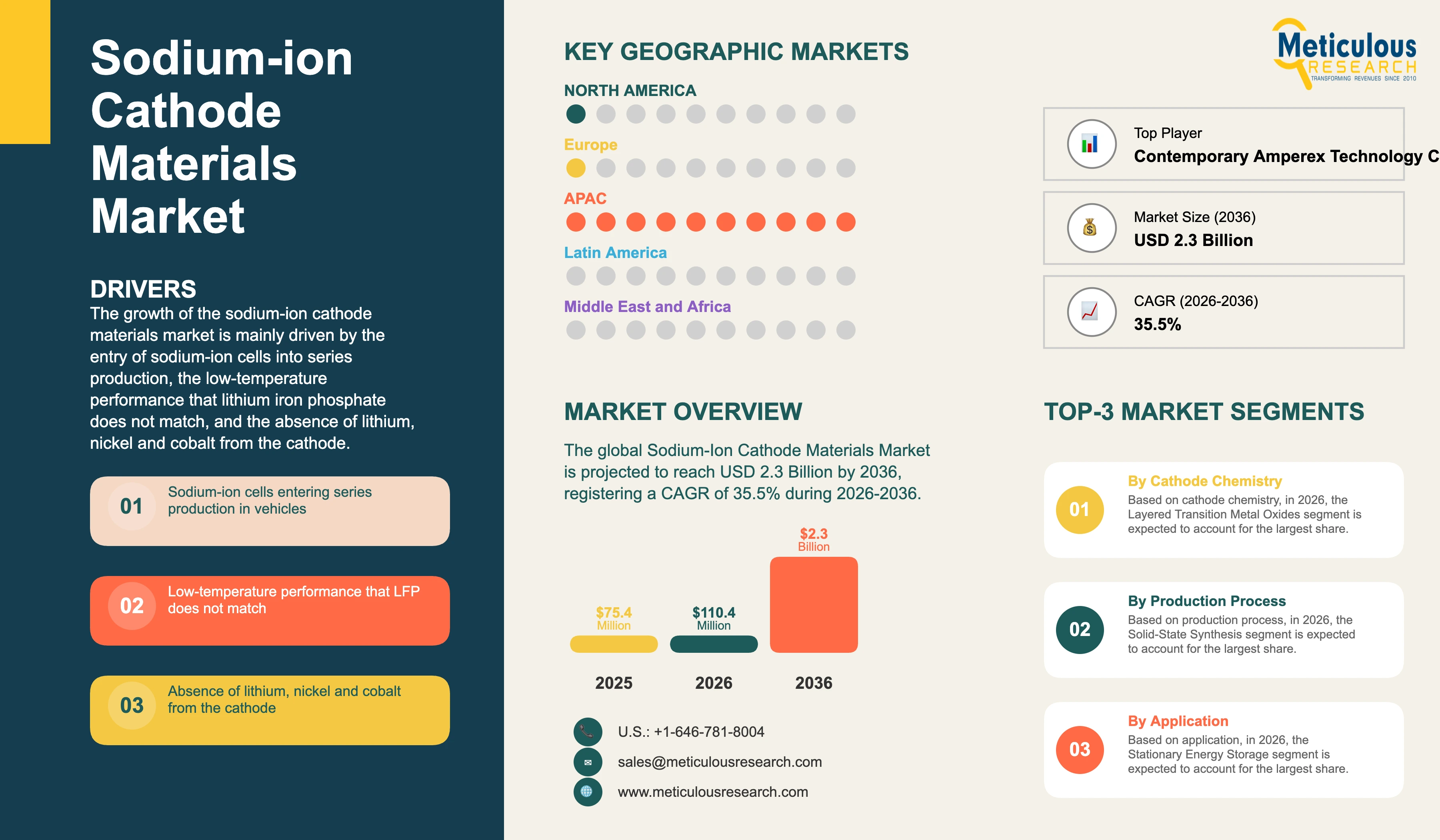
The global sodium-ion cathode materials market was valued at USD 75.4 million in 2025. This market is expected to reach USD 2.30 billion by 2036 from an estimated USD 110.4 million in 2026, registering a CAGR of 35.5% during the forecast period (2026-2036).
- Published
- Nov 2026
- Pages
- 275
- Format
- PDF + Excel
- Report ID
- MRCHM - 1042678
- Base year
- 2025
- 2025 · BASELINE
- $75.4M
- 2036
- $2.30B
- CAGR 2026–2036
- 35.5%
2025 baseline · 2026–2036 forecast at 35.5% CAGR · hover a bar for the value
Key highlights
The global sodium-ion cathode materials market is estimated at USD 110.4 million in 2026 and is projected to reach USD 2.30 billion by 2036.
Market volume is estimated at 9, 600.00 tonnes in 2026 and is projected to reach 320,022.62 tonnes by 2036 at a CAGR of 42.0%, measured as cathode active material supplied.
The average selling price is estimated at USD 11.50 per kg in 2026 and is projected to reach USD 7.20 per kg by 2036.
Layered transition metal oxides are expected to account for the largest chemistry share in 2026, while polyanionic compounds are projected to register the highest CAGR of 44.0%.
Solid-state synthesis is expected to hold the largest production process share in 2026, while co-precipitation is projected to grow fastest at a CAGR of 39.0%.
Stationary energy storage is expected to be the largest application in 2026, while electric passenger vehicles are projected to register the highest CAGR of 48.0%.
Asia-Pacific is expected to hold the largest regional share in 2026, while Europe is projected to register the highest CAGR of 45.0%.
Contemporary Amperex Technology Co., Limited and CHANGAN announced on 5 February 2026 the launch of the world first mass-production passenger vehicle equipped with sodium-ion batteries.
The announcement was made at Yakeshi in Inner Mongolia at the CHANGAN SDA Intelligence Milestone Release and Sodium-Ion Battery Global Strategy Launch event.
The vehicle is set to reach the market by the middle of 2026.
Naxtra sodium-ion batteries will be supplied across the CHANGAN brands AVATR, Deepal, Qiyuan and UNI.
The battery reaches an energy density of up to 175 Wh/kg.
Current pure-electric range is stated at more than 400 km, with projected pure-electric range of 500 to 600 km and projected range-extended operation of 300 to 400 km.
The companies state that those projected ranges would cover more than 50% of range requirements in the new energy vehicle market.
At minus 30 degrees Celsius the battery delivers nearly three times the discharge power of equivalent lithium iron phosphate batteries.
At minus 40 degrees Celsius it retains more than 90% of capacity, and at minus 50 degrees Celsius it delivers power stably.
The battery was crushed, drilled and sawed and is reported to have remained free of smoke and fire while continuing to provide power.
Contemporary Amperex Technology Co., Limited began sodium-ion research in 2016, has invested close to RMB 10 billion, has developed close to 300,000 test cells and has more than 300 research staff including 20 holders of doctorates.
More than 3,000 Choco-Swap battery swap stations are planned across 140 Chinese cities by 2026, including more than 600 in colder northern regions.
The announcement does not name the cathode chemistry used in the battery.
Report summary
| Particulars | Details |
|---|---|
| Base Year | 2025 |
| Forecast Period | 2026-2036 |
| Market Size in 2025 | USD 75.4 million |
| Market Size in 2026 | USD 110.4 million |
| Market Size by 2036 | USD 2.30 billion |
| Value CAGR (2026-2036) | 35.5% |
| Format | PDF, Excel & Cloud Portal · 275 pages |
| Volume in 2026 | 9,600.00 tonnes |
| Volume by 2036 | 320,022.62 tonnes |
| Volume CAGR (2026-2036) | 42.0% |
| Volume Basis | Sodium-ion cathode active material supplied |
| Average Selling Price in 2026 | USD 11.50 per kg |
| Average Selling Price by 2036 | USD 7.20 per kg |
| Commercialisation Status | Sodium-ion cells entered series production in a passenger vehicle announced on 5 February 2026 and reaching the market by the middle of 2026, with stationary storage remaining the largest application through the forecast period; the 2026 market size reflects qualification and early production quantities |
| Measurement Basis | Layered transition metal oxide, polyanionic and Prussian blue analogue cathode active materials in finished form, and excluding cathode precursors and the transition metal sulphates from which they are made, sodium carbonate and other sodium feedstocks, hard carbon and other anode materials, electrolytes, separators, current collectors, and finished cells and packs |
| Relationship to Adjacent Markets | This market measures finished cathode active material and is not additive to the cathode precursor or manganese sulphate markets upstream of it, nor to the cell and battery markets downstream, because the value of each step is carried forward into the next |
| Largest Cathode Chemistry | Layered transition metal oxides |
| Fastest-Growing Cathode Chemistry | Polyanionic compounds (CAGR 44.0%) |
| Largest Production Process | Solid-state synthesis |
| Fastest-Growing Production Process | Co-precipitation (CAGR 39.0%) |
| Largest Application | Stationary energy storage |
| Fastest-Growing Application | Electric passenger vehicles (CAGR 48.0%) |
| Largest Region | Asia-Pacific |
| Fastest-Growing Region | Europe (CAGR 45.0%) |
| Segments Covered | Cathode Chemistry, Production Process, Application, and Geography |
| Geographies Covered | Asia-Pacific, Europe, North America, Latin America, and Middle East & Africa |
| Companies Profiled | 10 companies, including Contemporary Amperex Technology Co., Limited, Beijing Easpring Material Technology Co., Ltd., Ningbo Ronbay New Energy Technology Co., Ltd., HiNa Battery Technology Co., Ltd., Umicore SA, and Altris AB |
Report overview
Segments covered: cathode chemistry, production process, application.
The growth of this market is mainly driven by the entry of sodium-ion cells into series production, including the first mass-production sodium-ion passenger vehicle that Contemporary Amperex Technology Co., Limited and CHANGAN announced on 5 February 2026, the low-temperature behaviour that no lithium iron phosphate cell matches, the absence of lithium, nickel and cobalt from the cathode, and the stationary storage installations where cost per cycle rather than energy density governs selection. However, factors such as the energy density that remains below lithium iron phosphate, the non-disclosure of cathode chemistry by the cell makers that would otherwise direct materials investment, the very small installed base against which cycle life claims can be verified, and the sensitivity of layered oxide chemistries to moisture during handling are expected to restrain the growth of this market to some extent.
A sodium-ion cathode material stores and releases sodium ions in a host structure, and three structural families compete to do it: layered transition metal oxides, polyanionic compounds and Prussian blue analogues. Market sizing in this report is on both a value basis in USD and a volume basis in tonnes measured as sodium-ion cathode active material supplied, with average selling price derived from the two. The measurement basis covers all three chemistry families in finished cathode active material form, and it excludes cathode precursors and the transition metal sulphates from which they are made, sodium carbonate and other sodium feedstocks, hard carbon and other anode materials, electrolytes, separators, current collectors, and the finished cells and packs into which the cathode material is built.
Measuring finished cathode active material rather than precursor matters because the two are consecutive positions in the same chain and the value of the precursor is carried forward into the cathode sold. Counting both would value the same transition metal twice. The same applies upstream to the manganese sulphate from which manganese-bearing sodium-ion cathodes are made, and downstream to the cells. This market therefore measures one step of the chain and is not additive to the markets either side of it.
Contemporary Amperex Technology Co., Limited and CHANGAN announced on 5 February 2026 at Yakeshi in Inner Mongolia the launch of the world first mass-production passenger vehicle equipped with sodium-ion batteries, set to reach the market by the middle of 2026, with Naxtra batteries to be supplied across the AVATR, Deepal, Qiyuan and UNI brands. The battery reaches up to 175 Wh/kg, delivers more than 400 km of pure-electric range now with 500 to 600 km projected, and at minus 30 degrees Celsius delivers nearly three times the discharge power of equivalent lithium iron phosphate batteries, retaining more than 90% of capacity at minus 40 degrees and delivering power stably at minus 50 degrees.
Series production in a passenger vehicle is a different order of evidence from a demonstration or a storage pilot. It commits a cathode material to automotive qualification, warranty exposure and a production schedule, and it places the chemistry in a product sold to retail buyers rather than to a utility procurement team. The supporting figures describe why: close to RMB 10 billion invested since research began in 2016, close to 300,000 test cells developed, more than 300 research staff including 20 holders of doctorates, and a battery reported to have remained free of smoke and fire after being crushed, drilled and sawed while continuing to provide power.
The announcement does not name the cathode chemistry, which is the central difficulty for a materials supplier in this market. A cell reaching 175 Wh/kg with that low-temperature behaviour could be built on a layered oxide, a polyanionic compound or a combination, and the three require different precursors, different synthesis equipment and different handling. Programme news therefore establishes that sodium-ion has entered production without establishing which chemistry family will be supplied at volume. Investment in this market is consequently made against a judgement rather than against a disclosed requirement.
Low-temperature behaviour rather than cost is the property that has opened the automotive application, and the figures make the case plainly. Lithium iron phosphate loses a large part of its deliverable power in severe cold, which is why cold-climate markets have resisted it, while the stated performance at minus 30, minus 40 and minus 50 degrees Celsius addresses exactly that gap. The plan for more than 600 of the 3,000 Choco-Swap stations to be sited in colder northern regions follows the same logic. Sodium-ion is therefore entering vehicles where lithium iron phosphate is weakest rather than competing with it generally.
Energy density remains the constraint and should be read honestly. At up to 175 Wh/kg the cell is in the range of lithium iron phosphate rather than ahead of it, and well below nickel-rich lithium-ion, so sodium-ion does not displace high-energy chemistries in long-range vehicles. The companies state the projected ranges would cover more than 50% of range requirements in the new energy vehicle market, which is a claim about the addressable part of that market rather than about all of it. The cathode material opportunity is correspondingly bounded by application rather than by total vehicle volume.
The absence of lithium, nickel and cobalt from the cathode is what makes the chemistry strategically interesting beyond its performance. Sodium is abundant and geographically dispersed, the current collector can be aluminium on both sides rather than copper, and the cathode can be built around manganese and iron, which are among the cheapest transition metals available. That removes exposure to the supply concentrations and price cycles that govern lithium-ion cathode procurement. Cost advantage depends on reaching scale, however, since a material made in qualification quantities is expensive whatever its inputs cost.
Stationary storage is where the volume sits today and will remain the largest application through the period. A grid or commercial installation is judged on cost per cycle, safety and siting approval rather than on mass or volume, which suits a chemistry with moderate energy density, strong thermal behaviour and inexpensive inputs. Polyanionic compounds fit that duty particularly well because their structural and thermal stability supports long cycle life, which is why they register the highest chemistry CAGR at 44.0% even though layered oxides hold the larger share.
Moisture sensitivity during handling is the practical problem that distinguishes this material from its lithium-ion equivalent. Sodium layered oxides react with atmospheric water and carbon dioxide to form surface species that raise impedance and consume capacity, so dry-room handling, controlled storage and tighter logistics are required from synthesis through to electrode coating. That raises the cost of manufacturing and shipping the material rather than the cost of making it. It is also why production is being established close to the cell plants it serves.
Asia-Pacific is expected to account for the largest share in 2026, on the cell capacity and cathode production located in China and the series production of the first sodium-ion passenger vehicle. India is projected to grow at 46.0%, South Korea at 37.4% and China at 33.2%.
Europe is projected to register the highest CAGR of 45.0% during the forecast period, with Germany at 46.6% and the United Kingdom at 42.0%.
Europe is the fastest-growing region at a CAGR of 45.0%, on storage deployment driven by grid connection and renewable integration, the cathode material developers established in the region, the cold-climate requirement across northern Europe, and the policy preference for chemistries that avoid lithium, nickel and cobalt supply concentration.
The Middle East & Africa is projected to grow at a CAGR of 31.0% and Latin America at a CAGR of 33.0%, both principally on stationary storage for grid support and off-grid supply rather than on vehicle or materials manufacturing.
Contemporary Amperex Technology Co., Limited, Beijing Easpring Material Technology Co., Ltd., Ningbo Ronbay New Energy Technology Co., Ltd., Hunan Changyuan Lico Co., Ltd. and HiNa Battery Technology Co., Ltd. together accounted for an estimated 56.2% of this market in 2026. The 10 companies profiled in this report together accounted for an estimated 78.4%, including captive production by integrated cell makers.
Report infographic
Market dynamics
15 factors across 5 forcesSodium-Ion Cells Entering Series Production in Vehicles
Contemporary Amperex Technology Co., Limited and CHANGAN announced on 5 February 2026 the launch of the world first mass-production passenger vehicle equipped with sodium-ion batteries, reaching the market by the middle of 2026 with Naxtra batteries supplied across the AVATR, Deepal, Qiyuan and UNI brands. Series production commits a cathode material to automotive qualification, warranty exposure and a production schedule rather than to a pilot. The driver acts by converting a demonstrated chemistry into a supply requirement with dates attached. Electric passenger vehicles register the highest application CAGR at 48.0%.
Multi-brand supply matters more than a single model would. A battery qualified across four vehicle brands is being engineered into several platforms at once, which gives the cathode supply chain volume visibility that a single launch does not provide and makes the qualification harder to reverse.
The commitment also reaches the cathode supply chain through warranty rather than through purchase orders alone. A vehicle battery carries a multi-year guarantee, so the cathode specification and its supplier are fixed for the life of the programme once the vehicle is homologated.
Low-Temperature Performance That Lithium Iron Phosphate Does Not Match
At minus 30 degrees Celsius the battery delivers nearly three times the discharge power of equivalent lithium iron phosphate batteries, retains more than 90% of capacity at minus 40 degrees and delivers power stably at minus 50 degrees, which addresses the specific weakness that has limited lithium iron phosphate in cold-climate markets. More than 600 of the 3,000 planned Choco-Swap stations are to be sited in colder northern regions on the same reasoning. The chemistry is therefore entering where the incumbent is weakest rather than competing across the board. That gives it a defensible application rather than a price argument.
The comparison also reframes what the energy density figure means. A cell with lower nominal energy that still delivers its power in severe cold can outperform a denser cell in service, so the useful capacity of a cold-climate pack is not read from its rating alone.
Absence of Lithium, Nickel and Cobalt From the Cathode
Sodium is abundant and geographically dispersed, the cathode can be built around manganese and iron rather than nickel and cobalt, and the current collector can be aluminium on both sides rather than copper, which removes exposure to the supply concentrations and price cycles that govern lithium-ion cathode procurement. A buyer adopting the chemistry is purchasing independence from those markets as well as a material. The advantage is structural rather than cyclical, which is why it survives periods of weak lithium prices. It is also why cell makers have continued development through such periods.
The aluminium current collector on both sides is a further saving that is often overlooked, since copper foil is a significant part of cell cost and its removal reduces both material cost and cell weight without affecting the cathode specification.
Stationary Storage Judged on Cost Per Cycle Rather Than Energy Density
A grid or commercial storage installation is constrained by cost per cycle, safety and siting approval rather than by mass or volume, which suits a chemistry with moderate energy density, strong thermal behaviour and inexpensive inputs, and the duty cycle is gentler than a vehicle imposes. The application therefore accepts sodium-ion on its merits rather than as a compromise. It is also where the first commercial volumes were installed, which provides the operating record that automotive qualification draws on. Stationary energy storage remains the largest application through the forecast period.
Storage demand is also less cyclical than vehicle demand, because it follows grid connection queues and renewable build rather than consumer purchasing, which gives a cathode producer a base load against which to plan capacity.
Table of contents
11 chapters · 131 sections · 275 pages · click to expandSegmental analysis
| Segment | Largest share (2026) | Fastest growth (2026–2036) |
|---|---|---|
| By Cathode Chemistry | Layered transition metal oxides | Polyanionic compounds |
| By Production Process | Solid-state synthesis | Co-precipitation |
| By Application | Stationary energy storage | Electric passenger vehicles |
| Other segments | Solid-state synthesis | Co-precipitation |
By Cathode Chemistry
- Sodium-Ion Cathode Materials Analysis by Cathode Chemistry
- The layered transition metal oxides segment is expected to account for the largest share of the global sodium-ion cathode materials market.
- The large share of this segment is mainly due to the highest specific capacity of the three chemistry families, the synthesis routes being closely related to those already used for lithium-ion cathode material, and the ability of established cathode producers to qualify compositions on equipment and process knowledge already in place.
- However, the polyanionic compounds segment is projected to register the highest CAGR of 44.0% during the forecast period.
- The rapid growth of this segment is attributed to structural frameworks that hold through repeated sodium extraction and insertion, thermal tolerance better than layered oxides, markedly lower moisture sensitivity in handling, and the long cycle life that the stationary storage duty where sodium-ion is being adopted first is purchased on.
- Prussian blue analogues hold the third position, offering an open framework that accommodates sodium readily and inexpensive iron-based inputs, at the cost of structural water that is difficult to remove completely and a lower density that reduces volumetric performance.
- Chemistry selection follows the duty: energy density for vehicles, cycle life and thermal behaviour for storage, cost for entry-level applications.
- That is why all three families remain in commercial development rather than one prevailing, and why a materials producer cannot treat the choice as settled.
- Chemistry also determines the upstream feedstock a producer must secure.
- A manganese-based layered oxide draws on manganese sulphate, an iron phosphate polyanionic compound on iron and phosphate inputs, and a Prussian blue analogue on iron and cyanide chemistry, so the composition decision commits a producer to a procurement position as well as to a process.
- Layered transition metal oxides are expected to account for the largest share in 2026, on the highest specific capacity of the three families and synthesis routes closely related to lithium-ion cathode production.
- Polyanionic compounds are projected to register the highest CAGR of 44.0% during the forecast period.
By Production Process
- Sodium-Ion Cathode Materials Analysis by Production Process
- The solid-state synthesis segment is expected to account for the largest share of the global sodium-ion cathode materials market.
- The large share of this segment is mainly due to the simplicity of calcining mixed solid precursors without a wet stage, the lower capital intensity and water consumption that follows, and the suitability of the route to the manganese and iron-based layered compositions on which most early production is based.
- However, the co-precipitation segment is projected to register the highest CAGR of 39.0% during the forecast period.
- The rapid growth of this segment is attributed to the control it gives over particle morphology, size distribution and elemental homogeneity, which determine electrode density and rate capability, and to the automotive qualification requirements that make that control necessary as sodium-ion moves from storage into vehicles.
- Sol-gel and spray pyrolysis routes hold a smaller position, used where composition uniformity at fine scale or a specific particle architecture matters more than cost, including for polyanionic compositions that are difficult to make homogeneously by solid-state routes.
- Process selection is tied to chemistry rather than chosen independently, since a polyanionic compound and a layered oxide impose different mixing, atmosphere and temperature requirements.
- The process decision therefore commits capital at plant design and is difficult to revisit afterwards.
- Process choice also sets how quickly a producer can respond to a change in specification.
- A co-precipitation line can adjust particle morphology and composition within its existing equipment, while a solid-state line is tuned to a narrower range, so the lower capital cost of solid-state synthesis is paid for in flexibility later.
By Application
- Sodium-Ion Cathode Materials Analysis by Application
- The stationary energy storage segment is expected to account for the largest share of the global sodium-ion cathode materials market.
- The large share of this segment is mainly due to installations being judged on cost per cycle, safety and siting approval rather than on mass or volume, the gentler duty cycle than a vehicle imposes, and the first commercial sodium-ion volumes having been installed in storage, which provides the operating record that later applications draw on.
- However, the electric passenger vehicles segment is projected to register the highest CAGR of 48.0% during the forecast period.
- The rapid growth of this segment is attributed to the first mass-production sodium-ion passenger vehicle announced on 5 February 2026 reaching the market by the middle of 2026 with supply across four vehicle brands, together with low-temperature performance at minus 30, minus 40 and minus 50 degrees Celsius that addresses the specific weakness of lithium iron phosphate in cold climates.
- Two and three wheelers take sodium-ion where purchase cost and cold-weather starting matter more than range, and the duty cycle is well within the capability of the chemistry.
- Start-stop and auxiliary batteries are a natural replacement for lead-acid on weight, cycle life and cold performance together.
- Other applications cover telecom backup, industrial equipment and marine use.
- Application mix rather than total battery demand governs this market, because the chemistry is being allocated to duties rather than competing for all of them.
- The applications also differ in what they will pay.
- Storage buys on cost per cycle and resists price, vehicles accept a premium for cold-weather capability, and start-stop replacement competes against lead-acid rather than against lithium-ion, so the average selling price in this market is set by the mix of those buyers as much as by production cost.
Other segments
- Solid-state synthesis is expected to hold the largest share in 2026, on the simplicity of calcining mixed solid precursors without a wet stage and the lower capital intensity that follows.
- Co-precipitation is projected to register the highest CAGR of 39.0% during the forecast period.
- Stationary energy storage is expected to account for the largest share in 2026, on installations being judged on cost per cycle, safety and siting approval rather than on mass or volume.
- Electric passenger vehicles are projected to register the highest CAGR of 48.0% during the forecast period.
Geographic analysis
Asia-Pacific
Largest shareIn 2026, Asia-Pacific is expected to account for the largest share of the global sodium-ion cathode materials market. The large share of this region is mainly due to the cell capacity and cathode production located in China, the series production of the first sodium-ion passenger vehicle announced on 5 February 2026 together with the plan for more than 3,000 Choco-Swap stations across 140 Chinese cities by 2026, and the storage installations that provided the first commercial volumes. China is projected to register a CAGR of 33.2%, South Korea a CAGR of 37.4%, Japan a CAGR of 36.0% and India a CAGR of 46.0% during the forecast period.
Europe
Fastest growthHowever, Europe is projected to register the highest CAGR of 45.0% during the forecast period. The rapid growth of this region is attributed to storage deployment driven by grid connection and renewable integration, the cathode material developers established in the region, the cold-climate vehicle and storage requirement across northern Europe, and the policy preference for chemistries that avoid lithium, nickel and cobalt supply concentration. Germany is projected to register a CAGR of 46.6% and the United Kingdom a CAGR of 42.0%.
North America
North America is projected to grow at 42.0%, with the United States at 42.8%, on storage deployment and on the critical mineral sourcing requirements that favour chemistries without lithium, nickel or cobalt, though from a very small base and without the cell capacity that anchors demand in Asia-Pacific.
Latin America
Latin America is projected to grow at 33.0% and the Middle East & Africa at 31.0%, both principally on stationary storage for grid support and off-grid supply rather than on vehicle or materials manufacturing. Regional share in this market follows cell assembly rather than resource location, which is the opposite of the position for lithium-ion cathode material. Sodium, manganese and iron are widely available and none of them concentrates the supply chain, so there is no orebody determining where production is located, while moisture sensitivity and qualification tie cathode plants to the cell capacity they serve. A region therefore acquires a cathode industry by building cells rather than by holding resources, which is why public support outside Asia-Pacific is directed at cell capacity and why cathode investment follows it rather than leading it. A region without cell plants will import finished cathode material or finished cells whatever its mineral position, so a mineral endowment confers no position in this market, and the sequence runs from cells to cathode rather than the reverse. resources.
Competitive landscape
The global sodium-ion cathode materials market is characterised by the presence of Chinese cathode active material producers qualifying sodium-ion compositions on lithium-ion equipment, integrated cell makers producing cathode material for their own cells, and European and Japanese specialists developing particular chemistry families. Competition is contested on qualification into a specific cell design and on proximity to the cell plant rather than on price alone, because moisture sensitivity limits shipping distance and requalification means revalidating electrode and cell performance. Contemporary Amperex Technology Co., Limited, Beijing Easpring Material Technology Co., Ltd., Ningbo Ronbay New Energy Technology Co., Ltd., Hunan Changyuan Lico Co., Ltd. and HiNa Battery Technology Co., Ltd. together accounted for an estimated 56.2% of this market in 2026, while the companies profiled in this report together accounted for an estimated 78.4%. These shares include captive production by integrated cell makers, which is a substantial part of this market.
Contemporary Amperex Technology Co., Limited and CHANGAN announced on 5 February 2026 the launch of the world first mass-production sodium-ion passenger vehicle, reaching the market by the middle of 2026 with Naxtra batteries across the AVATR, Deepal, Qiyuan and UNI brands, at up to 175 Wh/kg with more than 400 km of pure-electric range and nearly three times the discharge power of equivalent lithium iron phosphate batteries at minus 30 degrees Celsius. Qualification of compositions into cell designs, conversion of lithium-ion cathode capacity to sodium-ion production, and development of iron and manganese-based alternatives to vanadium and nickel-containing compositions accounted for most competitive activity through 2026.
Manufacturing position rather than composition separates the competitors, because a better material without a qualified plant close to a cell line cannot be supplied. Beijing Easpring Material Technology Co., Ltd., Ningbo Ronbay New Energy Technology Co., Ltd. and Hunan Changyuan Lico Co., Ltd. compete from established cathode active material production, Contemporary Amperex Technology Co., Limited and HiNa Battery Technology Co., Ltd. from integrated cell development, and Umicore SA, Sumitomo Chemical Company, Limited, Altris AB, Tiamat SAS and Reliance Industries Limited from regional positions and particular chemistry families. Some of the key players operating in the sodium-ion cathode materials market are Contemporary Amperex Technology Co., Limited (China), Beijing Easpring Material Technology Co., Ltd. (China), Ningbo Ronbay New Energy Technology Co., Ltd. (China), Hunan Changyuan Lico Co., Ltd. (China), HiNa Battery Technology Co., Ltd. (China), Umicore SA (Belgium), Sumitomo Chemical Company, Limited (Japan), Altris AB (Sweden), Tiamat SAS (France), and Reliance Industries Limited (India), among others.
- —
Contemporary Amperex Technology Co., Limited and CHANGAN announced on 5 February 2026 at Yakeshi in Inner Mongolia the launch of the world first mass-production passenger vehicle equipped with sodium-ion batteries, set to reach the market by the middle of 2026, with Naxtra batteries to be supplied across the AVATR, Deepal, Qiyuan and UNI brands. The battery reaches an energy density of up to 175 Wh/kg, delivers more than 400 km of pure-electric range with 500 to 600 km projected and 300 to 400 km in range-extended operation, and the companies state those projected ranges would cover more than 50% of range requirements in the new energy vehicle market. At minus 30 degrees Celsius the battery delivers nearly three times the discharge power of equivalent lithium iron phosphate batteries, retains more than 90% of capacity at minus 40 degrees and delivers power stably at minus 50 degrees, and it is reported to have remained free of smoke and fire while continuing to provide power after being crushed, drilled and sawed. The company began sodium-ion research in 2016, has invested close to RMB 10 billion, has developed close to 300,000 test cells and has more than 300 research staff including 20 holders of doctorates, and more than 3,000 Choco-Swap battery swap stations are planned across 140 Chinese cities by 2026, including more than 600 in colder northern regions. The announcement does not name the cathode chemistry.
- Contemporary Amperex Technology Co., Limited
- Beijing Easpring Material Technology Co., Ltd.
- Ningbo Ronbay New Energy Technology Co., Ltd.
- HiNa Battery Technology Co., Ltd.
- Umicore SA
- Altris AB
Expert perspectives
Volume grows at 42.0% against 35.5% in value over the forecast period, and the average selling price falls from USD 11.50 per kg in 2026 to USD 7.20 per kg by 2036 as synthesis moves from qualification quantities to continuous production in plants sized for the application. The growth rate describes a base effect as much as a market: USD 110.4 million in 2026 is a small number, and percentage growth and absolute quantity are separate facts.
What changed in February 2026 was the category of evidence rather than the volume. A mass-production passenger vehicle reaching the market by mid-2026 with batteries across four brands commits a cathode material to automotive qualification, warranty exposure and a production schedule, which a storage pilot does not. That is why the application growth rate sits at 48.0% even though stationary storage remains the larger segment throughout.
The case for the chemistry rests on cold weather rather than on cost. Nearly three times the discharge power of equivalent lithium iron phosphate at minus 30 degrees Celsius, more than 90% capacity retention at minus 40 and stable power at minus 50 address the specific weakness that has limited lithium iron phosphate in cold markets, and more than 600 of the 3,000 planned swap stations are sited in colder northern regions on that reasoning. Sodium-ion is entering where the incumbent is weakest.
Energy density sets the boundary and should not be read past. Up to 175 Wh/kg places the cell alongside lithium iron phosphate rather than ahead of it and well below nickel-rich lithium-ion, and the stated claim is that projected ranges would cover more than 50% of range requirements in the new energy vehicle market. That is a claim about the addressable part, so the cathode opportunity is bounded by application rather than by total vehicle production.
The hardest problem for a supplier is that the chemistry is not disclosed. The announcement gives energy density, range and cold performance and does not name the cathode, and a cell meeting those figures could be built on a layered oxide, a polyanionic compound or a combination needing different precursors, equipment and handling. Capacity is therefore committed against a judgement, and a wrong one means a plant built for a chemistry the industry did not adopt.
Where production is located follows cells rather than resources, which is the opposite of lithium-ion cathode material. Sodium, manganese and iron concentrate nothing, while moisture sensitivity limits shipping distance and qualification ties a plant to a cell line, so a region acquires this industry by building cells. That is why conversion of existing lithium-ion cathode capacity is the most likely entry route and why established producers rather than specialists hold most identified supply.
Customer perspectives
Cold-weather power delivery rather than nominal range is the deciding property in cold-climate vehicle markets, which is where sodium-ion addresses a gap that lithium iron phosphate has not closed.
Cycle life is the figure storage installations are purchased on and it cannot be demonstrated faster than real time, so buyers are accepting technical risk that falls on the cathode material as much as on the cell.
Because sodium-ion layered oxides are made by routes closely related to lithium-ion cathode production, established producers can qualify compositions on existing equipment rather than building new capacity, which shortens entry considerably and lets them carry both chemistries on one site while the division of duties between them is still being settled, which is a flexibility a new entrant does not have.
Conversion of existing capacity is consequently the most likely route by which supply outside China grows, rather than the entry of specialist producers with new compositions.
“In our northern markets the question customers ask is what happens in February, not what the range figure says in a brochure. A cell that still delivers power at minus thirty solves a complaint we have never been able to answer properly.”
“We buy on cost per cycle over twenty years, and nobody can show me twenty years of sodium-ion data because it does not exist yet. So we are running it in parallel on real sites and sizing our commitments to what we can afford to be wrong about.”
“We are not building a new plant for this. The calcining line and the analytical lab we already have for lithium-ion do the job, and the composition work is the part that is genuinely new. That is what makes it worth doing at this volume.”
Frequently asked questions
This market was valued at USD 46.5 million in 2024 and USD 75.4 million in 2025, and is estimated at USD 110.4 million in 2026. In volume terms it is estimated at 9,600.00 tonnes in 2026 as cathode active material supplied.
Cite this report
Meticulous Research. (2026). Sodium-Ion Cathode Materials Market - Global Opportunity Analysis and Industry Forecast (2026-2036) (Report No. MRCHM - 1042678). Meticulous Market Research Pvt. Ltd. https://www.meticulousresearch.com/product/sodium-ion-cathode-materials-market-7361