Electrolyte Additives for Batteries Market (2026-2036)
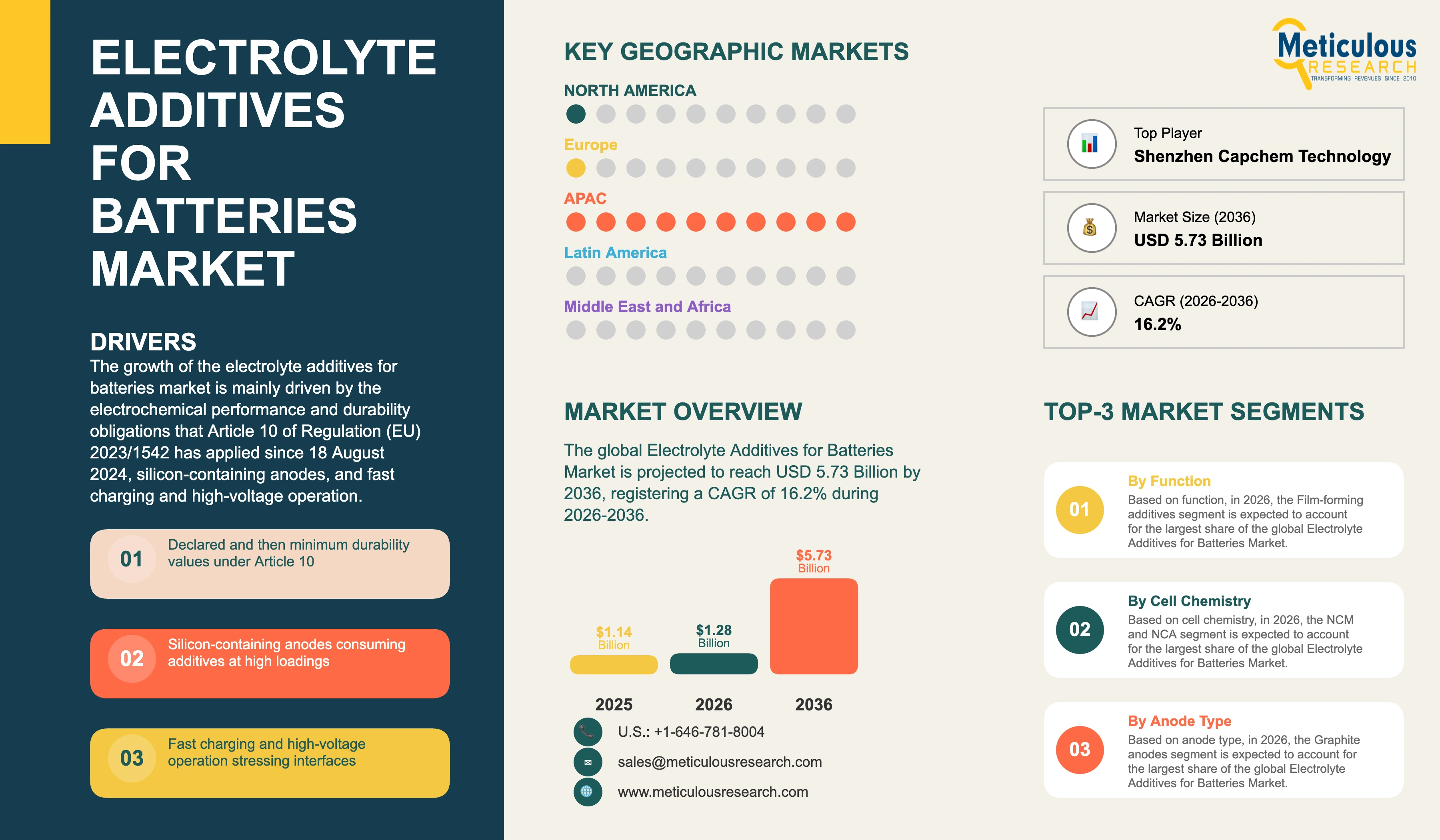
The global electrolyte additives for batteries market was valued at USD 1.14 billion in 2025. This market is expected to reach USD 5.73 billion by 2036 from an estimated USD 1.28 billion in 2026, registering a CAGR of 16.2% during the forecast period (2026-2036).
- Published
- Nov 2026
- Pages
- 248
- Format
- PDF + Excel
- Report ID
- MRCHM - 1042670
- Base year
- 2025
- 2025 · BASELINE
- $1.14B
- 2036
- $5.73B
- CAGR 2026–2036
- 16.2%
2025 baseline · 2026–2036 forecast at 16.2% CAGR · hover a bar for the value
Key highlights
The global electrolyte additives for batteries market is estimated at USD 1.28 billion in 2026 and is projected to reach USD 5.73 billion by 2036.
Market volume is estimated at 58.00 kilotons in 2026 and is projected to reach 293.43 kilotons by 2036 at a CAGR of 17.6%, measured as additive material supplied rather than formulated electrolyte.
The average selling price is estimated at USD 22.00 per kg in 2026 and is projected to reach USD 19.52 per kg by 2036.
Film-forming additives are expected to account for the largest function share in 2026, while lithium salt additives are projected to register the highest CAGR of 22.4%.
NCM and NCA chemistries are expected to hold the largest cell chemistry share in 2026, while sodium-ion and other emerging chemistries are projected to grow fastest at a CAGR of 27.6%.
Graphite anodes are expected to be the largest anode type served in 2026, while silicon-containing anodes are projected to register the highest CAGR of 26.2%.
Electric vehicles are expected to account for the largest application share in 2026, while stationary energy storage is projected to grow fastest at a CAGR of 20.6%.
Asia-Pacific is expected to hold the largest regional share in 2026, while Europe is projected to register the highest CAGR of 21.8%.
Article 10(1) of Regulation (EU) 2023/1542 has required since 18 August 2024 that rechargeable industrial batteries, LMT batteries and electric vehicle batteries be accompanied by a document giving values for the parameters in Annex IV Part A.
The technical documentation under Annex VIII must explain the specifications, standards and conditions used to measure, calculate or estimate those values, including the elements in Annex IV Part B.
Article 10(2) requires rechargeable industrial batteries above 2 kWh, excluding those with exclusively external storage, to meet minimum values from 18 August 2027 or 18 months after the relevant delegated act enters into force, whichever is later.
Article 10(3) requires LMT batteries to meet minimum values from 18 August 2028 or 18 months after that delegated act enters into force, whichever is later.
Article 10(5) requires the Commission to adopt minimum values for rechargeable industrial batteries above 2 kWh by 18 February 2026 and for LMT batteries by 18 February 2027.
Article 10(4) exempts batteries that have undergone preparation for re-use, preparation for repurposing, repurposing or remanufacturing where the operator shows the battery was placed on the market or put into service before those obligations applied.
Article 10(6) allows the Commission to amend the Annex IV parameters by delegated act in light of market developments and technical and scientific progress.
Article 9 requires portable batteries of general use, excluding button cells, to meet the minimum values in Annex III from 18 August 2028 or 24 months after the relevant delegated act enters into force, whichever is later.
Article 9(2) requires the Commission to adopt that delegated act by 18 August 2027.
Article 9(3) requires the Commission to assess by 31 December 2030 the feasibility of phasing out non-rechargeable portable batteries of general use.
Report summary
| Particulars | Details |
|---|---|
| Base Year | 2025 |
| Forecast Period | 2026-2036 |
| Market Size in 2025 | USD 1.14 billion |
| Market Size in 2026 | USD 1.28 billion |
| Market Size by 2036 | USD 5.73 billion |
| Value CAGR (2026-2036) | 16.2% |
| Format | PDF, Excel & Cloud Portal · 248 pages |
| Volume in 2026 | 58.00 kilotons |
| Volume by 2036 | 293.43 kilotons |
| Volume CAGR (2026-2036) | 17.6% |
| Volume Basis | Additive material supplied, not formulated electrolyte |
| Average Selling Price in 2026 | USD 22.00 per kg |
| Average Selling Price by 2036 | USD 19.52 per kg |
| Measurement Basis | Functional compounds blended into battery electrolyte at low loadings, covering film-forming and interface additives, lithium salt additives used at additive loadings, safety and flame retardant additives, overcharge protection additives, acid and water scavengers and stabilisers, and wetting and low-temperature additives, and excluding the primary conducting salt, the base carbonate and ether solvents, the finished formulated electrolyte, solid and polymer electrolytes and their precursors, separators, binders and conductive carbons |
| Largest Function | Film-forming additives |
| Fastest-Growing Function | Lithium salt additives (CAGR 22.4%) |
| Largest Cell Chemistry | NCM and NCA |
| Fastest-Growing Cell Chemistry | Sodium-ion and other emerging chemistries (CAGR 27.6%) |
| Largest Anode Type | Graphite anodes |
| Fastest-Growing Anode Type | Silicon-containing anodes (CAGR 26.2%) |
| Largest Application | Electric vehicles |
| Fastest-Growing Application | Stationary energy storage (CAGR 20.6%) |
| Largest Region | Asia-Pacific |
| Fastest-Growing Region | Europe (CAGR 21.8%) |
| Segments Covered | Function, Cell Chemistry, Anode Type, Application, and Geography |
| Geographies Covered | Asia-Pacific, Europe, North America, Latin America, and Middle East & Africa |
| Companies Profiled | 11 companies, including Shenzhen Capchem Technology Co., Ltd., Guangzhou Tinci Materials Technology Co., Ltd., Mitsubishi Chemical Group Corporation, Central Glass Co., Ltd., UBE Corporation, and Arkema S.A. |
Report overview
Segments covered: function, cell chemistry, anode type, application.
In volume terms, this market is estimated at 58.00 kilotons in 2026 and is projected to reach 293.43 kilotons by 2036, registering a CAGR of 17.6% during the same period, measured as additive material supplied rather than as formulated electrolyte, of which additives are a small weight fraction. The average selling price is estimated at USD 22.00 per kg in 2026 and is projected to decline to USD 19.52 per kg by 2036 as the higher-volume film formers and lithium salt additives scale toward commodity production economics while the specialised functional additives retain their premium.
The growth of this market is mainly driven by the electrochemical performance and durability obligations that Article 10 of Regulation (EU) 2023/1542 has applied since 18 August 2024 and extends to minimum values from 18 August 2027, the silicon-containing anodes whose volume change consumes film-forming additives at loadings graphite never required, the fast charging and high-voltage operation that place the electrode interfaces under conditions a base electrolyte cannot survive alone, and the growth of cell production itself. However, factors such as the small weight fraction an additive occupies in a cell and the consequent difficulty of capturing value for a performance contribution, and the long qualification cycles that tie an additive to a cell design once validated, are expected to restrain the growth of this market to some extent.
Film-forming additives account for the largest share of this market because the solid electrolyte interphase they build on the anode in the first charge determines the cycle life and calendar life of the cell, and no cell is manufactured without them. Lithium salt additives grow faster because they improve conductivity, low-temperature performance and thermal stability in ways the primary conducting salt cannot, and because they are the route by which fast-charge capability is delivered without changing the electrode materials.
Electrolyte additives are the functional compounds blended into a battery electrolyte at low loadings to control interface formation, safety behaviour, conductivity and ageing. Market sizing in this report is on both a value basis in USD and a volume basis in kilotons measured as additive material supplied rather than as formulated electrolyte, with average selling price derived from the two. The measurement basis covers film-forming and interface additives, lithium salt additives used at additive loadings, safety and flame retardant additives, overcharge protection additives, acid and water scavengers and stabilisers, and wetting and low-temperature additives, and it excludes the primary conducting salt, the base carbonate and ether solvents, the finished formulated electrolyte, solid and polymer electrolytes and their precursors, separators, binders and conductive carbons.
Separating additives from the electrolyte they are blended into is the only way to make this market measurable, and it is also what makes the figure small relative to its importance. Additives are a few per cent of electrolyte by weight but they determine whether a cell achieves the cycle life, calendar life and safety behaviour it was designed for, so a market of this size governs the performance of a battery industry orders of magnitude larger. Measuring formulated electrolyte instead would track solvent and conducting salt consumption and would hide the additive dynamic entirely. The additive is where the formulation intellectual property sits.
Article 10(1) of Regulation (EU) 2023/1542 has required since 18 August 2024 that rechargeable industrial batteries, LMT batteries and electric vehicle batteries be accompanied by a document giving values for the parameters in Annex IV Part A, with the technical documentation under Annex VIII explaining the specifications, standards and conditions used to measure, calculate or estimate those values including the elements in Annex IV Part B. Article 10(2) requires rechargeable industrial batteries above 2 kWh, excluding those with exclusively external storage, to meet minimum values from 18 August 2027 or 18 months after the relevant delegated act enters into force, whichever is later, and Article 10(3) applies the same structure to LMT batteries from 18 August 2028. Article 10(5) requires the Commission to adopt those minimum values by 18 February 2026 for industrial batteries above 2 kWh and by 18 February 2027 for LMT batteries.
The structure of Article 10 is worth reading closely because the obligations fall unevenly. Paragraph 1 applies the documentation requirement to industrial, LMT and electric vehicle batteries alike, while paragraphs 2 and 3 set minimum values only for rechargeable industrial batteries above 2 kWh and for LMT batteries, leaving electric vehicle batteries subject to declaration rather than to a floor. The durability requirement therefore bites first on stationary and industrial applications and on light means of transport, which is the opposite of where the volume sits. Paragraph 6 allows the Commission to amend the Annex IV parameters as the market and the technology move, so the scope is deliberately not fixed.
Making durability a declared value changes the commercial position of an additive even before any minimum applies. A cell maker that must publish performance and durability parameters and explain how they were measured can no longer treat cycle life as a specification it negotiates privately with each customer, and the additive package is the cheapest lever available for improving a declared figure without changing electrodes, format or plant. An additive therefore moves from a formulation detail toward a compliance input. That shift is what converts a performance argument into a purchasing requirement.
Film formation is the function on which everything else rests. On the first charge of a cell the electrolyte reduces at the anode surface to build a solid electrolyte interphase that must conduct lithium while blocking further electrolyte decomposition, and the composition of that layer is set by the additives present rather than by the base solvent. A well-formed interphase gives years of cycling, and a poorly formed one gives continuous consumption of electrolyte and lithium inventory. Every cell made contains film-forming additives for this reason, which is why they hold the largest share of the market.
Silicon changes the arithmetic of additive consumption rather than merely adding to it. A silicon-bearing anode expands and contracts far more than graphite through each cycle, which repeatedly cracks the interphase and exposes fresh surface that consumes more additive to re-passivate, so a silicon cell requires both higher additive loadings and additives designed for a surface that keeps moving. The effect is multiplicative with cell volume rather than additive to it. Silicon-containing anodes consequently register the highest anode type CAGR at 26.2%.
Fast charging and high-voltage operation push the same interfaces beyond what a base electrolyte tolerates. Charging at high rate drives lithium plating risk at the anode and accelerates oxidation at the cathode, and raising the upper cut-off voltage to extract more energy accelerates it further, so additives are required at both electrodes to stabilise surfaces that would otherwise degrade within a few hundred cycles. Those are also the two levers a cell maker uses to differentiate a product without changing its materials set. Additive content therefore rises with each increment of charging rate or operating voltage.
Lithium salt additives occupy the fastest-growing function because they act on properties the primary conducting salt sets badly. Added at additive loadings they raise conductivity, improve low-temperature behaviour, reduce the acid generation that attacks electrode surfaces and contribute to interphase composition, which together deliver fast-charge capability and cold-weather performance without a change of electrode materials. They cost considerably more per kilogram than carbonate film formers, so their growth lifts value as well as volume. Lithium salt additives register the highest function CAGR at 22.4%.
Qualification is what makes this market defensible and also slow. An additive package is validated through formation, cycle life, calendar life, abuse and low-temperature testing on a specific cell design, which takes long enough that a change of supplier or composition means repeating the programme, so a qualified additive holds its position for the production life of the cell. The barrier protects the incumbent and delays the newcomer in equal measure. Positions won during the current round of cell development will therefore persist well into the forecast period.
NCM and NCA chemistries are expected to hold the largest share in 2026, on the cell volume they represent and the additive loadings high-nickel surfaces demand.
Sodium-ion and other emerging chemistries are projected to register the highest CAGR of 27.6% during the forecast period, from the smallest base.
Graphite anodes are expected to account for the largest share in 2026, as graphite remains the anode in almost every cell in production.
Silicon-containing anodes are projected to register the highest CAGR of 26.2% during the forecast period.
Electric vehicles are expected to hold the largest share in 2026, on cell volume and on the fast charging and high-voltage operation that raise additive content per cell.
Stationary energy storage is projected to register the highest CAGR of 20.6% during the forecast period.
Asia-Pacific is expected to account for the largest share in 2026, on the concentration of cell manufacturing in China, South Korea and Japan and the electrolyte producers with integrated additive synthesis located alongside those plants. South Korea is projected to grow at 16.8% and China at 14.6%.
Europe is projected to register the highest CAGR of 21.8% during the forecast period, with Germany at 22.4% and Poland at 21.6%, both from a small base.
Europe is projected to grow at a CAGR of 21.8%, the highest of the regions, supported by the performance and durability obligations that Article 10 of Regulation (EU) 2023/1542 has applied since 18 August 2024 and extends to minimum values from 18 August 2027, the delegated acts that Article 10(5) requires by 18 February 2026 and 18 February 2027, the cell capacity being built that requires locally qualified electrolyte supply, and the fine chemical and fluorochemical capability already present among European producers.
The Middle East & Africa is projected to grow at a CAGR of 15.0% and Latin America at a CAGR of 16.0%, both from very small bases and almost entirely through imported electrolyte rather than local additive manufacture.
Shenzhen Capchem Technology Co., Ltd., Guangzhou Tinci Materials Technology Co., Ltd., Mitsubishi Chemical Group Corporation, Central Glass Co., Ltd. and UBE Corporation together accounted for an estimated 44.6% of this market in 2026. The 11 companies profiled in this report together accounted for an estimated 68.4%.
Report infographic
Market dynamics
15 factors across 5 forcesDeclared and Then Minimum Durability Values Under Article 10
Article 10(1) of Regulation (EU) 2023/1542 has required since 18 August 2024 that rechargeable industrial batteries, LMT batteries and electric vehicle batteries carry a document giving values for the Annex IV Part A parameters, with Annex VIII technical documentation explaining how those values were measured, calculated or estimated. Article 10(2) and 10(3) then set minimum values for rechargeable industrial batteries above 2 kWh from 18 August 2027 and for LMT batteries from 18 August 2028, with the Commission required by Article 10(5) to adopt those values by 18 February 2026 and 18 February 2027 respectively. The additive package is the cheapest route to improving a declared durability figure without changing electrodes, format or plant. A performance argument therefore becomes a compliance requirement. Article 10(6) also allows the Commission to amend the Annex IV parameters in light of market developments and technical and scientific progress, so the scope of what must be declared is deliberately not fixed, and a supplier cannot treat a current package as settled against a requirement that will stay still.
Silicon-Containing Anodes Consuming Additives at Loadings Graphite Never Required
A silicon-bearing anode expands and contracts far more than graphite through each cycle, repeatedly cracking the solid electrolyte interphase and exposing fresh surface that consumes additive to re-passivate, so a silicon cell needs both higher loadings and additives formulated for a surface that keeps moving. The requirement scales with the silicon content rather than appearing only at full replacement, so even modest silicon fractions in otherwise graphite anodes raise additive consumption per cell. That makes the effect multiplicative with cell volume rather than additive to it. Silicon-containing anodes register the highest anode type CAGR at 26.2%. Because the requirement tracks silicon content rather than a change of anode generation, it builds through the forecast period rather than arriving at a single point in it, and it applies to blended graphite anodes as well as to fully silicon ones, which is where most of the near-term volume sits.
Fast Charging and High-Voltage Operation Stressing Both Electrode Interfaces
Charging at high rate raises the risk of lithium plating at the anode and accelerates electrolyte oxidation at the cathode, and raising the upper cut-off voltage to extract more energy from the same materials accelerates the cathode side further, so additives are required at both electrodes to stabilise surfaces that would otherwise degrade within a few hundred cycles. Those are also the two levers by which a cell maker differentiates a product without changing its materials set or its plant. Additive content consequently rises with every increment of charging rate or operating voltage. The driver is physical and operates in every market irrespective of regulation. It also compounds with the durability requirement, since a cell charged harder has to declare the same cycle life, which leaves the additive package carrying both demands at once rather than trading one against the other.
Cell Production Volume in Electric Vehicles and Stationary Storage
Every cell manufactured contains an additive package, so demand here is a direct function of cell output rather than a discretionary spend, and both electric vehicle and stationary storage production continue to expand. Stationary storage contributes at a different weighting, with long calendar life and high cycle count favouring additives that suppress ageing over those that deliver peak rate capability, and it grows at the highest application CAGR of 20.6%. The two applications together make additive volume grow faster than additive value. The driver is volumetric and independent of the regulatory provisions above, so it sets a floor under demand growth whatever happens to the delegated acts and their timetable.
Table of contents
12 chapters · 147 sections · 248 pages · click to expandSegmental analysis
| Segment | Largest share (2026) | Fastest growth (2026–2036) |
|---|---|---|
| By Function | Film-forming additives | — |
| Other segments | — | Lithium salt additives |
By Function
- Film-forming additives are expected to account for the largest share in 2026, as the solid electrolyte interphase they build determines cycle life and calendar life and every cell manufactured contains them.
Other segments
- Lithium salt additives are projected to register the highest CAGR of 22.4% during the forecast period.
Geographic analysis
Asia-Pacific
Largest shareIn 2026, Asia-Pacific is expected to account for the largest share of the global electrolyte additives for batteries market. The large share of this region is mainly due to the concentration of cell manufacturing in China, South Korea and Japan, the electrolyte producers located alongside those plants with additive synthesis integrated into their operations, the fine chemical capability that additive manufacture requires, and two decades of qualification history with regional cell makers. China is projected to register a CAGR of 14.6%, South Korea a CAGR of 16.8% and Japan a CAGR of 13.8% during the forecast period. A cell maker in Asia-Pacific supplying European customers therefore specifies an additive package against the same Annex IV parameters as a European plant would. Additive manufacture itself remains concentrated where fine chemical capability and cell customers coincide, which is why Asia-Pacific holds the overwhelming majority of supply throughout the forecast period while the fastest growth occurs elsewhere. Additive synthesis also requires fine chemical capability that cannot be stood up alongside a cell plant on the same timetable, which is why new regional additive supply lags new regional cell capacity by several years.
Europe
Fastest growthHowever, Europe is projected to register the highest CAGR of 21.8% during the forecast period. The rapid growth of this region is attributed to the performance and durability obligations that Article 10 of Regulation (EU) 2023/1542 has applied since 18 August 2024 and extends to minimum values from 18 August 2027, the cell capacity being built that requires locally qualified electrolyte supply, the fine chemical and fluorochemical capability already present among European producers, and the delegated acts that Article 10(5) requires by 18 February 2026 and 18 February 2027. Germany is projected to register a CAGR of 22.4% and Poland a CAGR of 21.6%, both from a small base.
North America
North America is projected to grow at 21.0%, with the United States at 21.4%, where cell plant investment has drawn electrolyte and additive supply that previously did not exist at scale in the region.
Latin America
Latin America is projected to grow at 16.0% and the Middle East & Africa at 15.0%, both from very small bases and almost entirely through imported electrolyte rather than local additive manufacture. Regulation written for one market reaches additive formulation decisions in another, because a declared durability value and its supporting documentation attach to a battery placed on the European market regardless of where its electrolyte was blended.
Competitive landscape
The global electrolyte additives for batteries market is characterised by the presence of Chinese and Korean electrolyte producers with integrated additive synthesis, Japanese chemical companies with long qualification histories in fluorine and fine chemistry, and European and specialist producers supplying particular additive classes. Competition is contested on qualification positions with cell makers and on formulation capability rather than on price per kilogram, because an additive package is validated against a specific cell design and substitution means repeating the programme. Shenzhen Capchem Technology Co., Ltd., Guangzhou Tinci Materials Technology Co., Ltd., Mitsubishi Chemical Group Corporation, Central Glass Co., Ltd. and UBE Corporation together accounted for an estimated 44.6% of this market in 2026, while the companies profiled in this report together accounted for an estimated 68.4%.
Article 10(1) of Regulation (EU) 2023/1542 has applied since 18 August 2024, requiring declared values for the Annex IV Part A parameters with supporting documentation under Annex VIII, and Article 10(5) requires the Commission to adopt minimum values for rechargeable industrial batteries above 2 kWh by 18 February 2026 and for LMT batteries by 18 February 2027. Qualification of silicon anode additive packages, scale-up of lithium salt additive capacity, and integration of additive synthesis into electrolyte production accounted for most competitive activity through 2026.
Integration rather than independent supply is reshaping the field, because an electrolyte producer that synthesises its own additives controls both the formulation and its security of supply. Shenzhen Capchem Technology Co., Ltd. and Guangzhou Tinci Materials Technology Co., Ltd. compete from integrated electrolyte and additive positions, Central Glass Co., Ltd. and Nippon Shokubai Co., Ltd. from fluorine and salt chemistry, Arkema S.A. and Syensqo SA from European fluorochemical capability, and Enchem Co., Ltd., Soulbrain Co., Ltd. and Chunbo Co., Ltd. through proximity to Korean cell manufacturing. Some of the key players operating in the electrolyte additives for batteries market are Shenzhen Capchem Technology Co., Ltd. (China), Guangzhou Tinci Materials Technology Co., Ltd. (China), Mitsubishi Chemical Group Corporation (Japan), Central Glass Co., Ltd. (Japan), UBE Corporation (Japan), Enchem Co., Ltd. (South Korea), Soulbrain Co., Ltd. (South Korea), Arkema S.A. (France), Syensqo SA (Belgium), Nippon Shokubai Co., Ltd. (Japan), and Chunbo Co., Ltd. (South Korea), among others.
- —
Article 10(1) of Regulation (EU) 2023/1542 has required since 18 August 2024 that rechargeable industrial batteries, LMT batteries and electric vehicle batteries be accompanied by a document giving values for the parameters in Annex IV Part A, with the technical documentation under Annex VIII explaining the specifications, standards and conditions used to measure, calculate or estimate those values including the elements in Annex IV Part B. Article 10(2) requires rechargeable industrial batteries above 2 kWh, excluding those with exclusively external storage, to meet minimum values from 18 August 2027 or 18 months after the relevant delegated act enters into force, whichever is later, and Article 10(3) applies the same structure to LMT batteries from 18 August 2028. Article 10(5) requires the Commission to adopt those minimum values by 18 February 2026 and 18 February 2027 respectively. Article 9 requires portable batteries of general use, excluding button cells, to meet the minimum values in Annex III from 18 August 2028 or 24 months after the relevant delegated act enters into force, whichever is later, with that act due by 18 August 2027, and requires the Commission to assess by 31 December 2030 the feasibility of phasing out non-rechargeable portable batteries of general use.
- Shenzhen Capchem Technology Co., Ltd.
- Guangzhou Tinci Materials Technology Co., Ltd.
- Mitsubishi Chemical Group Corporation
- Central Glass Co., Ltd.
- UBE Corporation
- Arkema S.A
Expert perspectives
Volume grows at 17.6% against 16.2% in value over the forecast period, and the average selling price falls from USD 22.00 per kg in 2026 to USD 19.52 per kg by 2036 as the higher-volume film formers and lithium salt additives scale toward commodity economics while specialised functional additives retain their premium. Volume is measured as additive material supplied rather than formulated electrolyte, because measuring the blend would track solvent and conducting salt consumption and hide the additive dynamic entirely.
Article 10 is the provision to read closely, and its obligations fall unevenly. Paragraph 1 has required declared Annex IV Part A values with supporting documentation since 18 August 2024 for industrial, LMT and electric vehicle batteries alike, but paragraphs 2 and 3 set minimum values only for rechargeable industrial batteries above 2 kWh and for LMT batteries. The durability floor therefore bites first where the volume is not.
The declaration matters more than the floor for this market. Once cycle life and calendar life are published figures supported by documentation of how they were obtained, a cell maker will pay for an additive improvement that raises a declared number in a way it would not for one that only raises an internal margin. The additive is the cheapest lever for that, since it changes neither electrodes, format nor plant.
Silicon is the single largest volume driver and it is multiplicative rather than additive. A silicon anode cracks its interphase through every cycle and consumes additive to re-passivate fresh surface, so consumption scales with silicon content and with cell output together, and even modest silicon fractions in graphite anodes raise loadings. That is why silicon-containing anodes grow at 26.2% while graphite carries the volume.
What constrains returns is value capture rather than demand. An additive is a few per cent of an electrolyte that is itself a modest share of cell cost, so the supplier asks a customer to pay for a performance contribution rather than a material quantity, and the benefit shows up as cycle life measured over months. Procurement built around cost per kilogram is poorly equipped to price that.
The risk worth flagging is fluorine. Several of the highest-performing film formers and lithium salt additives are fluorinated, and chemical regulation of fluorinated substances has tightened across jurisdictions in ways that create long-term availability uncertainty. A cell maker qualifying a package for a platform with a decade of production ahead accepts an exposure it cannot resolve at qualification, and the non-fluorinated alternatives carry a performance penalty the electrode and format decisions were not made to absorb.
Customer perspectives
The additive package is the least disruptive route to improved durability and consequently the most tightly held once qualified, and the declared performance values now required have made an improvement there visible to customers and regulators outside the company itself.
Additives interact at the electrode surfaces during formation, so packages must be developed empirically against a specific cell design and formation protocol rather than assembled from individually validated compounds.
Silicon anodes present a distinct formulation requirement rather than a higher dose, and the fluorinated nature of several of the best-performing chemistries is a long-term exposure on a platform committed for a decade, which is a risk accepted at the point of qualification rather than one that can be managed afterwards.
“The additive package is the only thing we can change that improves cycle life without touching electrodes, format or the line, which makes it the first lever we reach for and the last one we are willing to change once qualified. Now that we publish durability values, an improvement there shows up somewhere our customers can see it.”
“Additives do not behave independently, they compete for the same surfaces during formation, so a compound that looks excellent on its own can make the package worse. We cannot assemble a formulation from validated parts, we have to develop it against the specific electrodes and the formation protocol the customer uses.”
“Silicon is where the additive conversation has moved. The surface keeps moving, so it keeps consuming additive, and that is a formulation problem rather than a dosing problem. The other thing we watch is how much of the best chemistry is fluorinated, because we are committing a platform for ten years.”
Frequently asked questions
This market was valued at USD 1.00 billion in 2024 and USD 1.14 billion in 2025, and is estimated at USD 1.28 billion in 2026. In volume terms it is estimated at 58.00 kilotons in 2026 as additive material supplied.
Cite this report
Meticulous Research. (2026). Electrolyte Additives for Batteries Market - Global Opportunity Analysis and Industry Forecast (2026-2036) (Report No. MRCHM - 1042670). Meticulous Market Research Pvt. Ltd. https://www.meticulousresearch.com/product/electrolyte-additives-for-batteries-market-7353