Silicon Carbide (SiC) Traction Inverters Market (2026-2036)
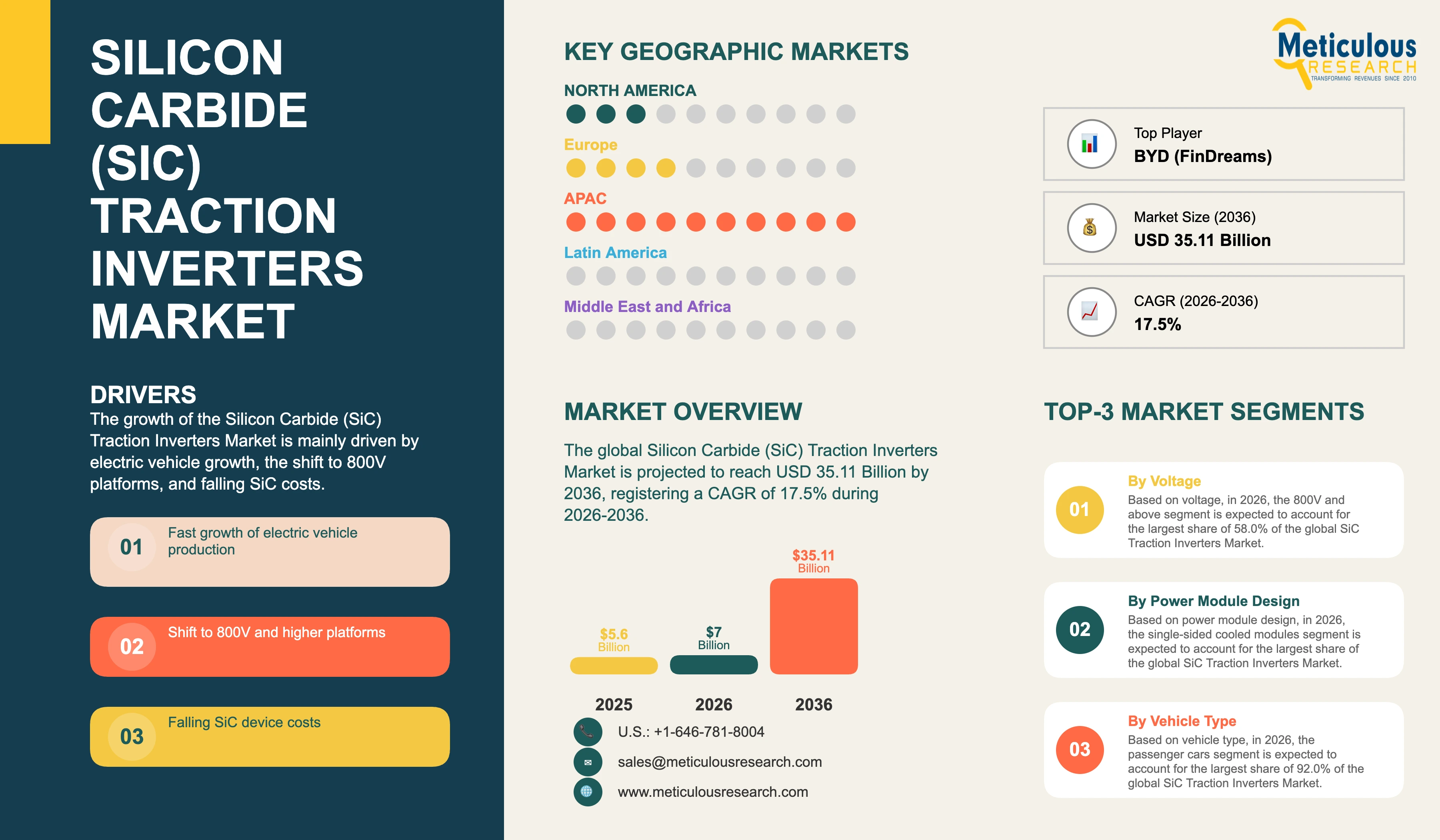
The global silicon carbide (SiC) traction inverters market was valued at USD 5.60 billion in 2025. This market is expected to reach USD 35.11 billion by 2036 from an estimated USD 7.00 billion in 2026, registering a CAGR of 17.5% during the forecast period (2026-2036).
- Published
- Nov 2026
- Pages
- 245
- Format
- PDF + Excel
- Report ID
- MRAUTO - 1042875
- Base year
- 2025
- 2025 · BASELINE
- $5.60B
- 2036
- $35.11B
- CAGR 2026–2036
- 17.5%
2025 baseline · 2026–2036 forecast at 17.5% CAGR · hover a bar for the value
Key highlights
Global electric car sales grew by 20% to more than 20 million units in 2025, accounting for one in four new cars sold, according to the IEA. Every electric vehicle needs at least one traction inverter, and the share of inverters using SiC power switches is rising quickly as vehicle makers move to 800V platforms.
BYD launched its Super e-Platform in March 2025, the first mass-produced passenger car platform with a full 1000V architecture, using new SiC power chips developed in-house and rated at 1500V, according to BYD. The platform supports charging power of 1,000 kW and single-motor power of 580 kW.
BorgWarner secured a major extension of multiple high-volume inverter programs with a European vehicle maker in August 2026, including an 800V traction inverter with its latest Viper SiC power switches and a dual-sided-cooled power module, with production planned for 2029, according to BorgWarner. In October 2026, it won another next-generation traction inverter award for future battery electric vehicles from a major global vehicle maker.
Schaeffler started production of a 900V SiC power module inverter unit at its site in Tianjin, China, while Bosch says the SiC inverters paired with its new rigid e-axle for trucks reach up to 99% efficiency, showing the spread of SiC inverters to higher voltages and commercial vehicles.
Wolfspeed, one of the largest SiC wafer and device makers, filed for Chapter 11 protection in June 2025 and emerged in late September 2025 after cutting its debt by about 70%, according to Wolfspeed. The restructuring followed production delays, Chinese competition, and slower electric vehicle demand, and highlighted supply chain risks in SiC.
Leading SiC traction inverter suppliers include BYD (FinDreams), BorgWarner, Bosch, ZF, Schaeffler, Denso, Astemo, Valeo, Hyundai Mobis, Mitsubishi Electric, Inovance, and Huawei Digital Power, supplied with SiC devices by Infineon, STMicroelectronics, onsemi, Wolfspeed, ROHM, and Chinese chip makers. Double-sided cooled modules are the fastest-growing power module design, as they allow higher power with less SiC per inverter and smaller inverter housings.
By voltage, 800V and above accounts for the larger share of 58.0% in 2026 and also registers the higher CAGR.
By power module design, single-sided cooled modules account for the largest share in 2026, while double-sided cooled modules register the highest CAGR.
By power output, 150-250 kW accounts for the largest share in 2026, while above 250 kW registers the highest CAGR.
By vehicle type, passenger cars account for the larger share of 92.0% in 2026, while commercial vehicles register the higher CAGR.
By geography, Asia-Pacific accounts for the largest share of 60.0% in 2026, while Asia-Pacific registers the highest CAGR of 18.2%.
Report summary
| Particulars | Details |
|---|---|
| Base Year | 2025 |
| Estimated Year | 2026 |
| Forecast Period | 2026-2036 |
| Market Size in 2025 | USD 5.60 billion |
| Market Size in 2026 | USD 7.00 billion |
| Market Size by 2036 | USD 35.11 billion |
| CAGR (2026-2036) | 17.5% |
| Format | PDF, Excel & Cloud Portal · 245 pages |
| Largest Segment by Voltage (2026) | 800V and Above (58.0%) |
| Largest Segment by Vehicle Type (2026) | Passenger Cars (92.0%) |
| Largest Region (2026) | Asia-Pacific (60.0%) |
| Fastest-Growing Region | Asia-Pacific (CAGR 18.2%) |
| Companies Profiled | 12 companies and other companies |
| Segments Covered | Voltage, Power Module Design, Power Output, Vehicle Type, Geography |
| Countries Covered | U.S., Canada, Germany, France, U.K., Sweden, Norway, Netherlands, Spain, Italy, Hungary, Poland, Czech Republic, Austria, Belgium, Rest of Europe, China, South Korea, Japan, India, Thailand, Indonesia, Malaysia, Vietnam, Taiwan, Philippines, Australia, Rest of Asia-Pacific, Brazil, Mexico, Chile, Colombia, Rest of Latin America, Turkey, UAE, Saudi Arabia, Israel, Morocco, South Africa, Rest of Middle East & Africa |
Report overview
Segments covered: voltage, power module design, power output, vehicle type.
A traction inverter converts direct current from the vehicle's high-voltage battery into alternating current to drive the electric motor, and it controls the motor's speed and torque. SiC traction inverters use silicon carbide MOSFETs instead of silicon IGBTs as power switches, which reduces switching and conduction losses, allows higher voltage and temperature operation, and makes the inverter smaller and lighter. SiC traction inverters are used in battery electric vehicles, plug-in hybrid and range-extended vehicles, and electric commercial vehicles.
The growth of this market is mainly driven by the fast growth of electric vehicle production, the shift to 800V and higher vehicle platforms, for which SiC is the preferred power switch technology, the efficiency benefits of SiC, which extend driving range or allow smaller batteries, falling SiC device costs as production moves to 200mm wafers, and the electrification of buses and trucks, which need high-power inverters. In addition, the spread of 800V platforms from premium vehicles to mid-priced models, especially in China, is expanding the market. However, the higher cost of SiC compared with silicon IGBTs, supply chain risks, and slower electric vehicle growth in some markets are expected to restrain the growth of this market to some extent.
The traction inverter is one of the most important parts of an electric vehicle, as it controls the flow of power between the battery and the motor during driving and regenerative braking. Its efficiency has a direct effect on driving range, and its size and cost affect vehicle packaging and price. For many years, traction inverters used silicon IGBTs as power switches. Since Tesla introduced SiC MOSFETs in its traction inverters, a growing number of vehicle makers have adopted SiC, first in premium and performance vehicles and now in mid-priced models.
This report covers the global SiC traction inverters market, including SiC traction inverters for 400V and 800V and above vehicle platforms, using single-sided cooled modules, double-sided cooled modules, and discrete SiC device-based designs, for passenger cars and commercial vehicles. The market is valued at the selling price of complete SiC traction inverter units supplied to vehicle makers and e-axle suppliers, including inverters integrated into e-axles valued at an estimated inverter price and inverters made in-house by vehicle makers valued at an estimated market price. The market is analyzed by voltage, power module design, power output, vehicle type, and geography. Silicon IGBT inverters, onboard chargers, and DC-DC converters are not included.
Compared with silicon, SiC offers several important advantages as a power switch material for traction inverters. SiC MOSFETs have lower switching losses, can switch at higher frequencies, can block higher voltages with thinner chips, and can operate at higher temperatures. In a traction inverter, these properties improve efficiency, especially at light loads where vehicles spend most of their time, and allow smaller cooling systems and inverter housings. The efficiency gain typically adds several percent to driving range or allows a smaller and cheaper battery for the same range, which can offset the higher cost of SiC devices.
SiC is especially important for 800V and higher platforms, where its benefits are largest. At these voltages, silicon IGBTs rated at 1,200V have higher losses, while SiC MOSFETs offer much better efficiency. Most 800V electric vehicles therefore use SiC traction inverters. BYD's Super e-Platform, launched in March 2025, uses a 1000V architecture with SiC chips rated at 1500V developed in-house, according to BYD. 800V and above inverters account for the largest and fastest-growing share of this market.
The value chain of SiC traction inverters includes SiC wafer and device makers, power module makers, and inverter suppliers. Device makers include Infineon, STMicroelectronics, onsemi, Wolfspeed, ROHM, and a growing number of Chinese companies. Inverter suppliers include global automotive suppliers, such as BorgWarner, Bosch, ZF, Schaeffler, Denso, Astemo, Valeo, Hyundai Mobis, and Mitsubishi Electric, and Chinese suppliers, such as Inovance and Huawei Digital Power. Several vehicle makers, such as BYD, Tesla, and Hyundai, design or produce inverters in-house, and some, such as BYD, also make their own SiC chips.
Inverter designs are changing quickly as suppliers work to cut cost and size. Power modules are moving from single-sided cooling to double-sided cooling, which removes heat from both sides of the chips and allows higher power from smaller modules. Some vehicle makers use designs based on discrete SiC devices to reduce cost and improve flexibility. Suppliers are also developing their own power switches and modules, such as BorgWarner's Viper power switch, and their own control chips, such as BorgWarner's ASIC technology, to reduce cost and improve performance.
In 2026, 800V and above inverters account for the largest share of the market by voltage and are also the fastest-growing voltage segment. Single-sided cooled modules account for the largest share by power module design, while double-sided cooled modules are the fastest-growing design. Inverters of 150-250 kW account for the largest share by power output, while inverters above 250 kW are the fastest-growing power output. Passenger cars account for the largest share by vehicle type, while commercial vehicles are the fastest-growing vehicle type. Asia-Pacific accounts for the largest share of the market and is also the fastest-growing region.
Market growth over the forecast period will depend on electric vehicle production, the pace of the move to 800V platforms, SiC device costs, the share of SiC in 400V inverters, and competition from new technologies, such as gallium nitride. Falling SiC prices will limit growth in market value per unit but will also make SiC competitive in more vehicles. Overall, the move to SiC in most new electric vehicle platforms is expected to drive fast growth of the SiC traction inverter market through 2036.
Passenger cars are expected to account for the largest share of 92.0% of the market in 2026, while commercial vehicles are projected to register the highest CAGR, driven by electric buses and trucks with 800V systems.
Asia-Pacific is expected to account for the largest share of 60.0% of the market in 2026, mainly due to China's large electric vehicle production, fast adoption of 800V and 1000V platforms, and growing local SiC supply chain.
Asia-Pacific is also projected to register the highest CAGR of 18.2% during the forecast period, driven by the spread of 800V SiC platforms to mid-priced Chinese vehicles and growing electric vehicle production in India and Southeast Asia.
The report profiles 12 companies, including BYD (FinDreams), BorgWarner, Bosch, ZF, Schaeffler, Denso, Astemo, Valeo, Hyundai Mobis, Mitsubishi Electric, Inovance, and Huawei Digital Power.
SiC MOSFETs have much lower switching losses than silicon IGBTs at 800V, can operate at higher temperatures, and allow smaller inverters and cooling systems, which improves efficiency and driving range.
Gallium nitride is emerging as an alternative for some 400V and lower-power applications, but SiC is expected to remain the leading technology for 800V and high-power traction inverters over the forecast period.
Report infographic
Market dynamics
17 factors across 5 forcesFast growth of electric vehicle production
Every electric vehicle needs at least one traction inverter, and dual-motor vehicles need two, so demand for traction inverters is closely linked to electric vehicle production. Global electric car sales grew by 20% to more than 20 million units in 2025, according to the IEA, led by China, with growing volumes in Europe, North America, and emerging markets. As the share of SiC in traction inverters rises, SiC inverter demand is growing faster than electric vehicle production.
Electric vehicle production is expected to keep growing over the forecast period, supported by falling battery costs, wider model choice, better charging networks, and government policies. Plug-in hybrid and range-extended vehicles, which are growing quickly in China, also use traction inverters, and many new models use 800V systems with SiC inverters. This growth provides a large and expanding base of demand for SiC traction inverters.
Shift to 800V and higher vehicle platforms
Vehicle makers are moving to 800V and higher platforms to offer faster charging, higher efficiency, and lower weight. At 800V, charging power can be doubled at the same current, cables can be thinner, and losses are lower. SiC MOSFETs are the preferred power switch for 800V traction inverters, as they offer much better efficiency than silicon IGBTs at these voltages. Most 800V electric vehicles launched in recent years use SiC traction inverters.
800V platforms are spreading from premium vehicles to mid-priced models, especially in China, where many vehicle makers have launched 800V models, and in Korea and Europe. BYD's Super e-Platform uses a 1000V architecture, according to BYD. European vehicle makers are also launching 800V platforms for their next generation of electric vehicles, such as the programs for which BorgWarner won 800V SiC inverter business in 2026. This shift is the main driver of SiC traction inverter growth.
Efficiency and range benefits of SiC
SiC traction inverters reduce energy losses compared with silicon IGBT inverters, especially at light and medium loads, which account for most real-world driving. This efficiency gain extends driving range or allows vehicle makers to use a smaller and cheaper battery for the same range. Because the battery is the most expensive part of an electric vehicle, battery savings can offset the higher cost of SiC devices, making SiC attractive even in some 400V vehicles.
SiC also allows smaller inverters and cooling systems, which saves space and weight and supports integration into compact e-axles. Higher switching frequencies can improve motor control and reduce motor losses. Bosch says the SiC inverters paired with its new rigid truck e-axle reach up to 99% efficiency. These benefits are driving the adoption of SiC in both passenger cars and commercial vehicles.
Falling SiC device costs and 200mm wafer production
SiC device costs have fallen as production volumes have grown, as manufacturing yields have improved, and as Chinese SiC wafer and device makers have expanded capacity. Device makers are moving from 150mm to 200mm wafers, which produce more chips per wafer and lower cost per chip. Wolfspeed, for example, has built a 200mm SiC platform, and several other device makers are expanding 200mm production.
Lower SiC device costs reduce the cost gap with silicon IGBTs and make SiC inverters competitive in more vehicles, including mid-priced and some entry-level models. Overcapacity in SiC wafers, especially in China, has also pushed prices down. As costs continue to fall, SiC is expected to account for a growing share of traction inverters, supporting fast growth in inverter volumes even as prices per unit decline.
Electrification of buses and trucks
Electric buses and trucks need high-power traction inverters, often above 250 kW, and they run for long hours, which makes efficiency especially valuable for operating cost. Many electric truck makers are adopting 800V systems to support megawatt charging and reduce cable weight, which favors SiC inverters. Bosch presented SiC inverters paired with its new rigid e-axle for trucks of 18 to 49 metric tons at IAA Transportation 2026, with efficiency of up to 99%, according to Bosch. Commercial vehicle SiC inverters are larger and more valuable than passenger car units, and commercial vehicles are the fastest-growing vehicle type in this market. Government support for electric buses in China, India, Europe, and other markets, and CO2 rules for heavy-duty vehicles in Europe, are expected to drive steady growth in this segment, while the high mileage of commercial vehicles makes the efficiency gains of SiC easier to justify.
Table of contents
12 chapters · 175 sections · 245 pages · click to expandSegmental analysis
| Segment | Largest share (2026) | Fastest growth (2026–2036) |
|---|---|---|
| By Voltage | 800V and above | 800V and above |
| By Power Module Design | Single-sided cooled modules | Double-sided cooled modules |
| By Power Output | 150-250 kW | Above 250 kW |
| By Vehicle Type | Passenger cars | Commercial vehicles |
| Other segments | Single-sided cooled modules | Double-sided cooled modules |
By Voltage
- SiC Traction Inverters Analysis by Voltage
- The 800V and above segment is expected to account for the largest share of 58.0% of the global SiC traction inverters market.
- The large share of this segment is mainly due to the use of SiC traction inverters in almost all 800V and higher electric vehicles, as SiC offers much better efficiency than silicon IGBTs at these voltages, the launch of many 800V models by Chinese, Korean, and European vehicle makers, and the higher value of 800V SiC inverters, which use SiC devices rated at 1,200V or higher.
- BorgWarner, Bosch, ZF, Schaeffler, Hyundai Mobis, BYD (FinDreams), Inovance, and Huawei Digital Power are among the leading suppliers of 800V SiC inverters.
- The 800V and above segment is also projected to register the highest CAGR during the forecast period.
- The rapid growth of this segment is driven by the spread of 800V platforms from premium vehicles to mid-priced models, especially in China, the launch of new 800V platforms by European and North American vehicle makers for their next generation of electric vehicles, the move to 900V and 1000V platforms, such as BYD's Super e-Platform, and the adoption of 800V systems in electric trucks and buses. 400V SiC inverters are also growing, supported by falling SiC costs.
- Tesla and other vehicle makers use SiC in some 400V models.
- 800V and above inverters are expected to account for the largest share of 58.0% of the market in 2026 and are also projected to register the highest CAGR, driven by the spread of 800V and 1000V platforms.
By Power Module Design
- SiC Traction Inverters Analysis by Power Module Design
- The single-sided cooled modules segment is expected to account for the largest share of the global SiC traction inverters market.
- The large share of this segment is mainly due to the wide use of single-sided cooled SiC power modules in current SiC inverter designs, their proven reliability and established supply chains, the availability of standard modules from leading SiC device makers, and the lower development cost for inverter suppliers.
- Many current 800V and 400V SiC inverters use single-sided cooled modules with direct liquid cooling.
- However, the double-sided cooled modules segment is projected to register the highest CAGR during the forecast period.
- The rapid growth of this segment is driven by the ability of double-sided cooling to remove heat from both sides of the chips, which allows higher power from smaller modules and reduces the amount of SiC needed per inverter, the need for compact inverters in integrated e-axles, and the adoption of double-sided cooled modules in new inverter programs, such as BorgWarner's 800V inverter with a dual-sided-cooled power module for a European vehicle maker.
By Power Output
- SiC Traction Inverters Analysis by Power Output
- The 150-250 kW segment is expected to account for the largest share of the global SiC traction inverters market.
- The large share of this segment is mainly due to the use of inverters in this power range in most 800V electric cars and SUVs, the use of SiC in higher-power inverters, where its efficiency benefits are greatest, and the use of 150-250 kW inverters in the rear motors of many dual-motor vehicles.
- Most leading inverter suppliers offer SiC inverter platforms in this power range.
- However, the above 250 kW segment is projected to register the highest CAGR during the forecast period.
- The rapid growth of this segment is driven by the growth of high-performance electric cars and SUVs, the electrification of buses and trucks, which need high-power inverters, the move to higher-speed and more powerful motors, and the spread of 1000V platforms, such as BYD's Super e-Platform, which offers single-motor power of 580 kW, according to BYD.
- High-power inverters also benefit most from SiC's efficiency and thermal advantages.
- Inverters of up to 150 kW are also adopting SiC in some front motors of dual-motor vehicles.
By Vehicle Type
- SiC Traction Inverters Analysis by Vehicle Type
- The passenger cars segment is expected to account for the largest share of 92.0% of the global SiC traction inverters market.
- The large share of this segment is mainly due to the very large number of electric passenger cars produced each year, with global electric car sales exceeding 20 million units in 2025 according to the IEA, the fast adoption of 800V platforms with SiC inverters in passenger cars, the use of two inverters in dual-motor cars and SUVs, and the adoption of SiC in some 400V passenger cars to extend range.
- However, the commercial vehicles segment is projected to register the highest CAGR during the forecast period.
- The rapid growth of this segment is driven by the electrification of buses and trucks, the adoption of 800V systems and megawatt charging in electric trucks, the high value of commercial vehicle inverters, and the importance of efficiency for vehicles that run long hours.
- Bosch's SiC inverters paired with its new rigid truck e-axle show the growing role of SiC in commercial vehicles.
Other segments
- The single-sided cooled modules segment is expected to account for the largest share of the SiC traction inverters market, while the double-sided cooled modules segment is projected to register the highest CAGR during the forecast period.
- The 150-250 kW segment is expected to account for the largest share of the SiC traction inverters market, while the above 250 kW segment is projected to register the highest CAGR during the forecast period.
Geographic analysis
Asia-Pacific
Largest shareIn 2026, Asia-Pacific is expected to account for the largest share of 60.0% of the global SiC traction inverters market. The large share of this region is mainly due to China's position as the largest electric vehicle producer in the world, the fast adoption of 800V and 1000V platforms by Chinese vehicle makers, the growth of the Chinese SiC wafer and device industry, which has reduced SiC costs, and the presence of leading inverter producers, such as BYD (FinDreams), Inovance, Huawei Digital Power, Denso, Astemo, Mitsubishi Electric, and Hyundai Mobis, as well as large Chinese operations of global suppliers, such as Schaeffler, Bosch, and BorgWarner. South Korea and Japan are also important markets, supported by 800V vehicles from Hyundai and Kia and by Japanese SiC and inverter suppliers, such as ROHM, Denso, and Mitsubishi Electric. Asia-Pacific is also projected to register the highest CAGR of 18.2% during the forecast period. The rapid growth of this region is mainly driven by the spread of 800V SiC platforms to mid-priced Chinese electric vehicles, the move to 1000V platforms, such as BYD's Super e-Platform, falling SiC device costs in China, the growth of electric vehicle production in India, Thailand, and Indonesia, and the growth of electric buses and trucks in China and India. Suppliers are expanding SiC inverter production in the region, such as Schaeffler's 900V SiC inverter production in Tianjin. India is expected to be one of the fastest-growing countries, supported by electric bus programs and new electric car platforms.
Europe
Europe accounts for a significant share of the market, supported by the production of premium and performance electric vehicles with 800V SiC platforms, the launch of new 800V platforms by European vehicle makers, strict CO2 emission rules, and the presence of leading inverter suppliers, such as Bosch, ZF, Schaeffler, Valeo, and BorgWarner's European operations, as well as SiC device makers Infineon and STMicroelectronics. BorgWarner won major 800V SiC inverter business with a European vehicle maker in 2026, according to BorgWarner. Germany is the largest market in the region, followed by France, Sweden, and Central and Eastern European countries, which are important locations for inverter and e-axle production. The EU's policies to support local semiconductor production are also encouraging investment in SiC device capacity in Europe.
North America
North America accounts for a significant share of the market, supported by electric vehicle production by Tesla, General Motors, Hyundai, Lucid, and other vehicle makers, the use of SiC inverters in electric pickup trucks and SUVs, and the presence of SiC device makers, such as onsemi and Wolfspeed, and inverter suppliers, such as BorgWarner. However, the end of federal electric vehicle purchase incentives in the U.S. in 2025 has slowed growth in the region. Mexico is also an important production location for electric drive components.
Latin America
Latin America and the Middle East & Africa account for small shares, with growth supported by electric vehicle and electric bus adoption in Brazil, Mexico, Chile, Turkey, and the Gulf countries.
Competitive landscape
The global SiC traction inverters market includes vehicle makers and affiliated suppliers that produce inverters in-house, global automotive power electronics suppliers, and fast-growing Chinese suppliers. The market is closely linked to the SiC device industry, and many inverter suppliers work in long-term partnerships with SiC device makers, while some vehicle makers and suppliers develop their own SiC chips, power switches, or modules.
BYD, through FinDreams, is the largest producer of SiC traction inverters, supplying its own electric vehicles with SiC chips developed in-house. BorgWarner, Bosch, ZF, Schaeffler, Denso, Astemo, Valeo, Hyundai Mobis, and Mitsubishi Electric are leading global suppliers, while Inovance and Huawei Digital Power are leading independent suppliers in China. Tesla designs its own inverters. SiC devices are supplied by Infineon, STMicroelectronics, onsemi, Wolfspeed, ROHM, and Chinese chip makers.
Companies in this market compete on efficiency, power density, cost, reliability, development speed, and secure supply of SiC devices. Key strategies include developing 800V and higher-voltage inverters, double-sided cooled modules, and in-house power switches and control chips, integrating inverters into e-axles, building local production in China, Europe, and North America, and forming long-term supply agreements with SiC device makers.
Recent competitive activity has focused on new inverter programs and higher voltages. BorgWarner secured a major extension of multiple high-volume inverter programs, including an 800V SiC inverter, with a European vehicle maker in August 2026 and a new traction inverter award from a global vehicle maker in October 2026, according to BorgWarner. Schaeffler started production of a 900V SiC inverter unit in Tianjin, and BYD launched 1500V SiC chips for its 1000V Super e-Platform, according to BYD.
We expect competition in this market to increase over the forecast period as Chinese inverter and SiC suppliers expand abroad, as SiC prices fall, and as vehicle makers decide how much inverter and SiC development to keep in-house. Suppliers with low costs, strong power module and packaging expertise, secure SiC supply, and close relationships with vehicle makers are expected to strengthen their positions over the forecast period, while partnerships between inverter suppliers and SiC device makers are likely to increase, along with consolidation among SiC device makers and inverter suppliers.
Some of the key players operating in the SiC traction inverters market are BYD Company Limited (FinDreams), BorgWarner Inc., Robert Bosch GmbH, ZF Friedrichshafen AG, Schaeffler AG, Denso Corporation, Astemo, Ltd., Valeo SE, Hyundai Mobis Co., Ltd., Mitsubishi Electric Corporation, Shenzhen Inovance Technology Co., Ltd., and Huawei Digital Power Technologies Co., Ltd., among others.
- —
BorgWarner won major 800V SiC inverter business with a European vehicle maker in August 2026 and a new inverter award in October 2026, Schaeffler started 900V SiC inverter production in Tianjin, and BYD launched 1500V SiC chips for its 1000V platform.
- BYD Company Limited (FinDreams)
- BorgWarner Inc.
- Robert Bosch GmbH
- ZF Friedrichshafen AG
- Schaeffler AG
- Denso Corporation
- Astemo, Ltd.
- Valeo SE
- Hyundai Mobis Co., Ltd.
- Mitsubishi Electric Corporation
- Shenzhen Inovance Technology Co., Ltd.
- Huawei Digital Power Technologies Co., Ltd.
Expert perspectives
SiC traction inverters have moved from a premium technology to the standard choice for 800V electric vehicles, and they are now spreading to mid-priced vehicles and commercial vehicles. The shift to 800V and higher platforms, together with falling SiC costs, makes SiC one of the fastest-growing technologies in the electric vehicle powertrain.
Over the forecast period, the market is expected to grow at a CAGR of 17.5%, from USD 7.00 billion in 2026 to USD 35.11 billion in 2036. Growth will be driven by the fast growth of electric vehicle production, the shift to 800V and higher platforms, the efficiency and range benefits of SiC, falling SiC device costs and 200mm wafer production, and the electrification of buses and trucks.
Among the market segments, 800V and above inverters are both the largest and the fastest-growing voltage segment. Single-sided cooled modules are the largest power module design, while double-sided cooled modules grow fastest. Inverters of 150-250 kW are the largest power output, while inverters above 250 kW grow fastest. Passenger cars are the largest vehicle type, while commercial vehicles grow fastest. Asia-Pacific is both the largest and the fastest-growing region, at a CAGR of 18.2%.
In our view, cost reduction will determine how quickly SiC spreads beyond 800V vehicles. Chinese SiC wafer and device makers have pushed prices down, and the move to 200mm wafers will reduce costs further. As the cost gap with silicon IGBTs narrows over the next few years, SiC is likely to become standard in most mid-priced electric vehicles, including many 400V models, which would greatly expand the market in unit terms, even as prices per inverter continue to fall.
We also see supply chain strategy as a key competitive factor for inverter suppliers and vehicle makers. Wolfspeed's restructuring showed the financial risks in the SiC industry, while BYD's in-house SiC chips show the advantages of vertical integration. Inverter suppliers and vehicle makers will need to secure diverse and reliable SiC supply from more than one region, while developing their own power modules, switches, and control software to differentiate their products and reduce cost.
Overall, we firmly believe that the SiC traction inverters market will grow strongly and steadily over the forecast period, with 800V and above inverters, double-sided cooled modules, high-power inverters, commercial vehicles, and Asia-Pacific providing the fastest growth. Companies with low costs, strong power module expertise, secure SiC supply, and integration capabilities will be best positioned to capture this growth, while uneven electric vehicle demand and competition from silicon and gallium nitride remain the main risks to this outlook.
Customer perspectives
Customers in the SiC traction inverters market are mainly vehicle makers and e-axle suppliers, which buy SiC inverters for electric passenger cars, buses, and trucks. They focus on efficiency, power density, cost, reliability, functional safety, development speed, and secure long-term supply of SiC devices. Vehicle makers increasingly ask for inverters designed for 800V and higher platforms, for compact designs that fit into integrated e-axles, and for inverter platforms that can be scaled across several power levels and vehicle models. They also value suppliers that can provide software for motor control and support over-the-air updates, and that have the financial strength to support long-term programs. Commercial vehicle makers focus most on efficiency and durability over long operating hours. Many also want two qualified chip sources. Bus makers value proven reliability.
This comment explains why 800V and above inverters account for 58.0% of the market and why Asia-Pacific is the fastest-growing region.
This comment explains why double-sided cooled modules are the fastest-growing power module design and why cost reduction is central to supplier competition.
This comment explains why commercial vehicles are the fastest-growing vehicle type and why passenger cars account for 92.0% of the market.
“All our new platforms are 800V or higher, and SiC is standard. Chip prices have fallen enough that we now use SiC in mid-priced models too.”
“Double-sided cooling lets us use less silicon carbide for the same power. For our next platform, inverter cost per kilowatt is the key measure.”
“Our trucks run long hours every day, so every percent of efficiency pays back quickly. SiC was the clear choice for our 800V system.”
Frequently asked questions
The global SiC traction inverters market was valued at USD 5.60 billion in 2025, up from USD 4.30 billion in 2024, and is estimated at USD 7.00 billion in 2026. The market includes SiC traction inverters for 400V and 800V and above electric passenger cars and commercial vehicles.
The global SiC traction inverters market is expected to reach USD 35.11 billion by 2036, driven by electric vehicle growth, the shift to 800V platforms, falling SiC costs, and the electrification of buses and trucks.
The market is expected to register a CAGR of 17.5% from 2026 to 2036, with the fastest growth in 800V and above inverters, double-sided cooled modules, inverters above 250 kW, commercial vehicles, and Asia-Pacific.
Market growth is mainly driven by the fast growth of electric vehicle production, the shift to 800V and higher platforms, the efficiency and range benefits of SiC, falling SiC device costs and 200mm wafer production, and the electrification of buses and trucks.
The higher cost of SiC compared with silicon IGBTs and uneven electric vehicle growth and supply chain volatility restrain growth, while reliability, thermal, and electromagnetic challenges and competition from silicon and gallium nitride are key challenges.
Key growth opportunities include SiC inverters for mid-priced and 400V vehicles, double-sided cooling and advanced power modules, commercial vehicle and high-power inverters, and integration into e-axles and multi-in-one drive units.
800V and above inverters are expected to account for the largest share of 58.0% of the market in 2026 and are also projected to register the highest CAGR, driven by the spread of 800V and 1000V platforms.
In 2026, the single-sided cooled modules segment is expected to account for the largest share of the SiC traction inverters market, while the double-sided cooled modules segment is projected to register the highest CAGR during the forecast period.
In 2026, the 150-250 kW segment is expected to account for the largest share of the SiC traction inverters market, while the above 250 kW segment is projected to register the highest CAGR during the forecast period.
Passenger cars are expected to account for the largest share of 92.0% of the market in 2026, while commercial vehicles are projected to register the highest CAGR, driven by electric buses and trucks with 800V systems.
Asia-Pacific is expected to account for the largest share of 60.0% of the market in 2026, mainly due to China's large electric vehicle production, fast adoption of 800V and 1000V platforms, and growing local SiC supply chain.
Asia-Pacific is also projected to register the highest CAGR of 18.2% during the forecast period, driven by the spread of 800V SiC platforms to mid-priced Chinese vehicles and growing electric vehicle production in India and Southeast Asia.
The report profiles 12 companies, including BYD (FinDreams), BorgWarner, Bosch, ZF, Schaeffler, Denso, Astemo, Valeo, Hyundai Mobis, Mitsubishi Electric, Inovance, and Huawei Digital Power.
BorgWarner won major 800V SiC inverter business with a European vehicle maker in August 2026 and a new inverter award in October 2026, Schaeffler started 900V SiC inverter production in Tianjin, and BYD launched 1500V SiC chips for its 1000V platform.
SiC MOSFETs have much lower switching losses than silicon IGBTs at 800V, can operate at higher temperatures, and allow smaller inverters and cooling systems, which improves efficiency and driving range.
Gallium nitride is emerging as an alternative for some 400V and lower-power applications, but SiC is expected to remain the leading technology for 800V and high-power traction inverters over the forecast period.
Cite this report
Meticulous Research. (2026). Silicon Carbide (SiC) Traction Inverters Market - Global Opportunity Analysis and Industry Forecast (2026-2036) (Report No. MRAUTO - 1042875). Meticulous Market Research Pvt. Ltd. https://www.meticulousresearch.com/product/silicon-carbide-sic-traction-inverters-market-7558