Automotive Rare Earth Magnets Market (2026-2036)
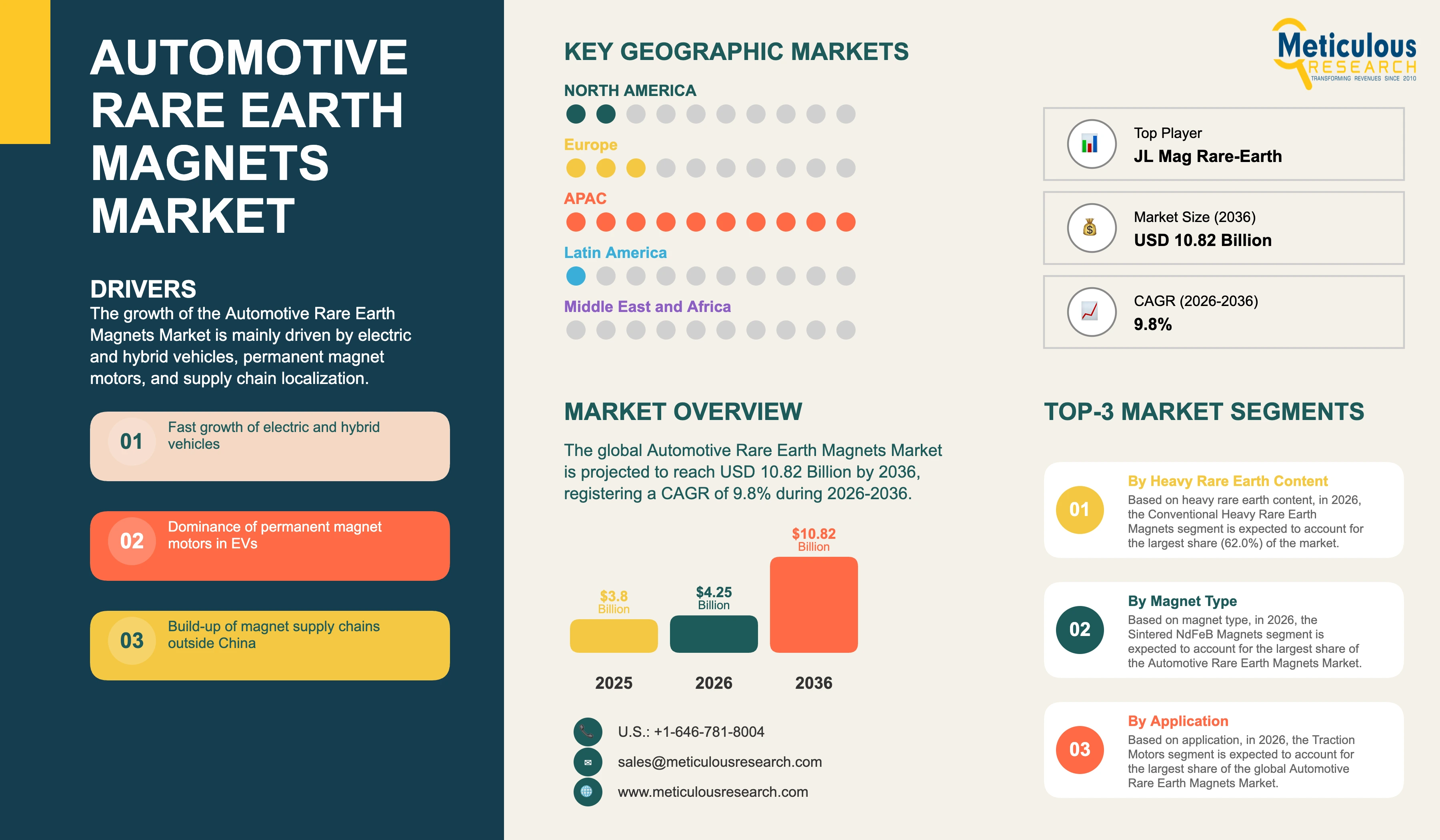
The global automotive rare earth magnets market was valued at USD 3.80 billion in 2025. This market is expected to reach USD 10.82 billion by 2036 from an estimated USD 4.25 billion in 2026, registering a CAGR of 9.8% during the forecast period (2026-2036).
- Published
- Nov 2026
- Pages
- 268
- Format
- PDF + Excel
- Report ID
- MRAUTO - 1042896
- Base year
- 2025
- 2025 · BASELINE
- $3.80B
- 2036
- $10.82B
- CAGR 2026–2036
- 9.8%
2025 baseline · 2026–2036 forecast at 9.8% CAGR · hover a bar for the value
Key highlights
China produced about 270, 000 tons of the world's roughly 390,000 tons of rare earth mine output in 2025, or about 69% of the total, according to the U.S. Geological Survey. The USGS notes that magnets were the leading global end use of rare earths, and China also controls most of the world's rare earth processing and magnet production.
China tightened export controls on seven medium and heavy rare earths, including dysprosium and terbium, in April 2025, and these controls remain in effect, according to the USGS. China's Ministry of Commerce extended the suspension of a wider set of controls announced in October 2025 to January 10, 2027, while the April 2025 controls on seven heavy rare earths remain in force, according to industry reports.
MP Materials produced its first NdFeB magnets on commercial equipment at its Independence facility in Fort Worth, Texas, and expects to ramp magnet production for General Motors in 2026, according to MP Materials. The company selected Northlake, Texas, for its new 10X magnet campus, which is expected to bring its total capacity to about 10,000 metric tons of NdFeB magnets per year, according to MP Materials.
VAC opened a magnet plant in Sumter, South Carolina, in late 2025 with a capacity of just under 2,000 tons per year, but General Motors terminated its long-term supply agreement with the plant in 2026, and the two companies are in arbitration, according to company filings reported by Reuters. Energy Fuels agreed in June 2026 to acquire VAC for USD 1.9 billion, according to Energy Fuels.
Global electric car sales topped 20 million units in 2025, according to the IEA. Most of these vehicles use permanent magnet traction motors with NdFeB magnets, which makes electric vehicles the largest and fastest-growing source of automotive demand for rare earth magnets.
Leading suppliers include JL Mag Rare-Earth, Ningbo Yunsheng, Beijing Zhong Ke San Huan, Proterial, Shin-Etsu Chemical, TDK, VAC, Daido Electronics, Neo Performance Materials, and MP Materials. Heavy rare earth-free magnets are the fastest-growing segment by heavy rare earth content, as vehicle makers seek to cut cost and supply risk.
By heavy rare earth content, conventional heavy rare earth magnets account for the largest share of 62.0% in 2026, while heavy rare earth-free magnets register the highest CAGR.
By magnet type, sintered NdFeB magnets account for the largest share in 2026 and also register the highest CAGR.
By application, traction motors account for the largest share in 2026 and also register the highest CAGR.
By vehicle type, passenger cars account for the larger share of 88.0% in 2026, while commercial vehicles register the higher CAGR.
By geography, Asia-Pacific accounts for the largest share of 64.0% in 2026, while Europe registers the highest CAGR of 12.5%.
Report summary
| Particulars | Details |
|---|---|
| Base Year | 2025 |
| Estimated Year | 2026 |
| Forecast Period | 2026-2036 |
| Market Size in 2025 | USD 3.80 billion |
| Market Size in 2026 | USD 4.25 billion |
| Market Size by 2036 | USD 10.82 billion |
| CAGR (2026-2036) | 9.8% |
| Format | PDF, Excel & Cloud Portal · 268 pages |
| Largest Segment by Heavy Rare Earth Content (2026) | Conventional Heavy Rare Earth Magnets (62.0%) |
| Largest Segment by Vehicle Type (2026) | Passenger Cars (88.0%) |
| Largest Region (2026) | Asia-Pacific (64.0%) |
| Fastest-Growing Region | Europe (CAGR 12.5%) |
| Companies Profiled | 10 companies and other companies |
| Segments Covered | Heavy Rare Earth Content, Magnet Type, Application, Vehicle Type, Geography |
| Countries Covered | U.S., Canada, Mexico, Germany, France, U.K., Spain, Italy, Sweden, Czech Republic, Poland, Slovakia, Hungary, Romania, Estonia, Netherlands, Belgium, Rest of Europe, China, Japan, South Korea, India, Thailand, Indonesia, Malaysia, Vietnam, Philippines, Taiwan, Singapore, Australia, Rest of Asia-Pacific, Brazil, Argentina, Chile, Colombia, Rest of Latin America, Turkey, Morocco, South Africa, Saudi Arabia, UAE, Israel, Rest of Middle East & Africa |
Report overview
Segments covered: heavy rare earth content, magnet type, application, vehicle type.
Automotive rare earth magnets are permanent magnets made mainly from neodymium-iron-boron (NdFeB) alloys, often with added dysprosium or terbium for heat resistance, and to a smaller extent from samarium-cobalt alloys. They create the strong, stable magnetic fields needed in permanent magnet synchronous motors, which are the most common traction motors in electric and hybrid vehicles, and they are also used in electric power steering motors, many small auxiliary motors for pumps, fans, seats, and windows, actuators, sensors, and loudspeakers. A typical battery electric vehicle traction motor uses one to two kilograms of NdFeB magnets.
The growth of this market is mainly driven by the fast growth of electric and hybrid vehicle production, the dominance of permanent magnet motors in electric vehicle traction because of their high efficiency and power density, the electrification of steering, braking, thermal management, and other systems, which adds small motors to every vehicle, and the move of vehicle makers and governments to build rare earth magnet supply chains outside China, which is creating new production capacity and supply agreements. In addition, technologies that reduce or remove heavy rare earths, such as grain boundary diffusion, are lowering cost and supply risk. However, the concentration of rare earth mining, processing, and magnet production in China, Chinese export controls, price volatility, and the development of rare earth-free motors are expected to restrain the growth of this market to some extent.
Rare earth permanent magnets are the strongest permanent magnets available, and they are essential to the compact, efficient electric motors used in modern vehicles. NdFeB magnets, developed in the 1980s, combine neodymium, often with praseodymium, iron, and boron, and they offer much higher magnetic strength than ferrite magnets. To keep their magnetic properties at the high temperatures found in traction motors, often above 150°C, NdFeB magnets for motors traditionally contain several percent of heavy rare earths, such as dysprosium and terbium, which are scarce, expensive, and mined mainly in China and Myanmar. Samarium-cobalt magnets offer even better heat resistance but are more expensive and used mainly in sensors and special applications.
This report covers the global automotive rare earth magnets market, including conventional heavy rare earth magnets, low heavy rare earth magnets, and heavy rare earth-free magnets, sintered NdFeB, bonded NdFeB, and samarium-cobalt and other rare earth magnets, used in traction motors, electric power steering, auxiliary motors and actuators, and sensors and other applications, in passenger cars and commercial vehicles. The market is valued at the selling price of finished rare earth magnets supplied to motor makers, system suppliers, and vehicle makers for automotive use. The market is analyzed by heavy rare earth content, magnet type, application, vehicle type, and geography. Rare earth oxides, metals, and alloys, ferrite magnets, and complete motors are not included.
Most electric and hybrid vehicles use permanent magnet synchronous motors for traction because they offer the highest efficiency and power density, especially at the low and medium speeds common in everyday driving, which improves driving range. Each traction motor typically uses one to two kilograms of NdFeB magnets, and vehicles with two or three motors use more. Some vehicle makers use induction motors or electrically excited synchronous motors, which do not need rare earth magnets, in some models or in secondary axles, but permanent magnet motors remain dominant. Conventional vehicles also use rare earth magnets in electric power steering motors, many small motors, and sensors.
The supply chain for rare earth magnets is highly concentrated in China, which mines most of the world's rare earths, processes an even larger share, and produces the large majority of NdFeB magnets. China produced about 69% of world rare earth mine output in 2025, according to the U.S. Geological Survey. China's export controls on medium and heavy rare earths since April 2025, and wider controls announced in October 2025 and then suspended, have disrupted supply for vehicle makers and parts makers outside China, with some suppliers in Europe and the U.S. reporting production stoppages in 2025. This has made magnet supply a strategic issue for vehicle makers and governments.
The market is led by Chinese magnet makers, such as JL Mag Rare-Earth, Ningbo Yunsheng, and Beijing Zhong Ke San Huan, which supply both Chinese and global vehicle makers, and Japanese makers, such as Proterial, Shin-Etsu Chemical, TDK, and Daido Electronics, which have long supplied Japanese vehicle makers. Outside Asia, VAC, which is being acquired by Energy Fuels, produces magnets in Germany and the U.S., Neo Performance Materials produces sintered magnets in Estonia, and MP Materials has started magnet production in Texas. Governments in the U.S., Europe, Japan, and South Korea are supporting new magnet plants through funding, tax incentives, and long-term purchase agreements.
Magnet makers and vehicle makers are working to reduce dependence on heavy rare earths. Grain boundary diffusion places dysprosium or terbium only at the boundaries between magnet grains, where it is most needed, which reduces heavy rare earth content sharply while keeping heat resistance. Daido Electronics and Honda developed hot-deformed NdFeB magnets without heavy rare earths for hybrid vehicle motors, and several magnet makers now offer heavy rare earth-free grades for traction motors. Motor makers are also improving motor cooling and design to allow magnets with less heat resistance. These efforts reduce cost and supply risk and are reshaping the mix of magnets used in vehicles.
In 2026, conventional heavy rare earth magnets account for the largest share of the market by heavy rare earth content, while heavy rare earth-free magnets are the fastest-growing segment. Sintered NdFeB magnets account for the largest share by magnet type and are also the fastest-growing magnet type. Traction motors account for the largest share by application and are also the fastest-growing application. Passenger cars account for the largest share by vehicle type, while commercial vehicles are the fastest-growing vehicle type. Asia-Pacific accounts for the largest share of the market, while Europe is the fastest-growing region.
Market growth over the forecast period will depend on electric and hybrid vehicle production, the share of permanent magnet motors compared with rare earth-free motors, rare earth prices, Chinese export policies, the build-up of magnet production outside China, and the adoption of low and heavy rare earth-free magnets. Strong electric vehicle growth will drive demand, while supply risks, prices, and alternative motors will shape how much of this demand is met by rare earth magnets. Overall, the market is expected to grow strongly, much faster than vehicle production, through 2036.
Passenger cars are expected to account for the largest share of 88.0% of the market in 2026, while commercial vehicles are projected to register the higher CAGR, driven by electric buses, vans, and trucks with larger motors.
Asia-Pacific is expected to account for the largest share of 64.0% of the market in 2026, mainly due to China's large electric vehicle production and its control of rare earth mining, processing, and magnet production.
Europe is projected to register the highest CAGR of 12.5% during the forecast period, driven by EU CO2 targets, new electric vehicle models, electric buses and trucks, and support for local magnet production.
The report profiles 10 companies, including JL Mag Rare-Earth, Ningbo Yunsheng, Beijing Zhong Ke San Huan, Proterial, Shin-Etsu Chemical, TDK, VAC, Daido Electronics, Neo Performance Materials, and MP Materials.
Most electric vehicles use permanent magnet synchronous motors, which use NdFeB magnets to deliver high efficiency and power density, improving driving range. Each traction motor typically uses one to two kilograms of magnets.
Heavy rare earth-free magnets are NdFeB magnets that achieve the heat resistance needed for motors without dysprosium or terbium, using special processing and motor cooling, which reduces cost and exposure to export controls.
Report infographic
Market dynamics
17 factors across 5 forcesFast growth of electric and hybrid vehicles
Global electric car sales topped 20 million units in 2025, according to the IEA, and electric and hybrid vehicles are expected to account for a growing share of new vehicle sales over the forecast period. Almost every electric and hybrid vehicle uses at least one traction motor, and most of these are permanent magnet synchronous motors with NdFeB magnets. Each traction motor typically uses one to two kilograms of magnets, compared with a few hundred grams in the small motors of a conventional vehicle, so the shift to electric and hybrid vehicles sharply increases magnet demand per vehicle.
Hybrid vehicles, which are growing strongly in Japan, China, Europe, and North America, also use permanent magnet motors and generators, and plug-in hybrids and range-extended electric vehicles, which are popular in China, use one or two motors. Electric buses and trucks use larger motors with more magnets. Traction motors are the largest and fastest-growing application in this market, and the growth of electric vehicles is the main driver of market growth over the forecast period.
Dominance of permanent magnet motors in electric vehicles
Permanent magnet synchronous motors offer higher efficiency, especially at low and medium speeds, and higher power density than induction motors and electrically excited motors, which means they can deliver more range from the same battery and fit in smaller spaces. As a result, they are used in the large majority of electric vehicles produced worldwide, including most Chinese electric vehicles. Even vehicle makers that use induction or electrically excited motors in some models often use permanent magnet motors on their main drive axles.
As electric vehicle makers compete on driving range and cost, the efficiency advantage of permanent magnet motors remains important, as every percent of efficiency gain reduces the battery size needed. New motor designs, such as hairpin windings and oil cooling, allow higher power from smaller permanent magnet motors. This dominance supports strong demand for sintered NdFeB magnets, which are the largest and fastest-growing magnet type in this market.
Electrification of vehicle systems
Vehicles are replacing mechanical and hydraulic systems with electric ones, such as electric power steering, electric brake boosters and brake-by-wire, electric water and oil pumps, electric air conditioning compressors, and electric seat, window, mirror, and tailgate motors. Many of these use small permanent magnet motors with NdFeB or bonded NdFeB magnets, which offer compact size and high efficiency. Electric power steering, which is now standard in most new vehicles, is a major user of rare earth magnets.
As vehicles add more comfort, convenience, and automated driving features, the number of small motors and actuators per vehicle continues to grow. Steer-by-wire and brake-by-wire systems, which are needed for higher levels of automated driving, also use permanent magnet motors, often with redundant designs. This electrification supports steady demand for rare earth magnets in all vehicles, including conventional vehicles, and adds to the growth from electric vehicles.
Build-up of magnet supply chains outside China
China's export controls on rare earths and magnets since 2025 have pushed vehicle makers and governments to build magnet supply chains outside China. In the U.S., MP Materials has started magnet production at its Independence facility in Fort Worth, Texas, and plans a new 10X campus in Northlake, Texas, to bring its total capacity to about 10,000 metric tons per year, according to MP Materials. VAC opened a magnet plant in Sumter, South Carolina, in late 2025, according to company reports, and Neo Performance Materials produces sintered magnets in Narva, Estonia.
Governments are supporting these projects through funding, tax incentives, defense contracts, and long-term purchase agreements, and vehicle makers are signing supply agreements with new producers. This build-up creates new supply, encourages magnet makers to invest, and supports demand for magnets made outside China at higher prices. Europe and North America are expected to grow faster than Asia-Pacific in this market, with Europe the fastest-growing region, supported by electric vehicle growth and local magnet production.
Heavy rare earth reduction technologies
Grain boundary diffusion and other heavy rare earth reduction technologies allow magnet makers to produce magnets with high heat resistance while using much less dysprosium and terbium, which are the most expensive and supply-constrained rare earths. Grain boundary diffusion places heavy rare earths only at the grain boundaries, where they protect the magnet against demagnetization, rather than throughout the magnet. Hot-deformed magnets and fine-grained sintered magnets can also achieve good heat resistance without heavy rare earths, as shown by the heavy rare earth-free magnets developed by Daido Electronics and Honda for hybrid vehicle motors. These technologies reduce magnet cost and supply risk, which makes permanent magnet motors more attractive compared with rare earth-free motors and supports continued growth in magnet demand. They also reduce exposure to Chinese export controls on heavy rare earths, which remain in force since April 2025, according to the USGS. Low heavy rare earth magnets and heavy rare earth-free magnets are the fastest-growing segments in this market, and they are expected to account for a growing share of traction motor magnets over the forecast period, especially for vehicle makers outside China that are most exposed to export controls.
Table of contents
12 chapters · 182 sections · 268 pages · click to expandSegmental analysis
| Segment | Largest share (2026) | Fastest growth (2026–2036) |
|---|---|---|
| By Heavy Rare Earth Content | Conventional heavy rare earth magnets | Heavy rare earth-free magnets |
| By Magnet Type | Sintered NdFeB magnets | Sintered NdFeB magnets |
| By Application | Traction motors | Traction motors |
| By Vehicle Type | Passenger cars | Rapid growth of this |
| Other segments | Traction motors | — |
By Heavy Rare Earth Content
- Automotive Rare Earth Magnets Market Analysis by Heavy Rare Earth Content
- The conventional heavy rare earth magnets segment is expected to account for the largest share of 62.0% of the global automotive rare earth magnets market.
- The large share of this segment is mainly due to the use of dysprosium and terbium in most traction motor magnets to provide heat resistance at high motor temperatures, the large installed base of motor designs qualified with these magnets, the long experience of magnet makers in producing them, and their use in electric power steering and other high-temperature motors.
- JL Mag Rare-Earth, Ningbo Yunsheng, Beijing Zhong Ke San Huan, and Shin-Etsu Chemical are among the leading suppliers of these magnets.
- However, the heavy rare earth-free magnets segment is projected to register the highest CAGR during the forecast period.
- The rapid growth of this segment is driven by Chinese export controls on dysprosium, terbium, and other heavy rare earths since April 2025, which have pushed vehicle makers to reduce heavy rare earth use, the high and volatile prices of heavy rare earths, improvements in hot-deformed and fine-grained magnets, such as those developed by Daido Electronics and Honda, and better motor cooling.
- Low heavy rare earth magnets made with grain boundary diffusion are also growing quickly.
- Conventional heavy rare earth magnets are expected to account for the largest share of 62.0% of the market in 2026, while heavy rare earth-free magnets are projected to register the highest CAGR, driven by export controls and cost.
By Magnet Type
- Automotive Rare Earth Magnets Market Analysis by Magnet Type
- The sintered NdFeB magnets segment is expected to account for the largest share of the global automotive rare earth magnets market.
- The large share of this segment is mainly due to the high magnetic strength of sintered NdFeB magnets, their use in almost all permanent magnet traction motors, electric power steering motors, and many other motors, the large production capacity of sintered NdFeB magnet makers in China and Japan, and the development of grain boundary diffusion, which improves their heat resistance.
- JL Mag Rare-Earth, Ningbo Yunsheng, Proterial, and TDK are among the leading suppliers of sintered NdFeB magnets.
- The sintered NdFeB magnets segment is also projected to register the highest CAGR during the forecast period.
- The rapid growth of this segment is driven by the fast growth of electric and hybrid vehicles with permanent magnet traction motors, the growth of electric commercial vehicles with larger motors, the build-up of sintered magnet production outside China, such as MP Materials' Independence facility in Texas, and new low and heavy rare earth-free sintered grades.
- Bonded NdFeB magnets, used in small motors and sensors, are growing more slowly.
- The sintered NdFeB magnets segment is expected to account for the largest share of the automotive rare earth magnets market, and it is also projected to register the highest CAGR during the forecast period.
By Application
- Automotive Rare Earth Magnets Market Analysis by Application
- The traction motors segment is expected to account for the largest share of the global automotive rare earth magnets market.
- The large share of this segment is mainly due to the large amount of magnets used in each traction motor, typically one to two kilograms, the dominance of permanent magnet synchronous motors in electric and hybrid vehicles, the fast growth of electric vehicle production, which topped 20 million units in 2025 according to the IEA, and the use of two or three motors in many electric vehicles.
- JL Mag Rare-Earth, Ningbo Yunsheng, and Proterial are among the leading suppliers of traction motor magnets.
- The traction motors segment is also projected to register the highest CAGR during the forecast period.
- The rapid growth of this segment is driven by the continued growth of electric and hybrid vehicle production, the efficiency advantage of permanent magnet motors in extending driving range, the growth of electric commercial vehicles with larger motors, and new heavy rare earth-free magnets that reduce cost and supply risk.
- Electric power steering and auxiliary motors are growing more slowly but steadily as vehicle systems are electrified.
By Vehicle Type
- Automotive Rare Earth Magnets Market Analysis by Vehicle Type
- The passenger cars segment is expected to account for the largest share of 88.0% of the global automotive rare earth magnets market.
- The large share of this segment is mainly due to the very large number of passenger cars produced each year, the fast growth of electric and hybrid passenger cars, the use of electric power steering and many small motors in passenger cars, and the large production of electric passenger cars in China.
- JL Mag Rare-Earth, Ningbo Yunsheng, and Shin-Etsu Chemical supply magnets used across many passenger car platforms.
- However, the commercial vehicles segment is projected to register the higher CAGR during the forecast period.
- The rapid growth of this segment is driven by the fast growth of electric buses, delivery vans, and trucks in China and Europe, the larger traction motors in electric commercial vehicles, which use more magnets per vehicle, emission rules for heavy vehicles, city bans on diesel buses, and the lower operating costs of electric commercial vehicles for fleet operators.
Other segments
- The traction motors segment is expected to account for the largest share of the automotive rare earth magnets market, and it is also projected to register the highest CAGR during the forecast period.
Geographic analysis
Asia-Pacific
Largest shareIn 2026, Asia-Pacific is expected to account for the largest share of 64.0% of the global automotive rare earth magnets market. The large share of this region is mainly due to China's position as the largest producer of electric vehicles and hybrid vehicles in the world, China's control of rare earth mining, processing, and magnet production, which gives Chinese motor makers secure, low-cost supply, the large hybrid vehicle production of Japan, and the presence of leading magnet makers, such as JL Mag Rare-Earth, Ningbo Yunsheng, Beijing Zhong Ke San Huan, Proterial, Shin-Etsu Chemical, TDK, and Daido Electronics. China is the largest market in the region, followed by Japan and South Korea. India is expected to grow quickly as electric two-wheelers, three-wheelers, and cars spread and as the government supports local magnet production to reduce import dependence.
Europe
Fastest growthHowever, Europe is projected to register the highest CAGR of 12.5% during the forecast period. The rapid growth of this region is mainly driven by the EU's strict CO2 emission targets for new cars and vans, which require a fast increase in electric vehicle sales, the launch of many new electric vehicle models by European vehicle makers, the growth of electric buses and trucks, the EU's Critical Raw Materials Act, which supports local magnet production and recycling, and new magnet production in Europe, such as Neo Performance Materials' plant in Estonia and VAC's operations in Germany. Germany is the largest market in the region, followed by France and the U.K., with Eastern Europe adding demand through new motor and vehicle plants.
North America
North America accounts for a significant share of the market, supported by electric and hybrid vehicle production by U.S. vehicle makers and foreign vehicle makers with U.S. plants, the large production of pickup trucks and SUVs with electric power steering and many small motors, and government support for local magnet production, including MP Materials' Independence facility and planned 10X campus in Texas and VAC's plant in South Carolina. The U.S. is the largest market in the region, followed by Mexico and Canada. However, the end of federal tax credits for electric vehicle purchases in 2025 and changes in vehicle makers' electric vehicle plans have slowed demand growth, as shown by GM's termination of its VAC supply agreement.
Latin America
Latin America and the Middle East and Africa account for smaller shares of the market but are expected to grow as electric and hybrid vehicles spread, supported by imports of Chinese electric vehicles and new local production. Brazil is the largest market in Latin America, supported by hybrid vehicle production and growing electric vehicle imports, while Turkey and Morocco are important vehicle production hubs supplying Europe. Some countries in Africa and South America, such as Brazil and South Africa, also have rare earth deposits that could support new supply chains in the long term.
Middle East & Africa
Saudi Arabia is also investing in rare earth processing as part of its mining strategy.
Competitive landscape
The global automotive rare earth magnets market includes Chinese magnet makers with large-scale, integrated production, Japanese magnet makers with strong technology and long relationships with Japanese vehicle makers, and new and expanding magnet makers in the U.S. and Europe supported by government funding. The market is concentrated, with Chinese producers holding the largest share of global capacity, while Japanese producers lead in advanced technologies, such as grain boundary diffusion and heavy rare earth-free magnets, and new Western producers compete on supply security.
JL Mag Rare-Earth, Ningbo Yunsheng, and Beijing Zhong Ke San Huan are among the largest Chinese suppliers of NdFeB magnets for electric vehicles. Proterial, Shin-Etsu Chemical, and TDK are leading Japanese suppliers, and Daido Electronics produces hot-deformed magnets, including heavy rare earth-free magnets developed with Honda. VAC produces magnets in Germany and the U.S. and is being acquired by Energy Fuels, according to Energy Fuels. Neo Performance Materials produces sintered magnets in Estonia, and MP Materials has started NdFeB magnet production in Texas, according to MP Materials.
Companies in this market compete mainly on magnetic performance, heat resistance, heavy rare earth content, quality consistency, price, supply security, and the ability to supply at large scale. Key strategies in this market include developing low and heavy rare earth-free magnets, securing rare earth feedstock through mining partnerships and recycling, building production outside China with government support, signing long-term supply agreements with vehicle makers and motor makers, and integrating along the supply chain from mining to magnets.
Recent competitive activity in this market has mainly focused on supply chains outside China. MP Materials produced its first NdFeB magnets on commercial equipment at Independence, selected Northlake, Texas, for its 10X campus, and plans to ramp magnet production for General Motors in 2026, according to MP Materials. Energy Fuels agreed to acquire VAC for USD 1.9 billion in June 2026, while General Motors terminated its supply agreement with VAC's South Carolina plant, according to company filings reported by Reuters.
We expect competition to increase over the forecast period as new magnet plants start production outside China, as Chinese producers expand abroad and defend their share, and as heavy rare earth-free magnets and rare earth-free motors change customer requirements. Magnet makers with secure feedstock, advanced heavy rare earth reduction technologies, cost-competitive production, and long-term agreements with vehicle makers are expected to strengthen their positions.
Some of the key players operating in the automotive rare earth magnets market are JL Mag Rare-Earth Co., Ltd., Ningbo Yunsheng Co., Ltd., Beijing Zhong Ke San Huan High-Tech Co., Ltd., Proterial, Ltd., Shin-Etsu Chemical Co., Ltd., TDK Corporation, Vacuumschmelze GmbH & Co. KG (VAC), Daido Electronics Co., Ltd., Neo Performance Materials Inc., and MP Materials Corp., among others.
- —
MP Materials started NdFeB magnet production in Texas and selected Northlake for its 10X campus, Energy Fuels agreed to acquire VAC in June 2026, and China extended the suspension of its October 2025 controls to January 2027.
- JL Mag Rare-Earth Co., Ltd.
- Ningbo Yunsheng Co., Ltd.
- Proterial, Ltd.
- Shin-Etsu Chemical Co., Ltd.
- TDK Corporation
- Vacuumschmelze GmbH & Co. KG (VAC)
- Daido Electronics Co., Ltd.
- Neo Performance Materials Inc.
- MP Materials Corp.
Expert perspectives
Automotive rare earth magnets are one of the most strategic materials in the shift to electric vehicles. Permanent magnet motors remain the preferred choice for most electric vehicles because of their efficiency and power density, which drives strong magnet demand. At the same time, China's control of the supply chain and its export controls have turned magnet supply into a geopolitical issue for vehicle makers and governments.
Over the forecast period, the market is expected to grow at a CAGR of 9.8%, from USD 4.25 billion in 2026 to USD 10.82 billion in 2036. Growth will be driven by the fast growth of electric and hybrid vehicles, the dominance of permanent magnet motors, the electrification of vehicle systems, the build-up of magnet supply chains outside China, and heavy rare earth reduction technologies. Supply concentration and export controls, price volatility, and rare earth-free motors will limit growth to some extent.
Among the market segments, conventional heavy rare earth magnets are the largest segment by heavy rare earth content, while heavy rare earth-free magnets grow fastest. Sintered NdFeB magnets are the largest magnet type and also grow fastest. Traction motors are the largest application and also grow fastest. Passenger cars are the largest vehicle type, while commercial vehicles grow fastest. Asia-Pacific is the largest region, led by China, while Europe is the fastest-growing region.
In our view, supply security will be as important as price for vehicle makers outside China over the forecast period. China's export controls, the extension of their suspension only to January 2027, and targeted restrictions on some Western companies show that supply can be disrupted at short notice. Vehicle makers are likely to diversify suppliers, reduce heavy rare earth use, and keep rare earth-free motor options ready, while still using permanent magnet motors in most vehicles.
We also see a difficult balance for new magnet producers outside China. They need long-term demand to justify investment, but electric vehicle policies and sales can change quickly, as shown by GM's termination of its VAC agreement. Government support, diversified customers, and recycling will be important for these producers to succeed. We expect the share of magnets made outside China to rise steadily but remain a minority of global supply through 2036.
Overall, we believe that the automotive rare earth magnets market will grow strongly over the forecast period, with heavy rare earth-free magnets, sintered NdFeB magnets, traction motors, commercial vehicles, and Europe providing the fastest growth. Companies with secure feedstock, advanced heavy rare earth reduction technologies, cost-competitive production, and diversified customers will be best positioned to capture this growth.
Customer perspectives
Customers in the automotive rare earth magnets market are mainly traction motor makers, electric power steering and auxiliary motor makers, and vehicle makers that design and build their own motors. They focus on magnetic strength, heat resistance, heavy rare earth content, quality consistency, corrosion resistance, price, supply security, and the supplier's ability to support motor design and qualification. Since 2025, vehicle makers outside China have placed much greater value on supply security and on magnets with low or no heavy rare earth content, while Chinese motor makers focus strongly on price and performance. Customers also increasingly ask magnet makers to trace the origin of rare earths used in each magnet.
This comment explains why heavy rare earth-free magnets are the fastest-growing segment and why Europe is the fastest-growing region, as European vehicle makers secure supply for their electric vehicles.
This comment explains why traction motors are the largest and fastest-growing application, while conventional heavy rare earth magnets still account for 62.0% of the market.
This comment explains why commercial vehicles are the fastest-growing vehicle type, while passenger cars account for 88.0% of the market, supported by their much larger production volumes.
“When the export controls hit in 2025, they nearly stopped our motor lines. We now qualify magnets from several regions and push for designs with little or no dysprosium.”
“Permanent magnet motors give us the best efficiency and range. Better cooling lets us use grain boundary diffusion magnets with much less heavy rare earth.”
“Our electric buses use large traction motors, and each one needs a lot of magnets. Reliable supply is now part of every motor supplier discussion.”
Frequently asked questions
The global automotive rare earth magnets market was valued at USD 3.80 billion in 2025, up from USD 3.45 billion in 2024, and is estimated at USD 4.25 billion in 2026. The market includes sintered NdFeB, bonded NdFeB, and samarium-cobalt magnets used in vehicles.
The global automotive rare earth magnets market is expected to reach USD 10.82 billion by 2036, driven by electric and hybrid vehicles, permanent magnet motors, the electrification of vehicle systems, and new supply outside China.
The market is expected to register a CAGR of 9.8% from 2026 to 2036, with the fastest growth in heavy rare earth-free magnets, sintered NdFeB magnets, traction motors, commercial vehicles, and Europe.
Market growth is mainly driven by the fast growth of electric and hybrid vehicles, the dominance of permanent magnet motors in electric vehicles, the electrification of vehicle systems, the build-up of magnet supply chains outside China, and heavy rare earth reduction technologies.
The concentration of supply in China and export controls and price volatility and rare earth-free motor alternatives restrain growth, while building cost-competitive supply chains outside China and meeting performance requirements at high temperatures are key challenges.
Key growth opportunities include magnet production outside China, low and heavy rare earth-free magnets, magnet recycling, and growth in electric commercial vehicles and emerging markets.
Conventional heavy rare earth magnets are expected to account for the largest share of 62.0% of the market in 2026, while heavy rare earth-free magnets are projected to register the highest CAGR, driven by export controls and cost.
In 2026, the sintered NdFeB magnets segment is expected to account for the largest share of the automotive rare earth magnets market, and it is also projected to register the highest CAGR during the forecast period.
In 2026, the traction motors segment is expected to account for the largest share of the automotive rare earth magnets market, and it is also projected to register the highest CAGR during the forecast period.
Passenger cars are expected to account for the largest share of 88.0% of the market in 2026, while commercial vehicles are projected to register the higher CAGR, driven by electric buses, vans, and trucks with larger motors.
Asia-Pacific is expected to account for the largest share of 64.0% of the market in 2026, mainly due to China's large electric vehicle production and its control of rare earth mining, processing, and magnet production.
Europe is projected to register the highest CAGR of 12.5% during the forecast period, driven by EU CO2 targets, new electric vehicle models, electric buses and trucks, and support for local magnet production.
The report profiles 10 companies, including JL Mag Rare-Earth, Ningbo Yunsheng, Beijing Zhong Ke San Huan, Proterial, Shin-Etsu Chemical, TDK, VAC, Daido Electronics, Neo Performance Materials, and MP Materials.
MP Materials started NdFeB magnet production in Texas and selected Northlake for its 10X campus, Energy Fuels agreed to acquire VAC in June 2026, and China extended the suspension of its October 2025 controls to January 2027.
Most electric vehicles use permanent magnet synchronous motors, which use NdFeB magnets to deliver high efficiency and power density, improving driving range. Each traction motor typically uses one to two kilograms of magnets.
Heavy rare earth-free magnets are NdFeB magnets that achieve the heat resistance needed for motors without dysprosium or terbium, using special processing and motor cooling, which reduces cost and exposure to export controls.
Cite this report
Meticulous Research. (2026). Automotive Rare Earth Magnets Market - Global Opportunity Analysis and Industry Forecast (2026-2036) (Report No. MRAUTO - 1042896). Meticulous Market Research Pvt. Ltd. https://www.meticulousresearch.com/product/automotive-rare-earth-magnets-market-7579