Immersion Cooling for Electric Vehicle Batteries Market (2026-2036)
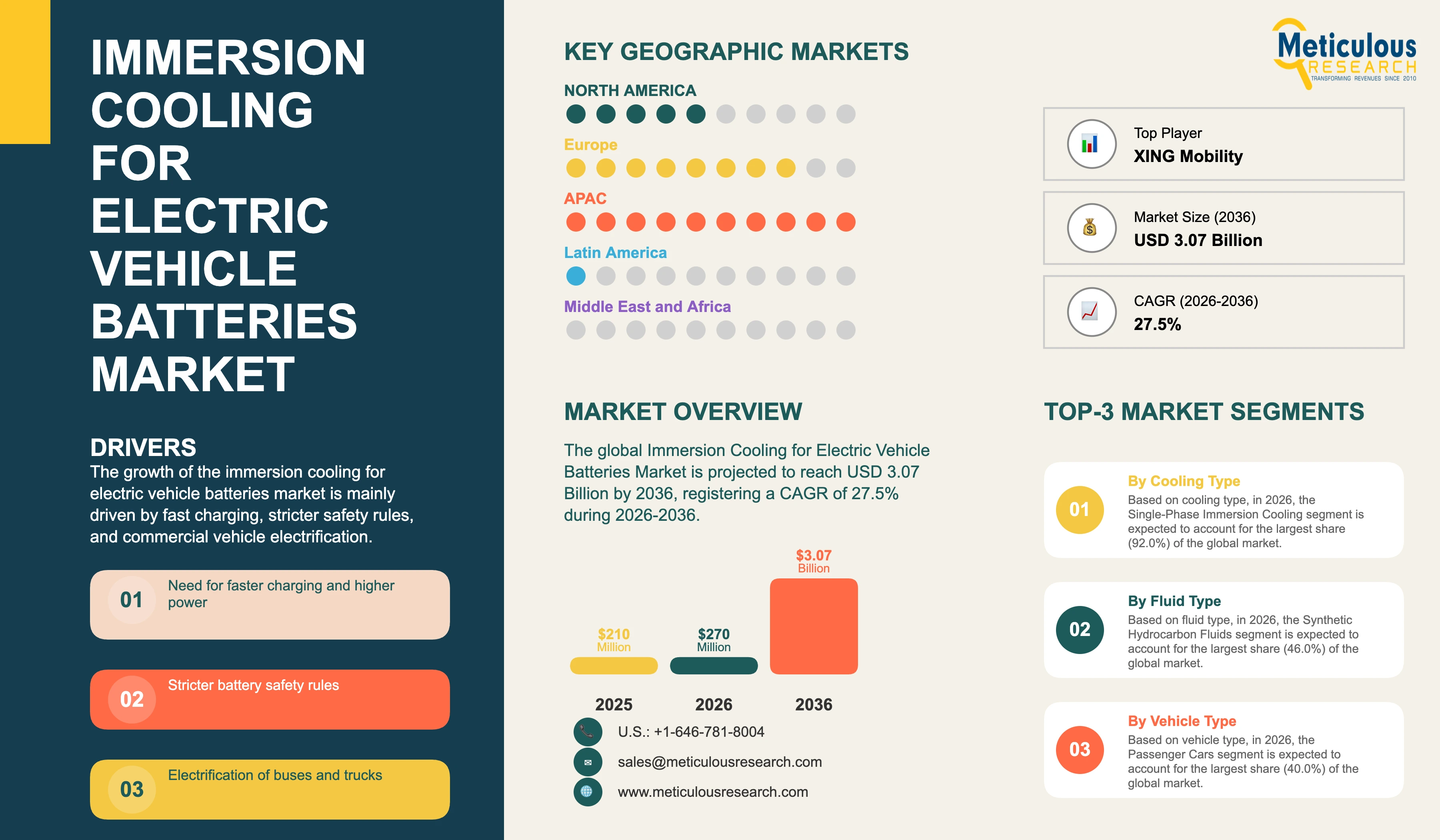
The global immersion cooling for electric vehicle batteries market was valued at USD 210.0 million in 2025. This market is expected to reach USD 3.07 billion by 2036 from an estimated USD 270.0 million in 2026, registering a CAGR of 27.5% during the forecast period (2026-2036).
- Published
- Nov 2026
- Pages
- 267
- Format
- PDF + Excel
- Report ID
- MRAUTO - 1042880
- Base year
- 2025
- 2025 · BASELINE
- $210.0M
- 2036
- $3.07B
- CAGR 2026–2036
- 27.5%
2025 baseline · 2026–2036 forecast at 27.5% CAGR · hover a bar for the value
Key highlights
EV battery deployment reached 1.2 TWh in 2025, an increase of almost 30% compared with 2024, according to the IEA. Almost all of this capacity uses indirect cooling with cold plates today, leaving large room for immersion cooling to grow in vehicles where fast charging, high power, and safety are most important.
XING Mobility, a Taiwan-based developer of immersion-cooled battery systems, signed a strategic agreement with German engineering firm Ideenion in November 2025 to jointly develop immersion-cooled cell-to-pack battery systems for European vehicle makers, using XING's factory in Thailand as a production site, according to the companies. XING showed its immersion-cooled technology in the Caterham Project V at IAA Mobility 2025 and presented an 800V immersion-cooled battery unit at CES 2026.
TotalEnergies Lubrifiants and XING Mobility signed a memorandum of understanding to jointly promote immersion cooling battery technologies, combining TotalEnergies' dielectric fluids with XING's battery architecture, according to the companies. The partnership initially focuses on marine applications and is planned to expand into mobility, energy storage, and backup power.
China's battery safety standard GB 38031-2025 took effect for new vehicle type approvals on July 1, 2026, requiring battery packs to show no fire or explosion after thermal runaway. Immersion cooling can absorb heat from a failing cell and limit propagation, which makes it one of the solutions considered by battery makers for the strictest safety requirements.
3M exited the production of PFAS, including the fluorinated fluids used in some two-phase immersion systems, by the end of 2025, and the EU is considering broad restrictions on PFAS. These changes are pushing the market toward non-fluorinated synthetic hydrocarbon and ester fluids.
Leading suppliers include XING Mobility, Kreisel Electric (John Deere), Ricardo, MAHLE, Shell, TotalEnergies, ExxonMobil, FUCHS, Castrol (bp), M&I Materials, Engineered Fluids, and Lubrizol. Commercial vehicles are the fastest-growing vehicle type and are expected to become the largest vehicle type by 2036, as buses and trucks value battery life, fast charging, and safety. Ester-based fluids are the fastest-growing fluid type.
By cooling type, single-phase immersion cooling accounts for the larger share of 92.0% in 2026, while two-phase immersion cooling registers the higher CAGR.
By fluid type, synthetic hydrocarbon fluids account for the largest share in 2026, while ester-based fluids register the highest CAGR.
By cell format, cylindrical cells account for the largest share in 2026, while prismatic cells register the highest CAGR.
By vehicle type, passenger cars account for the largest share of 40.0% in 2026, while commercial vehicles register the highest CAGR.
By geography, Asia-Pacific accounts for the largest share of 42.0% in 2026, while Europe registers the highest CAGR of 30.4%.
Report summary
| Particulars | Details |
|---|---|
| Forecast Period | 2026-2036 |
| Base Year | 2025 |
| Estimated Year | 2026 |
| CAGR (Value) | 27.5% |
| Format | PDF, Excel & Cloud Portal · 267 pages |
| Market Size (Value) in 2025 | USD 210.0 million |
| Market Size (Value) in 2026 | USD 270.0 million |
| Market Size (Value) by 2036 | USD 3.07 billion |
| Largest Segment by Cooling Type (2026) | Single-Phase Immersion Cooling (92.0%) |
| Largest Segment by Vehicle Type (2026) | Passenger Cars (40.0%) |
| Largest Region (2026) | Asia-Pacific (42.0%) |
| Fastest-Growing Region | Europe (CAGR 30.4%) |
| Segments Covered | Cooling Type, Fluid Type, Cell Format, Vehicle Type, Geography |
| Countries Covered | U.S., Canada, Germany, U.K., France, Austria, Italy, Sweden, Norway, Netherlands, Spain, Poland, Hungary, Rest of Europe, China, Taiwan, Japan, South Korea, India, Thailand, Indonesia, Vietnam, Malaysia, Australia, Rest of Asia-Pacific, Brazil, Chile, Mexico, Colombia, Rest of Latin America, Turkey, UAE, Saudi Arabia, Israel, South Africa, Rest of Middle East & Africa |
| Key Companies | 12 companies and other companies |
Report overview
Segments covered: cooling type, fluid type, cell format, vehicle type.
Immersion cooling places battery cells in direct contact with a non-conductive (dielectric) fluid that flows around the cells and removes heat, instead of cooling the cells indirectly through cold plates and coolant channels. It allows more even cell temperatures, faster charging, higher power output, and better control of thermal runaway. This market covers dielectric fluids and immersion-specific battery hardware, such as sealed housings, manifolds, pumps, and heat exchangers, supplied for electric vehicle batteries.
The growth of this market is mainly driven by the need for faster charging and higher power in electric vehicles, which increases heat generation in cells, stricter battery safety rules, such as China's GB 38031-2025 no-fire, no-explosion standard, the ability of immersion cooling to limit the spread of thermal runaway, the electrification of buses, trucks, and off-highway vehicles that need durable and high-power batteries, and new partnerships between battery system makers, fluid suppliers, and vehicle engineering firms. In addition, the development of lower-cost and more sustainable dielectric fluids is supporting adoption. However, the higher weight and cost of immersion systems, limited production experience, and the strong position of cold plate cooling in mass-market vehicles are expected to restrain the growth of this market to some extent.
Most electric vehicle batteries today are cooled indirectly, using cold plates placed under or between cells, through which a water-glycol coolant flows. Indirect cooling is low-cost and proven, but heat must pass through the cell casing, thermal interface materials, and the cold plate, which limits how quickly heat can be removed and creates temperature differences across each cell. As charging rates and power levels rise, these limits become more important, and cells near the cold plate can be cooler than cells far from it. These temperature differences cause cells to age at different rates, which reduces the usable life of the whole pack.
This report covers the global immersion cooling for electric vehicle batteries market, including single-phase and two-phase immersion cooling, using synthetic hydrocarbon, ester-based, mineral oil-based, and fluorinated fluids, for batteries with cylindrical, prismatic, and pouch cells, in passenger cars, commercial vehicles, two- and three-wheelers, and off-highway and specialty vehicles. The market is valued at the selling price of dielectric fluids and immersion-specific battery hardware supplied to battery system makers and vehicle makers. The market is analyzed by cooling type, fluid type, cell format, vehicle type, and geography. Battery cells, indirect cold plate cooling systems, and immersion cooling for data centers and energy storage are not included.
In single-phase immersion cooling, the dielectric fluid stays liquid and is pumped through the battery and an external heat exchanger. In two-phase immersion cooling, the fluid boils on the hot cell surfaces and condenses elsewhere, which removes heat very efficiently but requires fluids with low boiling points, many of which have been fluorinated. Single-phase cooling is much more common in vehicles because it is simpler and uses lower-cost fluids, while two-phase cooling is used mainly in high-performance applications.
Immersion cooling offers several benefits for electric vehicle batteries compared with indirect cooling. Because the fluid touches every cell, it removes heat quickly and keeps cell temperatures even, which allows faster charging, higher power output, and longer battery life. The fluid also absorbs heat from a cell in thermal runaway and can slow or stop the spread to other cells, and it protects cells from moisture and dust. In some designs, the fluid and pack structure also help hold the cells in place, which allows module-free, cell-to-pack designs.
The market is still at an early stage, with most volumes in niche and commercial applications. Immersion-cooled batteries have been used mainly in motorsport, high-performance cars, buses, off-highway machines, and specialty vehicles, where performance and safety are more important than cost. XING Mobility, Kreisel Electric, and Ricardo have developed immersion-cooled battery systems, and fluid suppliers, such as Shell, TotalEnergies, ExxonMobil, FUCHS, Castrol, M&I Materials, Engineered Fluids, and Lubrizol, have developed dielectric fluids for electric vehicles. XING Mobility opened what it describes as the world's first factory focused on volume production of immersion-cooled battery systems.
Fluid choice is an important part of the market, as the fluid affects performance, safety, cost, and sustainability. Synthetic hydrocarbon fluids, such as polyalphaolefins, are widely used because they offer good heat transfer, low viscosity, and compatibility with battery materials. Ester-based fluids offer high flash points, good biodegradability, and fire safety, while mineral oils are lower in cost. Fluorinated fluids offer very low flammability and are used in two-phase systems, but the exit of 3M from PFAS production and possible EU restrictions are reducing their use.
In 2026, single-phase immersion cooling accounts for the largest share of the market by cooling type, while two-phase immersion cooling is the fastest-growing cooling type. Synthetic hydrocarbon fluids account for the largest share by fluid type, while ester-based fluids are the fastest-growing fluid type. Cylindrical cells account for the largest share by cell format, while prismatic cells are the fastest-growing cell format. Passenger cars account for the largest share by vehicle type, while commercial vehicles are the fastest-growing vehicle type. Asia-Pacific accounts for the largest share of the market, while Europe is the fastest-growing region.
Market growth over the forecast period will depend on how quickly immersion cooling moves from niche high-performance and commercial applications into higher-volume vehicles, the cost of fluids and hardware, the adoption of stricter safety rules, and the development of sustainable fluids. Because the market starts from a small base, growth rates are high, but immersion cooling is expected to remain a small share of all electric vehicle battery cooling through 2036.
Passenger cars are expected to account for the largest share of 40.0% of the market in 2026, while commercial vehicles are projected to register the highest CAGR and to become the largest vehicle type by 2036.
Asia-Pacific is expected to account for the largest share of 42.0% of the market in 2026, mainly due to China's large electric vehicle and bus production, the GB 38031-2025 standard, and XING Mobility's presence in Taiwan and Thailand.
Europe is projected to register the highest CAGR of 30.4% during the forecast period, driven by immersion-cooled battery development for European vehicle makers, performance vehicles, bus and truck electrification, and sustainable fluids.
The report profiles 12 companies, including XING Mobility, Kreisel Electric, Ricardo, MAHLE, Shell, TotalEnergies, ExxonMobil, FUCHS, Castrol, M&I Materials, Engineered Fluids, and Lubrizol.
Immersion cooling places cells in direct contact with a dielectric fluid that removes heat from all cell surfaces, while cold plate cooling removes heat indirectly through plates and coolant channels, which is cheaper but less even.
This report covers immersion cooling fluids and hardware for electric vehicle batteries only. Broader immersion cooling fluid markets for data centers and battery cell cooling fluid markets are covered in separate reports.
Report infographic
Market dynamics
17 factors across 5 forcesNeed for faster charging and higher power
Vehicle makers are moving to faster charging, with many new electric vehicles able to charge at several C and some reaching 10C or more, and to higher-power batteries for performance cars, trucks, and buses. Faster charging and higher power increase heat generation inside cells, and indirect cooling can struggle to remove this heat quickly and evenly. Uneven temperatures reduce charging speed and battery life and can increase safety risks.
Immersion cooling removes heat directly from all cell surfaces, which keeps cell temperatures low and even during fast charging and high-power driving. This allows battery makers to charge faster without damaging cells and to deliver more power from the same battery. As fast charging becomes a key selling point, especially in China and for commercial vehicles, interest in immersion cooling is growing. Even cell temperatures also allow battery makers to use more of each cell's capacity, which can partly offset the added weight of the fluid.
Stricter battery safety rules
Battery safety rules are becoming stricter, led by China's GB 38031-2025 standard, which took effect for new vehicle type approvals on July 1, 2026, and requires battery packs to show no fire or explosion after thermal runaway. Meeting this requirement requires effective ways to stop heat from spreading between cells. Immersion cooling can absorb large amounts of heat from a failing cell and carry it away, and the fluid can cool neighboring cells and limit oxygen access, which helps prevent propagation.
Immersion cooling is therefore one of the solutions considered by battery makers and vehicle makers for the strictest safety requirements, especially in high-energy packs and commercial vehicles. Safety rules for buses, trucks, ships, and energy storage are also becoming stricter, which supports adoption in these applications. Fire services and insurers also prefer battery designs that limit fire risk in tunnels, depots, and car parks.
Electrification of buses, trucks, and off-highway vehicles
Electric buses, trucks, and off-highway vehicles, such as construction and agricultural machines, use large batteries that are charged quickly and work hard for long hours, often in hot or dusty conditions. These vehicles need batteries with long life, high power, and strong safety, and their operators value lower total cost of ownership over the life of the vehicle. Immersion cooling can extend battery life, protect cells from dust and moisture, and support fast charging and high power.
Kreisel Electric, owned by John Deere, uses immersion-cooled battery technology for off-highway and commercial applications, and XING Mobility's immersion technology has been used in passenger and commercial vehicles, agricultural and industrial machines, and marine applications. Commercial vehicles are the fastest-growing vehicle type in this market, supported by the electrification of buses and trucks.
Partnerships between battery makers, fluid suppliers, and engineering firms
Immersion cooling requires close cooperation between battery system makers, fluid suppliers, and vehicle makers, as the fluid, cells, materials, and pack design must work together. New partnerships are helping to bring immersion cooling closer to production. XING Mobility signed an agreement with Ideenion in November 2025 to develop immersion-cooled battery systems for European vehicle makers, and TotalEnergies and XING Mobility signed an agreement to promote immersion cooling battery technologies, according to the companies.
Fluid suppliers, such as Shell, ExxonMobil, FUCHS, and Castrol, are also working with battery makers and vehicle makers to develop and test dielectric fluids for electric vehicles. These partnerships reduce development risk and time for vehicle makers and are expected to accelerate adoption over the forecast period.
Development of lower-cost and sustainable dielectric fluids
Early immersion systems often used expensive fluorinated fluids, which raised costs and environmental concerns. Fluid suppliers have since developed synthetic hydrocarbon and ester-based fluids that offer good heat transfer, low viscosity, high flash points, and compatibility with battery materials at lower cost. Ester-based fluids, many of which are biodegradable and made from renewable sources, also offer strong fire safety performance. The exit of 3M from PFAS production by the end of 2025 and possible EU restrictions on PFAS are accelerating the move to these non-fluorinated fluids. Lower-cost fluids reduce the total cost of immersion systems and make them more attractive for higher-volume vehicles, while sustainable fluids help vehicle makers meet environmental goals. Ester-based fluids are the fastest-growing fluid type in this market, and suppliers such as M&I Materials, Engineered Fluids, TotalEnergies, and FUCHS are expanding their ester and synthetic fluid offerings for electric vehicles.
Table of contents
12 chapters · 173 sections · 267 pages · click to expandSegmental analysis
| Segment | Largest share (2026) | Fastest growth (2026–2036) |
|---|---|---|
| By Cooling Type | Synthetic hydrocarbon fluids | Ester-based fluids |
By Cooling Type
- The synthetic hydrocarbon fluids segment is expected to account for the largest share of the immersion cooling for electric vehicle batteries market, while the ester-based fluids segment is projected to register the highest CAGR during the forecast period.
- The cylindrical cells segment is expected to account for the largest share of the immersion cooling for electric vehicle batteries market, while the prismatic cells segment is projected to register the highest CAGR during the forecast period.
Geographic analysis
Asia-Pacific
Largest shareIn 2026, Asia-Pacific is expected to account for the largest share of 42.0% of the global immersion cooling for electric vehicle batteries market. The large share of this region is mainly due to China's position as the largest producer of electric vehicles, buses, and batteries, the implementation of China's GB 38031-2025 no-fire, no-explosion standard, the presence of XING Mobility in Taiwan and its production site in Thailand, the large production of electric two- and three-wheelers in India, China, and Southeast Asia, and the growth of electric buses and trucks in China and India. Several Chinese battery makers are also testing immersion cooling for high-power and commercial vehicle batteries. India is expected to be one of the fastest-growing countries, supported by electric two-wheeler, three-wheeler, and bus production in a hot climate where battery cooling is especially important. Japan and South Korea are also developing immersion cooling technologies.
Europe
Fastest growthHowever, Europe is projected to register the highest CAGR of 30.4% during the forecast period. The rapid growth of this region is mainly driven by the development of immersion-cooled battery systems for European vehicle makers, such as the partnership between XING Mobility and Ideenion, the strong presence of premium and performance vehicle makers, the electrification of buses and trucks under EU emission rules, the presence of immersion cooling companies, such as Kreisel Electric in Austria, Ricardo in the U.K., and MAHLE in Germany, and the strong focus on sustainable ester fluids. European fluid suppliers, such as TotalEnergies, Shell, and FUCHS, are also active in the market. EU rules on PFAS and sustainability favor the ester and synthetic fluids that European suppliers are developing. Germany, the U.K., France, Austria, and Italy are among the most important markets in Europe, supported by premium and performance vehicle makers, motorsport, engineering firms, and battery system developers. The Caterham Project V electric sports car, which uses XING Mobility's immersion-cooled battery, was shown at IAA Mobility 2025 in Munich. Scandinavian countries, such as Norway and Sweden, are also important for electric buses, trucks, and marine vessels, where immersion cooling is being tested. Several European bus makers are also evaluating immersion-cooled batteries for city buses with high daily mileage.
North America
North America accounts for a significant share of the market, led by the U.S., supported by performance electric vehicles, electric trucks, off-highway machines, and fluid suppliers, such as ExxonMobil, Lubrizol, and Engineered Fluids. Kreisel Electric's parent company, John Deere, is using Kreisel's battery technology to electrify off-highway machines. However, the end of federal electric vehicle purchase incentives in 2025 has slowed electric vehicle growth. Mexico is also a fast-growing location for electric bus and truck production for North American markets.
Latin America
Latin America and the Middle East & Africa account for small shares, with growth supported by electric bus adoption in Chile, Brazil, and Colombia and interest in high-temperature battery solutions in the Gulf countries, where very hot weather places high stress on batteries.
Competitive landscape
The global immersion cooling for electric vehicle batteries market includes immersion-cooled battery system makers, engineering firms, thermal management suppliers, and dielectric fluid suppliers. The market is still at an early stage, with a small number of specialist battery system makers and many fluid suppliers that serve immersion cooling across vehicles, data centers, and energy storage. Large battery makers and vehicle makers are testing immersion cooling but mostly rely on cold plate cooling in production, which limits the market today to specialist suppliers and smaller programs.
XING Mobility is a leading developer of immersion-cooled battery systems, with its Immersio cell-to-pack system and a production factory focused on immersion-cooled batteries. Kreisel Electric, owned by John Deere, offers immersion-cooled battery technology for off-highway and commercial vehicles, while Ricardo and MAHLE develop immersion cooling systems and engineering services. Shell, TotalEnergies, ExxonMobil, FUCHS, Castrol, M&I Materials, Engineered Fluids, and Lubrizol supply dielectric fluids.
Companies in this market compete on heat transfer performance, safety, fluid cost and sustainability, material compatibility, system weight, durability, and engineering support. Key strategies include developing immersion-cooled cell-to-pack systems, lower-cost and sustainable fluids, and solutions for buses, trucks, and off-highway vehicles, forming partnerships across the value chain, and using the same technology across vehicles, marine, and energy storage.
Recent competitive activity in this market has focused on partnerships, new applications, and European market entry. XING Mobility signed an agreement with Ideenion in November 2025 to develop immersion-cooled battery systems for European vehicle makers, TotalEnergies and XING Mobility signed an agreement to promote immersion cooling battery technologies, and XING Mobility presented an 800V immersion-cooled battery unit and other products at CES 2026, according to the companies.
We expect competition in this market to increase over the forecast period as more battery makers and thermal management suppliers develop immersion systems, as fluid suppliers compete for new programs, and as immersion cooling moves into commercial vehicles. Suppliers with proven production experience, sustainable fluids, strong safety performance, and partnerships with vehicle makers are expected to strengthen their positions, while consolidation and acquisitions of specialist companies by larger suppliers are likely, as shown by John Deere's acquisition of Kreisel Electric in 2022.
Some of the key players operating in the immersion cooling for electric vehicle batteries market are XING Mobility Inc., Kreisel Electric GmbH (John Deere), Ricardo plc, MAHLE GmbH, Shell plc, TotalEnergies SE, Exxon Mobil Corporation, FUCHS SE, Castrol Limited (bp), M&I Materials Ltd., Engineered Fluids, Inc., and The Lubrizol Corporation, among others.
- —
XING Mobility signed an agreement with Ideenion in November 2025 to develop immersion-cooled battery systems for European vehicle makers, TotalEnergies and XING Mobility agreed to promote immersion cooling, and XING presented an 800V immersion-cooled unit at CES 2026.
- XING Mobility Inc.
- Kreisel Electric GmbH · John Deere
- Ricardo plc
- MAHLE GmbH
- Shell plc
- TotalEnergies SE
- Exxon Mobil Corporation
- FUCHS SE
- Castrol Limited (bp)
- M&I Materials Ltd.
- Engineered Fluids, Inc.
- Lubrizol Corporation
Expert perspectives
Immersion cooling for electric vehicle batteries is an emerging technology that offers clear benefits for fast charging, high power, battery life, and safety, but faces challenges of weight, cost, and limited production experience. The market is small today but is expected to grow quickly as stricter safety rules, faster charging, and commercial vehicle electrification create demand in applications where its benefits matter most.
Over the forecast period, the market is expected to grow at a CAGR of 27.5%, from USD 270.0 million in 2026 to USD 3.07 billion in 2036. Growth will be driven by the need for faster charging and higher power, stricter battery safety rules, the electrification of buses, trucks, and off-highway vehicles, partnerships across the value chain, and the development of lower-cost and sustainable dielectric fluids.
Among the market segments, single-phase immersion cooling is the largest cooling type, while two-phase immersion cooling grows fastest. Synthetic hydrocarbon fluids are the largest fluid type, while ester-based fluids grow fastest. Cylindrical cells are the largest cell format, while prismatic cells grow fastest. Passenger cars are the largest vehicle type, while commercial vehicles grow fastest. Asia-Pacific is the largest region, while Europe grows fastest, at a CAGR of 30.4%.
In our view, commercial vehicles will be by far the most important path for immersion cooling to reach scale. Buses and trucks value battery life, safety, and fast charging more than weight and upfront cost, and their large batteries and intensive use make the benefits of immersion cooling easier to justify. We expect commercial vehicles to become the largest vehicle type in this market by 2036, overtaking passenger cars as bus and truck electrification accelerates.
We also see the shift to sustainable, non-fluorinated fluids as a key structural change in the market. Ester and synthetic hydrocarbon fluids offer good heat transfer and fire safety at lower cost and avoid PFAS concerns, which removes a major long-standing barrier to adoption in Europe and other regions. Fluid suppliers that combine strong fluid performance with testing, monitoring, and engineering support will play an important role in moving immersion cooling into production.
Overall, we firmly believe that the immersion cooling for electric vehicle batteries market will grow quickly over the forecast period from a small base, with two-phase cooling, ester-based fluids, prismatic cells, commercial vehicles, and Europe providing the fastest growth. Companies with proven production experience, sustainable fluids, and partnerships with vehicle makers will be best positioned to capture this growth, while the cost and weight of immersion systems and the strong position of cold plate cooling remain the main risks.
Customer perspectives
Customers in the immersion cooling for electric vehicle batteries market are mainly battery system makers and vehicle makers of performance cars, buses, trucks, off-highway machines, two- and three-wheelers, and specialty vehicles. They focus on heat removal performance, fast charging capability, safety and thermal runaway protection, battery life, weight, cost, fluid sustainability, material compatibility, and long-term reliability. Customers increasingly ask for non-fluorinated and biodegradable fluids, sealed and serviceable designs, and proof of performance in long-term field trials. They also value suppliers that can provide engineering support for integrating immersion cooling into their battery packs and vehicles. Commercial vehicle customers also focus on total cost of ownership and service support. Many also want supply from more than one fluid source, and bus operators and fleets want proof of fire safety and simple service.
This comment explains why passenger cars account for 40.0% of the market and why Europe is the fastest-growing region, led by performance and premium vehicle makers.
This comment explains why commercial vehicles are the fastest-growing vehicle type and why Asia-Pacific accounts for the largest share of the market, supported by China and India.
This comment explains why ester-based fluids are the fastest-growing fluid type and why single-phase immersion cooling accounts for 92.0% of the market.
“Immersion cooling lets us charge and race hard without hot spots in the pack. The weight penalty is worth it for our customers.”
“Our buses charge fast at the depot and run all day in the heat. Immersion cooling keeps cell temperatures even and should extend battery life.”
“We are moving away from fluorinated fluids. Ester fluids give us high flash points and biodegradability, which our customers now ask for.”
Frequently asked questions
The global immersion cooling for electric vehicle batteries market was valued at USD 210.0 million in 2025, up from USD 160.0 million in 2024, and is estimated at USD 270.0 million in 2026. The market includes dielectric fluids and immersion-specific battery hardware for electric vehicles.
The global immersion cooling for electric vehicle batteries market is expected to reach USD 3.07 billion by 2036, driven by fast charging, stricter safety rules, commercial vehicle electrification, and sustainable fluids.
The market is expected to register a CAGR of 27.5% from 2026 to 2036, with the fastest growth in two-phase cooling, ester-based fluids, prismatic cells, commercial vehicles, and Europe.
Market growth is mainly driven by the need for faster charging and higher power, stricter battery safety rules, the electrification of buses, trucks, and off-highway vehicles, partnerships across the value chain, and the development of lower-cost and sustainable dielectric fluids.
The higher weight and cost of immersion systems and the strong position of cold plate cooling restrain growth, while material compatibility and long-term reliability and sealing, service, and recycling are key challenges.
Key growth opportunities include immersion cooling for electric buses and trucks, immersion-cooled cell-to-pack designs for premium and performance vehicles, sustainable ester and bio-based dielectric fluids, and two- and three-wheelers and specialty vehicles.
Single-phase immersion cooling is expected to account for the largest share of 92.0% of the market in 2026, while two-phase immersion cooling is projected to register the highest CAGR, driven by extreme fast charging and high-performance applications.
In 2026, the synthetic hydrocarbon fluids segment is expected to account for the largest share of the immersion cooling for electric vehicle batteries market, while the ester-based fluids segment is projected to register the highest CAGR during the forecast period.
In 2026, the cylindrical cells segment is expected to account for the largest share of the immersion cooling for electric vehicle batteries market, while the prismatic cells segment is projected to register the highest CAGR during the forecast period.
Passenger cars are expected to account for the largest share of 40.0% of the market in 2026, while commercial vehicles are projected to register the highest CAGR and to become the largest vehicle type by 2036.
Asia-Pacific is expected to account for the largest share of 42.0% of the market in 2026, mainly due to China's large electric vehicle and bus production, the GB 38031-2025 standard, and XING Mobility's presence in Taiwan and Thailand.
Europe is projected to register the highest CAGR of 30.4% during the forecast period, driven by immersion-cooled battery development for European vehicle makers, performance vehicles, bus and truck electrification, and sustainable fluids.
The report profiles 12 companies, including XING Mobility, Kreisel Electric, Ricardo, MAHLE, Shell, TotalEnergies, ExxonMobil, FUCHS, Castrol, M&I Materials, Engineered Fluids, and Lubrizol.
XING Mobility signed an agreement with Ideenion in November 2025 to develop immersion-cooled battery systems for European vehicle makers, TotalEnergies and XING Mobility agreed to promote immersion cooling, and XING presented an 800V immersion-cooled unit at CES 2026.
Immersion cooling places cells in direct contact with a dielectric fluid that removes heat from all cell surfaces, while cold plate cooling removes heat indirectly through plates and coolant channels, which is cheaper but less even.
This report covers immersion cooling fluids and hardware for electric vehicle batteries only. Broader immersion cooling fluid markets for data centers and battery cell cooling fluid markets are covered in separate reports.
Cite this report
Meticulous Research. (2026). Immersion Cooling for Electric Vehicle Batteries Market - Global Opportunity Analysis and Industry Forecast (2026-2036) (Report No. MRAUTO - 1042880). Meticulous Market Research Pvt. Ltd. https://www.meticulousresearch.com/product/immersion-cooling-for-electric-vehicle-batteries-market-7563