EV Battery Enclosures Market (2026-2036)
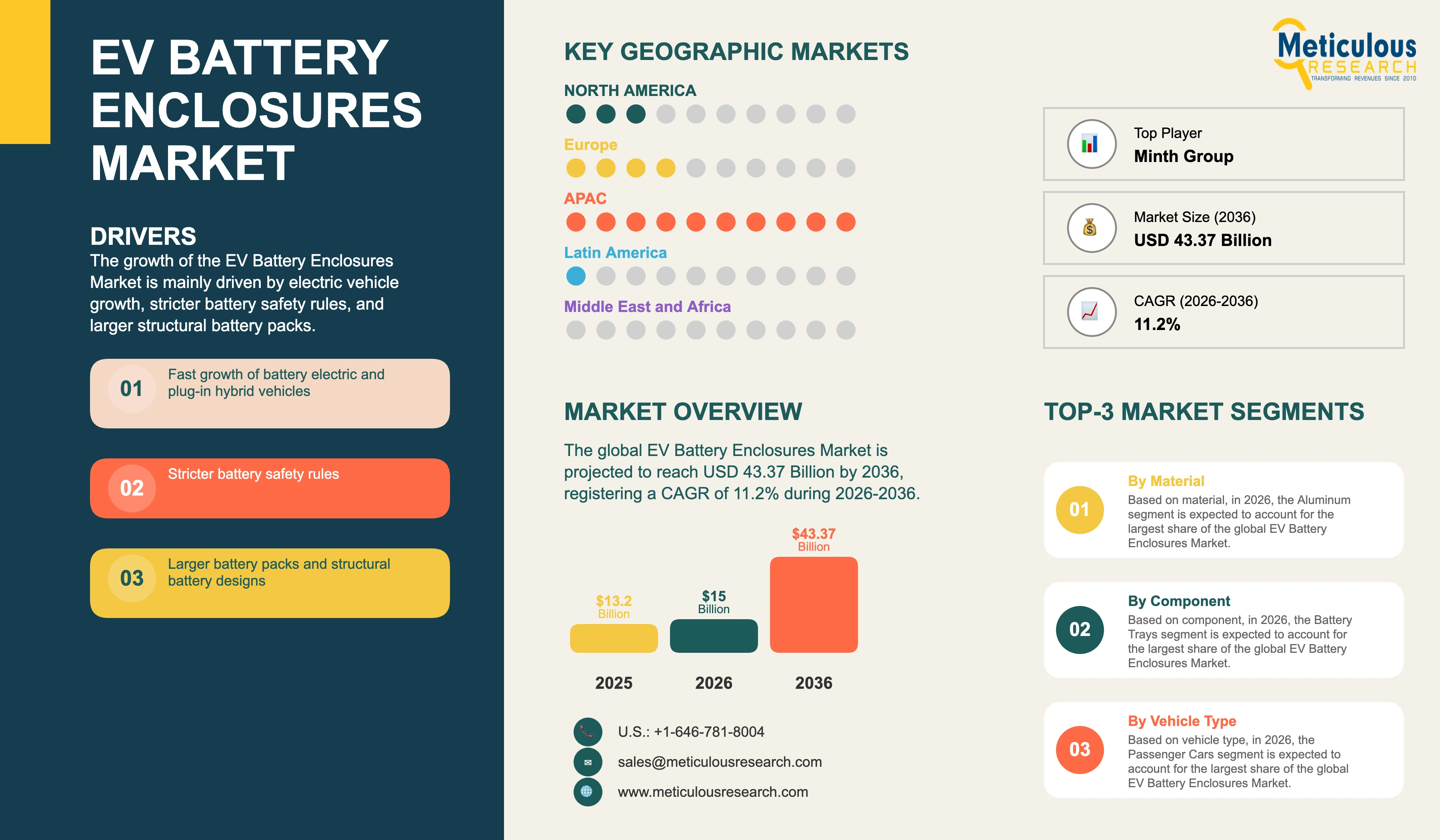
The global EV battery enclosures market was valued at USD 13.20 billion in 2025. This market is expected to reach USD 43.37 billion by 2036 from an estimated USD 15.00 billion in 2026, registering a CAGR of 11.2% during the forecast period (2026-2036).
- Published
- Nov 2026
- Pages
- 264
- Format
- PDF + Excel
- Report ID
- MRAUTO - 1042897
- Base year
- 2025
- 2025 · BASELINE
- $13.20B
- 2036
- $43.37B
- CAGR 2026–2036
- 11.2%
2025 baseline · 2026–2036 forecast at 11.2% CAGR · hover a bar for the value
Key highlights
Minth Group, one of the world's largest suppliers of battery housings, reported 2025 revenue of RMB 25.74 billion, up 11.2%, driven by rapid growth in battery housings and structural parts, according to Minth Group. Its body structure business, formerly known as battery housing, remained its fastest-growing business, with capacity use improving at its Serbian and Czech plants and new sites in Poland and France moving to mass production, according to the company.
Purem by Eberspächer started series production of high-strength steel battery housings in China at volumes of more than 100,000 units per year from the second half of 2026 and is bringing the technology to Europe, according to Eberspächer. The company states that higher-strength steel allows thinner walls, resulting in housings that are lighter than aluminium equivalents, cheaper to produce, and lower in manufacturing carbon footprint.
Kautex Textron secured an agreement to supply its Pentatonic battery enclosure system, including the top cover, bottom tray, and thermal management, to a vehicle maker for a multi-vehicle hybrid platform, with North American production scheduled to begin in 2028, according to Kautex. The Pentatonic line covers thermoplastic composite and composite-metal hybrid enclosures.
China's updated battery safety standard GB 38031-2025, which took effect on July 1, 2026, requires that traction batteries must not catch fire or explode, even in the event of thermal runaway, and adds a new thermal propagation test, according to the MIIT. The standard raises requirements for enclosure sealing, venting, and fire resistance.
Novelis, Shape Corp., and Metalsa are collaborating on aluminum roll-formed battery tray concepts, according to Novelis, and Novelis states that aluminum enclosures can be up to 50% lighter than equivalent steel enclosures. This shows the strong competition between aluminum and steel solutions for battery enclosures.
Leading suppliers include Minth Group, Lingyun Industrial, Magna International, Gestamp, Benteler, Constellium, Kautex Textron, Eberspächer Group, and SGL Carbon. Composite and multi-material enclosures are the fastest-growing material segment, and top covers are the fastest-growing component, as vehicle makers add fire protection and reduce weight. Constellium and Hydro supply extrusion- and sheet-based battery enclosure components.
By material, aluminum accounts for the largest share of 62.0% in 2026, while composite and multi-material registers the highest CAGR.
By component, battery trays account for the largest share in 2026, while top covers register the highest CAGR.
By propulsion type, battery electric vehicles account for the larger share in 2026 and also register the higher CAGR.
By vehicle type, passenger cars account for the larger share of 86.0% in 2026, while commercial vehicles register the higher CAGR.
By geography, Asia-Pacific accounts for the largest share of 58.0% in 2026, while Europe registers the highest CAGR of 12.9%.
Report summary
| Particulars | Details |
|---|---|
| Base Year | 2025 |
| Estimated Year | 2026 |
| Forecast Period | 2026-2036 |
| Market Size in 2025 | USD 13.20 billion |
| Market Size in 2026 | USD 15.00 billion |
| Market Size by 2036 | USD 43.37 billion |
| CAGR (2026-2036) | 11.2% |
| Format | PDF, Excel & Cloud Portal · 264 pages |
| Largest Segment by Material (2026) | Aluminum (62.0%) |
| Largest Segment by Vehicle Type (2026) | Passenger Cars (86.0%) |
| Largest Region (2026) | Asia-Pacific (58.0%) |
| Fastest-Growing Region | Europe (CAGR 12.9%) |
| Companies Profiled | 9 companies and other companies |
| Segments Covered | Material, Component, Propulsion Type, Vehicle Type, Geography |
| Countries Covered | U.S., Canada, Mexico, Germany, France, U.K., Spain, Italy, Sweden, Czech Republic, Poland, Slovakia, Hungary, Serbia, Romania, Netherlands, Belgium, Rest of Europe, China, Japan, South Korea, India, Thailand, Indonesia, Malaysia, Vietnam, Philippines, Taiwan, Singapore, Australia, Rest of Asia-Pacific, Brazil, Argentina, Chile, Colombia, Rest of Latin America, Turkey, Morocco, South Africa, Saudi Arabia, UAE, Israel, Rest of Middle East & Africa |
Report overview
Segments covered: material, component, propulsion type, vehicle type.
An EV battery enclosure is the structural housing that holds and protects the battery cells or modules of an electric vehicle. It typically includes a lower tray or housing that carries the cells and often the cooling plates, a top cover that seals the pack, and frames, side members, and cross members that give the enclosure strength and protect the battery in crashes. Enclosures must protect the battery from impacts, water, dust, and stone chips, contain and slow the spread of fire in case of a battery failure, help manage heat, and, in many new designs, form part of the vehicle body structure itself.
The growth of this market is mainly driven by the fast growth of battery electric and plug-in hybrid vehicle production, stricter battery safety rules, such as China's GB 38031-2025, which requires that batteries must not catch fire or explode after thermal runaway, the move to larger battery packs and cell-to-pack and cell-to-body designs that make the enclosure a larger and more valuable structural part, the localization of battery and vehicle production in Europe and North America, and the growth of electric buses and trucks with large battery packs. In addition, new materials, such as high-strength steel, composites, and multi-material designs, are expanding the range of enclosure solutions. However, strong price pressure, changes in electric vehicle demand in some regions, and the integration of enclosures into vehicle bodies are expected to restrain the growth of this market to some extent.
The battery pack is the largest and most expensive part of an electric vehicle, and the enclosure that houses it has become one of the most important structural parts of the vehicle. Early electric vehicles often used battery enclosures adapted from conventional vehicle parts, but today's enclosures are purpose-designed structures that must carry hundreds of kilograms of cells, resist crashes from all directions, remain sealed against water and dust for 15 years or more, help cool the battery, and contain a battery fire long enough for occupants to escape. In many vehicles, the enclosure also adds stiffness to the body, especially in skateboard platforms where the battery covers most of the floor.
This report covers the global EV battery enclosures market, including aluminum, steel, and composite and multi-material battery enclosures, comprising battery trays, top covers, and frames and crash structures, for battery electric vehicles and plug-in hybrid electric vehicles, in passenger cars and commercial vehicles. The market is valued at the selling price of finished battery enclosures and enclosure components supplied to vehicle makers and battery pack makers. The market is analyzed by material, component, propulsion type, vehicle type, and geography. Battery cells, modules, cooling plates sold separately, battery management systems, and enclosures for hybrid vehicles without plug-in charging and for stationary storage are not included.
Vehicle makers use several different enclosure designs, depending on cost targets, vehicle size, and production volume. Aluminum enclosures, made from extruded profiles, sheet, castings, or a combination, are the most common in many markets because they are light, strong, and easy to combine with cooling channels. Steel enclosures, made from high-strength and press-hardening steel, are gaining share because of their lower cost and better fire resistance, especially in mass-market vehicles. Composite enclosures, such as sheet molding compound covers and thermoplastic composite trays, offer low weight, good insulation, and fire resistance, and multi-material designs combine metals and composites to balance cost, weight, and safety.
Battery pack designs are also changing in ways that affect the role and value of the enclosure. Cell-to-pack designs remove modules and place cells directly in the enclosure, which increases energy density but makes the enclosure a more important structural part. Cell-to-body and cell-to-chassis designs go further by making the battery enclosure part of the vehicle floor, with the top cover serving as the cabin floor. These designs change what suppliers deliver, often shifting value from separate enclosure suppliers to integrated body and battery structures, but they also increase the structural and safety requirements of the enclosure.
The market includes automotive structural parts makers, aluminum companies, steel parts makers, and composite specialists. Minth Group is one of the world's largest battery housing suppliers, with plants in China, Europe, and North America. Lingyun Industrial supplies battery housings to Chinese vehicle makers, Magna International, Gestamp, and Benteler supply battery enclosures and structures to global vehicle makers, Constellium and other aluminum companies supply extrusion- and sheet-based enclosure components, Kautex Textron supplies thermoplastic composite and hybrid enclosures, Eberspächer supplies steel battery housings through Purem, and SGL Carbon supplies composite battery enclosure parts.
New and stricter battery safety rules in major markets are raising the requirements for battery enclosures. China's GB 38031-2025, which took effect in July 2026, requires that batteries must not catch fire or explode even after thermal runaway, according to the MIIT, and other regions are tightening battery safety rules under UN regulations. Enclosures must therefore provide better sealing, controlled venting of hot gases, fire-resistant materials and coatings, and protection against bottom impacts. These requirements increase the value of enclosures and favor suppliers with strong safety engineering and fire protection solutions.
In 2026, aluminum accounts for the largest share of the market by material, while composite and multi-material enclosures are the fastest-growing material segment. Battery trays account for the largest share by component, while top covers are the fastest-growing component. Battery electric vehicles account for the largest share by propulsion type and are also the fastest-growing propulsion type. Passenger cars account for the largest share by vehicle type, while commercial vehicles are the fastest-growing vehicle type. Asia-Pacific accounts for the largest share of the market, while Europe is the fastest-growing region.
Market growth over the forecast period will depend on electric vehicle production, battery pack sizes, the adoption of cell-to-pack and cell-to-body designs, material choices between aluminum, steel, and composites, battery safety rules, the localization of production in Europe and North America, and price pressure from vehicle makers. Strong electric vehicle growth will drive demand, while integration into vehicle bodies and falling prices will limit value growth per vehicle. Overall, the market is expected to grow strongly, in line with electric vehicle production, through 2036.
Passenger cars are expected to account for the largest share of 86.0% of the market in 2026, while commercial vehicles are projected to register the higher CAGR, driven by electric buses and trucks with very large battery packs.
Asia-Pacific is expected to account for the largest share of 58.0% of the market in 2026, mainly due to China's large electric vehicle and battery production and the presence of leading enclosure suppliers.
Europe is projected to register the highest CAGR of 12.9% during the forecast period, driven by EU CO2 targets, new electric vehicle models, and new battery and enclosure plants in the region.
The report profiles 9 companies, including Minth Group, Lingyun Industrial, Magna International, Gestamp, Benteler, Constellium, Kautex Textron, Eberspächer Group, and SGL Carbon.
No single material is best for every vehicle, as each involves trade-offs. Aluminum offers low weight, steel offers low cost and fire resistance, and composites offer low weight and fire resistance. Many vehicle makers combine materials to balance cost, weight, and safety.
Rules such as China's GB 38031-2025 require that batteries must not catch fire or explode after thermal runaway, which pushes vehicle makers to use enclosures with better sealing, controlled venting, and fire-resistant covers.
In 2026, the battery electric vehicles segment is expected to account for the larger share of the EV battery enclosures market, and it is also projected to register the higher CAGR during the forecast period.
Report infographic
Market dynamics
17 factors across 5 forcesFast growth of battery electric and plug-in hybrid vehicles
Global electric car sales topped 20 million units in 2025, according to the IEA, and electric vehicles are expected to account for a growing share of new vehicle sales over the forecast period, supported by emission rules in China and Europe, falling battery costs, and new lower-priced models. Every battery electric and plug-in hybrid vehicle needs a battery enclosure, so enclosure demand grows directly with electric vehicle production. Battery electric vehicles, which have larger batteries, use larger and more valuable enclosures than plug-in hybrids.
The growth of plug-in hybrid and range-extended electric vehicles, especially in China, also adds enclosure demand, although these vehicles use smaller packs. Minth Group's strong growth in battery housings, with new plants in Europe moving to mass production, reflects this demand, according to Minth Group. Battery electric vehicles are the largest and fastest-growing propulsion type in this market, supported by continued growth in battery electric vehicle sales in all major regions.
Stricter battery safety rules
Battery safety rules for electric vehicles are becoming stricter in China, Europe, and other major markets. China's GB 38031-2025, effective from July 2026, requires that traction batteries must not catch fire or explode even after thermal runaway and adds a new thermal propagation test, according to the MIIT. UN regulations on electric vehicle safety, which apply in Europe and many other countries, also set requirements for battery protection against crashes, water, and fire, and they are being updated to address thermal propagation.
These rules raise the requirements for battery enclosures, which must contain fires, vent hot gases safely away from occupants, remain sealed, and protect cells from crushing and bottom impacts. Vehicle makers are adding fire-resistant top covers, mica and ceramic linings, venting channels, and stronger underbody protection, which increases enclosure value. Top covers are the fastest-growing component in this market, supported by the use of fire-resistant composite and steel covers to meet these rules.
Larger battery packs and structural battery designs
Vehicle makers are increasing battery sizes to offer longer driving ranges, especially in SUVs, pickup trucks, and premium vehicles, which increases the size and value of enclosures. At the same time, cell-to-pack designs, which place cells directly in the enclosure without modules, and cell-to-body designs, which make the enclosure part of the vehicle floor, make the enclosure a more important structural part that must carry body loads and protect cells without module housings.
These designs require stronger, more precise enclosures, often with integrated cooling and complex shapes, which increases their value even as they remove other parts, such as module housings. Suppliers that can design and produce structural enclosures to tight tolerances can capture more value. Battery trays remain the largest component in this market, supported by their central role in carrying cells and cooling systems in cell-to-pack designs.
Localization of battery and vehicle production in Europe and North America
Vehicle makers and battery makers are building battery and electric vehicle plants in Europe and North America to meet local content rules, reduce logistics costs, and reduce dependence on imports. Battery enclosures are large and bulky, so they are usually produced close to battery pack and vehicle assembly plants. This localization creates demand for new enclosure plants in Europe and North America, often built by Chinese suppliers following their customers and by European and North American suppliers.
Minth Group has battery housing plants in Serbia and the Czech Republic and new sites in Poland and France, according to Minth Group, and Kautex plans North American production of its Pentatonic enclosures from 2028, according to Kautex. Europe is the fastest-growing region in this market, supported by the EU's CO2 targets, new electric vehicle models, and local battery and enclosure production.
Growth of electric buses and trucks
Electric buses, delivery vans, and trucks are growing quickly, especially in China and Europe, supported by emission rules for heavy vehicles, city bans on diesel buses, and the lower operating costs of electric commercial vehicles. These vehicles use very large battery packs, often several hundred kilowatt-hours, split into multiple packs, each with its own enclosure. Commercial vehicle enclosures must withstand strong vibration, long operating hours, and harsh road conditions, and they often need to be mounted on truck frames or under bus floors, where they are exposed to impacts. Enclosures for commercial vehicles are therefore larger and more strongly built than those for passenger cars, which makes them more valuable per vehicle. As battery prices fall and charging infrastructure for trucks expands, electric truck adoption is expected to accelerate, especially for urban delivery and regional haulage. Commercial vehicles are the fastest-growing vehicle type in this market, supported by these trends, and suppliers with experience in heavy-duty enclosures and modular pack designs are well placed to benefit over the forecast period.
Table of contents
12 chapters · 187 sections · 264 pages · click to expandSegmental analysis
| Segment | Largest share (2026) | Fastest growth (2026–2036) |
|---|---|---|
| By Material | Aluminum | Composite and multi-material |
| By Component | Battery trays | Top covers |
| By Propulsion Type | Battery electric vehicles | Rapid growth of this |
| By Vehicle Type | Passenger cars | Rapid growth of this |
By Material
- EV Battery Enclosures Market Analysis by Material
- The aluminum segment is expected to account for the largest share of 62.0% of the global EV battery enclosures market.
- The large share of this segment is mainly due to aluminum's low weight, which helps extend driving range, its good strength and crash performance, the ability to combine extruded profiles, sheet, and castings with integrated cooling channels, its corrosion resistance, and its long use in battery enclosures by vehicle makers in China, Europe, and North America.
- Minth Group, Lingyun Industrial, Constellium, and Benteler are among the leading suppliers of aluminum battery enclosures and components.
- However, the composite and multi-material segment is projected to register the highest CAGR during the forecast period.
- The rapid growth of this segment is driven by stricter battery safety rules, which favor materials with good fire resistance and electrical insulation, the low weight of composite top covers and trays, new thermoplastic composite and composite-metal hybrid enclosures, such as Kautex Textron's Pentatonic system, and vehicle makers' efforts to balance cost, weight, and safety.
- Steel enclosures are also growing quickly, supported by their low cost and fire resistance.
- Steel enclosures are expected to gain share in mass-market vehicles over the forecast period.
By Component
- EV Battery Enclosures Market Analysis by Component
- The battery trays segment is expected to account for the largest share of the global EV battery enclosures market.
- The large share of this segment is mainly due to the central role of the tray in carrying cells and modules, integrating cooling plates, and protecting the battery from bottom impacts, its large size and complex structure, the growing use of cell-to-pack designs, which place cells directly in the tray, and the high value of trays compared with covers.
- Minth Group, Magna International, Gestamp, and Benteler are among the leading suppliers of battery trays.
- However, the top covers segment is projected to register the highest CAGR during the forecast period.
- The rapid growth of this segment is driven by stricter battery safety rules, such as China's GB 38031-2025, which require covers that resist fire and hot gases during thermal runaway, the shift from simple stamped covers to fire-resistant composite and steel covers with linings, and the use of top covers as part of the cabin floor in cell-to-body designs.
- Frames and crash structures are also growing as enclosures take on more crash loads in side impacts.
- The battery trays segment is expected to account for the largest share of the EV battery enclosures market, while the top covers segment is projected to register the highest CAGR during the forecast period.
By Propulsion Type
- EV Battery Enclosures Market Analysis by Propulsion Type
- The battery electric vehicles segment is expected to account for the largest share of the global EV battery enclosures market.
- The large share of this segment is mainly due to the large battery packs in battery electric vehicles, which need large and valuable enclosures, the fast growth of battery electric vehicle production, the use of structural enclosures in skateboard platforms, and stricter safety requirements for large packs.
- Minth Group, Lingyun Industrial, and Magna International supply enclosures across many battery electric vehicle platforms.
- The battery electric vehicles segment is also projected to register the higher CAGR during the forecast period.
- The rapid growth of this segment is driven by the continued growth of battery electric vehicle sales, which accounted for most of the more than 20 million electric cars sold in 2025 according to the IEA, larger battery packs for longer range, cell-to-pack and cell-to-body designs, and stricter battery safety rules.
- Plug-in hybrid vehicles are also growing but use smaller enclosures.
- Plug-in hybrids remain important in China and for vehicle makers that are expanding their hybrid ranges.
By Vehicle Type
- EV Battery Enclosures Market Analysis by Vehicle Type
- The passenger cars segment is expected to account for the largest share of 86.0% of the global EV battery enclosures market.
- The large share of this segment is mainly due to the very large number of electric passenger cars produced each year, especially in China, the use of large battery packs in electric SUVs and premium cars, and the many new electric passenger car models launched by vehicle makers worldwide.
- Minth Group, Lingyun Industrial, and Gestamp supply enclosures across many passenger car platforms.
- However, the commercial vehicles segment is projected to register the higher CAGR during the forecast period.
- The rapid growth of this segment is driven by the fast growth of electric buses, delivery vans, and trucks in China and Europe, the very large battery packs in these vehicles, which use multiple enclosures per vehicle, emission rules for heavy vehicles, city bans on diesel buses, and the need for stronger enclosures that can withstand vibration and long operating hours.
- Electric delivery vans are a fast-growing part of this segment, supported by e-commerce fleets.
Geographic analysis
Asia-Pacific
Largest shareIn 2026, Asia-Pacific is expected to account for the largest share of 58.0% of the global EV battery enclosures market. The large share of this region is mainly due to China's position as the largest producer of electric vehicles and batteries in the world, the large production of electric buses and trucks in China, the presence of leading enclosure suppliers, such as Minth Group and Lingyun Industrial, and the large battery industries of South Korea and Japan. China is the largest market in the region, followed by South Korea and Japan, while India and Thailand are growing quickly as new electric vehicle and battery plants open. China's GB 38031-2025 is also raising enclosure requirements and value in the region.
Europe
Fastest growthHowever, Europe is projected to register the highest CAGR of 12.9% during the forecast period. The rapid growth of this region is mainly driven by the EU's strict CO2 emission targets for new cars and vans, which require a fast increase in electric vehicle sales, the launch of many new and lower-priced electric vehicle models, the construction of battery and electric vehicle plants in Europe, including plants built by Chinese companies, the growth of electric buses and trucks, and new enclosure plants, such as Minth Group's sites in Serbia, the Czech Republic, Poland, and France. Germany is the largest market in the region, followed by France, Spain, and Hungary. Hungary, Poland, and Serbia have become important hubs for battery and enclosure production, attracting Chinese, Korean, and European investment.
North America
North America accounts for a significant share of the market, supported by electric vehicle production by U.S. vehicle makers and foreign vehicle makers with U.S. plants, the production of large electric SUVs and pickup trucks with large battery packs, battery plants built in the U.S. and Mexico, and local content rules that favor local enclosure production. The U.S. is the largest market in the region, followed by Canada and Mexico. However, the end of federal tax credits for electric vehicle purchases in 2025 and vehicle makers' shifts toward hybrids have slowed growth, although Kautex's planned North American production of enclosures for a hybrid platform from 2028 shows continued investment, according to Kautex. Large electric pickup trucks and SUVs, which use very large packs, keep enclosure value per vehicle high in the region.
Latin America
Latin America and the Middle East and Africa account for smaller shares of the market but are expected to grow as electric vehicles spread and as Chinese vehicle makers build plants in Brazil, Mexico, Turkey, and other countries. Brazil is the largest market in Latin America, supported by new electric vehicle plants built by Chinese vehicle makers and growing imports, while Turkey and Morocco are important production hubs for vehicles supplied to Europe, including electric vehicles.
Middle East & Africa
Saudi Arabia and the UAE are investing in electric vehicle production as part of their economic diversification plans, which could create new local demand for enclosures over the forecast period.
Competitive landscape
The global EV battery enclosures market includes automotive structural parts makers, aluminum companies that supply enclosure components and complete enclosures, steel parts makers, and composite specialists. The market is moderately fragmented, with a few large suppliers, such as Minth Group, holding strong positions, especially in China and Europe, and many regional suppliers serving local vehicle makers. Competition is increasing as Chinese suppliers expand abroad and as steel and composite suppliers challenge aluminum designs.
Minth Group is one of the world's largest battery housing suppliers, with 2025 revenue of RMB 25.74 billion and battery housing as its fastest-growing business, according to Minth Group. Lingyun Industrial supplies battery housings to Chinese vehicle makers, Magna International, Gestamp, and Benteler supply enclosures and structures to global vehicle makers, Constellium supplies extrusion- and sheet-based enclosure components, Kautex Textron supplies thermoplastic composite and hybrid enclosures, Eberspächer supplies steel battery housings through Purem, and SGL Carbon supplies composite enclosure parts.
Companies in this market compete mainly on weight, cost, crash and fire performance, sealing, integration of cooling and fire protection, manufacturing quality and automation, engineering support, and capacity close to battery and vehicle plants. Key strategies in this market include building plants in Europe and North America, developing steel, composite, and multi-material enclosures, integrating thermal management and fire protection, partnering with material suppliers, and working with vehicle makers on cell-to-pack and cell-to-body designs.
Recent competitive activity in this market has mainly focused on new materials and capacity. Purem by Eberspächer started series production of high-strength steel battery housings in China at more than 100,000 units per year from the second half of 2026, according to Eberspächer. Kautex Textron secured an agreement to supply its Pentatonic enclosure system for a multi-vehicle hybrid platform, with North American production from 2028, according to Kautex. Minth Group brought new sites in Poland and France to mass production in 2025, according to Minth Group.
We expect competition to increase over the forecast period as Chinese suppliers expand in Europe and North America, as steel and composite designs challenge aluminum, and as cell-to-body designs shift some enclosure value to vehicle makers and body suppliers. Suppliers with multi-material capabilities, integrated thermal and fire protection, strong engineering, automated production, and plants close to their customers are expected to strengthen their positions.
Some of the key players operating in the EV battery enclosures market are Minth Group Ltd., Lingyun Industrial Corporation Limited, Magna International Inc., Gestamp Automoción, S.A., Benteler International AG, Constellium SE, Kautex Textron GmbH & Co. KG, Eberspächer Group, and SGL Carbon SE, among others.
- —
Purem by Eberspächer started steel battery housing production in China at over 100,000 units per year in 2026, Kautex won a hybrid platform enclosure award, and China's GB 38031-2025 took effect in July 2026.
- Minth Group Ltd.
- Lingyun Industrial Corporation Limited
- Magna International Inc.
- Gestamp Automoción, S.A.
- Benteler International AG
- Constellium SE
- Kautex Textron GmbH & Co. KG
- Eberspächer Group
- SGL Carbon SE
Expert perspectives
EV battery enclosures have become one of the most important and fastest-growing structural parts in electric vehicles. Every electric vehicle needs at least one enclosure, and stricter safety rules, larger battery packs, and structural battery designs are increasing their requirements and value. At the same time, strong cost pressure and competition between aluminum, steel, and composite designs are reshaping the market and the list of leading suppliers.
Over the forecast period, the market is expected to grow at a CAGR of 11.2%, from USD 15.00 billion in 2026 to USD 43.37 billion in 2036. Growth will be driven by the fast growth of battery electric and plug-in hybrid vehicles, stricter battery safety rules, larger battery packs and structural battery designs, the localization of battery and vehicle production in Europe and North America, and the growth of electric buses and trucks. Price pressure and changes in electric vehicle demand in some regions will limit growth to some extent.
Among the market segments, aluminum is the largest material, while composite and multi-material enclosures grow fastest. Battery trays are the largest component, while top covers grow fastest. Battery electric vehicles are the largest propulsion type and also grow fastest. Passenger cars are the largest vehicle type, while commercial vehicles grow fastest. Asia-Pacific is the largest region, led by China, while Europe is the fastest-growing region.
In our view, the competition between materials will be the most important factor shaping this market. Aluminum's weight advantage, steel's cost and fire resistance, and composites' combination of low weight and fire resistance each suit different vehicle segments and regions. We expect aluminum to remain the largest material, but steel and multi-material designs to gain share, especially in mass-market vehicles and under stricter fire safety rules, which raise the value of fire-resistant covers.
We also see cell-to-body designs as a long-term challenge for separate enclosure suppliers, as they shift some enclosure functions into the vehicle body. Suppliers that can deliver integrated body and battery structures, or work closely with vehicle makers on new architectures, will be best placed to keep their share of value. We expect separate enclosures to remain the main design through most of the forecast period, especially for vehicle makers that buy packs from battery makers.
Overall, we believe that the EV battery enclosures market will grow strongly over the forecast period from 2026 to 2036, with composite and multi-material enclosures, top covers, battery electric vehicles, commercial vehicles, and Europe providing the fastest growth. Companies with multi-material capabilities, integrated thermal and fire protection, strong engineering, and plants close to their customers will be best positioned to capture this growth.
Customer perspectives
“The new fire rules mean the cover has to hold back hot gases during a thermal event. We moved to a composite cover with a fire-resistant lining and kept the aluminum tray.”
“For our mass-market models, a high-strength steel housing costs less and resists fire better. Aluminum stays on our premium models where weight matters most.”
“Our buses carry several large battery packs, each in its own enclosure. They must survive years of vibration and potholes, so we pay for strong, well-sealed designs.”
Frequently asked questions
The global EV battery enclosures market was valued at USD 13.20 billion in 2025, up from USD 11.30 billion in 2024, and is estimated at USD 15.00 billion in 2026. The market includes aluminum, steel, and composite and multi-material enclosures for electric vehicles.
The global EV battery enclosures market is expected to reach USD 43.37 billion by 2036, driven by electric vehicle growth, stricter battery safety rules, larger packs and structural designs, and local production in Europe and North America.
The market is expected to register a CAGR of 11.2% from 2026 to 2036, with the fastest growth in composite and multi-material enclosures, top covers, battery electric vehicles, commercial vehicles, and Europe.
Market growth is mainly driven by the fast growth of battery electric and plug-in hybrid vehicles, stricter battery safety rules, larger battery packs and structural battery designs, the localization of battery and vehicle production, and the growth of electric buses and trucks.
Strong price pressure from vehicle makers and changes in electric vehicle demand in some regions restrain growth, while balancing weight, cost, safety, and repairability and the integration of enclosures into vehicle bodies are key challenges.
Key growth opportunities include fire-resistant and multi-material enclosures, high-strength steel enclosures for mass-market vehicles, integrated enclosures with thermal management, and enclosure production in new electric vehicle hubs.
Aluminum is expected to account for the largest share of 62.0% of the market in 2026, while composite and multi-material enclosures are projected to register the highest CAGR, driven by fire safety rules and weight targets.
In 2026, the battery trays segment is expected to account for the largest share of the EV battery enclosures market, while the top covers segment is projected to register the highest CAGR during the forecast period.
In 2026, the battery electric vehicles segment is expected to account for the larger share of the EV battery enclosures market, and it is also projected to register the higher CAGR during the forecast period.
Passenger cars are expected to account for the largest share of 86.0% of the market in 2026, while commercial vehicles are projected to register the higher CAGR, driven by electric buses and trucks with very large battery packs.
Asia-Pacific is expected to account for the largest share of 58.0% of the market in 2026, mainly due to China's large electric vehicle and battery production and the presence of leading enclosure suppliers.
Europe is projected to register the highest CAGR of 12.9% during the forecast period, driven by EU CO2 targets, new electric vehicle models, and new battery and enclosure plants in the region.
The report profiles 9 companies, including Minth Group, Lingyun Industrial, Magna International, Gestamp, Benteler, Constellium, Kautex Textron, Eberspächer Group, and SGL Carbon.
Purem by Eberspächer started steel battery housing production in China at over 100,000 units per year in 2026, Kautex won a hybrid platform enclosure award, and China's GB 38031-2025 took effect in July 2026.
No single material is best for every vehicle, as each involves trade-offs. Aluminum offers low weight, steel offers low cost and fire resistance, and composites offer low weight and fire resistance. Many vehicle makers combine materials to balance cost, weight, and safety.
Rules such as China's GB 38031-2025 require that batteries must not catch fire or explode after thermal runaway, which pushes vehicle makers to use enclosures with better sealing, controlled venting, and fire-resistant covers.
Cite this report
Meticulous Research. (2026). EV Battery Enclosures Market - Global Opportunity Analysis and Industry Forecast (2026-2036) (Report No. MRAUTO - 1042897). Meticulous Market Research Pvt. Ltd. https://www.meticulousresearch.com/product/ev-battery-enclosures-market-7580