Cell-to-Pack Battery Integration Market (2026-2036)
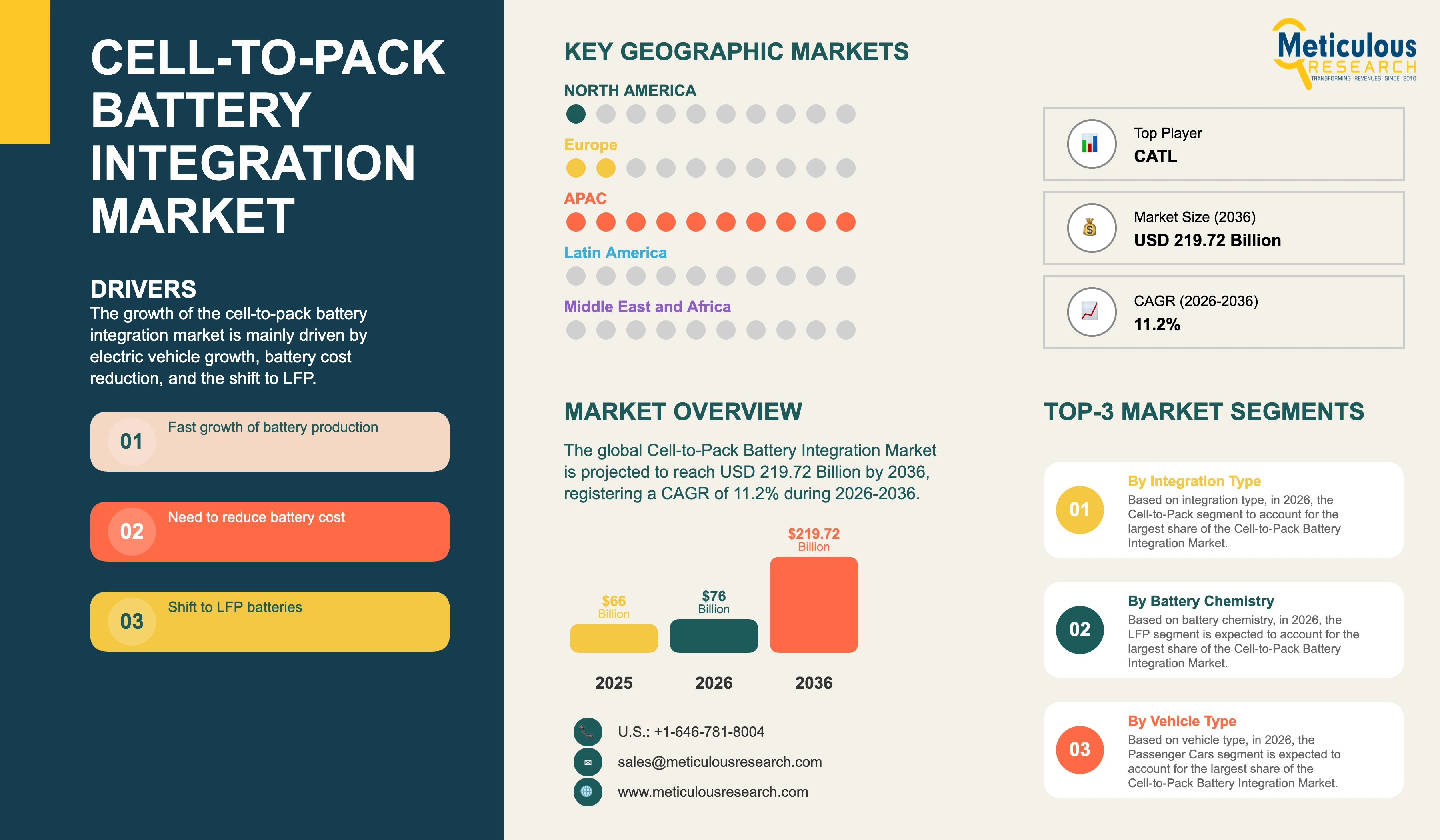
The global cell-to-pack battery integration market was valued at USD 66.00 billion in 2025. This market is expected to reach USD 219.72 billion by 2036 from an estimated USD 76.00 billion in 2026, registering a CAGR of 11.2% during the forecast period (2026-2036).
- Published
- Nov 2026
- Pages
- 257
- Format
- PDF + Excel
- Report ID
- MRAUTO - 1042879
- Base year
- 2025
- 2025 · BASELINE
- $66.00B
- 2036
- $219.7B
- CAGR 2026–2036
- 11.2%
2025 baseline · 2026–2036 forecast at 11.2% CAGR · hover a bar for the value
Key highlights
EV battery deployment reached 1.2 TWh in 2025, an increase of almost 30% compared with 2024 and more than seven times greater than in 2020, according to the IEA. China accounted for about 60% of global EV battery deployment, the European Union for almost 15%, and the United States for 10%. Cell-to-pack designs have become the most common way of integrating these batteries into vehicles, especially in China.
CATL's Qilin battery, its third-generation cell-to-pack design, integrates cells with multifunctional elastic interlayers, cooling plates, and structural beams, reaching a volume utilization rate of 72%, according to CATL. BYD's Blade Battery uses long LFP cells placed directly in the pack without modules, and BYD's cell-to-body design, used in the Seal, combines the pack lid with the vehicle floor.
LG Energy Solution agreed to supply about 39 GWh of LFP pouch batteries using its cell-to-pack technology to Ampere, Renault Group's electric vehicle unit, over five years starting in 2025, according to LG Energy Solution. LG Energy Solution says its pouch cell-to-pack design offers about 5% higher energy density per weight than prismatic cell-to-pack designs.
Ampere stated that combining LFP chemistry with cell-to-pack technology would allow it to cut the cost of batteries in its vehicles by about 20% from the beginning of 2026, with its first LFP-equipped models planned from early 2026, showing the cost benefits that are driving cell-to-pack adoption in Europe.
Electric trucks accounted for about 8% of global EV battery deployment in 2025, up from less than 5% in 2024, according to the IEA. Commercial vehicles use very large battery packs, and battery makers are offering cell-to-pack designs that increase capacity and reduce cost for trucks and buses.
Leading suppliers include CATL, BYD (FinDreams Battery), LG Energy Solution, CALB, Gotion High-Tech, SK On, Samsung SDI, EVE Energy, SVOLT, Sunwoda, and Envision AESC, while Tesla produces its own structural battery packs. Cell-to-body and cell-to-chassis designs, which make the battery part of the vehicle structure, are the fastest-growing integration type, led by BYD, Tesla, Xiaomi, and Leapmotor.
By integration type, cell-to-pack accounts for the larger share of 84.0% in 2026, while cell-to-body and cell-to-chassis register the higher CAGR.
By battery chemistry, LFP accounts for the largest share in 2026, while sodium-ion and other chemistries register the highest CAGR.
By cell format, prismatic cells account for the largest share in 2026, while cylindrical cells register the highest CAGR.
By vehicle type, passenger cars account for the larger share of 88.0% in 2026, while commercial vehicles register the higher CAGR.
By geography, Asia-Pacific accounts for the largest share of 74.0% in 2026, while Europe registers the highest CAGR of 14.8%.
Report summary
| Particulars | Details |
|---|---|
| Forecast Period | 2026-2036 |
| Base Year | 2025 |
| Estimated Year | 2026 |
| CAGR (Value) | 11.2% |
| Format | PDF, Excel & Cloud Portal · 257 pages |
| Market Size (Value) in 2025 | USD 66.00 billion |
| Market Size (Value) in 2026 | USD 76.00 billion |
| Market Size (Value) by 2036 | USD 219.72 billion |
| Largest Segment by Integration Type (2026) | Cell-to-Pack (84.0%) |
| Largest Segment by Vehicle Type (2026) | Passenger Cars (88.0%) |
| Largest Region (2026) | Asia-Pacific (74.0%) |
| Fastest-Growing Region | Europe (CAGR 14.8%) |
| Segments Covered | Integration Type, Battery Chemistry, Cell Format, Vehicle Type, Geography |
| Countries Covered | U.S., Canada, Germany, Hungary, Poland, France, Spain, U.K., Italy, Sweden, Norway, Czech Republic, Portugal, Netherlands, Belgium, Rest of Europe, China, South Korea, Japan, India, Thailand, Indonesia, Malaysia, Vietnam, Taiwan, Philippines, Australia, Rest of Asia-Pacific, Brazil, Mexico, Chile, Colombia, Rest of Latin America, Turkey, Morocco, UAE, Saudi Arabia, Israel, South Africa, Rest of Middle East & Africa |
| Key Companies | 12 companies and other companies |
Report overview
Segments covered: integration type, battery chemistry, cell format, vehicle type.
Cell-to-pack battery integration places battery cells directly into the battery pack without first assembling them into modules, while cell-to-body and cell-to-chassis designs go further by making the pack part of the vehicle's body or floor structure. These designs increase the share of the pack volume used by cells, raise energy density, reduce the number of parts, and lower cost. This market covers complete cell-to-pack, cell-to-body, and cell-to-chassis battery packs, including the cells, supplied for electric passenger cars and commercial vehicles.
The growth of this market is mainly driven by the fast growth of electric vehicle and battery production, the need to reduce battery cost to make electric vehicles more affordable, the shift to LFP batteries, which use cell-to-pack designs to close the energy density gap with NMC batteries, the use of larger cells, such as long prismatic and large cylindrical cells, that are well suited to module-free designs, and the move by vehicle makers to integrate the battery with the vehicle structure. In addition, the electrification of buses and trucks and the localization of battery production in Europe and North America are creating new demand. However, falling battery prices, repair and recycling challenges, and safety requirements for module-free packs are expected to restrain value growth to some extent.
In a traditional electric vehicle battery, cells are first assembled into modules, the modules are placed into the battery pack, and the pack is fixed under the vehicle floor. Modules made assembly and service easier, but they added frames, end plates, connectors, and wiring that took up space and added weight and cost. Cell-to-pack designs remove the module layer and place cells directly into the pack, often using the cells themselves to carry part of the structural load. This raises the share of the pack volume used by cells, increases energy density, and reduces the number of parts.
This report covers the global cell-to-pack battery integration market, including cell-to-pack battery packs and cell-to-body and cell-to-chassis battery systems using LFP, NMC and NCA, and sodium-ion and other chemistries, in prismatic, cylindrical, and pouch cell formats, for electric passenger cars and commercial vehicles. The market is valued at the selling price of complete battery packs and systems, including cells, supplied to vehicle makers, including packs produced in-house by vehicle makers valued at an estimated market price. The market is analyzed by integration type, battery chemistry, cell format, vehicle type, and geography. Module-based battery packs, battery packs for energy storage, and separate cell sales are not included.
Two main approaches to cell-to-pack integration have emerged among the leading battery makers. The first, represented by BYD's Blade Battery, uses long cells that run across the width of the pack and act as structural members, removing modules completely. The second, represented by CATL's Qilin battery, combines cells with elastic interlayers, cooling plates, and structural beams into integrated energy units, reaching a volume utilization rate of 72%, according to CATL. Both approaches have helped make LFP batteries competitive in mainstream electric vehicles by narrowing the energy density gap with NMC batteries.
Cell-to-body and cell-to-chassis designs take integration a step further by joining the battery and the vehicle. In these designs, the battery pack lid becomes part of the vehicle floor, or cells are mounted directly into the vehicle structure, which saves more space and weight and increases body stiffness. BYD's cell-to-body design is used in the Seal and other models, Tesla uses a structural battery pack with large cylindrical cells in some Model Y versions, and several Chinese vehicle makers, such as Xiaomi and Leapmotor, have launched cell-to-body or cell-to-chassis designs. These designs require close cooperation between battery makers and vehicle makers.
The market is led by Chinese battery makers, such as CATL, BYD, CALB, Gotion High-Tech, EVE Energy, SVOLT, and Sunwoda, which were the first to adopt cell-to-pack designs at scale and supply most of the world's electric vehicle batteries. Korean and Japanese battery makers, such as LG Energy Solution, SK On, and Samsung SDI, and Envision AESC have also launched cell-to-pack designs, including LG Energy Solution's pouch cell-to-pack design for LFP batteries. Some vehicle makers, such as Tesla and BYD, produce battery packs in-house.
Cell-to-pack designs also change how battery packs are serviced, recycled, and protected against thermal runaway. Because cells are not grouped into replaceable modules, damaged packs can be harder to repair, and cells are often bonded into the pack with adhesives, which makes recycling more difficult. Cells are also placed closer together, which increases the importance of thermal barriers and venting design to meet stricter safety rules, such as China's GB 38031-2025 no-fire, no-explosion standard.
In 2026, cell-to-pack designs account for the largest share of the market by integration type, while cell-to-body and cell-to-chassis designs are the fastest-growing integration type. LFP batteries account for the largest share by battery chemistry, while sodium-ion and other chemistries are the fastest-growing chemistry. Prismatic cells account for the largest share by cell format, while cylindrical cells are the fastest-growing cell format. Passenger cars account for the largest share by vehicle type, while commercial vehicles are the fastest-growing vehicle type. Asia-Pacific accounts for the largest share of the market, while Europe is the fastest-growing region.
Market growth over the forecast period will depend on the pace of electric vehicle and battery production growth, the share of module-free designs in new battery packs, the chemistry mix, battery price trends, and the localization of battery production outside China. Falling battery prices will limit growth in market value compared with battery volume. Overall, the shift to cell-to-pack and cell-to-body designs in most new electric vehicle platforms is expected to drive strong growth of this market through 2036.
Passenger cars are expected to account for the largest share of 88.0% of the market in 2026, while commercial vehicles are projected to register the highest CAGR, driven by electric truck and bus growth.
Asia-Pacific is expected to account for the largest share of 74.0% of the market in 2026, mainly due to China's large electric vehicle and battery production and the early adoption of cell-to-pack designs by Chinese battery makers.
Europe is projected to register the highest CAGR of 14.8% during the forecast period, driven by LFP and cell-to-pack adoption for affordable electric vehicles and new local battery plants.
The report profiles 12 companies, including CATL, BYD (FinDreams Battery), LG Energy Solution, CALB, Gotion High-Tech, SK On, Samsung SDI, EVE Energy, SVOLT, Sunwoda, Envision AESC, and Tesla.
Cell-to-pack places cells directly into the battery pack without modules, while cell-to-body makes the pack lid part of the vehicle floor or mounts cells into the vehicle structure, saving more space and weight.
This report covers only module-free cell-to-pack, cell-to-body, and cell-to-chassis battery packs for electric vehicles. The broader battery pack market, including module-based packs and other applications, is covered in a separate report.
Report infographic
Market dynamics
17 factors across 5 forcesFast growth of electric vehicle and battery production
Cell-to-pack battery packs are used in a growing share of new electric vehicles, so demand is closely linked to electric vehicle and battery production. EV battery deployment reached 1.2 TWh in 2025, an increase of almost 30% compared with 2024, according to the IEA. Global electric car sales topped 20 million units in 2025, and the IEA expects sales of about 23 million units in 2026, close to 30% of all cars sold worldwide.
Battery production is expected to keep growing over the forecast period, supported by falling battery costs, wider model choice, government policies, and the electrification of buses and trucks. Because cell-to-pack designs are now the standard approach for new battery packs in China and are spreading in other regions, most of this growth is expected to come from module-free designs, which supports fast growth of this market.
Need to reduce battery cost
The battery is the most expensive part of an electric vehicle, and reducing its cost is key to making electric vehicles affordable for more buyers. Cell-to-pack designs reduce cost by removing module frames, end plates, connectors, and wiring, by simplifying assembly, and by allowing more energy to be stored in the same pack size. Ampere stated that combining LFP chemistry with cell-to-pack technology would allow it to cut battery costs in its vehicles by about 20% from the beginning of 2026.
As competition among electric vehicle makers increases, especially in China, vehicle makers are looking for every way to reduce battery cost, and cell-to-pack designs are one of the most effective. This cost benefit is driving adoption in entry-level and mid-priced electric vehicles in all regions and is expected to make module-free designs standard in most new electric vehicles over the forecast period.
Shift to LFP batteries
LFP batteries are cheaper, safer, and longer-lasting than NMC batteries but have lower energy density at the cell level. Cell-to-pack designs help close this gap by using more of the pack volume for cells, which allows LFP packs to offer driving ranges suitable for mainstream electric vehicles. BYD's Blade Battery and CATL's cell-to-pack LFP designs have made LFP the leading chemistry in China, and LFP is now spreading to Europe and North America.
LG Energy Solution's agreement to supply about 39 GWh of LFP pouch batteries using cell-to-pack technology to Ampere is an example of LFP and cell-to-pack adoption in Europe, according to LG Energy Solution. LFP batteries account for the largest share of this market, and their growth outside China is expected to support strong demand for cell-to-pack designs.
Larger cells and new cell formats
Battery makers are developing larger cells, such as long prismatic cells, blade cells, and large-format cylindrical cells, which are well suited to module-free designs because fewer, larger cells can fill the pack and carry structural loads. Larger cells reduce the number of connections and simplify assembly. Large cylindrical cells, such as the 46-series cells used by several vehicle makers, are designed to be placed directly into packs or vehicle structures.
These new cell formats are making cell-to-pack and cell-to-body designs easier to adopt for vehicle makers that previously used modules. Cylindrical cells are the fastest-growing cell format in this market, supported by the adoption of large cylindrical cells by vehicle makers in Europe, North America, and Asia, while prismatic cells remain the most widely used format.
Integration of the battery with the vehicle structure
Vehicle makers are increasingly designing the battery as part of the vehicle structure, rather than as a separate component bolted under the floor. Cell-to-body and cell-to-chassis designs make the pack lid part of the vehicle floor or mount cells directly into the vehicle structure, which saves space and weight, lowers the vehicle floor, and increases body stiffness. BYD's cell-to-body design used in the Seal, Tesla's structural battery pack, and designs from Xiaomi, Leapmotor, and other Chinese vehicle makers show how quickly these designs are spreading. These designs also simplify vehicle assembly, as the battery and floor can be built as one unit and installed in a single step, which is attractive to vehicle makers using gigacasting and other new manufacturing methods. Cell-to-body and cell-to-chassis designs are the fastest-growing integration type in this market, supported by new dedicated electric vehicle platforms launched by Chinese, European, and North American vehicle makers, many of which plan to adopt structural battery designs over the forecast period.
Table of contents
12 chapters · 182 sections · 257 pages · click to expandSegmental analysis
| Segment | Largest share (2026) | Fastest growth (2026–2036) |
|---|---|---|
| By Integration Type | LFP | Sodium-ion and other chemistries |
By Integration Type
- The LFP segment is expected to account for the largest share of the cell-to-pack battery integration market, while the sodium-ion and other chemistries segment is projected to register the highest CAGR during the forecast period.
- The prismatic cells segment is expected to account for the largest share of the cell-to-pack battery integration market, while the cylindrical cells segment is projected to register the highest CAGR during the forecast period.
Geographic analysis
Asia-Pacific
Largest shareIn 2026, Asia-Pacific is expected to account for the largest share of 74.0% of the global cell-to-pack battery integration market. The large share of this region is mainly due to China's position as the largest producer of electric vehicles and batteries, accounting for about 60% of global EV battery deployment in 2025 according to the IEA, the early and wide adoption of cell-to-pack and cell-to-body designs by Chinese battery makers and vehicle makers, and the presence of leading battery makers, such as CATL, BYD, CALB, Gotion High-Tech, EVE Energy, SVOLT, and Sunwoda in China and LG Energy Solution, SK On, and Samsung SDI in South Korea. Japan, India, Thailand, and Indonesia are also growing markets for cell-to-pack batteries, supported by local electric vehicle production and new battery plants built by Chinese, Korean, and Japanese battery makers. Chinese battery makers are also building plants in Southeast Asia to supply exports.
Europe
Fastest growthHowever, Europe is projected to register the highest CAGR of 14.8% during the forecast period. The rapid growth of this region is mainly driven by the fast growth of electric vehicle production under strict CO2 rules, the adoption of LFP and cell-to-pack designs by European vehicle makers for affordable electric vehicles, such as Ampere's LFP models planned from early 2026, the growth of local battery production by Korean, Chinese, and European battery makers in Hungary, Poland, Germany, Spain, and other countries, and the electrification of trucks and buses. The European Union accounted for almost 15% of global EV battery deployment in 2025, according to the IEA, and its share is expected to rise as local production expands and more affordable electric vehicles are launched. Germany, Hungary, Poland, France, and Spain are among the largest and fastest-growing markets in Europe, supported by electric vehicle production and new battery plants. LG Energy Solution's plant in Poland, CATL's plants in Germany and Hungary, and new plants in Spain and other countries are adding local capacity for cell-to-pack batteries. Local content rules and trade measures are encouraging vehicle makers to source batteries from plants in Europe, and several European battery start-ups are also developing cell-to-pack designs for local vehicle makers.
North America
North America accounts for a smaller share of the market, with the United States accounting for 10% of global EV battery deployment in 2025, according to the IEA. Tesla's structural battery packs, new battery plants built by Korean and Japanese battery makers, and LFP cell production planned by several companies support demand, but the end of federal electric vehicle purchase incentives in 2025 has slowed growth, and some battery plant projects have been delayed or repurposed for energy storage.
Latin America
Latin America and the Middle East & Africa account for small shares, with growth supported by electric bus adoption and imported Chinese electric vehicles in Brazil, Mexico, Chile, Turkey, and the Gulf countries. BYD's vehicle plant in Brazil and new electric vehicle plants in Turkey and Morocco are expected to add local demand.
Competitive landscape
The global cell-to-pack battery integration market is led by a small number of large battery makers, mainly from China and South Korea, together with vehicle makers that produce battery packs in-house. Chinese battery makers, led by CATL and BYD, supply most of the world's cell-to-pack batteries and have set the benchmark for cost and design. Korean and Japanese battery makers are adopting cell-to-pack designs to compete, especially in Europe and North America.
CATL is the largest electric vehicle battery maker, with cell-to-pack products such as the Qilin and Shenxing batteries. BYD, through FinDreams Battery, supplies Blade Batteries and cell-to-body systems for its own vehicles and other vehicle makers. CALB, Gotion High-Tech, EVE Energy, SVOLT, and Sunwoda are major Chinese suppliers, while LG Energy Solution, SK On, and Samsung SDI lead in South Korea and Envision AESC operates in Japan, Europe, and other regions. Tesla produces its own structural battery packs.
Companies in this market compete on cost per kilowatt-hour, energy density, safety, charging speed, cycle life, local production, and the ability to support vehicle makers with integrated pack and structural battery designs. Key strategies include developing new cell-to-pack and cell-to-body designs, adopting LFP and sodium-ion chemistries, building plants in Europe, North America, and Southeast Asia, and forming partnerships and joint ventures with vehicle makers.
Recent competitive activity in this market reflects the spread of cell-to-pack designs and LFP chemistry outside China. LG Energy Solution agreed to supply about 39 GWh of LFP pouch batteries using its cell-to-pack technology to Ampere over five years from 2025, Ampere planned its first LFP and cell-to-pack models from early 2026, and CATL showed its Qilin Condensed and Shenxing batteries at its Tech Day in April 2026.
We expect competition to increase over the forecast period as Chinese battery makers expand abroad, as Korean and Japanese battery makers adopt cell-to-pack and LFP designs, and as vehicle makers decide whether to produce packs in-house. Battery makers with low costs, strong cell-to-pack and structural battery designs, LFP and sodium-ion capabilities, and local production in Europe and North America are expected to strengthen their positions.
Some of the key players operating in the cell-to-pack battery integration market are Contemporary Amperex Technology Co., Limited (CATL), BYD Company Limited (FinDreams Battery), LG Energy Solution, Ltd., CALB Group Co., Ltd., Gotion High-Tech Co., Ltd., SK On Co., Ltd., Samsung SDI Co., Ltd., EVE Energy Co., Ltd., SVOLT Energy Technology Co., Ltd., Sunwoda Electric Vehicle Battery Co., Ltd., Envision AESC Group Ltd., and Tesla, Inc., among others.
- —
LG Energy Solution agreed to supply about 39 GWh of LFP pouch cell-to-pack batteries to Ampere from 2025, Ampere planned its first LFP and cell-to-pack models from early 2026, and CATL showed new batteries at its April 2026 Tech Day.
- Qilin and Shenxing batteries. BYD
- Gotion High-Tech
- EVE Energy
- SVOLT
- Sunwoda
Expert perspectives
Cell-to-pack battery integration has become the standard approach for new electric vehicle battery packs, and the market is growing with electric vehicle production while moving toward cell-to-body and cell-to-chassis designs. Cell-to-pack designs have helped make LFP batteries competitive in mainstream electric vehicles and are now spreading from China to Europe, Korea, Japan, and North America.
Over the forecast period, the market is expected to grow at a CAGR of 11.2%, from USD 76.00 billion in 2026 to USD 219.72 billion in 2036. Growth will be driven by the fast growth of electric vehicle and battery production, the need to reduce battery cost, the shift to LFP batteries, larger cells and new cell formats, and the integration of the battery with the vehicle structure.
Among the market segments, cell-to-pack designs are the largest integration type, while cell-to-body and cell-to-chassis designs grow fastest. LFP batteries are the largest chemistry, while sodium-ion and other chemistries grow fastest. Prismatic cells are the largest cell format, while cylindrical cells grow fastest. Passenger cars are the largest vehicle type, while commercial vehicles grow fastest. Asia-Pacific is the largest region, while Europe grows fastest, at a CAGR of 14.8%.
In our view, the combination of LFP chemistry and cell-to-pack design will drive the next phase of electric vehicle growth in Europe and other markets outside China. European vehicle makers need lower-cost batteries for affordable electric vehicles, and cell-to-pack LFP packs, produced locally, offer the best combination of cost, safety, and range. In particular, battery makers that can produce these packs in Europe at Chinese cost levels will gain the most. We expect Chinese battery makers with European plants and Korean battery makers with new LFP lines to compete strongly for these programs.
We also see cell-to-body and structural batteries as a major long-term shift in vehicle design, as vehicle makers redesign their platforms around the battery. This shift will deepen partnerships between battery makers and vehicle makers and raise barriers to entry. However, repair, recycling, and safety concerns must be addressed for these designs to reach their full potential, especially in Europe under the EU Battery Regulation, which sets clear rules for battery removal and recycling.
Overall, we believe that the cell-to-pack battery integration market will grow strongly over the forecast period, with cell-to-body and cell-to-chassis designs, sodium-ion chemistries, cylindrical cells, commercial vehicles, and Europe providing the fastest growth. Companies with low costs, strong integration designs, flexible chemistry options, and local production in growth regions will be best positioned to capture this growth, while falling battery prices and repair and recycling concerns remain the main risks.
Customer perspectives
“For our affordable models, LFP cell-to-pack is the only way to hit our cost target. We also need the packs built in Europe to meet local content rules.”
“Our new platform uses cell-to-body, so the battery lid is the car floor. It saves space, lowers the car, and makes the body stiffer.”
“Cell-to-pack lets us fit more energy into the same space on the chassis, which means more range or more payload for our customers.”
Frequently asked questions
The global cell-to-pack battery integration market was valued at USD 66.00 billion in 2025, up from USD 54.00 billion in 2024, and is estimated at USD 76.00 billion in 2026. The market includes cell-to-pack, cell-to-body, and cell-to-chassis battery packs for electric passenger cars and commercial vehicles.
The global cell-to-pack battery integration market is expected to reach USD 219.72 billion by 2036, driven by electric vehicle growth, battery cost reduction, LFP adoption, and structural battery designs.
The market is expected to register a CAGR of 11.2% from 2026 to 2036, with the fastest growth in cell-to-body and cell-to-chassis designs, sodium-ion chemistries, cylindrical cells, commercial vehicles, and Europe.
Market growth is mainly driven by the fast growth of electric vehicle and battery production, the need to reduce battery cost, the shift to LFP batteries, larger cells and new cell formats, and the integration of the battery with the vehicle structure.
Falling battery prices and repair, second-life, and recycling challenges restrain growth, while thermal runaway and safety requirements and manufacturing complexity and quality control are key challenges.
Key growth opportunities include cell-to-pack adoption in Europe and North America, sodium-ion and new chemistries in cell-to-pack designs, cell-to-pack designs for electric buses and trucks, and structural battery partnerships with vehicle makers.
Cell-to-pack designs are expected to account for the largest share of 84.0% of the market in 2026, while cell-to-body and cell-to-chassis designs are projected to register the highest CAGR, driven by new structural battery platforms.
In 2026, the LFP segment is expected to account for the largest share of the cell-to-pack battery integration market, while the sodium-ion and other chemistries segment is projected to register the highest CAGR during the forecast period.
In 2026, the prismatic cells segment is expected to account for the largest share of the cell-to-pack battery integration market, while the cylindrical cells segment is projected to register the highest CAGR during the forecast period.
Passenger cars are expected to account for the largest share of 88.0% of the market in 2026, while commercial vehicles are projected to register the highest CAGR, driven by electric truck and bus growth.
Asia-Pacific is expected to account for the largest share of 74.0% of the market in 2026, mainly due to China's large electric vehicle and battery production and the early adoption of cell-to-pack designs by Chinese battery makers.
Europe is projected to register the highest CAGR of 14.8% during the forecast period, driven by LFP and cell-to-pack adoption for affordable electric vehicles and new local battery plants.
The report profiles 12 companies, including CATL, BYD (FinDreams Battery), LG Energy Solution, CALB, Gotion High-Tech, SK On, Samsung SDI, EVE Energy, SVOLT, Sunwoda, Envision AESC, and Tesla.
LG Energy Solution agreed to supply about 39 GWh of LFP pouch cell-to-pack batteries to Ampere from 2025, Ampere planned its first LFP and cell-to-pack models from early 2026, and CATL showed new batteries at its April 2026 Tech Day.
Cell-to-pack places cells directly into the battery pack without modules, while cell-to-body makes the pack lid part of the vehicle floor or mounts cells into the vehicle structure, saving more space and weight.
This report covers only module-free cell-to-pack, cell-to-body, and cell-to-chassis battery packs for electric vehicles. The broader battery pack market, including module-based packs and other applications, is covered in a separate report.
Cite this report
Meticulous Research. (2026). Cell-to-Pack Battery Integration Market - Global Opportunity Analysis and Industry Forecast (2026-2036) (Report No. MRAUTO - 1042879). Meticulous Market Research Pvt. Ltd. https://www.meticulousresearch.com/product/cell-to-pack-battery-integration-market-7562