Silane Pretreatment Chemicals Market (2026-2036)
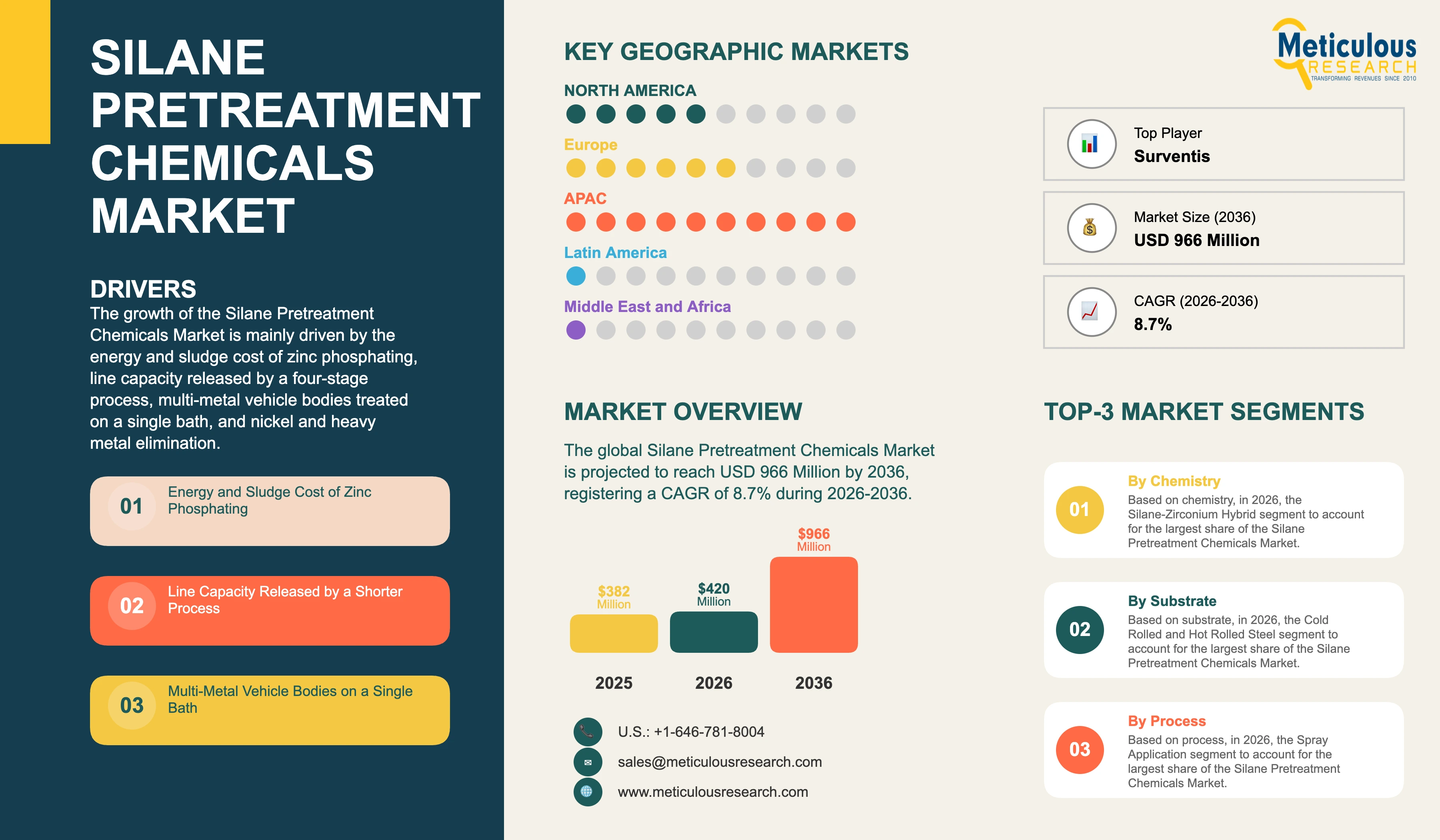
The global Silane Pretreatment Chemicals Market was valued at USD 382.0 million in 2025. This market is expected to reach USD 966.0 million by 2036 from an estimated USD 420.0 million in 2026, registering a CAGR of 8.7% during the forecast period (2026-2036).
- Published
- Nov 2026
- Pages
- 243
- Format
- PDF + Excel
- Report ID
- MRCHM - 1042827
- Base year
- 2025
- 2025 · BASELINE
- $382.0M
- 2036
- $966.0M
- CAGR 2026–2036
- 8.7%
2025 baseline · 2026–2036 forecast at 8.7% CAGR · hover a bar for the value
Key highlights
The global Silane Pretreatment Chemicals Market is projected to reach USD 966.0 million by 2036, driven by the energy and sludge cost of zinc phosphating, line capacity released by a shorter process, multi-metal vehicle bodies treated on a single bath, and nickel and heavy metal elimination.
Asia-Pacific is expected to account for the largest market share in 2026 and is also projected to register the fastest growth during the forecast period, supported by the concentration of automotive and appliance manufacturing capacity in the region together with the fastest commissioning of new paint lines, which are specified phosphate-free from the outset.
By chemistry, Silane-Zirconium Hybrid chemistry are expected to account for the largest market share, whereas Sol-Gel Silane systems are projected to witness the fastest growth through 2036.
By substrate, Cold Rolled and Hot Rolled Steel are expected to account for the largest market share, whereas Multi-Metal Mixed Line applications are projected to witness the fastest growth through 2036.
By process, Spray Application are expected to account for the largest market share, whereas Roll Coat and No-Rinse processes are projected to witness the fastest growth through 2036.
A commercial silane bath operates at 25 to 30 degrees Celsius with heating usually unnecessary, against 55 degrees Celsius for zinc phosphating, and at pH 4 to 5 against pH 3.
The conversion layer formed is about 100 nanometers, approximately one-tenth the thickness of a zinc phosphate coating, which removes the crystalline reservoir that a phosphate layer provides.
Line architecture shortens from seven stages to four, with the activation and passivation stages and one rinse removed, leaving cleaner, rinse, silane treatment and deionized water rinse, while sludge generation falls to at most 0.2 grams per square meter of material throughput, a 95% reduction.
Supplier calculations index heating cost at 60, electricity at 70, rinsing water at 50, waste disposal at 20, maintenance at 60 and carbon dioxide emissions at 60 against zinc phosphating at 100, with greenfield investment cost around 20% lower and material throughput reported 30% to 65% higher.
Corrosion performance is demonstrated above 480 hours and 1, 008 hours of neutral salt spray under ISO 9227, with steel and galvanized steel above 1,000 hours, and creepage below 0.5 millimeters on aluminum after 1,008 hours of copper-accelerated salt spray with a full paint system.
Almost seven million cars on the road carry silane-based pretreatment, and more than 100 licensed chrome-free third-party certifications have been issued on the technology, with substrate coverage extending to steel, galvanized steel, stainless steel, cast steel, aluminum, magnesium and magnesium alloys, zinc-magnesium sheet, high-strength steel and coil aluminum on a single bath.
Silane primer systems applied outside the conversion bath operate at 0.5% to 3% in aqueous or alcoholic solution and form layers of 1 micrometer or less, against about 5 micrometers for a conventional organic primer, and salt spray testing on aluminum alloy recorded failure of bare metal at 400 hours against 2,000 hours for one hydrolyzed silane oligomer system and 1,000 hours for another.
Phosphates, fluorides as total fluorine and nickel and its compounds are all identified as key environmental issues for water emissions in the current review of best available techniques for surface treatment of metals and plastics.
Report summary
| Particulars | Details |
|---|---|
| Forecast Period | 2026-2036 |
| Base Year | 2025 |
| Estimated Year | 2026 |
| CAGR (Value) | 8.7% |
| Format | PDF, Excel & Cloud Portal · 243 pages |
| CAGR (Volume) | 7.0% |
| Market Size (Value) in 2026 | USD 420.0 million |
| Market Size (Value) in 2036 | USD 966.0 million |
| Market Size (Volume) in 2026 | 63.00 kilotons of pretreatment chemistry as supplied |
| Market Size (Volume) in 2036 | 124.00 kilotons |
| Average Selling Price, 2026 | USD 6,667 per ton |
| Average Selling Price, 2036 | USD 7,790 per ton |
| Segments Covered | By Chemistry: Silane-Zirconium Hybrid, Pure Organofunctional Silane, Silane-Titanium and Other Hybrid, Sol-Gel Silane. By Substrate: Cold Rolled and Hot Rolled Steel, Galvanized and Zinc-Coated Steel, Aluminum and Aluminum Alloy, Multi-Metal Mixed Line, Magnesium and Other Substrates. By Process: Spray Application, Immersion and Dip, Roll Coat and No-Rinse. By End Use: Automotive OEM, Automotive Components and Tier Supply, Appliance and General Industrial, Construction and Architectural, Other End Uses. |
| Countries Covered | China; Japan; India; South Korea; Germany; France; Italy; Spain; U.S.; Canada; Mexico; Brazil |
| Key Companies | Surventis, Henkel AG & Co. KGaA, PPG Industries, Inc., Nihon Parkerizing Co., Ltd., and Evonik Industries AG |
Report overview
Segments covered: chemistry, substrate, process, end use.
In volume terms, the market is estimated at 63.00 kilotons of pretreatment chemistry as supplied in 2026 and is expected to reach 124.00 kilotons by 2036, registering a CAGR of 7.0% during the forecast period. The average selling price is estimated at USD 6,667 per ton in 2026 and USD 7,790 per ton in 2036.
The growth of this market is mainly driven by bath operation at 25 to 30 degrees Celsius against 55 degrees Celsius for zinc phosphating, sludge generation of at most 0.2 grams per square meter representing a 95% reduction, a four-stage process line against seven stages, and material throughput 30% to 65% higher than a phosphating plant. However, factors such as a conversion layer of about 100 nanometers against roughly ten times that for zinc phosphate, bath control that depends on pH, conductivity and free fluoride rather than on titration, fluoride discharge replacing phosphate discharge in the effluent, and competing phosphate-free systems built on zirconium chemistry without silane are expected to restrain the growth of this market to some extent.
Among processs, Spray Application are expected to account for the largest market share in 2026, while Roll Coat and No-Rinse processes are projected to register the highest CAGR during the forecast period. Geographically, Asia-Pacific is expected to account for the largest share of this market in 2026 and is also expected to register the highest CAGR during the forecast period.
The Silane Pretreatment Chemicals Market comprises formulated silane and silane-hybrid conversion pretreatment chemistry applied to metal before painting, taken at the manufacturer gate on a ton basis as supplied. The market includes Silane-Zirconium Hybrid, Pure Organofunctional Silane, Silane-Titanium and Other Hybrid, and Sol-Gel Silane chemistries, applied to cold rolled and hot rolled steel, galvanized and zinc-coated steel, aluminum and aluminum alloy, multi-metal mixed lines and magnesium, by spray, immersion and dip, or roll coat and no-rinse processes, across automotive OEM, automotive components and tier supply, appliance and general industrial, and construction and architectural end uses. Zirconium and titanium fluoroacid systems containing no silane, zinc and iron phosphate chemistry, alkaline cleaners and rinse aids sold separately, silane coupling agents supplied for adhesives, sealants and composites, and application equipment fall outside the scope.
A silane pretreatment bath replaces a crystalline zinc phosphate conversion layer with a molecular film. The silane hydrolyzes to silanols that bond to the metal oxide on one side and to the paint system on the other, which gives adhesion through chemical bonding rather than through mechanical keying into a crystal structure. The resulting layer is about 100 nanometers, approximately one-tenth the thickness of a zinc phosphate coating, and the difference in physical form is the source of both the operating advantages and the technical caution around the technology.
The operating case is quantified and large. A commercial bath runs at 25 to 30 degrees Celsius with heating usually unnecessary against 55 degrees Celsius for zinc phosphating, line architecture shortens from seven stages to four with activation, passivation and one rinse removed, and sludge generation falls to at most 0.2 grams per square meter, a 95% reduction. Supplier calculations index heating cost at 60, electricity at 70, rinsing water at 50, waste disposal at 20, maintenance at 60 and carbon dioxide emissions at 60 against zinc phosphating at 100.
Capacity rather than cost is often the stronger argument. Removing three stages from a line either shortens it or frees the tanks for additional throughput, and material throughput is reported 30% to 65% higher than at phosphating plants, with greenfield investment cost around 20% lower. On a constrained paint shop that throughput gain is worth more than the chemical saving, and it is available without adding building length.
Multi-metal capability is the second structural advantage. Substrate coverage extends to steel, galvanized steel, stainless steel, cast steel, aluminum, magnesium and magnesium alloys, zinc-magnesium sheet, high-strength steel and coil aluminum on a single bath, where zinc phosphating requires different control for each. As vehicle bodies mix steel grades with aluminum closures and castings, a single bath that treats all of them removes a process constraint from body engineering. Multi-Metal Mixed Line is projected to be the fastest-growing substrate in this market at 10.2%.
Performance is documented to the standard the paint approval requires. Corrosion resistance is demonstrated above 480 hours and 1,008 hours of neutral salt spray under ISO 9227, with steel and galvanized steel above 1,000 hours, and creepage below 0.5 millimeters on aluminum after 1,008 hours of copper-accelerated salt spray with a full paint system. Almost seven million cars on the road carry silane-based pretreatment and more than 100 licensed chrome-free third-party certifications have been issued, which is the adoption record a new line references.
What changes rather than disappears is process control. Bath control moves from manual titration of free acid, total acid and zinc to monitoring of pH, conductivity and free fluoride, which changes the skills required on the line rather than reducing them. Fluoride discharge also replaces phosphate discharge in the effluent, and phosphates, fluorides as total fluorine and nickel and its compounds are all identified as key environmental issues for water emissions in the current review of best available techniques for surface treatment of metals and plastics. Ownership of the leading position changed on 30 June 2026, when the coatings business comprising automotive OEM coatings, automotive refinish coatings and surface treatment was sold and renamed Surventis, in a transaction announced on 10 October 2025 at an enterprise value of EUR 7.7 billion.
Roll Coat and No-Rinse is projected to be the fastest-growing process segment in this market at 10.6%. A film of about 100 nanometers applied without a subsequent rinse suits coil and strip treatment, where immersion tanks are impractical and the treated surface is painted downstream. The process removes effluent from the treatment step altogether, which addresses the fluoride discharge question that replaces the phosphate discharge question on a conventional bath.
Bath control moves from manual titration of free acid, total acid and zinc to monitoring of pH, conductivity and free fluoride, which suits continuous instrumentation rather than periodic laboratory work. Suppliers that provide the sensors, control logic and remote monitoring alongside the chemistry sell a controlled process rather than a concentrate, which both secures the volume and addresses the operator concern that a thinner film leaves less margin for drift.
Asia-Pacific is expected to account for the largest share of this market in 2026 at 42.0%, supported by the largest regional automotive and appliance manufacturing capacity and by new paint lines specified phosphate-free at design stage.
Europe accounts for 27.0% of this market in 2026 and is projected to grow at 7.4%. The region carries the technology origin and the deepest conversion record in automotive OEM, and the regulatory driver is most direct there, with phosphates, fluorides as total fluorine and nickel and its compounds all identified as key water emission issues in the current best available techniques review. Germany, France, Italy and Spain hold most regional volume. Ownership of the leading supply position changed on 30 June 2026 with the sale and renaming of the coatings business to Surventis, announced on 10 October 2025 at an enterprise value of EUR 7.7 billion.
The Middle East & Africa region holds 3.0% of this market in 2026 with projected growth of 8.4%, concentrated in appliance, general industrial and construction metal coating with a developing vehicle assembly base, where water cost and effluent handling strengthen the case for a process whose rinsing water cost indexes at 50 against zinc phosphating at 100. Latin America holds 6.0% with projected growth of 8.6%, with Mexico accounting for most volume through vehicle and appliance assembly serving North American markets and Brazilian demand spanning assembly, components and general industrial coating.
Some of the key players operating in the silane pretreatment chemicals market are Surventis, Henkel AG & Co. KGaA, PPG Industries, Inc., Nihon Parkerizing Co., Ltd., and Evonik Industries AG, among others.
Key strategies include engaging plant engineering at line design stage where the four-stage phosphate-free architecture is specified from the outset, supplying bath control instrumentation and monitoring alongside the chemistry, extending sol-gel silane portfolios to applications outside the conversion bath, developing no-rinse and roll coat systems for coil and strip, and documenting multi-metal performance to support single-bath qualification.
Report infographic
Market dynamics
17 factors across 4 forcesEnergy and Sludge Cost of Zinc Phosphating
A zinc phosphate bath runs at 55 degrees Celsius and generates sludge that must be settled, dewatered and disposed of as waste. A silane bath operates at 25 to 30 degrees Celsius with heating usually unnecessary and produces at most 0.2 grams of sludge per square meter of material throughput, a 95% reduction. Supplier calculations index heating cost at 60, waste disposal at 20 and carbon dioxide emissions at 60 against zinc phosphating at 100. Those are recurring operating costs on an existing asset, which makes the conversion a cost reduction rather than an investment case. The sludge reduction also removes a handling and disposal operation from the plant entirely, which carries labor and compliance cost beyond the disposal fee itself.
Line Capacity Released by a Shorter Process
Line architecture shortens from seven stages to four, with the activation and passivation stages and one rinse removed, leaving cleaner, rinse, silane treatment and deionized water rinse. On an existing line those tanks become available for additional capacity or for a longer treatment time on the remaining stages, and material throughput is reported 30% to 65% higher than at phosphating plants. For a paint shop at capacity that throughput gain is worth considerably more than the chemical saving, and it requires no building extension. Greenfield investment cost is around 20% lower on the same logic, which makes the technology the default specification on a new line rather than a substitution decision.
Multi-Metal Vehicle Bodies on a Single Bath
Substrate coverage extends to steel, galvanized steel, stainless steel, cast steel, aluminum, magnesium and magnesium alloys, zinc-magnesium sheet, high-strength steel and coil aluminum on a single bath. Zinc phosphating treats these substrates differently and requires separate control, which constrains how freely a body engineer can mix materials. As bodies combine high-strength steel structures with aluminum closures and cast nodes, a single bath that handles all of them removes a manufacturing constraint from the design. Multi-Metal Mixed Line is projected to be the fastest-growing substrate segment in this market at 10.2%, and the capability is why Automotive OEM holds the largest end use share in 2026.
Nickel and Heavy Metal Elimination
Phosphates, fluorides as total fluorine and nickel and its compounds are all identified as key environmental issues for water emissions in the current review of best available techniques for surface treatment of metals and plastics. Conventional zinc phosphating uses nickel as an accelerator, and removing the phosphating stage removes the nickel with it. More than 100 licensed chrome-free third-party certifications have been issued on the silane technology, which gives a plant a documented position on heavy metals for its own permitting and for customer audits. The compliance argument runs alongside the cost argument rather than competing with it.
Corrosion Performance Documented to Paint Approval Standards
Adoption depends on the pretreatment satisfying the corrosion requirement written into an existing paint approval. Performance is demonstrated above 480 hours and 1,008 hours of neutral salt spray under ISO 9227, with steel and galvanized steel above 1,000 hours, and creepage below 0.5 millimeters on aluminum after 1,008 hours of copper-accelerated salt spray with a full paint system. Almost seven million cars on the road carry silane-based pretreatment, which converts the test data into field evidence a specifier can cite. That record is what allows a plant to propose the change without reopening the whole paint qualification from first principles.
Table of contents
12 chapters · 130 sections · 243 pages · click to expandSegmental analysis
| Segment | Largest share (2026) | Fastest growth (2026–2036) |
|---|---|---|
| By Chemistry | Silane-Zirconium Hybrid chemistry | Sol-Gel Silane systems |
| By Substrate | Cold Rolled and Hot Rolled Steel | Multi-Metal Mixed Line |
| By Process | Spray | Roll Coat and No-Rinse processes |
| By End use | Automotive OEM | Other End Uses |
| Other segments | Cold Rolled and Hot Rolled Steel | Sol-Gel Silane systems |
By Chemistry
- Silane-Zirconium Hybrid chemistry are expected to account for the largest share of the global Silane Pretreatment Chemicals Market.
- The large share of this segment is mainly due to the combination of a fluoroacid conversion reaction with silane adhesion chemistry, which delivers both a conversion layer and a coupling function in a single bath and is the basis of the corrosion performance demonstrated above 1,008 hours of neutral salt spray.
- However, Sol-Gel Silane systems are projected to register the highest CAGR during the forecast period.
- The rapid growth of this segment is attributed to their application outside the conversion bath at 0.5% to 3% in aqueous or alcoholic solution, forming layers of 1 micrometer or less against about 5 micrometers for a conventional organic primer, which opens volume that does not depend on a phosphate line conversion.
- Silane-Zirconium Hybrid chemistry are expected to account for the largest market share in 2026.
- Multi-Metal Mixed Line applications are projected to register the highest CAGR during the forecast period, owing to the mixing of high-strength steel structures with aluminum closures and cast nodes in modern bodies, where a single bath covering steel, galvanized steel, aluminum, magnesium and zinc-magnesium sheet removes a manufacturing constraint from the design.
By Substrate
- Cold Rolled and Hot Rolled Steel are expected to account for the largest market share.
- The large share of this segment is mainly due to its position as the dominant tonnage in vehicle bodies, appliance panels and general fabrication, where performance above 1,000 hours of neutral salt spray on steel and galvanized steel is established.
- However, Multi-Metal Mixed Line applications are projected to register the highest CAGR during the forecast period.
- The rapid growth of this segment is attributed to the mixing of high-strength steel structures with aluminum closures and cast nodes in modern bodies, where a single bath covering steel, galvanized steel, aluminum, magnesium and zinc-magnesium sheet removes a manufacturing constraint from the design.
By Process
- Spray Application are expected to account for the largest market share.
- The large share of this segment is mainly due to its standard arrangement on appliance, general industrial and component lines and its adaptability to the short contact times that a thin film conversion permits.
- However, Roll Coat and No-Rinse processes are projected to register the highest CAGR during the forecast period.
- The rapid growth of this segment is attributed to the suitability of a film of about 100 nanometers to coil and strip treatment without a subsequent rinse, which removes effluent from the treatment stage and addresses the fluoride discharge question directly.
By End use
- Automotive OEM applications are expected to account for the largest market share.
- The large share of this segment is mainly due to the scale at which the technology was first adopted, with almost seven million cars on the road carrying silane-based pretreatment and more than 100 licensed chrome-free third-party certifications issued on the technology.
- However, Other End Uses are projected to register the highest CAGR during the forecast period.
- The rapid growth of this segment is attributed to the extension of phosphate-free pretreatment beyond its established automotive and appliance base into rail, agricultural equipment, furniture and other fabricated metal work, where line conversions are now following the automotive precedent.
Other segments
- Sol-Gel Silane systems are projected to register the highest CAGR during the forecast period, owing to their application outside the conversion bath at 0.5% to 3% in aqueous or alcoholic solution, forming layers of 1 micrometer or less against about 5 micrometers for a conventional organic primer, which opens volume that does not depend on a phosphate line conversion.
- Cold Rolled and Hot Rolled Steel are expected to account for the largest market share in 2026.
- Spray Application are expected to account for the largest market share in 2026.
- Roll Coat and No-Rinse processes are projected to register the highest CAGR during the forecast period, owing to the suitability of a film of about 100 nanometers to coil and strip treatment without a subsequent rinse, which removes effluent from the treatment stage and addresses the fluoride discharge question directly.
- Automotive OEM applications are expected to account for the largest market share in 2026.
- Other End Uses are projected to register the highest CAGR during the forecast period, owing to the extension of phosphate-free pretreatment beyond its established automotive and appliance base into rail, agricultural equipment, furniture and other fabricated metal work, where line conversions are now following the automotive precedent.
Geographic analysis
Asia-Pacific
Fastest growthAsia-Pacific holds 42.0% of this market in 2026 and is projected to be the fastest-growing region at 10.0%, with India projected to be the fastest-growing country at 12.2%. New paint lines in the region are specified from the outset rather than converted, and greenfield investment cost around 20% lower with 30% to 65% higher throughput makes the phosphate-free route the default. Suppliers qualifying with regional vehicle and appliance manufacturers at line design stage secure the chemistry for the life of the plant. Asia-Pacific holds the largest share of this market in 2026 at 42.0% and is projected to be the fastest-growing region at 10.0%. The region carries the largest automotive and appliance manufacturing capacity and is commissioning new paint lines faster than elsewhere, which allows the four-stage architecture and the roughly 20% lower greenfield investment cost to be captured at design stage rather than through conversion. India is projected to be the fastest-growing country in this market at 12.2%, on vehicle and appliance capacity additions. China holds the largest regional volume. Japan is projected to be the slowest-growing country at 5.6%, where the installed line base is mature and conversion has already progressed. Asia-Pacific is also projected to register the highest CAGR at 10.0%, with India projected to be the fastest-growing country at 12.2% on vehicle and appliance capacity additions. Asia-Pacific Automotive and Appliance Capacity Geographic Analysis
Europe
Europe accounts for 27.0% of this market in 2026 with projected growth of 7.4%. The region carries the technology origin and the deepest conversion record in automotive OEM, and it is where the regulatory driver is most direct, with phosphates, fluorides as total fluorine and nickel and its compounds all identified as key environmental issues for water emissions in the current review of best available techniques for surface treatment of metals and plastics. Germany, France, Italy and Spain hold most regional volume across vehicle assembly, components and appliance manufacture. Ownership of the leading supply position changed on 30 June 2026 with the sale and renaming of the coatings business to Surventis, announced on 10 October 2025 at an enterprise value of EUR 7.7 billion.
North America
North America represents 22.0% of this market in 2026 with projected growth of 7.8%. The United States holds most regional volume across vehicle assembly, tier supply and a large general industrial and appliance coating base. Conversion is driven more by line throughput and sludge disposal cost than by discharge regulation, since material throughput reported 30% to 65% higher than at phosphating plants addresses capacity constraints in existing paint shops. Canadian demand follows vehicle and component assembly, and Mexican volume is reported under Latin America. Mexico accounts for most regional volume through vehicle and appliance assembly serving North American markets, where pretreatment specifications follow the standards set by the parent manufacturers, and Brazilian demand spans vehicle assembly, components and general industrial coating. New line investment in the region is specified phosphate-free on the same greenfield cost and throughput arguments as elsewhere.
Latin America
Latin America holds 6.0% of this market in 2026 and is projected to grow at 8.6%.
Middle East & Africa
The Middle East & Africa region accounts for 3.0% of this market in 2026 and is projected to grow at 8.4% from a small base. Demand is concentrated in appliance, general industrial and construction metal coating, with a developing vehicle assembly base in South Africa and the Gulf states. Water cost and effluent handling in arid markets strengthen the case for a process whose rinsing water cost indexes at 50 against zinc phosphating at 100, and for no-rinse processes that remove the treatment effluent altogether.
Competitive landscape
The global Silane Pretreatment Chemicals Market is consolidated, with competition among global surface treatment specialists, coatings groups with pretreatment divisions and regional metal treatment chemical suppliers. Market participants compete primarily on documented corrosion performance against paint approval requirements, multi-metal coverage on a single bath, line conversion engineering support, bath control instrumentation, and position against competing zirconium systems without silane.
engaging plant engineering at line design stage where the phosphate-free architecture is specified from the outset, supplying bath control instrumentation and monitoring with the chemistry, extending sol-gel silane portfolios outside the conversion bath, and developing no-rinse and roll coat systems for coil and strip
The report provides a comprehensive competitive assessment of the leading companies operating in the global Silane Pretreatment Chemicals Market. The key players profiled in the report include Surventis (Germany), Henkel AG & Co. KGaA (Germany), PPG Industries, Inc. (U.S.), Nihon Parkerizing Co., Ltd. (Japan), and Evonik Industries AG (Germany).
- Surventis
- Henkel AG & Co. KGaA
- PPG Industries, Inc.
- Nihon Parkerizing Co., Ltd.
- Evonik Industries AG
Expert perspectives
The strongest argument in this market is capacity, not chemistry cost. Removing three stages from a seven-stage line and running the bath at 25 to 30 degrees Celsius instead of 55 produces material throughput reported 30% to 65% higher, and on a paint shop at capacity that is worth more than the indexed savings on heating at 60, water at 50 and waste disposal at 20. Suppliers leading with chemical cost per square meter are selling the smaller number. The plant manager who cannot fill orders is the buyer.
The reservation that remains is physical rather than commercial. A 100 nanometer molecular film carries no crystalline reservoir, so where a phosphate layer continues to contribute after paint damage a silane film does not. That matters to a manufacturer with long corrosion warranty exposure, and it is why the documented record matters as much as the test data: almost seven million cars on the road and more than 100 licensed chrome-free certifications is the evidence that answers the objection, not another 1,008 hour salt spray result.
Defensible positions sit where the silane contribution is decisive and where the application is not a bath. Zirconium fluoroacid systems without silane deliver the same temperature, stage and sludge arguments, so on substrates and paint systems where adhesion is not the binding requirement the simpler chemistry wins on price. Silane-Zirconium Hybrid holds 44.0% because it carries both mechanisms, while Sol-Gel Silane growing at 9.8% and Roll Coat and No-Rinse growing at 10.6% are positions that no conversion bath competes for at all.
Customer perspectives
“We did not convert to save on chemicals. We converted because we got three tanks back and the oven line was no longer the bottleneck. The sludge handling going away was the other thing nobody on the finance side had priced properly, because it was labor and disposal in two different cost centers.”
“My concern was never the salt spray number, it was what happens after a stone chip in year eight. A phosphate layer has something in it. A hundred nanometer film does not. What moved us was not more test data, it was the number of vehicles already running on it and the certifications behind them.”
“The thing to understand is that the clean now decides everything. With four stages there is nowhere to recover a bad clean, and the film is too thin to cover anything we leave behind. We spend more attention on cleaner concentration and rinse water quality than we ever did on the conversion bath itself.”
Frequently asked questions
The global Silane Pretreatment Chemicals Market is estimated at USD 420.0 million in 2026.
The market is projected to reach USD 966.0 million by 2036.
The market is expected to grow at a CAGR of 8.7% during 2026-2036.
Growth is driven by bath operation at 25 to 30 degrees Celsius against 55 degrees Celsius for zinc phosphating, a 95% reduction in sludge, and a line shortened from seven stages to four with 30% to 65% higher throughput. Multi-metal coverage on a single bath and the elimination of nickel and phosphate also contribute.
A commercial silane bath operates at 25 to 30 degrees Celsius against 55 degrees Celsius for zinc phosphating, and at pH 4 to 5 against pH 3. The line shortens from seven stages to four and sludge falls to at most 0.2 grams per square meter, a 95% reduction.
Corrosion performance is demonstrated above 480 hours and 1,008 hours of neutral salt spray under ISO 9227, with steel and galvanized steel above 1,000 hours, and creepage below 0.5 millimeters on aluminum after 1,008 hours of copper-accelerated salt spray. Almost seven million cars on the road carry silane-based pretreatment.
The conversion layer is about 100 nanometers, approximately one-tenth the thickness of a zinc phosphate coating, which removes the crystalline reservoir and mechanical key a phosphate layer provides. Bath control moves to monitoring of pH, conductivity and free fluoride, and fluoride discharge replaces phosphate discharge in the effluent.
The principal challenges are a film with no crystalline inhibitor reservoir, fluoride discharge replacing phosphate discharge, competing zirconium systems without silane, cleaning and rinse quality becoming the controlling variable, and requalification of an existing paint approval.
Emerging technologies include sol-gel silane systems applied outside the conversion bath (growing at 9.8%), roll coat and no-rinse processes (growing at 10.6%), silane-hybrid formulations, and instrumented bath control based on pH, conductivity and free fluoride.
The governing factor is the review of best available techniques for surface treatment of metals and plastics, which identifies phosphates, fluorides as total fluorine and nickel and its compounds as key water emission issues. More than 100 licensed chrome-free third-party certifications have been issued on the silane technology.
Silane-Zirconium Hybrid chemistry are expected to account for the largest market share in 2026.
Sol-Gel Silane systems are projected to register the highest CAGR during the forecast period, owing to their application outside the conversion bath, which opens volume that does not depend on a phosphate line conversion.
Cold Rolled and Hot Rolled Steel are expected to account for the largest market share in 2026.
Multi-Metal Mixed Line applications are projected to register the highest CAGR during the forecast period, owing to the mixing of high-strength steel structures with aluminum closures and cast nodes in modern bodies.
Spray Application are expected to account for the largest market share in 2026.
Roll Coat and No-Rinse processes are projected to register the highest CAGR during the forecast period, owing to the suitability of a film of about 100 nanometers to coil and strip treatment without a subsequent rinse.
Automotive OEM applications are expected to account for the largest market share in 2026.
Other End Uses are projected to register the highest CAGR during the forecast period, owing to the extension of phosphate-free pretreatment into rail, agricultural equipment, furniture and other fabricated metal work.
Asia-Pacific is expected to account for the largest share of this market in 2026 at 42.0%, supported by the largest regional automotive and appliance manufacturing capacity and new paint lines specified phosphate-free at design stage.
Asia-Pacific is also projected to register the highest CAGR at 10.0%, with India projected to be the fastest-growing country at 12.2%.
Europe accounts for 27.0% of this market in 2026 and is projected to grow at 7.4%. The region carries the technology origin and deepest conversion record in automotive OEM, and the regulatory driver is most direct there.
The Middle East & Africa region holds 3.0% of this market in 2026 with projected growth of 8.4%, while Latin America holds 6.0% with projected growth of 8.6%. Mexico accounts for most Latin American volume through vehicle and appliance assembly.
Some of the key players operating in the silane pretreatment chemicals market are Surventis, Henkel AG & Co. KGaA, PPG Industries, Inc., Nihon Parkerizing Co., Ltd., and Evonik Industries AG, among others.
Key strategies include engaging plant engineering at line design stage, supplying bath control instrumentation alongside the chemistry, extending sol-gel silane portfolios outside the conversion bath, and developing no-rinse and roll coat systems for coil and strip. Companies also document multi-metal performance to support single-bath qualification.
Cite this report
Meticulous Research. (2026). Silane Pretreatment Chemicals Market - Global Opportunity Analysis and Industry Forecast (2026-2036) (Report No. MRCHM - 1042827). Meticulous Market Research Pvt. Ltd. https://www.meticulousresearch.com/product/silane-pretreatment-chemicals-market-7510