Lignin Based Chemicals Market (2026-2036)
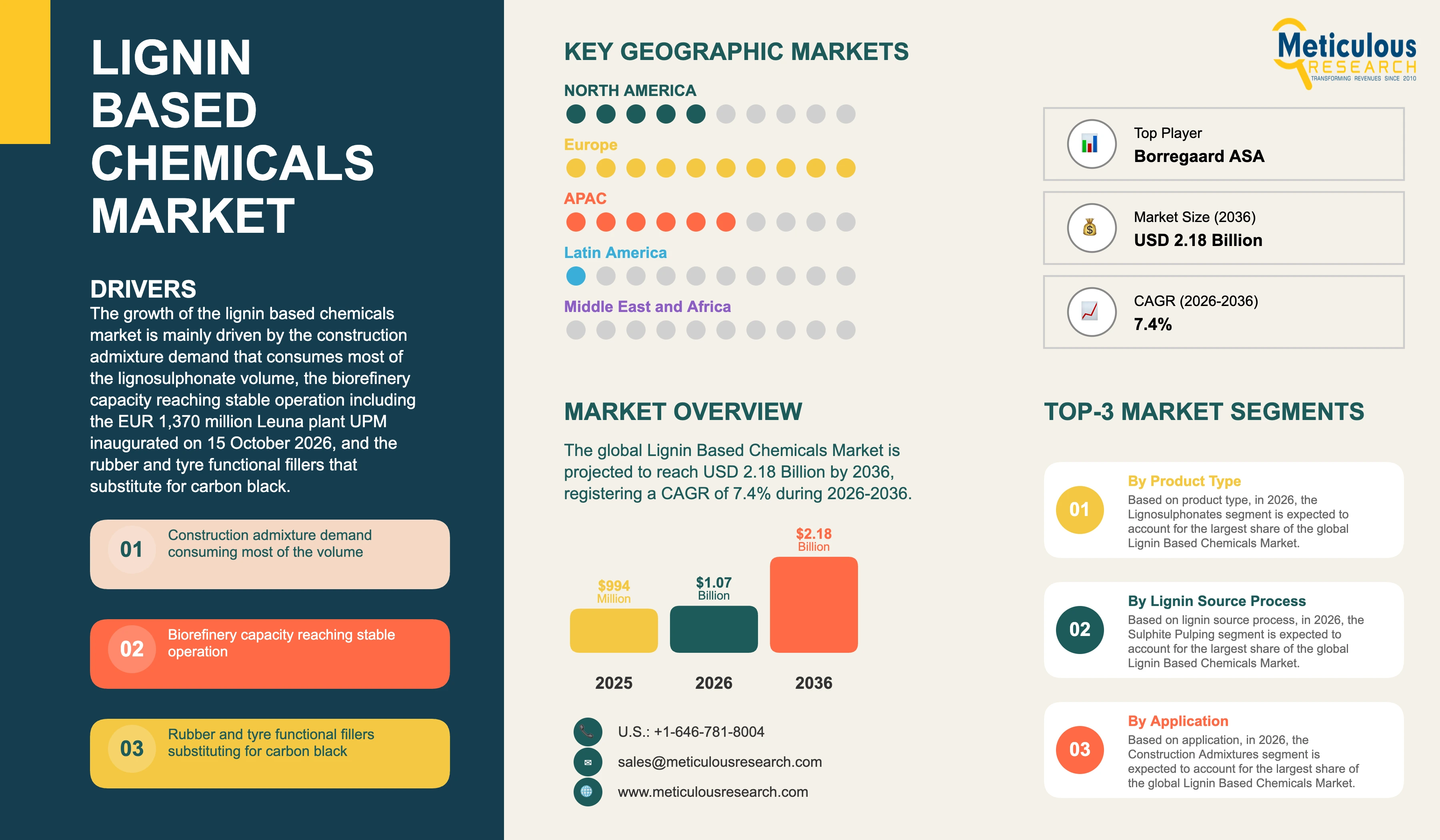
The global lignin based chemicals market was valued at USD 994.0 million in 2025. This market is expected to reach USD 2.18 billion by 2036 from an estimated USD 1.07 billion in 2026, registering a CAGR of 7.4% during the forecast period (2026-2036).
- Published
- Nov 2026
- Pages
- 262
- Format
- PDF + Excel
- Report ID
- MRCHM - 1042811
- Base year
- 2025
- 2025 · BASELINE
- $994.0M
- 2036
- $2.18B
- CAGR 2026–2036
- 7.4%
2025 baseline · 2026–2036 forecast at 7.4% CAGR · hover a bar for the value
Key highlights
The global lignin based chemicals market is estimated at USD 1.07 billion in 2026 and is projected to reach USD 2.18 billion by 2036.
Market volume is estimated at 1, 480.00 kilotons in 2026 and is projected to reach 2,320.49 kilotons by 2036 at a CAGR of 4.6%, measured as lignin-derived chemical products supplied on a dry basis.
The average selling price is estimated at USD 0.72 per kg in 2026 and is projected to reach USD 0.94 per kg by 2036 as price increases are realised and the mix shifts to specialities.
Lignosulphonates are expected to account for the largest product type share in 2026, while lignin-based functional fillers are projected to register the highest CAGR of 16.0%.
Sulphite pulping is expected to be the largest lignin source process in 2026, while enzymatic hydrolysis biorefining is projected to grow fastest at a CAGR of 22.0%.
Construction admixtures are expected to be the largest application in 2026, while rubber and tyres are projected to register the highest CAGR of 15.0%.
Europe is expected to hold the largest regional share in 2026, while Asia-Pacific is projected to register the highest CAGR of 9.0%.
UPM inaugurated its Leuna biorefinery in Germany on 15 October 2026, described in the release as the start of a new industrial platform for renewable chemicals made from wood.
Total investment at Leuna is EUR 1, 370 million and annual capacity is 220,000 tonnes, which the release states makes it the largest facility of its kind in the world.
The plant uses enzymatic hydrolysis to break lignocellulosic biomass into industrial sugars and lignin, so the lignin arrives as a co-product of sugar production rather than of pulping.
The release states that enzymatic hydrolysis and the production of lignin-derived specialty chemicals have reached stable operation and that UPM is ramping up sales of these products.
Feedstock is beechwood from thinnings and sawmill residues sourced within about 200 km and described as unsuitable for higher-value uses such as timber or furniture.
The 220,000 tonne figure covers the facility as a whole, since the release gives no capacities for individual products and names no specific lignin-derived chemical.
The release also does not state certifications, employment at the Leuna site, named customers, commercial delivery dates or full-capacity dates.
Borregaard reported third quarter 2026 results on 28 October 2026 with an all-time high EBITDA of NOK 557 million against NOK 440 million, operating revenues of NOK 1,894 million against NOK 1,799 million, and profit before tax of NOK 394 million against NOK 247 million.
The company attributed the improved BioSolutions result mainly to selective price increases and lower costs, while BioMaterials reached an all-time high result on higher deliveries and strong production.
That release gave no lignin volumes, prices or sales mix, no vanillin information, no segment-level figures, no end-market detail and no outlook statements.
The established lignin speciality business therefore improved on price rather than on volume, while the new biorefinery capacity is only now beginning to sell, which is the division this market runs along.
This market measures lignin converted into chemical products and excludes lignin based carbon fibre, which is a structural material rather than a chemical.
Report summary
| Particulars | Details |
|---|---|
| Base Year | 2025 |
| Forecast Period | 2026-2036 |
| Market Size in 2025 | USD 994.0 million |
| Market Size in 2026 | USD 1.07 billion |
| Market Size by 2036 | USD 2.18 billion |
| Value CAGR (2026-2036) | 7.4% |
| Format | PDF, Excel & Cloud Portal · 262 pages |
| Volume in 2026 | 1,480.00 kilotons |
| Volume by 2036 | 2,320.49 kilotons |
| Volume CAGR (2026-2036) | 4.6% |
| Volume Basis | Lignin-derived chemical products supplied on a dry basis |
| Average Selling Price in 2026 | USD 0.72 per kg |
| Average Selling Price by 2036 | USD 0.94 per kg |
| Price Direction | Average selling price rises across the forecast period as producers realise selective price increases on products whose feedstock volume is fixed by pulp production and as the mix shifts toward functional fillers, aromatics and polyols, rather than through any shortage of lignin itself |
| Scope Definition Note | The boundary is set at lignin converted into a chemical product, so lignosulphonates sold as dispersants fall inside it while lignin carbonised into a structural fibre does not; a dry basis is used because the material is supplied both as powder and as liquid at varying solids content, and a mixed basis would not compare between years or producers |
| Measurement Basis | Lignosulphonates, kraft lignin products, lignin-based functional fillers, lignin-derived aromatics and vanillin, and lignin-based polyols, by product type, lignin source process, application and geography, and excluding lignin based carbon fibre, lignin-derived battery anode carbon, lignin burnt or sold unmodified as fuel, the industrial sugars and cellulose derivatives co-produced alongside it, tall oil derivatives, and the finished concrete admixtures, feed products and rubber compounds into which the material is formulated |
| Relationship to Adjacent Markets | This market is not additive to the lignin based carbon fibre market, which carbonises a lignin-containing precursor into a structural material rather than deriving a chemical from the molecule; the lignin feedstock sits upstream of both, so a lignin availability figure read as potential output for either would overstate it, and the industrial sugars co-produced at a hydrolysis biorefinery are outside this measure |
| Note on Reported Capacity | The 220,000 tonne annual capacity UPM stated for its Leuna biorefinery on 15 October 2026 covers the facility as a whole rather than its lignin output; the release gives no capacities for individual products and names no specific lignin-derived chemical, so that figure is not a measure of capacity added to this market |
| Largest Product Type | Lignosulphonates |
| Fastest-Growing Product Type | Lignin-based functional fillers (CAGR 16.0%) |
| Largest Lignin Source Process | Sulphite pulping |
| Fastest-Growing Lignin Source Process | Enzymatic hydrolysis biorefinery (CAGR 22.0%) |
| Largest Application | Construction admixtures |
| Fastest-Growing Application | Rubber and tyres (CAGR 15.0%) |
| Largest Region | Europe |
| Fastest-Growing Region | Asia-Pacific (CAGR 9.0%) |
| Segments Covered | Product Type, Lignin Source Process, Application, and Geography |
| Geographies Covered | Europe, Asia-Pacific, North America, Latin America, and Middle East & Africa |
| Companies Profiled | 7 companies, including Borregaard ASA, UPM-Kymmene Corporation, Stora Enso Oyj, Domtar Corporation, Rayonier Advanced Materials Inc., Sappi Limited, and Suzano S.A. |
Report overview
Segments covered: product type, lignin source process, application.
The growth of this market is mainly driven by the construction admixture demand that consumes most of the lignosulphonate volume, the biorefinery capacity now reaching stable operation including the EUR 1,370 million Leuna plant UPM inaugurated on 15 October 2026, the rubber and tyre functional fillers that substitute for carbon black, and the pricing discipline the established producers have shown. However, factors such as the dependence of lignin availability on pulp production rather than on chemical demand, the low value density that limits how far the material can be shipped, the competition from synthetic dispersants with more consistent performance, and the variability of lignin as a feedstock are expected to restrain the growth of this market to some extent.
Lignin based chemicals are the dispersants, binders, fillers, polyols, aromatics and flavour compounds derived from lignin, the aromatic biopolymer separated from wood during sulphite and kraft pulping and, increasingly, during enzymatic hydrolysis in a sugar biorefinery. Market sizing in this report is on both a value basis in USD and a volume basis in kilotons measured as lignin-derived chemical products supplied on a dry basis, with average selling price derived from the two. The measurement basis covers lignosulphonates, kraft lignin products, lignin-based functional fillers, lignin-derived aromatics and vanillin, and lignin-based polyols, and it excludes lignin based carbon fibre, lignin-derived battery anode carbon, lignin burnt or sold unmodified as fuel, the industrial sugars and cellulose derivatives co-produced alongside it, tall oil derivatives, and the finished concrete admixtures, feed products and rubber compounds into which the material is formulated.
Measuring on a dry basis matters more here than in most chemical markets because lignosulphonates are supplied both as powders and as liquids at varying solids content, and a volume figure that mixed the two would not compare with itself between years or between producers. The dry basis also reconciles with the way the material is priced, since a buyer purchasing a dispersant is purchasing active content rather than water, and it allows the established products to be compared with the newer solid specialities on the same footing.
UPM inaugurated its Leuna biorefinery in Germany on 15 October 2026, with total investment of EUR 1,370 million and annual capacity of 220,000 tonnes, which the release states makes it the largest facility of its kind in the world. Enzymatic hydrolysis breaks lignocellulosic biomass into industrial sugars and lignin, the release states that enzymatic hydrolysis and the production of lignin-derived specialty chemicals have reached stable operation and that sales of these products are ramping up, and the feedstock is beechwood from thinnings and sawmill residues sourced within about 200 km and described as unsuitable for higher-value uses such as timber or furniture. Applications named include clothing, packaging, cosmetics, construction materials and tyres.
The 220,000 tonne figure needs reading carefully in a report on this market. It covers the facility as a whole rather than its lignin output, the release gives no capacities for individual products, and it names no specific lignin-derived chemical, referring only to the category. A reader who took that number as lignin-chemicals capacity would overstate the addition substantially, since the plant is primarily a sugar platform from which lignin emerges as a co-product. Certifications, site employment, named customers and commercial delivery dates are also not stated.
What the plant does establish is a second route to lignin at industrial scale. Every commercial lignin chemical to date has come from pulping, which means the quantity and the character of the material have been set by decisions made for pulp rather than for chemicals. A hydrolysis biorefinery produces lignin as a co-product of sugar, from a different process with a different severity, which gives producers a feedstock whose properties can be influenced by a plant designed for chemicals.
Borregaard reported third quarter 2026 results on 28 October 2026 with an all-time high EBITDA of NOK 557 million against NOK 440 million, operating revenues of NOK 1,894 million against NOK 1,799 million and profit before tax of NOK 394 million against NOK 247 million, attributing the improved BioSolutions result mainly to selective price increases and lower costs, while BioMaterials reached an all-time high on higher deliveries and strong production and Fine Chemicals improved on higher deliveries of fine chemical intermediates and bioethanol. Chief Executive Tom Erik Foss Jacobsen cited strong operations at the Sarpsborg biorefinery, cost savings, energy system optimisation and selective price increases. The release gave no lignin volumes, prices or sales mix, no vanillin information, no segment-level figures and no outlook.
Those two releases, thirteen days apart, describe the two halves of this market. The established speciality business improved on selective price increases rather than on volume, which is how a mature business with a fixed feedstock behaves; the new capacity reached stable operation and is beginning to sell, which is how a growth business behaves. Value therefore grows at nearly twice the volume rate across the forecast period, and the two sources of that growth are structurally different.
Lignin supply is set by pulp production rather than by chemical demand, and that is the defining constraint on the established part of this market. A sulphite mill generates lignosulphonate in proportion to the pulp it makes, so a producer cannot increase output in response to a strong dispersant market without a pulp decision being taken for pulp reasons, and sulphite capacity has been in long-term decline relative to kraft. Price rather than volume is therefore the lever available, which is precisely what the October 2026 results describe.
Construction admixtures consume most of the volume and set the demand pattern. Lignosulphonate acts as a water reducer and plasticiser in concrete, allowing a given workability at lower water content, and it is the low-cost option against which the synthetic superplasticisers are judged rather than a premium product. Demand therefore tracks construction activity, with the material holding the price-sensitive share of the admixture market. Construction admixtures accordingly account for the largest application share throughout the period.
Rubber and tyres are the fastest-growing application and the target is carbon black. A lignin-based functional filler can replace part of the carbon black in a rubber compound, which substitutes a wood-derived material for one made by burning heavy petroleum feedstock, and the arithmetic matters to a tyre maker reporting embodied carbon on a product with few other levers. UPM names tyres among the markets its Leuna chemicals serve. Rubber and tyres consequently register the highest application CAGR at 15.0%.
Vanillin is the one lignin chemical that commands a genuinely high price and it illustrates the ceiling rather than the opportunity. Producing it from lignosulphonate rather than from petrochemical guaiacol gives a wood-derived flavour compound that a food or fragrance customer will pay a substantial premium for, but the volumes are small relative to the lignin available and the application cannot absorb more. Lignin-derived aromatics and vanillin therefore grow faster than the market without changing its shape.
Value density is the limitation that shapes the geography of this market. A product selling under a dollar a kilogram cannot carry long-distance freight, so producers supply regional markets from regional mills and a shortage in one region is not readily covered from another, which is unusual in a chemical market of this size. It also means capacity location follows pulp mill location, and pulp mill location follows forest resource rather than chemical demand.
This market measures lignin converted into chemical products and therefore excludes lignin based carbon fibre, which is a structural material made by carbonising a lignin-containing precursor rather than a chemical derived from the molecule. The lignin feedstock sits upstream of both, so the two are not additive and a lignin availability figure read as potential output for either would overstate it. The industrial sugars co-produced at a hydrolysis biorefinery are likewise outside this measure.
Europe is expected to account for the largest share in 2026, on the integrated biorefineries that convert lignin into specialities rather than burning it, including the Sarpsborg site and the Leuna biorefinery, and on the construction and rubber industries close to where the material is made. Germany is projected to grow at 8.6%, Finland at 7.0% and Norway at 6.2%.
Asia-Pacific is projected to register the highest CAGR of 9.0% during the forecast period, with India at 10.6%, China at 9.4% and Japan at 5.0%.
Europe holds the largest share, with Germany growing at 8.6%, on the integrated sulphite and hydrolysis biorefineries located there, the Nordic and Central European pulp industry, and the construction and rubber industries that consume the output close to where it is produced, which a low value density product requires.
The Middle East & Africa is projected to grow at a CAGR of 6.0%, with construction admixtures carrying most of the consumption. Latin America is projected to grow at a CAGR of 8.0%, with Brazil at 8.0%, on the eucalyptus pulp industry that is among the largest lignin sources globally and on construction demand.
Borregaard ASA, UPM-Kymmene Corporation, Stora Enso Oyj, Domtar Corporation and Rayonier Advanced Materials Inc. together accounted for an estimated 58.4% of this market in 2026. The 7 companies profiled in this report together accounted for an estimated 64.2%.
Report infographic
Market dynamics
14 factors across 5 forcesConstruction Admixture Demand Consuming Most of the Volume
Lignosulphonate acts as a water reducer and plasticiser in concrete, allowing a given workability at lower water content, and it holds the price-sensitive share of the admixture market against the synthetic superplasticisers rather than competing with them on performance. Demand tracks construction activity across a very large number of small accounts rather than a few programmes.
That breadth also gives the application a stability that a concentrated end market would not, since no single customer decision moves the volume materially.
Concrete is also poured in every market, so the application is not exposed to the industrial cycles that concentrate in particular regions, and the volume recurs with construction activity rather than with specification decisions.
Water reduction in concrete also improves strength as well as workability, so the admixture pays for itself in cement content rather than being an added cost, which is why the application has persisted through every cycle in the construction industry.
Biorefinery Capacity Reaching Stable Operation
UPM inaugurated its Leuna biorefinery on 15 October 2026 with total investment of EUR 1,370 million and annual capacity of 220,000 tonnes, stating that enzymatic hydrolysis and the production of lignin-derived specialty chemicals have reached stable operation and that sales of these products are ramping up. A second route to industrial-scale lignin ends the dependence on pulping decisions.
Because the plant is designed for chemicals rather than for pulp, the character of the lignin it produces can be influenced by process choices made for the chemical products, which is not available to a producer taking a pulping byproduct.
Leuna also draws its feedstock from beechwood thinnings and sawmill residues sourced within about 200 km and described as unsuitable for timber or furniture, which puts the lignin on a residue stream rather than in competition with higher-value wood uses.
Stable operation on the hydrolysis route also demonstrates the lignin can be recovered in a saleable form at industrial scale rather than only in a pilot, which is the step the route needed.
Rubber and Tyre Functional Fillers Substituting for Carbon Black
A lignin-based functional filler can replace part of the carbon black in a rubber compound, substituting a wood-derived material for one made by burning heavy petroleum feedstock, which matters to a tyre maker reporting embodied carbon on a product with few other levers available, and UPM names tyres among the markets its Leuna chemicals serve.
Tyre volumes are also large enough that even a partial substitution represents a substantial tonnage, and functional fillers register the highest product type CAGR at 16.0%.
Rubber compounds are also formulated to a performance envelope rather than to a single property, which gives a compounder room to accommodate a filler whose characteristics differ from carbon black provided the compound as a whole performs.
Tyre labelling and material disclosure requirements are also tightening in the major markets, which turns a voluntary substitution into a reporting advantage.
Pricing Discipline on the Established Products
Borregaard reported an all-time high EBITDA of NOK 557 million against NOK 440 million in its third quarter of 2026 on 28 October 2026, attributing the improved BioSolutions result mainly to selective price increases and lower costs, with operating revenues of NOK 1,894 million against NOK 1,799 million.
Price is the lever available where feedstock volume is fixed by pulp production, and the ability to realise increases selectively rather than across the board indicates the speciality grades are defensible on performance rather than sold purely on cost.
Cost reduction and energy system optimisation contributed to the same result, which indicates the margin improvement is structural rather than a one-off recovery of input inflation.
Selective increases also indicate the producer is pricing by grade and application rather than across a commodity slate, which is only possible where the products are qualified on performance.
Table of contents
11 chapters · 136 sections · 262 pages · click to expandSegmental analysis
| Segment | Largest share (2026) | Fastest growth (2026–2036) |
|---|---|---|
| By Product Type | Lignosulphonates | Lignin-based functional fillers |
| By Lignin Source Process | Sulphite pulping | Enzymatic hydrolysis biorefinery |
| By Application | Construction admixtures | Rubber and tyres |
| Other segments | Construction admixtures | Enzymatic hydrolysis biorefining |
By Product Type
- Lignin Based Chemicals Analysis by Product Type
- The lignosulphonates segment is expected to account for the largest share of the global lignin based chemicals market.
- The large share of this segment is mainly due to decades of commercial supply as dispersants, water reducers and binders, the water solubility that sulphite pulping confers and kraft pulping does not, and the construction, agriculture and dispersant applications that take the material in bulk at low cost.
- However, the lignin-based functional fillers segment is projected to register the highest CAGR of 16.0% during the forecast period.
- The rapid growth of this segment is attributed to the rubber and tyre industry seeking a renewable substitute for carbon black on products where few other emissions levers exist, and to biorefinery capacity able to supply a consistent solid grade having only now reached stable operation.
- Kraft lignin products serve resins, binders and dispersant applications where water solubility is less critical, drawing on the far larger volume that kraft pulping generates.
- Lignin-derived aromatics and vanillin command the highest prices in this market but in volumes the application cannot extend.
- Lignin-based polyols substitute for petrochemical polyols in rigid foam.
- Product type therefore determines the price realised far more than the tonnage supplied, which is why value and volume grow at very different rates.
- Product type also determines whether a producer competes on cost or on performance.
- Lignosulphonates are sold against synthetic dispersants on price and therefore track the cost of the alternative, while functional fillers, aromatics and polyols are bought for a renewable content or emissions argument that the petrochemical product cannot make at any price.
- The second group is consequently far less exposed to substitution even though it is much smaller.
- Grade breadth within lignosulphonates is also wide, running from low-cost dust suppressants to purified dispersants for agrochemical formulations, so the segment contains much of the price range of this market within itself.
- Lignosulphonates are expected to account for the largest share in 2026, on decades of commercial supply as dispersants, water reducers and binders and on the water solubility that sulphite pulping confers.
- Lignin-based functional fillers are projected to register the highest CAGR of 16.0% during the forecast period.
- Sulphite pulping is expected to hold the largest share in 2026, since it produces lignosulphonates that are water-soluble and directly usable as dispersants without further conversion.
By Lignin Source Process
- Lignin Based Chemicals Analysis by Lignin Source Process
- The sulphite pulping segment is expected to account for the largest share of the global lignin based chemicals market.
- The large share of this segment is mainly due to sulphite pulping producing lignosulphonates that are water-soluble and directly usable as dispersants without further conversion, and to the established integrated producers whose biorefineries were built around that chemistry.
- However, the enzymatic hydrolysis biorefinery segment is projected to register the highest CAGR of 22.0% during the forecast period, from a small base.
- The rapid growth of this segment is attributed to the Leuna plant having reached stable operation on lignin-derived specialty chemicals, and to lignin from a hydrolysis route arriving from a process whose severity can be set for the chemical products rather than for pulp.
- Kraft pulping generates by far the largest quantity of lignin globally but produces a material that requires precipitation and often modification before use, which is why its share of chemical products is smaller than its share of available lignin.
- Organosolv and other routes remain small.
- Source process determines the chemistry a producer starts from and therefore which products are accessible without conversion, so it is a commercial axis rather than a technical description.
- Source process also determines where a producer sits in the industry.
- A sulphite producer runs a biorefinery whose chemical products are the reason the mill exists, a kraft producer recovers lignin as a side stream from a pulp business, and a hydrolysis producer makes it alongside sugars in a plant built for chemicals, so the commitment each brings to the chemical market differs as much as the chemistry does.
- The hydrolysis route is also the only one whose lignin volume can grow without a pulp decision being taken, which is why its growth rate is the highest on this axis despite the small base.
By Application
- Lignin Based Chemicals Analysis by Application
- The construction admixtures segment is expected to account for the largest share of the global lignin based chemicals market.
- The large share of this segment is mainly due to lignosulphonate acting as a water reducer and plasticiser that allows a given concrete workability at lower water content, its position as the low-cost option against which synthetic superplasticisers are judged, and the breadth of accounts that take it.
- However, the rubber and tyres segment is projected to register the highest CAGR of 15.0% during the forecast period.
- The rapid growth of this segment is attributed to lignin-based functional fillers replacing part of the carbon black in rubber compounds, substituting a wood-derived material for one made by burning heavy petroleum feedstock, with UPM naming tyres among the markets its Leuna chemicals serve.
- Agriculture and animal feed use the material as a pellet binder, a micronutrient chelate and a controlled-release agent.
- Dyes, pigments and dispersants use it to stabilise suspensions.
- Resins, adhesives and binders substitute lignin for part of the phenol in wood panel adhesives.
- Flavours and fragrances take the small vanillin volume at the highest price in this market.
- Application therefore determines both the grade required and the price achievable, and the two do not move together.
- Application also determines how far the material can travel, which few other chemical markets require as a segmentation consideration.
- Construction admixtures and feed binders are supplied regionally because the freight cannot be carried, while vanillin and the higher-value specialities move internationally, so the geographic footprint of a producer follows its product mix rather than its total output.
- Agricultural and feed applications sit between the two, taking bulk grades regionally while the chelate and controlled-release products carry enough value to travel.
Other segments
- Enzymatic hydrolysis biorefining is projected to register the highest CAGR of 22.0% during the forecast period, from a small base.
- Construction admixtures are expected to account for the largest share in 2026, on lignosulphonate acting as a water reducer and plasticiser that allows a given concrete workability at lower water content.
- Rubber and tyres are projected to register the highest CAGR of 15.0% during the forecast period.
Geographic analysis
Asia-Pacific
Largest shareConstruction activity and the dye, pigment and agrochemical dispersant applications are growing faster in Asia-Pacific than in the mature regions, and the regional pulp industry provides lignin close to that demand, which a low value density product requires. Asia-Pacific is accordingly projected to register the highest regional CAGR at 9.0%, with India at 10.6% and China at 9.4%, against Europe holding the largest share. Regional pulp capacity also continues to expand in Asia-Pacific, so feedstock availability is growing alongside the demand rather than having to be imported. Tyre manufacturing is also concentrated in Asia-Pacific, which places the fastest-growing application close to the fastest-growing region. Insulation demand is also policy-driven through building energy requirements, which gives the polyol application a growth rate independent of general construction activity. However, Asia-Pacific is projected to register the highest CAGR of 9.0% during the forecast period. The rapid growth of this region is attributed to construction activity growing faster than in the mature regions, the dye, pigment and agrochemical dispersant industries that take the material in bulk, the regional pulp capacity that supplies lignin close to that demand, and the tyre manufacturing concentrated there. India is projected to register a CAGR of 10.6%, China a CAGR of 9.4% and Japan a CAGR of 5.0%. Asia-Pacific Construction and Industrial Demand Geographic Analysis
Europe
In 2026, Europe is expected to account for the largest share of the global lignin based chemicals market. The large share of this region is mainly due to the integrated biorefineries that convert lignin into specialities rather than burning it, including the Sarpsborg site whose strong operations Borregaard cited in its third quarter 2026 results, the EUR 1,370 million Leuna biorefinery UPM inaugurated on 15 October 2026, the Nordic and Central European pulp industry, and the construction and rubber industries that consume the output close to where it is made. Germany is projected to register a CAGR of 8.6%, Finland a CAGR of 7.0% and Norway a CAGR of 6.2% during the forecast period.
North America
North America is projected to grow at 7.0%, with the United States at 7.0%, on kraft lignin recovered from the large pulp industry and on construction and wood panel adhesive demand. North America recovers kraft lignin at scale from a very large pulp industry, with wood panel adhesives and construction demand close to those mills.
Latin America
Latin America is projected to grow at 8.0%, with Brazil at 8.0%, on the eucalyptus pulp industry that is among the largest lignin sources globally and on construction demand. Latin America holds one of the largest lignin positions globally through its eucalyptus pulp industry, with most of that lignin still burnt for energy rather than converted into chemicals.
Middle East & Africa
The Middle East & Africa is projected to grow at 6.0%, with construction admixtures carrying most of the consumption. Regional balance in this market is set by freight economics rather than by comparative cost, which is unusual for a chemical. A product selling under a dollar a kilogram cannot be shipped far enough for low-cost capacity in one region to serve demand in another, so each region is supplied from its own mills and the regional shares reflect where pulp capacity and consuming industries happen to coincide. The higher-value specialities travel further, which is part of why the value shares and the volume shares differ.
Competitive landscape
The global lignin based chemicals market is characterised by integrated pulp and biorefinery companies that convert lignin into specialities rather than burning it for energy, with a clear leader in lignosulphonate specialities, a new entrant at industrial scale from the hydrolysis route, and several pulp producers supplying kraft lignin into resins and dispersants. Competition is contested on grade consistency, application support and regional proximity rather than on price alone, because the material cannot carry long freight. Borregaard ASA, UPM-Kymmene Corporation, Stora Enso Oyj, Domtar Corporation and Rayonier Advanced Materials Inc. together accounted for an estimated 58.4% of this market in 2026, while the companies profiled in this report together accounted for an estimated 64.2%.
UPM inaugurated its Leuna biorefinery on 15 October 2026 with total investment of EUR 1,370 million and annual capacity of 220,000 tonnes for the facility as a whole, stating that enzymatic hydrolysis and the production of lignin-derived specialty chemicals had reached stable operation and that sales were ramping up, without naming any specific lignin chemical, giving individual product capacities, or stating customers or commercial delivery dates. Borregaard reported an all-time high third quarter 2026 EBITDA of NOK 557 million against NOK 440 million on 28 October 2026, with operating revenues of NOK 1,894 million and the improved BioSolutions result attributed mainly to selective price increases and lower costs, giving no lignin volumes, prices or sales mix and no outlook.
Capacity commissioning and price realisation rather than acquisition accounted for most competitive activity through 2026. Borregaard ASA competes from an integrated sulphite biorefinery with the broadest lignosulphonate speciality range and the vanillin position, UPM-Kymmene Corporation from the new hydrolysis platform at Leuna, Stora Enso Oyj, Domtar Corporation and Suzano S.A. from kraft lignin recovered at scale from their pulp operations, and Rayonier Advanced Materials Inc. and Sappi Limited from lignosulphonate production alongside dissolving and speciality pulps. Some of the key players operating in the lignin based chemicals market are Borregaard ASA (Norway), UPM-Kymmene Corporation (Finland), Stora Enso Oyj (Finland), Domtar Corporation (U.S.), Rayonier Advanced Materials Inc. (U.S.), Sappi Limited (South Africa), and Suzano S.A. (Brazil), among others.
- —
UPM inaugurated its Leuna biorefinery in Germany on 15 October 2026, described as the start of a new industrial platform for renewable chemicals made from wood, with total investment of EUR 1,370 million and annual capacity of 220,000 tonnes which the release states makes it the largest facility of its kind in the world. Enzymatic hydrolysis breaks lignocellulosic biomass into industrial sugars and lignin, and the release states that enzymatic hydrolysis and the production of lignin-derived specialty chemicals have reached stable operation with sales ramping up, from beechwood thinnings and sawmill residues sourced within about 200 km and described as unsuitable for timber or furniture, serving clothing, packaging, cosmetics, construction materials and tyres. The release gives no capacities for individual products, names no specific lignin-derived chemical, and does not state certifications, site employment, named customers or commercial delivery dates. Borregaard reported third quarter 2026 results on 28 October 2026 with an all-time high EBITDA of NOK 557 million against NOK 440 million, operating revenues of NOK 1,894 million against NOK 1,799 million and profit before tax of NOK 394 million against NOK 247 million, attributing the improved BioSolutions result mainly to selective price increases and lower costs while BioMaterials reached an all-time high on higher deliveries and strong production, giving no lignin volumes, prices or sales mix, no vanillin information, no segment-level figures and no outlook.
- Borregaard ASA
- UPM-Kymmene Corporation
- Stora Enso Oyj
- Domtar Corporation
- Rayonier Advanced Materials Inc.
- Sappi Limited
- Suzano S.A
Expert perspectives
Value grows at 7.4% against 4.6% in volume over the forecast period, and the average selling price rises from USD 0.72 per kg in 2026 to USD 0.94 per kg by 2036. A value rate near twice the volume rate is the signature of a market whose feedstock is fixed and whose growth has to come from price and mix.
Two releases thirteen days apart in October 2026 describe the two halves of this market precisely. Borregaard reported an all-time high EBITDA of NOK 557 million against NOK 440 million with the BioSolutions improvement attributed mainly to selective price increases and lower costs. UPM inaugurated a EUR 1,370 million biorefinery at Leuna and said lignin-derived specialty chemical production had reached stable operation with sales ramping up.
The established business grew on price; the new one is only beginning to sell. That division is not a coincidence of timing but a consequence of where the lignin comes from, because a sulphite mill produces lignosulphonate in proportion to the pulp it makes and sulphite capacity has declined in the long term, leaving price and mix as the levers available to a producer on that route.
The Leuna capacity figure should not be read as a lignin-chemicals addition. The 220,000 tonnes covers the facility as a whole, which is primarily a sugar platform, the release gives no capacities for individual products and names no specific lignin chemical. What it does establish is a second industrial route to lignin, from enzymatic hydrolysis rather than pulping, with the process severity set for chemicals rather than for pulp.
Value density is the constraint that makes this market behave unlike other chemical markets of comparable size. A product selling under a dollar a kilogram cannot carry long freight, so low-cost capacity in one region cannot serve demand in another, each region is supplied from its own mills, and plant scale is bounded by geography rather than by the size of the application.
Where the growth sits is clear enough. Functional fillers at 16.0% and rubber and tyres at 15.0% both reflect carbon black substitution on a product with few other emissions levers, and hydrolysis-route lignin at 22.0% reflects a feedstock that can be specified rather than inherited. This market excludes lignin based carbon fibre, which carbonises a lignin-containing precursor into a structural material rather than deriving a chemical from the molecule, so the two are not additive.
Customer perspectives
Lignosulphonate holds the price-sensitive share of the admixture market rather than the performance-led share, because material from different mills behaves differently, which keeps the application growing below the market rate even while remaining the largest.
As construction specifications tighten, part of that volume migrates to the synthetic products rather than being retained on price.
A producer able to offer consistent speciality grades therefore captures the part of the volume that is not decided on price alone.
Carbon black is produced by burning heavy petroleum feedstock and accounts for a substantial share of embodied carbon in a tyre, so partial substitution by a lignin-based functional filler addresses a disclosure problem with few alternative solutions and across very large volumes.
Partial rather than complete replacement is what is available, but tyre volumes make even a modest substitution rate a substantial tonnage.
Low value density prevents the material from carrying long-distance freight, so applications located close to pulp mills are the ones that can use it economically, and regional proximity is a commercial qualification rather than a convenience.
That proximity also shortens the qualification path, since the supplier and the customer already have a commercial relationship through the pulp or panel business.
“We use it where cost decides and the synthetic where the specification is tight. That split has not changed much in twenty years, and it will not change until the consistency does.”
“Carbon black is a big part of our footprint and there is not much else we can change. A wood-based filler that takes out part of it is worth real effort to us, even at partial replacement.”
“The appeal is that the lignin comes from the same mills we already deal with. Freight on something this cheap would kill it otherwise.”
Frequently asked questions
This market was valued at USD 945.3 million in 2024 and USD 994.0 million in 2025, and is estimated at USD 1.07 billion in 2026. In volume terms it is estimated at 1,480.00 kilotons in 2026 as lignin-derived chemical products supplied on a dry basis.
This market is projected to reach USD 2.18 billion by 2036 in value and 2,320.49 kilotons in volume.
This market is projected to register a value CAGR of 7.4% and a volume CAGR of 4.6% during the forecast period 2026-2036. The average selling price is projected to move from USD 0.72 per kg in 2026 to USD 0.94 per kg by 2036.
Growth is driven by construction admixture demand, biorefinery capacity reaching stable operation including the EUR 1,370 million Leuna plant, rubber and tyre functional fillers substituting for carbon black, and pricing discipline evident in Borregaard's all-time high third quarter 2026 EBITDA of NOK 557 million.
Lignin availability is set by pulp production rather than chemical demand, and low value density prevents long-distance freight. Synthetic dispersants deliver more consistent performance, and lignin structure varies with species, pulping chemistry, process severity and separation route.
Hydrolysis biorefinery lignin can be specified rather than inherited from a pulp decision, and carbon black replacement in rubber compounds addresses an emissions problem across very large volumes. Lignin can also substitute for phenol in wood panel adhesives and polyol in rigid foam, and Asia-Pacific demand is growing faster than in mature regions.
Lignosulphonates are expected to account for the largest share in 2026, on decades of commercial supply as dispersants, water reducers and binders and on the water solubility that sulphite pulping confers.
Lignin-based functional fillers are projected to register the highest CAGR of 16.0% during the forecast period.
Sulphite pulping is expected to hold the largest share in 2026, since it produces lignosulphonates that are water-soluble and directly usable as dispersants without further conversion.
Enzymatic hydrolysis biorefining is projected to register the highest CAGR of 22.0% during the forecast period, from a small base.
Construction admixtures are expected to account for the largest share in 2026, on lignosulphonate acting as a water reducer and plasticiser that allows a given concrete workability at lower water content.
Rubber and tyres are projected to register the highest CAGR of 15.0% during the forecast period.
Europe is expected to account for the largest share in 2026, on integrated biorefineries including the Sarpsborg site and the Leuna biorefinery, and on construction and rubber industries close to where the material is made. Germany is projected to grow at 8.6%, Finland at 7.0% and Norway at 6.2%.
Asia-Pacific is projected to register the highest CAGR of 9.0% during the forecast period, with India at 10.6%, China at 9.4% and Japan at 5.0%.
Europe holds the largest share, with Germany growing at 8.6%, on the integrated sulphite and hydrolysis biorefineries located there, the Nordic and Central European pulp industry, and the construction and rubber industries that consume the output nearby.
The Middle East & Africa is projected to grow at a CAGR of 6.0%, with construction admixtures carrying most of the consumption. Latin America is projected to grow at a CAGR of 8.0%, with Brazil at 8.0%, on the eucalyptus pulp industry and construction demand.
Borregaard ASA, UPM-Kymmene Corporation, Stora Enso Oyj, Domtar Corporation and Rayonier Advanced Materials Inc. together accounted for an estimated 58.4% of this market in 2026. The 7 companies profiled in this report together accounted for an estimated 64.2%.
UPM inaugurated its Leuna biorefinery in Germany on 15 October 2026, with total investment of EUR 1,370 million and annual capacity of 220,000 tonnes, and stated that lignin-derived specialty chemical production had reached stable operation. Borregaard reported an all-time high third quarter 2026 EBITDA of NOK 557 million on 28 October 2026, attributed mainly to selective price increases and lower costs.
Cite this report
Meticulous Research. (2026). Lignin Based Chemicals Market - Global Opportunity Analysis and Industry Forecast (2026-2036) (Report No. MRCHM - 1042811). Meticulous Market Research Pvt. Ltd. https://www.meticulousresearch.com/product/lignin-based-chemicals-market-7494