Chemical Anchors Market (2026-2036)
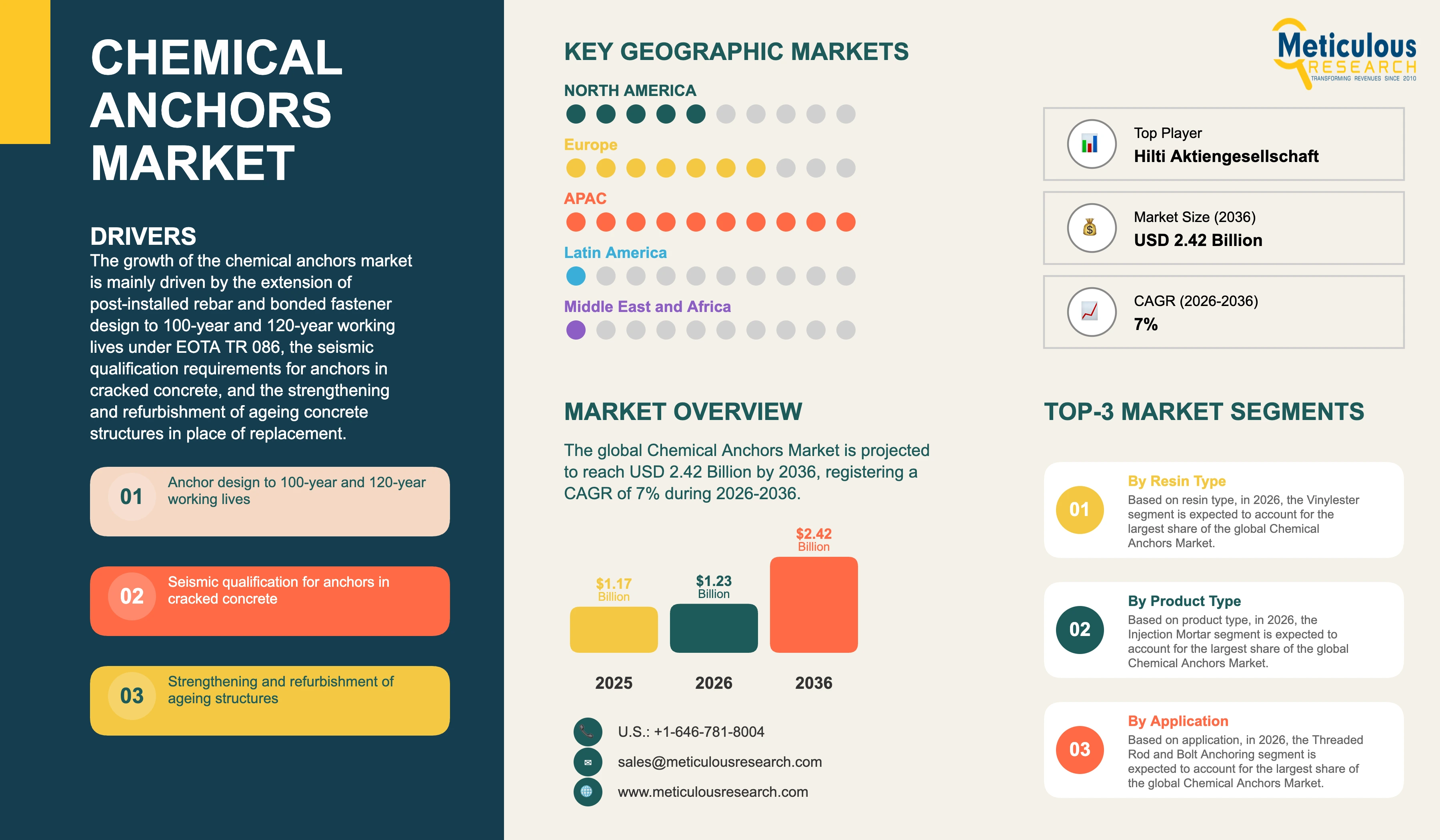
The global chemical anchors market was valued at USD 1.17 billion in 2025. This market is expected to reach USD 2.42 billion by 2036 from an estimated USD 1.23 billion in 2026, registering a CAGR of 7.0% during the forecast period (2026-2036).
- Published
- Nov 2026
- Pages
- 270
- Format
- PDF + Excel
- Report ID
- MRCHM - 1042647
- Base year
- 2025
- 2025 · BASELINE
- $1.17B
- 2036
- $2.42B
- CAGR 2026–2036
- 7.0%
2025 baseline · 2026–2036 forecast at 7.0% CAGR · hover a bar for the value
Key highlights
The global chemical anchors market is estimated at USD 1.23 billion in 2026 and is projected to reach USD 2.42 billion by 2036.
Market volume is estimated at 57.80 kilotons in 2026 and is projected to reach 130.70 kilotons by 2036 at a CAGR of 8.5%.
The average selling price is estimated at USD 21.30 per kg in 2026 and is projected to reach USD 18.50 per kg by 2036.
Vinylester is expected to account for the largest resin type share in 2026, while epoxy is projected to register the highest CAGR of 9.2%.
Injection mortars are expected to hold the largest product type share in 2026, and they are also projected to register the highest CAGR of 7.3%.
Threaded rod and bolt anchoring is expected to be the largest application in 2026, while post-installed rebar connections are projected to grow fastest at a CAGR of 9.6%.
Uncracked concrete is expected to account for the largest base material share in 2026, while cracked concrete is projected to register the highest CAGR of 8.4%.
Commercial and institutional buildings are expected to be the largest end-use industry in 2026, while infrastructure is projected to grow fastest at a CAGR of 8.6%.
Asia-Pacific is expected to hold the largest regional share in 2026, while the Middle East & Africa is projected to register the highest CAGR of 9.4%.
EOTA TR 086, published in September 2025, sets design requirements for working lives of 50, 100 and 120 years using life-specific bond strengths rather than a single 50-year value.
EOTA TR 069, published in August 2025, provides the design method for anchorage of post-installed reinforcing bars, including bond splitting.
Regulation (EU) 2024/3110 entered full application on 7 January 2026, with Regulation 305/2011 to be repealed in 2039.
Bonded fasteners for use in concrete are qualified under EAD 330499 and post-installed rebar systems under EAD 330087, with mechanical fasteners under EAD 330232.
Sika AnchorFix-3030 carries an epoxy European Technical Assessment on a 50-year or 100-year working life, seismic categories C1 and C2, and F240 fire exposure testing for rebar.
fischer FIS V Plus is assessed for a service life of more than 100 years in concrete, carries fire resistance class R120 and is listed for seismic categories C1 and C2.
Saint-Gobain completed the acquisition of Fosroc, announced on 27 June 2024, bringing a construction chemicals anchoring range in Asia and emerging markets under a single owner.
Report summary
| Particulars | Details |
|---|---|
| Base Year | 2025 |
| Forecast Period | 2026-2036 |
| Market Size in 2025 | USD 1.17 billion |
| Market Size in 2026 | USD 1.23 billion |
| Market Size by 2036 | USD 2.42 billion |
| Value CAGR (2026-2036) | 7.0% |
| Format | PDF, Excel & Cloud Portal · 270 pages |
| Volume in 2026 | 57.80 kilotons |
| Volume by 2036 | 130.70 kilotons |
| Volume CAGR (2026-2036) | 8.5% |
| Average Selling Price in 2026 | USD 21.30 per kg |
| Average Selling Price by 2036 | USD 18.50 per kg |
| Measurement Basis | Resin mortar and capsule material consumed in anchoring applications, excluding the steel anchoring element, mechanical expansion anchors and cast-in channel systems |
| Largest Resin Type Segment | Vinylester |
| Fastest-Growing Resin Type Segment | Epoxy (CAGR 9.2%) |
| Largest Product Type Segment | Injection mortar |
| Largest Application Segment | Threaded rod and bolt anchoring |
| Fastest-Growing Application Segment | Post-installed rebar connections (CAGR 9.6%) |
| Largest Base Material Segment | Uncracked concrete |
| Fastest-Growing Base Material Segment | Cracked concrete (CAGR 8.4%) |
| Largest End-Use Industry | Commercial and institutional buildings |
| Fastest-Growing End-Use Industry | Infrastructure (CAGR 8.6%) |
| Largest Region | Asia-Pacific |
| Fastest-Growing Region | Middle East & Africa (CAGR 9.4%) |
| Segments Covered | Resin Type, Product Type, Application, Base Material, End-Use Industry, and Geography |
| Geographies Covered | Asia-Pacific, Europe, North America, Latin America, and Middle East & Africa |
| Companies Profiled | 16 companies, including Hilti Aktiengesellschaft, fischerwerke GmbH & Co. KG, Simpson Manufacturing Co., Inc., Sika AG, Adolf Würth GmbH & Co. KG, and Compagnie de Saint-Gobain S.A. |
Report overview
Segments covered: resin type, product type, application, base material, end-use industry.
In volume terms, this market is estimated at 57.80 kilotons in 2026 and is projected to reach 130.70 kilotons by 2036, registering a CAGR of 8.5% during the same period. The average selling price is estimated at USD 21.30 per kg in 2026 and is projected to decline to USD 18.50 per kg by 2036 as cartridge filling capacity expands in Asia-Pacific and resin formulation volumes rise against a largely fixed approval cost.
The growth of this market is mainly driven by the extension of post-installed rebar and bonded fastener design to 100-year and 120-year working lives under EOTA TR 086, the seismic qualification requirements that design standards place on anchors in cracked concrete, the strengthening and refurbishment of ageing concrete structures in place of replacement, and the substitution of cast-in fixings with post-installed anchoring on site. However, factors such as the dependence of anchor performance on hole cleaning and cure conditions at the point of installation, and the hazard classification of styrene and peroxide components that constrains formulation and site handling, are expected to restrain the growth of this market to some extent.
Vinylester accounts for the largest share of this market because it carries most general-purpose anchoring in both concrete and masonry at a cost the alternatives do not match. Epoxy grows faster because the 100-year and 120-year working life designs, the highest bond strengths and the longest fire exposure ratings are specified in epoxy rather than in the faster-curing chemistries.
Chemical anchors are two-component resin systems injected or inserted into a drilled hole to bond a threaded rod, reinforcing bar or internally threaded sleeve into concrete, masonry or stone. Market sizing in this report is on both a value basis in USD and a volume basis in kilotons, with average selling price derived from the two. The measurement basis is the resin mortar or capsule consumed in anchoring applications, which excludes the steel anchoring element itself, mechanical expansion anchors and cast-in channel systems.
Hilti Aktiengesellschaft filters its chemical anchor range by product type into capsules and injectable adhesive anchors, by anchoring element into threaded rods, internally threaded rods, mesh sleeves, torque-controlled bonded anchors and rebar, and by base material into cracked concrete, uncracked concrete, masonry, concrete masonry units, natural stone and timber. The same range is filtered by base material condition into dry, saturated, submerged and water-filled holes, and by approval into European Technical Assessment, fire and seismic. Sika AG and fischerwerke GmbH & Co. KG organise their ranges on the same axes, and specification therefore proceeds from base material, hole condition and approval before any chemistry is selected.
Chemistry divides along cure speed and load performance. Hilti describes its HIT-HY products as hybrid mortar, its HIT-RE products as epoxy anchors and HIT-FP 700 R as an injectable cementitious adhesive anchor. Sika names AnchorFix-3030 as an epoxy high-performance anchoring adhesive and AnchorFix-1 as a fast curing anchoring adhesive, while AnchorFix-2+ and AnchorFix-2020 are identified by the absence of styrene rather than by resin family. The faster chemistries carry general-purpose work and the epoxies carry the highest loads and longest service lives, so the two groups compete less with each other than with the mechanical anchors on one side and cast-in fixings on the other.
Approval rather than product development governs market access. Bonded fasteners for use in concrete are assessed under EAD 330499, first published in July 2017 and revised in December 2018, and post-installed rebar systems under EAD 330087, revised in December 2020. Regulation (EU) 2024/3110, the recast Construction Products Regulation, which entered into force on 7 January 2025 and entered full application on 7 January 2026 applies only to products covered by a harmonised standard or a European assessment document cited in the Official Journal, and Regulation 305/2011 is to be repealed in 2039. A product without the relevant assessment cannot be specified for structural use, which places the cost and duration of assessment ahead of formulation cost in the economics of this market.
EOTA Technical Report TR 086, Design of post-installed rebar connections, bonded fasteners, and mechanical fasteners for use in concrete for a service life up to 120 years, published in September 2025 sets design requirements for working lives of 50, 100 and 120 years, covering static and quasi-static, seismic and fire loading while excluding fatigue. Fifty-year designs continue to use the existing EN 1992 provisions for cast-in rebar and the EN 1992-4 provisions for fastenings unchanged, while 100-year and 120-year designs apply the same principles to life-specific performance values, including bond strengths for post-installed rebar and characteristic bond resistance for bonded fasteners in cracked concrete. EOTA TR 069, published in August 2025, provides the design method for anchorage of post-installed reinforcing bars including bond splitting. Longer design lives require data a supplier either holds or must generate, which separates the assessment portfolios of the established manufacturers from those of new entrants.
Seismic and fire performance are now routine entries on a product data sheet rather than optional extras. Sika lists seismic categories C1 and C2 for AnchorFix-2020 and AnchorFix-3030, with F240 fire exposure testing for rebar on the epoxy grade, and a European Technical Assessment on a 50-year or 100-year working life. fischerwerke GmbH & Co. KG states that FIS V Plus carries an assessed service life of more than 100 years in concrete, fire resistance class R120, and listing for seismic performance categories C1 and C2 in Europe and categories A and B under American evaluation reports. Products qualified only for uncracked concrete under static load are consequently excluded from the structural work where margins are highest.
Hazard classification is reshaping formulation. fischerwerke GmbH & Co. KG introduced FIS V Zero with a curing system containing no peroxides and non-hazardous raw materials, which removes the need for hazard labelling, and holds a European Technical Assessment for fastenings in concrete, masonry and post-installed rebar. Sika identifies AnchorFix-2+ as a styrene-free anchoring adhesive for medium to high loads and AnchorFix-2020 as solvent-free and styrene-free. Site handling rules, enclosed-space working and waste cartridge disposal all follow from classification, so a low-hazard formulation holding the same assessment competes on cost of use rather than on bond performance.
Wet and submerged installation conditions separate products that otherwise test alike. Hilti filters its range by dry, saturated, submerged and water-filled holes, and Sika notes suitability for wet, damp or water-filled holes by product. Bridge decks, marine structures, basements and tunnel linings present holes that cannot be dried before injection, and a mortar that loses bond strength in a saturated hole is not specifiable for that work regardless of its dry-hole rating. Drinking water contact certification appears across the Sika range for the same reason, since reservoir and treatment plant fixings sit in permanent water contact.
Commercial and institutional buildings are expected to hold the largest share in 2026.
Infrastructure is projected to register the highest CAGR of 8.6% during the forecast period.
Asia-Pacific is expected to account for the largest share in 2026, supported by building and infrastructure construction volumes across China, India and southeast Asia and by regional cartridge filling capacity.
The Middle East & Africa is projected to register the highest CAGR of 9.4% during the forecast period.
Europe is projected to grow at a CAGR of 5.8%, supported by the European Technical Assessment framework and a refurbishment market working on an older building stock. Germany is projected to register a CAGR of 5.2%.
The Middle East & Africa is projected to grow at a CAGR of 9.4% on Gulf building programmes and the adoption of European and American assessment routes as specification references. Latin America is projected to grow at a CAGR of 7.9%, with Mexico the principal market.
Hilti Aktiengesellschaft, fischerwerke GmbH & Co. KG, Simpson Manufacturing Co., Inc., Sika AG and Adolf Würth GmbH & Co. KG together accounted for an estimated 54.0% of this market in 2026. The 16 companies profiled in this report together accounted for an estimated 81.5%.
Report infographic
Market dynamics
15 factors across 5 forcesExtension of Post-Installed Rebar and Bonded Fastener Design to 100-Year and 120-Year Working Lives
EOTA Technical Report TR 086, Design of post-installed rebar connections, bonded fasteners, and mechanical fasteners for use in concrete for a service life up to 120 years, published in September 2025 applies life-specific bond strengths in place of a single 50-year value, with separate characteristic resistances for 100-year and 120-year designs in both post-installed rebar and bonded fasteners. Infrastructure owners specifying a 120-year design life cannot accept a product assessed only to 50 years, and the data to support the longer life comes from sustained-load testing that takes years to generate. Sika already carries a European Technical Assessment on a 50-year or 100-year working life for its epoxy grade, and fischerwerke GmbH & Co. KG states an assessed service life of more than 100 years in concrete for FIS V Plus. Design life therefore operates as a filter on which products can be specified for the highest-value structural work, and it pulls demand toward the chemistries that hold the longer assessments.
Seismic Qualification Requirements for Anchors in Cracked Concrete
Seismic performance categories C1 and C2 under European assessment, and the equivalent categories under American evaluation reports, require testing in cracked concrete under cyclic load rather than in sound concrete under static load. fischerwerke GmbH & Co. KG lists FIS V Plus for categories C1 and C2 in Europe and for categories A and B under American evaluation reports, and Sika lists both AnchorFix-2020 and AnchorFix-3030 for C1 and C2. Concrete in service is assumed to be cracked at the anchor location in most structural design, so the cracked-concrete assessment has become the condition for structural specification rather than an addition to it. Each category adds a test programme and an assessment line, and the products that carry both categories take the work in seismic regions that the unqualified grades cannot.
Strengthening and Refurbishment of Ageing Concrete Structures in Place of Replacement
Post-installed rebar connections allow new concrete to be tied into existing structure, which makes widening a bridge deck, adding a floor or strengthening a column an alternative to demolition. Sika lists anchoring rebar for strengthening and refurbishment, repairing and reinstating failed fixings, and structural steel connections and brackets among the applications for its anchoring range, and holds European Technical Assessments to EAD 330087 for post-installed rebar on three of its four grades. EOTA TR 069, published in August 2025, provides the design method for anchorage of those bars including bond splitting, which gives engineers a published route to a calculated connection rather than a conservative detail. Refurbishment work consumes more resin per project than new-build fixing because rebar embedment depths run to many times the bar diameter, so the shift from replacement to strengthening raises volume faster than it raises the number of projects.
Substitution of Cast-In Fixings With Post-Installed Anchoring on Site
A cast-in fixing has to be located before the concrete is poured and cannot be moved afterwards, while a post-installed anchor is set once the structure is standing and the service runs are known. Hilti supports threaded rods, internally threaded rods, mesh sleeves, torque-controlled bonded anchors and rebar from the same injectable range, which lets one mortar cover fixings that would otherwise require several cast-in component types. Sika lists machinery, signage and facade support mounting alongside handrails, railings and balustrades for the same range. Tolerance recovery is the practical gain, since a post-installed anchor absorbs the position error between design and as-built concrete that a cast-in socket cannot, and that gain holds on every project regardless of its size. Sequencing is the second gain, since services and steelwork are frequently designed after the frame is let, and a post-installed anchor removes the need to freeze those positions at the pour.
Table of contents
13 chapters · 152 sections · 270 pages · click to expandSegmental analysis
| Segment | Largest share (2026) | Fastest growth (2026–2036) |
|---|---|---|
| By Resin Type | Vinylester | Epoxy |
| Other segments | Injection mortars | Post-installed rebar connections |
By Resin Type
- The vinylester segment is expected to account for the largest share of the global chemical anchors market.
- The large share of this segment is mainly due to the position vinylester holds in general-purpose anchoring across concrete, solid brick and perforated brick, the cure speed that allows a fixing to be loaded within hours rather than a day, and a cost per cartridge the epoxies do not match on the high-volume work that makes up most fixings on a project.
- Styrene-free vinylester grades have extended that position into contracts where hazard classification governs site handling.
- Hybrid mortars sit between vinylester and epoxy on both cure speed and load, and Hilti markets its HIT-HY range under that description rather than as a single resin family, while polyester carries light-duty and masonry work where assessment requirements are least demanding and cementitious grades serve wet and water-filled holes that organic resins handle less predictably.
- However, the epoxy segment is projected to register the highest CAGR of 9.2% during the forecast period.
- The rapid growth of this segment is attributed to the concentration of 100-year and 120-year working life assessments in epoxy rather than in the faster chemistries, the F240 fire exposure testing Sika reports for rebar on its epoxy grade against shorter ratings elsewhere, and the bond splitting assessment under TR 069 that post-installed rebar design requires.
- Infrastructure owners specifying long design lives select from the epoxy range by necessity, and that work carries the highest resin consumption per fixing.
- The injection mortar segment is expected to account for the largest share of the global chemical anchors market, and it is also projected to register the highest CAGR of 7.3% during the forecast period.
- The large share and rapid growth of this segment are mainly due to the single cartridge serving threaded rods, internally threaded sleeves, mesh sleeves and reinforcing bars across a project, the variable embedment depth a dispensed volume allows where a fixed-length capsule does not, and the perforated masonry work that requires a sleeve and an injected mortar rather than a capsule.
- Cartridge formats themselves divide between coaxial and side-by-side designs and between cartridge and foil pack, which lets a supplier serve both occasional fixing and continuous high-volume work from one formulation.
- Capsule anchors hold a defensible position in repetitive single-diameter work, since the resin and hardener are pre-dosed in the glass or foil capsule and the mix is completed by the rotating anchor rod rather than by a static mixer.
- Dosing error and nozzle waste are removed at the point of installation, which matters where the same fixing is repeated many times and where no dispensing gun is practical.
- Hilti retains capsules as a distinct product type alongside its injectable range for that reason.
- The format cannot serve variable embedment depths or perforated masonry, so its position is stable rather than expanding.
- The threaded rod and bolt anchoring segment is expected to account for the largest share of the global chemical anchors market.
- The large share of this segment is mainly due to the volume of mechanical and electrical services, steel brackets, handrails, balustrades and plant fixings that every building requires, the suitability of a bonded rod at small edge distances where a mechanical anchor would split the concrete, and the tolerance recovery a post-installed rod provides against as-built concrete positions.
- However, the post-installed rebar connections segment is projected to register the highest CAGR of 9.6% during the forecast period.
- The rapid growth of this segment is attributed to the publication of EOTA TR 069 in August 2025 giving engineers a design method for bar anchorage including bond splitting, the extension of rebar connection design to 120-year working lives under TR 086, and the resin volume a rebar connection consumes at embedment depths running to many times the bar diameter.
- Strengthening and widening existing structures depends on this connection, and that work substitutes for demolition rather than competing with other fixing methods.
- The uncracked concrete segment is expected to account for the largest share of the global chemical anchors market.
- The large share of this segment is mainly due to the non-structural and lightly loaded fixings that make up most anchor count on a building, the availability of every product family for uncracked conditions where only some carry cracked-concrete assessment, and the lower assessment cost that keeps cartridge prices in this segment below the structural grades.
- However, the cracked concrete segment is projected to register the highest CAGR of 8.4% during the forecast period.
- The rapid growth of this segment is attributed to the design assumption that concrete at an anchor location is cracked, which makes cracked-concrete assessment the condition for structural specification, the seismic categories C1 and C2 that are tested in cracked concrete under cyclic load, and the premium that products carrying both cracked-concrete and seismic assessment command over the uncracked grades.
- The commercial and institutional buildings segment is expected to account for the largest share of the global chemical anchors market.
- The large share of this segment is mainly due to the density of services, facade and fit-out fixings in offices, hospitals, schools and retail space, the refurbishment cycle that returns to the same buildings every fifteen to twenty years, and the structural steel and bracket connections that commercial frames require throughout.
- However, the infrastructure segment is projected to register the highest CAGR of 8.6% during the forecast period.
- The rapid growth of this segment is attributed to the 100-year and 120-year working lives that bridge, tunnel and retaining structure owners specify and that TR 086 now supports with life-specific bond strengths, the widening and strengthening programmes that depend on post-installed rebar connections, and the wet and submerged hole conditions in bridge decks, basements and marine structures that only the qualified grades can serve.
- Vinylester is expected to account for the largest share in 2026, supported by its position in general-purpose anchoring across concrete and masonry.
- Epoxy is projected to register the highest CAGR of 9.2% during the forecast period.
Other segments
- Injection mortars are expected to hold the largest share in 2026, and they are also projected to register the highest CAGR of 7.3% during the forecast period.
- Threaded rod and bolt anchoring is expected to hold the largest share in 2026.
- Post-installed rebar connections are projected to register the highest CAGR of 9.6% during the forecast period.
- Uncracked concrete is expected to account for the largest share in 2026.
- Cracked concrete is projected to register the highest CAGR of 8.4% during the forecast period.
Geographic analysis
Asia-Pacific
Largest shareIn 2026, Asia-Pacific is expected to account for the largest share of the global chemical anchors market. The large share of this region is mainly due to the volume of building and infrastructure construction under way across China, India and southeast Asia, the seismic design requirements that apply across Japan, Taiwan, Indonesia and the Philippines and that pull specification toward cracked-concrete and seismic-qualified grades, and the cartridge filling and resin formulation capacity sited in the region which keeps delivered cost below imported product. Saint-Gobain acquired Fosroc, announced on 27 June 2024, specifically for its construction chemicals position in Asia and emerging markets. China is projected to register a CAGR of 7.6% and India a CAGR of 10.8% during the forecast period.
Middle East & Africa
Fastest growthHowever, the Middle East & Africa is projected to register the highest CAGR of 9.4% during the forecast period. The rapid growth of this region is attributed to the scale of building programmes under way across the Gulf states, the structural steel and facade fixing content of those programmes, and the adoption of European Technical Assessment and seismic categories as specification references in markets without a domestic approval route.
Europe
Europe holds the second-largest share, supported by the European Technical Assessment framework that originates in the region and by a refurbishment and strengthening market working on a building stock older than elsewhere, and the region is projected to grow at 5.8%. Germany is projected to register a CAGR of 5.2% and the United States a CAGR of 6.3% during the forecast period. Approval route rather than construction volume explains much of the regional difference. Products reach the European market through European assessment documents cited in the Official Journal, while American evaluation reports and seismic categories A and B govern specification in the United States, and fischer states both routes for FIS V Plus. Markets without a domestic approval framework adopt one of the two, which gives suppliers holding both a position that local formulators cannot contest on structural work. Cartridge filling is in contrast a regional operation, since a two-component mortar with limited shelf life and hazard classification is not economically shipped far, and that division keeps formulation capacity close to demand while assessment stays centralised.
North America
North America is projected to grow at 6.4% on seismic specification across the western states and on bridge and tunnel renewal programmes.
Latin America
Latin America is projected to grow at 7.9%, with Mexico the principal market as building and industrial construction expands.
Competitive landscape
The global chemical anchors market is characterised by the presence of fastening system specialists, diversified construction chemicals companies and regional formulators serving contractors and distributors. Competition is contested on the breadth of the assessment portfolio rather than on resin formulation, since a supplier holding cracked-concrete, seismic, fire, wet-hole, masonry and post-installed rebar assessments across a single range can be specified for an entire project. Hilti Aktiengesellschaft, fischerwerke GmbH & Co. KG, Simpson Manufacturing Co., Inc., Sika AG and Adolf Würth GmbH & Co. KG together accounted for an estimated 54.0% of this market in 2026, while the companies profiled in this report together accounted for an estimated 81.5%.
Saint-Gobain completed the acquisition of Fosroc following an announcement on 27 June 2024, adding a construction chemicals range with anchoring products across Asia and emerging markets. fischerwerke GmbH & Co. KG introduced FIS V Zero with a peroxide-free curing system and non-hazardous raw materials that removes hazard labelling while holding a European Technical Assessment for concrete, masonry and post-installed rebar, and positions FIS V Plus on an assessed service life of more than 100 years in concrete with fire resistance class R120 and seismic categories C1 and C2. Sika AG carries AnchorFix-3030 as an epoxy grade with assessments on a 50-year or 100-year working life, post-installed rebar under EAD 330087-01-0601, bond splitting under TR 069 and F240 fire exposure for rebar. Hilti Aktiengesellschaft offers an injectable cementitious adhesive anchor alongside its hybrid and epoxy ranges and lists PROFIS design software availability by product. Assessment breadth, hazard classification and design software accounted for most competitive activity through 2026.
Regional formulators hold positions in masonry and light-duty work where a full structural assessment set is not required and delivered cartridge cost decides the sale. Nanjing Mankate Science & Technology Co., Ltd. supplies anchoring and structural strengthening materials into Chinese construction, and Rawlplug S.A. and MKT Metall-Kunststoff-Technik GmbH & Co. KG serve European distribution with assessed ranges at lower price points than the fastening specialists. Some of the key players operating in the chemical anchors market are Hilti Aktiengesellschaft (Liechtenstein), fischerwerke GmbH & Co. KG (Germany), Simpson Manufacturing Co., Inc. (U.S.), Sika AG (Switzerland), Adolf Würth GmbH & Co. KG (Germany), Stanley Black & Decker, Inc. (U.S.), Compagnie de Saint-Gobain S.A. (France), CRH plc (Ireland), Mapei S.p.A. (Italy), RPM International Inc. (U.S.), EJOT Holding SE & Co. KG (Germany), MKT Metall-Kunststoff-Technik GmbH & Co. KG (Germany), Rawlplug S.A. (Poland), MC-Bauchemie Müller GmbH & Co. KG (Germany), Mungo Befestigungstechnik AG (Switzerland), and Nanjing Mankate Science & Technology Co., Ltd. (China), among others.
- —
EOTA published TR 086 in September 2025, setting design requirements for 50-year, 100-year and 120-year working lives, and TR 069 in August 2025, providing the design method for post-installed rebar anchorage including bond splitting. Regulation (EU) 2024/3110 entered full application on 7 January 2026. Saint-Gobain completed the acquisition of Fosroc following an announcement on 27 June 2024.
- Hilti Aktiengesellschaft
- Simpson Manufacturing Co., Inc.
- Sika AG
- Adolf Würth GmbH & Co. KG
- Compagnie de Saint-Gobain S.A
Expert perspectives
Volume grows at 8.5% against 7.0% in value over the forecast period, and the average selling price falls from USD 21.30 per kg in 2026 to USD 18.50 per kg by 2036 as cartridge filling capacity expands in Asia-Pacific and formulation volumes rise against a largely fixed assessment cost. The kilograms required grow faster than the revenue they generate, so a supplier planning capacity from the value line alone provides for less resin than the market will consume.
EOTA TR 086 and TR 069, both published in the second half of 2025, moved design life and bar anchorage from engineering assumption to published calculation. A product assessed only to a 50-year working life is now visibly short of what infrastructure owners specify, and the sustained-load data behind a 100-year or 120-year assessment takes years to generate rather than months. The suppliers already holding those assessments, including Sika on a 50-year or 100-year basis and fischer at more than 100 years in concrete, carry an advantage that a competitor cannot close by reformulating.
Assessment economics rather than chemistry decides who competes in this market. A single mortar requires separate evidence for cracked and uncracked concrete, masonry, post-installed rebar, each seismic category, fire exposure, wet and submerged holes and each working life, with the evidence attached to the formulation and not to the product name. That cost is fixed per assessment and recovered across units sold, so breadth of range and volume reinforce each other, and narrow suppliers are pushed toward masonry and light-duty work where the full set is not demanded.
Hazard classification is the live reformulation pressure. fischer removed peroxides from FIS V Zero to eliminate hazard labelling and Sika identifies two grades by the absence of styrene, in both cases because the obligations fall on the contractor and show up in installed cost rather than in material price. Reformulating regenerates the assessment, which means the suppliers that moved early hold assessed low-hazard ranges while later movers face the test programme at current cost.
Regulation (EU) 2024/3110 entered full application on 7 January 2026 and covers products placed on the market through European assessment documents, which is the route chemical anchors take. Environmental declaration and digital documentation become conditions of sale, and the companies already publishing environmental declarations and holding drinking water certification absorb that as existing cost. The obligation is identical for a supplier with four assessments and one with forty, which compounds the concentration that assessment economics already produce.
Design software is where specification is decided before price is discussed. Hilti lists PROFIS availability as a product attribute, and the calculation routes in TR 086 and TR 069 are impractical to follow by hand across the many fixings on a project. An engineer who sizes anchors inside a supplier design environment carries that supplier assessment data into the drawing, so the tender arrives with the product family already resolved.
Customer perspectives
Assessment breadth rather than individual product performance governs specification, and it concentrates project volume with the suppliers holding the full set of conditions on a single range.
Installation discipline and hazard classification determine cost of use on site, which explains why cleaning method, cure speed and labelling appear as product selection attributes alongside load capacity.
Infrastructure demand concentrates on the long working life, wet-hole and published-design-method end of the range, which is the segment carrying the highest resin consumption per fixing and the fewest qualified suppliers.
“We specify from the assessment, not from the data sheet. If a client asks for a 120-year design life on a bridge, we can only use products with bond strengths assessed for that life, and the list is short. The same applies to cracked concrete and to seismic categories, because we have to assume the concrete is cracked at the anchor. A product that covers one condition but not the others creates a mixed specification we then have to justify, so we tend to stay inside one supplier range.”
“Hole cleaning is where these products are won or lost, and on a busy site it is the step that gets rushed. Cure time is the other one, because in winter a slow mortar means the fixing cannot be loaded that shift. We have moved toward the grades without hazard labelling, since they take the ventilation and enclosed-space paperwork off us and the disposal is simpler, and the price difference is smaller than what the paperwork costs.”
“Our structures are designed for a century and we cannot replace a fixing inside a bridge deck without closing the road. We need published design methods and assessed long-life data, not test results that only the supplier holds. Wet holes are a fact of life on decks and in tunnels, so a mortar that only performs in a dry hole is of no use to us whatever its dry rating.”
Frequently asked questions
This market was valued at USD 1.10 billion in 2024 and USD 1.17 billion in 2025, and is estimated at USD 1.23 billion in 2026. In volume terms it is estimated at 57.80 kilotons in 2026.
Cite this report
Meticulous Research. (2026). Chemical Anchors Market - Global Opportunity Analysis and Industry Forecast (2026-2036) (Report No. MRCHM - 1042647). Meticulous Market Research Pvt. Ltd. https://www.meticulousresearch.com/product/chemical-anchors-market-7330