Anodising Chemicals Market (2026-2036)
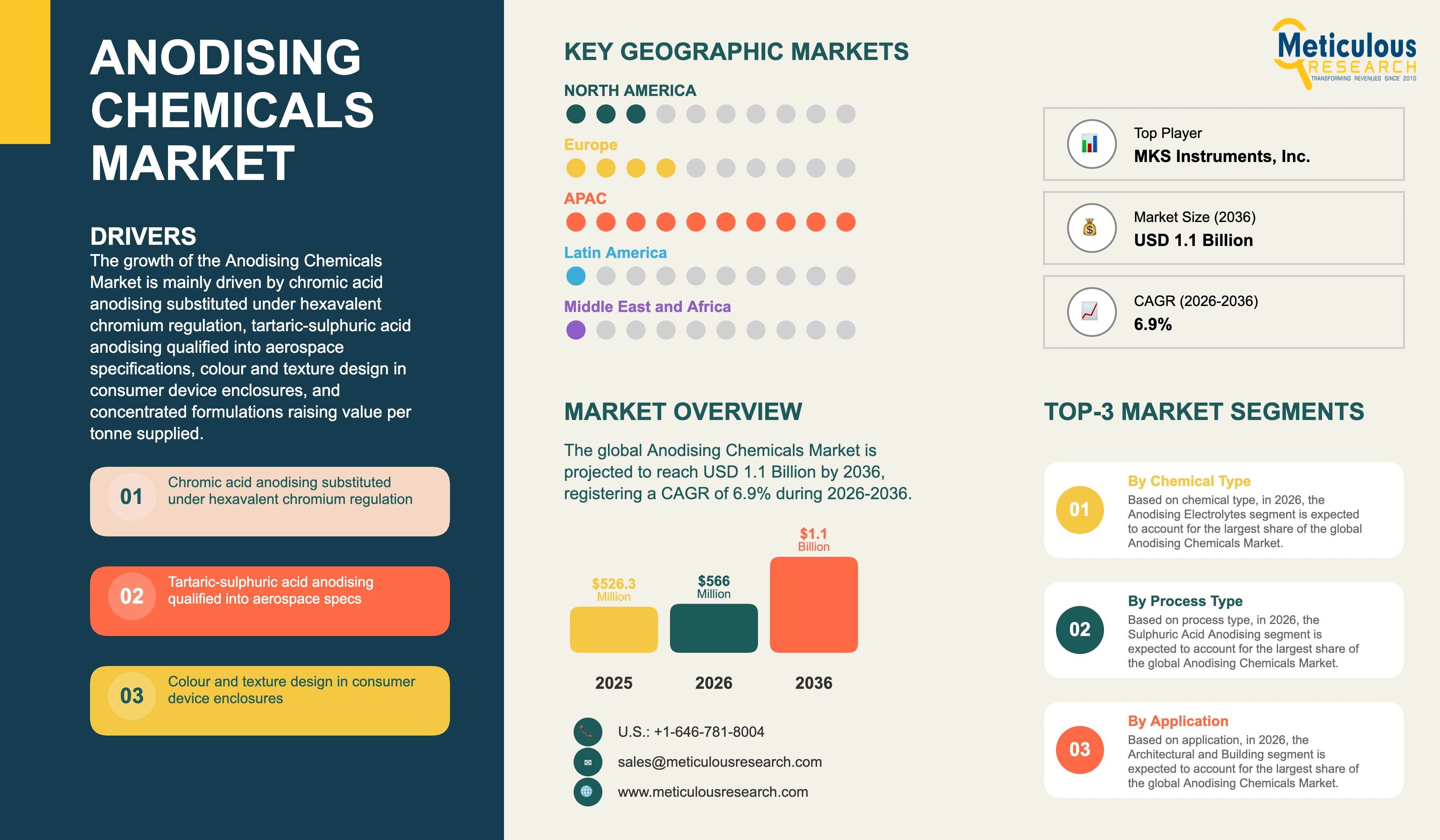
The anodising chemicals market is valued at USD 566.0 million in 2026 and is projected to reach USD 1.10 billion by 2036, at a CAGR of 6.9% during the forecast period. The market was valued at USD 526.3 million in 2025 and at USD 492.8 million in 2024.
- Published
- Nov 2026
- Pages
- 256
- Format
- PDF + Excel
- Report ID
- MRCHM - 1042791
- Base year
- 2025
- 2024 · HISTORICAL
- $492.8M
- 2036
- $1.10B
- CAGR 2026–2036
- 6.9%
2024–2025 baseline · 2026–2036 forecast at 6.9% CAGR · hover a bar for the value
Key highlights
This market measures chemicals consumed in the anodising process line, covering cleaners, etchants, desmutting agents, anodising electrolytes, colouring dyes and salts, sealing chemicals and process additives, at the supplier gate on a tonne basis.
Anodising equipment, rectifiers and racking are excluded, as are effluent treatment chemicals, the aluminium substrate, conversion coatings, plating chemistries and electronic grade sulphuric acid supplied for wafer processing.
The European Chemicals Agency ran a call for evidence and information on uses of certain hexavalent chromium substances from 5 June 2024 to 15 August 2024, supporting a possible REACH Annex XV restriction.
That call covered chromium trioxide, chromic and dichromic acids, sodium, potassium and ammonium dichromate, potassium and sodium chromate, dichromium tris(chromate), strontium chromate, potassium hydroxyoctaoxodizincatedichromate and pentazinc chromate octahydroxide.
Barium chromate was included at the request of the Commission although it is not listed in Annex XIV, to avoid regrettable substitution.
The background note identified data gaps for electroplating on plastics, for painting, spraying, brushing and slurry coating, and for speciality surface treatment including chemical conversion coating, anodisation and passivation.
Those gaps were linked to the transportation sectors covering maritime, rail, road and aviation, and to the aviation and defence sector.
The restriction proposal would permit defined use categories subject to conditions, covering formulation of mixtures, electroplating on plastic substrate, electroplating on metal substrate, use of primers and other slurries, other surface treatment, and functional additives and process aids.
Those uses would remain permitted only where they meet limits on worker exposure and emissions to the environment, with some restriction options expected to rely on one or more scientific limit values.
A six-month public consultation on the proposal was expected to start on 18 June 2025, after which the Committees for Risk Assessment and Socio-Economic Analysis evaluate the proposal and the Commission and member states decide on the restriction and its conditions.
The restriction, if adopted, would replace the current REACH authorisation requirement for the substances concerned.
European standard EN 4704 covers tartaric-sulphuric acid anodising of aluminium for aerospace corrosion protection, which is the qualified route replacing chromic acid anodising in airframe and component finishing.
Okuno Chemical Industries supplies an aluminium anodising line covering the ALCLEAN cleaner, the TOP_DESMUT impurity remover, a mist preventing agent for the anodising bath, the TAC SORMAL series promoting the dyeing reaction, and TAC DYESTUFF anodising dyes.
That dye range is described as 32 standard colours in one listing and 35 standard colouring dyes in another, including 10 standard black colours.
The same supplier states that it is developing nickel-free sealers and nickel-free sealing agents, which are presented as research rather than released products.
Surface treatment agents free of boron, phosphoric acid, nitric acid and fluorine are described by that supplier as in development, and heavy-metal-free anodising dyes as under research.
The application sectors named for that aluminium anodising line are smartphones and mobile devices, home appliances, music players, cameras, bicycles, furniture, leisure parts and wearable watches.
Italtecno supplies chemicals for anodising covering pretreatment, anodising, colouring and electrocolouring, and states that many of its products are highly concentrated to reduce transport and storage volumes, handling requirements and packaging disposal.
Report summary
| Particulars | Details |
|---|---|
| Base Year | 2025 |
| Actual Years | 2024-2025 |
| Forecast Period | 2026-2036 |
| Market Size in 2024 | USD 492.8 million |
| Market Size in 2025 | USD 526.3 million |
| Market Size in 2026 | USD 566.0 million |
| Market Size in 2036 | USD 1.10 billion |
| Value CAGR (2026-2036) | 6.9% |
| Format | PDF, Excel & Cloud Portal · 256 pages |
| Volume in 2025 | 306.00 kilotons |
| Volume in 2026 | 318.00 kilotons |
| Volume in 2036 | 452.00 kilotons |
| Volume CAGR (2026-2036) | 3.6% |
| Average Selling Price, 2026 | USD 1,780 per tonne |
| Average Selling Price, 2036 | USD 2,430 per tonne |
| Units | Value in USD million; volume in kilotons of anodising chemicals; price in USD per tonne |
| Measurement Basis | Chemicals consumed in the anodising process line, covering cleaners, etchants, desmutting agents, anodising electrolytes, colouring dyes and salts, sealing chemicals and process additives, measured at the supplier gate on a tonne basis |
| Commodity Share Note | Anodising electrolytes, cleaners and etchants together account for 56.5% of this market in 2026 and consist largely of sulphuric acid, caustic soda and desmutting mixtures priced against bulk chemical indices; value growth of 6.9% against volume growth of 3.6% is the specialty fraction taking share rather than the market repricing |
| Historical Value Growth | Value grew at 7.2% a year between 2024 and 2026 against volume growth of 3.6% a year, with average selling price rising 3.4% a year over the same period; the forecast of 6.9% carries a similar mix shift at a marginally lower rate |
| Regulatory Status Note | The European Chemicals Agency ran a call for evidence on uses of certain hexavalent chromium substances from 5 June 2024 to 15 August 2024 in support of a possible REACH Annex XV restriction, naming speciality surface treatment including chemical conversion coating, anodisation and passivation among the uses with data gaps; a six-month public consultation was expected to start on 18 June 2025, and a restriction would replace the current authorisation requirement |
| Substitution Readiness Note | European standard EN 4704 covers tartaric-sulphuric acid anodising of aluminium for aerospace corrosion protection, so the chromic acid substitution is executable; the next wave is not, with one supplier describing nickel-free sealers, agents free of boron, phosphoric acid, nitric acid and fluorine, and heavy-metal-free anodising dyes as in development or under research |
| Overlap Note | Hard anodising chemicals counted here are also counted in the Hard Chrome Alternatives Market title to the extent that title treats hard anodising as a hard chrome alternative, so the two are non-additive on that route |
| Exclusions | Anodising equipment, rectifiers, racking and tankage; effluent treatment chemicals and sludge handling; the aluminium substrate; chrome-free and chrome-based conversion coatings; trivalent and hexavalent chromium plating chemistries; electroless nickel plating chemicals; silane and zirconium pretreatment chemicals; electronic grade sulphuric acid supplied for wafer cleaning and etching; organic paints and powder coatings applied over anodised surfaces |
| Segments: Chemical Type | Anodising Electrolytes; Cleaners and Etchants; Sealing Chemicals; Colouring Dyes and Salts; Desmutting and Pre-treatment; Additives and Brighteners |
| Segments: Process Type | Sulphuric Acid Anodising; Hard Anodising; Tartaric-Sulphuric Acid Anodising; Chromic Acid Anodising; Other Processes |
| Segments: Application | Architectural and Building; Consumer Electronics and Devices; Automotive and Transportation; Industrial and Engineering; Aerospace and Defence; Other Applications |
| Segments: Finish | Clear and Natural; Electrolytically Coloured; Organically Dyed; Hard and Engineering; Interference and Other |
| Largest Segment by Chemical Type, 2026 | Anodising Electrolytes, at 34.0% |
| Fastest-Growing Segment by Chemical Type | Additives and Brighteners, at 9.4% |
| Largest Segment by Process Type, 2026 | Sulphuric Acid Anodising, at 61.0% |
| Fastest-Growing Segment by Process Type | Tartaric-Sulphuric Acid Anodising, at 18.5% |
| Declining Segment by Process Type | Chromic Acid Anodising, contracting at 3.5% a year |
| Largest Segment by Application, 2026 | Architectural and Building, at 33.0% |
| Fastest-Growing Segment by Application | Aerospace and Defence, at 9.8% |
| Largest Segment by Finish, 2026 | Clear and Natural, at 39.0% |
| Fastest-Growing Segment by Finish | Interference and Other, at 11.6% |
| Largest Region, 2026 | Asia-Pacific, at 52.0% |
| Fastest-Growing Region | Europe, at 8.0% |
| Fastest-Growing Country | Germany, at 8.6% |
| Slowest-Growing Country | Canada, at 5.8% |
| Regions Covered | Asia-Pacific; Europe; North America; Latin America; Middle East & Africa |
| Countries Covered | China; Japan; South Korea; India; Germany; Italy; France; U.K.; U.S.; Canada; Mexico; Brazil |
| Key Players | MKS Instruments, Inc.; Element Solutions Inc.; BASF SE; Henkel AG & Co. KGaA; Quaker Houghton; Okuno Chemical Industries Co., Ltd.; Nihon Parkerizing Co., Ltd.; Italtecno S.r.l.; Socomore SAS; Chemeon Surface Technology, LLC |
| Top Five Share, 2026 | 41.5% |
| Profiled Companies Share, 2026 | 52.0% |
| Currency | USD |
Report overview
Market value is measured in in USD million; volume in kilotons of anodising chemicals; price in USD per tonne. Segments covered: chemical type, process type, application, finish.
The growth of this market is mainly driven by the substitution of chromic acid anodising under hexavalent chromium regulation, tartaric-sulphuric acid anodising qualified into aerospace specifications, colour and texture design in consumer device enclosures, and concentrated chemical formulations that raise value per tonne supplied. However, factors such as architectural anodising competing against powder coating in the largest application, more than half the tonnage being commodity sulphuric acid and caustic soda, nickel-free sealing and heavy-metal-free dye chemistries still in development, and process energy intensity in a market priced per tonne of chemical are expected to restrain the growth of this market to some extent.
Anodising converts the surface of an aluminium part into a thick oxide layer grown from the metal itself rather than applied over it. The part is cleaned, etched to a defined texture, desmutted, then made the anode in an acid electrolyte where the oxide grows as a porous columnar film, typically 5 to 25 micrometres thick for architectural and decorative work and above 25 for engineering duty. The pores are then dyed or electrolytically coloured if required and sealed by hydration or a chemical sealant. Every one of those steps consumes a chemical, and this market is the sum of them.
The cost structure is unusual for a specialty chemicals market because the largest volumes are commodities. Sulphuric acid is the electrolyte in the overwhelming majority of anodising, caustic soda does the etching, and nitric or sulphuric mixtures do the desmutting. Anodising electrolytes, cleaners and etchants together account for 56.5% of this market in 2026 and are priced against bulk chemical indices. The value sits in the smaller fractions: dyes, electrolytic colouring salts, sealing chemistries and proprietary additive packages.
That split explains the forecast. Volume grows at 3.6% a year while value grows at 6.9%, because the specialty fraction is taking share rather than because the commodity half is repricing. Additives and brighteners grow fastest among chemical types at 9.4% and sealing chemicals at 8.0%, against 5.2% for cleaners and etchants, and average selling price rises 3.2% a year as a result of that mix shift.
The driver named for this title combines architectural and device finishing, and the two behave very differently. Architectural and building is the largest application at 33.0% of the market in 2026 and the slowest-growing at 5.4%, because anodising competes directly with powder coating on facade and window systems and loses on colour range, cost per square metre and repairability. Anodising retains the specification where metallic appearance, abrasion resistance and long-term colour stability matter, which is a defensible position rather than an expanding one.
Consumer electronics and devices is the smaller half of the stated driver and the stronger one, growing at 8.6%. A phone, laptop or watch enclosure is anodised for feel, scratch resistance and colour, and the colour design is the product differentiator rather than a protective requirement. The application sectors named by one supplier for its aluminium anodising line illustrate the breadth: smartphones and mobile devices, home appliances, music players, cameras, bicycles, furniture, leisure parts and wearable watches.
Device work pulls the specialty chemistry rather than the commodity. Achieving a consistent colour across a batch of machined enclosures requires surface conditioning before dyeing, a controlled dye with defined lightfastness, and a seal that locks the dye without bleeding or blooming. One supplier lists a surface conditioning series promoting the dyeing reaction alongside a dye range described as 32 standard colours in one listing and 35 standard colouring dyes in another, with 10 standard black colours.
What actually moves value in this market over the forecast period is regulation rather than either half of the stated driver. Chromic acid anodising is the only process route in this market with a negative growth rate, declining at 3.5% a year, while tartaric-sulphuric acid anodising grows at 18.5% from a comparable 2026 base. Aerospace and defence is the fastest-growing application at 9.8% for the same reason, despite holding only 9.5% of the market.
The regulatory position is specific and still open. The European Chemicals Agency ran a call for evidence on uses of certain hexavalent chromium substances from 5 June to 15 August 2024 in support of a possible REACH Annex XV restriction, covering twelve substances including chromium trioxide, chromic and dichromic acids and the chromate and dichromate salts, with barium chromate added at the request of the Commission to avoid regrettable substitution.
The background note to that call identified data gaps for speciality surface treatment including chemical conversion coating, anodisation and passivation, and linked them to the maritime, rail, road and aviation transportation sectors and to aviation and defence. A restriction, if adopted, would replace the current authorisation requirement for those substances rather than sit alongside it.
The proposal would permit defined use categories including other surface treatment, but only where they meet limits on worker exposure and emissions to the environment, with some options expected to rely on one or more scientific limit values. A six-month public consultation was expected to start on 18 June 2025, after which the risk assessment and socio-economic committees evaluate the proposal and the Commission and member states decide.
Aerospace has already moved. European standard EN 4704 covers tartaric-sulphuric acid anodising of aluminium for aerospace corrosion protection, which is the qualified replacement for chromic acid anodising on airframe and component work. Tartaric acid added to a sulphuric electrolyte produces a thinner, less porous film with corrosion performance adequate for a painted system, at the cost of tighter bath control than a straight sulphuric process requires.
That control requirement is itself a commercial opportunity, because a tartaric-sulphuric bath needs continuous analysis of two acids and a defined aluminium content, which raises the value of the chemical package and the analytical service around it well above the cost of the acids. The same logic applies to hard anodising, where current density, temperature and electrolyte additives determine whether the coating meets an engineering specification.
The next regulatory wave is pointed at the sealing step and the dyes rather than the electrolyte. Nickel acetate is the established sealant for dyed coatings, and nickel compounds are classified for carcinogenicity and sensitisation, so the step is exposed. One supplier states that it is developing nickel-free sealers and nickel-free sealing agents, and describes surface treatment agents free of boron, phosphoric acid, nitric acid and fluorine as in development and heavy-metal-free anodising dyes as under research.
The distinction between developing and released matters for a forecast. Sealing chemicals grow at 8.0% and organically dyed finishes at 8.2%, which is the market pricing an expected substitution rather than buying a substitute that exists at scale. Where a nickel-free sealant is qualified it commands a premium over nickel acetate, and that premium is a material part of the 3.2% a year rise in average selling price.
Supply is concentrating around formulation and service rather than around the acids. Chemical suppliers sell concentrated packages, analytical control and bath management rather than tonnes, and one supplier states that many of its products are highly concentrated to reduce transport and storage volumes, handling requirements and packaging disposal. That positioning raises revenue per tonne supplied and is the reason value per tonne rises faster than the underlying chemical prices.
Asia-Pacific holds the largest regional share because aluminium extrusion, device assembly and anodising capacity are concentrated there, with China the largest single market for both architectural extrusion and consumer device enclosures. The region grows at 6.5%, below the global rate, because its mix is weighted toward architectural work. Europe grows fastest at 8.0% on the chromium regulation, the aerospace conversion and a device and automotive base that specifies anodised finishes at the premium end.
Report infographic
Market dynamics
20 factors across 5 forcesChromic Acid Anodising Substituted Under Hexavalent Chromium Regulation
The European Chemicals Agency ran a call for evidence and information on uses of certain hexavalent chromium substances from 5 June 2024 to 15 August 2024 in support of a possible REACH Annex XV restriction, covering chromium trioxide, chromic and dichromic acids and the chromate and dichromate salts, with barium chromate added at the request of the Commission.
The background note identified data gaps for speciality surface treatment including chemical conversion coating, anodisation and passivation, and linked them to the maritime, rail, road and aviation transportation sectors and to aviation and defence, so anodising is named rather than implied.
A restriction would replace the current authorisation requirement, permitting other surface treatment only where it meets limits on worker exposure and emissions. Chromic acid anodising is the only process route in this market with a negative growth rate over the forecast period, declining at 3.5% a year.
Tartaric-Sulphuric Acid Anodising Qualified Into Aerospace Specifications
European standard EN 4704 covers tartaric-sulphuric acid anodising of aluminium for aerospace corrosion protection, which gives airframe and component work a qualified route away from chromic acid anodising rather than a development option.
Adding tartaric acid to a sulphuric electrolyte produces a thinner, less porous film with corrosion performance adequate for a painted system, at the cost of continuous analysis of two acids and a defined aluminium content in the bath.
That control requirement raises the value of the chemical package and the analytical service around it above the cost of the acids themselves. Tartaric-sulphuric acid anodising grows at 18.5% over the forecast period, the fastest of any process route, and aerospace and defence at 9.8%, the fastest application.
Colour and Texture Design in Consumer Device Enclosures
A phone, laptop or watch enclosure is anodised for feel, scratch resistance and colour, and the colour is the product differentiator rather than a protective requirement, which makes the dye and sealing chemistry a design input rather than a consumable.
Achieving consistent colour across machined enclosures requires surface conditioning before dyeing, a dye of defined lightfastness and a seal that locks the dye without bleeding, and one supplier lists a surface conditioning series promoting the dyeing reaction alongside a range described as 32 standard colours in one listing and 35 standard colouring dyes in another with 10 standard blacks.
The application sectors named for that line are smartphones and mobile devices, home appliances, music players, cameras, bicycles, furniture, leisure parts and wearable watches. Consumer electronics and devices grow at 8.6% and organically dyed finishes at 8.2% on that demand.
Concentrated Formulations Raising Value per Tonne Supplied
Chemical suppliers are selling concentrated packages, analytical control and bath management rather than tonnes of acid, which changes what a tonne of product delivered is worth.
One supplier states that many of its products are highly concentrated to reduce transport and storage volumes, handling requirements and packaging and drum disposal, with dilution used only where safety or technical reasons require it.
That positioning is why average selling price rises 3.2% a year to 2036 while volume grows only 3.6%, and why additives and brighteners record the highest chemical type CAGR at 9.4% from a 7.0% share of the market in 2026.
Table of contents
12 chapters · 138 sections · 256 pages · click to expandSegmental analysis
| Segment | Largest share (2026) | Fastest growth (2026–2036) |
|---|---|---|
| By Chemical Type | Anodising electrolytes | Additives and brighteners |
| By Process Type | Sulphuric acid anodising | Tartaric-sulphuric acid anodising |
| By Application | Architectural and building | Aerospace and defence |
| By Finish | Clear and natural finishes | Interference and other specialty finishes |
By Chemical Type
- Anodising Chemicals Market Analysis by Chemical Type
- Anodising electrolytes are expected to hold the largest share of this market in 2026.
- Sulphuric acid is the electrolyte in the overwhelming majority of anodising, consumed as it dissolves aluminium during film growth and replenished continuously, which makes it the largest single tonnage in the process line.
- The segment grows at 7.5% rather than at a commodity rate because tartaric-sulphuric and hard anodising electrolytes carry formulation and control value above the cost of the acid, and those routes are taking share.
- Additives and brighteners are expected to record the highest CAGR during the forecast period at 9.4% from a 7.0% share in 2026.
- These are the proprietary packages that control pore structure, film clarity, bath life and aluminium tolerance, and they are the fraction of the process line that a supplier can differentiate rather than quote against an index.
- They are also where concentration and reduced consumption are sold as a total cost argument.
- Sealing chemicals grow at 8.0% from a 15.0% share.
- Sealing closes the pores and fixes any dye, with nickel acetate the established chemistry for dyed coatings, and nickel compounds are classified for carcinogenicity and sensitisation.
- One supplier states that it is developing nickel-free sealers and nickel-free sealing agents, so the growth reflects an anticipated substitution carrying a premium rather than an existing substitute at scale.
- Colouring dyes and salts grow at 6.6%, covering organic dyes, electrolytic colouring salts and interference deposition chemistries, with heavy-metal-free anodising dyes described by one supplier as under research.
- Cleaners and etchants grow slowest at 5.2% as the most commoditised step, and desmutting and pre-treatment at 5.6%, both tracking throughput rather than specification change.
By Process Type
- Anodising Chemicals Market Analysis by Process Type
- Sulphuric acid anodising is expected to hold the largest share of this market in 2026.
- It is the default route for architectural, decorative and general industrial work, it tolerates a wide alloy range, and the Qualanod quality label for sulphuric acid-based anodising of aluminium is written around it.
- The route grows at 6.2%, close to the market rate, because it serves the largest applications and gains only marginally from the chromium substitution happening above it.
- Tartaric-sulphuric acid anodising is expected to record the highest CAGR during the forecast period at 18.5% from an 8.0% share in 2026.
- European standard EN 4704 covers the route for aerospace corrosion protection, which makes it the qualified replacement for chromic acid anodising on airframe and component work.
- The film is thinner and less porous than a sulphuric coating, with corrosion performance adequate for a painted system, at the cost of tighter bath control.
- Chromic acid anodising declines at 3.5% a year, the only negative growth rate in this market.
- The European Chemicals Agency identified speciality surface treatment including anodisation among the uses it sought evidence on for a possible REACH restriction, and a restriction would replace the current authorisation requirement and permit the use only under conditions.
- The route survives where no qualified alternative exists for a legacy specification.
- Hard anodising grows at 7.8%, producing coatings above 25 micrometres for wear and dimensional duty in hydraulics, pistons, textile machinery and defence components, where current density, temperature and electrolyte additives determine whether the coating meets specification.
- Other routes including phosphoric, oxalic and plasma electrolytic oxidation grow at 11.0% from the smallest base, serving adhesive bonding pretreatment and magnesium and titanium work.
By Application
- Anodising Chemicals Market Analysis by Application
- Architectural and building is expected to hold the largest share of this market in 2026 and the slowest growth at 5.4%.
- Anodised facade, window and curtain wall systems are specified for metallic appearance, abrasion resistance and long-term colour stability, and the finish competes directly with powder coating on colour range, cost per square metre and repairability.
- The application defines the volume base of this market without driving its growth.
- Aerospace and defence is expected to record the highest CAGR during the forecast period at 9.8% from a 9.5% share, on the chromium substitution rather than on build rates.
- European standard EN 4704 provides the qualified tartaric-sulphuric route, the European Chemicals Agency linked its hexavalent chromium data gaps to the aviation and defence sector, and hard anodising serves wear components alongside the corrosion protection work.
- Consumer electronics and devices grow at 8.6% from a 21.0% share, the second fastest application.
- Enclosure anodising is specified for feel, scratch resistance and colour, with colour as the product differentiator, and the sectors named by one supplier for its aluminium line include smartphones and mobile devices, music players, cameras and wearable watches alongside home appliances, bicycles, furniture and leisure parts.
- Automotive and transportation grow at 7.2%, on trim, heat exchanger and structural components where anodising provides corrosion protection without the weight of a coating system.
- Industrial and engineering applications grow at 6.0% on hard anodising for wear duty, and other applications at 6.4%.
By Finish
- Anodising Chemicals Market Analysis by Finish
- Clear and natural finishes are expected to hold the largest share of this market in 2026 and the slowest growth at 5.8%.
- An undyed anodic film gives the silver-grey metallic appearance that architectural and industrial specifications have used for decades, consumes only the electrolyte, cleaner and sealant, and therefore carries the lowest chemical value per square metre of any finish while accounting for the largest treated area.
- Interference and other specialty finishes are expected to record the highest CAGR during the forecast period at 11.6% from a 4.0% share.
- Interference colouring deposits metal in the pore base so that colour arises optically rather than from a dye, which reaches shades and stability that organic dyes cannot and depends entirely on pore geometry and deposition chemistry, making it the most formulation-led and highest-value finish.
- Organically dyed finishes grow at 8.2% from a 21.0% share, pulled by device enclosure colour design and constrained by dye lightfastness and by sealing performance, with one supplier offering a range described as 32 standard colours in one listing and 35 standard colouring dyes in another including 10 standard blacks, and describing heavy-metal-free dyes as under research.
- Electrolytically coloured finishes grow at 6.4% from a 23.5% share, depositing tin, nickel or cobalt salts in the pores to produce the bronze and black shades used in architectural work, where lightfastness exceeds organic dyes and the colour range is narrower.
- Hard and engineering finishes grow at 7.8%, matching the hard anodising route they correspond to.
Geographic analysis
Asia-Pacific
Largest shareAsia-Pacific is expected to account for the largest share of this market in 2026, while Europe is expected to register the highest CAGR during the forecast period. Asia-Pacific leads because aluminium extrusion, device assembly and anodising capacity are all concentrated there. China is the largest single market for both architectural extrusion and consumer device enclosures, so it carries the volume base of this market on both halves of the stated demand driver. The region grows at 6.5%, below the global rate, because its mix is weighted toward architectural work where growth is slowest. Japan holds the specialty position within the region, supplying the dye, surface conditioning and sealing chemistries that device enclosure work depends on, with one domestic supplier naming smartphones and mobile devices, cameras and wearable watches among its application sectors. South Korea follows on device and display enclosure work, and India grows from a smaller base on architectural extrusion and an expanding anodising capacity.
Europe
Fastest growthEurope grows fastest at 8.0%, on regulation rather than on volume. The European Chemicals Agency ran its call for evidence on certain hexavalent chromium substances from 5 June to 15 August 2024 and a six-month public consultation on the restriction proposal was expected to start on 18 June 2025, while European standard EN 4704 provides the qualified tartaric-sulphuric route for aerospace. Germany grows fastest of the countries covered at 8.6%. Italy carries the largest concentration of anodising plant and anodising technology supply in Europe, with one domestic supplier offering chemicals for pretreatment, anodising, colouring and electrocolouring. France holds the aerospace surface treatment position, and the United Kingdom carries aerospace and defence work alongside architectural capacity.
North America
North America grows at 7.0%. The driver is aerospace and defence conversion and device finishing rather than a domestic chromium restriction, and the United States holds the great majority of the regional total through aerospace, architectural extrusion and engineering hard anodising. Canada grows slowest of the countries covered at 5.8%. Mexico carries automotive and aerospace component finishing under multinational specifications and Brazil architectural extrusion, while Gulf markets carry architectural anodising attached to construction programmes and a growing aluminium extrusion base supplied from regional smelters.
Latin America
Latin America grows at 6.2% and the Middle East and Africa at 6.8%.
Competitive landscape
Two supplier types compete and they sell different things. Diversified surface treatment chemical groups supply the whole process line with formulation, analytical control and technical service, and compete on bath management and qualification support. Specialist anodising houses supply dyes, conditioners and sealants where chemistry rather than service is the differentiator, and in several cases supply the diversified groups as well as end users. Commodity acid and caustic supply sits outside both, bought locally against bulk indices.
Concentration is moderate and sits in the specialty fraction rather than in tonnage. The top five participants are estimated to hold 41.5% of this market in 2026 and the profiled companies 52.0%, with the balance across regional formulators, local acid suppliers and the anodisers that mix their own baths from bulk chemicals. A supplier share measured on tonnage would look very different from one measured on value, because the largest volumes are the least differentiated.
The specialist dye and sealing position is where product-level differentiation is clearest. Okuno Chemical Industries supplies an aluminium anodising line covering the ALCLEAN cleaner, the TOP_DESMUT impurity remover, a mist preventing agent for the anodising bath, the TAC SORMAL series promoting the dyeing reaction and TAC DYESTUFF anodising dyes, with the range described as 32 standard colours in one listing and 35 standard colouring dyes in another including 10 standard black colours.
That supplier also defines the substitution pipeline the market is pricing. It states that it is developing nickel-free sealers and nickel-free sealing agents, and describes surface treatment agents free of boron, phosphoric acid, nitric acid and fluorine as in development and heavy-metal-free anodising dyes as under research. Italtecno supplies chemicals for anodising covering pretreatment, anodising, colouring and electrocolouring, and states that many of its products are highly concentrated to reduce transport and storage volumes, handling requirements and packaging disposal.
Some of the key players operating in the anodising chemicals market are MKS Instruments, Inc., Element Solutions Inc., BASF SE, Henkel AG & Co. KGaA, Quaker Houghton, Okuno Chemical Industries Co., Ltd., Nihon Parkerizing Co., Ltd., Italtecno S.r.l., Socomore SAS, and Chemeon Surface Technology, LLC, among others.
- MKS Instruments, Inc.
- Element Solutions Inc.
- BASF SE
- Henkel AG & Co. KGaA
- Quaker Houghton
- Okuno Chemical Industries Co., Ltd.
- Nihon Parkerizing Co., Ltd.
- Italtecno S.r.l
- Socomore SAS
- Chemeon Surface Technology, LLC
Expert perspectives
The list driver for this title is aluminium architectural and device finishing, and the two halves behave in opposite directions. Architectural and building is the largest application at 33.0% of the market in 2026 and the slowest-growing at 5.4%, because anodising competes directly with powder coating on facade and window systems and loses on colour range, cost per square metre and repairability. The larger half of the stated driver is the slower half.
Device finishing is the smaller half and the stronger one at 8.6%, and it is where the specialty chemistry is pulled. Colour design rather than corrosion protection is the specification, which means surface conditioning, dye and sealing chemistry are design inputs, and the application sectors one supplier names for its aluminium line are smartphones and mobile devices, home appliances, music players, cameras, bicycles, furniture, leisure parts and wearable watches.
What actually moves value over the forecast period is neither half of that driver but the hexavalent chromium restriction. Chromic acid anodising declines at 3.5% a year, the only negative growth rate in this market, while tartaric-sulphuric acid anodising grows at 18.5% and aerospace and defence at 9.8% from a 9.5% share. European standard EN 4704 provides the qualified route, so the substitution is executable rather than prospective.
The regulatory position is still open in a way that delays conversion. The European Chemicals Agency ran its call for evidence from 5 June to 15 August 2024, naming speciality surface treatment including chemical conversion coating, anodisation and passivation among the uses with data gaps, and a six-month public consultation was expected to start on 18 June 2025. The proposal would permit other surface treatment only subject to worker exposure and emission limits, with some options relying on scientific limit values that are not yet set.
The second substitution wave is announced rather than available, and the forecast reflects that distinction. Nickel acetate sealing is exposed because nickel compounds are classified for carcinogenicity and sensitisation, and one supplier states that it is developing nickel-free sealers while describing boron-, phosphoric-, nitric- and fluorine-free agents as in development and heavy-metal-free dyes as under research. Sealing at 8.0% and organically dyed finishes at 8.2% price that expectation.
The structural point about this market is that most of its tonnage is commodity. Electrolytes, cleaners and etchants are 56.5% of the market in 2026 and consist largely of sulphuric acid, caustic soda and desmutting mixtures priced against bulk indices. Value growth of 6.9% against volume growth of 3.6% is the specialty fraction taking share, with additives at 9.4% and average selling price rising 3.2% a year on mix and on concentration rather than on input cost.
Frequently asked questions
The market is valued at USD 566.0 million in 2026 and is projected to reach USD 1.10 billion by 2036, at a CAGR of 6.9%. It was valued at USD 526.3 million in 2025 and USD 492.8 million in 2024.
Cite this report
Meticulous Research. (2026). Anodising Chemicals Market - Global Opportunity Analysis and Industry Forecast (2026-2036) (Report No. MRCHM - 1042791). Meticulous Market Research Pvt. Ltd. https://www.meticulousresearch.com/product/anodising-chemicals-market-7474