Refinery Automation Market (2026-2036)
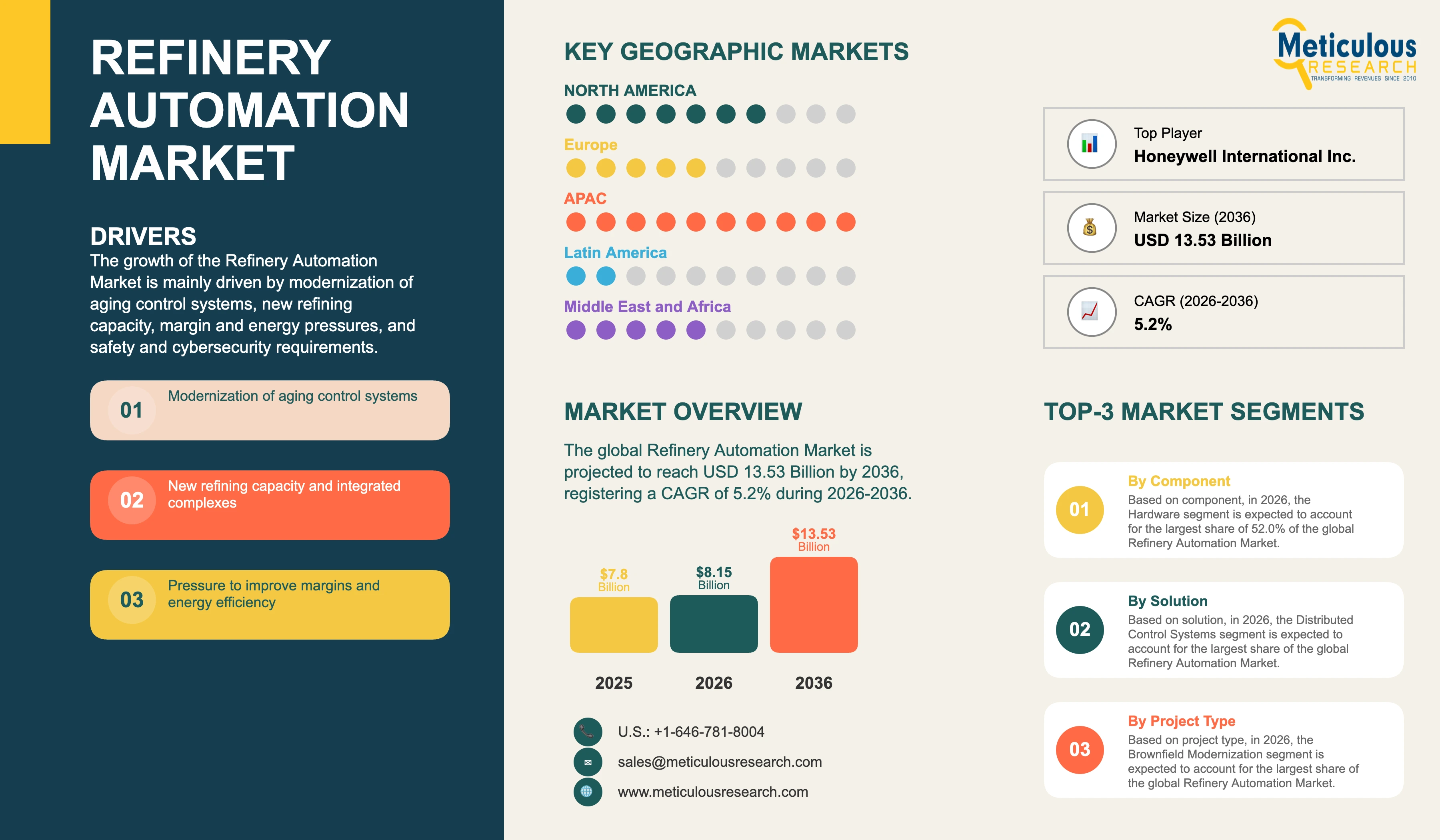
The global refinery automation market was valued at USD 7.80 billion in 2025. This market is expected to reach USD 13.53 billion by 2036 from an estimated USD 8.15 billion in 2026, registering a CAGR of 5.2% during the forecast period (2026-2036).
- Published
- Nov 2026
- Pages
- 249
- Format
- PDF + Excel
- Report ID
- MREP - 1042730
- Base year
- 2025
- 2025 · BASELINE
- $7.80B
- 2036
- $13.53B
- CAGR 2026–2036
- 5.2%
2025 baseline · 2026–2036 forecast at 5.2% CAGR · hover a bar for the value
Key highlights
Emerson, one of the largest suppliers of process automation to refineries, reported fiscal 2026 net sales of USD 18,982 million, up 5%, with underlying orders up 9% and fourth-quarter underlying orders up 14%, supported by exceptional long-cycle project activity and broad-based growth across all business groups and regions.
Emerson reported that its second-quarter fiscal 2026 sales were affected by the conflict in the Middle East, while third-quarter sales in its Intelligent Devices business were supported by the Middle East, project shipment timing, and sensors, which shows the importance of the Middle East to process automation suppliers.
Emerson's software annual contract value increased 9% year over year to USD 1.68 billion in the third quarter of fiscal 2026, and its Control Systems and Software business grew 7%, which reflects strong demand for automation software across process industries, including refining.
Yokogawa's CENTUM VP integrated production control system, ProSafe-RS safety instrumented system, and related software received cybersecurity certification in April 2026, which reflects the growing importance of cybersecurity in refinery and process control systems.
Yokogawa was selected in November 2026 as the main automation contractor for the LNG Canada Phase 2 project, with a scope that includes integrated control and safety systems, fire and gas systems, process historians, operator training simulators, and asset management solutions, which illustrates the scope of large automation contracts in the hydrocarbon processing industries. Similar scopes are typical for new refineries and large integrated complexes.
Emerson reported fourth-quarter fiscal 2026 net sales of USD 5, 201 million, up 7%, and guided underlying sales growth of about 5% for fiscal 2027, which indicates continued investment in automation across process industries, including refining.
Global refining capacity additions are concentrated in China, India, the Middle East, and Africa, while many refineries in North America, Europe, and Japan operate control systems installed in the 1990s and 2000s that are approaching the end of their supported lives.
By component, hardware accounts for the largest share of 52.0% in 2026, while software registers the highest CAGR.
By solution, distributed control systems account for the largest share of 30.0% in 2026, while advanced process control and optimization registers the highest CAGR.
By project type, brownfield modernization accounts for the larger share in 2026 and also registers the higher CAGR.
By geography, Asia-Pacific accounts for the largest share of 34.0% in 2026 and also registers the highest CAGR of 6.1%.
Report summary
| Particulars | Details |
|---|---|
| Base Year | 2025 |
| Estimated Year | 2026 |
| Forecast Period | 2026-2036 |
| Market Size in 2025 | USD 7.80 billion |
| Market Size in 2026 | USD 8.15 billion |
| Market Size by 2036 | USD 13.53 billion |
| CAGR (2026-2036) | 5.2% |
| Format | PDF, Excel & Cloud Portal · 249 pages |
| Largest Segment by Component (2026) | Hardware (52.0%) |
| Largest Segment by Solution (2026) | Distributed Control Systems (30.0%) |
| Largest Region (2026) | Asia-Pacific (34.0%) |
| Fastest-Growing Region | Asia-Pacific (CAGR 6.1%) |
| Companies Profiled | 12 companies and other companies |
| Segments Covered | Component, Solution, Project Type, Geography |
| Countries Covered | China, India, South Korea, Japan, Singapore, Rest of Asia-Pacific, U.S., Canada, Saudi Arabia, UAE, Kuwait, Nigeria, Rest of Middle East & Africa, Germany, Netherlands, Italy, U.K., Spain, Rest of Europe, Brazil, Mexico, Rest of Latin America |
Report overview
Segments covered: component, solution, project type.
The growth of this market is mainly driven by the modernization of aging control systems at refineries built several decades ago, the construction of new refineries and integrated refining and petrochemical complexes in Asia-Pacific, the Middle East, and Africa, the need to improve margins through advanced process control and optimization, stricter safety and environmental regulations that require modern safety instrumented systems and emissions monitoring, the growing adoption of artificial intelligence, digital twins, and asset performance management, and the conversion of refineries to renewable fuels and petrochemical production. However, factors such as the high cost and operational risk of control system migrations, cybersecurity threats to operational technology, the shortage of skilled automation engineers, and refinery closures in mature markets are expected to restrain the growth of this market to some extent.
Refinery automation refers to the control systems, safety systems, field instruments, analyzers, software, and services used to monitor, control, optimize, and protect refinery operations. Refineries are complex, continuous process facilities that operate dozens of interconnected process units, such as crude distillation, fluid catalytic cracking, hydrocracking, hydrotreating, reforming, and alkylation units, under high temperatures and pressures with flammable and toxic materials. Automation is essential to operate these units safely, efficiently, and in compliance with environmental regulations, and it has a direct impact on refinery margins, reliability, and safety performance.
This report covers global revenue from refinery automation, including hardware such as distributed control systems, safety instrumented systems, programmable logic controllers, supervisory control and data acquisition systems, field instruments, and process analyzers, software such as advanced process control, real-time optimization, manufacturing execution systems, asset performance management, operator training simulators, and process historians, and services such as engineering, integration, migration, maintenance, and cybersecurity services, for brownfield modernization and greenfield projects at petroleum and renewable fuel refineries. Control valves and actuators, rotating equipment, electrical systems, automation for petrochemical, chemical, gas processing, and liquefied natural gas plants, and general information technology are excluded from the scope of this report.
Distributed control systems are the core of refinery automation at nearly every modern refinery. They control the process units of a refinery from central control rooms, integrating thousands of measurements and control loops, and they are typically replaced or upgraded every 15 to 25 years. Safety instrumented systems, which are separate from control systems, automatically shut down equipment when unsafe conditions are detected, and they are required by international safety standards for hazardous processes. Field instruments, such as pressure, temperature, level, and flow transmitters, and process analyzers, which measure product quality and emissions, provide the data on which control and safety systems depend.
Advanced process control and optimization software uses models of refinery processes to adjust operating conditions automatically, increasing throughput, improving product yields, and reducing energy consumption. Real-time optimization and planning and scheduling software help refiners choose the best crude oils, operating modes, and product slates. Manufacturing execution systems and asset performance management software monitor production, inventories, and equipment health, and they help refiners reduce unplanned downtime. These software solutions often deliver rapid paybacks, as small improvements in yields or energy efficiency can be worth millions of dollars per year at a large refinery.
Many refineries in North America, Europe, and Japan operate control systems that were installed in the 1990s and 2000s and are approaching the end of their supported lives. Migrating these systems to modern platforms is a major source of demand, as obsolete systems increase the risk of failures, cybersecurity vulnerabilities, and spare parts shortages. At the same time, new refineries and integrated complexes in China, India, the Middle East, and Africa require complete automation systems, often delivered through main automation contractor arrangements in which a single supplier is responsible for control, safety, instrumentation, and software.
The market is concentrated among a small number of global automation suppliers, including Honeywell, Emerson, Yokogawa, ABB, Siemens, Schneider Electric, and Rockwell Automation, together with instrument specialists such as Endress+Hauser and KROHNE, and Chinese suppliers such as SUPCON and Hollysys, which have strong positions in China. Emerson's acquisition of the remaining shares of AspenTech and Schneider Electric's ownership of AVEVA have strengthened the software positions of these companies. Engineering, procurement, and construction contractors also play an important role in the market, as they often select automation suppliers for greenfield projects or manage main automation contractor arrangements on behalf of refiners.
Over the forecast period, the market is expected to grow steadily, supported by modernization, new capacity, optimization, and digitalization. Hardware is expected to remain the largest component, while software grows fastest. Distributed control systems are expected to remain the largest solution, while advanced process control and optimization grows fastest. Brownfield modernization is expected to remain the largest and fastest-growing project type. Asia-Pacific is expected to remain the largest region and to grow fastest.
Advanced process control and optimization pay back quickly by increasing yields and reducing energy use.
This comment explains why advanced process control and optimization is the fastest-growing solution.
For our new refinery, we chose a main automation contractor to reduce interfaces and schedule risk.
This comment explains why main automation contractor projects are growing.
Across all customer groups, reliability and safety are the most important selection criteria, as control and safety system failures can cause shutdowns, incidents, and large financial losses. Refiners also value suppliers with strong local support, proven migration experience, and certified cybersecurity, and they increasingly consider total cost of ownership over the system's life rather than initial price.
National oil companies often prefer suppliers with local presence and the ability to train local staff, while independent refiners in mature markets focus on migration risk, cost, and optimization benefits. Renewable fuel producers value flexible control. Engineering, procurement, and construction contractors value suppliers that can deliver on schedule and integrate smoothly with other packages, which is why main automation contractor arrangements are becoming more common on large projects.
Asia-Pacific is expected to account for the largest share of 34.0% of the market in 2026, mainly due to large refining capacity and new complexes in China and India.
Asia-Pacific is projected to register the highest CAGR of 6.1% during the forecast period, driven by new capacity in India and China.
Many refineries operate control and safety systems installed decades ago that are approaching the end of their supported lives, which increases the risk of failures and cyberattacks, so refiners are migrating to modern platforms that also enable optimization and digital operations.
The report profiles 12 companies, including Honeywell International Inc., Emerson Electric Co., Yokogawa Electric Corporation, ABB Ltd., Siemens AG, Schneider Electric SE, Rockwell Automation, Inc., Endress+Hauser Group, KROHNE Messtechnik GmbH, Azbil Corporation, SUPCON Technology Co., Ltd., and Hollysys Automation Technologies Ltd.
Report infographic
Market dynamics
16 factors across 5 forcesModernization of aging control systems
A large share of the world's refineries operate control systems and safety systems that are 20 years old or more. Many of these systems are no longer fully supported by suppliers, spare parts are becoming scarce, and they lack modern cybersecurity features and connectivity. Refiners are therefore migrating to modern distributed control systems and safety systems, often in phases during planned turnarounds to minimize disruption. These migration projects are a major and recurring source of demand for automation suppliers, particularly in North America, Europe, and Japan.
Modernization projects also provide opportunities to consolidate control rooms, add advanced process control and optimization, improve alarm management, and integrate operations data with enterprise systems, which increases the value of each project. Suppliers offer migration solutions that allow refiners to keep existing field wiring and input and output hardware while upgrading controllers and operator interfaces, which reduces cost and risk.
Control room consolidation is another important trend in many refinery modernization projects around the world. By combining several unit control rooms into a single central control room, refiners can improve coordination between units, reduce staffing requirements, and speed up decision making. These projects require new operator consoles, networks, and alarm management systems, as well as careful planning to manage the transition safely. The growing risk of cyberattacks on industrial control systems has also made the replacement of obsolete systems a priority for many refiners and their insurers.
New refining capacity and integrated complexes
New refineries and integrated refining and petrochemical complexes are being built in China, India, the Middle East, and Africa to meet rising demand for fuels and petrochemicals. Each new refinery requires a complete automation system, including distributed control systems, safety systems, fire and gas systems, field instruments, analyzers, and software, which can represent a significant contract value. Large complexes are increasingly designed with integrated control rooms and digital operations from the start. Greenfield projects also offer suppliers the opportunity to establish their platforms at new sites for decades, as refiners typically continue to use the same control system supplier for upgrades, expansions, and lifecycle services. This makes winning large greenfield projects strategically important for automation suppliers.
India in particular plans substantial expansion of its refining capacity, and national oil companies in the Middle East are investing in new refineries and upgrades. Emerson reported that demand in the Middle East supported its Intelligent Devices business in 2026, despite disruptions from the regional conflict. In Africa, new refineries are being built to reduce dependence on imported fuels, and these projects require complete automation systems, often supplied by international vendors with local partners.
Pressure to improve margins and energy efficiency
Refining margins are volatile, and refiners face pressure to improve profitability through higher yields, lower energy consumption, and better reliability. Advanced process control, real-time optimization, and planning and scheduling software can increase throughput, improve yields of high-value products, and reduce energy use, and these solutions typically pay back quickly. Energy is one of the largest operating costs for refineries, and automation can help reduce fuel consumption, steam use, and flaring. Refiners are also seeking to reduce carbon emissions, and automation solutions that optimize energy use and monitor emissions help them meet regulatory and corporate targets. As margins tighten in mature markets, optimization becomes even more important for refinery competitiveness.
Planning and scheduling software helps refiners choose crude oils and operating modes that maximize margins, which is particularly valuable when crude oil prices and product spreads change rapidly, as they did during the 2026 regional conflict in the Gulf. Refiners that can respond quickly to market changes can capture significant additional value.
Safety, environmental, and cybersecurity requirements
Refineries are subject to strict safety regulations, and international standards require safety instrumented systems for hazardous processes. Major incidents at refineries have led to stricter requirements for process safety management, alarm management, and safety systems, which drives investment in modern safety systems and related services. Environmental regulations also require continuous monitoring of emissions, which increases demand for analyzers and monitoring systems.
Cybersecurity has become a critical concern, as cyberattacks on industrial control systems could disrupt operations or cause safety incidents. Regulators and industry standards are increasing requirements for cybersecurity in operational technology, and suppliers are obtaining certifications for their control and safety systems, as shown by Yokogawa's certification of CENTUM VP and ProSafe-RS in 2026. Insurers are also paying closer attention to the cybersecurity of industrial control systems, which encourages refiners to invest in modern systems, network segmentation, and security monitoring.
Table of contents
11 chapters · 124 sections · 249 pages · click to expandSegmental analysis
| Segment | Largest share (2026) | Fastest growth (2026–2036) |
|---|---|---|
| By Component | Advanced process control and optimization | Advanced process control and optimization |
By Component
- Advanced process control and optimization is projected to register the highest CAGR, while distributed control systems account for the largest share of 30.0%.
- The brownfield modernization segment is expected to account for the larger share of the refinery automation market, and it is also projected to register the higher CAGR during the forecast period.
Geographic analysis
Asia-Pacific
Largest shareIn 2026, Asia-Pacific is expected to account for the largest share of 34.0% of the global refinery automation market. The large share of this region is mainly due to the large refining capacity in China, India, South Korea, Japan, and Southeast Asia, and the construction of new refineries and integrated complexes. Asia-Pacific is also projected to register the highest CAGR of 6.1% during the forecast period. The rapid growth of this region is mainly due to new refining capacity in India and China and the modernization of existing refineries. Within Asia-Pacific, China is the largest country market, with the world's largest refining capacity and many large integrated complexes, and it is served by both international suppliers and domestic suppliers such as SUPCON and Hollysys. India is the fastest-growing major market, supported by significant planned expansion of refining capacity and the modernization of existing refineries. Japan and South Korea have large, mature refining industries with ongoing modernization and control room consolidation projects.
North America
North America is the second-largest market, supported by modernization and optimization programs. In North America, the U.S. has the world's second-largest refining capacity, and refiners are investing in modernization, optimization, and cybersecurity, as well as automation for renewable fuel conversions.
Middle East & Africa
The Middle East & Africa is the third-largest market and is expected to be the second-fastest-growing region, supported by new refineries and upgrades by national oil companies in Saudi Arabia, the UAE, Kuwait, and Iraq, as well as new refineries in Nigeria and other African countries.
Europe
In Europe, refinery closures limit growth, but remaining refineries continue to modernize and convert to renewable fuels.
Latin America
Latin America is expected to grow at a moderate pace, supported by refinery upgrades in Brazil and Mexico, including Mexico's efforts to improve the reliability of its refining system.
Competitive landscape
The global refinery automation market is consolidated, with the top five players estimated to account for about 55% of the market in 2025. The market includes global automation suppliers, instrument specialists, software companies, and regional suppliers.
Honeywell, Emerson, Yokogawa, ABB, and Siemens are leading suppliers of distributed control systems and safety systems for refineries. Schneider Electric, with AVEVA, and Rockwell Automation are important suppliers of software and control systems. Endress+Hauser and KROHNE are leading instrument suppliers, Azbil is a leading supplier in Japan, and SUPCON and Hollysys are leading suppliers in China. Companies compete on technology, installed base, project execution, software capabilities, cybersecurity, and service. Key strategies include software acquisitions, artificial intelligence development, main automation contractor projects, and lifecycle services.
The installed base is a major competitive advantage, as refiners usually upgrade their existing control systems with the same supplier, which creates long-term relationships and recurring revenue. Barriers to entry are high because of the need for proven, certified control and safety systems, large engineering organizations, and global service networks. Software is becoming a key battleground, as suppliers compete to offer advanced process control, optimization, and asset management solutions that can work across different control systems. Recent developments include Emerson's strong fiscal 2026 order growth and software expansion, Yokogawa's cybersecurity certification and main automation contractor awards, and continued investment by suppliers in artificial intelligence and digital twins. Chinese suppliers are expanding internationally, particularly in Asia, the Middle East, and Africa. Smaller software companies and system integrators also compete in niche areas, such as alarm management, cybersecurity, and analytics, and they often partner with major automation suppliers. We expect further acquisitions of software and artificial intelligence companies by large automation suppliers over the forecast period.
Pricing in the market is influenced by the size and complexity of projects, the strength of installed-base relationships, and competition in tenders for greenfield projects, where suppliers often compete aggressively to establish their platforms. In brownfield projects, the incumbent supplier usually has an advantage, but refiners sometimes switch suppliers during major migrations when they see clear benefits in technology, cost, or support, which creates opportunities for competitors to win installed base.
Some of the key players operating in the refinery automation market are Honeywell International Inc., Emerson Electric Co., Yokogawa Electric Corporation, ABB Ltd., Siemens AG, Schneider Electric SE, Rockwell Automation, Inc., Endress+Hauser Group, KROHNE Messtechnik GmbH, Azbil Corporation, SUPCON Technology Co., Ltd., and Hollysys Automation Technologies Ltd., among others.
- —
Emerson reported strong fiscal 2026 orders and software growth, Yokogawa received cybersecurity certification for its integrated control and safety system and was selected as main automation contractor for LNG Canada Phase 2.
- Honeywell International Inc.
- Emerson Electric Co.
- Yokogawa Electric Corporation
- ABB Ltd.
- Siemens AG
- Schneider Electric SE
- Rockwell Automation, Inc.
- Endress+Hauser Group
- KROHNE Messtechnik GmbH
- Azbil Corporation
- SUPCON Technology Co., Ltd.
- Hollysys Automation Technologies Ltd.
Expert perspectives
The refinery automation market is supported by a large installed base of aging systems, new capacity in emerging markets, and strong demand for optimization and digital solutions. We expect steady growth over the forecast period.
Over the forecast period, the market is expected to grow at a CAGR of 5.2%, from USD 8.15 billion in 2026 to USD 13.53 billion in 2036. Growth will be supported by modernization, new capacity, optimization, and safety and cybersecurity requirements, while migration costs, refinery closures, and skills shortages will moderate growth.
In terms of segments, hardware remains the largest component, while software grows fastest. Distributed control systems remain the largest solution, while advanced process control and optimization grows fastest. Brownfield modernization remains the largest and fastest-growing project type. Asia-Pacific remains the largest region and grows fastest at a CAGR of 6.1%.
For suppliers, the key priorities are to expand software and artificial intelligence capabilities, strengthen cybersecurity, offer migration solutions, and build lifecycle service businesses. We believe that software and services will account for a growing share of supplier revenue.
We expect brownfield modernization to remain the main source of demand, as a large share of the global installed base of control systems reaches the end of its supported life over the forecast period. New refineries in Asia, the Middle East, and Africa will provide additional growth, while refinery closures in mature markets will moderate growth in these regions. Our forecast assumes that global refining capacity remains broadly stable, with additions in emerging markets offsetting closures, and that refiners continue to invest in optimization and cybersecurity. A sharp downturn in refining margins could delay projects, while faster adoption of artificial intelligence and autonomous operations could add upside. In our view, suppliers with large installed bases, strong software portfolios, and global service networks will be best positioned.
We also expect the share of software and services in the market to rise steadily, as refiners invest in optimization, asset management, and cybersecurity, and as suppliers shift toward subscription and outcome-based business models. This shift should make supplier revenue more recurring and less dependent on large projects.
We see cybersecurity as an increasingly important factor in supplier selection, as refiners seek certified systems and suppliers that can provide ongoing security monitoring and updates. We also expect artificial intelligence to become a standard part of advanced process control and asset management within the forecast period, although adoption for closed-loop control of critical processes will be gradual and subject to strict validation. Suppliers that can demonstrate measurable benefits and safe deployment will gain an advantage.
Customer perspectives
Buyers of refinery automation include integrated oil companies, independent refiners, national oil companies, and engineering, procurement, and construction contractors. Their decisions depend mainly on reliability, safety, installed base, total cost of ownership, cybersecurity, and supplier support.
Automation Manager - refinery, U.S.
Our control system is more than 20 years old, so we are migrating in phases during turnarounds to reduce risk.
This comment explains why brownfield modernization is the largest segment.
Frequently asked questions
The global refinery automation market was valued at USD 7.80 billion in 2025, up from USD 7.50 billion in 2024, and is estimated at USD 8.15 billion in 2026. The market includes hardware, software, and services for control, safety, instrumentation, optimization, and asset management in refineries.
The global refinery automation market is expected to reach USD 13.53 billion by 2036, supported by modernization, new capacity, optimization, and digitalization.
The market is expected to register a CAGR of 5.2% from 2026 to 2036, with the fastest growth in software, advanced process control and optimization, brownfield modernization, and Asia-Pacific.
Emerson reported fiscal 2026 net sales of USD 18,982 million, up 5%, with underlying orders up 9% and fourth-quarter underlying orders up 14%, and its software annual contract value reached USD 1.68 billion in the third quarter of fiscal 2026.
Market growth is mainly driven by the modernization of aging control systems, new refining capacity and integrated complexes, pressure to improve margins and energy efficiency, and safety, environmental, and cybersecurity requirements.
The high cost and operational risk of migrations and refinery closures in mature markets restrain growth, while cybersecurity threats and the shortage of skilled automation engineers are key challenges.
Key opportunities include artificial intelligence, digital twins, and autonomous operations, renewable fuels and refinery conversions, main automation contractor projects, and lifecycle services and remote operations.
Hardware is expected to account for the largest share of 52.0% of the market in 2026, while software is projected to register the highest CAGR.
Advanced process control and optimization is projected to register the highest CAGR, while distributed control systems account for the largest share of 30.0%.
Asia-Pacific is expected to account for the largest share of 34.0% of the market in 2026, mainly due to large refining capacity and new complexes in China and India.
Asia-Pacific is projected to register the highest CAGR of 6.1% during the forecast period, driven by new capacity in India and China.
Many refineries operate control and safety systems installed decades ago that are approaching the end of their supported lives, which increases the risk of failures and cyberattacks, so refiners are migrating to modern platforms that also enable optimization and digital operations.
The report profiles 12 companies, including Honeywell International Inc., Emerson Electric Co., Yokogawa Electric Corporation, ABB Ltd., Siemens AG, Schneider Electric SE, Rockwell Automation, Inc., Endress+Hauser Group, KROHNE Messtechnik GmbH, Azbil Corporation, SUPCON Technology Co., Ltd., and Hollysys Automation Technologies Ltd.
Emerson reported strong fiscal 2026 orders and software growth, Yokogawa received cybersecurity certification for its integrated control and safety system and was selected as main automation contractor for LNG Canada Phase 2.
In 2026, the brownfield modernization segment is expected to account for the larger share of the refinery automation market, and it is also projected to register the higher CAGR during the forecast period.
Cite this report
Meticulous Research. (2026). Refinery Automation Market - Global Opportunity Analysis and Industry Forecast (2026-2036) (Report No. MREP - 1042730). Meticulous Market Research Pvt. Ltd. https://www.meticulousresearch.com/product/refinery-automation-market-7413