Refinery Hydrogen Supply Market (2026-2036)
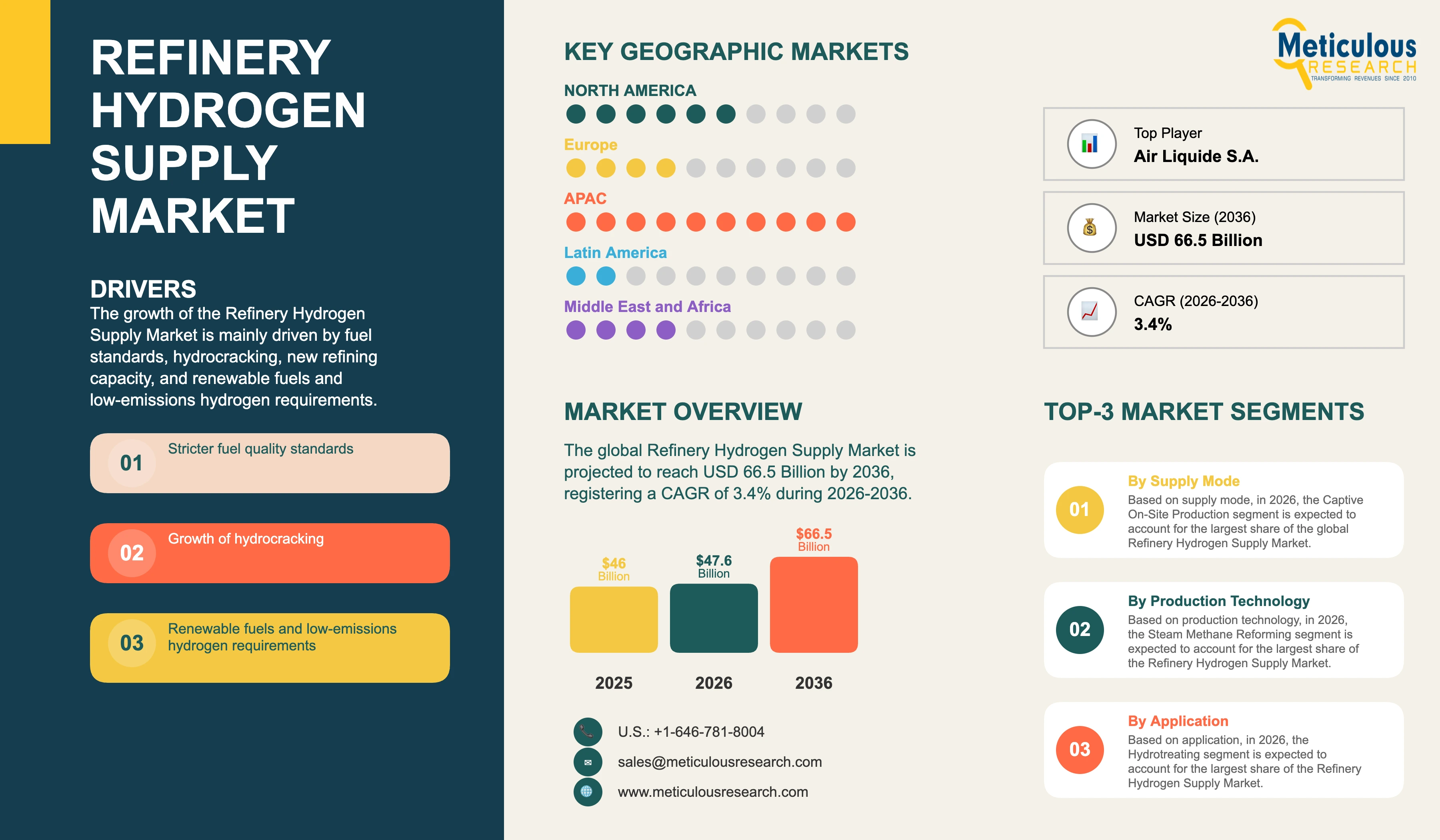
The global refinery hydrogen supply market was valued at USD 46.00 billion in 2025. This market is expected to reach USD 66.50 billion by 2036 from an estimated USD 47.60 billion in 2026, registering a CAGR of 3.4% during the forecast period (2026-2036).
- Published
- Nov 2026
- Pages
- 258
- Format
- PDF + Excel
- Report ID
- MREP - 1042732
- Base year
- 2025
- 2024 · HISTORICAL
- $4.30B
- 2036
- $66.50B
- CAGR 2026–2036
- 3.4%
2024–2025 baseline · 2026–2036 forecast at 3.4% CAGR · hover a bar for the value
Key highlights
According to the International Energy Agency's Global Hydrogen Review 2025, global hydrogen demand reached almost 100 million tonnes in 2024, up 2% from 2023, driven mainly by oil refining and industrial uses, with refining one of the largest consuming sectors.
The International Energy Agency reported that low-emissions hydrogen production grew by about 10% in 2024 and was on track to reach about 1 million tonnes in 2025, but it still accounted for less than 1% of global production, held back by high costs and insufficient policy support.
Tenders for low-emissions hydrogen in the refining sector achieved positive results, with more than 220 thousand tonnes per year of renewable hydrogen contracted by refineries in Europe and India, according to the International Energy Agency.
Hydrogen production consumed about 290 billion cubic meters of natural gas and 90 million tonnes of coal equivalent in 2024, which shows the dependence of refinery hydrogen supply on fossil fuels and its exposure to natural gas prices.
Global installed water electrolysis capacity reached about 2 gigawatts in 2024, with more than 1 gigawatt added through July 2025, which shows the early stage of electrolysis deployment relative to total hydrogen demand.
Air Liquide secured new long-term hydrogen supply agreements with two of the largest refiners in the U.S. in 2025 and is investing close to USD 50 million to upgrade its U.S. Gulf Coast hydrogen pipeline network, which is connected to its hydrogen storage cavern at Spindletop, Texas.
Capital spending on low-emissions hydrogen projects reached USD 4.3 billion in 2024, an 80% increase from 2023, with spending of nearly USD 8 billion projected for 2025 based on final investment decisions, and refining is one of the leading sectors for these projects.
New hydrogen offtake agreements in 2024 totaled 1.7 million tonnes per year, compared with 2.4 million tonnes per year in 2023, and they were concentrated in refining, chemicals, and shipping, according to the International Energy Agency.
By supply mode, captive on-site production accounts for the larger share of 64.0% in 2026, while merchant supply registers the higher CAGR.
By production technology, steam methane reforming accounts for the largest share of 74.5% in 2026, while water electrolysis register the highest CAGR.
By application, hydrotreating accounts for the largest share in 2026, while renewable fuels processing and other registers the highest CAGR.
By geography, Asia-Pacific accounts for the largest share of 38.0% in 2026, while Middle East & Africa registers the highest CAGR of 4.3%.
Report summary
| Particulars | Details |
|---|---|
| Base Year | 2025 |
| Estimated Year | 2026 |
| Forecast Period | 2026-2036 |
| Market Size in 2025 | USD 46.00 billion |
| Market Size in 2026 | USD 47.60 billion |
| Market Size by 2036 | USD 66.50 billion |
| CAGR (2026-2036) | 3.4% |
| Format | PDF, Excel & Cloud Portal · 258 pages |
| Largest Segment by Supply Mode (2026) | Captive On-Site Production (64.0%) |
| Largest Segment by Production Technology (2026) | Steam Methane Reforming (74.5%) |
| Largest Region (2026) | Asia-Pacific (38.0%) |
| Fastest-Growing Region | Middle East & Africa (CAGR 4.3%) |
| Companies Profiled | 12 companies and other companies |
| Segments Covered | Supply Mode, Production Technology, Application, Geography |
| Countries Covered | China, India, South Korea, Japan, Singapore, Rest of Asia-Pacific, U.S., Canada, Saudi Arabia, UAE, Kuwait, Nigeria, Rest of Middle East & Africa, Germany, Netherlands, Italy, U.K., Spain, Rest of Europe, Brazil, Mexico, Rest of Latin America |
Report overview
Segments covered: supply mode, production technology, application.
The growth of this market is mainly driven by stricter fuel quality standards that increase hydrogen consumption for desulfurization, the growth of hydrocracking capacity and the processing of heavier crude oils, new refining capacity in Asia-Pacific, the Middle East, and Africa, the growth of renewable diesel and sustainable aviation fuel production, which requires large amounts of hydrogen, the increasing outsourcing of hydrogen supply to industrial gas companies, and policies in Europe and other regions that require refineries to use low-emissions hydrogen. However, factors such as volatile natural gas prices, the high cost of low-emissions hydrogen, refinery closures and slower fuel demand in mature markets, and uncertainty over hydrogen policies and incentives are expected to restrain the growth of this market to some extent.
Hydrogen is an essential input for nearly every modern petroleum refinery in the world. It is used in hydrotreating units to remove sulfur, nitrogen, and other impurities from fuels and feedstocks, and in hydrocracking units to convert heavy gas oils and residues into diesel, jet fuel, and naphtha. Refineries also use hydrogen in isomerization, lube oil production, and other processes, and renewable fuel plants use large amounts of hydrogen to convert vegetable oils, animal fats, and waste oils into renewable diesel and sustainable aviation fuel. Refining is one of the largest consumers of hydrogen in the world.
This report covers the global value of hydrogen supplied to petroleum refineries and renewable fuel refineries through on-purpose production, including captive on-site production by refiners and merchant supply by industrial gas companies through pipelines and over-the-fence plants, produced by steam methane reforming, coal and residue gasification, fossil-based production with carbon capture, and water electrolysis, for hydrotreating, hydrocracking, and renewable fuels processing and other applications. Captive production is valued at its estimated production cost, and merchant supply is valued at the price paid by refiners. By-product hydrogen recovered from catalytic reforming units, hydrogen used outside refineries, and the sale of hydrogen production equipment are excluded from the scope of this report.
Refineries obtain the hydrogen they need from several different internal and external sources. Catalytic reforming units produce hydrogen as a by-product, but this is usually not enough to meet the needs of modern refineries with large hydrotreating and hydrocracking units. The remaining demand is met by on-purpose hydrogen production, mainly through steam methane reforming of natural gas, which accounts for most refinery hydrogen supply in North America, Europe, the Middle East, and many other regions. In China, coal and petroleum residue gasification is also widely used. Refiners either build and operate their own hydrogen plants or buy hydrogen from industrial gas companies, which operate large plants and pipeline networks that serve several refineries and chemical plants.
Industrial gas companies, such as Air Liquide, Linde, and Air Products, are major suppliers of hydrogen to refineries, particularly in the U.S. Gulf Coast, Northwest Europe, and parts of Asia, where they operate extensive pipeline networks. Outsourcing hydrogen supply allows refiners to avoid capital investment, benefit from the reliability of networked supply, and focus on their core business. Merchant supply contracts are typically long-term, often 15 years or more, with take-or-pay terms, which provides stable revenue for industrial gas companies.
The refinery hydrogen supply market is also being shaped by decarbonization policies and corporate targets. Refinery hydrogen production from natural gas and coal is a significant source of carbon dioxide emissions, and governments and companies are seeking to reduce these emissions by capturing carbon dioxide from existing hydrogen plants or by producing hydrogen through electrolysis using renewable electricity. In the European Union, the revised Renewable Energy Directive creates obligations for renewable fuels of non-biological origin, including renewable hydrogen used in refineries, and several European refineries have contracted renewable hydrogen through tenders. However, low-emissions hydrogen still accounts for less than 1% of global hydrogen production because of its high cost.
Natural gas prices have a major impact on the cost of refinery hydrogen, as natural gas typically accounts for the largest share of the cost of steam methane reforming. Higher gas prices in Europe since 2022 and disruptions to gas markets during the 2026 regional conflict in the Gulf have increased hydrogen costs for refiners in some regions, while abundant and low-cost gas in North America and the Middle East supports competitive hydrogen supply.
Over the forecast period, the market is expected to grow steadily, supported by fuel standards, hydrocracking, new refining capacity, renewable fuels, and low-emissions hydrogen requirements. Captive on-site production is expected to remain the largest supply mode, while merchant supply grows fastest. Steam methane reforming is expected to remain the largest production technology, while water electrolysis grows fastest from a very small base. Hydrotreating is expected to remain the largest application, while renewable fuels processing grows fastest. Asia-Pacific is expected to remain the largest region, while the Middle East & Africa is expected to grow fastest.
Report infographic
Market dynamics
16 factors across 5 forcesStricter fuel quality standards
Stricter limits on sulfur in gasoline, diesel, jet fuel, and marine fuels require refineries to remove more sulfur through hydrotreating, which consumes hydrogen. Ultra-low sulfur fuel standards in the U.S., Europe, China, India, and other countries, and the International Maritime Organization's global limit on sulfur in marine fuels, have significantly increased hydrogen demand in refineries over the past two decades. Many developing countries in Africa, the Middle East, and Asia are still tightening fuel standards, which is expected to increase refinery hydrogen demand in these regions.
Deeper desulfurization also requires more severe operating conditions and more hydrogen per barrel of fuel processed, particularly when refineries process higher-sulfur crude oils. As a result, hydrogen consumption per barrel of crude processed has risen in many refineries, even where crude throughput has remained flat. Fuel quality improvements in emerging markets are expected to continue throughout the forecast period, which supports steady growth in hydrogen demand for hydrotreating. This trend is strongest in Africa and South Asia.
Hydrotreating of jet fuel and naphtha, as well as diesel and gasoline, also requires hydrogen, and refineries that produce feedstocks for petrochemical plants must remove impurities that could poison downstream catalysts, which adds to hydrogen demand. As refineries integrate more closely with petrochemicals, overall hydrogen intensity is expected to rise.
Growth of hydrocracking and heavier crude processing
Hydrocracking units, which use large amounts of hydrogen to convert heavy fractions into diesel, jet fuel, and petrochemical feedstocks, are a key part of many new and upgraded refineries, particularly in Asia and the Middle East. As refiners seek to maximize middle distillate and petrochemical yields and process heavier, higher-sulfur crude oils, hydrocracking capacity is expected to grow, which increases hydrogen demand. Residue upgrading technologies, such as residue hydrocracking and residue hydrotreating, also consume large amounts of hydrogen, and they are increasingly used in new refineries to maximize the conversion of heavy crude oils into high-value products.
Hydrocracking is particularly important in Asia and the Middle East, where refiners seek to maximize diesel, jet fuel, and petrochemical naphtha. A single large hydrocracker can require several hundred tonnes of hydrogen per day, which often requires a dedicated hydrogen plant or a large merchant supply contract.
New refining capacity in emerging markets
New refining capacity is being added in China, India, the Middle East, and Africa, and new refineries are typically designed with large hydrotreating and hydrocracking units, which require substantial hydrogen supply. Each large new refinery requires one or more large hydrogen plants or a long-term supply contract with an industrial gas company. India in particular plans significant expansion of its refining capacity, and new refineries in the Middle East and Africa are also adding hydrogen demand. New integrated refining and petrochemical complexes also often include large hydrogen and syngas plants that serve both refining and chemical units, which creates opportunities for industrial gas companies to supply hydrogen under long-term contracts. In Africa, new refineries such as those being developed to reduce dependence on imported fuels require complete hydrogen supply systems, and national oil companies in the Middle East are investing in refinery upgrades that add hydrotreating and hydrocracking capacity.
Renewable fuels and low-emissions hydrogen requirements
Renewable diesel and sustainable aviation fuel production requires large amounts of hydrogen to remove oxygen from renewable feedstocks and to isomerize and crack the resulting hydrocarbons. The rapid growth of renewable fuel production in the U.S., Europe, and Asia, including the conversion of petroleum refineries to renewable fuel plants, is increasing hydrogen demand. Renewable fuel plants often require more hydrogen per barrel of product than conventional hydrotreating.
Policies in Europe and other regions are also requiring or incentivizing the use of low-emissions hydrogen in refineries. Refineries in Europe and India have contracted more than 220 thousand tonnes per year of renewable hydrogen through tenders, according to the International Energy Agency, and refining is one of the leading sectors for low-emissions hydrogen offtake agreements. These requirements are expected to increase the value of refinery hydrogen supply, as low-emissions hydrogen is more expensive than conventional hydrogen. In the U.S., refineries that produce renewable diesel and sustainable aviation fuel can benefit from low-carbon fuel standards and other incentives when they use lower-carbon hydrogen, which encourages the adoption of carbon capture and other low-emissions solutions.
Table of contents
11 chapters · 124 sections · 258 pages · click to expandSegmental analysis
| Segment | Largest share (2026) | Fastest growth (2026–2036) |
|---|---|---|
| By Supply Mode | Hydrotreating | Renewable fuels processing and other |
By Supply Mode
- The hydrotreating segment is expected to account for the largest share of the refinery hydrogen supply market, while the renewable fuels processing and other segment is projected to register the highest CAGR during the forecast period.
Geographic analysis
Asia-Pacific
Largest shareIn 2026, Asia-Pacific is expected to account for the largest share of 38.0% of the global refinery hydrogen supply market. The large share of this region is mainly due to the large refining capacity in China, India, South Korea, Japan, and Southeast Asia, and the widespread use of coal gasification for hydrogen production in China. Within Asia-Pacific, China is the largest country market, with the world's largest refining capacity and extensive use of coal gasification for hydrogen production, and Sinopec is the largest hydrogen producer in the country. India is a fast-growing market, supported by new refining capacity and renewable hydrogen tenders for refineries. South Korea, Japan, Singapore, and Southeast Asian countries have large refineries that use steam methane reforming.
North America
North America is the second-largest market, supported by its large refining capacity and Gulf Coast hydrogen networks. In North America, the U.S. is the second-largest country market, with large merchant hydrogen networks on the Gulf Coast operated by Air Liquide, Linde, and Air Products, and with growing hydrogen demand from renewable diesel plants. Demand growth in the region is expected to be moderate, supported by renewable fuels and the outsourcing of hydrogen supply.
Middle East & Africa
Fastest growthThe Middle East & Africa is projected to register the highest CAGR of 4.3% during the forecast period. The rapid growth of this region is mainly due to new refineries and upgrades with large hydrocracking units in Saudi Arabia, the UAE, Kuwait, and Africa. In the Middle East & Africa, new refineries and upgrades in Saudi Arabia, the UAE, Kuwait, and Nigeria are expected to drive growth, supported by low-cost natural gas.
Europe
In Europe, refinery closures are reducing conventional hydrogen demand, but renewable hydrogen requirements are increasing the value of hydrogen supply. The Netherlands and Germany lead this trend in Europe.
Latin America
Latin America is a smaller market, supported by refineries in Brazil and Mexico, where hydrotreating capacity is being expanded to meet stricter fuel standards. Brazil's renewable fuel programs may also create demand for hydrogen in renewable diesel and sustainable aviation fuel production over the forecast period. In Latin America, Mexico's efforts to improve the reliability of its refineries may also require investment in hydrogen supply.
Competitive landscape
The global refinery hydrogen supply market is fragmented, as most hydrogen is produced captively by refiners, while the merchant segment is concentrated among a few industrial gas companies, with the top five merchant suppliers estimated to account for about 25% of the total market in 2025.
Air Liquide, Linde, and Air Products are the leading merchant hydrogen suppliers, with large pipeline networks in the U.S. Gulf Coast and Northwest Europe. Nippon Sanso and Messer are other industrial gas suppliers. Sinopec is the largest hydrogen producer in China, and Shell is developing renewable hydrogen for its refineries. Technip Energies and Topsoe supply hydrogen production technologies, and thyssenkrupp nucera, ITM Power, and Nel supply electrolyzers. Companies compete on reliability, cost, pipeline networks, and low-emissions solutions. Key strategies include long-term supply agreements, pipeline network expansion, carbon capture, and electrolysis projects.
Industrial gas companies have significant advantages in the merchant segment because of their pipeline networks, operating expertise, and ability to finance and operate large plants under long-term contracts. Refiners that produce hydrogen captively compete with merchant suppliers when deciding whether to build their own plants or outsource. Technology licensors and equipment suppliers, such as Technip Energies, Topsoe, thyssenkrupp nucera, ITM Power, and Nel, play an important role by supplying hydrogen production technologies to both refiners and industrial gas companies. Recent developments include Air Liquide's new supply agreements with two of the largest U.S. refiners and its Gulf Coast network investment, and renewable hydrogen tenders by refineries in Europe and India. We expect industrial gas companies to increase their share of refinery hydrogen supply over the forecast period.
Competition among industrial gas companies is focused on reliability, network reach, cost, and the ability to offer low-emissions hydrogen, and long-term relationships with refiners are an important competitive advantage. Smaller industrial gas companies and regional suppliers also serve refineries in Asia, the Middle East, and Latin America, often in partnership with national oil companies. These partnerships often involve build-own-operate hydrogen plants at new refineries, which give national oil companies access to industrial gas expertise while allowing suppliers to secure long-term contracts.
Some of the key players operating in the refinery hydrogen supply market are Air Liquide S.A., Linde plc, Air Products and Chemicals, Inc., Nippon Sanso Holdings Corporation, Messer SE & Co. KGaA, China Petroleum & Chemical Corporation (Sinopec), Shell plc, Technip Energies N.V., Topsoe A/S, thyssenkrupp nucera AG & Co. KGaA, ITM Power plc, and Nel ASA, among others.
- —
Air Liquide signed long-term hydrogen supply agreements with two of the largest U.S. refiners and is investing close to USD 50 million in its Gulf Coast network, and refineries in Europe and India contracted renewable hydrogen through tenders.
- Air Liquide S.A.
- Linde plc
- Air Products and Chemicals, Inc.
- Nippon Sanso Holdings Corporation
- Messer SE & Co. KGaA
- China Petroleum & Chemical Corporation · Sinopec
- Shell plc
- Technip Energies N.V.
- Topsoe A/S
- ITM Power plc
- Nel ASA
Expert perspectives
The refinery hydrogen supply market is large and stable, supported by the essential role of hydrogen in refining. We expect moderate growth over the forecast period, with a gradual shift toward merchant supply and low-emissions hydrogen.
Over the forecast period, the market is expected to grow at a CAGR of 3.4%, from USD 47.60 billion in 2026 to USD 66.50 billion in 2036. Growth will be supported by fuel standards, hydrocracking, new capacity, renewable fuels, and low-emissions requirements, while gas price volatility, costs, policy uncertainty, and refinery closures will moderate growth.
In terms of segments, captive on-site production remains the largest supply mode, while merchant supply grows fastest. Steam methane reforming remains the largest technology, while water electrolysis grows fastest. Hydrotreating remains the largest application, while renewable fuels processing grows fastest. Asia-Pacific remains the largest region, while the Middle East & Africa grows fastest at a CAGR of 4.3%.
For suppliers, the key priorities are to secure long-term contracts, expand networks, and develop low-emissions solutions. We believe that carbon capture on existing plants will be the most cost-effective path to lower-emissions refinery hydrogen in the near term.
We expect hydrogen demand in refineries to grow slowly in volume, supported by fuel standards, hydrocracking, and new capacity in emerging markets, while the value of the market grows faster because of the gradual adoption of more expensive low-emissions hydrogen and the growth of merchant supply. Our forecast assumes that natural gas prices remain within a moderate range over the forecast period, that European renewable hydrogen requirements are implemented broadly as planned, and that renewable fuel production continues to grow. A faster decline in refining activity or a sharp fall in gas prices could reduce the value of the market, while stronger policies for low-emissions hydrogen could add upside. In our view, industrial gas companies with large networks and low-emissions solutions will be the main beneficiaries of the market's evolution.
We also see the integration of hydrogen supply with carbon capture and storage hubs as an important development, as these hubs allow refiners and industrial gas companies to reduce emissions at lower cost by sharing infrastructure. Such hubs are being developed on the U.S. Gulf Coast, in the North Sea region, and in the Middle East, and they could significantly change the economics of low-emissions hydrogen for refineries later in the forecast period. We see the Middle East as a potential low-cost producer of low-emissions hydrogen for its own refineries, given its access to low-cost gas and carbon storage capacity.
Customer perspectives
Supply Manager - refinery, U.S. Gulf Coast
We buy hydrogen by pipeline under a long-term contract because it is reliable and avoids the cost of building our own plant.
Energy Transition Manager - refinery, Europe
We have contracted renewable hydrogen to meet our obligations under European rules.
Project Manager - national oil company, Middle East
Our new hydrocracker requires a large hydrogen plant, and we are evaluating carbon capture.
Frequently asked questions
The global refinery hydrogen supply market was valued at USD 46.00 billion in 2025, up from USD 45.20 billion in 2024, and is estimated at USD 47.60 billion in 2026. The market measures the value of on-purpose hydrogen supplied to petroleum and renewable fuel refineries through captive production and merchant supply.
The global refinery hydrogen supply market is expected to reach USD 66.50 billion by 2036, supported by fuel standards, hydrocracking, new refining capacity, renewable fuels, and low-emissions hydrogen requirements.
The market is expected to register a CAGR of 3.4% from 2026 to 2036, with the fastest growth in merchant supply, water electrolysis, renewable fuels processing, and the Middle East & Africa.
According to the International Energy Agency, global hydrogen demand reached almost 100 million tonnes in 2024, up 2% from 2023, driven mainly by refining and industrial uses, while low-emissions hydrogen accounted for less than 1% of production.
Market growth is mainly driven by stricter fuel quality standards, the growth of hydrocracking and heavier crude processing, new refining capacity in emerging markets, and renewable fuels and low-emissions hydrogen requirements.
Volatile natural gas prices and the high cost of low-emissions hydrogen and policy uncertainty restrain growth, while refinery closures and infrastructure and reliability requirements are key challenges.
Key opportunities include carbon capture on existing refinery hydrogen plants, renewable hydrogen for European refineries, outsourcing of hydrogen supply to industrial gas companies, and hydrogen for renewable fuels production.
Captive on-site production is expected to account for the largest share of 64.0% of the market in 2026, while merchant supply is projected to register the highest CAGR.
Water electrolysis is projected to register the highest CAGR from a very small base, while steam methane reforming accounts for the largest share of 74.5%.
Asia-Pacific is expected to account for the largest share of 38.0% of the market in 2026, mainly due to the large refining capacity in China and India.
The Middle East & Africa is projected to register the highest CAGR of 4.3% during the forecast period, driven by new refineries and hydrocracking capacity.
According to the International Energy Agency, more than 220 thousand tonnes per year of renewable hydrogen have been contracted by refineries in Europe and India through tenders.
The report profiles 12 companies, including Air Liquide S.A., Linde plc, Air Products and Chemicals, Inc., Nippon Sanso Holdings Corporation, Messer SE & Co. KGaA, China Petroleum & Chemical Corporation (Sinopec), Shell plc, Technip Energies N.V., Topsoe A/S, thyssenkrupp nucera AG & Co. KGaA, ITM Power plc, and Nel ASA.
Air Liquide signed long-term hydrogen supply agreements with two of the largest U.S. refiners and is investing close to USD 50 million in its Gulf Coast network, and refineries in Europe and India contracted renewable hydrogen through tenders.
In 2026, the hydrotreating segment is expected to account for the largest share of the refinery hydrogen supply market, while the renewable fuels processing and other segment is projected to register the highest CAGR during the forecast period.
Cite this report
Meticulous Research. (2026). Refinery Hydrogen Supply Market - Global Opportunity Analysis and Industry Forecast (2026-2036) (Report No. MREP - 1042732). Meticulous Market Research Pvt. Ltd. https://www.meticulousresearch.com/product/refinery-hydrogen-supply-market-7415