Red Mud Valorisation Market (2026-2036)
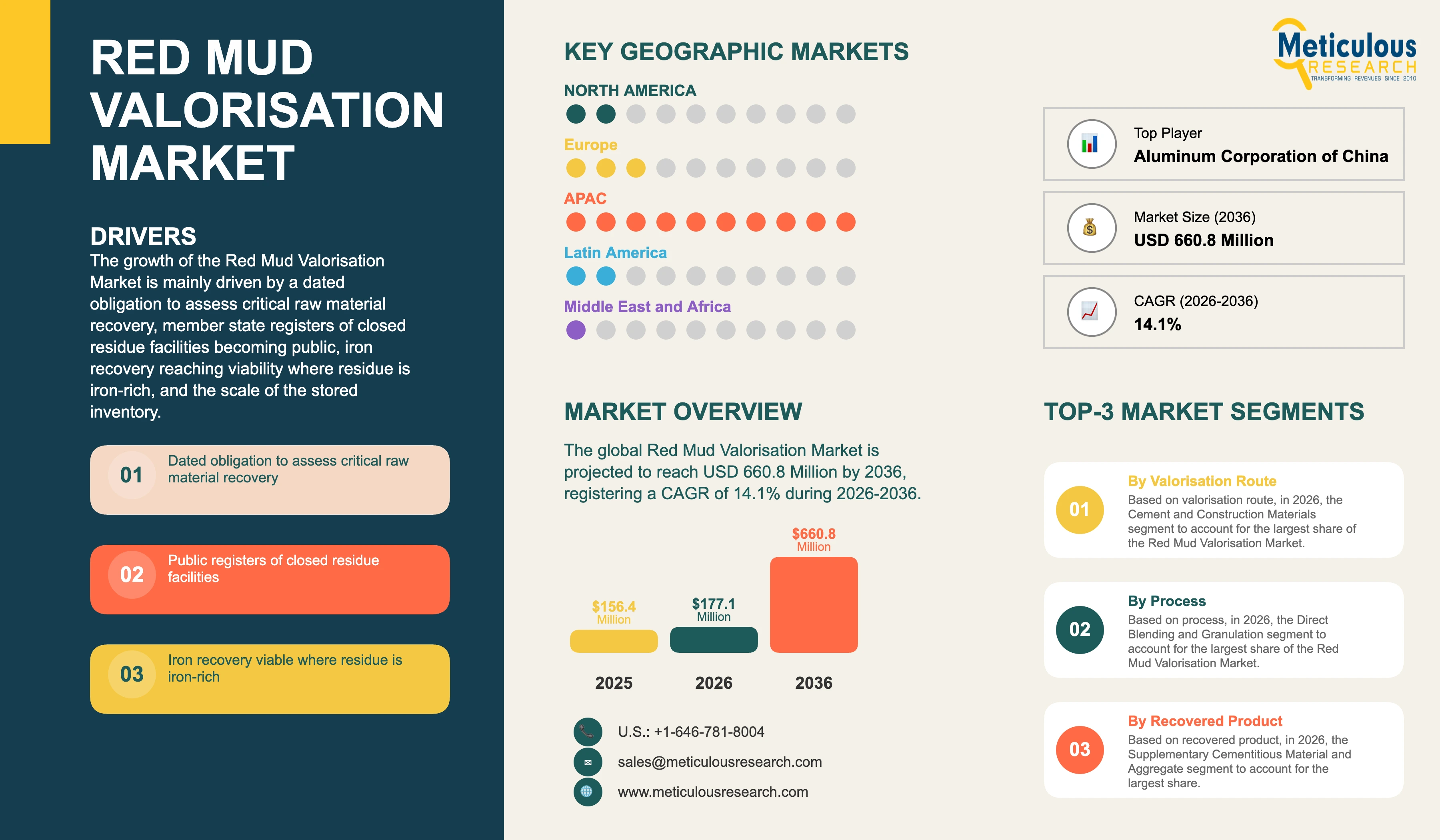
The red mud valorisation market is valued at USD 177.1 million in 2026 and is projected to reach USD 660.8 million by 2036, at a CAGR of 14.1% during the forecast period. The market was valued at USD 156.4 million in 2025 and at USD 140.2 million in 2024.
- Published
- Nov 2026
- Pages
- 245
- Format
- PDF + Excel
- Report ID
- MRCHM - 1042749
- Base year
- 2025
- 2024 · HISTORICAL
- $140.2M
- 2036
- $660.8M
- CAGR 2026–2036
- 14.1%
2024–2025 baseline · 2026–2036 forecast at 14.1% CAGR · hover a bar for the value
Key highlights
This market measures revenue earned from processing bauxite residue into saleable products, taken at the processor gate and expressed per tonne of residue valorised.
Alumina refining and the Bayer process are excluded, as are residue storage, dewatering and dam operation, and gallium recovered upstream from Bayer liquor rather than from the residue.
The International Aluminium Institute states that around 1.2 tonnes of residue is generated per tonne of alumina, and projects a global inventory of 10 billion tonnes by 2050.
The same source states that between 2.5 million and 5 million tonnes of residue is recycled annually, against disposal by dry stacking and lagooning, with press filter solids at 70% to 75%.
A paper presented at the 43rd ICSOBA Conference in October 2025 by authors at the Worley Bauxite and Alumina Centre of Excellence puts the global inventory stored on land at over 6 billion tonnes, which could reach beyond 10 billion tonnes by 2050.
That paper assumes 1.5 tonnes of residue solids on average per tonne of alumina, and records annual residue production up 180% over the last 25 years from a baseline of about 2 billion tonnes in 2000.
Regulation (EU) 2024/1252, the Critical Raw Materials Act, was adopted on 11 April 2024 and sets a benchmark of recycling capacity covering at least 25% of annual Union consumption.
Article 27(1) of that regulation requires operators obliged to draw up waste management plans under Article 5 of Directive 2006/21/EC to give the competent authority a study on recovering critical raw materials from extractive waste already stored at the facility and from waste being generated.
Article 27(2) requires that study to estimate the quantities and concentrations present, assess their technical and economic recoverability, and specify the estimation methods used.
Operators are exempt where they can demonstrate with a high degree of certainty that the extractive waste contains no technically recoverable critical raw materials.
Article 27(3) requires operators of existing facilities to submit that study by 24 November 2026, with operators of new facilities submitting it alongside their waste management plans under Article 7 of Directive 2006/21/EC.
Article 27(4) requires member states to record closed facilities including abandoned ones in a database, which must be in place by 24 November 2026 with all information entered by 24 May 2027, publicly accessible in digital form and updated at least every three years.
Article 27(5) requires member states by 24 November 2027 to adopt and implement measures to promote recovery from closed facilities in that database which contain potentially economically recoverable critical raw materials.
Article 27(7) requires permitting files for closed facilities to be reviewed by 24 November 2026, representative geochemical sampling by 24 May 2026 where indications exist, and detailed characterisation by 24 March 2027.
A study published in Nature on 24 January 2024 by authors at the Max-Planck-Institut fuer Eisenforschung reports melting red mud in an electric arc furnace and reducing the iron oxide with a plasma containing 10% hydrogen, with reduction taking about ten minutes.
That work records red mud containing up to 60% iron oxide, about 180 million tonnes produced each year and about four billion tonnes accumulated worldwide, capable of yielding almost 700 million tonnes of carbon-dioxide-free steel.
The reported economics show the process paying off at 50% iron oxide or more with partially renewable electricity and hydrogen, at 35% once red mud disposal costs are included, and at 30% to 40% with green hydrogen and electricity at current costs including landfill costs.
Metlen Energy & Metals took a final investment decision of EUR 295.5 million on 16 January 2025 for about 2 million tonnes of bauxite, 1,265,000 tonnes of alumina and 50 tonnes of gallium a year in Greece, with the gallium recovered from bauxite rather than from residue.
Report summary
| Particulars | Details |
|---|---|
| Base Year | 2025 |
| Actual Years | 2024-2025 |
| Forecast Period | 2026-2036 |
| Market Size in 2024 | USD 140.2 million |
| Market Size in 2025 | USD 156.4 million |
| Market Size in 2026 | USD 177.1 million |
| Market Size in 2036 | USD 660.8 million |
| Value CAGR (2026-2036) | 14.1% |
| Format | PDF, Excel & Cloud Portal · 245 pages |
| Volume in 2025 | 4.25 million tonnes |
| Volume in 2026 | 4.60 million tonnes |
| Volume in 2036 | 11.80 million tonnes |
| Volume CAGR (2026-2036) | 9.9% |
| Average Realised Value, 2026 | USD 38.50 per tonne |
| Average Realised Value, 2036 | USD 56.00 per tonne |
| Units | Value in USD million; volume in million tonnes of bauxite residue valorised; realised value in USD per tonne of residue valorised |
| Measurement Basis | Revenue earned from processing bauxite residue into saleable products, measured at the processor gate and expressed per tonne of residue valorised |
| Share of Generation Valorised | About 180 million tonnes of bauxite residue arise each year; this market covers 4.60 million tonnes valorised in 2026, or about 2.6% of annual generation, reaching roughly 5.6% by 2036, so the stored inventory continues to grow across the forecast period |
| Stored Inventory Basis | The accumulated inventory is put at about four billion tonnes in the Nature study of January 2024 and at over 6 billion tonnes in a 2025 engineering assessment presented at the 43rd ICSOBA Conference; both that assessment and the International Aluminium Institute project beyond 10 billion tonnes by 2050, and residue arises at 1.2 to 1.5 tonnes per tonne of alumina depending on source |
| Obligation Timing | Article 27 of Regulation (EU) 2024/1252 requires operators of existing extractive waste facilities to submit a critical raw material recovery study by 24 November 2026; member state databases of closed facilities must be in place by that date and fully populated by 24 May 2027; measures to promote recovery from closed facilities are due by 24 November 2027; detailed sampling and characterisation is due by 24 March 2027 where indications exist |
| Obligation Scope Note | Article 27 requires a study, a database and measures promoting recovery; no provision requires an operator to valorise residue or a buyer to purchase a residue-derived product, and operators able to demonstrate with a high degree of certainty that their waste holds no technically recoverable critical raw materials are exempt from the study |
| Iron Route Threshold Note | Hydrogen plasma reduction of red mud, published in Nature on 24 January 2024, is reported to pay off at 50% iron oxide or more with partially renewable electricity and hydrogen, at 35% once disposal costs are included, and at 30% to 40% with green hydrogen and electricity at current costs including landfill; chromium present in the residue was detected in the iron after reduction |
| Upstream Recovery Note | Gallium recovered from Bayer liquor during alumina refining is excluded from this market because it is captured before the residue is formed; the Metlen final investment decision of EUR 295.5 million taken on 16 January 2025 for 50 tonnes of gallium a year in Greece recovers it on that upstream basis and does not involve bauxite residue |
| Overlap Note | Residue-derived supplementary cementitious material and aggregate counted here also compete with steel slag products counted in the Steel Slag Valorisation Market title; the two titles cover different waste streams and are additive, but their cement and concrete end markets are the same |
| Exclusions | Alumina refining and the Bayer process; residue storage, dewatering, dam construction and aftercare; residue used within a storage facility for dam construction or capping; gallium and other metals recovered upstream from Bayer liquor; bauxite mining and mine waste; aluminium dross and salt cake, which are measured separately; disposal and landfill services |
| Segments: Valorisation Route | Cement and Construction Materials; Iron and Metal Recovery; Alumina and Soda Recovery; Critical Raw Material Recovery; Soil Amendment and Other |
| Segments: Process | Direct Blending and Granulation; Hydrometallurgical Leaching; Pyrometallurgical Smelting and Reduction; Magnetic and Physical Separation; Other Processes |
| Segments: Recovered Product | Supplementary Cementitious Material and Aggregate; Pig Iron and Iron Concentrate; Alumina and Sodium Carbonate; Titanium Dioxide and Concentrate; Scandium and Rare Earth Concentrate; Other Products |
| Segments: End Use | Cement and Concrete; Iron and Steel; Alumina Refining; Ceramics and Bricks; Agriculture and Land Rehabilitation; Other End Uses |
| Largest Segment by Valorisation Route, 2026 | Cement and Construction Materials, at 54.0% |
| Fastest-Growing Segment by Valorisation Route | Critical Raw Material Recovery, at 24.0% |
| Largest Segment by Process, 2026 | Direct Blending and Granulation, at 46.0% |
| Fastest-Growing Segment by Process | Pyrometallurgical Smelting and Reduction, at 18.0% |
| Largest Segment by Recovered Product, 2026 | Supplementary Cementitious Material and Aggregate, at 51.0% |
| Fastest-Growing Segment by Recovered Product | Scandium and Rare Earth Concentrate, at 25.5% |
| Largest Segment by End Use, 2026 | Cement and Concrete, at 43.0% |
| Fastest-Growing Segment by End Use | Iron and Steel, at 17.8% |
| Largest Region, 2026 | Asia-Pacific, at 58.0% |
| Fastest-Growing Region | Europe, at 18.4% |
| Fastest-Growing Country | Greece, at 20.6% |
| Slowest-Growing Country | Canada, at 12.2% |
| Regions Covered | Asia-Pacific; Europe; North America; Latin America; Middle East & Africa |
| Countries Covered | China; India; Australia; Indonesia; Germany; Greece; Spain; Ireland; U.S.; Canada; Brazil; Jamaica |
| Key Players | Aluminum Corporation of China Limited; Alcoa Corporation; Hindalco Industries Limited; Rio Tinto Group; Vedanta Limited; Norsk Hydro ASA; Emirates Global Aluminium PJSC; Metlen Energy & Metals S.A.; National Aluminium Company Limited; South32 Limited |
| Top Five Share, 2026 | 41.2% |
| Profiled Companies Share, 2026 | 52.6% |
| Currency | USD |
Report overview
Market value is measured in in USD million; volume in million tonnes of bauxite residue valorised; realised value in USD per tonne of residue valorised. Segments covered: valorisation route, process, recovered product, end use.
The growth of this market is mainly driven by a dated obligation on operators of extractive waste facilities to assess critical raw material recovery, member state registers of closed residue facilities becoming public, iron recovery routes reaching economic viability where residue is iron-rich and disposal is expensive, and the scale of a stored inventory running to several billion tonnes. However, factors such as valorisation absorbing only a small percentage of annual arisings, an obligation that requires a study rather than recovery, alkalinity and soda content limiting how much residue a cement or concrete formulation accepts, and recovered iron carrying chromium from the residue are expected to restrain the growth of this market to some extent.
Bauxite residue is the single largest industrial waste stream that no one has found a use for. Refining bauxite into alumina by the Bayer process leaves behind an alkaline slurry of iron oxides, unreacted alumina, silica, titania and caustic soda at a ratio of 1.2 to 1.5 tonnes of residue solids per tonne of alumina. The material is useful in principle, since it carries up to 60% iron oxide and measurable titanium, scandium and rare earth content, and unusable in practice because it arrives wet, fine, highly alkaline and in quantities no downstream industry can absorb.
The scale is what defines the problem. About 180 million tonnes are produced each year and about four billion tonnes have accumulated worldwide on the Nature estimate, while a 2025 engineering assessment presented at ICSOBA puts the inventory stored on land at over 6 billion tonnes. Both sources converge on the trajectory: the International Aluminium Institute and the ICSOBA paper each project an inventory beyond 10 billion tonnes by 2050, and annual residue production has risen 180% over the last 25 years.
Against that, valorisation is small. Between 2.5 million and 5 million tonnes of residue is recycled annually, which is roughly 1.4% to 2.8% of what is generated each year, and this market is estimated at 4.60 million tonnes valorised in 2026, or about 2.6% of annual arisings. On the forecast to 11.80 million tonnes in 2036 the share reaches roughly 5.6%, so even a decade of growth at 9.9% a year leaves the stored inventory rising rather than falling.
The chemistry explains why. Caustic soda carried over from the Bayer liquor gives fresh residue a pH above 11, which attacks cement hydration chemistry, mobilises in groundwater and makes handling a regulated activity. Soda content also limits how much residue a cement or concrete formulation will accept, because sodium drives alkali-silica reaction in hardened concrete. Washing and neutralisation remove some of it and cost money the recovered product cannot repay at construction material prices.
Cement and construction materials nevertheless carry the largest route share, because the volumes are the only ones large enough to matter and because the residue needs little processing beyond dewatering and blending. A cement kiln can take residue as an iron and alumina corrective in the raw meal at a few percent of feed, and a brick or tile plant can take more. The constraint is proximity: residue is 70% to 75% solids at best after press filtration, so transport cost over any distance exceeds the value of what is delivered.
Iron recovery is where the economics have changed. A study published in Nature on 24 January 2024 describes melting red mud in an electric arc furnace and reducing the iron oxide with a plasma containing 10% hydrogen, with reduction complete in about ten minutes and the liquid iron separating from liquid oxides that solidify into a glass-like material which is no longer corrosive. Treating the oxide residue as a product rather than a waste is as important to the economics as the iron.
The reported thresholds are specific and they bound the addressable inventory. The process pays off at 50% iron oxide or more with partially renewable electricity and hydrogen, at 35% once disposal costs are included, and at 30% to 40% with green hydrogen and electricity at current costs including landfill. Residue iron content varies widely by bauxite source, so a route viable on a Jamaican or Australian residue may not be viable on a Greek or Chinese one.
Two constraints on the iron route are not price-related. Chromium present in the residue was detected in the iron after reduction, which is a product specification problem for a steelmaker buying on residual element limits. And the authors note that their estimates are conservative because disposal costs are probably underestimated, which is an argument for the route and a reminder that it depends on avoided liability rather than on metal value alone.
Critical raw material recovery is the fastest-growing route and the smallest. Bauxite residue carries scandium at concentrations that make it one of the few viable sources outside titanium dioxide production, alongside gallium, titanium and rare earths at low grade. The recoverable value per tonne is high and the tonnage is low, so the route grows from a small base at 24.0% a year without displacing the construction materials volume.
Regulation is where the forward case rests, and the obligation is more precisely drawn than the liability narrative suggests. Article 27 of Regulation (EU) 2024/1252 requires operators obliged to draw up waste management plans under the extractive waste directive to submit a study on recovering critical raw materials from stored and arising waste by 24 November 2026, estimating quantities and concentrations, assessing technical and economic recoverability, and specifying the estimation methods used.
The surrounding duties fall on member states rather than operators. A database of closed and abandoned facilities must be in place by 24 November 2026 and fully populated by 24 May 2027, publicly accessible and updated at least every three years. Permitting files must be reviewed by 24 November 2026, representative geochemical sampling carried out by 24 May 2026 where indications exist, and detailed characterisation by 24 March 2027 where that sampling shows potentially recoverable quantities.
What follows from all of that is information rather than demand. Article 27(5) requires member states by 24 November 2027 to adopt and implement measures to promote recovery from closed facilities containing potentially economically recoverable critical raw materials, and promotion is not procurement. An operator able to demonstrate with a high degree of certainty that its waste contains no technically recoverable critical raw materials is exempt from the study altogether.
The flagship European project in this field illustrates the gap between the residue and the metal. Metlen Energy & Metals took a final investment decision of EUR 295.5 million on 16 January 2025 for about 2 million tonnes of bauxite, 1,265,000 tonnes of alumina and 50 tonnes of gallium a year in Greece, carrying the Commission STEP Sovereignty Seal. The gallium is recovered as a by-product of refining certain qualities of bauxite into alumina, upstream in the Bayer circuit, and bauxite residue does not feature in the investment.
Asia-Pacific holds the largest regional share because alumina refining is concentrated there. China accounts for roughly half of world alumina output and operates the largest body of residue utilisation research and the largest installed base of cement and brick applications, while India has a national policy interest in residue use and a refining industry growing faster than its disposal capacity. Australia and Indonesia carry refining capacity with iron-rich residues and remote storage.
Europe grows fastest on Article 27 and on a research base that has produced most of the published valorisation chemistry, with Greece the fastest-growing country covered. Latin America and the Middle East and Africa hold disproportionate shares relative to their industrial size because the largest single refineries sit there, in Brazil, Jamaica, the United Arab Emirates and Saudi Arabia, and a single refinery decision moves a regional total.
The structural question is whether valorisation can ever scale to the arisings. At 2.6% of annual generation in 2026 and roughly 5.6% in 2036, it cannot, and the stored inventory continues to grow on every published projection. What the forecast does carry is a shift in what valorisation is for: from absorbing tonnage at construction material prices toward recovering iron and critical raw materials at metal prices, which is why the average realised value rises 3.8% a year while volume rises 9.9%.
Report infographic
Market dynamics
20 factors across 5 forcesA Dated Obligation to Assess Critical Raw Material Recovery
Article 27(1) of Regulation (EU) 2024/1252 requires operators obliged to draw up waste management plans under Article 5 of Directive 2006/21/EC to give the competent authority a study on recovering critical raw materials from extractive waste already stored at the facility and from waste being generated or from the extracted volume before it becomes waste.
Article 27(2) requires that study to estimate the quantities and concentrations of critical raw materials present, assess their technical and economic recoverability, and specify the estimation methods used, which is a quantified characterisation of an inventory most operators have never assayed for recoverable value.
Article 27(3) sets the deadline for operators of existing facilities at 24 November 2026, with new facilities submitting alongside their waste management plans. Bauxite residue carries scandium, gallium, titanium and rare earths, so a refinery residue area falls squarely inside the duty.
Member State Registers of Closed Residue Facilities Becoming Public
Article 27(4) requires member states to record closed facilities including abandoned ones in a database covering location, extent and volume, the operator or former operator and any legal successor, and approximate quantities and concentrations of raw materials.
That database must be in place by 24 November 2026 with all information entered by 24 May 2027, publicly accessible in digital form and updated at least every three years, which converts a dispersed set of legacy sites into an addressable list.
Article 27(7) adds the supporting work, requiring permitting files for closed facilities to be reviewed by 24 November 2026, representative geochemical sampling by 24 May 2026 where indications exist, and detailed sampling and characterisation by 24 March 2027 where those steps show potentially recoverable quantities.
Iron Recovery Reaching Viability Where Residue Is Iron-Rich
A study published in Nature on 24 January 2024 describes melting red mud in an electric arc furnace and reducing the iron oxide with a plasma containing 10% hydrogen, with reduction complete in about ten minutes and the liquid iron separating from liquid oxides that solidify into a glass-like material no longer corrosive.
The reported economics are threshold-based. The process pays off at 50% iron oxide or more with partially renewable electricity and hydrogen, at 35% once red mud disposal costs are included, and at 30% to 40% with green hydrogen and electricity at current costs including landfill.
Red mud can carry up to 60% iron oxide, so the route is viable on iron-rich residues today. Iron and steel is the fastest-growing end use in this market at 17.8% and pyrometallurgical smelting and reduction the fastest-growing process at 18.0%.
The Scale of the Stored Inventory
About 180 million tonnes of bauxite residue are produced each year and about four billion tonnes have accumulated worldwide, with a 2025 engineering assessment putting the inventory stored on land at over 6 billion tonnes and both that paper and the International Aluminium Institute projecting beyond 10 billion tonnes by 2050.
Annual production has risen 180% over the last 25 years from a baseline of about 2 billion tonnes in 2000, so the storage estate requiring management, monitoring and eventual closure grows with alumina demand rather than with any disposal decision.
The Nature work records that converting the accumulated stockpile could yield almost 700 million tonnes of carbon-dioxide-free steel, roughly a good third of annual global steel production, which is the scale that makes the inventory a resource position rather than only a liability.
Table of contents
12 chapters · 138 sections · 245 pages · click to expandSegmental analysis
| Segment | Largest share (2026) | Fastest growth (2026–2036) |
|---|---|---|
| By Valorisation Route | Cement and construction materials | Critical raw material recovery |
| By Process | Direct blending and granulation | Pyrometallurgical smelting and reduction |
| By Recovered Product | Supplementary cementitious material and aggregate | Scandium and rare earth concentrate |
| By End Use | Cement and concrete | Iron and steel |
By Valorisation Route
- Red Mud Valorisation Market Analysis by Valorisation Route
- Cement and construction materials are expected to hold the largest share of this market in 2026.
- The route needs little processing beyond dewatering and blending, and it is the only one with volumes large enough to absorb residue at the rate a refinery generates it.
- A cement kiln takes residue as an iron and alumina corrective in the raw meal at a few percent of feed, and a brick or tile plant takes more, with soda content and alkali-silica reaction setting the ceiling in each case.
- The route grows at 12.5%, the second slowest of the five.
- Critical raw material recovery is expected to record the highest CAGR during the forecast period at 24.0%.
- Bauxite residue carries scandium at concentrations that make it one of the few viable sources outside titanium dioxide production, alongside gallium, titanium and rare earths at low grade, and Article 27 of Regulation (EU) 2024/1252 requires the quantities, concentrations and recoverability of those materials to be assessed by 24 November 2026, which produces the assay data a developer would otherwise fund.
- Iron and metal recovery grows at 17.6% and is the route where the economics have changed most.
- Hydrogen plasma reduction in an electric arc furnace reduces iron oxide in about ten minutes and pays off at 50% iron oxide or more on metal value alone, at 35% once disposal costs are included, and at 30% to 40% with green hydrogen and electricity at current costs including landfill.
- Residue carrying up to 60% iron oxide therefore sits inside the window today.
- Alumina and soda recovery grows at 13.4%, returning unreacted alumina and caustic soda from the residue to the refinery that generated it, which avoids the transport constraint because the processing sits inside the fence.
- Soil amendment and other uses grow slowest at 10.6%, limited by the alkalinity that makes untreated residue unsuitable for land application without neutralisation.
By Process
- Red Mud Valorisation Market Analysis by Process
- Direct blending and granulation are expected to hold the largest share of this market in 2026, because the largest route is cement and construction materials and that route requires dewatering, milling and blending rather than chemical processing.
- The step is cheap, tolerant of composition variation and limited only by how much alkaline fine material the receiving formulation accepts.
- The process grows at 11.9%, the slowest of the five, because it scales with construction demand near a refinery rather than with metal value.
- Pyrometallurgical smelting and reduction are expected to record the highest CAGR during the forecast period at 18.0%.
- The hydrogen plasma route melts residue in an electric arc furnace and reduces the iron oxide with a plasma containing 10% hydrogen, separating liquid iron from liquid oxides that solidify into a glass-like material which is no longer corrosive.
- Treating that oxide as a product rather than a waste is part of what makes the route viable.
- Hydrometallurgical leaching grows at 16.4%, and is the route for scandium, gallium, titanium and rare earth recovery where the target is present at low grade and selectivity matters more than throughput.
- Acid and alkaline leach circuits followed by solvent extraction or ion exchange are the established flowsheets, and the reagent consumption that alkalinity drives is the principal operating cost.
- Magnetic and physical separation grows at 13.0%, used to upgrade the iron fraction ahead of smelting or to produce an iron concentrate for direct sale, and limited by the fineness of the residue and the degree to which iron minerals are liberated.
- Other processes including bioleaching and carbonation grow at 12.4% from a small base.
By Recovered Product
- Red Mud Valorisation Market Analysis by Recovered Product
- Supplementary cementitious material and aggregate are expected to hold the largest share of this market in 2026, matching the dominance of the cement and construction route.
- The product sells at construction material prices measured in low tens of dollars a tonne, which is why the segment carries the largest volume and the lowest realised value, and why the average realised value across this market rises as other products take share.
- It grows at 12.0%, the second slowest.
- Scandium and rare earth concentrate is expected to record the highest CAGR during the forecast period at 25.5%, on value density rather than tonnage.
- A route earning metal prices on a few thousand tonnes of residue can support a plant that construction material prices on a million tonnes cannot, and the Article 27 assay requirement removes the exploration cost that has deterred developers from legacy sites.
- Pig iron and iron concentrate grow at 17.8%.
- The accumulated stockpile could yield almost 700 million tonnes of carbon-dioxide-free steel on the Nature estimate, roughly a good third of annual global steel production, though chromium present in the residue was detected in the iron after reduction, which is a specification constraint for a steelmaker buying on residual element limits.
- Titanium dioxide and concentrate grow at 16.0%, recovered from the titania fraction that the Bayer process leaves intact, with grade and iron co-deportment setting the economics.
- Alumina and sodium carbonate grow at 13.4%, returned to the refinery rather than sold externally, and other products grow slowest at 11.0%.
By End Use
- Red Mud Valorisation Market Analysis by End Use
- Cement and concrete are expected to hold the largest share of this market in 2026.
- The industry can absorb residue in the quantities a refinery produces, accepts a variable alkaline input better than most, and sits in the same industrial geography as alumina refining in China, India and Brazil.
- The ceiling is chemical rather than commercial, since sodium carried from the Bayer liquor drives alkali-silica reaction in hardened concrete.
- The end use grows at 12.9%.
- Iron and steel are expected to record the highest CAGR during the forecast period at 17.8%.
- Hydrogen plasma reduction places residue iron inside the decarbonisation agenda of a steel industry already investing in hydrogen-based reduction, and the published economics show the route paying off at 35% iron oxide once disposal costs are counted.
- The qualification is chromium carry-over into the recovered iron.
- Ceramics and bricks grow at 14.6%, taking higher residue loadings than cement because firing stabilises the alkali content and because colour from iron oxide is an advantage rather than a defect in the product.
- Alumina refining grows at 13.4% as an internal end use, taking recovered alumina and soda back into the Bayer circuit.
- Agriculture and land rehabilitation grow slowest at 10.2%, applying treated residue as a soil amendment and a phosphorus-binding or acid-neutralising agent, constrained by the neutralisation required before land application and by permitting.
- Other end uses including abrasives, pigments and wastewater treatment grow at 16.5% from a small base.
Geographic analysis
Asia-Pacific
Largest shareAsia-Pacific is expected to account for the largest share of this market in 2026, while Europe is expected to register the highest CAGR during the forecast period. Asia-Pacific leads because alumina refining is concentrated there and residue arises where alumina is made. China accounts for roughly half of world alumina output, operates the largest installed base of residue use in cement, brick and tile production, and holds the largest body of utilisation research. The region grows at 13.2%, below the global rate, because its base is already the largest and because growth tracks construction demand near refineries. India is the second position within the region, with a refining industry expanding faster than its disposal capacity and a national policy interest in residue use, and it grows faster than China on that basis. Australia and Indonesia carry refining capacity with iron-rich residues and remote storage, which favours iron recovery over construction materials because the nearest cement demand is distant.
Europe
Fastest growthEurope grows fastest at 18.4%, on Article 27 of Regulation (EU) 2024/1252 and on a research base that has produced most of the published valorisation chemistry. Operators of existing facilities must submit a critical raw material recovery study by 24 November 2026, member state databases of closed facilities must be in place by the same date and fully populated by 24 May 2027, and measures promoting recovery from closed facilities are due by 24 November 2027. Greece grows fastest of the countries covered at 20.6%, carrying both the European refining position and the Metlen final investment decision of EUR 295.5 million taken on 16 January 2025 for bauxite, alumina and gallium production. Germany carries the metallurgical research that produced the hydrogen plasma route, Ireland and Spain carry long-established refineries with large stored inventories, and all four sit inside the Article 27 duty.
North America
North America grows at 13.0% and Latin America at 13.6%. The United States has limited remaining refining capacity and a legacy storage estate, while Canada grows slowest of the countries covered at 12.2%.
Latin America
Brazil holds the largest single refining position in Latin America and Jamaica a long history of bauxite residue storage, and both regional totals move with individual refinery decisions rather than with policy.
Middle East & Africa
The Middle East and Africa grows at 14.0% and holds a share disproportionate to regional industrial size, because the largest and newest single refineries sit there. The United Arab Emirates and Saudi Arabia operate integrated refining and smelting complexes where residue areas were engineered from the outset, which favours planned valorisation over retrofitting a legacy stockpile.
Competitive landscape
The participants in this market are almost entirely the alumina producers that generate the residue. A refinery holds the material, the storage liability, the land and the permit, and no third party can process residue without its agreement, so valorisation is pursued as an internal project or a joint venture on the refinery site rather than as a merchant service. That structure is the opposite of most recycling markets, where the waste holder and the processor are separate businesses.
Concentration follows alumina refining rather than any recycling capability. The top five participants are estimated to hold 41.2% of this market in 2026 and the profiled companies 52.6%, with the balance across smaller refiners and the cement, brick and tile producers that take residue from a neighbouring plant. The cement offtakers are counted here only to the extent they pay for processed residue rather than for a disposal service.
Technology sits outside the producer group and reaches the market by licence or collaboration. The hydrogen plasma reduction route was published in Nature on 24 January 2024 by authors at the Max-Planck-Institut fuer Eisenforschung, now the Max Planck Institute for Sustainable Materials, and the engineering assessment of sintering flowsheets presented at the 43rd ICSOBA Conference in October 2025 came from the Worley Bauxite and Alumina Centre of Excellence. Neither holds residue, and both depend on a refiner to deploy.
Where a producer has committed capital to critical raw material recovery it has so far done so upstream of the residue. Metlen Energy & Metals, formerly Mytilineos, took a final investment decision of EUR 295.5 million on 16 January 2025 covering about 2 million tonnes of bauxite, 1,265,000 tonnes of alumina and 50 tonnes of gallium a year in Greece, with gallium recovered as a by-product of refining certain qualities of bauxite and the project carrying the Commission STEP Sovereignty Seal. Bauxite residue does not feature in that investment.
Some of the key players operating in the red mud valorisation market are Aluminum Corporation of China Limited, Alcoa Corporation, Hindalco Industries Limited, Rio Tinto Group, Vedanta Limited, Norsk Hydro ASA, Emirates Global Aluminium PJSC, Metlen Energy & Metals S.A., National Aluminium Company Limited, and South32 Limited, among others.
- Aluminum Corporation of China Limited
- Alcoa Corporation
- Hindalco Industries Limited
- Rio Tinto Group
- Vedanta Limited
- Norsk Hydro ASA
- Emirates Global Aluminium PJSC
- Metlen Energy & Metals S.A.
- National Aluminium Company Limited
- South32 Limited
Expert perspectives
The list driver for this title is bauxite residue liability, and the liability is real and growing rather than being retired. About 180 million tonnes arise each year, the accumulated inventory is put at about four billion tonnes in the Nature work and over 6 billion tonnes in a 2025 engineering assessment, and both the International Aluminium Institute and that assessment project beyond 10 billion tonnes by 2050. Annual production has risen 180% over the last 25 years.
Against that, valorisation is marginal. Between 2.5 million and 5 million tonnes is recycled a year, roughly 1.4% to 2.8% of arisings, and this market is estimated at 4.60 million tonnes valorised in 2026, about 2.6% of annual generation, reaching roughly 5.6% by 2036. A decade of 9.9% volume growth still leaves the stored inventory rising, so the forecast describes a growing business inside a growing liability rather than the liability being worked down.
The new regulatory obligation is precisely drawn and narrower than the liability framing implies. Article 27 of Regulation (EU) 2024/1252 requires operators of existing extractive waste facilities to submit a study on critical raw material recovery by 24 November 2026, estimating quantities and concentrations and assessing technical and economic recoverability. Member states must hold a database of closed facilities by the same date, populate it by 24 May 2027, and adopt measures to promote recovery by 24 November 2027.
Every one of those duties produces information or encouragement. No provision requires an operator to valorise residue or a buyer to purchase a residue-derived product, and an operator able to demonstrate with a high degree of certainty that its waste holds no technically recoverable critical raw materials is exempt from the study. What Article 27 delivers is the assay and site data that processors have lacked, which is worth more to this market than a target would be.
The clearest evidence on where producers see value is where they are spending. The Metlen final investment decision of EUR 295.5 million taken on 16 January 2025 recovers 50 tonnes of gallium a year as a by-product of refining certain qualities of bauxite into alumina, upstream in the Bayer circuit, and carries the Commission STEP Sovereignty Seal. Bauxite residue does not feature in it. Capturing a critical raw material before it enters the residue is cheaper than recovering it afterwards.
What changes the forecast is iron, on thresholds rather than on sentiment. Hydrogen plasma reduction pays off at 50% iron oxide or more on metal value, at 35% once disposal costs are included, and at 30% to 40% with green hydrogen and electricity at current costs including landfill, against residue carrying up to 60% iron oxide. That is why iron and steel is the fastest-growing end use at 17.8% and why the average realised value rises 3.8% a year while volume rises 9.9%, with chromium carry-over into the recovered iron the constraint to watch.
Frequently asked questions
The market is valued at USD 177.1 million in 2026 and is projected to reach USD 660.8 million by 2036, at a CAGR of 14.1%. It was valued at USD 156.4 million in 2025 and USD 140.2 million in 2024.
It measures revenue earned from processing bauxite residue into saleable products, taken at the processor gate and expressed per tonne of residue valorised. Alumina refining and the Bayer process, residue storage, dewatering and dam operation, gallium and other metals recovered upstream from Bayer liquor, bauxite mining waste, and aluminium dross and salt cake are excluded.
The liability holds and is growing; the valorisation response does not keep pace with it. About 180 million tonnes arise each year, and 2.5 million to 5 million tonnes is recycled annually, so valorisation absorbs roughly 1.4% to 2.8% of arisings.
About 2.6% in 2026, at 4.60 million tonnes valorised against roughly 180 million tonnes arising, and roughly 5.6% by 2036 at 11.80 million tonnes. A decade of volume growth at 9.9% a year still leaves the inventory rising rather than falling.
Article 27(1) of Regulation (EU) 2024/1252 requires operators obliged to draw up waste management plans to submit a study on recovering critical raw materials from stored and arising extractive waste, with 24 November 2026 as the deadline for operators of existing facilities. The study must estimate quantities and concentrations, assess technical and economic recoverability, and specify the estimation methods used.
Member states must record closed and abandoned facilities in a database in place by 24 November 2026 and fully populated by 24 May 2027, publicly accessible and updated at least every three years. Permitting files must be reviewed by 24 November 2026, geochemical sampling carried out by 24 May 2026 where indications exist, and detailed characterisation by 24 March 2027.
No. Article 27(5) requires member states by 24 November 2027 to adopt measures to promote recovery from closed facilities, and promotion is not procurement. Operators able to demonstrate with a high degree of certainty that their waste contains no technically recoverable critical raw materials are exempt from the study.
A Nature study of 24 January 2024 describes melting red mud in an electric arc furnace and reducing the iron oxide with a plasma containing 10% hydrogen in about ten minutes. The process is reported to pay off at 50% iron oxide or more, at 35% once disposal costs are included, and at 30% to 40% with green hydrogen and electricity at current costs including landfill.
Chromium present in the red mud was detected in the iron after reduction, which is a specification problem for steelmakers. Residue composition also varies by bauxite source, so a flowsheet proven on one refinery residue requires requalification on another.
It is the only route with volumes large enough to absorb residue at the rate a refinery generates it, and it requires dewatering and blending rather than chemical processing. The constraint is proximity, since residue is 70% to 75% solids at best and transport over distance exceeds the delivered value.
Critical raw material recovery records the highest route CAGR at 24.0% and scandium and rare earth concentrate the highest recovered product CAGR at 25.5%, both from small 2026 bases. Bauxite residue carries scandium at concentrations that make it one of the few viable sources outside titanium dioxide production.
Asia-Pacific holds the largest share in 2026 at 58.0%, because alumina refining is concentrated there and China accounts for roughly half of world output. Europe grows fastest at 18.4%, with Greece the fastest-growing country at 20.6% and Canada the slowest at 12.2%.
That gallium is captured from Bayer liquor before the residue is formed, so counting it would measure a refining by-product rather than residue valorisation. The Metlen final investment decision of EUR 295.5 million taken on 16 January 2025 is on that upstream basis and bauxite residue does not feature in it.
Key players include Aluminum Corporation of China Limited, Alcoa Corporation, Hindalco Industries Limited, Rio Tinto Group, Vedanta Limited, Norsk Hydro ASA, Emirates Global Aluminium PJSC, Metlen Energy & Metals S.A., National Aluminium Company Limited, and South32 Limited, among others. The top five hold an estimated 41.2% in 2026 and the profiled companies 52.6%.
A refinery holds the residue, the storage liability, the land and the permit, and no third party can process residue without its agreement. Valorisation is therefore pursued as an internal project or a joint venture on the refinery site rather than as a merchant service.
Residue at 70% to 75% solids cannot bear transport cost against construction material prices, and soda content caps cement and concrete loadings. Composition varies by bauxite source so a flowsheet does not transfer between refineries, and nothing in the regulation requires anyone to valorise residue or buy a residue-derived product.
Cite this report
Meticulous Research. (2026). Red Mud Valorisation Market - Global Opportunity Analysis and Industry Forecast (2026-2036) (Report No. MRCHM - 1042749). Meticulous Market Research Pvt. Ltd. https://www.meticulousresearch.com/product/red-mud-valorisation-market-7432