Steel Slag Valorisation Market (2026-2036)
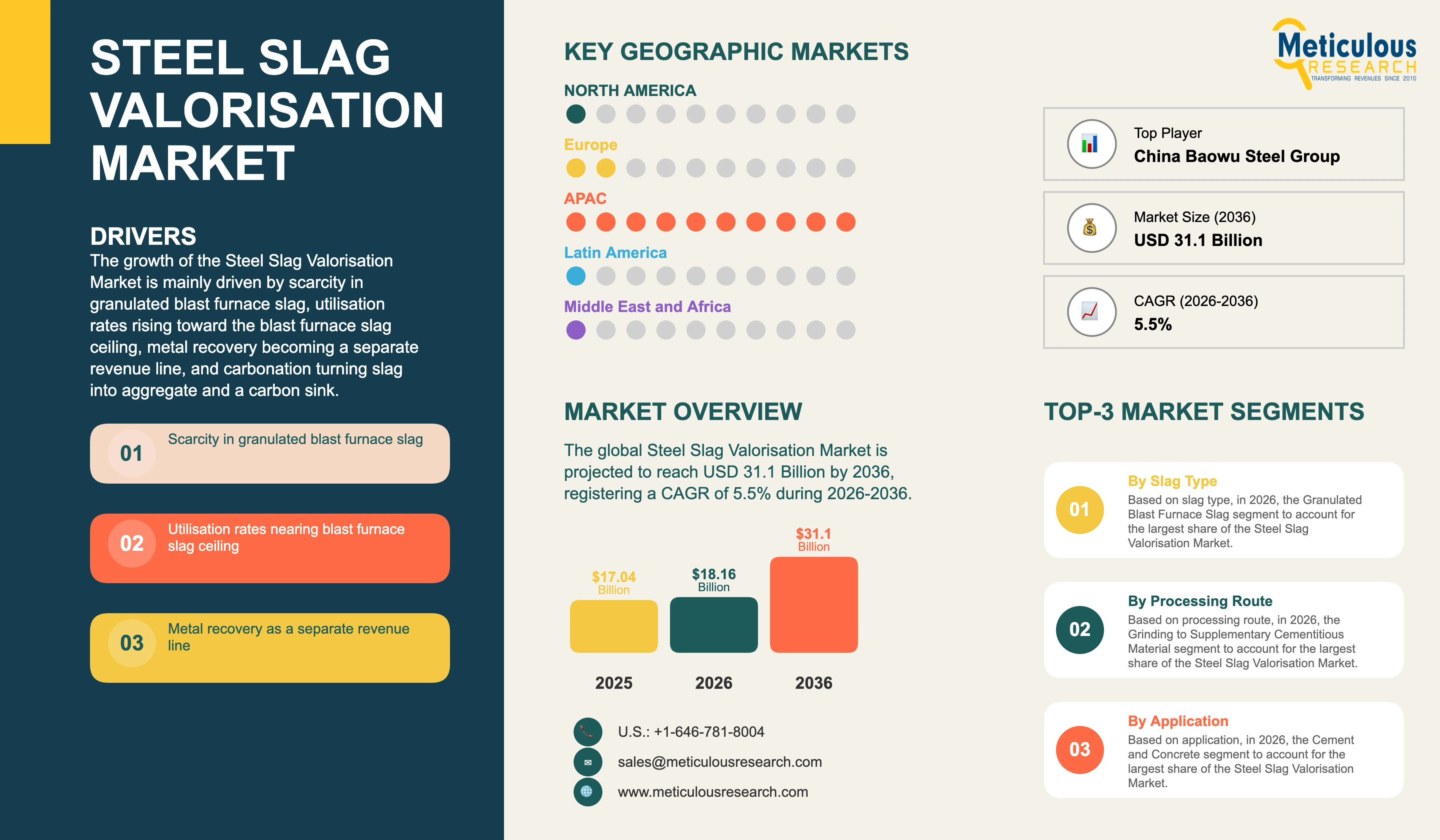
The steel slag valorisation market is valued at USD 18.16 billion in 2026 and is projected to reach USD 31.10 billion by 2036, at a CAGR of 5.5% during the forecast period. The market was valued at USD 17.04 billion in 2025 and at USD 16.17 billion in 2024.
- Published
- Nov 2026
- Pages
- 265
- Format
- PDF + Excel
- Report ID
- MRCHM - 1042743
- Base year
- 2025
- 2024 · HISTORICAL
- $16.17B
- 2036
- $31.10B
- CAGR 2026–2036
- 5.5%
2024–2025 baseline · 2026–2036 forecast at 5.5% CAGR · hover a bar for the value
Key highlights
This market measures revenue from processing ferrous slag, covering blast furnace slag and steelmaking slag from basic oxygen, electric arc and ladle furnaces, into saleable products at the processor gate, per tonne of slag valorised.
Slag sent to interim storage or final deposit is excluded, as are iron and steel production, slag handling inside the furnace bay, landfill services, and other supplementary cementitious materials such as fly ash and calcined clay.
The United States Geological Survey estimates world iron slag production at 330 million to 390 million tons and world steel slag production at 190 million to 290 million tons in 2025.
The same source reports about 16 million tons of ferrous slag sold or used in the United States in 2025 at a value of about USD 620 million, with granulated blast furnace slag less than 30% of tonnage but about 80% of value.
Average unit value of ferrous slag sold in the United States free on board plant moved from USD 28 a tonne in 2021 to USD 29 in 2022, USD 36 in 2023, USD 38 in 2024 and an estimated USD 40 in 2025.
Net import reliance as a share of apparent United States consumption was 14% in 2021 and 2022, 15% in 2023, 12% in 2024 and an estimated 13% in 2025.
That survey states that the availability of imported granulated slag was expected to eventually decrease as foreign blast furnaces are shut down in decarbonisation efforts.
It also records that ground granulated blast furnace slag competes mainly with fly ash, metakaolin and volcanic ash pozzolans for cementitious use, and that portland-limestone cement can serve the same purpose.
Steel slag can partly substitute for limestone and other raw materials in clinker manufacture, while ferrous slags compete with natural aggregates that are far more widely available.
The World Steel Association reports world crude steel production of 1, 849 million tonnes in 2025, down from 1,887 million tonnes in 2024.
Production by process in 2025 was 69.4% basic oxygen furnace, 30.3% electric arc furnace and 0.3% other routes.
World pig iron production, which governs blast furnace slag arisings, was 1,271.2 million tonnes in 2025 against 1,293.4 million tonnes in 2024, with China accounting for 836.0 million tonnes of the 2025 total.
The largest crude steel producers in 2025 were China at 960.8 million tonnes, India at 164.9, the United States at 81.9, Japan at 80.7, Russia at 67.9, South Korea at 62.2, Turkiye at 38.1, Germany at 34.1, Brazil at 33.4 and Iran at 32.0 million tonnes.
Cemvision announced on 19 November 2026 a patent-pending beneficiation process that upcycles electric arc furnace and basic oxygen furnace slag into a supplementary cementitious material while recovering metals.
That announcement states that 99% of the iron oxide in electric arc furnace slag can be extracted and returned to steel producers, with chromium also recoverable.
It further states that third-party testing shows the resulting material matching or beating ground granulated blast furnace slag on reactivity and glass content, with the trials piloted alongside the metallurgical research institute Swerim.
The same announcement records that granulated blast furnace slag has historically been crucial for cement decarbonisation but that its availability is declining as electric arc furnaces and direct reduced iron replace traditional blast furnaces.
It puts the electric arc furnace share of steel production at 70% in the United States and 30% in Europe, with that share growing.
Report summary
| Particulars | Details |
|---|---|
| Base Year | 2025 |
| Actual Years | 2024-2025 |
| Forecast Period | 2026-2036 |
| Market Size in 2024 | USD 16.17 billion |
| Market Size in 2025 | USD 17.04 billion |
| Market Size in 2026 | USD 18.16 billion |
| Market Size in 2036 | USD 31.10 billion |
| Value CAGR (2026-2036) | 5.5% |
| Format | PDF, Excel & Cloud Portal · 265 pages |
| Volume in 2025 | 468.00 million tonnes |
| Volume in 2026 | 478.00 million tonnes |
| Volume in 2036 | 598.00 million tonnes |
| Volume CAGR (2026-2036) | 2.3% |
| Average Realised Value, 2026 | USD 38.00 per tonne |
| Average Realised Value, 2036 | USD 52.00 per tonne |
| Units | Value in USD million; volume in million tonnes of ferrous slag valorised; realised value in USD per tonne of slag valorised |
| Measurement Basis | Revenue from processing ferrous slag, covering blast furnace slag and steelmaking slag from basic oxygen, electric arc and ladle furnaces, into saleable products at the processor gate, per tonne of slag valorised |
| Scope Note | The title keyword covers ferrous slag valorisation including ground granulated blast furnace slag, which is the cement substitution route; blast furnace slag and steelmaking slag are different materials with different buyers and are segmented separately throughout |
| Arisings Basis | The United States Geological Survey estimates world iron slag production at 330 million to 390 million tons and world steel slag production at 190 million to 290 million tons in 2025; blast furnace slag arisings track pig iron output, which fell from 1,293.4 million tonnes in 2024 to 1,271.2 million tonnes in 2025, so forecast volume growth of 2.3% a year is utilisation rate rather than arisings |
| Value Concentration Note | Granulated blast furnace slag is less than 30% of United States ferrous slag tonnage but about 80% of its value; as the mix shifts toward steelmaking slag the average value of a tonne valorised deteriorates even while the premium grade tightens |
| Feedstock Decline Note | The United States Geological Survey states that the availability of imported granulated slag was expected to eventually decrease as foreign blast furnaces are shut down in decarbonisation efforts; electric arc furnaces reached 30.3% of world crude steel in 2025 and the share is reported at 70% in the United States and 30% in Europe and rising |
| Substitute Note | Ground granulated blast furnace slag competes mainly with fly ash, metakaolin and volcanic ash pozzolans for cementitious use, and portland-limestone cement can serve the same purpose; ferrous slag aggregate competes with natural aggregates that are far more widely available |
| Overlap Note | Residue-derived supplementary cementitious material counted in the Red Mud Valorisation Market title covers a different waste stream and is additive with this one, but the two compete in the same cement and concrete end market; concrete admixtures for low carbon cement are a separate product and are excluded here |
| Exclusions | Iron and steel production; slag handling inside the furnace bay before it reaches a processor; slag sent to interim storage or final deposit; landfill and disposal services; other supplementary cementitious materials including fly ash, calcined clay, silica fume and natural pozzolans; natural aggregates; cement and concrete manufacture; non-ferrous slags |
| Segments: Slag Type | Granulated Blast Furnace Slag; Air-Cooled Blast Furnace Slag; Basic Oxygen Furnace Slag; Electric Arc Furnace Slag; Ladle and Secondary Slag |
| Segments: Processing Route | Grinding to Supplementary Cementitious Material; Granulation; Crushing and Screening; Metal Recovery and Magnetic Separation; Carbonation and Other Routes |
| Segments: Application | Cement and Concrete; Road Construction and Aggregate; Internal Metallurgical Recycling; Fertiliser and Soil Conditioner; Hydraulic Engineering and Fill; Carbon Mineralisation and Other |
| Segments: Service Model | On-Site Processing under Contract; In-House Processing by the Steel Producer; Merchant Processing; Trading and Distribution |
| Largest Segment by Slag Type, 2026 | Granulated Blast Furnace Slag, at 58.0% |
| Fastest-Growing Segment by Slag Type | Electric Arc Furnace Slag, at 11.4% |
| Largest Segment by Processing Route, 2026 | Grinding to Supplementary Cementitious Material, at 41.0% |
| Fastest-Growing Segment by Processing Route | Carbonation and Other Routes, at 16.5% |
| Largest Segment by Application, 2026 | Cement and Concrete, at 52.0% |
| Fastest-Growing Segment by Application | Carbon Mineralisation and Other, at 12.6% |
| Largest Segment by Service Model, 2026 | On-Site Processing under Contract, at 38.0% |
| Fastest-Growing Segment by Service Model | Merchant Processing, at 6.3% |
| Largest Region, 2026 | Asia-Pacific, at 64.0% |
| Fastest-Growing Region | Middle East & Africa, at 8.6% |
| Fastest-Growing Country | India, at 7.8% |
| Slowest-Growing Country | Japan, at 2.6% |
| Regions Covered | Asia-Pacific; Europe; North America; Middle East & Africa; Latin America |
| Countries Covered | China; India; Japan; South Korea; Germany; Turkiye; Italy; U.S.; Canada; Iran; Brazil; Mexico |
| Key Players | China Baowu Steel Group Co., Ltd.; ArcelorMittal S.A.; Enviri Corporation; Nippon Steel Corporation; POSCO Holdings Inc.; Tata Steel Limited; JFE Holdings, Inc.; Holcim Ltd; Heidelberg Materials AG; Ecocem Materials Limited; Edw. C. Levy Co. |
| Top Five Share, 2026 | 28.4% |
| Profiled Companies Share, 2026 | 36.1% |
| Currency | USD |
Report overview
Market value is measured in in USD million; volume in million tonnes of ferrous slag valorised; realised value in USD per tonne of slag valorised. Segments covered: slag type, processing route, application, service model.
In volume terms, the market is estimated at 478.00 million tonnes of ferrous slag valorised in 2026, rising to 598.00 million tonnes by 2036, at a CAGR of 2.3%. The average realised value is estimated at USD 38.00 per tonne in 2026 and USD 52.00 per tonne in 2036, the increase reflecting scarcity in granulated blast furnace slag rather than a general price rise across the slag stream.
The growth of this market is mainly driven by scarcity in granulated blast furnace slag as blast furnaces are replaced, utilisation rates rising toward the ceiling already reached by blast furnace slag, metal recovery from steelmaking slag becoming a separate revenue line, and carbonation routes turning steel slag into both an aggregate and a carbon dioxide sink. However, factors such as the material that substitutes for clinker being a by-product of the ironmaking route steel decarbonisation removes, steelmaking slag carrying free lime and chromium that keep it out of cement, pig iron output flat to declining, and competing supplementary cementitious materials including limestone are expected to restrain the growth of this market to some extent.
Among slag types, granulated blast furnace slag is expected to hold the largest share of this market in 2026, while electric arc furnace slag is expected to record the highest CAGR during the forecast period. Geographically, Asia-Pacific is expected to account for the largest share of this market in 2026, while the Middle East and Africa is expected to register the highest CAGR during the forecast period.
Ferrous slag is the largest industrial by-product stream that already has a market. Ironmaking and steelmaking generate between 520 million and 680 million tonnes a year on the United States Geological Survey estimate, split between 330 million to 390 million tonnes of iron slag and 190 million to 290 million tonnes of steel slag, and most of it is sold rather than stored. That is the opposite position to every other residue in this sub-domain, and it means the commercial question here is not how to create a market but what happens to an established one as its feedstock changes.
The two halves of the stream are different materials with different buyers. Blast furnace slag quenched in water forms a glassy granulate that is latently hydraulic: ground to a powder it reacts with the calcium hydroxide released by cement hydration and substitutes for clinker directly. Steelmaking slag from basic oxygen and electric arc furnaces is crystalline, carries free lime and magnesia that cause volumetric expansion, and is used as a graded aggregate in road base and asphalt rather than as a binder.
That distinction decides where value sits. The United States Geological Survey records granulated blast furnace slag at less than 30% of United States ferrous slag tonnage but about 80% of its value, with average unit value across the whole stream rising from USD 28 a tonne in 2021 to an estimated USD 40 in 2025. A tonne of ground granulated slag replacing a tonne of clinker is worth several times a tonne of slag aggregate replacing crushed rock.
The driver named for this title combines cement substitution with waste rules, and the cement substitution half is running down its own feedstock. Blast furnace slag arises only where iron is made in a blast furnace, and the decarbonisation of steelmaking replaces blast furnaces with electric arc furnaces and direct reduced iron. The United States Geological Survey states that the availability of imported granulated slag was expected to eventually decrease as foreign blast furnaces are shut down in decarbonisation efforts.
The numbers behind that are already moving. World crude steel production fell from 1,887 million tonnes in 2024 to 1,849 million tonnes in 2025, and pig iron production, which governs blast furnace slag arisings, fell from 1,293.4 million tonnes to 1,271.2 million tonnes over the same period. Electric arc furnaces accounted for 30.3% of crude steel in 2025, against 69.4% for basic oxygen furnaces, and that share is rising in every region.
The consequence for this market is a mix shift rather than a contraction. Electric arc furnace slag is the fastest-growing slag type at 11.4% a year because the furnaces producing it are being built, while granulated blast furnace slag grows at 4.6% on scarcity value rather than on volume. The growing stream is the lower-value one, which is why the average realised value rises only 3.2% a year even as the premium grade tightens.
Volume growth comes from utilisation rate rather than from arisings, and that has a ceiling. Blast furnace slag is already almost entirely sold, so the headroom sits in steelmaking slag, where free lime, volumetric instability and chromium content limit the applications available. Forecast volume growth of 2.3% a year reflects the rate at which that headroom is taken up against a slag arising base that is flat to declining.
Bridging the two halves of the stream is where the technical effort now sits. Cemvision announced on 19 November 2026 a patent-pending beneficiation process that upcycles electric arc furnace and basic oxygen furnace slag into a supplementary cementitious material while recovering metals, stating that 99% of the iron oxide in electric arc furnace slag can be extracted and returned to steel producers and that chromium is also recoverable.
The performance claim is the significant part. Third-party testing is reported to show the resulting material matching or beating ground granulated blast furnace slag on reactivity and glass content, which is the specification a clinker replacement has to meet. The trials were piloted alongside the metallurgical research institute Swerim and are described as proving technical feasibility and commercial potential, with no production capacity stated.
If that route scales it changes the structure of this market, because it converts the growing lower-value stream into the shrinking higher-value one and pays for the conversion with recovered iron. Until it does, a cement producer facing granulated slag scarcity has other options, and the United States Geological Survey names them: fly ash, metakaolin and volcanic ash pozzolans compete for cementitious use, and portland-limestone cement can serve the same purpose.
Waste rules are the other half of the driver and they work on the aggregate side. Slag that meets end-of-waste or by-product criteria can be sold as a product rather than managed as waste, and specification in road construction depends on demonstrating volumetric stability and leaching behaviour. Those rules have made the aggregate market possible rather than created demand within it, since the competing material is natural crushed rock at a price slag has to meet.
Metal recovery is becoming a revenue line in its own right. Steelmaking slag carries entrained iron and alloying elements that magnetic separation returns to the furnace, which reduces the slag volume requiring an outlet and credits the steelmaker with metallic yield. Metal recovery and magnetic separation grow at 9.6% a year, and the Cemvision route takes the same logic further by targeting 99% iron oxide extraction rather than entrained metallics alone.
Carbonation is the smallest route and the fastest-growing. Steel slag is rich in calcium and magnesium oxides that react with carbon dioxide to form stable carbonates, which both cures the free lime problem that keeps the material out of cement and sequesters carbon dioxide in the product. Carbonation and other emerging routes grow at 16.5% a year from a 4.0% base in 2026.
The industry structure is unlike the rest of this sub-domain because the slag never leaves the mill unprocessed. On-site processing under contract is the largest service model, with a specialist operating inside the plant boundary under a long-term agreement, and in-house processing by the steel producer second. Merchant processing grows fastest at 6.3% as independent processors take material from mills without the scale to justify dedicated capacity.
Asia-Pacific holds the largest regional share because steel production is concentrated there, with China at 960.8 million tonnes of crude steel and 836.0 million tonnes of pig iron in 2025 and India at 164.9 million tonnes and growing on blast furnace capacity. The region grows at 4.7%, below the global rate, because its base is the largest and because Chinese steel output is no longer expanding.
The Middle East and Africa grows fastest at 8.6% because new capacity there is almost entirely direct reduced iron and electric arc furnace based, which generates steelmaking slag without the blast furnace slag that the established regions are losing. Iran at 32.0 million tonnes of crude steel in 2025 illustrates the pattern, and the same logic drives growth in Saudi Arabia, Egypt and Algeria.
Report infographic
Market dynamics
20 factors across 5 forcesScarcity in Granulated Blast Furnace Slag
The United States Geological Survey states that the availability of imported granulated slag was expected to eventually decrease as foreign blast furnaces are shut down in decarbonisation efforts, and records that as United States blast furnaces shut down, domestic granulated slag supply declined to the point where only two granulators were operating at the end of 2015.
Granulated blast furnace slag is less than 30% of United States ferrous slag tonnage but about 80% of its value, so scarcity in that grade moves the realised value of the whole stream. Average unit value across United States ferrous slag rose from USD 28 a tonne in 2021 to an estimated USD 40 in 2025.
Net import reliance as a share of apparent United States consumption was 13% in 2025, so a tightening international granulated slag market reaches domestic buyers directly. Granulated blast furnace slag holds the largest slag type share in this market in 2026 and grows at 4.6% on price rather than on volume.
Utilisation Rates Rising Toward the Blast Furnace Slag Ceiling
Blast furnace slag is already almost entirely sold, so the remaining headroom in this market sits in steelmaking slag from basic oxygen, electric arc and ladle furnaces, where the applications available are narrower.
World steel slag production is estimated at 190 million to 290 million tons against iron slag at 330 million to 390 million tons, so the stream with the utilisation headroom is also the larger of the two by potential.
Forecast volume growth of 2.3% a year is that headroom being taken up rather than arisings increasing, since world crude steel fell from 1,887 million tonnes in 2024 to 1,849 million tonnes in 2025 and pig iron from 1,293.4 million tonnes to 1,271.2 million tonnes.
Metal Recovery Becoming a Separate Revenue Line
Steelmaking slag carries entrained iron and alloying elements that magnetic separation returns to the furnace, which reduces the slag volume requiring an outlet and credits the steelmaker with metallic yield rather than a disposal cost.
Cemvision stated on 19 November 2026 that 99% of the iron oxide in electric arc furnace slag can be extracted and returned to steel producers under its patent-pending beneficiation process, with chromium also recoverable, which takes the logic beyond entrained metallics to the oxide itself.
Metal recovery and magnetic separation grow at 9.6% a year over the forecast period against 4.0% for crushing and screening, because the recovered metal is valued at steel rather than aggregate prices and improves the economics of processing the slag that remains.
Carbonation Turning Slag Into Aggregate and a Carbon Sink
Steel slag is rich in calcium and magnesium oxides that react with carbon dioxide to form stable carbonates, which cures the free lime responsible for volumetric expansion and sequesters carbon dioxide in the product at the same time.
Treating the free lime is what opens cement and concrete applications to a material otherwise confined to road base, so the route addresses the specification barrier rather than only the emissions arithmetic.
Carbonation and other emerging routes grow at 16.5% a year from a 4.0% share of this market in 2026, and carbon mineralisation and other applications at 12.6%, the fastest rates in their respective segmentations.
Table of contents
12 chapters · 137 sections · 265 pages · click to expandSegmental analysis
| Segment | Largest share (2026) | Fastest growth (2026–2036) |
|---|---|---|
| By Slag Type | Granulated blast furnace slag | Electric arc furnace slag |
| By Processing Route | Grinding to supplementary cementitious material | Carbonation and other emerging routes |
| By Application | Cement and concrete | Carbon mineralisation and other |
| By Service Model | On-site processing under contract | Merchant processing |
By Slag Type
- Steel Slag Valorisation Market Analysis by Slag Type
- Granulated blast furnace slag is expected to hold the largest share of this market in 2026.
- Quenching blast furnace slag in water forms a glassy granulate that is latently hydraulic, so ground to a powder it reacts with the calcium hydroxide released during cement hydration and substitutes for clinker directly.
- The United States Geological Survey records it at less than 30% of United States ferrous slag tonnage but about 80% of value.
- It grows at 4.6% on scarcity rather than on volume, since arisings track pig iron output that fell in 2025.
- Electric arc furnace slag is expected to record the highest CAGR during the forecast period at 11.4%, because the furnaces producing it are the ones being built.
- Electric arc furnaces accounted for 30.3% of world crude steel in 2025 against 69.4% for basic oxygen furnaces, with the electric share reported at 70% in the United States and 30% in Europe and rising.
- The material is crystalline and carries chromium from alloy steel production, which governs its leaching assessment.
- Basic oxygen furnace slag grows at 5.8%, carrying free lime and magnesia that cause volumetric expansion in bound applications and therefore going to road base, fill and increasingly to fertiliser and soil conditioning, where the free lime is the functional property rather than the defect.
- Ladle and secondary slags grow at 7.0% from the smallest base, with higher alloy content and smaller unit volumes that favour metal recovery over bulk use.
- Air-cooled blast furnace slag grows slowest at 3.6%.
- Cooling blast furnace slag in air rather than water produces a crystalline material with no latent hydraulic activity, so it serves as a dense graded aggregate rather than a binder and competes directly with natural crushed rock.
- Its volumes fall with blast furnace closures alongside the granulated grade but without the price support that scarcity in a cementitious material provides.
By Processing Route
- Steel Slag Valorisation Market Analysis by Processing Route
- Grinding to supplementary cementitious material is expected to hold the largest share of this market in 2026, because it serves the cement and concrete application that holds the largest share of demand and because it is the step that converts a granulate worth tens of dollars into a binder competing with clinker.
- Fineness, glass content and reactivity are the controlled variables, and the route grows at 4.9% constrained by the granulate available to feed it.
- Carbonation and other emerging routes are expected to record the highest CAGR during the forecast period at 16.5% from a 4.0% share in 2026.
- Calcium and magnesium oxides in steel slag react with carbon dioxide to form stable carbonates, which cures the free lime responsible for volumetric expansion and fixes carbon dioxide in the product at the same time, addressing a specification barrier and an emissions objective in one operation.
- Metal recovery and magnetic separation grow at 9.6%, returning entrained iron and alloying elements to the furnace and reducing the slag volume requiring an outlet.
- The Cemvision announcement of 19 November 2026 extends the route from entrained metallics to the oxide itself, stating that 99% of the iron oxide in electric arc furnace slag can be extracted and returned to steel producers.
- Granulation grows at 4.2% and crushing and screening slowest at 4.0%.
- Granulation capacity is added only where a blast furnace exists to feed it, so investment follows ironmaking rather than cement demand, while crushing and screening is the lowest-cost route and the one competing most directly with natural aggregate prices.
By Application
- Steel Slag Valorisation Market Analysis by Application
- Cement and concrete are expected to hold the largest share of this market in 2026, taking ground granulated blast furnace slag as a clinker replacement at substitution rates that can exceed half the binder in some mixes.
- The application pays the highest price per tonne and carries the regulatory pull from cement sector decarbonisation, and it grows at 4.9%, limited by the granulate supply rather than by demand.
- Carbon mineralisation and other applications are expected to record the highest CAGR during the forecast period at 12.6% from a 3.5% share in 2026, as carbonated slag is appraised as an aggregate, a free lime treatment and a durable carbon dioxide sink at the same time.
- Fertiliser and soil conditioner applications follow at 8.2%, using basic oxygen furnace slag as an acid-neutralising conditioner and a slow-release silicon and phosphate source.
- Road construction and aggregate hold the second largest share and grow at 4.6%.
- Steel slag aggregate offers high density and skid resistance in asphalt surfacing, and the constraint is proximity and volumetric stability rather than performance, since ferrous slags compete with natural aggregates that are far more widely available.
- Internal metallurgical recycling grows at 7.4%, returning slag to the sinter plant or the furnace as a flux and iron source, which avoids transport entirely and credits the mill rather than an external buyer.
- Hydraulic engineering and fill grow slowest at 4.0%, using unbound coarse slag in armour, embankment and reclamation work where density is the property sought.
By Service Model
- Steel Slag Valorisation Market Analysis by Service Model
- On-site processing under contract is expected to hold the largest share of this market in 2026.
- Slag must be handled hot and promptly and cannot leave the works untreated, and a processor needs the steelmaker to control charge mix and cooling practice to deliver a consistent product, so the commercial form is a long-term agreement inside the plant boundary rather than a purchase of material.
- The model grows at 6.0%.
- Merchant processing is expected to record the highest CAGR during the forecast period at 6.3%, as independent processors take material from mills without the scale to justify dedicated on-site capacity and from electric arc furnace works whose slag volumes are smaller per plant than an integrated mill generates.
- The model also serves the beneficiation and carbonation routes, which need process plant rather than a crushing circuit.
- In-house processing by the steel producer holds the second largest share and grows slowest at 4.4%.
- Integrated producers with granulation assets and established cement offtakes retain the activity because the granulate is valuable and the customer relationship is their own, and that position erodes only as blast furnaces close.
- Trading and distribution grow at 5.4%, moving ground granulated slag and graded aggregate between surplus and deficit regions, with net import reliance in the United States at an estimated 13% of apparent consumption in 2025.
- The model gains where granulated slag scarcity makes long-distance movement of a cementitious powder worth the freight.
Geographic analysis
Asia-Pacific
Largest shareAsia-Pacific is expected to account for the largest share of this market in 2026, while the Middle East and Africa is expected to register the highest CAGR during the forecast period. Asia-Pacific leads because steel production is concentrated there. China produced 960.8 million tonnes of crude steel and 836.0 million tonnes of pig iron in 2025, which makes it the largest source of both blast furnace and steelmaking slag and the largest consumer of ground granulated slag in cement. The region grows at 4.7%, below the global rate, because its base is the largest and because Chinese steel output is no longer expanding. India grows fastest of the countries covered at 7.8%, producing 164.9 million tonnes of crude steel in 2025 and adding blast furnace capacity rather than retiring it, which makes it the one major market where granulated slag arisings are still rising. Japan grows slowest at 2.6% on 80.7 million tonnes of declining output, and South Korea at 62.2 million tonnes sits between the two.
Europe
Europe grows at 6.6%, on granulated slag scarcity rather than on arisings. Germany produced 34.1 million tonnes of crude steel in 2025 and Turkiye 38.1 million tonnes, the latter predominantly through electric arc furnaces, so the two largest European producers sit on opposite sides of the mix shift. Italy carries a substantial electric arc furnace base and the associated steelmaking slag stream.
North America
North America grows at 6.0%. The United States produced 81.9 million tonnes of crude steel in 2025 with the electric arc furnace share reported at 70%, so domestic granulated slag supply is minimal and net import reliance ran at an estimated 13% of apparent consumption. Canada retains integrated capacity and therefore a granulated position disproportionate to its output.
Middle East & Africa
Fastest growthThe Middle East and Africa grows fastest at 8.6% because new capacity is almost entirely direct reduced iron and electric arc furnace based, generating steelmaking slag without the blast furnace slag that established regions are losing. Iran produced 32.0 million tonnes of crude steel in 2025 on that route, and the same pattern drives capacity in Saudi Arabia, Egypt and Algeria.
Latin America
Latin America grows at 7.0%. Brazil produced 33.4 million tonnes of crude steel in 2025 and retains integrated blast furnace capacity with established granulation and cement offtake, while Mexico operates predominantly electric arc furnace capacity and therefore a steelmaking slag stream served by aggregate and road applications.
Competitive landscape
Three groups participate and they monetise the same material differently. Steel producers own the slag and in many cases process it themselves, keeping the granulate and the cement customer. Specialist slag service companies operate inside the plant boundary under long-term contract, earning a service fee and a share of product revenue. Cement and construction materials producers buy granulate or ground slag and sell the cementitious product, and in several cases own grinding capacity at port or plant.
Concentration is low because slag is processed where it arises and every works has a local arrangement. The top five participants are estimated to hold 28.4% of this market in 2026 and the profiled companies 36.1%, the lowest concentration of any title in this sub-domain, and the balance sits with regional processors, aggregate producers and the many smaller mills handling their own material.
The specialist service position is the one built on slag alone. Enviri Corporation, through its environmental services business, operates slag processing and metal recovery inside steelworks under long-term contract across multiple regions, which is the model that holds the largest service share in this market at 38.0% in 2026. That position depends on the steel producer remaining in operation rather than on the slag market itself.
The technical frontier sits with newer entrants rather than incumbents. Cemvision announced on 19 November 2026 a patent-pending beneficiation process upcycling electric arc furnace and basic oxygen furnace slag into a supplementary cementitious material while recovering metals, stating 99% iron oxide extraction from electric arc furnace slag with chromium also recoverable, and reporting third-party testing in which the material matches or beats ground granulated blast furnace slag on reactivity and glass content, piloted alongside the metallurgical research institute Swerim.
Some of the key players operating in the steel slag valorisation market are China Baowu Steel Group Co., Ltd., ArcelorMittal S.A., Enviri Corporation, Nippon Steel Corporation, POSCO Holdings Inc., Tata Steel Limited, JFE Holdings, Inc., Holcim Ltd, Heidelberg Materials AG, Ecocem Materials Limited, and Edw. C. Levy Co., among others.
- China Baowu Steel Group Co., Ltd.
- ArcelorMittal S.A.
- Enviri Corporation
- Nippon Steel Corporation
- POSCO Holdings Inc.
- Tata Steel Limited
- JFE Holdings, Inc.
- Holcim Ltd
- Heidelberg Materials AG
- Ecocem Materials Limited
- Edw. C. Levy Co
Expert perspectives
The list driver for this title is cement substitution and waste rules, and the cement substitution half is self-limiting in a way the phrase conceals. Ground granulated blast furnace slag is latently hydraulic because blast furnace slag is quenched from a molten state, and it arises only where iron is made in a blast furnace. The United States Geological Survey states that the availability of imported granulated slag was expected to eventually decrease as foreign blast furnaces are shut down in decarbonisation efforts.
The material that decarbonises cement is therefore a by-product of the route that steel decarbonisation removes. Electric arc furnaces reached 30.3% of world crude steel in 2025 against 69.4% for basic oxygen furnaces, world pig iron output fell from 1,293.4 million tonnes to 1,271.2 million tonnes, and the electric share is reported at 70% in the United States and 30% in Europe and rising. The premium half of this market has no volume growth to draw on.
That matters more than the tonnage suggests because the value is concentrated in the shrinking half. Granulated blast furnace slag is less than 30% of United States ferrous slag tonnage but about 80% of its value. As the mix moves toward crystalline steelmaking slag the average value of a tonne valorised deteriorates even while the premium grade tightens, which is why realised value rises 3.2% a year and the market grows at 5.5% rather than at a scarcity rate.
The waste rules half of the driver works, but on the aggregate side and as an enabler rather than a source of demand. End-of-waste and by-product criteria allow slag to be sold as a product, and road specification depends on demonstrating volumetric stability and leaching behaviour for each source. The competing material is natural crushed rock, which the United States Geological Survey notes is far more widely available, so slag wins on proximity and specific properties rather than on price.
Substitution also runs against this market from the cement side. Ground granulated blast furnace slag competes with fly ash, metakaolin and volcanic ash pozzolans, and portland-limestone cement can serve the same purpose. A cement producer facing granulated slag scarcity has options that do not depend on steelmaking at all, which caps how far slag prices can rise before demand moves.
What would change the structure is converting the growing stream into the valuable one, and the first credible attempt is dated to the day this analysis closes. Cemvision announced on 19 November 2026 a patent-pending beneficiation process producing a supplementary cementitious material from electric arc furnace and basic oxygen furnace slag, with 99% iron oxide extraction returned to steel producers and third-party testing showing reactivity and glass content matching or beating ground granulated blast furnace slag. It is a pilot result with no capacity stated, so the forecast carries it as the reason carbonation and beneficiation routes grow fastest rather than as supply.
Customer perspectives
The buyer and the material owner are often the same group, since integrated steel producers keep granulation and the cement offtake that goes with it.
Cement producers buy ground granulated slag on reactivity, glass content and fineness, and will pay a clinker-related price rather than an aggregate price for material that meets specification.
Concrete producers buy on strength development and durability performance in the mix rather than on the recycled content of the binder.
Buyers facing granulated slag scarcity weigh fly ash, metakaolin, volcanic ash pozzolans and portland-limestone cement against it, so the purchase is contestable above a certain price.
Road authorities buy slag aggregate on volumetric stability and leaching data established for the specific source, which must be re-demonstrated rather than carried across from another mill.
Asphalt producers value the density and skid resistance of steel slag aggregate specifically, which is the one application where the material is preferred rather than substituted.
Steel producers buying back recovered iron judge it on yield credit and on residual element content, and prefer it returned to their own furnace over sale into the scrap market.
Farmers and agricultural distributors buy basic slag for acid neutralisation and slow-release silicon and phosphate, where the free lime that disqualifies the material elsewhere is the functional property.
Buyers of carbonated slag are appraising an aggregate, a free lime treatment and a carbon dioxide sink in one purchase, which makes the valuation harder than a materials specification alone.
Mills without the scale for on-site capacity buy a processing service rather than sell a material, which is why merchant processing grows fastest among the service models.
Price expectation across the buyer set runs from low tens of dollars a tonne for graded aggregate to a clinker-related price for a qualified cementitious powder, and that spread is what the rise in realised value to 2036 reflects.
Frequently asked questions
The market is valued at USD 18.16 billion in 2026 and is projected to reach USD 31.10 billion by 2036, at a CAGR of 5.5%. It was valued at USD 17.04 billion in 2025 and USD 16.17 billion in 2024.
Cite this report
Meticulous Research. (2026). Steel Slag Valorisation Market - Global Opportunity Analysis and Industry Forecast (2026-2036) (Report No. MRCHM - 1042743). Meticulous Market Research Pvt. Ltd. https://www.meticulousresearch.com/product/steel-slag-valorisation-market-7426