Phosphogypsum Valorisation Market (2026-2036)
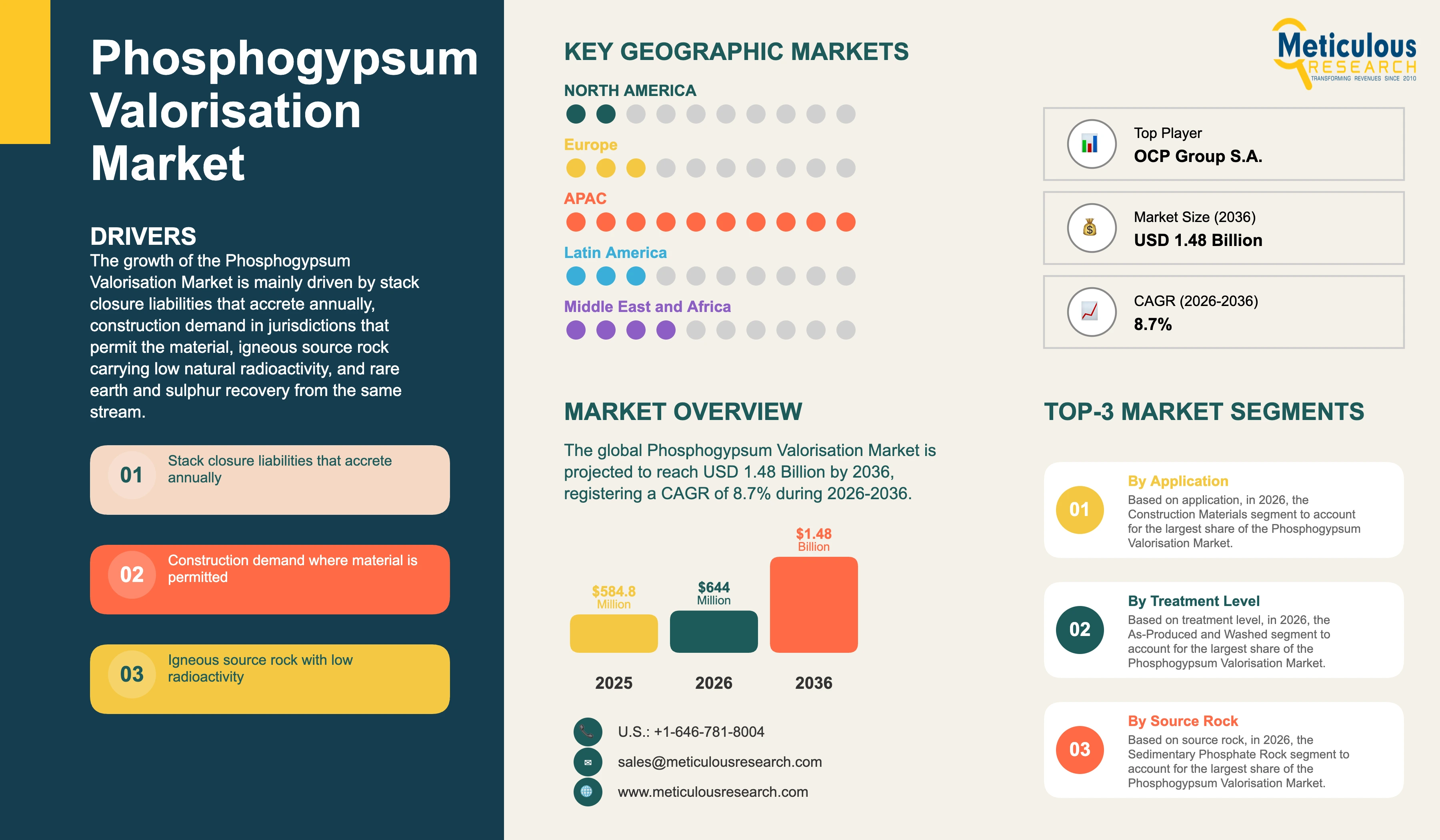
The phosphogypsum valorisation market is valued at USD 644.0 million in 2026 and is projected to reach USD 1.48 billion by 2036, at a CAGR of 8.7% during the forecast period. The market was valued at USD 584.8 million in 2025 and at USD 534.1 million in 2024.
- Published
- Nov 2026
- Pages
- 252
- Format
- PDF + Excel
- Report ID
- MRCHM - 1042755
- Base year
- 2025
- 2023 · HISTORICAL
- $96.1M
- 2036
- $1.48B
- CAGR 2026–2036
- 8.7%
2023–2025 baseline · 2026–2036 forecast at 8.7% CAGR · hover a bar for the value
Key highlights
This market measures phosphogypsum diverted from stacking into a valorised use, on a tonne of material valorised basis at the plant gate, covering the realised value of the material sold together with processing revenue where it is beneficiated, purified or calcined.
The construction materials portion of this market, sized at USD 244.7 million in 2026, is also counted within the synthetic gypsum title in this series as the phosphogypsum type of that market. The two titles are not additive across that portion.
Phosphogypsum is generated at roughly five tonnes for each tonne of phosphorus pentoxide produced by the wet process, and more than 95% of United States phosphate rock went to wet-process phosphoric acid and superphosphoric acid.
World phosphate rock production reached 250 million tonnes in 2025 against 239 million in 2024, with China at 110 million tonnes and Morocco at 36 million, which implies phosphogypsum generation of roughly 300 million tonnes a year.
Against that generation, the volume valorised in 2026 is about 15% of arisings, rising to about 22% by 2036, so the stacks continue to grow throughout the forecast period.
The Mosaic Company carried asset retirement obligations of USD 2, 572.2 million at the end of 2024 against USD 2,213.4 million a year earlier, a rise of 16.2%.
Accretion expense on those obligations was USD 111.2 million in 2024 against USD 96.1 million in 2023 and USD 81.6 million in 2022, a rise of 36.3% in two years, which is the annual cost of holding the liability before any remediation is carried out.
A single producer accreting USD 111.2 million a year exceeds the realised value of the material it could sell at a few dollars a tonne, so valorisation slows the growth of the liability rather than retiring it.
Under 40 CFR Part 61 Subpart R, phosphogypsum must be managed in engineered stacks to limit radon exposure, and removal is permitted only for outdoor agriculture and indoor research and development.
Every other use is prohibited unless the Environmental Protection Agency approves it in advance, case by case, after a risk assessment showing the use is at least as protective of public health as placement of the material in a stack.
Inactive stacks must be covered and tested against a radon flux limit of 20 picocuries per square metre per second.
A conditional approval granted in 2020 for government road projects was withdrawn with effect from 30 June 2021, and a fresh request submitted in March 2022 received completeness determinations on 17 March 2023 and 20 May 2024.
A notice of pending approval issued on 9 October 2024 with a comment period extended to 23 November 2024 led to final approval on 23 December 2024, and what was approved is a small-scale pilot on private land, with no other applications currently under review.
Project updates on that pilot run to 20 March 2026, with sampling results dated 9 September 2025.
Nearly three years of regulatory process delivering a small-scale pilot indicates that permission rather than liability governs the pace of this market in the jurisdiction where the liability is best documented.
Igneous phosphate rock carries far less uranium than sedimentary rock, so the phosphogypsum derived from it carries correspondingly less radium and is more readily accepted into construction use, which is why source rock is a segmentation axis in this market.
The same producer records that it sells phosphogypsum in Brazil, where regulatory treatment differs from the United States, which shows the material moving commercially where permission exists.
Among treatment levels, as-produced and washed material is expected to hold the largest share in 2026, while calcined and specialty grades are expected to grow fastest.
Report summary
| Particulars | Details |
|---|---|
| Base Year | 2025 |
| Actual Years | 2024-2025 |
| Forecast Period | 2026-2036 |
| Market Size in 2024 | USD 534.1 million |
| Market Size in 2025 | USD 584.8 million |
| Market Size in 2026 | USD 644.0 million |
| Market Size in 2036 | USD 1.48 billion |
| Value CAGR (2026-2036) | 8.7% |
| Format | PDF, Excel & Cloud Portal · 252 pages |
| Volume in 2025 | 43.64 million tonnes |
| Volume in 2026 | 46.00 million tonnes |
| Volume in 2036 | 77.84 million tonnes |
| Volume CAGR (2026-2036) | 5.4% |
| Realised Value per Tonne, 2026 | USD 14.00 per tonne |
| Realised Value per Tonne, 2036 | USD 19.00 per tonne |
| Units | Value in USD million; volume in million tonnes of phosphogypsum valorised; price in USD per tonne |
| Measurement Basis | Phosphogypsum diverted from stacking into a valorised use, measured at the plant gate on a tonne of material valorised basis, covering the realised value of the material sold together with processing revenue where it is beneficiated, purified or calcined |
| Overlap Note | The construction materials portion of this market, sized at USD 244.7 million in 2026, is also counted within the synthetic gypsum title in this series as the phosphogypsum type of that market; the two titles are not additive across that portion |
| Generation and Valorised Share | World phosphate rock output of 250 million tonnes in 2025 implies phosphogypsum generation of roughly 300 million tonnes a year; the valorised share is about 15% in 2026 rising to about 22% by 2036, so stacks grow throughout the forecast period |
| Exclusions | Natural mined gypsum and flue gas desulphurisation gypsum; stack construction, operation, closure and water treatment services; phosphoric acid and fertiliser production; separated rare earth oxides and refined sulphur, which are counted in their own markets; land disposal and landfill services |
| Segments: Application | Construction Materials; Agricultural Soil Amendment; Road Base and Civil Fill; Mine Backfill and Land Reclamation; Rare Earth and Sulphur Recovery |
| Segments: Treatment Level | As-Produced and Washed; Beneficiated and Purified; Calcined and Specialty |
| Segments: Source Rock | Sedimentary Phosphate Rock; Igneous Phosphate Rock |
| Largest Segment by Application, 2026 | Construction Materials, at 38.0% |
| Fastest-Growing Segment by Application | Rare Earth and Sulphur Recovery, at 13.6% |
| Largest Segment by Treatment Level, 2026 | As-Produced and Washed, at 54.0% |
| Fastest-Growing Segment by Treatment Level | Calcined and Specialty, at 11.6% |
| Largest Segment by Source Rock, 2026 | Sedimentary Phosphate Rock, at 86.0% |
| Fastest-Growing Segment by Source Rock | Igneous Phosphate Rock, at 9.9% |
| Largest Region, 2026 | Asia-Pacific, at 48.0% |
| Fastest-Growing Region | Middle East & Africa, at 9.8% |
| Fastest-Growing Country | Morocco, at 11.2% |
| Slowest-Growing Country | U.S., at 7.0% |
| Regions Covered | Asia-Pacific; Middle East & Africa; Europe; Latin America; North America |
| Countries Covered | China; India; Vietnam; Morocco; Jordan; Saudi Arabia; Tunisia; Russia; Finland; Brazil; Mexico; U.S. |
| Key Players | OCP Group S.A.; The Mosaic Company; Nutrien Ltd.; ICL Group Ltd; Saudi Arabian Mining Company; Coromandel International Limited |
| Top Five Share, 2026 | 28.4% |
| Profiled Companies Share, 2026 | 31.2% |
| Currency | USD |
Report overview
Market value is measured in in USD million; volume in million tonnes of phosphogypsum valorised; price in USD per tonne. Segments covered: application, treatment level, source rock.
In volume terms, the market is estimated at 46.00 million tonnes of phosphogypsum valorised in 2026, rising to 77.84 million tonnes by 2036, at a CAGR of 5.4%. The realised value is estimated at USD 14.00 per tonne in 2026 and USD 19.00 per tonne in 2036, the increase reflecting a shift from as-produced material sold for agricultural use toward beneficiated, purified and calcined grades supplied into construction.
The growth of this market is mainly driven by stack closure liabilities that accrete annually whether or not material is removed, construction demand in jurisdictions that permit the material, igneous source rock that carries low natural radioactivity, and rare earth and sulphur recovery from the same stream. However, factors such as removal from a stack being prohibited in the United States except for two named uses, a realised value of a few dollars a tonne against haulage cost, generation of roughly 300 million tonnes a year that outruns any valorisation rate, and radium content that varies with the deposit are expected to restrain the growth of this market to some extent.
Among applications, construction materials are expected to hold the largest share of this market in 2026, while rare earth and sulphur recovery is expected to record the highest CAGR during the forecast period. Geographically, Asia-Pacific is expected to account for the largest share of this market in 2026, while the Middle East & Africa is expected to register the highest CAGR during the forecast period.
Phosphogypsum is calcium sulphate dihydrate precipitated when phosphate rock is digested in sulphuric acid to make phosphoric acid. The reaction produces roughly five tonnes of it for each tonne of phosphorus pentoxide, and more than 95% of United States phosphate rock was used to make wet-process phosphoric acid and superphosphoric acid, so the by-product arises wherever fertiliser phosphate is made rather than in a few specialised places.
The scale follows directly from rock production. World phosphate rock output reached 250 million tonnes in 2025 against 239 million in 2024, with China at 110 million tonnes, Morocco at 36 million, Russia at 14 million, Jordan at 12 million and Saudi Arabia at 10 million, which implies generation of roughly 300 million tonnes of phosphogypsum a year.
Chemically the material is close to natural gypsum, and in a world without radioactivity it would be an ordinary construction mineral. What separates it is the uranium decay chain in the source rock. Uranium reports largely to the acid while radium-226 follows the calcium into the gypsum, and radium decays to radon, which is why the material is regulated as a radiological rather than a chemical concern and why a construction specifier treats it differently from a mineral of identical chemistry.
Radium content varies with the deposit, and that variation is the single most important technical variable in this market. Sedimentary phosphate rock, which supplies the great majority of world output, carries appreciable uranium. Igneous rock carries far less, so phosphogypsum derived from it is more readily accepted into construction use without any treatment at all.
United States regulation is the strictest and the best documented. Under 40 CFR Part 61 Subpart R, phosphogypsum must be managed in engineered stacks to limit public exposure to radon, and removal from a stack is permitted only for outdoor agricultural purposes and for indoor research and development.
Every other use is prohibited unless the Environmental Protection Agency approves it in advance, case by case, after a risk assessment demonstrating the use is at least as protective of public health as placement of the material in a stack. Inactive stacks must be covered and tested against a radon flux limit of 20 picocuries per square metre per second.
The record of that approval process is instructive. A conditional approval granted in 2020 for government road projects was withdrawn with effect from 30 June 2021. A fresh request submitted in March 2022 received a completeness determination on 17 March 2023, a further determination on a revised request on 20 May 2024, a notice of pending approval on 9 October 2024, and final approval on 23 December 2024.
What that nearly three-year process approved is a small-scale pilot on private land, with project updates dated 26 September 2025, 23 December 2025 and 20 March 2026, and no other applications currently under review.
Against that stands a liability of a different order. The largest United States producer carried asset retirement obligations of USD 2,572.2 million at the end of 2024 against USD 2,213.4 million a year earlier, with accretion expense of USD 111.2 million in 2024 against USD 81.6 million in 2022.
Accretion is the annual unwinding of the discount on a closure obligation, incurred whether or not any material moves, and at USD 111.2 million a year it exceeds what the same producer could realise by selling its entire annual arisings at the few dollars a tonne the material commands.
That arithmetic explains the structure of this market. Valorisation does not retire a stack liability; it slows the growth of one. The commercial case therefore rests on the value of the material in its end use rather than on avoided closure cost, which is the opposite of how the opportunity is usually described.
Only a route that reduces the footprint eventually requiring closure, rather than diverting a share of current arisings, touches the disclosed obligation at all, and most valorisation routes consume fresh material because it is cleaner and easier to handle than aged stack material.
Realised value is low because the material competes against natural gypsum and against flue gas desulphurisation gypsum, both of which arrive without a radiological question. At USD 14.00 per tonne in 2026 the material cannot bear long haulage, so a valorisation route must exist within a short radius of the stack or not at all.
Treatment adds value and cost together. As-produced material, washed to remove residual acid and fluoride, serves agriculture and mine backfill. Beneficiated and purified grades, with impurities and radium reduced, enter cement and plasterboard. Calcined and specialty grades reach plaster, self-levelling compounds and higher value construction products.
Four uses carry the volume. Construction materials take the largest share, as a set retarder in cement and as feedstock for plasterboard and plaster. Agricultural soil amendment uses the calcium and sulphur directly and is the one route explicitly permitted in the United States. Road base and civil fill consume large tonnages where permitted, and mine backfill and land reclamation absorb material close to the stack.
Rare earth and sulphur recovery is the newest route and the fastest growing. Phosphate rock carries rare earth elements that follow the calcium into the gypsum, and sulphur can be recovered and returned to the acid plant, so the same stream that is a disposal problem is also a secondary source of two contested materials.
Geography follows permission and rock type rather than liability. Asia-Pacific holds the largest share on Chinese rock output of 110 million tonnes and established use of phosphogypsum in cement and plasterboard, while North America holds the smallest share and grows slowest despite carrying the best-documented liability in the industry.
That inversion is the single most counter-intuitive feature of this market, and it is the reason a geographic ranking built from phosphate production alone would misstate where the commercial activity actually sits.
Asia-Pacific is expected to account for 48.0% of this market in 2026, with China producing 110 million tonnes of phosphate rock in 2025 and using phosphogypsum in cement and plasterboard at scale. The Middle East & Africa is projected to grow fastest at 9.8%, and Morocco is the fastest growing country at 11.2%.
The Middle East & Africa grows fastest at 9.8% on Moroccan output of 36 million tonnes of rock and reserves of 50 billion tonnes, with Jordan, Saudi Arabia, Tunisia and Egypt adding further arisings. Latin America grows at 9.6% on Brazilian igneous deposits whose phosphogypsum carries low radium, and Europe at 8.0% on Russian and Finnish igneous rock.
The construction materials portion of this market, sized at USD 244.7 million in 2026, is also counted within that title as its phosphogypsum type. The two titles are not additive across that portion, while agricultural, civil fill, backfill and recovery applications are counted here only.
Accretion expense alone was USD 111.2 million in 2024 at a single producer, which exceeds what that producer could realise by selling its entire annual arisings at USD 14.00 per tonne. Valorisation slows the growth of a closure obligation rather than retiring it, so the commercial case rests on the value of the material in its end use rather than on avoided closure cost.
Under 40 CFR Part 61 Subpart R, phosphogypsum must be managed in engineered stacks to limit public exposure to radon, and removal is permitted only for outdoor agricultural purposes and for indoor research and development. Every other use is prohibited unless the Environmental Protection Agency approves it in advance after a risk assessment showing it is at least as protective as placement in a stack. Inactive stacks are covered and tested against a radon flux limit of 20 picocuries per square metre per second.
A conditional approval granted in 2020 for government road projects was withdrawn with effect from 30 June 2021. A fresh request submitted in March 2022 received completeness determinations on 17 March 2023 and 20 May 2024, a notice of pending approval on 9 October 2024, and final approval on 23 December 2024 for a small-scale pilot on private land. Project updates run to 20 March 2026 and no other applications are under review.
Uranium in phosphate rock reports partly to radium-226 in the gypsum, and igneous deposits carry far less uranium than sedimentary deposits. Phosphogypsum from igneous rock therefore carries less radium and is accepted into construction use more readily, which makes geology rather than process the primary determinant of what a producer can do with its by-product.
OCP Group S.A., The Mosaic Company, Nutrien Ltd., ICL Group Ltd, Saudi Arabian Mining Company and Coromandel International Limited. The top five hold 28.4% of this market in 2026 and the six profiled companies hold 31.2%, with the majority of valorised volume held by Chinese producers.
Report infographic
Market dynamics
20 factors across 5 forcesStack closure liabilities that accrete annually
The largest United States producer carried asset retirement obligations of USD 2,572.2 million at the end of 2024 against USD 2,213.4 million a year earlier, a rise of 16.2%, with accretion expense of USD 111.2 million in 2024 against USD 96.1 million in 2023 and USD 81.6 million in 2022.
Accretion is incurred whether or not material moves, and a liability rising 36.3% in accretion terms over two years concentrates management attention on anything that reduces the footprint to be closed or the water to be treated.
Florida rules require phosphate facilities to meet more stringent process water management objectives for phosphogypsum stack systems, with comparable federal and Louisiana requirements set out in consent decrees, so the cost of holding material is rising alongside the obligation to close it.
Water rather than solids is often the binding cost, since a stack accumulates process water that must be treated before discharge, and reducing the active footprint reduces the rainfall captured as well as the area to be capped.
Construction demand in jurisdictions that permit the material
Phosphogypsum is chemically close to natural gypsum and serves the same duties, as a set retarder in cement and as feedstock for plasterboard and plaster, wherever regulation permits its use.
China produced 110 million tonnes of phosphate rock in 2025, the largest national output, and uses phosphogypsum in cement and plasterboard at scale, which is why Asia-Pacific holds 48% of this market.
Construction materials hold 38% of application in 2026 and grow at 8.2%, and because the material displaces mined gypsum one tonne for one, demand tracks construction activity rather than fertiliser output.
Igneous source rock carrying low natural radioactivity
Uranium in phosphate rock reports partly to radium-226 in the gypsum, and igneous deposits carry far less uranium than sedimentary deposits, so phosphogypsum from igneous rock is more readily accepted into construction use without treatment.
Igneous rock accounts for 14% of this market in 2026 and grows faster at 9.9% against 8.5% for sedimentary rock, because the material it produces faces a lower regulatory and commercial barrier at every step.
That distinction also explains why valorisation rates differ so widely between producing countries on identical technology, since the constraint originates in the orebody rather than in the plant, and it cannot be engineered away by a producer working sedimentary rock.
Rare earth and sulphur recovery from the same stream
Phosphate rock carries rare earth elements that follow calcium into the gypsum during acidulation, so a stack is a low-grade but very large secondary resource for materials whose supply is concentrated and contested.
Sulphur can also be recovered and returned to the acid plant, which converts part of the largest single raw material cost in phosphoric acid production into a recovered stream.
Rare earth and sulphur recovery holds 7% of this market in 2026 and grows fastest at 13.6%, because it attaches a high value product to a material whose bulk value is a few dollars a tonne, and because a stack of known tonnage and known grade is a more tractable resource than an undeveloped orebody.
Table of contents
11 chapters · 121 sections · 252 pages · click to expandSegmental analysis
| Segment | Largest share (2026) | Fastest growth (2026–2036) |
|---|---|---|
| By Application | Construction materials | Road base and civil fill |
| By Treatment Level | As-produced and washed material | Calcined and specialty grades |
| By Source Rock | Sedimentary phosphate rock | — |
| Other segments | As-produced and washed material | Calcined and specialty grades |
By Application
- Phosphogypsum Valorisation Market Analysis by Application
- Construction materials are expected to account for the largest share of this market in 2026 at 38%.
- Phosphogypsum is chemically close to natural gypsum and serves the same duties, as a set retarder controlling the hydration of Portland cement and as feedstock for plasterboard and plaster, displacing mined gypsum one tonne for one wherever regulation permits.
- The segment grows at 8.2%, tracking construction activity rather than fertiliser output, and it is concentrated in China, which produced 110 million tonnes of phosphate rock in 2025 and uses the by-product in cement and plasterboard at scale.
- It is also the portion of this market counted again within the synthetic gypsum title in this series, so the two must be read together rather than summed.
- Agricultural soil amendment holds 31% and grows slowest at 7.0%, using the calcium and sulphur directly to improve soil structure, displace sodium from sodic ground and supply subsoil calcium that surface-applied lime cannot reach.
- It is the one route explicitly permitted for removal from a stack in the United States, and it needs only washing rather than a process plant, which is why it carries the lowest realised value of any application.
- Road base and civil fill grow at 11.2%, the second fastest application, consuming bulk tonnage close to the point of production, which suits a material that cannot bear long haulage and which moves enough volume per project to affect a stack footprint rather than merely offset it.
- In the United States the route remains prohibited without prior approval, and the only approval granted is a small-scale pilot on private land.
- Mine backfill and land reclamation grow at 9.2%, absorbing material close to the stack with minimal treatment and solving a haulage problem rather than creating a product, which makes them the route of choice where no construction or agricultural outlet exists within range.
- Rare earth and sulphur recovery is projected to register the highest CAGR of 13.6% during the forecast period.
- Rare earth elements follow calcium into the gypsum during acidulation and sulphur can be returned to the acid plant, so the route attaches a contested high-value product to a material whose bulk value is a few dollars a tonne.
- Construction materials are expected to hold the largest share in 2026 at 38.0%, serving as a cement set retarder and as plasterboard feedstock.
- Rare earth and sulphur recovery is projected to grow fastest at 13.6%, followed by road base and civil fill at 11.2%.
By Treatment Level
- Phosphogypsum Valorisation Market Analysis by Treatment Level
- As-produced and washed material is expected to hold the largest share of this market in 2026 at 54%.
- Washing removes residual phosphoric and fluosilicic acid and soluble fluoride, which is sufficient for agricultural use, mine backfill and civil fill, and it requires only water handling rather than a process plant.
- It grows slowest at 7.4%, because the uses it serves are the lowest value and because washing does nothing to reduce radium, which is the property that governs entry into construction.
- It nonetheless carries the majority of tonnage, since most valorised material goes to agriculture, backfill and fill rather than into a specified product.
- Beneficiated and purified material grows at 9.6%, reducing impurities and radium by flotation, acid leaching or selective crystallisation so that the product meets cement and plasterboard specifications, and that treatment addresses the regulatory and the commercial barrier together.
- Calcined and specialty grades are projected to register the highest CAGR of 11.6% during the forecast period, dehydrating the dihydrate to hemihydrate or anhydrite for plaster, self-levelling compounds and higher value construction products.
- At that end the material competes on setting behaviour and strength development rather than on price, which is the only position in this market where phosphogypsum is specified for what it does rather than tolerated for what it costs.
By Source Rock
- Phosphogypsum Valorisation Market Analysis by Source Rock
- Sedimentary phosphate rock is expected to account for the largest share of this market in 2026 at 86%, since it supplies the great majority of world phosphate output including Morocco at 36 million tonnes, China at 110 million and Jordan at 12 million in 2025.
- It grows at 8.5%, and its phosphogypsum carries appreciable radium because sedimentary deposits concentrate uranium, which is the reason the material is regulated radiologically rather than chemically and why most valorisation routes require treatment.
- Igneous phosphate rock holds 14% and grows faster at 9.9%.
- Igneous deposits carry far less uranium, so the derived phosphogypsum carries correspondingly less radium and is accepted into construction use more readily, in some jurisdictions without treatment at all.
- Brazil, Russia, South Africa and Finland hold igneous deposits, and the largest United States producer records selling phosphogypsum in Brazil, which demonstrates the material moving commercially where both the rock and the regulation allow.
- That split makes geology rather than process the primary determinant of what a producer can do with its by-product, which is unusual for an industrial residue and is why valorisation rates differ so widely between producers running identical technology on different rock.
Other segments
- As-produced and washed material is expected to hold the largest share in 2026 at 54.0%, sufficient for agriculture, backfill and civil fill.
- Calcined and specialty grades are projected to grow fastest at 11.6%, followed by beneficiated and purified material at 9.6%.
- Sedimentary phosphate rock is expected to hold the largest share in 2026 at 86.0%, supplying the great majority of world phosphate output.
- Igneous phosphate rock is projected to grow faster at 9.9%, because it carries far less uranium and so its phosphogypsum carries less radium.
Geographic analysis
Asia-Pacific
Largest shareAsia-Pacific is expected to account for the largest share of this market in 2026, at 48%. China produced 110 million tonnes of phosphate rock in 2025, the largest national output by a wide margin, and uses phosphogypsum in cement and plasterboard at scale, so the region combines the greatest generation with the most established construction outlet. The region grows at 8.4%, with India adding both phosphoric acid capacity and construction demand, and Vietnam producing 3.0 million tonnes of rock in 2025 alongside its own fertiliser industry. Regional growth is therefore paced by construction activity rather than by any change in permission, since the outlets are already open.
Middle East & Africa
Fastest growthThe Middle East & Africa is projected to register the highest CAGR of 9.8% during the forecast period, holding 18% of this market. Morocco produced 36 million tonnes of phosphate rock in 2025 and holds reserves of 50 billion tonnes, Jordan 12 million tonnes and Saudi Arabia 10 million, with Tunisia, Egypt, Senegal and Togo adding further output. Morocco is the fastest growing country in this market at 11.2%, on the scale of its arisings, on construction demand within the country and on interest in recovering rare earth elements from a resource whose size follows from reserves held.
Latin America
Latin America grows at 9.6% and holds 13%, with Brazil producing 5.0 million tonnes of rock in 2025 from igneous deposits whose phosphogypsum carries low radium, and with the material sold commercially there as a soil amendment on acidic tropical soils where calcium and sulphur both improve subsoil conditions.
Europe
Europe holds 13% and grows at 8.0%, with Russia producing 14 million tonnes of rock from igneous Kola deposits and Finland 980 thousand tonnes, and with construction use established where the source rock permits it.
North America
North America holds the smallest share at 8% and grows slowest at 7.4%, despite carrying the best-documented stack liability in the industry, because removal is permitted only for outdoor agriculture and indoor research and development. Five companies operated only 10 mines in four states in 2025, in Florida, Idaho, North Carolina and Utah, so both the arisings and the regulatory exposure are concentrated among few operators.
Competitive landscape
This market is fragmented, with the six companies profiled holding 31.2% of it in 2026 and the top five 28.4%. The majority of valorised volume sits with Chinese producers, whose output of 110 million tonnes of phosphate rock in 2025 and established use of the by-product in cement and plasterboard give them the largest tonnage without the regulatory constraint that shapes the market elsewhere.
Participants are the phosphate producers themselves rather than specialist processors, because the material cannot bear haulage at USD 14.00 per tonne and because the regulatory obligation attaches to the generator, so position follows plant location and source rock rather than technology.
OCP Group S.A. holds the largest position outside China on Moroccan output of 36 million tonnes of rock in 2025 and reserves of 50 billion tonnes, which makes its arisings the largest single accumulation of the material anywhere and its valorisation decisions the most consequential.
The Mosaic Company carries asset retirement obligations of USD 2,572.2 million, sells phosphogypsum in Brazil and holds the only United States approval for use outside the two permitted routes, a small-scale pilot on private land granted on 23 December 2024. Nutrien Ltd., ICL Group Ltd, Saudi Arabian Mining Company and Coromandel International Limited hold producer positions in North America, Israel, Saudi Arabia and India respectively.
Competitive position in this market is unusual in that it is inherited rather than built. A producer working igneous rock can valorise a far higher share of its arisings than one working sedimentary rock at the same level of treatment, and a producer in a jurisdiction that permits construction use has outlets that a producer in the United States must apply for one project at a time.
Activity has therefore concentrated on securing permission and on recovery technology rather than on competing for customers, since the material is sold close to the plant and the constraint is on what may be sold rather than on who will buy it.
Some of the key players operating in the phosphogypsum valorisation market are OCP Group S.A., The Mosaic Company, Nutrien Ltd., ICL Group Ltd, Saudi Arabian Mining Company, and Coromandel International Limited, among others.
- —
The Environmental Protection Agency issued final approval on 23 December 2024 for a small-scale phosphogypsum road pilot on private land, with sampling results dated 9 September 2025 and project updates through 20 March 2026; and The Mosaic Company disclosed asset retirement obligations of USD 2,572.2 million at the end of 2024 against USD 2,213.4 million a year earlier, with accretion expense of USD 111.2 million.
- OCP Group S.A.
- Mosaic Company
- Nutrien Ltd.
- ICL Group Ltd
- Saudi Arabian Mining Company
- Coromandel International Limited
Expert perspectives
The stated demand driver for this market is stack liability and material demand, and the two halves behave very differently. The liability is large, documented and growing: one producer carried asset retirement obligations of USD 2,572.2 million at the end of 2024, up 16.2% in a year, with accretion expense of USD 111.2 million against USD 81.6 million two years earlier.
That liability does not create a market, because valorisation cannot retire it. Accretion alone at a single producer exceeds what the same producer could realise by selling its entire annual arisings at USD 14.00 per tonne, so removing material slows the growth of the obligation rather than discharging it.
What creates a market is permission, and permission is the binding constraint where the liability is best documented. Removal from a stack in the United States is allowed only for outdoor agriculture and indoor research and development, every other use requires prior approval on a risk assessment showing it is at least as protective as leaving the material in place, and the only approval granted is a small-scale pilot on private land.
That approval took from March 2022 to December 2024 and no other applications are under review, which is why North America holds the smallest regional share at 8% and grows slowest at 7.4% while carrying the largest disclosed liability.
Growth therefore sits where regulation already permits the material and where the orebody helps. Asia-Pacific holds 48% on Chinese rock output of 110 million tonnes and established construction use, the Middle East & Africa grows fastest at 9.8% on Moroccan arisings, and igneous-derived material grows at 9.9% against 8.5% for sedimentary because it carries far less radium.
The route that changes the arithmetic is rare earth and sulphur recovery, growing at 13.6%, because it attaches a contested high-value product to a bulk material worth a few dollars a tonne. Against generation of roughly 300 million tonnes a year, the valorised share still rises only from about 15% to about 22% by 2036, so the stacks grow throughout the forecast period and the honest reading of this market is a slowing accumulation rather than a drawdown.
Customer perspectives
Cement producers evaluate phosphogypsum against natural gypsum and flue gas desulphurisation gypsum on set retardation performance, residual phosphate and fluoride content, and delivered cost, since all three serve the same duty in the mill. Their first question is whether residual acidity will interfere with hydration, and their second is whether using the material exposes them to a radiological assessment their competitors do not face.
Plasterboard manufacturers apply a tighter specification, because board is an interior product and the radium question becomes a question about occupied space rather than about a bulk material. They ask for radium data on every consignment rather than on a type test, since content varies with the source rock and the acid plant rather than staying constant for a given supplier.
Farmers and agronomists buy on calcium and sulphur content and on cost per hectare, and in the United States this is the one route for which removal from a stack is explicitly permitted. Those buyers ask about soluble fluoride and residual acidity rather than radium, because the agronomic risk is to the crop and the soil rather than to the handler.
Road and civil contractors ask first whether the material is permitted at all in their jurisdiction, and in the United States the answer is that it is prohibited without prior approval. Where it is permitted they ask about long-term leaching behaviour and about who carries liability if the regulatory position changes after the road is built, which is a question no technical datasheet answers.
Rare earth processors approach the stacks as an orebody rather than as a waste, asking about grade, distribution between the heavy and light elements, and whether the material can be fed without pre-treatment.
Producers themselves ask whether a valorisation route reduces the footprint that must eventually be closed or merely diverts a share of current arisings, since only the former affects the asset retirement obligation they disclose.
Across every buyer group the recurring request is for a consistent specification from a named source rock, because variability rather than any single property is what prevents the material being treated as an ordinary mineral.
Frequently asked questions
The market is valued at USD 644.0 million in 2026, having stood at USD 584.8 million in 2025 and USD 534.1 million in 2024, and is projected to reach USD 1.48 billion by 2036.
A CAGR of 8.7% in value terms and 5.4% in volume terms between 2026 and 2036, with realised value rising from USD 14.00 per tonne to USD 19.00 per tonne.
Stack closure liabilities that accrete annually, construction demand in jurisdictions that permit the material, igneous source rock carrying low natural radioactivity, and rare earth and sulphur recovery from the same stream.
Removal from a stack is prohibited in the United States except for outdoor agriculture and indoor research and development, and realised value is a few dollars a tonne against haulage cost. Generation of roughly 300 million tonnes a year outruns valorisation, radium content varies with the deposit, and gypsum with no radiological question competes.
Rare earth recovery from a very large low-grade resource, beneficiated and calcined grades for construction, igneous rock producers with a structural advantage, and road base and civil fill where permitted.
Construction materials are expected to hold the largest share in 2026 at 38.0%. Rare earth and sulphur recovery is projected to grow fastest at 13.6%, followed by road base and civil fill at 11.2%.
As-produced and washed material is expected to hold the largest share in 2026 at 54.0%. Calcined and specialty grades are projected to grow fastest at 11.6%, followed by beneficiated and purified material at 9.6%.
Sedimentary phosphate rock is expected to hold the largest share in 2026 at 86.0%. Igneous phosphate rock is projected to grow faster at 9.9%, because it carries far less uranium and so its phosphogypsum carries less radium.
Asia-Pacific is expected to account for 48.0% of this market in 2026, with China using phosphogypsum in cement and plasterboard at scale. The Middle East & Africa is projected to grow fastest at 9.8%, and Morocco is the fastest growing country at 11.2%.
The Middle East & Africa grows fastest at 9.8% on Moroccan output and reserves. Latin America grows at 9.6% on Brazilian igneous deposits, and Europe at 8.0% on Russian and Finnish igneous rock.
The construction materials portion of this market, sized at USD 244.7 million in 2026, is also counted within that title as its phosphogypsum type. The two titles are not additive across that portion, while agricultural, civil fill, backfill and recovery applications are counted here only.
Accretion expense alone was USD 111.2 million in 2024 at a single producer, which exceeds what that producer could realise by selling its entire annual arisings at USD 14.00 per tonne. Valorisation slows the growth of a closure obligation rather than retiring it.
Under 40 CFR Part 61 Subpart R, removal from a stack is permitted only for outdoor agricultural purposes and for indoor research and development. Every other use is prohibited unless the Environmental Protection Agency approves it in advance after a risk assessment, and inactive stacks are tested against a radon flux limit of 20 picocuries per square metre per second.
A conditional approval granted in 2020 was withdrawn with effect from 30 June 2021, and a fresh request submitted in March 2022 received final approval on 23 December 2024 for a small-scale pilot on private land. Project updates run to 20 March 2026 and no other applications are under review.
Igneous deposits carry far less uranium than sedimentary deposits, so their phosphogypsum carries less radium and is accepted into construction use more readily. Geology rather than process is therefore the primary determinant of what a producer can do with its by-product.
OCP Group S.A., The Mosaic Company, Nutrien Ltd., ICL Group Ltd, Saudi Arabian Mining Company and Coromandel International Limited. The top five hold 28.4% of this market in 2026 and the six profiled companies hold 31.2%.
The Environmental Protection Agency issued final approval on 23 December 2024 for a small-scale phosphogypsum road pilot on private land, with project updates through 20 March 2026. The Mosaic Company disclosed asset retirement obligations of USD 2,572.2 million at the end of 2024 against USD 2,213.4 million a year earlier.
Cite this report
Meticulous Research. (2026). Phosphogypsum Valorisation Market - Global Opportunity Analysis and Industry Forecast (2026-2036) (Report No. MRCHM - 1042755). Meticulous Market Research Pvt. Ltd. https://www.meticulousresearch.com/product/phosphogypsum-valorisation-market-7438