Isothiazolinone Biocides Market (2026-2036)
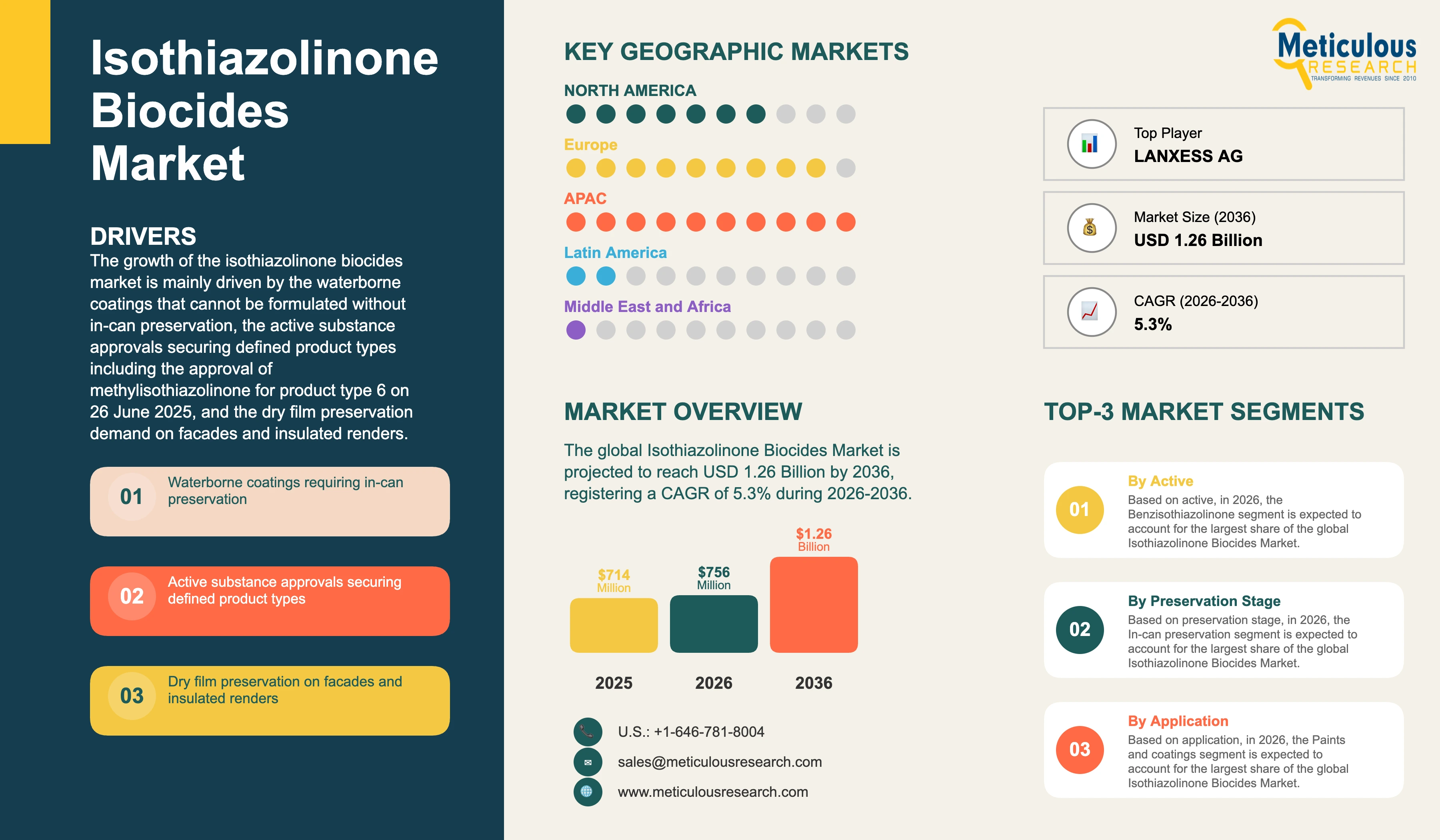
The global isothiazolinone biocides market was valued at USD 714.0 million in 2025. This market is expected to reach USD 1.26 billion by 2036 from an estimated USD 756.0 million in 2026, registering a CAGR of 5.3% during the forecast period (2026-2036).
- Published
- Nov 2026
- Pages
- 267
- Format
- PDF + Excel
- Report ID
- MRCHM - 1042808
- Base year
- 2025
- 2025 · BASELINE
- $714.0M
- 2036
- $1.26B
- CAGR 2026–2036
- 5.3%
2025 baseline · 2026–2036 forecast at 5.3% CAGR · hover a bar for the value
Key highlights
The global isothiazolinone biocides market is estimated at USD 756.0 million in 2026 and is projected to reach USD 1.26 billion by 2036.
Market volume is estimated at 42.00 kilotons in 2026 and is projected to reach 58.67 kilotons by 2036 at a CAGR of 3.4%, measured as active substance on a 100% active basis.
The average selling price is estimated at USD 18.00 per kg in 2026 and is projected to reach USD 21.50 per kg by 2036 as compliance costs are recovered and the active mix shifts.
Benzisothiazolinone is expected to account for the largest active share in 2026, while dichlorooctylisothiazolinone is projected to register the highest CAGR of 8.4%.
In-can preservation is expected to hold the largest preservation stage share in 2026, while dry film preservation is projected to grow fastest at a CAGR of 7.6%.
Paints and coatings are expected to be the largest application in 2026, while adhesives and sealants are projected to register the highest CAGR of 7.4%.
Asia-Pacific is expected to hold the largest regional share in 2026 and is also projected to register the highest CAGR of 7.4%.
Commission Implementing Regulation (EU) 2025/1257 of 26 June 2025, published in the Official Journal on 27 June 2025, approved 2-methyl-2H-isothiazol-3-one as an existing active substance for use in biocidal products of product type 6, preservatives for products during storage.
The substance is identified as EC No 220-239-6 and CAS No 2682-20-4, with a minimum degree of purity greater than 950 g/kg, subject to a technical equivalence provision.
The date of approval is 1 February 2027 and the expiry date is 31 January 2037, so the approval period straddles almost the whole of this forecast period.
The Annex requires product assessments to give particular attention to industrial and professional users, to non-professional users exposed through treated articles, and to the soil compartment.
Mixtures other than paints that are treated with or contain the substance and are sold for non-professional use must not contain it at a concentration that classifies the mixture as skin sensitiser Category 1 under the Classification, Labelling and Packaging Regulation.
That condition carries an exception where exposure can be avoided by means other than personal protective equipment.
Paints are treated separately: where sold to non-professionals at a concentration triggering the same classification, the responsible person must supply protective gloves meeting EN 374 or an equivalent standard, and the label must state that gloves must be worn during use.
Paints are therefore the one consumer product category in which the active may still be used at a sensitising concentration, on condition that gloves are supplied with it.
The assessment report was submitted by Slovenia, and the regulation does not state whether the substance is a candidate for substitution, does not give the numeric concentration threshold for the Category 1 classification, and does not specify label wording.
In Great Britain the expiry of dichlorooctylisothiazolinone in product type 8 was postponed to 30 June 2026 for reasons recorded as beyond the applicants control.
This market measures the active substances and is not additive to the formulated preservative markets that deliver them, including dry film preservatives and antimicrobial textile finishes.
Report summary
| Particulars | Details |
|---|---|
| Base Year | 2025 |
| Forecast Period | 2026-2036 |
| Market Size in 2025 | USD 714.0 million |
| Market Size in 2026 | USD 756.0 million |
| Market Size by 2036 | USD 1.26 billion |
| Value CAGR (2026-2036) | 5.3% |
| Format | PDF, Excel & Cloud Portal · 267 pages |
| Volume in 2026 | 42.00 kilotons |
| Volume by 2036 | 58.67 kilotons |
| Volume CAGR (2026-2036) | 3.4% |
| Volume Basis | Active substance supplied on a 100% active basis |
| Average Selling Price in 2026 | USD 18.00 per kg |
| Average Selling Price by 2036 | USD 21.50 per kg |
| Price Direction | Average selling price rises across the forecast period as the mix shifts toward the longer-chain actives used in film and substrate protection and as registration and compliance costs are recovered against a modest tonnage, rather than through any constraint on supply |
| Volume Basis Note | These actives are shipped as dilute aqueous or glycol solutions at widely differing strengths, from a few per cent for the chloromethyl blends to around a fifth for benzisothiazolinone, so a product mass basis would make tonnages between actives incomparable and would move with dilution choices rather than with demand; the active basis is also how loadings are specified in formulation and how concentration limits are written in regulation |
| Scope Definition Note | The boundary is set at the active substance across all its uses, which is the reciprocal of the formulated-product basis used in the reports on dry film preservatives and antimicrobial textile finishes; a formulated preservative is a dispersion in which the active is a fraction of the delivered mass, so the two measures sit at different points in the same chain |
| Measurement Basis | Benzisothiazolinone, methylisothiazolinone, chloromethylisothiazolinone and its blends, octylisothiazolinone, dichlorooctylisothiazolinone and methylbenzisothiazolinone, by active, preservation stage, application and geography, and excluding formulated preservative products measured as formulated product, non-isothiazolinone biocides, and the finished paints, adhesives, cleaners and cosmetics into which the actives are incorporated |
| Relationship to Adjacent Markets | This market is not additive to the dry film preservatives or antimicrobial textile finishes markets, which measure formulated products in which these actives are a fraction of the delivered mass; adding them together would count the same chemistry twice at two points in the chain |
| Regulatory Note | Commission Implementing Regulation (EU) 2025/1257 of 26 June 2025, published in the Official Journal on 27 June 2025, approved 2-methyl-2H-isothiazol-3-one (EC No 220-239-6, CAS No 2682-20-4) for product type 6 at a minimum degree of purity above 950 g/kg, with a date of approval of 1 February 2027 and expiry of 31 January 2037, on an assessment report submitted by Slovenia |
| Note on Treated Article Conditions | Mixtures other than paints treated with or containing the substance and sold for non-professional use must not contain it at a concentration that classifies the mixture as skin sensitiser Category 1 under the Classification, Labelling and Packaging Regulation, with an exception where exposure can be avoided other than by personal protective equipment; paints sold to non-professionals at such a concentration are permitted provided the responsible person supplies protective gloves meeting EN 374 or equivalent and the label states that gloves must be worn during use |
| Note on What the Regulation Does Not State | The regulation does not state whether the substance is a candidate for substitution, does not give the numeric concentration threshold at which the Category 1 classification is triggered, does not specify label wording or the content of the summary of product characteristics, and does not set out transitional arrangements beyond the approval and entry into force dates |
| Largest Active | Benzisothiazolinone |
| Fastest-Growing Active | Dichlorooctylisothiazolinone (CAGR 8.4%) |
| Largest Preservation Stage | In-can preservation |
| Fastest-Growing Preservation Stage | Dry film preservation (CAGR 7.6%) |
| Largest Application | Paints and coatings |
| Fastest-Growing Application | Adhesives and sealants (CAGR 7.4%) |
| Largest Region | Asia-Pacific |
| Fastest-Growing Region | Asia-Pacific (CAGR 7.4%) |
| Segments Covered | Active, Preservation Stage, Application, and Geography |
| Geographies Covered | Asia-Pacific, Europe, North America, Latin America, and Middle East & Africa |
| Companies Profiled | 6 companies, including LANXESS AG, Arxada AG, Dow Inc., Thor Group Limited, Clariant AG, and Vink Chemicals GmbH & Co. KG |
Report overview
Segments covered: active, preservation stage, application.
In volume terms, this market is estimated at 42.00 kilotons in 2026 and is projected to reach 58.67 kilotons by 2036, registering a CAGR of 3.4% during the same period, measured as active substance supplied on a 100% active basis rather than as the dilute solutions in which these actives are shipped. The average selling price is estimated at USD 18.00 per kg in 2026 and is projected to rise to USD 21.50 per kg by 2036 as registration and compliance costs are recovered and the mix shifts toward the longer-chain actives.
The growth of this market is mainly driven by the waterborne coatings that cannot be formulated without in-can preservation, the active substance approvals that have secured particular actives for defined product types, the dry film preservation demand on facades and insulated renders, and the adhesive and sealant formulations that have followed coatings into water-based chemistry. However, factors such as the skin sensitisation classification that governs how much may be used in consumer mixtures, the concentration limits applied to treated articles sold for non-professional use, the withdrawal of actives from cosmetic applications, and the cost of maintaining registrations across jurisdictions are expected to restrain the growth of this market to some extent.
Benzisothiazolinone accounts for the largest share of this market because it is the workhorse in-can preservative for waterborne paints and adhesives and is used at higher loadings than the shorter-chain actives. Dichlorooctylisothiazolinone grows fastest because its low water solubility suits the dry film and substrate applications where the active must remain in place rather than migrate out.
Isothiazolinone biocides are a family of heterocyclic actives built on the isothiazol-3-one ring, comprising benzisothiazolinone, methylisothiazolinone, chloromethylisothiazolinone and its blends with methylisothiazolinone, octylisothiazolinone, dichlorooctylisothiazolinone and methylbenzisothiazolinone, used to prevent microbial spoilage in water-based products and to protect surfaces and substrates. Market sizing in this report is on both a value basis in USD and a volume basis in kilotons measured as active substance supplied on a 100% active basis, with average selling price derived from the two. The measurement basis covers the actives themselves across all uses, and it excludes formulated preservative products measured as formulated product, non-isothiazolinone biocides, and the finished paints, adhesives, cleaners and cosmetics into which the actives are incorporated.
Measuring on a 100% active basis is necessary rather than conventional here. These actives are shipped as dilute aqueous or glycol solutions at widely differing strengths, from a few per cent for the chloromethyl blends to around a fifth for benzisothiazolinone, so a product mass basis would make tonnages between actives incomparable and would move with dilution choices rather than with demand. The active basis is also how loadings are specified in a formulation and how concentration limits are written in regulation.
Commission Implementing Regulation (EU) 2025/1257 of 26 June 2025, published in the Official Journal on 27 June 2025, approved 2-methyl-2H-isothiazol-3-one, identified as EC No 220-239-6 and CAS No 2682-20-4, as an existing active substance for product type 6, preservatives for products during storage, with a minimum degree of purity greater than 950 g/kg subject to a technical equivalence provision. The date of approval is 1 February 2027 and the expiry date is 31 January 2037, so the approval period covers almost the whole of this forecast period. The assessment report was submitted by Slovenia.
The conditions attached to that approval are where its commercial effect sits. Product assessments must give particular attention to industrial and professional users, to non-professional users exposed through treated articles, and to the soil compartment, and competent authorities must specify the instructions for use and the treated article label precautions. More consequentially, mixtures other than paints that are treated with or contain the substance and sold for non-professional use must not contain it at a concentration that classifies the mixture as skin sensitiser Category 1 under the Classification, Labelling and Packaging Regulation, with an exception where exposure can be avoided by means other than personal protective equipment.
Paints are then carved out of that prohibition and given their own rule. Where a paint is sold to non-professionals at a concentration triggering the same skin sensitiser classification, the responsible person must supply protective gloves meeting EN 374 or an equivalent standard, and the label must state that gloves must be worn during use. A paint is therefore the one consumer product in which this active may still be used at a sensitising concentration, provided the manufacturer physically supplies gloves with it.
That differential treatment is unusual in biocidal regulation and it explains a good deal about this market. The regulator has accepted that waterborne paint cannot readily be preserved without an active of this class at a meaningful concentration, and has managed the exposure through a physical control rather than a concentration limit, while applying the concentration limit everywhere else in consumer use. Paints consequently retain a position that household and personal care products have lost.
The regulation also leaves several things unstated, and this report does not fill them. It does not say whether the substance is a candidate for substitution, does not give the numeric concentration threshold at which the Category 1 classification is triggered, referring to it only by classification, does not specify label wording or the content of the summary of product characteristics, and does not set out transitional arrangements beyond the approval and entry into force dates.
Skin sensitisation is the property that governs this entire class and it is not a side issue. These actives are effective against bacteria and fungi at very low concentrations, which is what makes them commercially useful, and the same reactivity toward biological nucleophiles produces sensitisation in exposed skin. The regulatory history of the class, including its removal from leave-on cosmetic use and its restriction in rinse-off products, follows from that single property rather than from any question about efficacy.
In-can preservation is the largest stage because a waterborne product is vulnerable from the moment it is made. A can of paint, adhesive or cleaner contains water, organic binder and often starch or cellulose thickener, which is a growth medium at ambient temperature, and spoilage produces gas, odour and viscosity loss that render the product unsaleable. In-can preservation accordingly accounts for the largest preservation stage share throughout the period.
Dry film preservation is the fastest-growing stage and it uses the longer-chain members of the class. Octylisothiazolinone and dichlorooctylisothiazolinone have low water solubility, so they remain in a dried coating rather than leaching out quickly, which is what a facade requires over years of weather. The growth in insulated render systems extends that demand. Dry film preservation consequently registers the highest preservation stage CAGR at 7.6%.
Chain length is the variable that sorts this class commercially. The short-chain actives are highly active and water soluble, which suits in-can use and makes them unsuitable for retention in a film; the octyl and dichlorooctyl members are less soluble and persist in place, which suits film and substrate protection. A formulator does not choose between these actives on price so much as on where the active has to remain and for how long.
Regulatory divergence is a growing cost in this market. Beyond the European approval described above, the expiry of dichlorooctylisothiazolinone in product type 8 was postponed in Great Britain to 30 June 2026 for reasons recorded as beyond the applicants control, and each jurisdiction maintains its own approval, classification and labelling requirements. Maintaining a registration portfolio across regions is therefore a substantial fixed cost carried against a modest tonnage.
This market is not additive to the formulated preservative markets that deliver these actives. A dry film preservative or an antimicrobial textile finish is a dispersion in which the active is a fraction of the delivered mass, counted in those markets as formulated product, whereas this report counts the active itself across every use including in-can preservation, metalworking fluids, process water and personal care. Adding them together would count the same chemistry twice at two points in the chain.
Asia-Pacific is expected to account for the largest share in 2026, on the waterborne coatings and adhesives manufacturing concentrated there, the warm and humid climates that raise both spoilage and exterior growth risk, and the active substance production based in the region. India is projected to grow at 9.0%, China at 7.6% and Japan at 3.0%.
Asia-Pacific is also projected to register the highest CAGR of 7.4% during the forecast period, holding both the largest share and the fastest growth.
Europe is projected to grow at a CAGR of 4.0%, with Germany at 3.6% and France at 3.4%, on architectural coatings, external wall insulation systems and industrial applications, below the global rate because the regulatory framework constrains consumer concentrations and the cosmetic application has contracted, though its approvals and classifications set the conditions formulators design to globally.
The Middle East & Africa is projected to grow at a CAGR of 5.0%, concentrated in coatings and industrial water applications. Latin America is projected to grow at a CAGR of 5.4%, with Brazil at 5.4%, on coatings consumption and tropical exposure.
LANXESS AG, Arxada AG, Dow Inc., Thor Group Limited and Clariant AG together accounted for an estimated 56.2% of this market in 2026. The 6 companies profiled in this report together accounted for an estimated 62.4%, with the balance sitting largely with Chinese producers whose registered legal names could not be established to the standard applied in this report.
Report infographic
Market dynamics
14 factors across 5 forcesWaterborne Coatings Requiring In-Can Preservation
A can of waterborne paint contains water, organic binder and often starch or cellulose thickener, which is a growth medium at ambient temperature, and spoilage produces gas, odour and viscosity loss that makes the product unsaleable, so preservation is a formulation requirement rather than an optional addition.
Commission Implementing Regulation (EU) 2025/1257 approved methylisothiazolinone precisely for product type 6, preservatives for products during storage, which is that function, with approval running from 1 February 2027 to 31 January 2037.
There is also no practical alternative at comparable cost for many of these formulations, since the competing preservative families either release formaldehyde or require much higher loadings, so the demand is held by necessity rather than by preference.
Waterborne systems have also displaced solvent-based ones across most coatings categories for emissions and workplace exposure reasons, so the share of coatings requiring preservation at all has risen rather than held steady.
That substitution is largely complete in the mature regions and still progressing elsewhere.
Active Substance Approvals Securing Defined Product Types
An approval for a specified product type with a stated purity and a ten-year term gives a formulator the certainty to design an active into a product range, and the European approval sets a minimum degree of purity greater than 950 g/kg with provision for technically equivalent material.
Because actives in this class support modest tonnages against substantial dossier costs, a secured approval is worth more to the market than a performance improvement, and it is what allows investment in the formulations that use it.
A ten-year term also matches the period over which a coating range is developed, launched and amortised, which is why the approval dates are read as planning horizons rather than as compliance detail.
A stated minimum purity also gives a buyer a specification to test against rather than relying on a supplier assay, which matters where several producers supply the same active.
Dry Film Preservation on Facades and Insulated Renders
Octylisothiazolinone and dichlorooctylisothiazolinone have low water solubility, so they remain in a dried coating rather than leaching out quickly, which is what an exterior facade requires through years of weathering and what the growing stock of insulated render systems demands.
Dry film preservation accordingly registers the highest preservation stage CAGR at 7.6%, and dichlorooctylisothiazolinone the highest active CAGR at 8.4%.
Retrofit insulation programmes applied to existing building stock extend that surface area faster than new construction alone would, so the film preservation demand grows independently of construction activity.
Exterior surfaces in humid climates also require higher loadings for the same service life, so the application grows in value faster than in treated area.
Adhesives and Sealants Following Coatings Into Water-Based Chemistry
As adhesive and sealant formulations have moved from solvent to water-based systems for emissions and workplace exposure reasons, they have acquired the same microbial vulnerability as waterborne paint and the same requirement for in-can preservation.
Those products are also often stored for long periods before use and applied in damp joints, so they need both stages of preservation, and adhesives and sealants register the highest application CAGR at 7.4%.
Water-based adhesives are also applied in volumes comparable to paint in construction and packaging, so the application contributes meaningful tonnage rather than only a growth rate.
Sealants applied in bathrooms and kitchens also face continuous damp service, which is among the most demanding duties for a film preservative in any application.
All four drivers rest on the chemistry being required for a formulation to function rather than on it being preferred, which is why this market grows steadily through regulatory pressure that would have displaced a discretionary additive.
Table of contents
11 chapters · 137 sections · 267 pages · click to expandSegmental analysis
| Segment | Largest share (2026) | Fastest growth (2026–2036) |
|---|---|---|
| By Active | Benzisothiazolinone | Adhesives and sealants |
| Other segments | — | Dichlorooctylisothiazolinone |
By Active
- Benzisothiazolinone is expected to account for the largest share in 2026, as the workhorse in-can preservative for waterborne paints, adhesives and sealants, used at higher loadings than the shorter-chain actives.
- In-can preservation is expected to hold the largest share in 2026, since every waterborne product is vulnerable from manufacture onward and spoilage renders it unsaleable.
- Paints and coatings are expected to account for the largest share in 2026, since waterborne architectural paint requires both in-can and dry film preservation and benefits from the paint-specific provision in the European approval.
- Adhesives and sealants are projected to register the highest CAGR of 7.4% during the forecast period.
Other segments
- Dichlorooctylisothiazolinone is projected to register the highest CAGR of 8.4% during the forecast period.
- Dry film preservation is projected to register the highest CAGR of 7.6% during the forecast period.
Geographic analysis
Asia-Pacific
Largest shareWaterborne coatings and adhesives consumption is growing faster in Asia-Pacific than in the mature regions, much of it in warm and humid climates where both in-can spoilage risk and exterior biological growth are greater than in temperate Europe. Asia-Pacific is accordingly expected to hold the largest regional share in 2026 and also to register the highest regional CAGR at 7.4%, with India at 9.0% and China at 7.6%. Active substance production is also located in the region, so regional formulators buy from resident suppliers with shorter logistics than their European or North American counterparts. Humid climates also shorten the time before spoilage or growth appears, so loadings in the region tend to be at the higher end of the formulation range. Three of these four openings follow from the regulation rather than from product development, and the fourth depends on where coatings consumption is growing, so none of them requires a new active to be registered. That matters in a class where the cost of a dossier is rarely justified by the tonnage a single active supports. Each also acts on a different part of the class, so the opportunities are complementary rather than alternative, and a supplier with a broad portfolio can pursue all four. In 2026, Asia-Pacific is expected to account for the largest share of the global isothiazolinone biocides market and is also projected to register the highest CAGR of 7.4% during the forecast period. The large share and rapid growth of this region are attributed to the waterborne coatings and adhesives manufacturing concentrated there, the warm and humid climates in which both in-can spoilage risk and exterior biological growth are greater than in temperate regions, the active substance production based in the region, and the pulp and paper and metalworking industries that consume slimicide and fluid preservation. India is projected to register a CAGR of 9.0%, China a CAGR of 7.6% and Japan a CAGR of 3.0%. Asia-Pacific Coatings and Adhesives Consumption Geographic Analysis
Europe
Europe is projected to grow at 4.0%, with Germany at 3.6% and France at 3.4%, on architectural coatings, external wall insulation systems and industrial applications, below the global rate because the regulatory framework constrains consumer concentrations and because the cosmetic application has contracted. It is nonetheless the region whose approvals and classifications set the conditions under which these actives are used globally, since formulators selling into it design to its requirements.
North America
North America is projected to grow at 4.2%, with the United States at 4.2%, on coatings, adhesives and metalworking fluid demand under its own registration framework. North America operates its own registration framework, so an approval in one region does not transfer to the other and both must be maintained separately. Permitted concentration rather than technical need is therefore what varies between regions, which is unusual for an industrial chemical and specific to a class defined by a sensitisation property.
Latin America
Latin America is projected to grow at 5.4%, with Brazil at 5.4%, on coatings consumption and tropical exposure.
Middle East & Africa
The Middle East & Africa is projected to grow at 5.0%, concentrated in coatings and industrial water applications. What differs between regions is the permitted concentration rather than the technical requirement. The microbial challenge to a can of paint is much the same everywhere and the challenge to a facade depends on climate, but the loading a formulator may use in a consumer product depends on the classification and labelling rules of the market it is sold into. A multinational formulator therefore designs to the most restrictive jurisdiction it serves or maintains separate formulations, and regional value shares reflect that as much as consumption. A formulator serving several regions therefore designs to the most restrictive jurisdiction it sells into or carries separate formulations, and both responses raise cost without improving performance.
Competitive landscape
The global isothiazolinone biocides market is characterised by a small number of established biocide houses holding the registrations and supplying both actives and formulated preservatives, alongside Chinese producers supplying actives into regional and export markets. Competition is contested on registration coverage, product type approvals and formulation support rather than on active substance price, because an active without an approval for the relevant product type cannot be used at all. LANXESS AG, Arxada AG, Dow Inc., Thor Group Limited and Clariant AG together accounted for an estimated 56.2% of this market in 2026, while the companies profiled in this report together accounted for an estimated 62.4%. The balance sits largely with Chinese producers whose registered legal names could not be established to the standard applied in this report.
Regulatory decisions rather than capacity accounted for the significant developments through 2026. Commission Implementing Regulation (EU) 2025/1257 of 26 June 2025 approved methylisothiazolinone for product type 6 with a date of approval of 1 February 2027 and expiry of 31 January 2037, a minimum degree of purity greater than 950 g/kg, and conditions requiring attention to industrial and professional users, to non-professional users exposed through treated articles and to the soil compartment. The assessment report was submitted by Slovenia, and the regulation does not state whether the substance is a candidate for substitution.
The treated article conditions in that approval shape how these companies serve the consumer market. Mixtures other than paints sold for non-professional use may not contain the substance at a concentration classifying the mixture as skin sensitiser Category 1, while paints at such a concentration are permitted provided gloves meeting EN 374 are supplied and the label instructs their use. In Great Britain the expiry of dichlorooctylisothiazolinone in product type 8 was postponed to 30 June 2026 for reasons recorded as beyond the applicants control. Some of the key players operating in the isothiazolinone biocides market are LANXESS AG (Germany), Arxada AG (Switzerland), Dow Inc. (U.S.), Thor Group Limited (U.K.), Clariant AG (Switzerland), and Vink Chemicals GmbH & Co. KG (Germany), among others.
Registration breadth is consequently the most durable asset in this market, since it determines who can still offer a compliant formulation when an approval lapses or a condition tightens.
- —
Commission Implementing Regulation (EU) 2025/1257 of 26 June 2025, published in the Official Journal on 27 June 2025, approved 2-methyl-2H-isothiazol-3-one, identified as EC No 220-239-6 and CAS No 2682-20-4, as an existing active substance for use in biocidal products of product type 6, preservatives for products during storage, at a minimum degree of purity greater than 950 g/kg subject to a technical equivalence provision, with a date of approval of 1 February 2027 and an expiry date of 31 January 2037, on an assessment report submitted by Slovenia. The Annex requires product assessments to address uses not covered by the Union-level assessment and to give particular attention to industrial and professional users, to non-professional users exposed through treated articles and to the soil compartment, and requires competent authorities to specify instructions for use and treated-article label precautions. Mixtures other than paints treated with or containing the substance and sold for non-professional use must not contain it at a concentration that classifies the mixture as skin sensitiser Category 1 under Regulation (EC) No 1272/2008, with an exception where exposure can be avoided by means other than personal protective equipment, while paints sold to non-professionals at such a concentration are permitted provided the responsible person supplies protective gloves meeting EN 374 or an equivalent standard and the label states that gloves must be worn during use. The regulation does not state whether the substance is a candidate for substitution, does not give the numeric concentration threshold for the Category 1 classification, and does not specify label wording. In Great Britain the expiry of dichlorooctylisothiazolinone in product type 8 was postponed to 30 June 2026 for reasons recorded as beyond the applicants control.
- LANXESS AG
- Arxada AG
- Dow Inc.
- Thor Group Limited
- Clariant AG
- Vink Chemicals GmbH & Co. KG
Expert perspectives
Value grows at 5.3% against 3.4% in volume over the forecast period, and the average selling price rises from USD 18.00 per kg in 2026 to USD 21.50 per kg by 2036. The gap is a shift toward the longer-chain actives used in film and substrate protection, together with the recovery of registration and compliance costs carried against a modest tonnage.
The most informative document on this market is Commission Implementing Regulation (EU) 2025/1257 of 26 June 2025, which approved methylisothiazolinone for product type 6 from 1 February 2027 to 31 January 2037 at a minimum purity above 950 g/kg. The term alone matters, because it gives a formulator a defined horizon over almost the whole of this forecast period.
The conditions matter more. Mixtures other than paints sold for non-professional use may not contain the active at a concentration that classifies the mixture as skin sensitiser Category 1, except where exposure can be avoided by means other than personal protective equipment. That is a concentration cap on consumer products reached through classification rather than through a stated number, and the regulation does not give the numeric threshold.
Paints are then treated separately, and that is the finding worth carrying away. A paint sold to non-professionals at a sensitising concentration is permitted provided the responsible person supplies gloves meeting EN 374 and the label states they must be worn. The regulator has managed exposure in the one application it evidently judged could not be preserved otherwise through a physical control rather than a concentration limit.
For this market that carve-out protects its largest application. Paints and coatings consume more of these actives than anything else, they require both in-can and dry film preservation, and the consumer segment of that demand would have been constrained had the general rule applied. No other consumer category received comparable treatment, and personal care, having lost leave-on use entirely, grows slowest here.
What sorts this class is chain length rather than price. The short-chain actives are water soluble and suit in-can duty; the octyl and dichlorooctyl members stay in a film or substrate, which is why dichlorooctylisothiazolinone grows fastest at 8.4% and dry film preservation at 7.6%. This market measures the actives and is not additive to the formulated dry film preservative or antimicrobial textile finish markets that deliver them.
That is also why the leading positions in this market have remained stable through repeated regulatory change, since breadth of approval rather than capacity is what defends them.
Customer perspectives
Under the European approval a paint sold to non-professionals at a sensitising concentration is permitted provided gloves meeting EN 374 are supplied and the label instructs their use, while other consumer mixtures face a concentration limit reached through classification.
That distinction preserves the loadings waterborne paint requires for storage stability.
The obligation also sits with the party placing the paint on the market rather than with the biocide supplier, so the cost of compliance falls downstream of this market.
Mixtures other than paints sold for non-professional use may not contain the active above the concentration that classifies the mixture as skin sensitiser Category 1, so formulators combine actives with different spectra to reach the required preservation while keeping each below the threshold.
Combination systems also spread regulatory exposure across more than one approval, which is a secondary reason for adopting them.
The European approval of methylisothiazolinone for product type 6 runs from 1 February 2027 to 31 January 2037, so the term of an approval sets the horizon over which a formulation can be relied upon and is now requested alongside performance data.
An approval that expires inside a product development cycle is treated as a reason not to start, which is why terms matter as much as conditions.
“The glove requirement is workable. A hard concentration cap would not have been, because below a certain level the can simply spoils in the warehouse.”
“We do not get the paint exemption, so we are combining actives to stay under the classification. That usually means more total preservative, not less.”
“We now ask for the approval date and the expiry before the technical data. A ten-year term tells me how long I can build a product around it.”
Frequently asked questions
This market was valued at USD 677.2 million in 2024 and USD 714.0 million in 2025, and is estimated at USD 756.0 million in 2026. In volume terms it is estimated at 42.00 kilotons in 2026 as active substance supplied on a 100% active basis.
This market is projected to reach USD 1.26 billion by 2036 in value and 58.67 kilotons in volume.
This market is projected to register a value CAGR of 5.3% and a volume CAGR of 3.4% during the forecast period 2026-2036. The average selling price is projected to move from USD 18.00 per kg in 2026 to USD 21.50 per kg by 2036 as the active mix shifts.
Growth is driven by the waterborne coatings that cannot be formulated without in-can preservation, the active substance approvals securing defined product types including the approval of methylisothiazolinone for product type 6 on 26 June 2025, the dry film preservation demand on facades and insulated renders, and the adhesive and sealant formulations that have followed coatings into water-based chemistry.
Skin sensitisation classification rather than efficacy governs permitted concentrations, and mixtures other than paints sold for non-professional use may not contain the active above the concentration classifying the mixture as skin sensitiser Category 1. The class has been withdrawn from leave-on cosmetic use, and maintaining registrations across jurisdictions is a substantial fixed cost against modest tonnage.
The paint carve-out permits consumer use at sensitising concentrations where gloves meeting EN 374 are supplied, and longer-chain actives are retained in films and substrates where short-chain actives cannot be. Combination systems reach efficacy at lower individual loadings, and Asia-Pacific coatings and adhesives consumption is growing in climates where the microbial challenge is greater.
Benzisothiazolinone is expected to account for the largest share in 2026, as the workhorse in-can preservative for waterborne paints, adhesives and sealants, used at higher loadings than the shorter-chain actives.
Dichlorooctylisothiazolinone is projected to register the highest CAGR of 8.4% during the forecast period.
In-can preservation is expected to hold the largest share in 2026, since every waterborne product is vulnerable from manufacture onward and spoilage renders it unsaleable.
Dry film preservation is projected to register the highest CAGR of 7.6% during the forecast period.
Paints and coatings are expected to account for the largest share in 2026, since waterborne architectural paint requires both in-can and dry film preservation and benefits from the paint-specific provision in the European approval.
Adhesives and sealants are projected to register the highest CAGR of 7.4% during the forecast period.
Asia-Pacific is expected to account for the largest share in 2026, on the waterborne coatings and adhesives manufacturing concentrated there, the warm and humid climates, and the active substance production based in the region. India is projected to grow at 9.0%, China at 7.6% and Japan at 3.0%.
Asia-Pacific is also projected to register the highest CAGR of 7.4% during the forecast period, holding both the largest share and the fastest growth.
Europe is projected to grow at a CAGR of 4.0%, with Germany at 3.6% and France at 3.4%, below the global rate because the regulatory framework constrains consumer concentrations and the cosmetic application has contracted. Its approvals and classifications still set the conditions formulators design to globally.
The Middle East & Africa is projected to grow at a CAGR of 5.0%, concentrated in coatings and industrial water applications. Latin America is projected to grow at a CAGR of 5.4%, with Brazil at 5.4%, on coatings consumption and tropical exposure.
LANXESS AG, Arxada AG, Dow Inc., Thor Group Limited and Clariant AG together accounted for an estimated 56.2% of this market in 2026. The 6 companies profiled in this report together accounted for an estimated 62.4%, with the balance largely with Chinese producers whose registered legal names could not be established.
Commission Implementing Regulation (EU) 2025/1257 of 26 June 2025 approved 2-methyl-2H-isothiazol-3-one for product type 6, with approval from 1 February 2027 to 31 January 2037 and a minimum purity greater than 950 g/kg. Mixtures other than paints sold for non-professional use may not contain it at a concentration classifying the mixture as skin sensitiser Category 1, while paints are permitted if EN 374 gloves are supplied; in Great Britain the expiry of dichlorooctylisothiazolinone in product type 8 was postponed to 30 June 2026.
Cite this report
Meticulous Research. (2026). Isothiazolinone Biocides Market - Global Opportunity Analysis and Industry Forecast (2026-2036) (Report No. MRCHM - 1042808). Meticulous Market Research Pvt. Ltd. https://www.meticulousresearch.com/product/isothiazolinone-biocides-market-7491