Pyrolysis Oil from Waste Plastics Market (2026-2036)
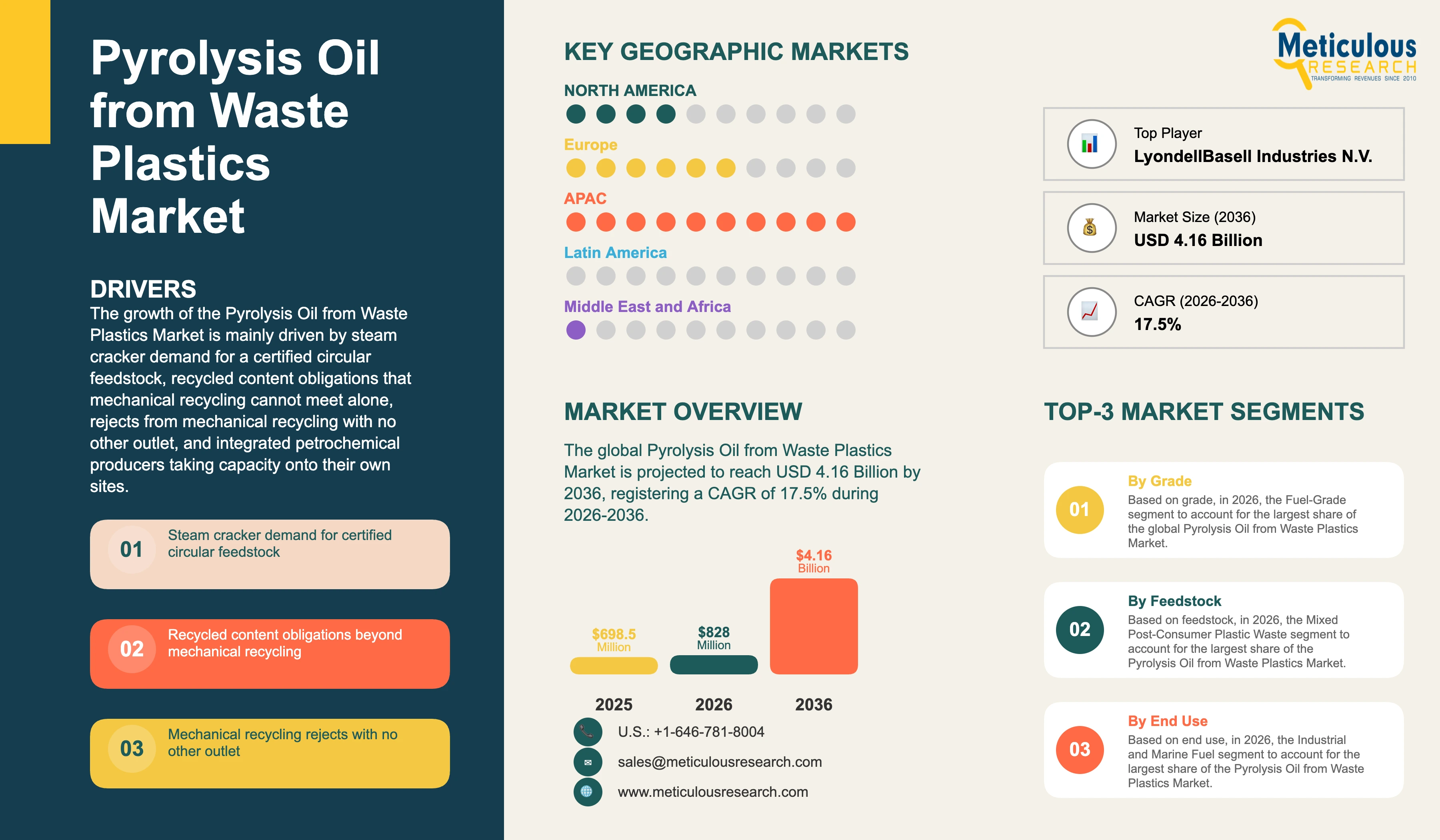
The pyrolysis oil from waste plastics market is valued at USD 828.0 million in 2026 and is projected to reach USD 4.16 billion by 2036, at a CAGR of 17.5% during the forecast period. The market was valued at USD 698.5 million in 2025 and at USD 591.9 million in 2024.
- Published
- Nov 2026
- Pages
- 249
- Format
- PDF + Excel
- Report ID
- MRCHM - 1042754
- Base year
- 2025
- 2024 · HISTORICAL
- $591.9M
- 2036
- $4.16B
- CAGR 2026–2036
- 17.5%
2024–2025 baseline · 2026–2036 forecast at 17.5% CAGR · hover a bar for the value
Key highlights
This market measures pyrolysis oil produced from waste plastics and sold or transferred as petrochemical or refinery feedstock or as fuel, measured at the pyrolysis plant gate on a tonne of oil basis.
Tyre pyrolysis oil is excluded because its feedstock, sulphur content and outlets differ, as are pyrolysis gas and solid char sold separately, the waste plastic feedstock itself, and the polymers subsequently made from the oil.
The flagship European project is MoReTec-1, a fully electrified chemical recycling plant at Wesseling in Germany coordinated by Basell Polyolefine GmbH, with pyrolysis oil output of 40 kilotonnes a year and pyrolysis gas output of 7 kilotonnes a year.
That plant carries a European Union Innovation Fund grant of EUR 40 million and is expected to avoid 823,484 tonnes of carbon dioxide equivalent against its reference scenario.
Its start date was 1 January 2024, financial close 30 June 2025 and entry into operation 31 July 2027, as recorded in the project fiche updated on 2 October 2026.
The same company announced the project on 18 November 2022 with a capacity of 50, 000 tonnes a year and an expected start-up at the end of 2025, so the flagship European plant has slipped about 19 months against its own announced schedule.
A 40 kilotonne oil output is about 3.5% of world pyrolysis oil volume in 2026, so the plant that defines European chemical recycling ambition is a small fraction of the material actually produced.
Article 7 of Regulation (EU) 2025/40 requires recycled content to be recovered from post-consumer plastic waste, calculated as an average per manufacturing plant and year, and demonstrated in the technical information concerning the packaging.
The obligation applies by 1 January 2030 or three years from the date of entry into force of the implementing act referred to in Article 7(8), whichever is later, and that implementing act is due by 31 December 2026.
Because the deadline moves with the act, and because the act will set the rules for calculating and verifying recycled content, the single largest commercial uncertainty in this market is a measure that has not yet been made.
Recital 152 states that it is not yet appropriate to amend the targets set for 2030, and that any review should not take place earlier than the general evaluation seven years after entry into force.
Recital 151 nonetheless records that it should still be possible to postpone the deadlines for attaining the 2030 recycling targets under certain conditions, with the Commission able to reject a revised implementation plan.
That post-consumer requirement matters directly, because post-industrial and commercial film is the cleanest pyrolysis feedstock and holds 31% of this market in 2026.
Pyrolysis oil as produced carries chlorine, silicon, nitrogen, oxygenates, metals and reactive dienes at levels a steam cracker will not accept, so it must be hydrotreated or blended heavily before it can displace naphtha.
Most current tonnage is fuel-grade and is burned rather than cracked, at 58% of volume in 2026, and material burned as fuel counts toward no recycled content obligation anywhere.
Circular polymer output at one integrated producer was held steady at about 206, 000 tonnes in 2025, which indicates that the downstream pull for certified circular material has not yet grown as fast as the supply ambition.
The pyrolysis oil from the Wesseling plant is fed to the crackers of its owner rather than sold on, with waste supplied by the Source One Plastics joint venture, which is the integration pattern emerging across this market.
Among feedstocks, mixed post-consumer plastic waste is expected to hold the largest share in 2026, while among end uses steam cracker feedstock is expected to grow fastest.
Report summary
| Particulars | Details |
|---|---|
| Base Year | 2025 |
| Actual Years | 2024-2025 |
| Forecast Period | 2026-2036 |
| Market Size in 2024 | USD 591.9 million |
| Market Size in 2025 | USD 698.5 million |
| Market Size in 2026 | USD 828.0 million |
| Market Size in 2036 | USD 4.16 billion |
| Value CAGR (2026-2036) | 17.5% |
| Format | PDF, Excel & Cloud Portal · 249 pages |
| Volume in 2025 | 1,012.32 kilotons |
| Volume in 2026 | 1,150.00 kilotons |
| Volume in 2036 | 4,116.15 kilotons |
| Volume CAGR (2026-2036) | 13.6% |
| Average Selling Price, 2026 | USD 720 per tonne |
| Average Selling Price, 2036 | USD 1,010 per tonne |
| Units | Value in USD million; volume in kilotons of pyrolysis oil; price in USD per tonne |
| Measurement Basis | Pyrolysis oil produced from waste plastics and sold or transferred as petrochemical or refinery feedstock or as fuel, measured at the pyrolysis plant gate on a tonne of oil basis |
| Fuel-Grade Note | Fuel-grade oil is 58% of volume in 2026 and is burned rather than cracked; material burned as fuel counts toward no recycled content obligation in any jurisdiction, so the majority of current tonnage sits outside the chemical recycling case |
| Regulatory Dependency | The recycled content obligation in Article 7 of Regulation (EU) 2025/40 applies by 1 January 2030 or three years from the entry into force of the implementing act under Article 7(8), whichever is later; that act is due by 31 December 2026 and will set the attribution rules |
| Exclusions | Tyre pyrolysis oil; pyrolysis gas and solid char sold separately; the waste plastic feedstock itself; polymers subsequently produced from the oil; mechanical recycling; gasification and methanolysis routes; waste-to-energy incineration; sorting and pre-treatment equipment |
| Segments: Grade | Fuel-Grade; Petrochemical-Grade; Upgraded and Hydrotreated |
| Segments: Feedstock | Mixed Post-Consumer Plastic Waste; Post-Industrial and Commercial Film; Rejects from Mechanical Recycling; Other and Mixed Streams |
| Segments: End Use | Steam Cracker Feedstock; Industrial and Marine Fuel; Refinery Co-Processing; Chemicals and Waxes |
| Largest Segment by Grade, 2026 | Fuel-Grade, at 58.0% |
| Fastest-Growing Segment by Grade | Upgraded and Hydrotreated, at 25.6% |
| Largest Segment by Feedstock, 2026 | Mixed Post-Consumer Plastic Waste, at 46.0% |
| Fastest-Growing Segment by Feedstock | Mixed Post-Consumer Plastic Waste, at 19.3% |
| Largest Segment by End Use, 2026 | Industrial and Marine Fuel, at 38.0% |
| Fastest-Growing Segment by End Use | Steam Cracker Feedstock, at 23.6% |
| Largest Region, 2026 | Asia-Pacific, at 47.0% |
| Fastest-Growing Region | Europe, at 20.4% |
| Fastest-Growing Country | Germany, at 22.4% |
| Slowest-Growing Country | Japan, at 14.0% |
| Regions Covered | Asia-Pacific; Europe; North America; Middle East & Africa; Latin America |
| Countries Covered | China; India; Japan; South Korea; Germany; Netherlands; Spain; U.K.; U.S.; Canada; Mexico; Brazil |
| Key Players | LyondellBasell Industries N.V.; ExxonMobil Corporation; BASF SE; Saudi Basic Industries Corporation; OMV Aktiengesellschaft; Mura Technology Limited |
| Top Five Share, 2026 | 34.8% |
| Profiled Companies Share, 2026 | 36.6% |
| Currency | USD |
Report overview
Market value is measured in in USD million; volume in kilotons of pyrolysis oil; price in USD per tonne. Segments covered: grade, feedstock, end use.
In volume terms, the market is estimated at 1,150.00 kilotons of pyrolysis oil in 2026, rising to 4,116.15 kilotons by 2036, at a CAGR of 13.6%. The average selling price is estimated at USD 720 per tonne in 2026 and USD 1,010 per tonne in 2036, the increase reflecting a shift in the mix from fuel-grade oil priced against fuel oil toward petrochemical-grade and hydrotreated oil sold into steam crackers at a certified circular premium.
The growth of this market is mainly driven by steam cracker demand for a certified circular feedstock, recycled content obligations that mechanical recycling alone cannot meet, rejects from mechanical recycling that have no other outlet, and integrated petrochemical producers taking pyrolysis capacity onto their own sites. However, factors such as flagship capacity arriving late and small against announcement, the implementing act that will decide how the output counts not yet made, oil that must be hydrotreated before a cracker will accept it, and most current tonnage being burned as fuel rather than cracked are expected to restrain the growth of this market to some extent.
Among grades, fuel-grade pyrolysis oil is expected to hold the largest share of this market in 2026, while upgraded and hydrotreated oil is expected to record the highest CAGR during the forecast period. Geographically, Asia-Pacific is expected to account for the largest share of this market in 2026, while Europe is expected to register the highest CAGR during the forecast period.
Pyrolysis heats mixed waste plastic in the absence of oxygen so that the polymer chains break into shorter hydrocarbons. The output separates into a condensable liquid, a non-condensable gas and a solid char. The liquid, pyrolysis oil, is a naphtha-like mixture whose composition depends entirely on what went into the reactor, and that dependence is the defining commercial feature of this market.
A polyolefin feed yields largely paraffinic and olefinic hydrocarbons that a steam cracker can use. Polystyrene yields styrene and aromatics. Polyvinyl chloride yields hydrogen chloride that attacks the reactor and poisons downstream catalysts, and polyethylene terephthalate yields oxygenates and acids. A mixed municipal stream contains all of them, so sorting ahead of the reactor determines what the oil is worth.
Even from a clean polyolefin feed the oil as produced is not cracker feedstock. It carries chlorine, silicon, nitrogen, oxygenates, metals and reactive dienes at levels that foul furnace tubes, poison hydrogenation catalysts and contaminate product streams, so it must be hydrotreated or blended at low percentages into fossil naphtha before a cracker will accept it.
That requirement splits the market into three grades. Fuel-grade oil is sold as industrial or marine fuel and priced against fuel oil. Petrochemical-grade oil meets a cracker specification after sorting, process control and light treatment. Upgraded and hydrotreated oil has been through a hydroprocessing step and commands the highest price.
Fuel-grade material holds 58% of volume in 2026, which is the single most important and least discussed fact about this market. Most pyrolysis oil produced today is burned, and material burned as fuel counts toward no recycled content obligation in any jurisdiction, so the majority of current tonnage sits outside the chemical recycling story entirely.
That split is not a transitional artefact. Fuel sale requires no sorting discipline beyond keeping chlorine within boiler tolerance, no hydrotreating, no certification and no qualification programme, and it pays promptly against a crude-linked index. Cracker sale requires all four and pays only once a qualification is complete, so the easier transaction wins wherever the premium is not yet contracted.
The commercial case for the petrochemical grades rests on recycled content obligation. Article 7 of Regulation (EU) 2025/40 requires minimum recycled content in plastic packaging, recovered from post-consumer plastic waste, calculated as an average per manufacturing plant and year and demonstrated in the technical information concerning the packaging.
Mechanical recycling cannot meet those thresholds alone for contact-sensitive and multilayer packaging, so chemical recycling is the route by which a converter reaches a figure it otherwise cannot, and that is what justifies a premium over fossil naphtha.
The obligation is not yet operable, and that is the central uncertainty. It applies by 1 January 2030 or three years from the entry into force of the implementing act referred to in Article 7(8), whichever is later, and that implementing act is due by 31 December 2026.
Until the act is made, the rules for calculating and verifying recycled content are unknown, which means nobody can state with certainty how a tonne of pyrolysis oil fed to a cracker will be attributed to a finished polymer, and the deadline itself moves with the act. Recital 151 records that it should still be possible to postpone the deadlines for attaining the 2030 recycling targets under certain conditions, while Recital 152 states that it is not yet appropriate to amend the 2030 targets themselves.
The requirement that content be recovered from post-consumer waste cuts directly across the feedstock a pyrolysis plant most wants. Post-industrial and commercial film is cleaner, drier, of known polymer and available in contracted volumes, and it holds 31% of this market in 2026, but it is not post-consumer.
Capacity is the second constraint, and the published record shows it arriving late and small. MoReTec-1 at Wesseling in Germany was announced on 18 November 2022 at 50,000 tonnes a year with an expected start-up at the end of 2025.
The European project fiche updated on 2 October 2026 records pyrolysis oil output of 40 kilotonnes a year and pyrolysis gas of 7 kilotonnes, a European Union Innovation Fund grant of EUR 40 million, financial close on 30 June 2025 and entry into operation on 31 July 2027.
A slippage of about 19 months on the flagship European plant, which needed a EUR 40 million grant to reach financial close, is a better guide to the pace of this market than any announced capacity total, and 40 kilotonnes is about 3.5% of world pyrolysis oil volume in 2026.
Integration rather than merchant supply is how the credible capacity is being built. The Wesseling oil goes to the crackers of its own owner, with waste supplied through the Source One Plastics joint venture, so feedstock supply, pyrolysis, upgrading and cracking sit inside one group and no price has to be agreed between them.
Downstream pull has not yet matched the ambition. Circular polymer output at that producer was held steady at about 206,000 tonnes in 2025, and a flat figure indicates that brand owners have been slower to contract certified circular material at a premium than the supply announcements assumed. A premium that exists in principle but is not drawn in volume cannot support capacity, and the obligation that would compel it is not yet in force.
Geography follows that split. Asia-Pacific holds the largest volume share on a large base of fuel-grade production, while Europe grows fastest because it is where the recycled content obligation and the petrochemical-grade premium both sit.
Asia-Pacific is expected to account for 47.0% of this market in 2026, holding the largest installed pyrolysis base and the largest steam cracking capacity. Europe is projected to grow fastest at 20.4%, where the recycled content obligation sits, and Germany is the fastest growing country at 22.4%.
Europe grows fastest at 20.4%, holding the recycled content obligation and the flagship project carrying a EUR 40 million Innovation Fund grant. The Middle East & Africa grows at 17.0%, where new cracker capacity is designed with circular feedstock provision from the outset, and Latin America at 16.0% from the smallest base.
The flagship European project, MoReTec-1 at Wesseling, will deliver 40 kilotonnes a year of pyrolysis oil and 7 kilotonnes of pyrolysis gas from an entry into operation of 31 July 2027. That is about 3.5% of world pyrolysis oil volume in 2026, most of which comes from a long tail of small-scale fuel-grade producers rather than from petrochemical-grade plants.
It was announced on 18 November 2022 with a capacity of 50,000 tonnes a year and an expected start-up at the end of 2025. The project fiche updated on 2 October 2026 records a start date of 1 January 2024, financial close on 30 June 2025 and entry into operation on 31 July 2027, a slippage of about 19 months, with a EUR 40 million Innovation Fund grant supporting it.
It sets the rules for calculating and verifying recycled content, including how output from a chemical recycling route is attributed to a finished product. It is due by 31 December 2026, and the recycled content obligation applies by 1 January 2030 or three years from its entry into force, whichever is later, so both the attribution rules and the deadline depend on it.
As produced it carries chlorine, silicon, nitrogen, oxygenates, metals and reactive dienes at levels that foul furnace tubes and poison downstream catalysts, so it must be hydrotreated or blended at low percentages. Fuel-grade sale requires none of that discipline, pays against fuel oil and is the easier transaction, which is why 58% of volume is burned.
Growth is concentrated in the grades and outlets that carry a regulatory obligation behind them. Upgraded and hydrotreated oil grows at 25.6% and steam cracker feedstock at 23.6%, against 12.2% for fuel-grade and 11.2% for fuel use, so the mix shift raises the average selling price from USD 720 per tonne to USD 1,010 per tonne.
LyondellBasell Industries N.V., ExxonMobil Corporation, BASF SE, Saudi Basic Industries Corporation, OMV Aktiengesellschaft and Mura Technology Limited. The top five hold 34.8% of this market in 2026 and the six profiled companies hold 36.6%, with fuel-grade production spread across a long tail of small operators.
Report infographic
Market dynamics
20 factors across 5 forcesSteam cracker demand for a certified circular feedstock
A steam cracker is the single largest consumer of naphtha in the chemical industry, and a tonne of pyrolysis oil that meets specification displaces a tonne of fossil naphtha in an asset already built, which makes it the lowest capital route to circular polymer for an integrated producer.
MoReTec-1 at Wesseling will deliver 40 kilotonnes a year of pyrolysis oil and 7 kilotonnes of pyrolysis gas into its owner crackers, producing polymers for food packaging and healthcare applications that mechanical recyclate cannot serve.
Steam cracker feedstock grows at 23.6%, the fastest end use in this market, and it is the segment that carries the certified circular premium on which the whole petrochemical-grade case depends.
Recycled content obligations that mechanical recycling cannot meet alone
Article 7 of Regulation (EU) 2025/40 requires minimum recycled content in plastic packaging recovered from post-consumer plastic waste, calculated as an average per manufacturing plant and year and demonstrated in the technical information concerning the packaging.
Contact-sensitive packaging, multilayer film and coloured or contaminated streams cannot reach those thresholds through mechanical recycling, because the recyclate either fails food-contact approval or cannot be separated to a single polymer at acceptable quality.
Chemical recycling is the route by which a converter reaches a figure it otherwise cannot, which is the basis for a premium over fossil naphtha and the reason Europe grows fastest in this market at 20.4%.
Rejects from mechanical recycling that have no other outlet
A mechanical recycling plant rejects a substantial share of its input as mixed, multilayer, coloured or contaminated material that cannot be separated to a saleable polymer, and that reject stream currently goes to incineration or landfill.
Pyrolysis takes material that mechanical recycling has already declined, so the two routes are complementary rather than competing, and a pyrolysis plant sited alongside a sorting facility secures feedstock that nobody else wants.
Rejects from mechanical recycling hold 14% of feedstock in 2026 and grow at 18.5%, above the feedstock average, because the volume rises with mechanical recycling capacity rather than against it.
Integrated petrochemical producers taking capacity onto their own sites
The Wesseling plant feeds its pyrolysis oil and gas directly to the crackers of its owner, with waste supplied through the Source One Plastics joint venture, so feedstock supply, pyrolysis, upgrading and cracking all sit inside a single group.
Integration removes the need to agree a transfer price for an oil whose specification is still being established, and it removes the counterparty risk that has undermined merchant pyrolysis projects dependent on a single offtake agreement.
It also places the plant behind the gate of an operator that already holds the hydrotreating and cracking assets, which is why the credible capacity additions in this market are being made by petrochemical producers rather than by waste companies.
Integration additionally gives the plant a single quality standard to meet rather than a negotiated specification, since the cracker operator and the pyrolysis operator are the same party and can trade yield against blend ratio internally.
Table of contents
11 chapters · 123 sections · 249 pages · click to expandSegmental analysis
| Segment | Largest share (2026) | Fastest growth (2026–2036) |
|---|---|---|
| By Grade | Fuel-grade pyrolysis oil | Upgraded and hydrotreated oil |
| By Feedstock | Mixed post-consumer plastic waste | — |
| By End Use | Industrial and marine fuel | Steam cracker feedstock holds 34% and |
| Other segments | Mixed post-consumer plastic waste | Mixed post-consumer plastic waste |
By Grade
- Pyrolysis Oil from Waste Plastics Market Analysis by Grade
- Fuel-grade pyrolysis oil is expected to account for the largest share of this market in 2026 at 58%.
- It requires no sorting discipline beyond keeping chlorine within boiler tolerance, no hydrotreating and no certification, and it is sold as industrial or marine fuel at a price set against fuel oil and therefore against crude.
- The segment grows slowest at 12.2%, and material burned as fuel counts toward no recycled content obligation anywhere, so the largest grade in this market sits entirely outside the chemical recycling case that justifies its growth.
- Its price moves with crude rather than with regulation, which makes it the segment least exposed to the implementing act and least rewarded by it.
- Petrochemical-grade oil holds 29% and grows at 24.4%, meeting a steam cracker specification after controlled sorting, careful process operation and light treatment.
- It carries the certified circular premium that makes the economics work, and it is the grade whose value depends most directly on how the implementing act under Article 7(8) resolves attribution.
- Upgraded and hydrotreated oil is projected to register the highest CAGR of 25.6% during the forecast period.
- Hydroprocessing removes chlorine, silicon, nitrogen and oxygenates and saturates reactive dienes, so the product can be fed to a cracker at far higher blend ratios than untreated oil.
- Blend ratio rather than availability is what currently limits how much pyrolysis oil a cracker can take, which is why the most processed grade grows fastest from the smallest base and why the margin in this market is migrating toward whoever owns the hydrotreater.
- Hydroprocessing also consumes hydrogen, so the cost of the step tracks the hydrogen price as well as the capital, which is a second reason it sits with an operator that already makes its own.
- Fuel-grade pyrolysis oil is expected to hold the largest share in 2026 at 58.0%, requiring no hydrotreating or certification and priced against fuel oil.
- Upgraded and hydrotreated oil is projected to grow fastest at 25.6%, followed by petrochemical-grade at 24.4%.
By Feedstock
- Pyrolysis Oil from Waste Plastics Market Analysis by Feedstock
- Mixed post-consumer plastic waste is expected to account for the largest share of this market in 2026 at 46%.
- It is the stream the regulation recognises, since Article 7 of Regulation (EU) 2025/40 requires recycled content to be recovered from post-consumer plastic waste, and it is the stream with the greatest available tonnage.
- It grows fastest among the major feedstocks at 19.3%, but it also carries the greatest variability, since a municipal stream contains polyvinyl chloride and polyethylene terephthalate alongside the polyolefins the process wants, and the cost of removing them falls on sorting rather than on pyrolysis.
- Post-industrial and commercial film holds 31% and grows slowest at 14.9%.
- It is cleaner, drier, of known polymer and available in contracted volumes, which makes it the preferred feedstock technically, but it is not post-consumer and therefore does not satisfy the sourcing requirement for regulated recycled content.
- Rejects from mechanical recycling hold 14% and grow at 18.5%, comprising mixed, multilayer, coloured and contaminated material that a sorting plant has already declined, and the volume rises with mechanical recycling capacity rather than competing against it.
- Other and mixed streams grow at 15.9%, covering agricultural film, fishing gear, automotive shredder plastics and construction waste, each of which arrives with its own contamination profile and requires its own sorting arrangement, which is why they remain a collection of niches rather than a single addressable stream.
By End Use
- Pyrolysis Oil from Waste Plastics Market Analysis by End Use
- Industrial and marine fuel is expected to hold the largest share of end use in 2026 at 38%, which is the plainest statement of what this market currently does with its output.
- The oil displaces heavy fuel oil or gas oil in boilers, kilns and marine engines at a price linked to crude.
- It grows slowest at 11.2%, because the application creates no circularity claim, attracts no premium and is exposed directly to fuel price cycles, yet it remains the default outlet wherever cracker qualification has not been completed.
- Steam cracker feedstock holds 34% and is projected to register the highest CAGR of 23.6% during the forecast period, displacing fossil naphtha in an asset already built and producing polymers that can carry a certified circular claim into food packaging and healthcare applications.
- Refinery co-processing holds 18% and grows at 18.0%, taking oil into an existing hydrotreater or fluid catalytic cracker at modest blend ratios without the specification discipline a steam cracker demands, which makes it the pragmatic destination for oil better than fuel-grade but not yet cracker-grade.
- Chemicals and waxes grow at 19.6% from the smallest base, covering aromatics recovery from polystyrene-rich feeds and wax fractions used in coatings and adhesives, where a narrow cut commands a price no bulk outlet matches.
- That segment depends on feedstock purity rather than on volume, since recovering styrene or a defined wax cut requires a single-polymer input that a mixed municipal stream cannot provide, so it grows where dedicated collection exists rather than where tonnage is largest.
Other segments
- Mixed post-consumer plastic waste is expected to hold the largest share in 2026 at 46.0% and is also the fastest growing at 19.3%, because it is the stream the regulation recognises.
- Rejects from mechanical recycling follow at 18.5%.
- Industrial and marine fuel is expected to hold the largest share in 2026 at 38.0%, which is the plainest statement of what this market currently does with its output.
- Steam cracker feedstock is projected to grow fastest at 23.6%, followed by chemicals and waxes at 19.6%.
Geographic analysis
Asia-Pacific
Largest shareAsia-Pacific is expected to account for the largest share of this market in 2026, at 47%. The region holds the largest installed base of pyrolysis capacity, much of it small-scale and producing fuel-grade oil for industrial burners, alongside the largest concentration of steam cracking capacity in China, South Korea and Japan. The region grows slowest at 15.4%, because its base is already large and because most of its output is fuel-grade and therefore exposed to crude-linked pricing rather than to a certified circular premium. Growth there depends on converting existing fuel-grade plants to a cracker specification rather than on building capacity, which is a sorting and process-control problem rather than a capital one.
Europe
Fastest growthEurope is projected to register the highest CAGR of 20.4% during the forecast period, holding 27% of this market. It is where the recycled content obligation sits, where the petrochemical-grade premium is being established, and where the flagship project carries a EUR 40 million Innovation Fund grant. Germany holds the largest European position and is the fastest growing country in this market at 22.4%, with MoReTec-1 at Wesseling entering operation on 31 July 2027 and feeding its 40 kilotonnes a year of pyrolysis oil to crackers on the same site.
North America
North America grows at 19.0% and holds 20%, with integrated producers adding advanced recycling capacity alongside existing crackers on the Gulf Coast, and with state-level rules treating pyrolysis as manufacturing rather than incineration shaping where plants can be permitted.
Middle East & Africa
The Middle East & Africa grows at 17.0% and holds 4%, where new cracker capacity is being built with circular feedstock provision designed in from the outset rather than retrofitted, which avoids the blend-ratio constraint that limits an existing furnace.
Latin America
Latin America grows at 16.0% from the smallest base, with demand following export packaging specifications rather than domestic rules. Regional shares in this market follow cracking capacity rather than waste generation, because the oil is worth far more delivered to a cracker than burned, and because the oil travels more readily than the baled waste it came from.
Competitive landscape
This market is fragmented in production and concentrated in offtake, with the six companies profiled holding 36.6% of it in 2026 and the top five 34.8%. Fuel-grade oil is produced by a long tail of small operators, while petrochemical-grade oil is almost entirely produced or consumed by integrated petrochemical companies that own the hydrotreating and cracking assets which realise its value.
LyondellBasell Industries N.V. holds the most advanced European position through MoReTec, with MoReTec-1 at Wesseling delivering 40 kilotonnes a year of pyrolysis oil and 7 kilotonnes of pyrolysis gas to its own crackers from 31 July 2027, supported by a EUR 40 million Innovation Fund grant and fed by the Source One Plastics joint venture. Its circular polymer output was held steady at about 206,000 tonnes in 2025.
ExxonMobil Corporation holds the largest North American advanced recycling position, processing waste plastic alongside existing cracker and refining assets on the United States Gulf Coast, which gives it the hydrotreating capacity that standalone developers lack.
BASF SE and Saudi Basic Industries Corporation both buy pyrolysis oil as a certified feedstock and sell the resulting polymers under circular product lines, OMV Aktiengesellschaft operates its own pyrolysis technology integrated with a refinery and cracker complex, and Mura Technology Limited holds a technology and plant development position licensing its process to operators.
Position in this market is held by owning both ends of the chain rather than by scale in the middle. A pyrolysis plant without a hydrotreater sells an intermediate into a market with very few buyers, each of whom holds the assets that create the value, so the credible capacity is being built behind petrochemical gates rather than offered to a merchant market.
Competitive activity over the last two years has consisted of final investment decisions, public funding awards and schedule revisions rather than of capacity races. The flagship European project reached financial close only on 30 June 2025 with a EUR 40 million grant, nearly three years after it was announced, which is the pace at which position is currently changing.
Some of the key players operating in the pyrolysis oil from waste plastics market are LyondellBasell Industries N.V., ExxonMobil Corporation, BASF SE, Saudi Basic Industries Corporation, OMV Aktiengesellschaft, and Mura Technology Limited, among others.
- —
The MoReTec-1 project fiche updated on 2 October 2026 records 40 kilotonnes a year of pyrolysis oil output, a EUR 40 million Innovation Fund grant, financial close on 30 June 2025 and entry into operation on 31 July 2027 against an announcement on 18 November 2022 for start-up at the end of 2025; and circular polymer output at that producer was held steady at about 206,000 tonnes in 2025.
- LyondellBasell Industries N.V.
- ExxonMobil Corporation
- BASF SE
- Saudi Basic Industries Corporation
- OMV Aktiengesellschaft
- Mura Technology Limited
Expert perspectives
The stated demand driver for this market is chemical recycling capacity, and the published record shows that capacity arriving late, small and grant-supported. MoReTec-1 at Wesseling was announced on 18 November 2022 at 50,000 tonnes a year for start-up at the end of 2025, and its project fiche updated on 2 October 2026 gives 40 kilotonnes a year of oil and entry into operation on 31 July 2027.
A slippage of about 19 months on the flagship European project, which needed a EUR 40 million Innovation Fund grant to reach financial close on 30 June 2025, is a better guide to the pace of this market than any announced capacity total, and its 40 kilotonnes is about 3.5% of world volume in 2026.
The regulation that justifies the premium is not yet operable either. Article 7 of Regulation (EU) 2025/40 applies by 1 January 2030 or three years from the entry into force of the implementing act under Article 7(8), whichever is later, and that act is due by 31 December 2026, so both the attribution rules and the deadline remain open.
Meanwhile the majority of what this market produces is burned. Fuel-grade oil is 58% of volume in 2026 and counts toward no recycled content obligation anywhere, so the volume figure and the circularity story describe different businesses that happen to share a reactor.
Growth is therefore concentrated in the grades and outlets that carry an obligation behind them. Upgraded and hydrotreated oil grows at 25.6%, petrochemical-grade at 24.4% and steam cracker feedstock at 23.6%, against 12.2% for fuel-grade and 11.2% for fuel use, which is why value grows at 17.5% against 13.6% of volume.
The margin is migrating to whoever owns the hydrotreater and the cracker, because raw oil cannot enter a cracker and the assets that fix that belong to integrated producers. That is why the credible capacity is being built behind petrochemical gates rather than sold into a merchant market, and why a standalone developer sells an intermediate into a market with very few buyers.
Customer perspectives
Steam cracker operators assess pyrolysis oil on chlorine, silicon, nitrogen, metals and diene content before price, because each of those fouls furnace tubes, poisons downstream catalysts or contaminates product streams.
Their practical question is the maximum blend ratio into fossil naphtha at which the furnace run length is unaffected, since that ratio rather than the availability of oil sets how much they can take.
They also ask for consistency between consignments rather than a good average, since a cracker cannot re-tune for each delivery.
Refiners approach the same material more tolerantly, asking what blend a hydrotreater or fluid catalytic cracker can absorb without a unit modification, which makes them the first customer for oil that is better than fuel-grade but not yet cracker-grade.
Converters and brand owners buying the resulting polymer ask how the recycled content will be evidenced to a regulator rather than how the oil was made, and that question has no settled answer until the implementing act under Article 7(8) is in force.
They also ask whether the feedstock was post-consumer, since Article 7 of Regulation (EU) 2025/40 requires recycled content to be recovered from post-consumer plastic waste and much pyrolysis feedstock is post-industrial film.
Fuel buyers ask only about calorific value, chlorine, water and flash point, and they pay against fuel oil, which makes them the easiest customer and the reason most tonnage never reaches a cracker.
Waste holders ask whether a plant will take mixed material that mechanical recycling has rejected, and at what gate fee.
Project financiers ask when the implementing act will be made and what it will say, because the 2030 deadline runs three years from its entry into force where that is later and the premium depends on its attribution rules.
Integrated producers ask whether to own the pyrolysis step at all, given that the value sits in assets they already hold.
Across every counterparty the recurring question is who carries the specification risk between the reactor and the furnace, and the answer has so far been whoever owns both ends, which is why integration rather than contracting defines this market.
Frequently asked questions
The market is valued at USD 828.0 million in 2026, having stood at USD 698.5 million in 2025 and USD 591.9 million in 2024, and is projected to reach USD 4.16 billion by 2036.
A CAGR of 17.5% in value terms and 13.6% in volume terms between 2026 and 2036, with the average selling price rising from USD 720 per tonne to USD 1,010 per tonne.
Steam cracker demand for a certified circular feedstock, recycled content obligations that mechanical recycling cannot meet alone for contact-sensitive and multilayer packaging, rejects from mechanical recycling that have no other outlet, and integrated petrochemical producers taking pyrolysis capacity onto their own sites.
Flagship capacity arriving about 19 months late and at 40 kilotonnes a year, the implementing act that will decide how the output counts not yet made, oil that must be hydrotreated before a cracker will accept it, 58% of volume burned as fuel rather than cracked, and a premium that depends on downstream willingness to pay.
The implementing act resolving attribution and fixing the compliance date, upgraded and hydrotreated grades that raise achievable blend ratios, mechanical recycling rejects available at a gate fee rather than a purchase price, and refinery co-processing as a bridge outlet while cracker qualification is completed.
Fuel-grade pyrolysis oil is expected to hold the largest share in 2026 at 58.0%, requiring no hydrotreating or certification and priced against fuel oil. Upgraded and hydrotreated oil is projected to grow fastest at 25.6%, followed by petrochemical-grade at 24.4%.
Mixed post-consumer plastic waste is expected to hold the largest share in 2026 at 46.0% and is also the fastest growing at 19.3%, because it is the stream the regulation recognises. Rejects from mechanical recycling follow at 18.5%.
Industrial and marine fuel is expected to hold the largest share in 2026 at 38.0%, which is the plainest statement of what this market currently does with its output. Steam cracker feedstock is projected to grow fastest at 23.6%, followed by chemicals and waxes at 19.6%.
Asia-Pacific is expected to account for 47.0% of this market in 2026, holding the largest installed pyrolysis base and the largest steam cracking capacity. Europe is projected to grow fastest at 20.4%, where the recycled content obligation sits, and Germany is the fastest growing country at 22.4%.
Europe grows fastest at 20.4%, holding the recycled content obligation and the flagship project carrying a EUR 40 million Innovation Fund grant. The Middle East & Africa grows at 17.0%, where new cracker capacity is designed with circular feedstock provision from the outset, and Latin America at 16.0% from the smallest base.
The flagship European project, MoReTec-1 at Wesseling, will deliver 40 kilotonnes a year of pyrolysis oil and 7 kilotonnes of pyrolysis gas from an entry into operation of 31 July 2027. That is about 3.5% of world pyrolysis oil volume in 2026, most of which comes from a long tail of small-scale fuel-grade producers rather than from petrochemical-grade plants.
It was announced on 18 November 2022 with a capacity of 50,000 tonnes a year and an expected start-up at the end of 2025. The project fiche updated on 2 October 2026 records a start date of 1 January 2024, financial close on 30 June 2025 and entry into operation on 31 July 2027, a slippage of about 19 months, with a EUR 40 million Innovation Fund grant supporting it.
It sets the rules for calculating and verifying recycled content, including how output from a chemical recycling route is attributed to a finished product. It is due by 31 December 2026, and the recycled content obligation applies by 1 January 2030 or three years from its entry into force, whichever is later, so both the attribution rules and the deadline depend on it.
As produced it carries chlorine, silicon, nitrogen, oxygenates, metals and reactive dienes at levels that foul furnace tubes and poison downstream catalysts, so it must be hydrotreated or blended at low percentages. Fuel-grade sale requires none of that discipline, pays against fuel oil and is the easier transaction, which is why 58% of volume is burned.
Growth is concentrated in the grades and outlets that carry a regulatory obligation behind them. Upgraded and hydrotreated oil grows at 25.6% and steam cracker feedstock at 23.6%, against 12.2% for fuel-grade and 11.2% for fuel use, so the mix shift raises the average selling price from USD 720 per tonne to USD 1,010 per tonne.
LyondellBasell Industries N.V., ExxonMobil Corporation, BASF SE, Saudi Basic Industries Corporation, OMV Aktiengesellschaft and Mura Technology Limited. The top five hold 34.8% of this market in 2026 and the six profiled companies hold 36.6%, with fuel-grade production spread across a long tail of small operators.
The MoReTec-1 project fiche updated on 2 October 2026 records 40 kilotonnes a year of pyrolysis oil output, a EUR 40 million Innovation Fund grant, financial close on 30 June 2025 and entry into operation on 31 July 2027 against an announcement on 18 November 2022 for start-up at the end of 2025; and circular polymer output at that producer was held steady at about 206,000 tonnes in 2025.
Cite this report
Meticulous Research. (2026). Pyrolysis Oil from Waste Plastics Market - Global Opportunity Analysis and Industry Forecast (2026-2036) (Report No. MRCHM - 1042754). Meticulous Market Research Pvt. Ltd. https://www.meticulousresearch.com/product/pyrolysis-oil-from-waste-plastics-market-7437