Resources
About Us

Construction Waste Management Market – By Service (Collection, Recycling, Disposal, Waste Reduction), Waste Type (Inert, Wood, Drywall, Metal, Plastic, Hazardous), Source (Residential, Commercial, Industrial), & Geography - Global Forecast to 2032
Report ID: MRCHM - 1041488 Pages: 205 May-2025 Formats*: PDF Category: Chemicals and Materials Delivery: 24 to 72 Hours Download Free Sample Report
This in-depth market research report analyzes the global construction waste management market, evaluating how waste management solution providers are addressing increasing regulatory requirements, sustainability goals, resource efficiency challenges, and environmental compliance across various construction sectors and regions. The report provides a strategic analysis of market dynamics, growth projections till 2032, and competitive positioning across global and regional/country-level markets.
Key Market Drivers & Trends and Insights
Click here to: Get Free Sample Pages of this Report
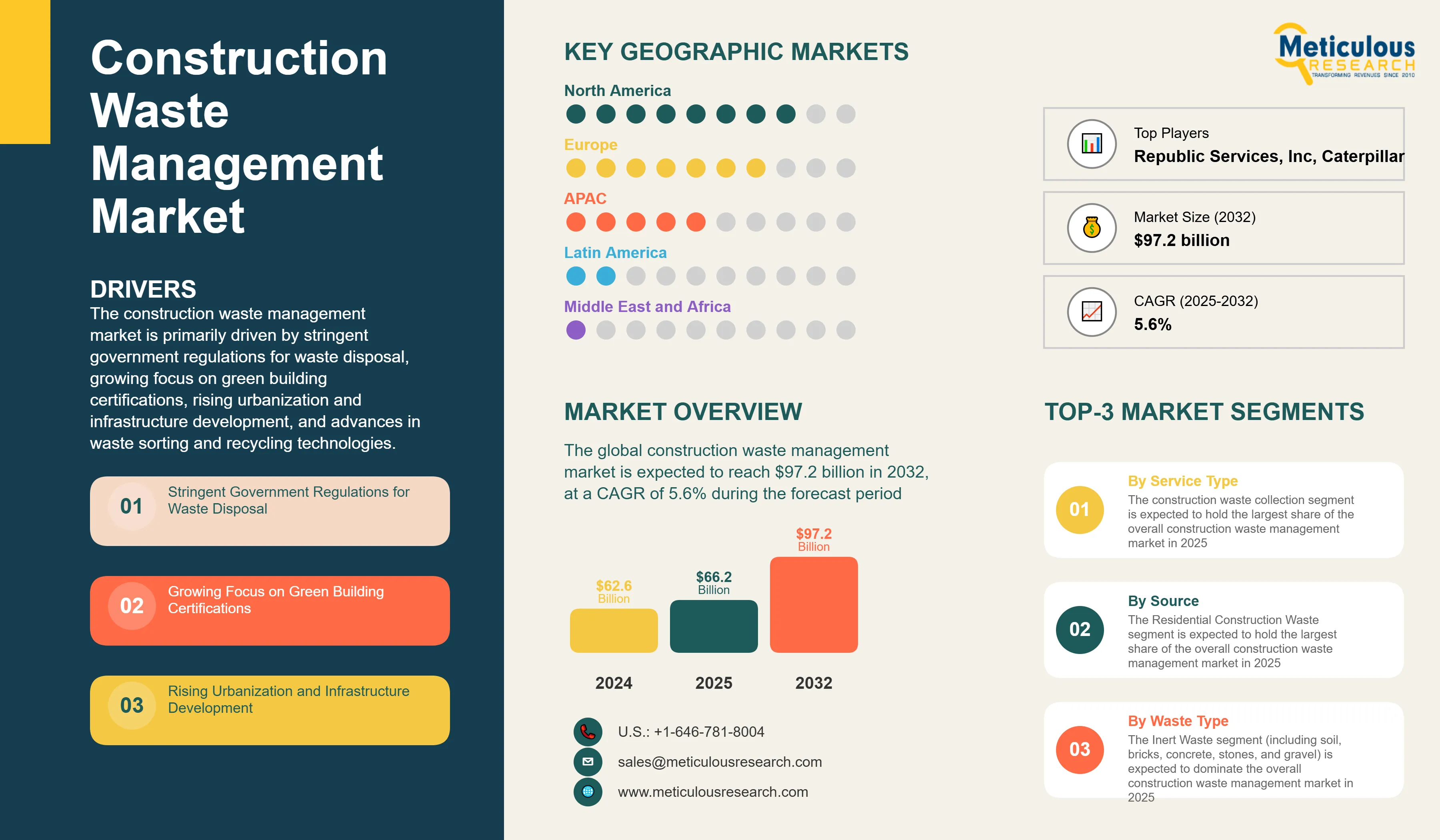
The construction waste management market is primarily driven by stringent government regulations for waste disposal, growing focus on green building certifications, rising urbanization and infrastructure development, and advances in waste sorting and recycling technologies. On-site waste sorting and processing is transforming the industry, while prefabrication to minimize construction waste is gaining significant traction. Additionally, blockchain-based waste chain-of-custody systems and integration of waste data with Building Information Modeling (BIM) are further driving market growth, especially in North America and Europe.
Key Challenges
Despite significant growth potential, the overall construction waste management market faces challenges to some extent including high initial implementation costs, lack of awareness in developing regions, and complex logistical challenges in urban areas. Additionally, contamination in mixed construction waste, balancing cost with sustainability goals, varying regulatory standards across regions, and limited markets for recycled construction materials present significant barriers, potentially slowing down market adoption in different sectors across the globe.
Growth Opportunities
The construction waste management market offers several high-growth opportunities. Circular economy initiatives in construction are driving innovation across multiple segments. Another major opportunity lies in digital waste tracking and management systems. Additionally, resource recovery from construction & demolition waste is creating new revenue streams for solution providers, as organizations increasingly seek to maximize the value of waste materials and minimize disposal costs.
Market Segmentation Highlights
By Service Type
The construction waste collection segment is expected to hold the largest share of the overall construction waste management market in 2025, due to the essential role of waste removal services in construction projects, including containers, dumpsters, and transportation. The construction waste recycling segment follows closely, particularly growing in importance as sustainability regulations become more stringent. However, the Waste Minimization Planning segment is expected to grow at the highest CAGR during the forecast period, driven by increasing emphasis on pre-construction waste reduction strategies and growing demand for specialized consulting, waste audits, and compliance reporting as organizations implement and optimize their construction waste management programs.
By Waste Type
The Inert Waste segment (including soil, bricks, concrete, stones, and gravel) is expected to dominate the overall construction waste management market in 2025, primarily due to its high volume and weight in construction and demolition activities. However, the Plastic Waste segment is expected to grow at the highest CAGR through 2032, driven by increasing regulatory pressures on plastic pollution, growing emphasis on plastic recycling, and innovations in plastic waste processing technologies that enable more effective recovery and reuse.
By Source
The Residential Construction Waste segment is expected to hold the largest share of the overall construction waste management market in 2025, as housing development, renovations, and demolition generate significant waste volumes that require proper management. The Commercial Construction segment follows as retail, office, healthcare, and educational facilities implement comprehensive waste management strategies to meet sustainability goals. However, the Infrastructure and Public Works segment is expected to experience the fastest growth rate during the forecast period, driven by increasing government investments in sustainable infrastructure, large-scale public projects, and growing requirements for waste management compliance in publicly funded construction activities.
By Geography
North America is expected to hold the largest share of the global construction waste management market in 2025, driven by stringent regulatory environments, high adoption of green building certifications, and significant investment in waste recycling technology innovation. Additionally, growing sustainability commitments from major construction firms contribute significantly to market dominance. Europe follows as the second-largest market, bolstered by advanced circular economy frameworks and strong public environmental consciousness. However, Asia-Pacific is witnessing the fastest growth rate during the forecast period, primarily driven by rapid urbanization, increasing construction activities in emerging economies, and strengthening waste management regulations in countries like China and India.
Competitive Landscape
The global construction waste management market features a diverse competitive landscape with established waste management companies, recycling specialists, equipment manufacturers, and innovative digital solution developers pursuing varied approaches to construction waste management.
The broader solution provider landscape is categorized into industry leaders, market differentiators, vanguards, and contemporary stalwarts, with each group employing distinctive strategies to maintain competitive advantage. Leading providers are focusing on integrated solutions that combine traditional waste management with digital tracking systems and circular economy principles while addressing industry-specific challenges.
The key players operating in the global construction waste management market are Waste Management, Inc., Republic Services, Inc., Veolia Environment S.A., Caterpillar Inc., Hitachi Construction Machinery Co., Ltd., Terex Corporation, Komptech GmbH, Rubble Master HMH GmbH, Metso Outotec Corporation, Doppstadt GmbH, HAAS Recycling Systems, BHS-Sonthofen GmbH, and ARJES GmbH, among others.
|
Particulars |
Details |
|
Number of Pages |
205 |
|
Format |
PDF & Excel |
|
Forecast Period |
2025–2032 |
|
Base Year |
2024 |
|
CAGR (Value) |
5.6% |
|
Market Size (Value) in 2025 |
USD 66.2 Billion |
|
Market Size (Value) in 2032 |
USD 97.2 Billion |
|
Segments Covered |
Market Assessment, by Service Type
Market Assessment, by Waste Type
Market Assessment, by Source
|
|
Countries Covered |
North America (U.S., Canada, Mexico), Europe (Germany, France, U.K., Italy, Spain, Nordics, Rest of Europe), Asia-Pacific (China, Japan, India, Australia, South Korea, Rest of Asia-Pacific), Latin America (Brazil, Argentina, Rest of Latin America), Middle East & Africa (UAE, Saudi Arabia, South Africa, Rest of Middle East & Africa) |
|
Key Companies |
Waste Management, Inc., Republic Services, Inc., Veolia Environment S.A., Caterpillar Inc., Hitachi Construction Machinery Co., Ltd., Terex Corporation, Komptech GmbH, Rubble Master HMH GmbH, Metso Outotec Corporation, Doppstadt GmbH, HAAS Recycling Systems, BHS-Sonthofen GmbH, ARJES GmbH |
The global construction waste management market was valued at $62.6 billion in 2024. This market is expected to reach approximately $66.2 billion in 2025, and is projected to grow at a CAGR of 5.6% from 2025 to 2034, reaching an estimated value of $97.2 billion by 2032.
The global construction waste management market is expected to grow at a CAGR of 5.6% during the forecast period of 2025–2032.
The global construction waste management market is expected to reach approximately $97.2 billion by 2032, growing from an estimated $66.2 billion in 2025, at a CAGR of 5.6% during the forecast period of 2025–2032.
The key companies operating in this market include Waste Management, Inc., Republic Services, Inc., Veolia Environment S.A., Caterpillar Inc., Hitachi Construction Machinery Co., Ltd., Terex Corporation, Komptech GmbH, Rubble Master HMH GmbH, Metso Outotec Corporation, Doppstadt GmbH, HAAS Recycling Systems, BHS-Sonthofen GmbH, and ARJES GmbH.
Major trends shaping the market include on-site waste sorting and processing, prefabrication to minimize construction waste, blockchain-based waste chain-of-custody systems, and integration of waste data with Building Information Modeling (BIM).
• In 2025, the Collection segment is expected to dominate the overall construction waste management market by service type
• Based on waste type, the Inert Waste segment is expected to hold the largest share of the overall construction waste management market in 2025
• Based on source, the Residential Construction segment is expected to hold the largest share of the global construction waste management market in 2025
North America is expected to hold the largest share of the global construction waste management market in 2025, driven by stringent regulatory environments, high adoption of green building certifications, and significant investment in waste recycling technology innovation. Asia-Pacific is witnessing the fastest growth rate during the forecast period.
The growth of this market is driven by stringent government regulations for waste disposal, growing focus on green building certifications, rising urbanization and infrastructure development, and advances in waste sorting and recycling technologies.






















Published Date: Sep-2026
Published Date: Sep-2026
Published Date: Jun-2026
Published Date: May-2026
Published Date: May-2026
Please enter your corporate email id here to view sample report.
Subscribe to get the latest industry updates


