Pyrolysis Oil Market (2026-2036)
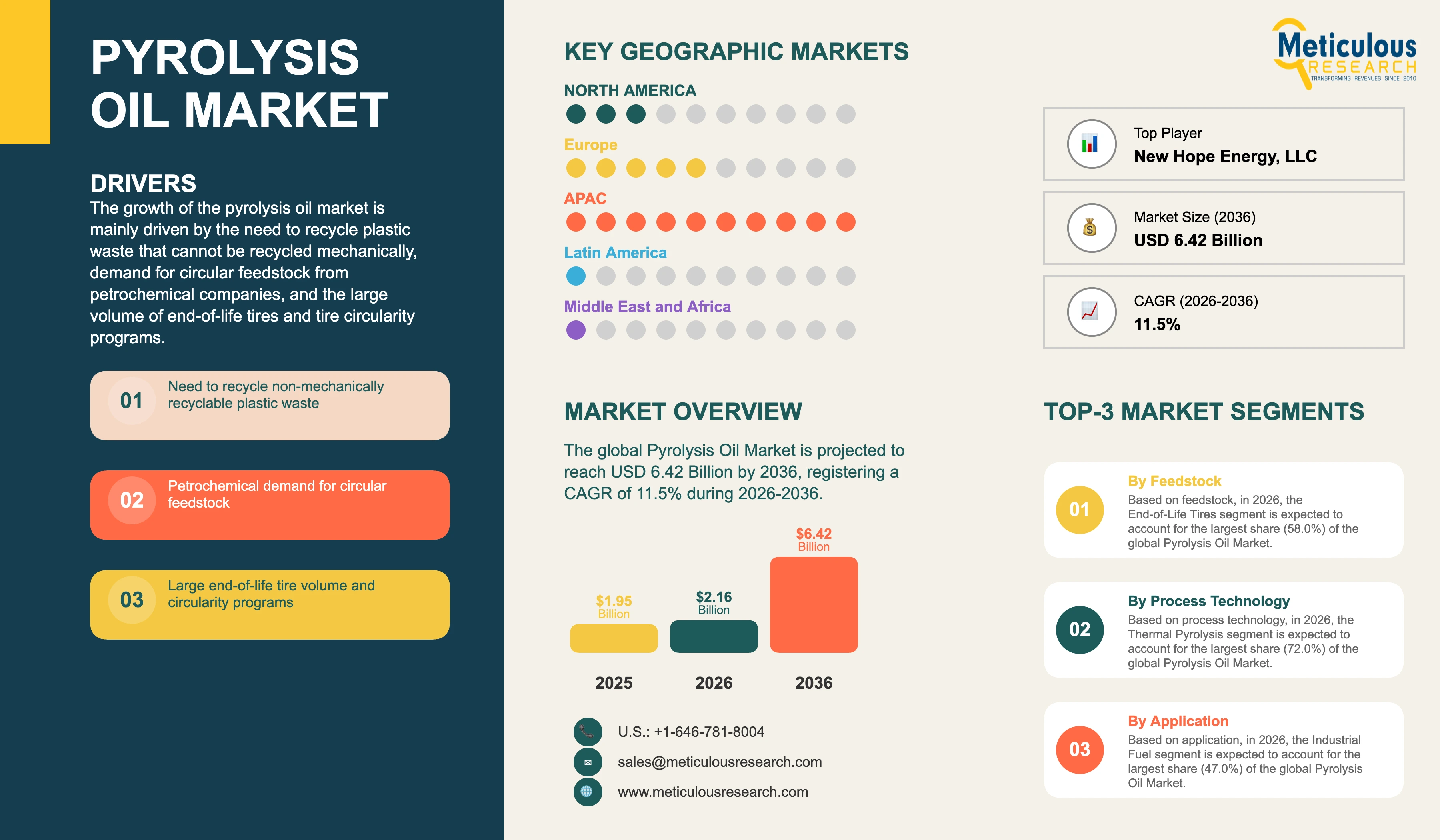
The global pyrolysis oil market was valued at USD 1.95 billion in 2025. This market is expected to reach USD 6.42 billion by 2036 from an estimated USD 2.16 billion in 2026, registering a CAGR of 11.5% during the forecast period (2026-2036). In terms of volume, this market is expected to reach 8.26 million tons by 2036 from an estimated 3.52 million tons in 2026, registering a CAGR of 8.9% during the forecast period.
- Published
- Nov 2026
- Pages
- 293
- Format
- PDF + Excel
- Report ID
- MRCHM - 1042474
- Base year
- 2025
- 2025 · BASELINE
- $1.95B
- 2036
- $6.42B
- CAGR 2026–2036
- 11.5%
2025 baseline · 2026–2036 forecast at 11.5% CAGR · hover a bar for the value
Key highlights
The European Commission adopted an implementing decision on 30 June 2026 that, for the first time, allows chemically recycled content to count toward the recycled content targets for single-use plastic beverage bottles, using a fuel-use excluded mass balance method that is expected to serve as a model for future EU rules.
TotalEnergies' Grandpuits advanced recycling plant in France, which converts hard-to-recycle household plastics into pyrolysis oil, began production in March 2026 with a capacity of 15,000 tons of plastic waste per year, and TotalEnergies took full ownership of the plant after a restructuring of Plastic Energy's shareholding.
Freepoint Eco-Systems is building a plastic pyrolysis plant in Eloy, Arizona, with a nameplate capacity of about 180,000 tons of plastic waste per year, and its first phase, starting as early as 2026, is expected to supply about 65,000 metric tons per year of pyrolysis oil exclusively to Dow.
French authorities officially recognized tire pyrolysis oil as a raw material for the chemical industry on 17 January 2026, and Pyrum Innovations' new plant in Dillingen, Germany, entered regular production in April 2026.
Michelin, Antin Infrastructure Partners, and Scandinavian Enviro Systems are building a tire recycling plant in Uddevalla, Sweden, with Michelin signing a multi-year agreement to buy recovered carbon black and pyrolysis oil from the plant.
Pirelli, Pyrum Innovations, Synthos, and BASF launched a European tire-to-tire initiative in July 2026, in which recovered carbon black goes to Pirelli and pyrolysis oil goes to BASF, with recycled content returning to Pirelli in certified synthetic rubber tracked by mass balance under ISCC PLUS.
Agilyx exited U.S. chemical recycling in early 2026, while ExxonMobil brought its third advanced recycling plant into operation, reflecting the consolidation of the plastic pyrolysis industry around larger, better-funded players.
Plastic waste is the fastest-growing feedstock, catalytic pyrolysis is the fastest-growing process technology, and upgraded and purified pyrolysis oil is the fastest-growing product grade.
By feedstock, end-of-life tires account for the largest share of 58.0% in 2026, while plastic waste registers the highest CAGR.
By process technology, thermal pyrolysis accounts for the largest share in 2026, while catalytic pyrolysis registers the highest CAGR.
By product grade, crude pyrolysis oil accounts for the largest share in 2026, while upgraded and purified pyrolysis oil registers the highest CAGR.
By application, industrial fuel accounts for the largest share of 47.0% in 2026, while petrochemical feedstock registers the highest CAGR.
By geography, Asia-Pacific accounts for the largest share of 52.0% in 2026, while Europe registers the highest CAGR of 13.9%.
Report summary
| Particulars | Details |
|---|---|
| Base Year | 2025 |
| Estimated Year | 2026 |
| Forecast Period | 2026-2036 |
| Market Size in 2025 | USD 1.95 billion |
| Market Size in 2026 | USD 2.16 billion |
| Market Size by 2036 | USD 6.42 billion |
| CAGR (2026-2036), Value | 11.5% |
| Format | PDF, Excel & Cloud Portal · 293 pages |
| Market Volume (2026 to 2036) | 3.52 million tons to 8.26 million tons (CAGR 8.9%) |
| Largest Segment by Feedstock (2026) | End-of-Life Tires (58.0%) |
| Largest Segment by Application (2026) | Industrial Fuel (47.0%) |
| Largest Region (2026) | Asia-Pacific (52.0%) |
| Fastest-Growing Region | Europe (CAGR 13.9%) |
| Segments Covered | Feedstock, Process Technology, Product Grade, Application, and Geography |
| Geographic Scope | Asia-Pacific, Europe, North America, Latin America, and Middle East and Africa |
| Key Companies Profiled | Plastic Energy, Brightmark, New Hope Energy, Freepoint Eco-Systems, Nexus Circular, Clean Planet Energy, Pyrum Innovations, Scandinavian Enviro Systems, Contec, Klean Industries, LD Carbon, Bolder Industries, BTG Bioliquids, and Alterra Energy |
Report overview
Segments covered: feedstock, process technology, product grade, application.
The growth of this market is mainly driven by the need to recycle plastic waste that cannot be recycled mechanically, the demand from petrochemical companies for circular feedstock to make certified recycled plastics, the large and growing volume of end-of-life tires, and new rules that allow chemically recycled content to count toward recycled content targets, such as the EU's mass balance rules for PET bottles adopted in June 2026. However, factors such as the high cost and technical difficulty of producing pyrolysis oil that meets steam cracker specifications, the uneven and contaminated supply of plastic waste feedstock, and the financial difficulties and delays faced by several chemical recycling projects are expected to restrain the growth of this market to some extent.
Pyrolysis oil is a liquid produced by heating waste materials, such as end-of-life tires, plastic waste, or biomass, to high temperatures in the absence of oxygen, which breaks the material down into oil, gas, and a solid residue such as carbon black or char. The oil can be used as an industrial fuel, refined into fuels, or, after cleaning and upgrading, used as a feedstock for steam crackers and refineries to make new plastics and chemicals. This market covers the sale of pyrolysis oil produced from tires, plastics, biomass, and other feedstocks, including crude oil, upgraded and purified oil, and distilled fractions. Pyrolysis oil is sold either directly by plant operators or through traders and offtakers, and its price depends strongly on its quality, feedstock, and certification, ranging from low-cost fuel-grade tire oil to premium certified oil for petrochemical use.
Tire pyrolysis is the largest and most established part of the market by volume, with many plants in India, China, Southeast Asia, Eastern Europe, and other regions converting end-of-life tires into tire pyrolysis oil, recovered carbon black, and steel. Much of this oil is sold as a low-cost industrial fuel for boilers, furnaces, and kilns, particularly in India and China. In Europe and North America, newer tire pyrolysis companies, such as Pyrum Innovations, Scandinavian Enviro Systems, Contec, and Bolder Industries, are producing higher-quality oil and recovered carbon black for use by chemical and tire companies. These companies often use continuous reactors, better feedstock preparation, and oil cleaning steps to meet the specifications of chemical buyers, which allows them to sell oil at higher prices than fuel-grade tire oil.
Plastic pyrolysis has attracted the most investment in recent years, as petrochemical companies such as Dow, TotalEnergies, Shell, BASF, LyondellBasell, SABIC, and ExxonMobil seek circular feedstock to produce certified recycled plastics, including food-grade packaging that is difficult to make through mechanical recycling. Companies such as Plastic Energy, Brightmark, New Hope Energy, Freepoint Eco-Systems, Nexus Circular, and Clean Planet Energy produce plastic pyrolysis oil and sell it to these companies under long-term contracts, and the recycled content is tracked through mass balance certification schemes such as ISCC PLUS. Typical yields of oil from polyolefin-rich plastic waste are around 70% to 80% by weight, while mixed and contaminated waste gives lower yields and more by-products.
Biomass pyrolysis, often called fast pyrolysis, converts wood residues and other biomass into bio-oil, which can be used as a renewable heating fuel or upgraded into biofuels. Companies such as BTG Bioliquids and its partners operate fast pyrolysis plants in the Netherlands, Finland, and Sweden, and refiners are testing the co-processing of bio-oil to make renewable fuels. This segment is smaller than tire and plastic pyrolysis but offers growth potential as demand for low-carbon fuels increases. Bio-oil has different properties from tire and plastic oil, with high oxygen and water content, which makes upgrading more complex.
Regulation is shaping the market strongly, as the EU adopted rules in June 2026 that allow chemically recycled content to count toward PET bottle recycled content targets using a fuel-use excluded mass balance method. The PPWR's recycled content targets for plastic packaging from 2030 are expected to create further demand, subject to how mass balance rules are set for other packaging. In the U.S., several states have passed laws treating advanced recycling as manufacturing, while others have restricted it, and in India and other countries EPR rules for tires and plastics are encouraging pyrolysis. Japan, South Korea, and Australia are also supporting chemical recycling through national plastic strategies and funding programs.
The industry has also faced setbacks, as many plastic pyrolysis projects have been delayed, scaled back, or canceled because of high costs, technical problems with feedstock contamination and oil quality, and uncertain demand. Plastic Energy restructured its shareholding, Agilyx exited U.S. chemical recycling in early 2026, and several European projects have faced insolvency or delays. Despite this, large companies continue to invest, and the industry is expected to consolidate around larger, better-integrated plants with secure feedstock and offtake agreements. Petrochemical companies taking direct control of projects, as TotalEnergies did at Grandpuits, is one sign of this shift.
End-of-life tires are expected to account for the largest share of 58.0% of the market in 2026, while plastic waste is projected to register the highest CAGR.
Catalytic pyrolysis is projected to register the highest CAGR among process technologies, and upgraded and purified pyrolysis oil is projected to register the highest CAGR among product grades.
Industrial fuel is expected to account for the largest share of 47.0% of the market in 2026, while petrochemical feedstock is projected to register the highest CAGR.
Asia-Pacific is expected to account for the largest share of 52.0% of the market in 2026.
Europe is projected to register the highest CAGR of 13.9% during the forecast period, supported by EU recycled content rules and tire-to-tire initiatives.
The report profiles 14 companies, including Plastic Energy, Brightmark, New Hope Energy, Freepoint Eco-Systems, Pyrum Innovations, and Scandinavian Enviro Systems. The top five players account for an estimated 12.5% of the market in 2025.
Report infographic
Market dynamics
15 factors across 5 forcesNeed to recycle plastic waste that cannot be recycled mechanically
Mechanical recycling works well for clean, single-material plastics such as PET bottles and HDPE containers, but much of the world's plastic waste, including mixed plastics, flexible packaging, and contaminated materials, cannot be recycled mechanically into high-quality products. This waste is mostly landfilled, incinerated, or leaked into the environment. Pyrolysis offers a way to convert these hard-to-recycle plastics into oil that can be used to make new plastics, which is why it is seen as a complement to mechanical recycling.
Governments, brand owners, and waste management companies are looking for solutions for these plastics as recycling targets rise and landfill and incineration become more expensive or restricted. Waste companies such as Veolia and Suez and packaging recovery organizations such as Citeo are working with pyrolysis companies to secure outlets for mixed plastic waste. Plastic waste is the fastest-growing feedstock in this market. The availability of large volumes of low-cost or negative-cost plastic waste supports the economics of pyrolysis plants. Gate fees paid by waste suppliers can provide an important source of revenue for pyrolysis plants, alongside oil sales.
Demand for circular feedstock from petrochemical companies
Petrochemical companies are under pressure from customers and regulators to offer plastics with recycled content, including food-contact and medical grades that are difficult to make from mechanically recycled material. Pyrolysis oil can be fed into steam crackers alongside naphtha to produce ethylene, propylene, and other building blocks, which are then made into virgin-quality plastics with certified recycled content.
Dow, TotalEnergies, Shell, BASF, LyondellBasell, SABIC, INEOS, and others have signed long-term offtake agreements with pyrolysis oil producers, such as Dow's agreement with Freepoint Eco-Systems for about 65,000 metric tons per year and TotalEnergies' agreements with New Hope Energy and Plastic Energy. Some companies, such as ExxonMobil, have built their own large pyrolysis-based plants. Petrochemical feedstock is the fastest-growing application in this market. Brand owners' demand for certified circular plastics, particularly in food packaging, supports this driver. Many brand owners have signed agreements to buy certified circular polymers made from pyrolysis oil, which gives petrochemical companies confidence to sign long-term offtake contracts.
Large volume of end-of-life tires and tire circularity programs
Around the world, more than a billion tires reach the end of their life each year, and many countries have EPR schemes that require tire producers or importers to ensure that end-of-life tires are collected and recovered. Pyrolysis allows these tires to be converted into tire pyrolysis oil, recovered carbon black, and steel, which have commercial value and reduce the need for landfill or burning.
Tire makers such as Michelin, Continental, Pirelli, Bridgestone, and Nokian have set targets for recycled and renewable materials and are working with pyrolysis companies to use recovered carbon black and pyrolysis oil in new tires and chemicals. Pirelli, Pyrum, Synthos, and BASF launched a European tire-to-tire initiative in July 2026, in which pyrolysis oil goes to BASF and recycled content returns to tires through mass balance. End-of-life tires account for the largest share of feedstock in this market. France's recognition of tire pyrolysis oil as a chemical raw material in January 2026 also supports the use of tire oil in chemicals. Tire EPR schemes in Europe, India, and other countries ensure that tire producers fund collection and recovery, which provides a steady and growing supply of feedstock.
Regulatory recognition of chemically recycled content
Regulations that allow chemically recycled content to count toward recycled content targets are a key driver for plastic pyrolysis oil. The EU's implementing decision adopted on 30 June 2026 recognizes chemical recycling for PET bottle recycled content targets under the Single-Use Plastics Directive, using a fuel-use excluded mass balance method, and it is expected to serve as a model for rules under the PPWR and other EU legislation.
In the U.S., more than 20 states have passed laws that regulate advanced recycling facilities as manufacturing rather than waste disposal, which makes it easier to build plants. Mass balance certification schemes, such as ISCC PLUS, also allow companies to track and claim recycled content through complex petrochemical supply chains. Clear rules give investors and offtakers more confidence to commit to pyrolysis projects. The EU rules also limit the use of recycled content produced outside the EU for an initial period, which supports investment in European capacity. Europe is the fastest-growing region in this market.
Table of contents
12 chapters · 123 sections · 293 pages · click to expandSegmental analysis
| Segment | Largest share (2026) | Fastest growth (2026–2036) |
|---|---|---|
| By Feedstock | End-of-life tires | Plastic waste |
| By Process Technology | Thermal pyrolysis | Catalytic pyrolysis |
| By Product Grade | Crude pyrolysis oil | Upgraded and purified pyrolysis oil |
| By Application | Industrial fuel | Petrochemical feedstock |
By Feedstock
- Pyrolysis Oil Market Analysis by Feedstock
- The end-of-life tires segment is expected to account for the largest share of 58.0% of the global pyrolysis oil market.
- The large share of this segment is mainly due to the large number of tire pyrolysis plants in India, China, Southeast Asia, and Eastern Europe, the steady supply of end-of-life tires, and the established use of tire pyrolysis oil as an industrial fuel.
- Tire pyrolysis is a mature process, and tires are a relatively consistent feedstock compared with mixed plastic waste, which makes it easier to operate plants at commercial scale.
- Each ton of tires typically yields around 40% to 45% oil, along with recovered carbon black, steel, and gas, and the sale of these products, together with tire disposal fees, supports plant economics.
- India has one of the largest tire pyrolysis industries in the world, with hundreds of plants supplying oil to industrial users, while China, Southeast Asia, and Eastern Europe also have large tire pyrolysis capacity.
- In Europe and North America, newer companies such as Pyrum Innovations, Scandinavian Enviro Systems, Contec, and Bolder Industries are producing higher-quality oil for chemical companies such as BASF and tire makers such as Michelin.
- Tire EPR schemes in Europe, India, and other countries ensure a steady flow of feedstock, and tire makers' circularity targets are increasing demand for both recovered carbon black and pyrolysis oil.
- However, the plastic waste segment is projected to register the highest CAGR during the forecast period.
- The rapid growth of this segment is driven by investments by petrochemical companies in circular feedstock, new plastic pyrolysis plants in Europe, North America, and Asia, and regulations that recognize chemically recycled content.
- Biomass and other feedstocks make up the rest of the market.
- Tire pyrolysis is a mature process with a steady supply of end-of-life tires, supported by tire EPR schemes, and a large number of plants in India, China, and other countries sell tire pyrolysis oil as a low-cost industrial fuel, which gives the segment the largest share of the market.
By Process Technology
- Pyrolysis Oil Market Analysis by Process Technology
- The thermal pyrolysis segment is expected to account for the largest share of the market.
- The large share of this segment is mainly due to the wide use of conventional thermal pyrolysis in tire pyrolysis plants and in most plastic pyrolysis plants, which use batch, semi-continuous, or continuous reactors such as rotary kilns, augers, and stirred tanks.
- Thermal pyrolysis is the simplest and most widely used technology, as it heats feedstock without catalysts and can handle a range of materials.
- Most tire pyrolysis plants in Asia use batch or semi-continuous thermal reactors, while newer plants in Europe and North America use continuous reactors with better control and higher output.
- Thermal pyrolysis typically produces a broad range of hydrocarbons, which often need further processing for use in crackers.
- Continuous thermal processes are expected to gain share within this segment as plants scale up.
- Leading plastic pyrolysis producers, such as New Hope Energy, Brightmark, and Plastic Energy, use continuous thermal processes at commercial scale, and many tire pyrolysis companies in Europe and North America have also adopted continuous reactors to improve consistency and output.
- Thermal pyrolysis is expected to remain the largest technology over the forecast period because of its large installed base and relatively low capital cost.
- However, the catalytic pyrolysis segment is projected to register the highest CAGR during the forecast period.
- The rapid growth of this segment is driven by its ability to produce higher-quality oil with more targeted product ranges and fewer contaminants, which suits petrochemical feedstock applications.
- Fast pyrolysis and microwave and other pyrolysis technologies make up the rest of the market.
By Product Grade
- Pyrolysis Oil Market Analysis by Product Grade
- The crude pyrolysis oil segment is expected to account for the largest share of the market.
- The large share of this segment is mainly due to the large volume of crude tire pyrolysis oil sold as industrial fuel and the sale of crude plastic pyrolysis oil to petrochemical companies that blend or upgrade it at their own sites.
- Crude pyrolysis oil is sold with minimal processing after condensation and separation, which keeps costs low but limits its value and range of uses.
- Most tire pyrolysis oil in Asia is sold in crude form to industrial users, such as cement kilns, steel mills, boilers, and furnaces.
- Crude plastic pyrolysis oil is also sold to petrochemical companies, which blend it in small amounts into crackers or upgrade it on site.
- The share of this segment is expected to decline as more producers invest in upgrading to reach higher-value applications.
- Crude oil also remains the main product of smaller tire pyrolysis plants in emerging markets, which lack the scale to invest in upgrading.
- Petrochemical companies that buy crude oil often prefer to control the upgrading step themselves, so that they can manage quality and integrate it with their existing processes.
- However, the upgraded and purified pyrolysis oil segment is projected to register the highest CAGR during the forecast period.
- The rapid growth of this segment is driven by the need for cracker-ready oil with low levels of contaminants and by investments in hydrotreating and purification units.
- Distilled fractions make up the rest of the market.
By Application
- Pyrolysis Oil Market Analysis by Application
- The industrial fuel segment is expected to account for the largest share of 47.0% of the market.
- The large share of this segment is mainly due to the widespread use of tire pyrolysis oil as a low-cost fuel for boilers, furnaces, kilns, and generators in India, China, Southeast Asia, and other regions.
- Industrial users buy pyrolysis oil as a cheaper alternative to furnace oil, light diesel oil, and other heavy fuels, particularly in price-sensitive markets in Asia, Africa, and Latin America.
- Tire pyrolysis oil has a high heating value and can be used in many industrial burners with little modification, which makes it attractive to cement, steel, glass, ceramics, and textile producers.
- However, environmental regulators in India and other countries have tightened rules on tire pyrolysis plants and on the use of pyrolysis oil as fuel because of emissions concerns, and the EU's fuel-use excluded approach means that oil used as fuel does not count toward recycled content targets.
- As a result, the share of this segment is expected to decline significantly over the forecast period as more oil is upgraded for chemical uses, although industrial fuel will remain an important outlet in emerging markets.
- However, the petrochemical feedstock segment is projected to register the highest CAGR during the forecast period.
- The rapid growth of this segment is driven by long-term offtake agreements between pyrolysis oil producers and petrochemical companies such as Dow, TotalEnergies, Shell, BASF, and LyondellBasell, and by demand for certified circular plastics.
- Refinery co-processing and transport fuels and chemicals and other applications make up the rest of the market.
Geographic analysis
Asia-Pacific
Largest shareIn 2026, Asia-Pacific is expected to account for the largest share of 52.0% of the global pyrolysis oil market. The large share of this region is mainly due to the very large tire pyrolysis industries in India and China, the growing number of plastic pyrolysis projects in Japan, South Korea, Southeast Asia, and Australia, and the region's large volumes of tire and plastic waste. India has one of the world's largest tire pyrolysis industries, supported by large domestic and imported volumes of end-of-life tires and strong demand for low-cost industrial fuel, although regulators have tightened rules on plant emissions and safety. China also has a large tire and plastic pyrolysis industry, and its chemical companies are developing chemical recycling projects. South Korea has some of the largest established pyrolysis capacity among non-EU OECD countries, with companies such as SK Geo Centric, LG Chem, and LD Carbon investing in plastic and tire pyrolysis. Japan and Australia are also developing plastic pyrolysis projects with petrochemical companies, and Southeast Asian countries, such as Thailand, Malaysia, and Indonesia, are attracting pyrolysis investments linked to regional petrochemical complexes. Asia-Pacific is expected to remain the largest market over the forecast period, although its share will decline as Europe and North America grow faster. Rising volumes of end-of-life tires from the region's large and growing vehicle fleets will also continue to supply the tire pyrolysis industry.
Europe
Fastest growthEurope is projected to register the highest CAGR of 13.9% during the forecast period. Growth is driven by the EU's recognition of chemically recycled content, the PPWR's recycled content targets from 2030, investments by petrochemical companies such as TotalEnergies, BASF, Shell, and INEOS, and tire-to-tire initiatives involving Michelin, Pirelli, Continental, and pyrolysis companies such as Pyrum, Scandinavian Enviro Systems, and Contec.
North America
North America holds a significant share of the market, supported by large plastic pyrolysis plants operated or developed by New Hope Energy, Brightmark, Freepoint Eco-Systems, Nexus Circular, and ExxonMobil, offtake agreements with Dow, TotalEnergies, and others, and state laws that support advanced recycling. The U.S. also has a large and growing tire pyrolysis sector, with companies such as Bolder Industries producing recovered carbon black and oil for industrial customers.
Latin America
Latin America and the Middle East and Africa are smaller markets, with tire pyrolysis and early plastic pyrolysis projects. Brazil and Mexico have tire EPR rules that support tire pyrolysis, and several Gulf countries are exploring plastic pyrolysis linked to their petrochemical industries.
Competitive landscape
The pyrolysis oil market is highly fragmented, with hundreds of small tire pyrolysis plants in Asia and a smaller number of larger plastic and tire pyrolysis companies in Europe, North America, and Asia. Leading plastic pyrolysis oil producers include Plastic Energy, Brightmark, New Hope Energy, Freepoint Eco-Systems, Nexus Circular, and Clean Planet Energy, while leading tire pyrolysis companies include Pyrum Innovations, Scandinavian Enviro Systems, Contec, Klean Industries, LD Carbon, and Bolder Industries.
Many pyrolysis oil producers work closely with petrochemical companies, which often provide offtake agreements, investment, or joint venture partnerships, and some petrochemical companies, such as ExxonMobil, operate their own pyrolysis-based plants. Technology licensors, such as Lummus Technology, Honeywell, Alterra Energy, and others, license pyrolysis and upgrading technologies to project developers. BTG Bioliquids is a leading supplier of fast pyrolysis technology for biomass. Engineering firms such as Technip Energies, Lummus Technology, and others also play important roles in designing and building pyrolysis and upgrading units.
The top five players are estimated to account for 12.5% of the market in 2025, reflecting the fragmented nature of the tire pyrolysis industry in Asia. In India alone, hundreds of small tire pyrolysis plants supply oil to local industrial users, and many of them are not organized into larger groups. Concentration is higher in plastic pyrolysis oil for petrochemical use, where a small number of companies operate commercial-scale plants with long-term offtake agreements.
Players use several strategies to grow in this market, including securing long-term offtake agreements with petrochemical and tire companies, forming joint ventures with waste management and petrochemical companies, investing in upgrading and purification, licensing their technologies, and obtaining ISCC PLUS and other certifications. Many are also seeking feedstock agreements with packaging recovery organizations and municipalities. Competition is expected to center on oil quality, scale, feedstock security, cost, and the ability to meet certification and regulatory requirements. Companies with strong partners are better placed to survive the industry's consolidation. Larger players are also acquiring or partnering with smaller technology developers to gain access to proven processes and project pipelines. Waste management companies, such as Veolia and Suez, are also entering the market through partnerships, which gives them a role in both feedstock supply and processing.
Some of the key players operating in the pyrolysis oil market are Plastic Energy Ltd., Brightmark LLC, New Hope Energy, LLC, Freepoint Eco-Systems, Nexus Circular LLC, Clean Planet Energy, Pyrum Innovations AG, Scandinavian Enviro Systems AB, Contec S.A., Klean Industries Inc., LD Carbon Co., Ltd., Bolder Industries, BTG Bioliquids B.V., and Alterra Energy.
- —
The EU adopted mass balance rules for chemically recycled content in PET bottles in June 2026, TotalEnergies' Grandpuits plant started production in March 2026, Freepoint Eco-Systems is starting a plant that will supply Dow with about 65,000 metric tons per year of pyrolysis oil, and Pirelli, Pyrum, Synthos, and BASF launched a tire-to-tire initiative in July 2026.
- Plastic Energy
- Brightmark
- New Hope Energy
- Freepoint Eco-Systems
- Nexus Circular
- Clean Planet Energy
- Pyrum Innovations
- Scandinavian Enviro Systems
- Contec
- Klean Industries
- LD Carbon
- Bolder Industries
- BTG Bioliquids
- Alterra Energy
Expert perspectives
The pyrolysis oil market is at an important stage, as regulatory recognition of chemically recycled content and long-term offtake agreements with petrochemical companies are creating real demand for plastic pyrolysis oil, while tire pyrolysis is moving toward higher-value chemical and tire applications. The EU's adoption of mass balance rules for PET bottles in June 2026 is a key milestone, and similar rules for other packaging under the PPWR could greatly expand demand after 2030.
At the same time, the industry has been through a difficult period, with many plastic pyrolysis projects delayed, canceled, or restructured because of high costs, technical problems, and uncertain economics. The market is now consolidating around larger plants with strong partners, secure feedstock, and upgrading capacity, and companies that cannot reach these standards are likely to exit. The value of pyrolysis oil depends heavily on quality, and the shift from fuel to chemical uses is the main source of value growth.
Plastic waste is the fastest-growing feedstock, catalytic pyrolysis is the fastest-growing process technology, upgraded and purified pyrolysis oil is the fastest-growing product grade, and petrochemical feedstock is the fastest-growing application. End-of-life tires, thermal pyrolysis, crude oil, and industrial fuel remain the largest segments, but their shares are expected to decline as the market shifts toward higher-value chemical applications.
Asia-Pacific remains the largest market, while Europe is the fastest-growing region at a CAGR of 13.9%. The main swing factors are the final mass balance rules under the PPWR, the economics of upgrading pyrolysis oil, oil and naphtha prices, the success of large plants now starting up, and public and regulatory acceptance of plastic pyrolysis. Competition from other recycling technologies will also shape the role of pyrolysis. Carbon pricing and changes in fuel taxes could also affect the relative value of pyrolysis oil used as fuel and as feedstock.
For petrochemical companies and brand owners, the key decision is securing reliable supply of certified, cracker-ready pyrolysis oil at a sustainable cost. For pyrolysis oil producers, success depends on feedstock security, oil quality, scale, and strong offtake partners. Companies that combine these elements are expected to capture most of the growth in this market. Tire makers will play an increasingly important role as buyers and partners, as they seek to close the loop on their products.
Overall, growth in this market rests on regulation, petrochemical demand for circular feedstock, and the industry's ability to deliver consistent, high-quality oil at scale. Value growth is expected to outpace volume growth as the market shifts from fuel to chemical uses.
Customer perspectives
Head of Circular Feedstock - petrochemical company, Europe
Our customers want food-grade plastics with certified recycled content, and pyrolysis oil is one of the few ways to get there. But oil quality is everything, so we only sign long-term contracts with producers who can deliver consistent, upgraded oil.
The demand for certified circular plastics is why petrochemical feedstock is the fastest-growing application and why upgraded and purified pyrolysis oil is the fastest-growing product grade. Consistent quality has become the main criterion buyers use when choosing suppliers.
Purchase Manager - cement plant, India
Tire pyrolysis oil has been a cheaper fuel for our kilns for years. Supply is steady, but the rules on emissions are getting stricter, so we now check that our suppliers' plants are approved.
The established use of tire oil as a fuel in Asia is why industrial fuel accounts for 47.0% of the market, why end-of-life tires account for 58.0% of the market by feedstock, and why Asia-Pacific holds the largest share at 52.0%.
Sustainability Director - tire manufacturer, Europe
We want our end-of-life tires to come back as raw materials for new tires. Recovered carbon black goes into our compounds, and the pyrolysis oil goes to our chemical partners, with the recycled content returning to us through mass balance.
Tire-to-tire initiatives and new rules recognizing chemically recycled content are supporting rapid growth in Europe, the fastest-growing region at a CAGR of 13.9%. Tire makers increasingly see pyrolysis as a central part of their circularity strategies. Long-term supply agreements with pyrolysis companies are becoming a standard part of their sourcing plans.
Frequently asked questions
The market was valued at USD 1.95 billion in 2025 and USD 1.78 billion in 2024, and is estimated at USD 2.16 billion in 2026.
Cite this report
Meticulous Research. (2026). Pyrolysis Oil Market - Global Opportunity Analysis and Industry Forecast (2026-2036) (Report No. MRCHM - 1042474). Meticulous Market Research Pvt. Ltd. https://www.meticulousresearch.com/product/pyrolysis-oil-market-7157