Procurement Software Market (2026-2036)
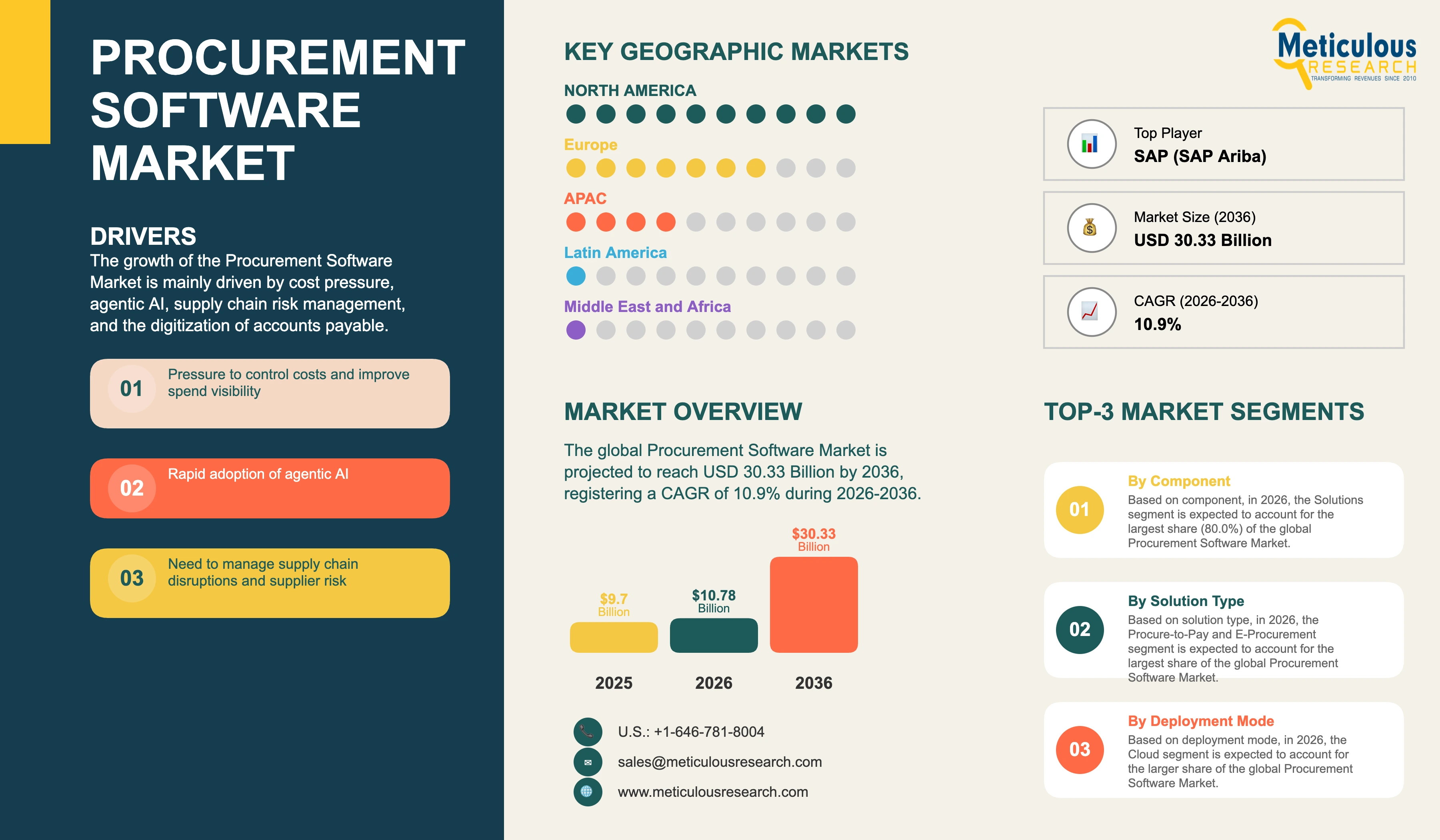
The global procurement software market was valued at USD 9.70 billion in 2025. This market is expected to reach USD 30.33 billion by 2036 from an estimated USD 10.78 billion in 2026, registering a CAGR of 10.9% during the forecast period (2026-2036).
- Published
- Nov 2026
- Pages
- 233
- Format
- PDF + Excel
- Report ID
- MRICT - 1042615
- Base year
- 2025
- 2025 · BASELINE
- $9.70B
- 2036
- $30.33B
- CAGR 2026–2036
- 10.9%
2025 baseline · 2026–2036 forecast at 10.9% CAGR · hover a bar for the value
Key highlights
Coupa announced in February 2026 that it had delivered its highest revenue quarter ever in the fourth quarter of its fiscal year 2026, as the company celebrated its 20th anniversary and passed USD 300 billion in lifetime customer savings, with strong adoption of its Coupa Navi AI agents by customers such as Xylem and Jabil, according to Coupa.
Coupa said in August 2026 that more than 450 customers were using its AI agents in production, with some recording reductions of up to 50% in requisition cycle times and 40% in sourcing cycle times, and that it was opening its platform to external AI agents, including Microsoft Copilot, through MCP integration in Navi Connect, according to IT Brief.
Coupa announced in June 2026 that more than 20 persona-based Navi AI agents were generally available, with 65 agents expected by January 2027, and in May 2026 it launched Coupa Compose, an environment for building, managing, and orchestrating AI agents across procurement, finance, and supply chain, according to Coupa.
SAP released its next-generation SAP Ariba platform in 2026, which it positions as an AI-native source-to-pay suite built on SAP Business Technology Platform, with a rebuilt architecture that unifies real-time data, enables open APIs, and integrates with SAP Cloud ERP, according to the Futurum Group.
Zip entered the 2026 Gartner Magic Quadrant for Source-to-Pay Suites as a Visionary, with USD 371 million in funding and a USD 2.2 billion valuation, while SAP was positioned as a Leader in the same report, according to Procurement Magazine.
Coupa reported in November 2026 that Coupa Pay had grown at a 69% compound annual growth rate, with transaction growth up 58% year over year and five consecutive quarters of transaction revenue growth above 50%, reflecting the convergence of procurement and payments, according to Coupa. Coupa released new invoice-to-pay agents in its September 2026 release focused on payment approval efficiency, working capital optimization, and accounts payable execution, and was named a Leader in the 2026 Gartner Magic Quadrant for Accounts Payable Applications and the 2026 IDC MarketScape for AI-enabled accounts payable automation software for large enterprises, according to Coupa. Zip has prioritized research and development investment in fiscal year 2026, building teams across AI innovation centers in San Francisco, New York, Toronto, and London, according to Procurement Magazine.
By component, solutions account for the larger share of 80.0% in 2026 and also register the higher CAGR.
By solution type, procure-to-pay and e-procurement accounts for the largest share in 2026, while intake and orchestration registers the highest CAGR.
By deployment mode, cloud accounts for the larger share in 2026 and also registers the higher CAGR.
By end-use industry, manufacturing accounts for the largest share of 20.0% in 2026, while healthcare and life sciences register the highest CAGR.
By geography, North America accounts for the largest share of 44.0% in 2026, while Asia-Pacific registers the highest CAGR of 14.2%.
Report summary
| Particulars | Details |
|---|---|
| Base Year | 2025 |
| Estimated Year | 2026 |
| Forecast Period | 2026-2036 |
| Market Size in 2025 | USD 9.70 billion |
| Market Size in 2026 | USD 10.78 billion |
| Market Size by 2036 | USD 30.33 billion |
| CAGR (2026-2036) | 10.9% |
| Format | PDF, Excel & Cloud Portal · 233 pages |
| Largest Segment by Component (2026) | Solutions (80.0%) |
| Largest Segment by End-Use Industry (2026) | Manufacturing (20.0%) |
| Largest Region (2026) | North America (44.0%) |
| Fastest-Growing Region | Asia-Pacific (CAGR 14.2%) |
| Companies Profiled | 15 companies and other companies |
| Segments Covered | Component, Solution Type, Deployment Mode, End-Use Industry, Geography |
| Countries Covered | U.S., Canada, Germany, U.K., France, Italy, Spain, Netherlands, Switzerland, Belgium, Sweden, Denmark, Norway, Finland, Austria, Poland, Ireland, Rest of Europe, China, Japan, India, South Korea, Australia, Indonesia, Thailand, Singapore, Malaysia, Vietnam, Philippines, Taiwan, New Zealand, Rest of Asia-Pacific, Brazil, Mexico, Argentina, Colombia, Chile, Peru, Rest of Latin America, Saudi Arabia, U.A.E., Israel, South Africa, Turkey, Egypt, Rest of Middle East & Africa |
Report overview
Segments covered: component, solution type, deployment mode, end-use industry.
The growth of this market is mainly driven by the growing pressure on companies to control costs and improve spend visibility, the rapid adoption of agentic AI that automates sourcing, purchasing, invoicing, and payments, the need to manage supply chain disruptions and supplier risks, the digitization of procurement and accounts payable processes that still rely on manual work, the growing importance of supplier compliance and sustainability requirements, and the shift of procurement applications to the cloud. However, factors such as the complexity and cost of implementing source-to-pay suites, low user adoption of procurement tools outside the procurement function, the difficulty of integrating procurement software with multiple enterprise resource planning systems, and poor supplier data quality are expected to restrain the growth of this market to some extent. Nevertheless, the large share of business spend that is still not managed through procurement software offers significant room for growth.
Procurement software helps organizations manage the process of buying goods and services from suppliers, from identifying needs and selecting suppliers to purchasing, receiving, invoicing, and payment. The main categories of procurement software include procure-to-pay and e-procurement solutions that manage requisitions, catalogs, purchase orders, and approvals, sourcing and supplier management solutions that support tenders, auctions, supplier onboarding, performance, and risk management, contract lifecycle management solutions, accounts payable and invoice automation solutions, spend analytics solutions, and intake and orchestration solutions that guide employees through purchasing requests. Integrated source-to-pay suites combine many of these capabilities on a single platform.
This report covers the global procurement software market, including source-to-pay suites and specialized procurement solutions delivered as cloud services or deployed on-premises, and related services, such as implementation, integration, consulting, training, and managed services. The market is analyzed by component, solution type, deployment mode, end-use industry, and geography. The market is measured on a revenue basis. General enterprise resource planning software, payment transaction revenue, and procurement outsourcing services that are not related to software are not included, except for their procurement software modules.
Procurement has become a strategic function in many organizations, as companies face pressure to control costs, manage inflation, secure supply chains, and meet sustainability and compliance requirements. Procurement software gives organizations visibility into their spending, enforces purchasing policies, automates manual processes, and helps them negotiate better terms with suppliers. Coupa reported that its platform had helped customers achieve more than USD 300 billion in lifetime savings by early 2026.
Agentic AI is the most important development in the procurement software market. Vendors are deploying AI agents that can handle tasks such as processing purchase requests, comparing quotes, drafting and reviewing contracts, running sourcing events, matching invoices, and approving payments. Coupa had more than 20 AI agents generally available by mid-2026, with 65 expected by January 2027, and more than 450 customers using its agents in production. SAP has rebuilt Ariba as an AI-native platform with its Joule AI copilot and agents, and other vendors, such as Zip, GEP, Ivalua, Jaggaer, and Oracle, are also launching AI agents.
The market is also seeing the convergence of procurement, accounts payable, payments, and treasury. Organizations want to connect purchasing with invoicing and payments to improve control, working capital, and supplier relationships. Coupa Pay grew at a 69% compound annual growth rate, according to Coupa, which shows the growing importance of payments within procurement platforms. At the same time, intake and orchestration platforms, such as Zip, have grown rapidly by simplifying how employees request purchases and by orchestrating workflows across procurement, legal, finance, IT, and security teams.
The competitive landscape includes large enterprise software vendors, such as SAP, Oracle, and Workday, source-to-pay specialists, such as Coupa, GEP, Ivalua, and Jaggaer, and specialized vendors focusing on intake, contract management, accounts payable, spend analytics, and sourcing, such as Zip, Icertis, Basware, Sievo, and Fairmarkit. The 2026 Gartner Magic Quadrant for Source-to-Pay Suites recognized SAP as a Leader and Zip as a Visionary, according to Procurement Magazine.
In 2026, solutions account for the largest share of the market by component and are also the faster-growing component. Procure-to-pay and e-procurement is the largest solution type, while intake and orchestration is the fastest-growing solution type. Cloud deployment accounts for the larger share by deployment mode and is also the faster-growing mode. Manufacturing is the largest end-use industry, while healthcare and life sciences is the fastest-growing industry. North America accounts for the largest share of the market, while Asia-Pacific is the fastest-growing region.
Over the forecast period, the procurement software market is expected to grow steadily, supported by agentic AI, cost pressure, supply chain risk management, the digitization of accounts payable, and expansion in mid-sized companies and emerging regions. Vendors that deliver measurable savings and productivity gains through AI and that make procurement easy for every employee are expected to gain share. Procurement leaders are also changing how they measure the value of procurement software. In addition to savings, organizations now track cycle times, the share of spending under management, supplier risk exposure, working capital, and employee satisfaction with purchasing processes. AI agents are expected to improve all of these measures, which significantly strengthens the business case for investment and encourages organizations to expand their use of procurement platforms beyond the procurement team.
North America is expected to account for the largest share of 44.0% of the market in 2026, mainly due to the large number of large enterprises, high cloud adoption, cost and tariff pressures, and the presence of leading procurement software vendors.
Asia-Pacific is projected to register the highest CAGR of 14.2% during the forecast period, driven by the digitization of procurement and accounts payable, expanding supply chains, electronic invoicing mandates, and growing cloud adoption.
The report profiles 15 companies, including SAP (SAP Ariba), Coupa, Oracle, GEP, Ivalua, Jaggaer, Zip, Basware, Icertis, Sievo, Fairmarkit, Workday, Tradeshift, Esker, and Medius.
Source-to-pay software covers the full procurement process, including sourcing, supplier management, contract management, purchasing, invoicing, and payment, on a single platform. It helps organizations control spending, manage suppliers, and automate procurement and accounts payable processes. Leading source-to-pay suites include SAP Ariba, Coupa, Oracle, GEP, Ivalua, and Jaggaer.
AI agents can review purchase requests, recommend suppliers, run sourcing events, review contracts, match invoices, and approve payments with limited human involvement, while humans oversee exceptions and strategic decisions. Coupa reported that some customers using its agents reduced requisition cycle times by up to 50% and sourcing cycle times by up to 40%.
In 2026, the cloud segment is expected to account for the larger share of the procurement software market, and it is also projected to register the higher CAGR during the forecast period.
Report infographic
Market dynamics
18 factors across 5 forcesPressure to control costs and improve spend visibility
Companies face ongoing pressure to control costs due to inflation, higher interest rates, tariffs, and economic uncertainty, and procurement is one of the most effective levers for reducing costs. Many organizations lack full visibility into their spending, as purchases are made across many business units, systems, and suppliers, and a significant share of spending occurs outside procurement processes. Procurement software helps organizations capture and analyze spending, enforce purchasing policies, consolidate suppliers, and negotiate better prices.
Coupa reported that its customers had achieved more than USD 300 billion in lifetime savings by early 2026, which shows the scale of value that procurement software can deliver. As finance and procurement leaders seek to protect margins, demand for spend analytics, sourcing, and procure-to-pay solutions is expected to remain strong over the forecast period. Cost pressure is the most important driver of the procurement software market.
Rapid adoption of agentic AI
Agentic AI is transforming procurement software by automating tasks that previously required significant manual work. AI agents can review purchase requests, recommend suppliers, compare quotes, draft and review contracts, run sourcing events, match invoices to purchase orders, flag exceptions, and approve payments. More than 450 Coupa customers were using AI agents in production by August 2026, with some recording reductions of up to 50% in requisition cycle times and 40% in sourcing cycle times, according to IT Brief.
SAP has rebuilt its Ariba platform as an AI-native source-to-pay suite with Joule AI agents, and Coupa launched Coupa Compose to let customers build and orchestrate their own agents. Vendors are also opening their platforms to external AI agents, such as Microsoft Copilot, through standards such as MCP. The productivity gains from AI are encouraging organizations to invest in new procurement platforms or upgrade existing ones, and AI is expected to be a key driver of the market over the forecast period.
Need to manage supply chain disruptions and supplier risk
Supply chain disruptions caused by geopolitical tensions, tariffs, trade restrictions, natural disasters, and supplier failures have highlighted the importance of supplier risk management and supply chain resilience. Organizations need to identify alternative suppliers quickly, monitor supplier financial health, compliance, and performance, and understand their exposure to risks in their supply base. Procurement software helps organizations manage supplier information, assess and monitor risks, run sourcing events to find alternative suppliers, and manage contracts.
Sourcing and supplier management solutions have become more important as organizations diversify their supply chains and respond to changing trade policies. AI capabilities that monitor supplier risks and recommend alternative suppliers are increasing the value of these solutions. Tariff changes in 2025 and 2026 have also led many organizations to review their supplier networks and sourcing strategies, which supports demand for sourcing and analytics tools.
Digitization of procurement and accounts payable processes
Many organizations still rely on manual processes, emails, spreadsheets, and paper invoices for purchasing and accounts payable, which are slow, error-prone, and costly. Digitizing these processes improves efficiency, reduces errors and fraud, provides better control and visibility, and improves relationships with suppliers through faster payments. Electronic invoicing mandates in many countries, particularly in Europe, Latin America, and Asia, are also requiring organizations to adopt digital invoicing solutions.
Accounts payable and invoice automation solutions are growing strongly, supported by AI that extracts invoice data, matches invoices to purchase orders and receipts, and manages exceptions. Coupa was named a Leader in the 2026 Gartner Magic Quadrant for Accounts Payable Applications and in the 2026 IDC MarketScape for AI-enabled accounts payable automation software, according to Coupa. The digitization of procurement and accounts payable is expected to drive demand across organizations of all sizes.
Supplier compliance and sustainability requirements
Organizations face growing requirements to ensure that their suppliers comply with laws and standards on human rights, labor practices, anti-corruption, data protection, cybersecurity, and environmental performance. Regulations on supply chain due diligence and sustainability reporting in Europe and other regions require companies to collect and report information about their suppliers. Procurement software helps organizations onboard suppliers, collect compliance information, assess risks, and monitor supplier performance. Supplier sustainability data, such as greenhouse gas emissions, is also becoming important for companies reporting their indirect emissions, which increases demand for supplier management and data collection capabilities. These supplier compliance and sustainability requirements are expected to grow over time as regulations expand.
Table of contents
12 chapters · 169 sections · 233 pages · click to expandSegmental analysis
| Segment | Largest share (2026) | Fastest growth (2026–2036) |
|---|---|---|
| By Component | Solutions | — |
| By Solution Type | Procure-to-pay and e-procurement | Intake and orchestration |
| By Deployment Mode | — | — |
| By End-Use Industry | Manufacturing | Healthcare and life sciences |
| Other segments | Manufacturing | Healthcare and life sciences |
By Component
- Procurement Software Market Analysis by Component
- The solutions segment is expected to account for the largest share of 80.0% of the global procurement software market.
- The large share of this segment is mainly due to the subscription-based pricing models of procurement software vendors, which generate recurring revenue based on users, modules, and spend under management, the broad adoption of source-to-pay suites and specialized procurement solutions by large enterprises, the expansion of platforms into new areas, such as intake, payments, and supplier risk, and the addition of AI agents that increase the value of software subscriptions.
- The solutions segment is also projected to register the higher CAGR during the forecast period, driven by AI adoption, the digitization of accounts payable, and adoption among mid-sized companies.
- Leading procurement solutions include SAP Ariba, Coupa, Oracle Fusion Cloud Procurement, GEP SMART, Ivalua, Jaggaer, Zip, Basware, Icertis, Sievo, and Fairmarkit.
- Source-to-pay suites cover most procurement processes on a single platform, while specialized solutions focus on specific areas, such as intake, contract management, accounts payable, spend analytics, or autonomous sourcing.
- Many organizations combine a suite with specialized solutions to meet specific needs.
- The services segment includes implementation, integration, consulting, training, support, and managed services provided by vendors, system integrators, and consulting firms.
- Services are important for large implementations of source-to-pay suites, which require process design, configuration, integration, supplier onboarding, and change management.
- Demand for services related to AI deployment is also growing, as shown by Coupa's launch of Catalyst AI transformation services in 2026.
- Managed procurement services, in which partners operate parts of the procurement process using software, are also growing among organizations seeking to reduce costs.
- Transaction-based revenue from payments is also expected to grow, particularly for vendors with integrated procure-to-pay and payment capabilities.
- Services revenue is expected to grow steadily, supported by AI deployment, platform consolidation, and migrations from older procurement and enterprise resource planning systems.
By Solution Type
- Procurement Software Market Analysis by Solution Type
- The procure-to-pay and e-procurement segment is expected to account for the largest share of the global procurement software market.
- The large share of this segment is mainly due to the central role of procure-to-pay solutions in managing day-to-day purchasing, including requisitions, catalogs, purchase orders, approvals, and receiving, the large number of users across organizations who use these solutions, the importance of procure-to-pay for enforcing purchasing policies and capturing savings, and the broad adoption of these solutions by large enterprises in all industries.
- However, the intake and orchestration segment is projected to register the highest CAGR during the forecast period.
- The rapid growth of this segment is driven by the need to simplify how employees request purchases, the need to coordinate approvals across procurement, legal, finance, IT, and security teams, the poor user experience of many traditional procurement tools, and the strong growth of vendors such as Zip, which entered the 2026 Gartner Magic Quadrant for Source-to-Pay Suites as a Visionary.
- AI agents that guide employees through requests and route them automatically are further increasing the value of intake and orchestration solutions.
- The sourcing and supplier management segment accounts for a significant share of the market and includes solutions for running tenders, auctions, and negotiations, as well as supplier onboarding, performance, and risk management, which have become more important due to supply chain disruptions.
- The accounts payable and invoice automation segment is growing strongly, supported by electronic invoicing mandates and AI-based invoice processing.
- The contract lifecycle management segment includes solutions for drafting, negotiating, storing, and analyzing contracts, which benefit from AI that reviews and summarizes contracts.
- The spend analytics segment includes solutions that classify and analyze spending data to identify savings opportunities, and the other solutions segment includes catalog management, supplier networks, and procurement analytics tools.
- Organizations are expected to buy more capabilities from a single vendor, although many will continue to use specialized solutions for areas such as contract management and intake.
- Autonomous sourcing for simple categories, in which AI runs quotes and negotiations with suppliers, is also expected to grow quickly.
By Deployment Mode
- Procurement Software Market Analysis by Deployment Mode
- The cloud segment is expected to account for the larger share of the global procurement software market.
- The large share of this segment is mainly due to the software-as-a-service delivery model of most procurement software vendors, the ability of cloud platforms to connect organizations with large supplier networks, faster access to new features and AI capabilities, lower upfront costs and IT maintenance requirements, and the ability to support users and suppliers across many countries.
- The cloud segment is also projected to register the higher CAGR during the forecast period, driven by the migration of on-premises procurement systems and the delivery of AI agents as cloud services.
- The on-premises segment includes procurement software deployed in customers' own data centers, often as part of older enterprise resource planning systems.
- This segment remains important for some government agencies, defense organizations, and companies with strict data security requirements, but its share is expected to decline as organizations migrate to cloud platforms to access AI and supplier network capabilities.
- SAP's modernization of Ariba and the move of many organizations to cloud enterprise resource planning are expected to accelerate this shift.
By End-Use Industry
- Procurement Software Market Analysis by End-Use Industry
- The manufacturing segment is expected to account for the largest share of 20.0% of the global procurement software market.
- The large share of this segment is mainly due to the large volumes of direct and indirect spending in manufacturing companies, the complexity of their supply chains, the importance of supplier risk management and supply chain resilience, the need to manage raw material and component costs in response to inflation and tariffs, and the broad adoption of source-to-pay suites by large manufacturers.
- Manufacturers such as Xylem and Jabil have adopted Coupa's AI agents, according to Coupa.
- However, the healthcare and life sciences segment is projected to register the highest CAGR during the forecast period.
- The rapid growth of this segment is driven by cost pressure on hospitals and health systems, the need to manage complex supply chains for medical supplies, devices, and pharmaceuticals, the need to control spending on clinical and research services in life sciences companies, and the growing adoption of cloud procurement and accounts payable solutions in the sector.
- The banking, financial services, and insurance segment accounts for a significant share of the market, supported by large indirect spending on technology and services and strict requirements for third-party risk management.
- The retail and consumer goods, IT and telecommunications, government and public sector, energy and utilities, and other industries segments are also adopting procurement software to control costs and manage supplier risks.
Other segments
- The manufacturing segment is expected to account for the largest share of 20.0% of the procurement software market, while the healthcare and life sciences segment is projected to register the highest CAGR during the forecast period.
Geographic analysis
North America
Largest shareIn 2026, North America is expected to account for the largest share of 44.0% of the global procurement software market. The large share of this region is mainly due to the large number of large enterprises with significant spending and complex supply chains in the U.S. and Canada, high adoption of cloud software, strong pressure to control costs and manage tariff impacts, and the presence of leading procurement software vendors, such as Coupa, Oracle, Zip, Jaggaer, Icertis, Fairmarkit, and Workday. North American companies are also early adopters of AI agents in procurement and accounts payable. Large investments by private equity and venture capital in procurement software companies have also supported innovation in the region.
Asia-Pacific
Fastest growthAsia-Pacific is projected to register the highest CAGR of 14.2% during the forecast period. The rapid growth of this region is mainly driven by the digitization of procurement and accounts payable processes in India, China, Japan, Australia, and Southeast Asia, the expansion of manufacturing and supply chains in the region, electronic invoicing mandates in several countries, the growing adoption of cloud software, and the extension of global procurement platforms to operations in the region by multinational companies. India's large technology services sector also provides implementation and support capacity for procurement software projects worldwide, and GEP has a strong delivery presence in the country.
Europe
Europe accounts for a significant share of the market, supported by large enterprises in Germany, the U.K., France, the Netherlands, and the Nordic countries, electronic invoicing requirements in many European countries, supply chain due diligence and sustainability regulations, and the presence of vendors such as SAP, Ivalua, Basware, and Sievo. European companies are particularly focused on supplier due diligence, supplier compliance, sustainability, and electronic invoicing, which supports demand for supplier management and accounts payable solutions. Public procurement rules also create demand from government agencies across Europe for compliant, transparent e-procurement platforms.
Latin America
Latin America and the Middle East & Africa account for smaller shares of the market but offer growth potential. In Latin America, electronic invoicing requirements in Brazil, Mexico, Colombia, and Chile and the digitization of large companies are driving demand for accounts payable and procurement solutions.
Middle East & Africa
In the Middle East & Africa, national digital transformation programs and large public and private sector investments in Saudi Arabia and the U.A.E., and the modernization of procurement in South Africa, are creating demand for procurement software. Growing cloud adoption, electronic invoicing requirements, and the expansion of multinational companies are expected to support the growth of the market in both regions over the forecast period. Regional differences in enterprise software adoption, electronic invoicing rules, supply chain structures, regulatory requirements, and cost pressures shape the demand for procurement software around the world. Regions with rapid digitization and expanding supply chains are expected to grow fastest, while mature markets such as the U.S. and Western Europe grow through AI adoption, platform consolidation, and the replacement of older systems.
Competitive landscape
The global procurement software market is moderately consolidated, with the top five players estimated to account for about 45% of the market in 2025. The market includes large enterprise software vendors, source-to-pay specialists, and specialized vendors.
SAP, through SAP Ariba and SAP Business Network, is one of the largest procurement software vendors and was positioned as a Leader in the 2026 Gartner Magic Quadrant for Source-to-Pay Suites. Coupa, which reported its highest revenue quarter ever in early 2026, offers a total spend management platform with AI agents and integrated payments. Oracle offers procurement within its Fusion Cloud applications, while GEP, Ivalua, and Jaggaer are leading source-to-pay specialists. Zip, valued at USD 2.2 billion, leads in intake and orchestration, Icertis in contract lifecycle management, Basware in accounts payable and electronic invoicing, Sievo in spend analytics, and Fairmarkit in autonomous sourcing. Workday also offers procurement capabilities within its finance applications for its large customer base.
Companies in this market compete on the breadth and depth of capabilities, AI agents, ease of use, supplier network reach, integration with enterprise resource planning systems, payments capabilities, industry expertise, implementation speed, and total cost of ownership. Key strategies include developing AI agents, opening platforms to external agents, expanding into payments and treasury, improving user experience, building partnerships with consulting firms and system integrators, and targeting mid-sized companies.
Recent competitive activity has focused on AI. Coupa launched more than 20 generally available AI agents, Coupa Compose, and Catalyst services in 2026, and opened its platform to external agents through MCP. SAP released its next-generation AI-native Ariba platform, and Zip expanded its enterprise capabilities and entered the Gartner Magic Quadrant. Coupa also partnered with Boston Consulting Group on a fourteen-city global AI roadshow for procurement leaders, according to Coupa.
We expect competition to intensify as AI changes how procurement software is used and priced. Vendors with strong AI agents, open platforms, integrated payments, and simple user experiences are expected to gain share.
Some of the key players operating in the procurement software market are SAP SE (SAP Ariba), Coupa Software Inc., Oracle Corporation, GEP Worldwide, Ivalua Inc., Jaggaer, Zip HQ Inc., Basware Corporation, Icertis, Inc., Sievo Oy, Fairmarkit, Inc., Workday, Inc., Tradeshift Holdings, Inc., Esker SA, and Medius, among others. Partnerships with consulting firms and system integrators also remain important channels for large implementations, and vendors are building AI-focused partnerships with technology companies, such as cloud providers and AI model developers, to strengthen their offerings.
- —
Coupa reported its highest revenue quarter ever, made more than 20 AI agents generally available, and launched Coupa Compose in 2026, SAP released its next-generation AI-native Ariba platform, and Zip entered the 2026 Gartner Magic Quadrant for Source-to-Pay Suites.
- SAP SE (SAP Ariba)
- Coupa Software Inc.
- Oracle Corporation
- GEP Worldwide
- Ivalua Inc.
- Jaggaer
- Zip HQ Inc.
- Basware Corporation
- Icertis, Inc.
- Sievo Oy
- Fairmarkit, Inc.
- Workday, Inc.
- Tradeshift Holdings, Inc.
- Esker SA
- Medius
Expert perspectives
The procurement software market is entering an era of autonomous procurement, as AI agents begin to handle tasks that previously required significant manual work. Coupa's rapid rollout of AI agents, SAP's rebuilding of Ariba as an AI-native platform, and the growth of intake and orchestration vendors such as Zip show how quickly the market is changing.
Over the forecast period, the market is expected to grow at a CAGR of 10.9%, from USD 10.78 billion in 2026 to USD 30.33 billion in 2036. Growth will be supported by cost pressure, agentic AI, supply chain risk management, the digitization of accounts payable, supplier compliance and sustainability requirements, and adoption among mid-sized companies and in emerging regions.
Among the market segments, solutions are the largest and faster-growing component, and cloud is the larger and faster-growing deployment mode. Procure-to-pay and e-procurement is the largest solution type, while intake and orchestration grows fastest, and manufacturing is the largest end-use industry, while healthcare and life sciences grows fastest. North America is the largest region, and Asia-Pacific is the fastest-growing region at a CAGR of 14.2%.
In our view, the most important factor for the market over the forecast period will be the ability of vendors to deliver AI agents that produce measurable savings and productivity gains while maintaining control and compliance. Procurement involves spending decisions, contracts, and payments, so organizations will need strong governance, audit trails, and controls before allowing AI agents to act autonomously. Vendors that build trust in their AI through transparency and strong controls will be well positioned.
We also expect the convergence of procurement, payments, and treasury to reshape the market, creating new transaction-based revenue opportunities and increasing the strategic importance of procurement platforms. At the same time, the focus on user experience will continue, as organizations seek to bring all spending under management. Mid-sized companies and emerging regions are expected to become increasingly important sources of growth as cloud solutions become easier to adopt.
Overall, we believe the procurement software market will grow steadily over the forecast period, with intake and orchestration, cloud deployment, healthcare and life sciences, and Asia-Pacific providing the fastest growth. Vendors that combine trusted AI agents, easy-to-use experiences, and integrated payments will be best positioned to capture this growth. We also expect pricing models to change, with more vendors charging for AI agents and outcomes rather than only for users and modules. Customers will look for clear evidence that AI agents deliver savings and productivity gains that justify these costs, and vendors will need transparent, predictable pricing to maintain customer trust.
Customer perspectives
Chief Procurement Officer - Manufacturing Company, U.S.
Tariffs and supplier disruptions have made procurement a board-level topic in our company over the past two years. Our platform gives us the visibility to act quickly and the savings to show for it.
Procurement Director - Health System, U.S.
We are under constant cost pressure, and AI agents now handle many routine requests and invoices that used to take our team days.
“Our employees now request everything through one simple intake process, which has brought far more spending under management.”
Frequently asked questions
The global procurement software market was valued at USD 9.70 billion in 2025, up from USD 8.75 billion in 2024, and is estimated at USD 10.78 billion in 2026. The market includes procurement software solutions and related services.
The global procurement software market is expected to reach USD 30.33 billion by 2036, supported by cost pressure, agentic AI, supply chain risk management, the digitization of accounts payable, and adoption among mid-sized companies.
The market is expected to register a CAGR of 10.9% from 2026 to 2036.
Market growth is mainly driven by pressure to control costs and improve spend visibility, the rapid adoption of agentic AI, the need to manage supply chain disruptions and supplier risk, the digitization of procurement and accounts payable processes, and supplier compliance and sustainability requirements.
The complexity and cost of implementing source-to-pay suites and low user adoption and off-contract spending restrain growth, while integration with multiple ERP systems and data quality and intense competition and pressure on pricing are key challenges.
Key growth opportunities include AI agents for autonomous procurement, the convergence of procurement, payments, and treasury, adoption among mid-sized companies, and expansion in Asia-Pacific and emerging markets.
Solutions are expected to account for the largest share of 80.0% of the market in 2026 and are also projected to register the higher CAGR.
Procure-to-pay and e-procurement is expected to account for the largest share of the market in 2026, while intake and orchestration is projected to register the highest CAGR.
In 2026, the manufacturing segment is expected to account for the largest share of 20.0% of the procurement software market, while the healthcare and life sciences segment is projected to register the highest CAGR during the forecast period.
In 2026, the cloud segment is expected to account for the larger share of the procurement software market, and it is also projected to register the higher CAGR during the forecast period.
North America is expected to account for the largest share of 44.0% of the market in 2026, mainly due to the large number of large enterprises, high cloud adoption, cost and tariff pressures, and the presence of leading procurement software vendors.
Asia-Pacific is projected to register the highest CAGR of 14.2% during the forecast period, driven by the digitization of procurement and accounts payable, expanding supply chains, electronic invoicing mandates, and growing cloud adoption.
The report profiles 15 companies, including SAP (SAP Ariba), Coupa, Oracle, GEP, Ivalua, Jaggaer, Zip, Basware, Icertis, Sievo, Fairmarkit, Workday, Tradeshift, Esker, and Medius.
Coupa reported its highest revenue quarter ever, made more than 20 AI agents generally available, and launched Coupa Compose in 2026, SAP released its next-generation AI-native Ariba platform, and Zip entered the 2026 Gartner Magic Quadrant for Source-to-Pay Suites.
Source-to-pay software covers the full procurement process, including sourcing, supplier management, contract management, purchasing, invoicing, and payment, on a single platform. It helps organizations control spending, manage suppliers, and automate procurement and accounts payable processes.
AI agents can review purchase requests, recommend suppliers, run sourcing events, review contracts, match invoices, and approve payments with limited human involvement, while humans oversee exceptions and strategic decisions. Coupa reported that some customers using its agents reduced requisition cycle times by up to 50% and sourcing cycle times by up to 40%.
Cite this report
Meticulous Research. (2026). Procurement Software Market - Global Opportunity Analysis and Industry Forecast (2026-2036) (Report No. MRICT - 1042615). Meticulous Market Research Pvt. Ltd. https://www.meticulousresearch.com/product/procurement-software-market-7298