AI Agents in Freight and Logistics Market (2026-2036)
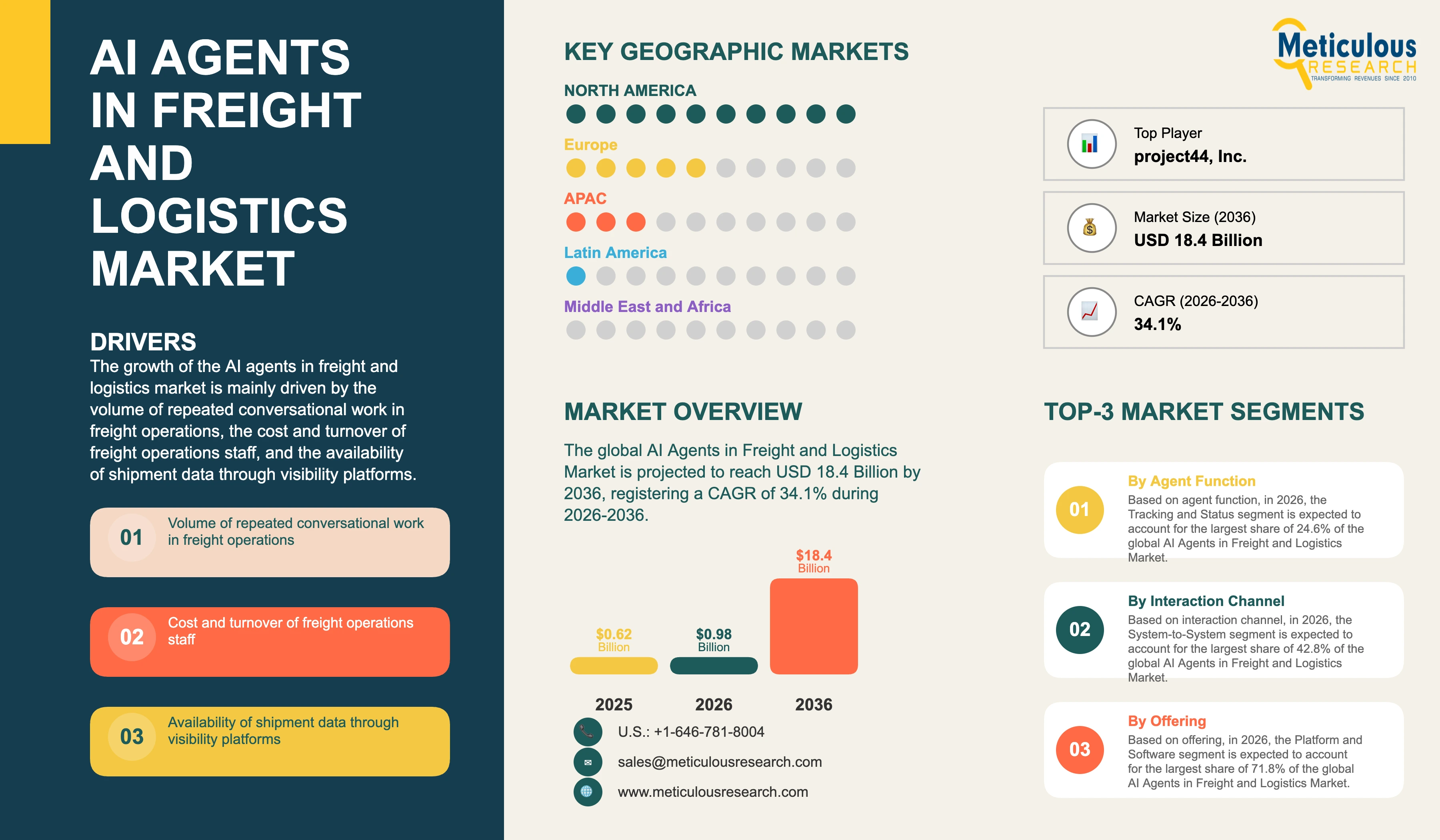
The global AI agents in freight and logistics market was valued at USD 0.62 billion in 2025. This market is expected to reach USD 18.40 billion by 2036 from an estimated USD 0.98 billion in 2026, registering a CAGR of 34.1% during the forecast period (2026-2036).
- Published
- Nov 2026
- Pages
- 248
- Format
- PDF + Excel
- Report ID
- MRICT - 1042551
- Base year
- 2025
- 2025 · BASELINE
- $620.0M
- 2036
- $18.40B
- CAGR 2026–2036
- 34.1%
2025 baseline · 2026–2036 forecast at 34.1% CAGR · hover a bar for the value
Key highlights
The global AI agents in freight and logistics market is estimated at USD 0.98 billion in 2026 and is projected to reach USD 18.40 billion by 2036.
Tracking and status agents are expected to account for the largest share of 24.6% in 2026, while quoting and tendering agents are projected to register the highest CAGR of 38.6%.
System-to-system interaction is expected to hold the largest channel share of 42.8% in 2026, while voice is projected to grow fastest at a CAGR of 41.2%.
Platform and software is expected to be the largest offering with a share of 71.8% in 2026, while implementation and managed services are projected to register the highest CAGR of 36.2%.
Freight brokers and third-party logistics providers are expected to be the largest end user with a share of 34.2% in 2026, while carriers are projected to grow fastest at a CAGR of 37.8%.
North America is expected to hold the largest share of 51.4% in 2026, while Asia-Pacific is projected to register the highest CAGR of 39.4%.
Loadsmart, Inc. sells named agents for document collection and filing, tracking and status updates, tender failures, load audits, claims processing, scheduling, detention handling and dock and yard tasks.
project44, Inc. announced AI Data Quality Agents, an AI Disruption Navigator and an AI supply chain assistant on 12 February 2025.
HappyRobot names carrier sales and track and trace as its logistics use cases and has extended the same agents into utilities, airlines, finance and insurance.
Every deployment currently retains human staff on exceptions, which is the factor that determines whether the labour saving is realised.
Report summary
| Particulars | Details |
|---|---|
| Base Year | 2025 |
| Estimated Year | 2026 |
| Forecast Period | 2026-2036 |
| Market Size in 2025 | USD 0.62 billion |
| Estimated Market Size in 2026 | USD 0.98 billion |
| Projected Market Size by 2036 | USD 18.40 billion |
| CAGR (2026-2036) | 34.1% |
| Format | PDF, Excel & Cloud Portal · 248 pages |
| Segments Covered | Agent Function, Interaction Channel, Offering, End User, and Geography |
| Agent Functions Covered | Tracking and Status, Quoting and Tendering, Document Processing and Data Entry, Appointment Scheduling and Dock Coordination, Carrier Sourcing and Booking, Exception, Claims and Settlement, and Other Functions |
| Interaction Channels Covered | System-to-System, Voice, Email and Messaging, and Chat and Web Interface |
| Offerings Covered | Platform and Software, and Implementation and Managed Services |
| End Users Covered | Freight Brokers and Third-Party Logistics Providers, Carriers, Shippers, Freight Forwarders, and Warehouse and Terminal Operators |
| Geographies Covered | North America, Europe, Asia-Pacific, Latin America, and Middle East & Africa |
| Companies Profiled | 13 leading players |
Report overview
Segments covered: agent function, interaction channel, offering, end user.
The growth of this market is mainly driven by the volume of freight operations work that consists of repeated phone calls and emails confirming information both parties already hold, the cost and turnover of the staff who perform that work, the availability of shipment data through visibility platforms that gives an agent something accurate to say, and pricing models that charge per task and therefore require no capital approval. However, factors such as the inability of an agent to be accountable for a commitment it makes on a customer behalf, the exception rate that determines whether the saving is real, the quality of data in carrier and shipper systems that an agent cannot improve, and the reluctance of carriers to accept automated calls in place of a known contact are expected to restrain the growth of this market to some extent.
Tracking and status agents account for the largest share of this market because check calls and status enquiries are the highest volume repeated task in freight operations. Quoting and tendering agents grow faster because they act at the point where revenue is won rather than where cost is incurred, which makes the value easier for a buyer to measure.
AI agents in freight and logistics are software that conducts a defined operational task from start to finish without a person performing each step, which in this sector means placing and answering calls, reading and replying to emails, entering data into portals and updating records across systems. The work they replace is conversational rather than analytical, because freight operations run on repeated exchanges confirming information both parties already hold, and that distinguishes these agents from the optimisation and planning software that transportation management systems have carried for years.
The inventory of tasks these agents perform is visible in the way providers package and name what they sell. Loadsmart, Inc. sells named agents for document collection and filing, tracking and status updates, tender failures, proactive load audits, claims processing, scheduling and re-scheduling, detention handling, purchase order follow-up, warehouse customer service, dock schedule management and yard task orchestration, alongside the ability to build custom agents. HappyRobot names carrier sales and track and trace as its logistics use cases. project44, Inc. announced AI Data Quality Agents that resolve visibility gaps, an AI Disruption Navigator and an AI supply chain assistant on 12 February 2025. The segmentation that providers use is therefore the task rather than the technology.
Check calls are the highest volume task of all of them, because a single load generates repeated position enquiries over its journey. A shipper or broker confirming the position of a load calls or emails the carrier, waits, records the answer and repeats the exercise on a schedule, and the exchange carries no judgement that a person needs to supply. Carrier sales works the same way in reverse, with a broker contacting many carriers to find capacity on a lane and conducting a near-identical conversation each time. Both are performed at volume by staff whose turnover is high and whose training cost is recurring, which is why the first agents deployed commercially in this sector addressed these two tasks rather than pricing or planning.
An agent can conduct a conversation and record an outcome, and it cannot be answerable for a commitment made to a customer, so every deployment retains people to handle what the agent cannot complete. Loadsmart, Inc. states the position directly in describing freight experts who step in on exceptions. The commercial consequence is that the saving a buyer realises depends on the proportion of interactions that complete without intervention, and a deployment with a high exception rate costs more than the manual process it replaced because the exception arrives with context that has to be reconstructed.
What an agent is able to say is set by the data it can reach rather than by the model behind it. An agent answering a status enquiry needs the shipment position, and that sits in carrier telematics, in electronic logging devices or in a visibility platform rather than in the agent itself, so providers holding that data moved into agents from an advantageous position. Pure-play providers integrate rather than compete on it, and the quality of the underlying records limits both. An agent cannot correct a wrong appointment time or a missing reference number, and project44, Inc. addressed that constraint by positioning agents to resolve data gaps as a task in its own right.
Pricing is per task, per minute of conversation or per equivalent seat rather than per named user, which removes the capital approval that software purchases normally require and allows a buyer to begin with one task and extend. The model also ties provider revenue to freight volume rather than to licence renewals, so revenue falls in a freight downturn in a way transportation management software revenue does not. Buyers justify the spend against headcount they do not rehire rather than headcount they remove, which makes the business case easier to approve and harder to audit. Contract terms are correspondingly short, so a provider that cannot keep the exception rate down loses the account at the next renewal rather than at the end of a multi-year term.
The technology carries no characteristic specific to freight, and its providers have begun proving that in other sectors. HappyRobot has extended the same agents into utilities, airlines, finance, insurance, manufacturing, retail and telecommunications, which indicates that freight was an entry market chosen for the volume of repeated conversation rather than for any characteristic unique to it. That portability means freight-focused providers compete with general purpose agent platforms as well as with each other, and it places a premium on the integrations and the freight-specific context that a general platform does not hold.
North America, with a share of 51.4% in 2026 at USD 0.50 billion, with the United States growing at a CAGR of 32.1%.
Asia-Pacific, at a CAGR of 39.4%, with India at 42.6% and China at 38.8%.
Europe holds a share of 26.2% in 2026 at USD 0.26 billion and is projected to grow at a CAGR of 34.4%.
The Middle East & Africa holds 2.4% at USD 0.02 billion with a CAGR of 34.2%, and Latin America holds 3.2% at USD 0.03 billion with a CAGR of 36.0%.
The 13 companies profiled accounted for 41.8% of the market in 2025, and the top five players, project44, Inc., Loadsmart, Inc., FourKites, Inc., HappyRobot and C.H. Robinson Worldwide, Inc., accounted for 23.4%.
System-to-system, with a share of 42.8% in 2026 at USD 0.42 billion.
Voice, at a CAGR of 41.2%, from USD 0.24 billion and a share of 24.4% in 2026.
Platform and software, with a share of 71.8% in 2026 at USD 0.70 billion.
Implementation and managed services, at a CAGR of 36.2%, from USD 0.28 billion and a share of 28.2% in 2026.
Freight brokers and third-party logistics providers, with a share of 34.2% in 2026 at USD 0.34 billion.
Carriers, at a CAGR of 37.8%, from USD 0.24 billion and a share of 24.8% in 2026.
Report infographic
Market dynamics
15 factors across 5 forcesVolume of Repeated Conversational Work in Freight Operations
A broker or shipper confirming load positions, chasing documents, booking appointments and answering status enquiries conducts the same exchange many times each day, and the content of each exchange is information that one party already holds and the other needs recorded. The work requires no judgement and cannot be eliminated, because the parties operate separate systems that do not share data, so it is performed by people whose entire role is conversation. The number of such interactions scales with shipment counts rather than with tonnage, and shipment counts are rising as inventory is held in smaller quantities closer to consumption. This volume is the reason the AI agents in freight and logistics market is being adopted first in operations rather than in planning. The same interactions also occur across organisational boundaries rather than inside one company, which is why no amount of internal system investment removes them and why a tool that conducts the exchange has value that a better internal platform does not.
Cost and Turnover of Freight Operations Staff
The staff performing check calls, carrier sales and appointment booking are employed at scale by brokers, carriers and third-party logistics providers, and turnover in those roles is high because the work is repetitive and the pay reflects it. Each departure carries recruitment and training cost, and a team running below strength degrades service rather than reducing cost, which makes the labour position the operating problem these agents are bought to solve. Providers price against the cost of a person performing the same task, so the value case strengthens wherever wages rise. Buyers also gain capacity outside business hours without paying a shift premium, which is particularly valuable where freight moves across time zones, and they gain it without the recruitment lead time that adding a shift would require. Retention improves on the remaining roles as well, because the staff who stay handle exceptions and judgement rather than repetition.
Availability of Shipment Data Through Visibility Platforms
An agent is only useful if what it says is accurate, and the data that makes a status answer accurate sits in carrier telematics, electronic logging devices and visibility platforms that have been connected over the past decade. That connected data is what allows an agent to answer a status enquiry rather than merely forward it, and the providers holding it have moved into agents from a position competitors must integrate to reach. project44, Inc. announced AI Data Quality Agents on 12 February 2025 that resolve visibility gaps without manual follow-up, which treats the data problem as a task an agent performs rather than a precondition for one. The growth of connected shipment data therefore expands what agents can be sold to do, and each new integration raises the proportion of enquiries an agent can answer without escalation.
Pricing Models That Require No Capital Approval
Agents are sold per task completed, per minute of conversation or per equivalent seat, so a buyer can begin with one task at a cost that sits within an operating budget rather than a capital plan. The purchase avoids the implementation project, the integration programme and the approval cycle that a transportation management system requires, and a buyer that is satisfied extends to further tasks without a new business case. That structure has allowed adoption to spread through mid-sized brokers and carriers that would not have bought enterprise software, and it is the reason the installed base is broadening faster than the average contract value is rising. Pricing against a unit of work rather than a user count also means the spend scales with activity, so a buyer whose volumes fall is not left paying for seats it no longer needs, which removes the objection that has slowed software adoption among cyclical freight businesses.
Table of contents
12 chapters · 133 sections · 248 pages · click to expandSegmental analysis
| Segment | Largest share (2026) | Fastest growth (2026–2036) |
|---|---|---|
| By Agent Function | Tracking and status | Rapid growth of this |
| By Interaction Channel | System-to-system | Rapid growth of this |
| By Offering | Platform and software | Rapid growth of this |
| By End User | Freight brokers and third-party logistics providers | Rapid growth of this |
By Agent Function
- AI Agents in Freight and Logistics Market Analysis by Agent Function
- The tracking and status segment is expected to account for the largest share of 24.6% of the global AI agents in freight and logistics market, valued at USD 0.24 billion.
- The large share of this segment is mainly due to the number of times a load position is requested and recorded during a single movement, which exceeds the count of any other interaction in freight operations, and to the availability of shipment data that lets an agent answer the enquiry rather than forward it.
- The conversation also carries no commitment, so buyers deploy it without the approval controls they impose on tasks that create an obligation, which makes it the first task in almost every deployment and therefore the one with the widest installed base.
- However, the quoting and tendering segment, valued at USD 0.19 billion in 2026 and accounting for a share of 19.8%, is projected to register the highest CAGR of 38.6% during the forecast period.
- The rapid growth of this segment is attributed to the value showing in freight won rather than in labour saved, which buyers approve more readily because a win rate is easier to measure than an exception rate, and to quote volumes arriving in bursts that a fixed desk cannot absorb.
- The spend also sits with commercial budgets rather than operations budgets, which removes it from headcount discussions altogether and shortens the approval path that cost-justified tasks have to follow.
- Tracking and status, with a share of 24.6% in 2026 at USD 0.24 billion.
- Quoting and tendering, at a CAGR of 38.6%, from USD 0.19 billion and a share of 19.8% in 2026.
By Interaction Channel
- AI Agents in Freight and Logistics Market Analysis by Interaction Channel
- The system-to-system segment is expected to account for the largest share of 42.8% of the global AI agents in freight and logistics market, valued at USD 0.42 billion.
- The large share of this segment is mainly due to the proportion of agent work that consists of reading and writing records across platforms, portals and electronic data interchange connections rather than speaking to a person, which completes without a counterparty who can refuse.
- These interactions also carry the lowest exception rate, so buyers extend them furthest before a person is required, and the work is invisible to the counterparty, which removes the resistance that automated contact provokes.
- However, the voice segment, valued at USD 0.24 billion in 2026 and accounting for a share of 24.4%, is projected to register the highest CAGR of 41.2% during the forecast period.
- The rapid growth of this segment is attributed to carriers and drivers answering telephone calls rather than portals, which makes voice the only channel that reaches the counterparty in carrier sales and check calls, and to the ability of a voice agent to hold many conversations at once in several languages and outside business hours.
- The countable nature of calls placed and capacity found also makes the result easier for a buyer to verify than any other channel.
By Offering
- AI Agents in Freight and Logistics Market Analysis by Offering
- The platform and software segment is expected to account for the largest share of 71.8% of the global AI agents in freight and logistics market, valued at USD 0.70 billion.
- The large share of this segment is mainly due to the per task and per minute pricing on which agents are sold, which places the majority of the spend in the software line and requires no implementation project to begin.
- Providers also build the agent once and sell it many times, so the software component scales with adoption while the service component does not, which is why providers present themselves as software businesses even where a substantial part of each deployment is delivered by people.
- However, the implementation and managed services segment, valued at USD 0.28 billion in 2026 and accounting for a share of 28.2%, is projected to register the highest CAGR of 36.2% during the forecast period.
- The rapid growth of this segment is attributed to the tuning each deployment requires before exception rates fall to an economic level, which is specific to the operation rather than reusable, and to buyers that lack the internal capability asking providers to run the agents on their behalf.
- Integration into carrier and shipper systems with inconsistent data also consumes service effort that the software cannot absorb.
By End User
- AI Agents in Freight and Logistics Market Analysis by End User
- The freight brokers and third-party logistics providers segment is expected to account for the largest share of 34.2% of the global AI agents in freight and logistics market, valued at USD 0.34 billion.
- The large share of this segment is mainly due to the concentration of conversational work in brokerage, where carrier sales and check calls are performed at volume by staff whose entire role is conversation, and to the direct relationship between the number of those conversations and the freight the business wins.
- Brokers also operate on margins thin enough that labour cost changes are commercially material, and they buy software readily because the technology is the business rather than a support function, which shortens the evaluation cycle relative to shippers and carriers.
- However, the carriers segment, valued at USD 0.24 billion in 2026 and accounting for a share of 24.8%, is projected to register the highest CAGR of 37.8% during the forecast period.
- The rapid growth of this segment is attributed to carriers performing the mirror image of the broker task, answering calls, booking appointments at consignee facilities, pursuing detention claims and managing driver communication, which providers addressed later than the broker side.
- The population is also far larger, because carriers outnumber brokers by a wide margin and the smallest of them perform the work with no software at all, which rewards products that install without integration.
Geographic analysis
North America
Largest shareIn 2026, North America is expected to account for the largest share of 51.4% of the global AI agents in freight and logistics market, valued at USD 0.50 billion. The region holds this position because its brokerage sector is the largest and most fragmented in the world, which concentrates the conversational work these agents perform in one market, and because the carrier base is numerous enough that finding capacity on a lane requires contacting many parties rather than a few. Providers including Loadsmart, Inc., project44, Inc. and HappyRobot built and sold their first agents here, so the integrations and the sector context are deepest in this region. Wage levels also make the labour comparison most favourable, since the cost of the person an agent replaces is higher here than in any other region. Canada is served from the same product and the same integrations, so it adopts without a separate development cycle. The United States is projected to grow at a CAGR of 32.1% during the forecast period, with growth moderated by the share of large brokers that have already deployed agents on the highest volume tasks.
Asia-Pacific
Fastest growthHowever, Asia-Pacific is projected to register the highest CAGR of 39.4% during the forecast period. The rapid growth of this region is attributed to the volume of freight coordination conducted by telephone and messaging rather than through connected systems, which is the condition agents address most directly, and to the number of languages and dialects a regional operation must handle, where a voice agent removes a staffing constraint that no amount of recruitment resolves. Export freight coordination between the region and its customers also runs across time zones, so agents supply coverage outside business hours that would otherwise require a night shift. Adoption is also starting from a very low base, so the increase reflects first deployments rather than extension into further tasks, and providers entering the region compete on language coverage and local integrations rather than against an incumbent agent. Domestic freight coordination in the region also runs through messaging applications rather than email, which favours providers building for those channels rather than porting a product designed around North American workflows. Regional freight forwarders handling export documentation across several jurisdictions are the earliest buyers, since the documentation volume justifies the spend before the call volume does, and they operate in English alongside local languages, which lets them deploy products built elsewhere without waiting for language coverage. India is projected to grow at a CAGR of 42.6% and China at 38.8%.
Competitive landscape
The competitive structure of the AI agents in freight and logistics market divides between visibility and platform providers that added agents to software buyers already run, specialists built around the agent itself, and logistics operators that developed agents for their own operations and then sold them. project44, Inc., FourKites, Inc., Trimble Inc., The Descartes Systems Group Inc., WiseTech Global Limited, Manhattan Associates, Inc., Oracle Corporation and Panasonic Holdings Corporation compete from the platform position, where the shipment data an agent needs already sits. HappyRobot competes as a specialist on conversational tasks, and Loadsmart, Inc., C.H. Robinson Worldwide, Inc., Uber Technologies, Inc. and Flexport, Inc. sell agents developed inside their own freight operations.
Competition turns on which provider holds the data an agent must rely on and on how low an exception rate it can demonstrate in a buyer own operation, rather than on the breadth of the agent catalogue. The platform providers hold the advantage on tasks that depend on shipment data and the specialists hold it on tasks that depend on conducting a conversation, which is why the two groups have so far grown without displacing each other. The capability is not specific to freight, so both also compete with general purpose agent platforms, and the defence in each case is the integrations and the sector context that a general platform does not hold. Acquisition is the likely route by which the two groups combine, because a platform provider can buy conversational capability faster than it can build it and a specialist cannot assemble shipment data at all. The 13 companies profiled accounted for 41.8% of the market in 2025, which is high for a market at this stage and reflects how few providers have taken agents beyond a pilot.
Some of the key players operating in the AI agents in freight and logistics market are project44, Inc. (U.S.), Loadsmart, Inc. (U.S.), FourKites, Inc. (U.S.), HappyRobot (U.S.), C.H. Robinson Worldwide, Inc. (U.S.), Uber Technologies, Inc. (U.S.), Trimble Inc. (U.S.), The Descartes Systems Group Inc. (Canada), WiseTech Global Limited (Australia), Manhattan Associates, Inc. (U.S.), Oracle Corporation (U.S.), Panasonic Holdings Corporation (Japan), and Flexport, Inc. (U.S.), among others.
- —
project44, Inc. announced AI Data Quality Agents, an AI Disruption Navigator and an AI supply chain assistant on 12 February 2025, Loadsmart, Inc. released a set of twelve named agents covering document handling, tracking, scheduling, claims and dock and yard tasks, and HappyRobot extended its freight agents into utilities, airlines, finance and insurance.
- FourKites, Inc.
- Trimble Inc.
- Descartes Systems Group Inc.
- WiseTech Global Limited
- Manhattan Associates, Inc.
- Oracle Corporation and Panasonic Holdings Corporation
Expert perspectives
The reason these agents work in freight is that the work they replace is conversation rather than judgement. Freight operations consist of repeated calls and emails confirming information both parties already hold, and the cost sits in conducting the exchange rather than in deciding anything. That is why the first commercially deployed agents handled check calls and carrier sales rather than pricing or planning, and it is why the market is being sold task by task with a named agent and a price for each.
Exception rate rather than agent capability decides whether a deployment pays, because an interaction that an agent cannot complete arrives with partial context that a person must reconstruct, which costs more than handling it from the start, so a deployment at a high exception rate is worse than the manual process. Buyers who measured this honestly found the rate above what provider cases assumed, particularly on carrier conversations where the other party can simply end the call. The tuning that brings the rate down is specific to each operation and does not transfer, which is why the services component of this market grows faster than its scale would suggest.
Accountability sets a ceiling on this market that better models will not lift, since the organisation rather than the software answers for what is promised. An agent can accept a tender or confirm an appointment, and the organisation carries the consequence if the commitment fails, so buyers keep approval steps on anything creating an obligation and keep people available for the remainder. Deployments therefore reduce headcount growth rather than headcount, and the business case rests on positions not rehired, which makes it easy to approve and difficult to audit. Contractual and insurance treatment of automated commitments remains unsettled and will shape how far this extends.
Data position rather than agent quality will determine who wins the larger tasks. An agent answering a status enquiry is only as accurate as the record behind it, and that record sits with the visibility platforms and the carrier systems, which is why platform providers moved into agents from an advantageous position and why specialists integrate rather than compete there. The specialists hold the conversational tasks because conducting a call well is a different capability from holding the data, and the two groups have grown so far without taking share from each other.
Growth in the AI agents in freight and logistics market rests on the volume of repeated conversational work that freight operations cannot eliminate, and it is paced by exception rates, by data quality in carrier and shipper systems and by how much accountability buyers will transfer. Providers that can demonstrate a low exception rate in a buyer own operation, hold or reach the underlying shipment data and reach carriers as well as brokers will take a disproportionate share of the increase.
Customer perspectives
Brokerage buyers evaluate these agents on completion rate rather than on capability, and that single measure is what decides whether a deployment in the sector extends beyond its first task.
Carrier buyers represent a far larger population than brokers and have been reached later, with the absence of systems to integrate into being the condition that shapes what the sector can adopt, and with distribution rather than product capability determining which providers reach them.
Shipper buyers in the sector draw the line at commitments made on their behalf, which is why adoption among them concentrates in status and documentation tasks rather than in anything creating an obligation, and why their spend per organisation stays below that of brokers performing the same volume of work, with the balance of the industry spend sitting with the providers they outsource the freight to, which concentrates the purchasing in brokerage and carriage rather than across the shipper base, and makes the shipper segment a slower but more durable one for providers to hold.
“Our industry measures this on one number, which is how many calls finish without a person picking them up. Below a certain level it is cheaper to keep the desk, because a half-finished call is worse than no call at all.”
“Nobody sold us anything for years because the attention was all on the broker side, and our people do the same work in reverse. The problem for our sector is that half our offices run on a phone and a spreadsheet, so anything needing integration is not an option.”
“We will let it tell a customer where the truck is. We will not let it agree a delivery window, because if that fails it is our name on it, not the software.”
Frequently asked questions
The market was valued at USD 0.62 billion in 2025 and USD 0.38 billion in 2024, and is estimated at USD 0.98 billion in 2026.
Cite this report
Meticulous Research. (2026). AI Agents in Freight and Logistics Market - Global Opportunity Analysis and Industry Forecast (2026-2036) (Report No. MRICT - 1042551). Meticulous Market Research Pvt. Ltd. https://www.meticulousresearch.com/product/ai-agents-in-freight-and-logistics-market-7234