AI in Customer Service Market (2026-2036)
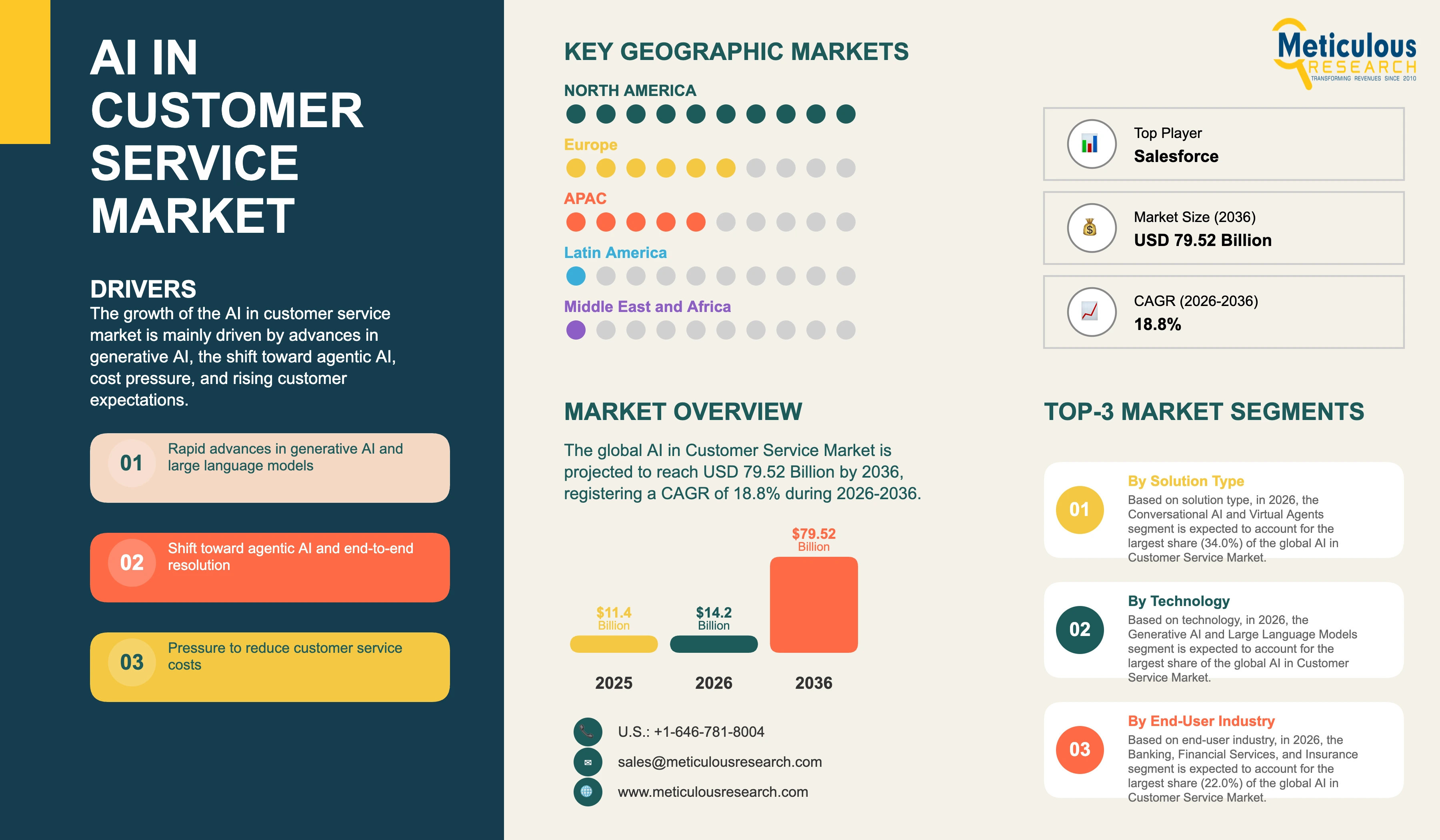
The global AI in customer service market was valued at USD 11.40 billion in 2025. This market is expected to reach USD 79.52 billion by 2036 from an estimated USD 14.20 billion in 2026, registering a CAGR of 18.8% during the forecast period (2026-2036).
- Published
- Nov 2026
- Pages
- 250
- Format
- PDF + Excel
- Report ID
- MRICT - 1042603
- Base year
- 2025
- 2025 · BASELINE
- $11.40B
- 2036
- $79.52B
- CAGR 2026–2036
- 18.8%
2025 baseline · 2026–2036 forecast at 18.8% CAGR · hover a bar for the value
Key highlights
Salesforce reported that Agentforce reached USD 800 million in annual recurring revenue in the fourth quarter of its fiscal year 2026, which ended January 31, 2026, up 169% year-over-year, with more than 29,000 Agentforce deals signed, and its Q1 fiscal 2027 results later showed Agentforce annual recurring revenue of USD 1.2 billion, up 205% year-over-year, making it one of the fastest-growing AI products in enterprise software.
Salesforce signed a definitive agreement to acquire Fin, the AI customer service company formerly known as Intercom, for approximately USD 3.6 billion on June 15, 2026, and completed the acquisition on September 10, 2026, adding an AI agent that resolves on average 76% of support volume end-to-end for many customers and a base of more than 30,000 customer companies.
Sierra, the AI customer service agent company co-founded by former Salesforce co-CEO Bret Taylor, raised USD 950 million in a Series E round led by Tiger Global and GV in May 2026 at a post-money valuation of USD 15.8 billion, after reporting more than USD 150 million in annual recurring revenue in February 2026.
Decagon, a provider of AI agents for enterprise customer support, raised USD 250 million in a Series D round led by Coatue and Index Ventures in January 2026, tripling its valuation to USD 4.5 billion from USD 1.5 billion in June 2025, which reflects strong investor demand for agentic customer service platforms.
NiCE completed its acquisition of Cognigy, a conversational and agentic AI company, in September 2025, and it is making Cognigy's platform, which supports more than 100 languages, available to its base of more than 25,000 customers, while Verint expanded its AI portfolio with the acquisition of Cogito, a provider of real-time AI coaching for contact center agents.
By solution type, conversational AI and virtual agents account for the largest share of 34.0% in 2026, while agentic AI and autonomous service agents register the highest CAGR.
By technology, generative AI and large language models account for the largest share in 2026 and also register the highest CAGR.
By deployment, cloud accounts for the larger share in 2026 and also registers the higher CAGR.
By end-user industry, banking, financial services, and insurance accounts for the largest share of 22.0% in 2026, while healthcare and life sciences register the highest CAGR.
By geography, North America accounts for the largest share of 44.0% in 2026, while Asia-Pacific registers the highest CAGR of 22.5%.
Report summary
| Particulars | Details |
|---|---|
| Forecast Period | 2026-2036 |
| Base Year | 2025 |
| Estimated Year | 2026 |
| CAGR (2026-2036) | 18.8% |
| Format | PDF, Excel & Cloud Portal · 250 pages |
| Market Size in 2025 | USD 11.40 billion |
| Market Size in 2026 | USD 14.20 billion |
| Market Size by 2036 | USD 79.52 billion |
| Largest Segment by Solution Type (2026) | Conversational AI and Virtual Agents (34.0%) |
| Largest Segment by End-User Industry (2026) | Banking, Financial Services, and Insurance (22.0%) |
| Largest Region (2026) | North America (44.0%) |
| Fastest-Growing Region | Asia-Pacific (CAGR 22.5%) |
| Companies Profiled | 16 companies and other companies |
| Segments Covered | Solution Type, Technology, Deployment, End-User Industry, Geography |
| Countries Covered | U.S., Canada, U.K., Germany, France, Netherlands, Spain, Italy, Ireland, Sweden, Poland, Switzerland, Rest of Europe, China, Japan, India, South Korea, Australia, Singapore, Indonesia, Philippines, Malaysia, Rest of Asia-Pacific, Brazil, Mexico, Colombia, Argentina, Chile, Rest of Latin America, Saudi Arabia, U.A.E., Israel, South Africa, Rest of Middle East & Africa |
Report overview
Segments covered: solution type, technology, deployment, end-user industry.
The growth of this market is mainly driven by the rapid maturing of generative AI and large language models, the shift from scripted chatbots to agentic AI that can resolve customer issues end-to-end, pressure on companies to reduce the cost of contact center operations while improving customer experience, rising customer expectations for instant, always-available, and multilingual service across digital and voice channels, and the migration of contact centers to cloud platforms that embed AI. However, factors such as concerns over the accuracy and reliability of AI responses, data privacy and security risks, integration complexity with legacy systems, and the uncertain return on investment of some AI deployments are expected to restrain the growth of this market to some extent.
AI in customer service refers to the use of artificial intelligence technologies, including generative AI, large language models, natural language processing, machine learning, and speech recognition, to automate, assist, and improve customer service interactions and operations. It includes conversational AI and virtual agents that answer customer questions through chat, messaging, email, and voice, agent assist and AI copilots that help human agents during live interactions, agentic AI and autonomous service agents that can take actions in business systems to resolve issues end-to-end, customer service analytics and quality management solutions, knowledge management and self-service tools, and AI-based intelligent routing and workforce optimization. This report covers software and platform revenue from AI customer service solutions, together with related implementation and managed services. General contact center software without AI capabilities and business process outsourcing services are analyzed in separate reports. The market is measured on a revenue basis.
Customer service is one of the largest and most mature applications of AI in the enterprise. Companies around the world spend very large amounts each year on customer service staff, contact centers, and outsourcing, and Sierra co-founder Bret Taylor has estimated that roughly USD 400 billion is spent each year on customer service globally, a growing share of which is expected to shift to AI agents. Customer service also involves large volumes of repetitive, text- and voice-based interactions, which makes it well suited to automation with language models. As a result, it has become one of the first business functions where companies are deploying generative and agentic AI at scale.
The market has evolved through several stages over the past two decades. Early chatbots and interactive voice response systems relied on fixed scripts and decision trees and often frustrated customers. Natural language processing and machine learning improved intent recognition and routing in the 2010s. Since 2023, large language models have enabled virtual agents to understand complex questions, generate natural responses, summarize conversations, and draw on company knowledge bases. Since 2025, the focus has shifted to agentic AI, which can plan and carry out multi-step tasks, such as processing refunds, changing bookings, updating accounts, and troubleshooting products, by connecting to CRM, order management, billing, and other systems.
Conversational AI and virtual agents account for the largest share of the market, since they handle a large and growing share of customer interactions on websites, mobile apps, messaging channels, and phone lines. Agent assist and AI copilots are the second-largest solution area, providing real-time suggestions, knowledge retrieval, conversation summaries, and after-call work automation for human agents. Agentic AI and autonomous service agents are the fastest-growing solution area, supported by products such as Salesforce Agentforce, Fin, Sierra, Decagon, NiCE Cognigy, Google Customer Engagement Suite, and Microsoft Dynamics 365 Contact Center.
The market is served by several distinct groups of companies with different strengths and routes to customers. CRM and customer service platform providers, such as Salesforce, ServiceNow, Zendesk, Freshworks, and Microsoft, embed AI agents and copilots into their service applications. Contact center as a service (CCaaS) and customer experience software providers, such as NiCE, Genesys, Five9, Talkdesk, and Verint, offer AI across routing, self-service, agent assist, analytics, and workforce management. Cloud and AI platform providers, such as Google Cloud and Amazon Web Services, offer contact center AI services and foundation models. AI-native companies, such as Sierra, Decagon, Kore.ai, and LivePerson, focus on conversational and agentic AI for customer experience.
Banking, financial services, and insurance is the largest end-user industry, since banks, card issuers, and insurers handle very large volumes of customer interactions and have invested heavily in digital service. Retail and e-commerce, telecommunications, healthcare, technology, travel and hospitality, and government are other important industries. North America is the largest regional market, supported by early adoption, large contact center operations, and the presence of most leading vendors, while Asia-Pacific is the fastest-growing region.
Pricing models in the market are also changing as AI agents take over work previously done by human agents. Traditional contact center software has been sold mainly on a per-seat basis, but AI agents reduce the number of human seats needed, so vendors are shifting toward consumption-based and outcome-based pricing, such as pricing per conversation or per resolution. This shift is changing how companies budget for customer service technology and how vendors report revenue.
Over the forecast period, the AI in customer service market is expected to grow strongly, supported by advances in generative and agentic AI, cost pressure on customer service operations, rising customer expectations, and cloud migration of contact centers. At the same time, accuracy, governance, privacy, and integration requirements will shape how quickly companies move from pilots to large-scale deployments.
North America is expected to account for the largest share of 44.0% of the market in 2026, mainly due to early and widespread AI adoption, large contact center operations, high labor costs, strong cloud adoption, and the presence of most leading vendors.
Asia-Pacific is projected to register the highest CAGR of 22.5% during the forecast period, driven by large digital consumer populations, growth of e-commerce and digital banking, widespread use of messaging channels, AI adoption by outsourcing providers, and local-language AI models.
The report profiles 16 companies, including Salesforce, NICE, Genesys, Zendesk, Verint, Five9, Google, Microsoft, Amazon Web Services, ServiceNow, Sierra, Decagon, Freshworks, LivePerson, Kore.ai, and Talkdesk.
Vendors are moving from per-seat pricing toward consumption-based and outcome-based pricing, such as charges per conversation or per resolved issue, since AI agents reduce the number of human agent seats required and buyers want costs linked to measurable results.
Report infographic
Market dynamics
18 factors across 5 forcesRapid advances in generative AI and large language models
The rapid improvement of large language models since 2023 has transformed what AI can do in customer service. Modern models can understand complex and ambiguous questions, maintain context across long conversations, generate natural and brand-appropriate responses, summarize interactions, translate between languages, and retrieve answers from company knowledge bases using retrieval-augmented generation. These capabilities allow virtual agents to resolve a much larger share of customer questions without human involvement than earlier rules-based chatbots, and they make agent assist tools far more useful for human agents.
The cost of using language models has also fallen sharply, while speed has improved, which makes it economical to apply AI to every customer interaction, including real-time voice conversations. Specialized models trained for customer service, such as Fin's Apex model, which Salesforce says outperforms general-purpose frontier models on resolution rates, are further improving performance.
Voice AI has improved particularly quickly, with low-latency speech recognition and natural-sounding speech synthesis now allowing AI voice agents to hold phone conversations that are much closer to human conversations than traditional interactive voice response menus. Since voice remains the main channel for complex and urgent customer issues in many industries, this improvement is opening a very large new area for automation.
Shift toward agentic AI and end-to-end resolution
Customer service is moving from AI that answers questions to AI that resolves issues. Agentic AI systems can connect to CRM, order management, billing, scheduling, and other systems through APIs and take actions on behalf of customers, such as issuing refunds, changing orders, rebooking travel, updating account details, and troubleshooting devices. This allows companies to automate complete customer journeys rather than only simple questions, which greatly increases the value of AI.
The commercial momentum behind agentic AI has been very strong since 2025, and it is visible in vendor results and funding. Salesforce reported Agentforce annual recurring revenue of USD 1.2 billion in its first quarter of fiscal year 2027, up 205% year-over-year, and acquired Fin for approximately USD 3.6 billion to strengthen its service agent offering. Sierra and Decagon raised large funding rounds in 2026, and NiCE, Genesys, Zendesk, Microsoft, Google, and Amazon have all launched agentic AI capabilities for customer service. Vendors increasingly report autonomous resolution rates for common requests well above those of earlier chatbots.
Outcome-based pricing models, where companies pay for each resolved conversation, also make it easier for buyers to justify investments in agentic AI, since costs are directly linked to measurable results.
Pressure to reduce customer service costs
Customer service is a large cost for companies in banking, telecommunications, retail, utilities, travel, and many other industries, and labor accounts for most of the cost of contact center operations. Companies face rising wages, high agent turnover, recruitment and training costs, and pressure to improve margins, which makes automation of routine interactions highly attractive. AI virtual agents can handle large volumes of interactions at a fraction of the cost of human agents, while agent assist tools reduce average handling time and after-call work and help new agents become productive faster.
Many companies are now setting specific targets for the share of customer interactions handled by AI and are redeploying human agents to more complex, sensitive, and high-value interactions. Business process outsourcing providers are also adopting AI to protect their margins and offer new services, which further expands demand.
Economic uncertainty has reinforced this driver, since companies seeking to control costs without reducing service levels are prioritizing AI projects that show clear savings within one or two years.
Rising customer expectations for instant and omnichannel service
Customers increasingly expect fast, accurate, and personalized service at any time of day, across websites, mobile apps, messaging channels such as WhatsApp, email, social media, and phone. Long wait times, repeated explanations, and limited service hours are major sources of customer dissatisfaction. AI virtual agents provide instant responses at any hour, can handle sudden increases in volume, support many languages, and maintain context across channels, which helps companies meet these expectations without proportional increases in staffing.
Global companies also value the ability of AI to provide consistent service in many languages, since platforms such as Cognigy support more than 100 languages, which reduces the need for separate language-specific teams.
Younger customers in particular prefer digital and messaging channels to phone calls, and companies are responding by expanding AI-powered messaging service on the channels that customers already use every day.
Migration of contact centers to cloud platforms
Contact centers are moving from on-premise systems to cloud-based contact center as a service platforms, which offer flexibility, faster innovation, and easier integration with CRM and other cloud applications. Cloud platforms make it much easier to deploy AI capabilities, since vendors can deliver new AI features continuously, and AI models require scalable computing resources that are best provided in the cloud. Many companies are combining contact center modernization projects with AI deployments, which increases demand for AI-enabled cloud platforms from NiCE, Genesys, Five9, Talkdesk, Amazon Connect, Google Cloud, and Microsoft.
The migration is still far from complete, especially among large enterprises in Europe and Asia, which means that cloud migration will continue to support AI adoption throughout the forecast period.
Table of contents
12 chapters · 166 sections · 250 pages · click to expandSegmental analysis
| Segment | Largest share (2026) | Fastest growth (2026–2036) |
|---|---|---|
| By Solution Type | Generative AI and large language models | Agentic AI and autonomous service agents |
By Solution Type
- The generative AI and large language models segment is expected to account for the largest share of the AI in customer service market, and it is also projected to register the highest CAGR during the forecast period.
- The cloud segment is expected to account for the larger share of the AI in customer service market, and it is also projected to register the higher CAGR during the forecast period.
Geographic analysis
North America
Largest shareIn 2026, North America is expected to account for the largest share of 44.0% of the global AI in customer service market. The large share of this region is mainly due to early and widespread adoption of AI in customer service, large contact center operations in banking, retail, telecommunications, healthcare, and other industries, high labor costs that strengthen the case for automation, strong cloud adoption, and the presence of most leading vendors, including Salesforce, ServiceNow, Microsoft, Google, Amazon Web Services, Genesys, Five9, Zendesk, Sierra, Decagon, Talkdesk, and LivePerson. The U.S. is the largest market in the region, followed by Canada. Venture capital investment in AI customer service companies is also concentrated in the U.S., which supports rapid innovation and adoption.
Asia-Pacific
Fastest growthAsia-Pacific is projected to register the highest CAGR of 22.5% during the forecast period. The rapid growth of this region is mainly driven by large and growing digital consumer populations, rapid growth of e-commerce, digital banking, and telecommunications services, widespread use of messaging channels for customer service, large business process outsourcing industries in India and the Philippines that are integrating AI, government digitalization programs, and the development of AI models for local languages. China, Japan, India, South Korea, Australia, Singapore, Indonesia, the Philippines, and Malaysia are important markets, and Chinese technology companies such as Alibaba, Baidu, and Tencent offer AI customer service solutions for the domestic market.
Europe
Europe accounts for a significant share of the global market, supported by large banking, insurance, telecommunications, and retail industries, the need for multilingual service across many countries, and strong contact center software vendors such as NiCE's European operations and Cognigy in Germany. The EU AI Act and the General Data Protection Regulation shape how AI is deployed in customer service, encouraging transparency, human oversight, and data protection. The U.K., Germany, France, the Netherlands, Spain, Italy, Ireland, Sweden, Poland, and Switzerland are important markets, and Ireland is home to the European headquarters of many technology companies and to Fin, which was founded in Dublin as Intercom.
Latin America
Latin America and the Middle East & Africa account for smaller shares of the market but are growing rapidly, supported by digital banking and e-commerce growth, wide use of WhatsApp and other messaging channels for customer service, Spanish- and Portuguese-language contact center industries in Mexico, Colombia, and Brazil, and national AI and digital transformation strategies in Saudi Arabia and the U.A.E. Arabic-language AI models are an important area of development for vendors serving the Middle East.
Competitive landscape
The global AI in customer service market is highly competitive and moderately fragmented, with the top five players estimated to account for about 30% of the market in 2025. The market includes CRM and customer service platform providers, contact center as a service and customer experience software providers, cloud and AI platform providers, AI-native conversational and agentic AI companies, and business process outsourcing providers that offer AI-enabled services.
Salesforce has emerged as a leading player through Agentforce and its acquisition of Fin, while ServiceNow, Microsoft, Zendesk, and Freshworks embed AI agents and copilots into their service management and CRM applications. NiCE, Genesys, Five9, Talkdesk, and Verint offer AI across contact center platforms, including routing, self-service, agent assist, analytics, quality management, and workforce engagement. Google Cloud and Amazon Web Services provide contact center AI services, foundation models, and cloud contact center platforms. Sierra and Decagon are leading AI-native providers of agentic customer service, while Kore.ai and LivePerson offer conversational AI platforms for enterprises.
Competition among these groups is increasing, since platform vendors are adding AI agents to their existing products, AI-native companies are building complete platforms, and cloud providers are offering AI capabilities that companies can use to build their own solutions. Large enterprises often use solutions from several vendors and are evaluating which platform will serve as the main orchestration layer for AI and human agents.
Companies in this market compete on AI accuracy and resolution rates, speed of deployment, integration with CRM and back-office systems, voice capabilities, language coverage, governance and security, pricing models, industry expertise, and customer support. Key strategies include acquisitions of AI specialists, development of specialized models, launches of agentic AI and voice products, partnerships with model providers and system integrators, and expansion into new industries and regions.
The rapid growth of AI-native companies, supported by large venture capital investments, is putting pressure on established vendors to innovate quickly, while established vendors benefit from large customer bases, existing integrations, and trusted relationships. We expect further consolidation as established vendors acquire AI-native companies and as smaller vendors struggle to compete with well-funded leaders.
System integrators and consulting firms also play an important role in the market, since large enterprises often need help with data preparation, process redesign, integration, and change management when deploying AI agents at scale.
Some of the key players operating in the AI in customer service market are Salesforce, Inc., NICE Ltd., Genesys, Zendesk, Inc., Verint Systems Inc., Five9, Inc., Google LLC, Microsoft Corporation, Amazon Web Services, Inc., ServiceNow, Inc., Sierra Technologies, Inc., Decagon AI, Inc., Freshworks Inc., LivePerson, Inc., Kore.ai, Inc., and Talkdesk, Inc., among others.
- —
Salesforce completed its USD 3.6 billion acquisition of Fin, formerly Intercom, in September 2026 and reported Agentforce annual recurring revenue of USD 1.2 billion in Q1 fiscal 2027, Sierra raised USD 950 million at a USD 15.8 billion valuation in May 2026, Decagon raised USD 250 million at a USD 4.5 billion valuation in January 2026, and NiCE completed its acquisition of Cognigy in September 2025.
- Salesforce, Inc.
- NICE Ltd.
- Genesys
- Zendesk, Inc.
- Verint Systems Inc.
- Five9, Inc.
- Google LLC
- Microsoft Corporation
- Amazon Web Services, Inc.
- ServiceNow, Inc.
- Sierra Technologies, Inc.
- Decagon AI, Inc.
- Freshworks Inc.
- LivePerson, Inc.
- Kore.ai, Inc.
- Talkdesk, Inc.
Expert perspectives
Customer service has become one of the clearest and largest commercial applications of generative and agentic AI. The combination of large interaction volumes, high labor costs, measurable outcomes, and rapidly improving AI capabilities makes customer service a natural first area for enterprise AI at scale, and investment by vendors, buyers, and investors has accelerated sharply since 2025.
Over the forecast period, the market is expected to grow at a CAGR of 18.8%, from USD 14.20 billion in 2026 to USD 79.52 billion in 2036. Growth will be supported by advances in generative AI and large language models, the shift toward agentic AI, cost pressure, rising customer expectations, and cloud migration of contact centers.
Among the market segments, conversational AI and virtual agents are the largest solution type, while agentic AI and autonomous service agents grow fastest. Generative AI and large language models are the largest and fastest-growing technology, cloud is the larger and faster-growing deployment model, and banking, financial services, and insurance is the largest end-user industry, while healthcare and life sciences grow fastest. North America is the largest region, and Asia-Pacific is the fastest-growing region at a CAGR of 22.5%.
In our view, the most important change over the next five years will be the shift from AI that assists and deflects to AI that resolves. Companies that can connect AI agents to their data and business systems, govern them effectively, and redesign their service operations around a combined human and AI workforce will achieve the greatest benefits. Those that deploy AI only as a cost-cutting tool without attention to customer experience risk damaging loyalty.
We expect the vendor landscape to consolidate around a smaller number of platforms that combine AI agents, contact center capabilities, data, and governance. Salesforce's acquisition of Fin shows that large platform vendors are willing to pay high prices for proven AI agent technology, and we expect further acquisitions of AI-native companies.
Voice is likely to be the next major growth area, since it accounts for a large share of contact center costs and AI voice agents have recently become capable of natural conversations. We also expect outcome-based pricing to become more common, which will change vendor revenue models and could compress per-interaction prices while expanding total market value.
Regulation and customer trust will remain important constraints on the pace of automation. Companies will need to ensure transparency, accuracy, privacy, and access to human agents, and vendors that offer strong governance, testing, and monitoring tools will have an advantage, especially in regulated industries.
Overall, we believe AI will become a standard part of every customer service operation within the forecast period, and the AI in customer service market will remain one of the largest and fastest-growing segments of enterprise AI.
Customer perspectives
Head of Customer Operations - Retail bank, U.S.
We started with a virtual agent for simple balance and card questions, and it now handles a large share of our digital conversations. The next step is letting AI complete transactions, but only with strong controls and a clear path to a human agent.
Director of Patient Access - Health system, U.S.
Our call center cannot hire enough staff to handle appointment and billing calls, so we are deploying AI voice agents, but every solution must meet our privacy requirements.
“We moved to an AI agent that can process returns and change orders end-to-end, and we pay per resolution, so the business case was easy to make. We need it to work in every language we sell in.”
Frequently asked questions
The global AI in customer service market was valued at USD 11.40 billion in 2025, up from USD 9.10 billion in 2024, and is estimated at USD 14.20 billion in 2026. The market includes conversational AI and virtual agents, agent assist and AI copilots, agentic AI and autonomous service agents, customer service analytics and quality management, knowledge management and self-service, and intelligent routing and workforce optimization.
Cite this report
Meticulous Research. (2026). AI in Customer Service Market - Global Opportunity Analysis and Industry Forecast (2026-2036) (Report No. MRICT - 1042603). Meticulous Market Research Pvt. Ltd. https://www.meticulousresearch.com/product/ai-in-customer-service-market-7286