AI in Real Estate Market (2026-2036)
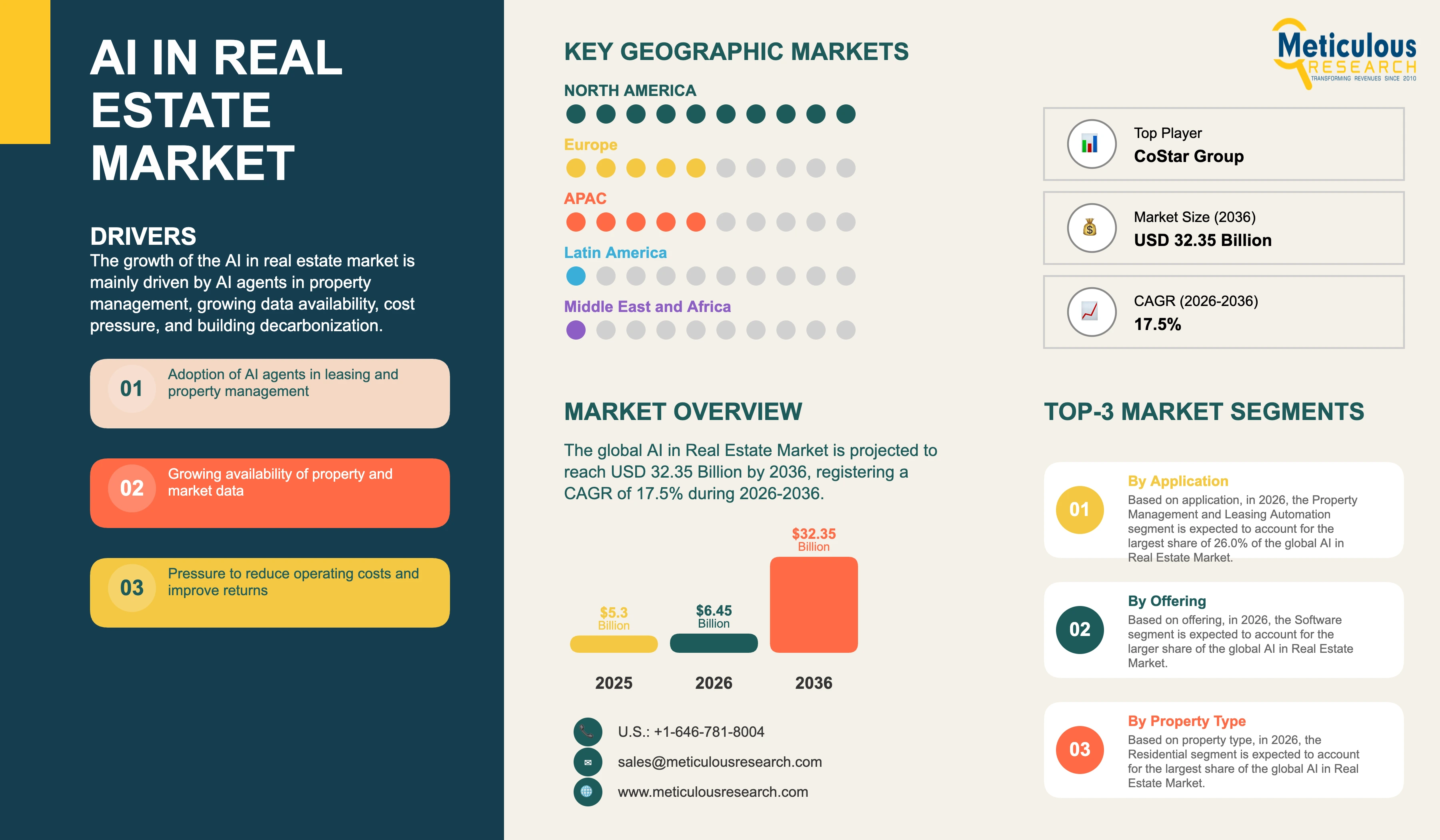
The global AI in real estate market was valued at USD 5.30 billion in 2025. This market is expected to reach USD 32.35 billion by 2036 from an estimated USD 6.45 billion in 2026, registering a CAGR of 17.5% during the forecast period (2026-2036).
- Published
- Nov 2026
- Pages
- 247
- Format
- PDF + Excel
- Report ID
- MRICT - 1042601
- Base year
- 2025
- 2025 · BASELINE
- $5.30B
- 2036
- $32.35B
- CAGR 2026–2036
- 17.5%
2025 baseline · 2026–2036 forecast at 17.5% CAGR · hover a bar for the value
Key highlights
EliseAI, a provider of AI agents for property management and healthcare, raised USD 350 million at a valuation of USD 4 billion in September 2026, following a USD 250 million Series E round at a USD 2.2 billion valuation in August 2025, after surpassing USD 200 million in annual recurring revenue in June 2026, and it launched its Apollo AI agent for property operations in September 2026.
Venture capital investment in property technology reached USD 16.7 billion in 2025, up 67.9% from 2024, according to the Center for Real Estate Technology & Innovation (CRETI), as reported by Bisnow, with AI-focused companies attracting a large share of the funding.
Vantaca, a provider of AI-powered software for community association and homeowners association management, raised USD 300 million in October 2025 to expand its AI automation platform, while Juniper Square, a provider of fund administration and investment management software with AI capabilities for real estate investors, joined the ranks of proptech companies valued at more than USD 1 billion. Both companies illustrate how AI is spreading beyond multifamily leasing into community association management and real estate fund administration.
CoStar Group completed its acquisition of Matterport, a provider of digital twin and 3D capture technology for buildings, in February 2025, combining Matterport's AI-based spatial data with CoStar's commercial and residential real estate information, marketplaces, and analytics.
Regulatory attention to AI in real estate has increased in the U.S., where the Department of Justice filed an antitrust lawsuit against RealPage in 2024 over algorithmic rent-pricing software and several cities have passed restrictions on algorithmic rent-setting, while the Department of Housing and Urban Development issued guidance in 2024 on the application of the Fair Housing Act to AI-based tenant screening and housing advertising.
By application, property management and leasing automation accounts for the largest share of 26.0% in 2026, while transaction and document processing registers the highest CAGR.
By offering, software accounts for the larger share in 2026 and also registers the higher CAGR.
By property type, residential accounts for the largest share in 2026, while commercial registers the highest CAGR.
By end user, property managers, owners, and operators account for the largest share of 38.0% in 2026, while investors, lenders, and REITs register the highest CAGR.
By geography, North America accounts for the largest share of 46.0% in 2026, while Asia-Pacific registers the highest CAGR of 20.5%.
Report summary
| Particulars | Details |
|---|---|
| Base Year | 2025 |
| Estimated Year | 2026 |
| Forecast Period | 2026-2036 |
| Market Size in 2025 | USD 5.30 billion |
| Market Size in 2026 | USD 6.45 billion |
| Market Size by 2036 | USD 32.35 billion |
| CAGR (2026-2036) | 17.5% |
| Format | PDF, Excel & Cloud Portal · 247 pages |
| Largest Segment by Application (2026) | Property Management and Leasing Automation (26.0%) |
| Largest Segment by End User (2026) | Property Managers, Owners, and Operators (38.0%) |
| Largest Region (2026) | North America (46.0%) |
| Fastest-Growing Region | Asia-Pacific (CAGR 20.5%) |
| Companies Profiled | 16 companies and other companies |
| Segments Covered | Application, Offering, Property Type, End User, Geography |
| Countries Covered | U.S., Canada, U.K., Germany, France, Netherlands, Spain, Italy, Sweden, Switzerland, Poland, Rest of Europe, China, Japan, India, Australia, Singapore, South Korea, Indonesia, Malaysia, Rest of Asia-Pacific, Brazil, Mexico, Colombia, Chile, Argentina, Rest of Latin America, U.A.E., Saudi Arabia, Israel, South Africa, Rest of Middle East & Africa |
Report overview
Segments covered: application, offering, property type, end user.
The growth of this market is mainly driven by the adoption of AI agents to automate leasing, resident communication, and property management tasks, the growing availability of property, market, and building data that supports AI-based valuation and investment analytics, pressure on owners and operators to reduce operating costs and improve net operating income, the use of AI to optimize energy use and building operations in line with decarbonization goals, and strong venture capital investment in property technology companies. However, factors such as fragmented and inconsistent real estate data, the slow pace of technology adoption among many smaller firms, regulatory scrutiny of algorithmic pricing and tenant screening, and concerns about data privacy and fair housing compliance are expected to restrain the growth of this market to some extent.
AI in real estate refers to the use of artificial intelligence technologies, including machine learning, generative AI and large language models, computer vision, natural language processing, and predictive analytics, across the real estate value chain, from acquisition, development, and financing to leasing, sales, property management, building operations, and investment management. It includes AI agents for leasing and resident communication, AI-based property valuation and investment analytics, AI tools for marketing, lead generation, and customer engagement, AI for building operations and energy optimization, AI for transaction and document processing, and AI for development planning and other applications. This report covers AI software and platforms, together with related implementation, data, and managed services, sold to real estate companies and professionals. General property management software without AI capabilities, real estate brokerage commissions, and smart building hardware are analyzed in separate reports. The market is measured on a revenue basis.
Real estate is the largest asset class in the world, but it has historically been slower than many other industries to adopt digital technology. Transactions are complex and infrequent, data is fragmented across many sources, and the industry includes very large numbers of small owners, brokers, and management companies. However, this situation has changed rapidly since the early 2020s, as cloud-based property management, listing, and analytics platforms have become widespread, and since 2023, as generative AI has made it possible to automate many communication-heavy and document-heavy tasks that make up a large share of real estate work.
Property management and leasing automation accounts for the largest share of the market. Multifamily owners and operators in particular handle very large volumes of inquiries from prospective residents, tour scheduling, applications, renewals, maintenance requests, and payment questions, and AI leasing and resident communication agents from companies such as EliseAI can handle a large share of these interactions automatically through email, text, chat, and voice. Property management software providers, including Yardi, RealPage, AppFolio, Entrata, and MRI Software, have also embedded AI assistants and agents into their platforms.
Property valuation and investment analytics is the second-largest application, used across lending, investment, and brokerage. Automated valuation models, which use machine learning to estimate property values from transaction, listing, and property data, are widely used by lenders, investors, portals, and brokers, and AI-based analytics help investors identify acquisition opportunities, forecast rents and values, assess risks, and manage portfolios. Companies such as CoStar, Zillow, HouseCanary, Cherre, and Juniper Square offer AI-based data and analytics for different parts of the market.
Marketing, lead generation, and customer engagement is another important application, including AI-generated listing descriptions, virtual staging, image recognition and tagging, personalized property recommendations, and AI assistants for agents and buyers. Building operations and energy optimization uses AI to control heating, ventilation, and air conditioning systems, predict equipment failures, and reduce energy use and emissions in commercial buildings. Transaction and document processing is the fastest-growing application, as generative AI is used to extract, summarize, and analyze leases, contracts, title documents, loan files, and due diligence materials.
Residential property accounts for the largest share of the market by property type, supported by the very large number of homes and apartments, high transaction volumes, and the wide use of AI in multifamily property management and residential brokerage. Commercial property, including offices, retail, hotels, and mixed-use buildings, is the fastest-growing property type, supported by the use of AI for building operations, lease analysis, and investment analytics. North America is the largest regional market, while Asia-Pacific is the fastest-growing region.
Investment in AI-focused property technology companies has been strong in recent years. Venture capital investment in property technology reached USD 16.7 billion in 2025, up 67.9% from 2024, according to the Center for Real Estate Technology & Innovation, and AI-focused companies such as EliseAI, Vantaca, and Juniper Square have raised large funding rounds and reached valuations of more than USD 1 billion. Established real estate data and software companies are also acquiring AI capabilities, as shown by CoStar's acquisition of Matterport.
Over the forecast period, the AI in real estate market is expected to grow strongly, supported by AI agents for property operations, growing data availability, cost and efficiency pressure, building decarbonization, and continued investment. At the same time, data quality, regulation, fair housing compliance, and the slow pace of adoption among smaller firms will influence how quickly AI is adopted across the industry.
North America is expected to account for the largest share of 46.0% of the market in 2026, mainly due to the large institutionally owned real estate market, data availability, high labor costs, strong proptech investment, and the presence of leading companies.
Asia-Pacific is projected to register the highest CAGR of 20.5% during the forecast period, driven by urbanization, large development pipelines, growing institutional investment, smart city programs, and wide use of digital property platforms.
The report profiles 16 companies, including CoStar Group, Zillow Group, EliseAI, Juniper Square, Vantaca, Yardi Systems, RealPage, AppFolio, Entrata, MRI Software, VTS, JLL Technologies, Compass, Cherre, HouseCanary, and Restb.ai.
In the U.S., the Department of Justice filed an antitrust lawsuit against RealPage in 2024 over algorithmic rent-pricing software, several cities have restricted algorithmic rent-setting, and the Department of Housing and Urban Development has issued Fair Housing Act guidance on AI-based tenant screening and advertising, while the EU AI Act sets requirements for high-risk AI systems.
In 2026, the software segment is expected to account for the larger share of the AI in real estate market, and it is also projected to register the higher CAGR during the forecast period.
Report infographic
Market dynamics
18 factors across 5 forcesAdoption of AI agents in leasing and property management
Property management is a labor-intensive business that involves large volumes of routine communication and administrative work, including responding to inquiries from prospective residents and tenants, scheduling tours, processing applications, handling renewals, collecting rent, answering resident questions, and coordinating maintenance requests. Many owners and operators face high staff turnover, difficulty hiring leasing and maintenance staff, and rising labor costs. AI agents can handle a large share of these tasks automatically at any time of day across email, text, chat, and phone, which reduces workload for on-site teams, speeds up responses, and improves lead conversion and resident satisfaction.
The commercial success of AI agents in this area has been remarkable. EliseAI surpassed USD 200 million in annual recurring revenue in June 2026 and raised USD 350 million at a USD 4 billion valuation in September 2026, and leading property management software providers such as Yardi, RealPage, AppFolio, and Entrata have launched AI agents and assistants within their platforms. Many large multifamily operators are now centralizing leasing and resident services and using AI to manage portfolios with fewer on-site staff.
AI agents are also expanding to new tasks, such as maintenance triage, delinquency follow-up, lease renewal negotiation support, and accounts payable processing, which further increases the value of AI for property managers and owners.
Growing availability of property and market data
The amount of digital data on properties, markets, buildings, and tenants has grown significantly, including transaction and listing data, rent and occupancy data, property characteristics, imagery and 3D scans, building sensor data, demographic and economic data, and alternative data such as mobility and foot traffic. Data platforms such as CoStar, Zillow, Cherre, and others aggregate and standardize this data, which makes it possible to train and apply machine learning models for valuation, forecasting, risk assessment, and investment decision-making.
Investors, lenders, and real estate investment trusts increasingly use AI-based analytics to screen acquisition opportunities, underwrite properties, forecast rents and values, assess climate and other risks, and monitor portfolios. The use of AI allows these firms to analyze much larger numbers of properties and markets than traditional manual methods.
Computer vision applied to photographs, satellite imagery, and 3D scans adds further information about property condition, features, and surroundings, which improves the accuracy of automated valuation models and inspection processes.
Pressure to reduce operating costs and improve returns
Real estate owners and operators have faced significant pressure on returns in recent years from higher interest rates, rising insurance, labor, and maintenance costs, and weak demand in some property types, particularly offices. In this environment, owners are focused on reducing operating expenses, improving occupancy and rent collection, and increasing net operating income, and AI offers clear opportunities to do so through automation of administrative work, better pricing and marketing, predictive maintenance, and energy savings.
Investment managers and lenders also face pressure to improve efficiency and decision-making, which supports adoption of AI for underwriting, asset management, investor reporting, and document processing.
Brokerages and real estate agents, which operate on thin margins in many markets, are adopting AI assistants for listing preparation, client communication, marketing, and transaction management to increase productivity and serve more clients.
Building decarbonization and energy optimization
Buildings account for a large share of global energy use and carbon emissions, and owners face growing requirements to reduce emissions, including building performance standards in cities such as New York, energy performance requirements under the EU Energy Performance of Buildings Directive, and investor and tenant expectations related to sustainability. AI-based building operations platforms can optimize heating, ventilation, and air conditioning systems in real time, detect faults, predict equipment failures, and reduce energy use and emissions without major capital investment, which makes them attractive tools for meeting these requirements.
Rising energy costs and tenant demand for healthy and comfortable buildings further increase the value of AI-based building operations, especially in large commercial portfolios.
Strong investment in property technology and AI
Venture capital and private equity investors have invested heavily in property technology and AI companies, providing funding for product development, expansion, and acquisitions. Venture capital investment in property technology reached USD 16.7 billion in 2025, up 67.9% from 2024, according to the Center for Real Estate Technology & Innovation, and companies such as EliseAI, Vantaca, and Juniper Square have raised large rounds. Established real estate companies, including large owners, brokerages, and data providers, are also investing in AI through internal development, partnerships, venture funds, and acquisitions, such as CoStar's acquisition of Matterport.
This investment is expanding the range and quality of AI solutions available to the industry and accelerating adoption across property types and regions.
Table of contents
12 chapters · 160 sections · 247 pages · click to expandSegmental analysis
| Segment | Largest share (2026) | Fastest growth (2026–2036) |
|---|---|---|
| By Application | Property management and leasing automation | Transaction and document processing |
| By Offering | — | Rapid growth of this |
| By Property Type | Residential | Commercial |
| By End User | Property managers, owners, and operators | REITs |
| Other segments | Residential | Commercial |
By Application
- AI in Real Estate Market Analysis by Application
- The property management and leasing automation segment is expected to account for the largest share of 26.0% of the global AI in real estate market.
- The large share of this segment is mainly due to the very large volumes of routine communication and administrative work in property management, the rapid adoption of AI leasing and resident communication agents by multifamily owners and operators, labor shortages and high turnover among on-site staff, and the integration of AI agents into widely used property management platforms such as Yardi, RealPage, AppFolio, Entrata, and MRI Software.
- AI agents in this segment handle inquiries, tour scheduling, applications, renewals, maintenance requests, and payment questions, and they have demonstrated clear savings and improvements in lead conversion.
- Multifamily residential property is the largest area of adoption in this segment, since apartment operators manage large numbers of units and residents and have standardized processes that are well suited to automation.
- Single-family rental operators, student housing providers, and community association management companies are also adopting AI agents, as shown by Vantaca's growth in homeowners association management.
- Within this segment, AI for maintenance coordination and accounts payable is growing rapidly, as operators extend automation beyond leasing to other parts of property operations.
- However, the transaction and document processing segment is projected to register the highest CAGR during the forecast period.
- The rapid growth of this segment is driven by the ability of generative AI to extract, summarize, and analyze leases, contracts, title documents, loan files, and due diligence materials, the high cost and time requirements of manual document review, and growing adoption by investors, lenders, brokerages, title companies, and law firms.
- Property valuation and investment analytics form the second-largest segment, followed by marketing, lead generation, and customer engagement, building operations and energy optimization, and development planning and other applications.
- Building operations and energy optimization is also growing strongly, supported by decarbonization requirements.
By Offering
- AI in Real Estate Market Analysis by Offering
- The software segment is expected to account for the larger share of the global AI in real estate market.
- The large share of this segment is mainly due to the wide use of AI-enabled property management, leasing, valuation, analytics, marketing, and building operations software, the delivery of most AI capabilities through cloud-based software platforms, and the subscription and usage-based pricing models used by leading vendors.
- Software vendors increasingly offer AI capabilities as add-on modules or premium tiers within their platforms, which allows them to increase revenue from existing customers, while AI-native companies offer standalone AI agents that integrate with existing property management systems.
- This segment is also projected to register the higher CAGR during the forecast period.
- The rapid growth of this segment is driven by the adoption of AI agents, generative AI tools, and analytics platforms, the shift to cloud-based software, and the scalability of software-based AI solutions.
- The services segment accounts for the remaining share and includes data services, implementation, integration, consulting, and managed services, which are important for large owners, investors, and operators that need help preparing data and integrating AI into their operations.
- Services also include training and change management support, which help on-site teams and asset managers adopt AI tools effectively, as well as ongoing monitoring and optimization of AI agents after deployment.
By Property Type
- AI in Real Estate Market Analysis by Property Type
- The residential segment is expected to account for the largest share of the global AI in real estate market.
- The large share of this segment is mainly due to the very large number of homes and apartments worldwide, high volumes of residential sales and rental transactions, the wide use of AI in multifamily and single-family rental property management, the use of AI by residential brokerages and property portals, and the wide use of automated valuation models in residential lending and investment.
- Residential property portals, such as Zillow and others, use AI extensively for home value estimates, search, personalized recommendations, and marketing, while residential brokerages and agents use AI assistants for listing preparation and client communication.
- However, the commercial segment is projected to register the highest CAGR during the forecast period.
- The rapid growth of this segment is driven by the adoption of AI for building operations and energy optimization, lease abstraction and analysis, investment analytics, and tenant experience in offices, retail, hotels, and mixed-use buildings, together with decarbonization requirements and the need to improve returns in challenged property types such as offices.
- The industrial and other properties segment, including logistics facilities, data centers, and life sciences buildings, accounts for the remaining share.
- Owners of commercial properties are particularly interested in AI that helps reduce energy costs and improve space utilization, since many offices face low occupancy, while owners of logistics and data center properties use AI for site selection and operations.
By End User
- AI in Real Estate Market Analysis by End User
- The property managers, owners, and operators segment is expected to account for the largest share of 38.0% of the global AI in real estate market.
- The large share of this segment is mainly due to the wide adoption of AI agents for leasing, resident communication, and property operations, the use of AI for building operations and energy optimization, pressure to reduce operating costs and improve net operating income, and the large number of properties managed by multifamily, single-family rental, and commercial operators.
- Large institutional operators are typically the earliest adopters, since they have the scale, data, and technology budgets to deploy AI across many properties, but mid-sized operators are adopting AI agents rapidly as solutions become easier to deploy and are offered by their existing software providers.
- Property managers also use AI for revenue management, expense control, and maintenance planning, and many report measurable improvements in response times, occupancy, and staff productivity after deploying AI agents.
- However, the investors, lenders, and REITs segment is projected to register the highest CAGR during the forecast period.
- The rapid growth of this segment is driven by the use of AI for underwriting, valuation, investment analytics, risk assessment, portfolio monitoring, document processing, and investor reporting, the growth of private real estate and debt funds, and the availability of AI-based investment management platforms such as Juniper Square.
- Brokers and agents form the second-largest segment, followed by developers and construction firms and other end users, such as appraisers, title companies, and government agencies.
Other segments
- The residential segment is expected to account for the largest share of the AI in real estate market, while the commercial segment is projected to register the highest CAGR during the forecast period.
Geographic analysis
North America
Largest shareIn 2026, North America is expected to account for the largest share of 46.0% of the global AI in real estate market. The large share of this region is mainly due to the large and institutionally owned real estate market, particularly the large multifamily and single-family rental sectors, the availability of property and transaction data, high labor costs, strong venture capital investment in property technology, and the presence of leading companies such as CoStar, Zillow, EliseAI, Juniper Square, Vantaca, Yardi, RealPage, AppFolio, Entrata, VTS, Compass, Cherre, and HouseCanary. The U.S. is the largest market in the region, followed by Canada. U.S. building performance standards in cities such as New York also support demand for AI-based building operations.
Asia-Pacific
Fastest growthAsia-Pacific is projected to register the highest CAGR of 20.5% during the forecast period. The rapid growth of this region is mainly driven by rapid urbanization and large development pipelines, growing institutional investment in real estate, government smart city and digital government programs, wide use of digital property portals and mobile apps, and investment in smart buildings in China, Japan, India, Australia, Singapore, South Korea, and Southeast Asia. Singapore, Australia, and Japan have mature real estate investment markets and strong adoption of property technology, while India and China offer large growth potential.
Europe
Europe accounts for a significant share of the global market, supported by large commercial and residential real estate markets, strong institutional investment, building energy performance requirements under the EU Energy Performance of Buildings Directive, and growing property technology ecosystems in the U.K., Germany, France, the Netherlands, and the Nordic countries. The EU AI Act and data protection rules shape how AI is used, especially in credit and tenant assessment. The U.K., Germany, France, the Netherlands, Spain, Italy, Sweden, Switzerland, and Poland are important markets, and Restb.ai in Spain and MRI Software's European operations serve the region.
Latin America
Latin America and the Middle East & Africa account for smaller shares of the market but are growing rapidly, supported by urbanization, digital property portals, and large development projects in Saudi Arabia and the U.A.E., where government programs are promoting smart cities and digital real estate registration. Brazil and Mexico are the largest markets in Latin America.
Middle East & Africa
Israel also has an active property technology sector, and South Africa is the largest market in Africa, supported by a sophisticated real estate investment industry.
Competitive landscape
The global AI in real estate market is fragmented, with the top five players estimated to account for about 25% of the market in 2025. The market includes real estate data and marketplace companies, property management software providers, AI-native property technology companies, commercial real estate software and services companies, brokerages with in-house technology, and building operations and smart building technology providers.
CoStar Group and Zillow Group are leading data and marketplace companies that use AI for valuation, search, marketing, and analytics, and CoStar has expanded its spatial data capabilities through its acquisition of Matterport. Yardi Systems, RealPage, AppFolio, Entrata, and MRI Software are leading property management software providers that have embedded AI assistants and agents into their platforms. EliseAI is a leading AI-native provider of leasing and resident communication agents, Vantaca serves community association management, and Juniper Square provides investment management and fund administration software for real estate investors. VTS offers leasing and asset management software for commercial real estate, JLL Technologies provides AI and software solutions for commercial real estate owners and occupiers, Compass offers a brokerage technology platform, Cherre and HouseCanary offer real estate data and analytics, and Restb.ai offers computer vision for real estate images.
Companies in this market compete on AI performance, data quality and coverage, integration with property management and other systems, industry expertise, ease of use, compliance features, pricing, and customer support. Key strategies include launches of AI agents and generative AI features, acquisitions of data and AI companies, partnerships with property management software providers and data providers, and expansion into new property types and regions.
The competitive dynamics in this market vary considerably by application and customer group. In property management, established software providers benefit from large installed bases and integrated data, while AI-native companies such as EliseAI compete on the performance and breadth of their AI agents. In valuation and analytics, access to proprietary data is a key competitive advantage. In building operations, AI software providers compete with building automation companies and energy service providers.
We expect consolidation to continue, as established software and data companies acquire AI-native companies and as private equity investors combine complementary businesses. Partnerships between AI vendors and property management software providers will also be important, since integration with core systems is essential for AI agents to perform tasks.
Some of the key players operating in the AI in real estate market are CoStar Group, Inc., Zillow Group, Inc., EliseAI, Juniper Square, Inc., Vantaca, LLC, Yardi Systems, Inc., RealPage, Inc., AppFolio, Inc., Entrata, Inc., MRI Software LLC, VTS, Inc., JLL Technologies, Compass, Inc., Cherre, Inc., HouseCanary, Inc., and Restb.ai, among others.
- —
EliseAI raised USD 350 million at a USD 4 billion valuation in September 2026 after passing USD 200 million in annual recurring revenue, Vantaca raised USD 300 million in October 2025, CoStar completed its acquisition of Matterport in February 2025, and proptech venture capital investment reached USD 16.7 billion in 2025.
- CoStar Group, Inc.
- Zillow Group, Inc.
- EliseAI
- Juniper Square, Inc.
- Vantaca, LLC
- Yardi Systems, Inc.
- RealPage, Inc.
- AppFolio, Inc.
- Entrata, Inc.
- MRI Software LLC
- VTS, Inc.
- JLL Technologies
- Compass, Inc.
- Cherre, Inc.
- HouseCanary, Inc.
- Restb.ai
Expert perspectives
The real estate industry is moving from being a slow adopter of technology to being one of the most active adopters of AI agents, particularly in property management. The combination of labor-intensive processes, large volumes of routine communication and documents, cost pressure, and improving AI capabilities has created a strong business case for AI, and investment by vendors and investors has accelerated sharply.
Over the forecast period, the market is expected to grow at a CAGR of 17.5%, from USD 6.45 billion in 2026 to USD 32.35 billion in 2036. Growth will be supported by AI agents in leasing and property management, growing data availability, cost pressure, building decarbonization, and strong investment in property technology.
Among the market segments, property management and leasing automation is the largest application, while transaction and document processing grows fastest. Software is the larger and faster-growing offering, residential is the largest property type, while commercial grows fastest, and property managers, owners, and operators are the largest end users, while investors, lenders, and REITs grow fastest. North America is the largest region, and Asia-Pacific is the fastest-growing region at a CAGR of 20.5%.
In our view, AI agents will fundamentally change the operating model of property management over the next five years. Leasing, resident services, and many administrative tasks will be largely automated and centralized, and on-site teams will focus on maintenance, resident relationships, and complex issues. Operators that adopt AI early and redesign their operations around it will gain significant cost and service advantages.
We also expect generative AI to have a major impact on document-heavy processes in investment, lending, leasing, and transactions, reducing the time and cost of due diligence and lease administration. In commercial real estate, AI-based building operations will become a standard tool for meeting decarbonization requirements and reducing energy costs.
Regulation will shape the development of this market in important ways over the forecast period. Scrutiny of algorithmic rent pricing, tenant screening, and automated valuation will require vendors and users to focus on transparency, fairness, and compliance, and companies that build these capabilities into their products will be better positioned. Users of AI will also need clear internal policies on how AI is applied in pricing, screening, and marketing decisions.
Data will remain a key source of competitive advantage, and we expect continued investment and consolidation among data providers, property management software companies, and AI-native vendors.
Overall, we believe AI will become embedded in almost every part of the real estate value chain within the forecast period, and the AI in real estate market will be one of the fastest-growing areas of property technology.
Customer perspectives
Chief Operating Officer - Multifamily operator, U.S.
Our AI leasing agent now answers most prospect inquiries and schedules tours at any hour, and we have centralized renewals and resident requests. Our on-site teams are smaller but can focus on residents and maintenance.
“We use AI to review leases and due diligence documents and to screen many more deals than before. It has cut our underwriting time significantly, but we still need clean data and human judgment.”
“AI-based building controls help us reduce energy use across our office portfolio without major capital projects, which supports our emissions targets.”
Frequently asked questions
The global AI in real estate market was valued at USD 5.30 billion in 2025, up from USD 4.35 billion in 2024, and is estimated at USD 6.45 billion in 2026. The market includes AI for property management and leasing automation, property valuation and investment analytics, marketing and customer engagement, building operations and energy optimization, transaction and document processing, and development planning.
Cite this report
Meticulous Research. (2026). AI in Real Estate Market - Global Opportunity Analysis and Industry Forecast (2026-2036) (Report No. MRICT - 1042601). Meticulous Market Research Pvt. Ltd. https://www.meticulousresearch.com/product/ai-in-real-estate-market-7284