Fraud Detection and Prevention Market (2026-2036)
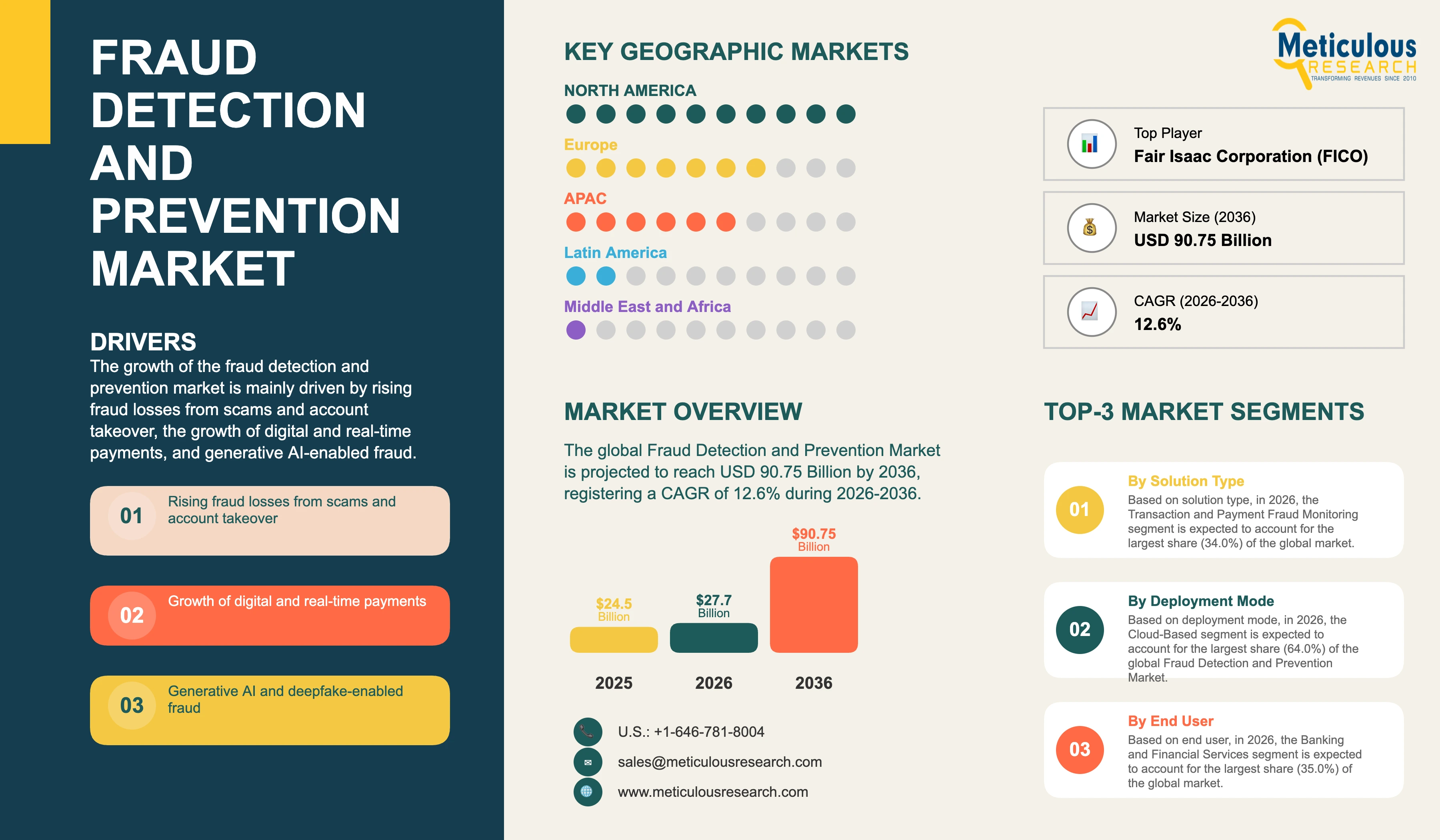
The global fraud detection and prevention market was valued at USD 24.50 billion in 2025. This market is expected to reach USD 90.75 billion by 2036 from an estimated USD 27.70 billion in 2026, registering a CAGR of 12.6% during the forecast period (2026-2036).
- Published
- Nov 2026
- Pages
- 288
- Format
- PDF + Excel
- Report ID
- MRICT - 1042539
- Base year
- 2025
- 2024 · HISTORICAL
- $12.00B
- 2036
- $90.75B
- CAGR 2026–2036
- 12.6%
2024–2025 baseline · 2026–2036 forecast at 12.6% CAGR · hover a bar for the value
Key highlights
The U.S. Federal Trade Commission reported that consumers submitted about 3 million fraud reports in 2025 and reported losses of USD 15.9 billion, up from more than USD 12 billion in 2024, with investment scams accounting for USD 7.9 billion, or about half of all reported losses, and imposter scams generating more than 1 million reports.
UK Finance's Annual Fraud Report 2026 found that criminals stole GBP 1.28 billion through payment fraud in the U.K. in 2025, a 4% increase, with authorised push payment fraud losses rising 19% to GBP 576.4 million, while banks prevented GBP 1.68 billion of unauthorised fraud and reimbursed GBP 354.3 million to APP fraud victims.
Since October 2024, payment service providers in the U.K. have been required to reimburse most victims of authorised push payment fraud, which has given banks and payment firms strong financial incentives to invest in scam detection, and the EU's Instant Payments Regulation has required verification of payee checks for euro credit transfers since October 2025.
Payment networks are investing heavily in fraud prevention, as shown by Visa's acquisition of Featurespace and Mastercard's acquisition of Recorded Future, both completed in late 2024, which add AI-based fraud detection and threat intelligence to their value-added services.
Criminals are using generative AI to create convincing phishing messages, fake documents, voice clones, and deepfake videos, which increases the volume and sophistication of scams and identity fraud and drives demand for AI-based detection, liveness checks, and deepfake detection across banking, payments, and e-commerce.
The U.S. Federal Trade Commission has estimated that the overall cost of fraud to U.S. consumers in 2024, including unreported losses, may have been as high as USD 195.9 billion, which shows that reported losses capture only a fraction of the true scale of fraud and highlights the size of the prevention opportunity.
By solution type, transaction and payment fraud monitoring accounts for the largest share of 34.0% in 2026, while scam and APP fraud detection registers the highest CAGR.
By deployment mode, cloud-based solutions account for the largest share in 2026 and register the higher CAGR.
By end user, banking and financial services account for the largest share of 35.0% in 2026, while payment service providers and fintechs register the highest CAGR.
By geography, North America accounts for the largest share of 40.0% in 2026, while Asia-Pacific registers the highest CAGR of 15.3%.
Report summary
| Particulars | Details |
|---|---|
| Base Year | 2025 |
| Estimated Year | 2026 |
| Forecast Period | 2026-2036 |
| Market Size in 2025 | USD 24.50 billion |
| Market Size in 2026 | USD 27.70 billion |
| Market Size by 2036 | USD 90.75 billion |
| CAGR (2026-2036) | 12.6% |
| Format | PDF, Excel & Cloud Portal · 288 pages |
| Largest Segment by Solution Type (2026) | Transaction and Payment Fraud Monitoring (34.0%) |
| Largest Segment by End User (2026) | Banking and Financial Services (35.0%) |
| Largest Region (2026) | North America (40.0%) |
| Fastest-Growing Region | Asia-Pacific (CAGR 15.3%) |
| Segments Covered | Offering, Solution Type, Deployment Mode, Organization Size, End User, and Geography |
| Geographic Scope | North America, Europe, Asia-Pacific, Latin America, and Middle East and Africa |
| Key Companies Profiled | FICO, NICE Actimize, LexisNexis Risk Solutions, Experian, TransUnion, Visa, Mastercard, SAS, Feedzai, BioCatch, ACI Worldwide, Signifyd, Riskified, Forter, and Sift |
Report overview
Segments covered: offering, solution type, deployment mode, organization size, end user.
The growth of this market is mainly driven by the rapid rise in fraud losses from scams, account takeover, synthetic identities, and payment fraud, the growth of digital and real-time payments that leave little time to stop fraudulent transactions, the use of generative AI and deepfakes by criminals, new rules that make banks and payment providers reimburse scam victims, such as the UK's mandatory reimbursement of authorised push payment fraud, and the adoption of machine learning, behavioral biometrics, and consortium data to detect fraud more accurately. However, factors such as high false positive rates that frustrate genuine customers, the cost and complexity of replacing legacy fraud systems, data privacy rules that limit data sharing, and the shortage of skilled fraud analysts and data scientists are expected to restrain the growth of this market to some extent.
Fraud detection and prevention solutions help organizations identify and stop fraudulent activity before it causes financial loss, such as unauthorized payments, account takeovers, scams in which customers are tricked into sending money, new accounts opened with stolen or synthetic identities, fraudulent online purchases, false insurance claims, and abuse of promotions and refunds. These solutions analyze transactions, user behavior, device and network data, identity information, and external intelligence in real time, using rules, machine learning, behavioral biometrics, graph analytics, and consortium data shared across many organizations, to score risk and decide whether to approve, challenge, or block an activity.
This market covers the global revenue from fraud detection and prevention solutions and related services, measured in value. Solutions include transaction and payment fraud monitoring, identity and account fraud prevention, e-commerce fraud and chargeback management, behavioral biometrics and device intelligence, scam and authorised push payment fraud detection, insurance claims fraud detection, and other solutions. Services include professional services and managed fraud services. The market is segmented by offering, solution type, deployment mode, organization size, end user, and geography. Anti-money laundering compliance software, stand-alone identity document verification and know-your-customer onboarding services, general cybersecurity products, and fraud losses absorbed by organizations are not included, although many vendors sell these alongside fraud prevention.
Fraud has grown rapidly as commerce, banking, and government services have moved online and as payments have become faster. Real-time payment systems, such as FedNow and RTP in the U.S., Faster Payments in the U.K., SEPA Instant in Europe, UPI in India, and Pix in Brazil, allow money to move in seconds, which is convenient for customers but also gives criminals a way to move stolen funds quickly before they can be recovered. Criminals have shifted from attacking systems to manipulating people through investment scams, romance scams, impersonation scams, and fake purchase scams, in which victims authorize payments themselves, making traditional controls less effective.
The scale of fraud is large and growing in almost every major market. The U.S. Federal Trade Commission reported that consumers lost USD 15.9 billion to fraud in 2025, and it noted that reported losses represent only a fraction of the total, since many victims do not report. UK Finance reported that GBP 1.28 billion was stolen through payment fraud in the U.K. in 2025, with authorised push payment fraud rising 19%. Generative AI is making scams more convincing and easier to run at scale, with criminals using AI-written messages, cloned voices, and deepfake videos to impersonate banks, executives, family members, and public figures.
Organizations are responding to these threats by investing in more advanced fraud prevention technologies and processes. Banks and payment providers are moving from rules-based systems to machine learning models that analyze many more signals, adding behavioral biometrics that detect when a customer is being coached by a scammer, and sharing data through consortiums and industry schemes. Regulators are also increasing pressure. The U.K. requires payment providers to reimburse most victims of authorised push payment fraud, the EU requires verification of payee checks for instant euro payments, and regulators in Australia, Singapore, and other countries have introduced scam prevention frameworks that place obligations on banks, telecommunications companies, and digital platforms.
The market includes a wide range of vendors with different data assets and areas of focus. Analytics and decisioning companies, such as FICO and SAS, provide fraud platforms used by many of the world's largest banks. Financial crime specialists, such as NICE Actimize and Feedzai, offer integrated fraud and financial crime platforms. Data and identity companies, such as LexisNexis Risk Solutions, Experian, and TransUnion, combine identity data, device intelligence, and consortium networks. Payment networks and processors, such as Visa, Mastercard, and ACI Worldwide, provide fraud scoring as part of payment processing. Specialists such as BioCatch focus on behavioral biometrics, while Signifyd, Riskified, Forter, and Sift focus on e-commerce fraud and chargeback protection for merchants.
Over the forecast period, the fraud detection and prevention market is expected to grow strongly, supported by rising fraud, faster payments, AI-driven attacks, and regulation. North America is expected to remain the largest market, while Asia-Pacific is expected to grow fastest as digital payments expand and governments introduce scam prevention rules across the region.
With instant payments, we have milliseconds to decide. Cloud-based machine learning and shared intelligence are the only way to keep up.
This explains why Asia-Pacific and fintechs are growing fastest.
For fintechs operating on real-time payment systems, cloud-based fraud services allow them to scale quickly without building large in-house fraud teams.
Every false decline is a lost customer who may never come back to our store. We moved to a fraud provider that guarantees chargebacks, and our approval rate went up while fraud went down.
This explains why retail and e-commerce form a large end user segment and why e-commerce fraud and chargeback management services that combine accuracy with guarantees are in strong demand.
Fraud Operations Director - insurer, U.S.
We are seeing more fake documents and staged claims created with AI. Our claims fraud tools now check images and documents for signs of manipulation.
This explains why insurers are investing in claims fraud detection and why AI-enabled fraud is a key driver across all end users in this market.
Cloud-based solutions are expected to account for the largest share of the market in 2026 and to register the higher CAGR, driven by scalability, faster model updates, access to consortium data, and adoption by fintechs and merchants.
The FTC reported that U.S. consumers lost USD 15.9 billion to fraud in 2025, with investment scams accounting for USD 7.9 billion. UK Finance reported GBP 1.28 billion in payment fraud losses in the U.K. in 2025, including GBP 576.4 million from APP fraud.
APP fraud occurs when a person is tricked into sending money to a criminal, for example through investment, romance, impersonation, or purchase scams. Because the victim authorizes the payment, it is harder to detect than unauthorized fraud. The U.K. requires payment providers to reimburse most APP fraud victims.
Criminals use generative AI to create convincing scam messages, fake documents, cloned voices, and deepfake videos, while fraud prevention vendors use AI to detect anomalies, analyze behavior, check for manipulated media, and help analysts investigate cases faster.
Report infographic
Market dynamics
16 factors across 5 forcesRising fraud losses from scams, account takeover, and synthetic identities
Fraud losses are rising across the world, despite growing investment in prevention. The U.S. Federal Trade Commission reported that consumer fraud losses reached USD 15.9 billion in 2025, a substantial increase from more than USD 12 billion in 2024, and that reported losses have risen in each of the past six years. Investment scams were the largest category by losses at USD 7.9 billion, while imposter scams were the most frequently reported. In the U.K., UK Finance reported that authorised push payment fraud losses rose 19% to GBP 576.4 million in 2025, with investment scam losses up 40%, and that confirmed fraud cases reached a record of more than 4 million.
Account takeover, in which criminals use stolen credentials or social engineering to take control of customers' accounts, and synthetic identity fraud, in which criminals combine real and fake information to create new identities and open accounts, are also growing. These trends force banks, payment providers, merchants, and other organizations to invest in more advanced fraud detection that can identify suspicious behavior across the customer journey, from account opening to login and payment. Identity and account fraud prevention is one of the largest and fastest-growing solution types in this market.
Growth of digital and real-time payments
Digital payments, e-commerce, mobile banking, and real-time payment systems continue to grow rapidly around the world. Real-time payments, such as UPI in India, Pix in Brazil, Faster Payments in the U.K., SEPA Instant in Europe, and FedNow and RTP in the U.S., settle in seconds and are usually irrevocable, which means that fraud must be detected before the payment is sent. The EU's Instant Payments Regulation requires payment providers to offer instant euro credit transfers at no extra cost, which is expected to increase their use and the need for real-time fraud screening.
The growth of digital commerce also increases card-not-present fraud, account takeover, and refund and promotion abuse, which drives demand for e-commerce fraud prevention among merchants and payment providers. Transaction and payment fraud monitoring accounts for the largest share of the market by solution type, reflecting the large volume of payments that must be screened in real time.
Cross-border e-commerce, marketplaces, and digital goods such as gift cards, gaming credits, and cryptocurrency are particularly attractive to fraudsters because they can be resold quickly. Merchants face chargebacks, lost goods, and fees when fraudulent orders are approved, and they also lose sales when genuine orders are declined, which drives demand for e-commerce fraud prevention services that offer chargeback guarantees and higher approval rates.
Generative AI and deepfake-enabled fraud
Generative AI is lowering the cost and increasing the effectiveness of fraud. Criminals use AI to write convincing phishing and scam messages in many languages, create fake identity documents and synthetic faces, clone voices to impersonate family members or executives, and produce deepfake videos for investment scams and identity verification attacks. These techniques allow criminals to run scams at much larger scale and to bypass traditional checks, such as document verification and voice authentication.
Organizations are responding by adopting AI-based fraud detection, liveness detection, behavioral biometrics, and device intelligence that can detect signs of manipulation, automation, or impersonation. The arms race between AI-enabled criminals and AI-enabled defenders is a major driver of investment in fraud prevention technology over the forecast period.
Deepfake attacks on remote identity verification are a particular concern for banks and fintechs that open accounts online, since criminals can use synthetic faces and injected video streams to pass selfie checks. Vendors are adding injection attack detection, document authenticity checks, and cross-checks against consortium data to counter these attacks.
Regulatory requirements and reimbursement rules
Regulators are increasing the responsibility of banks and payment providers for preventing fraud and compensating victims. In the U.K., the Payment Systems Regulator's mandatory reimbursement rules, in force since October 2024, require payment providers to reimburse most victims of authorised push payment fraud, with costs shared between sending and receiving firms, which gives both sides a strong incentive to detect scams and money mule accounts. UK Finance reported that banks reimbursed GBP 354.3 million to APP fraud victims in 2025, equivalent to 61% of losses. In the EU, the Instant Payments Regulation requires verification of payee checks, and the proposed Payment Services Regulation includes measures on fraud data sharing and liability for impersonation scams.
Australia's Scams Prevention Framework, Singapore's Shared Responsibility Framework, and similar rules in other countries place obligations on banks, telecommunications companies, and digital platforms to prevent scams. In the U.S., regulators and lawmakers are increasing scrutiny of scams on payment apps and the responsibility of banks. These regulations are expected to drive investment in fraud detection and prevention, particularly scam detection, which is the fastest-growing solution type in this market.
Table of contents
13 chapters · 134 sections · 288 pages · click to expandSegmental analysis
| Segment | Largest share (2026) | Fastest growth (2026–2036) |
|---|---|---|
| By Offering | Solutions | — |
| By Solution Type | Transaction and payment fraud monitoring | Scam and APP fraud detection |
| By Deployment Mode | Cloud-based | — |
| By Organization Size | Large enterprises | — |
| By End User | Banking and financial services | Payment service providers and fintechs |
By Offering
- Fraud Detection and Prevention Market Analysis by Offering
- The solutions segment is expected to account for the largest share of the market by offering, due to the wide deployment of fraud detection software and cloud-based fraud scoring services by banks, payment providers, merchants, and insurers.
- However, the services segment is projected to register the higher CAGR during the forecast period, driven by demand for managed fraud services, model development, and implementation support, particularly among smaller organizations and fintechs that lack in-house fraud expertise.
- Solutions are sold as software licenses, subscriptions, and per-transaction cloud services, while services include implementation, model development, consulting, and managed fraud operations in which vendors review alerts and manage cases on behalf of clients.
- E-commerce fraud specialists often sell their services on a guaranteed basis, accepting liability for chargebacks on approved orders in return for a fee.
By Solution Type
- Fraud Detection and Prevention Market Analysis by Solution Type
- The transaction and payment fraud monitoring segment is expected to account for the largest share of 34.0% of the market.
- The large share of this segment is mainly due to the very large volume of card, account-to-account, and real-time payments that banks, payment providers, and payment networks must screen for fraud, the long history of transaction monitoring systems in the banking industry, and regulatory requirements for strong fraud controls.
- Transaction and payment fraud monitoring solutions score each payment in milliseconds, using machine learning models, rules, and consortium data to identify unauthorized card transactions, account-to-account fraud, and suspicious real-time payments.
- Leading providers include FICO with its Falcon platform, NICE Actimize, Feedzai, SAS, ACI Worldwide, and payment networks such as Visa and Mastercard, which offer network-level risk scoring.
- The growth of real-time payments is transforming this segment, because payments must be screened before they are sent and cannot easily be reversed.
- Banks are upgrading their transaction monitoring to handle real-time payment volumes, adding behavioral and device signals, and integrating scam detection.
- The segment also benefits from strong regulatory requirements, such as strong customer authentication under the EU's second Payment Services Directive, which allows exemptions for low-risk transactions only when fraud rates are kept below set thresholds, giving payment providers a strong incentive to invest in accurate transaction risk analysis.
- Transaction and payment fraud monitoring is expected to remain the largest solution type over the forecast period, although its share is expected to decline as scam detection and identity fraud prevention grow faster.
- However, the scam and APP fraud detection segment is projected to register the highest CAGR during the forecast period.
- The rapid growth of this segment is driven by the rise in scams and new reimbursement rules.
- Identity and account fraud prevention, e-commerce fraud and chargeback management, behavioral biometrics and device intelligence, insurance claims fraud detection, and other solutions make up the rest of the market.
- Identity and account fraud prevention covers account opening, login, and account takeover detection, including synthetic identity detection, and is one of the largest and fastest-growing segments.
- E-commerce fraud and chargeback management serves online merchants and marketplaces.
- Behavioral biometrics and device intelligence provide signals used across many use cases.
- Insurance claims fraud detection helps insurers identify false or exaggerated claims, and other solutions include promotion abuse, loyalty fraud, and internal fraud detection.
By Deployment Mode
- Fraud Detection and Prevention Market Analysis by Deployment Mode
- The cloud-based segment is expected to account for the largest share of the market and is also projected to register the higher CAGR during the forecast period, driven by the scalability of cloud services, access to consortium data, faster model updates, and adoption by fintechs and merchants.
- The on-premises segment remains important for large banks with legacy systems and strict data residency requirements.
- Cloud-based services also allow vendors to pool data across clients, improving model accuracy, and to deploy new models quickly in response to emerging threats, while on-premises systems are increasingly being moved to private or hybrid cloud environments.
By Organization Size
- Fraud Detection and Prevention Market Analysis by Organization Size
- The large enterprises segment is expected to account for the largest share of the market, due to the large transaction volumes and fraud exposure of major banks, payment providers, and retailers.
- However, the small and medium-sized enterprises segment is projected to register the higher CAGR during the forecast period, driven by cloud-based services designed for smaller merchants and financial institutions.
By End User
- Fraud Detection and Prevention Market Analysis by End User
- The banking and financial services segment is expected to account for the largest share of 35.0% of the market.
- The large share of this segment is mainly due to the large volume of payments and accounts handled by banks, frequent targeting by fraudsters, regulatory requirements for fraud controls, and new reimbursement rules that make banks responsible for many scam losses.
- Banks use fraud detection and prevention across the customer lifecycle, from account opening and login to payments, card transactions, and lending, and they are among the earliest adopters of machine learning, behavioral biometrics, and consortium data.
- Banking and financial services is expected to remain the largest end user over the forecast period, supported by real-time payment growth and reimbursement rules that make fraud prevention a direct driver of profitability.
- Large banks typically use several fraud solutions from different vendors for cards, digital banking, and payments, and many are consolidating onto enterprise fraud platforms that provide a single view of customer risk.
- New reimbursement rules in the U.K. and growing regulatory pressure in other countries are pushing banks to invest more heavily in scam detection, mule account detection, and behavioral analytics.
- Banks are also among the main users of consortium data, sharing information about fraud and mule accounts through industry schemes.
- However, the payment service providers and fintechs segment is projected to register the highest CAGR during the forecast period.
- The rapid growth of this segment is driven by the growth of digital wallets, neobanks, and real-time payments.
- Insurance, retail and e-commerce, telecommunications, government and public sector, healthcare, and other end users make up the rest of the market, each with its own fraud patterns and requirements.
- Retail and e-commerce companies use fraud prevention to reduce chargebacks and false declines, insurance companies use claims fraud detection, telecommunications companies combat subscription fraud and SIM swap fraud, and government agencies protect benefit programs, tax systems, and public procurement from fraud, an area that received significant attention after pandemic-era losses.
Geographic analysis
North America
Largest shareIn 2026, North America is expected to account for the largest share of 40.0% of the global fraud detection and prevention market. The large share of this region is mainly due to high fraud losses, a large and mature financial services and e-commerce sector, the presence of leading fraud prevention vendors, and early adoption of advanced technologies. The U.S. is the largest market in the world for fraud detection and prevention. The Federal Trade Commission reported that consumers lost USD 15.9 billion to fraud in 2025, and the growth of real-time payments through FedNow and RTP, peer-to-peer payment apps, and e-commerce continues to increase the need for real-time fraud prevention. North America is expected to remain the largest region throughout the forecast period, supported by continued investment by large banks and payment companies. Most leading fraud prevention vendors, including FICO, LexisNexis Risk Solutions, TransUnion, Visa, Mastercard, SAS, ACI Worldwide, Signifyd, Forter, and Sift, are based in or have major operations in the U.S. Synthetic identity fraud is a particular concern for U.S. lenders, and the growth of peer-to-peer payment apps has led to scrutiny from regulators and lawmakers. Canada is also seeing rising fraud losses and investing in real-time payments and fraud prevention.
Asia-Pacific
Fastest growthAsia-Pacific is projected to register the highest CAGR of 15.3% during the forecast period. Growth is driven by the rapid growth of digital and real-time payments, such as UPI in India, rising scams, and new scam prevention rules in Australia, Singapore, and other countries. India's Reserve Bank has introduced measures to curb digital payment fraud, Australia's Scams Prevention Framework places obligations on banks, telecommunications companies, and digital platforms, and Singapore's Shared Responsibility Framework sets duties for financial institutions and telecom operators. China, Japan, South Korea, and Southeast Asian countries are also strengthening fraud controls as digital payments grow.
Europe
Europe holds a significant share, supported by U.K. reimbursement rules and EU payment regulations, while Latin America and the Middle East and Africa are growing markets. The U.K. is one of the most advanced fraud prevention markets in the world, with mandatory APP fraud reimbursement and extensive data sharing, while the EU's Instant Payments Regulation and proposed Payment Services Regulation are expected to increase investment across the region.
Latin America
In Latin America, Brazil's Pix and Mexico's digital payments growth are driving demand, while the GCC countries and South Africa lead in the Middle East and Africa.
Competitive landscape
The fraud detection and prevention market is fragmented, with analytics companies, financial crime specialists, data and identity providers, payment networks, and e-commerce fraud specialists. Leading companies include FICO, NICE Actimize, LexisNexis Risk Solutions, Experian, TransUnion, Visa, Mastercard, SAS, Feedzai, BioCatch, ACI Worldwide, Signifyd, Riskified, Forter, and Sift.
Companies compete on detection accuracy, false positive rates, real-time performance, data and consortium networks, ease of integration, AI capabilities, and price.
FICO's Falcon platform is used by many of the world's largest card issuers, while NICE Actimize offers an integrated financial crime platform covering fraud and anti-money laundering. LexisNexis Risk Solutions, Experian, and TransUnion combine identity data, device intelligence, and consortium networks. Visa, through Featurespace, and Mastercard, through Brighterion and Recorded Future, offer network-level fraud scoring and threat intelligence. SAS provides analytics-based fraud solutions, Feedzai offers a cloud-based risk platform for banks and payment providers, and BioCatch specializes in behavioral biometrics for scam and account takeover detection. ACI Worldwide offers fraud management as part of its payment software, while Signifyd, Riskified, Forter, and Sift focus on e-commerce merchants and digital businesses, often with chargeback guarantees.
The top five players are estimated to account for 28.0% of the fraud detection and prevention market in 2025, reflecting the fragmented nature of the market across many fraud types and end users.
Players use several strategies to grow in this market, including acquisitions, AI investment, expansion of consortium data networks, and partnerships.
For example, payment networks have acquired fraud and threat intelligence companies, vendors are launching scam detection and mule account solutions in response to reimbursement rules, and many are adding generative AI assistants for fraud analysts. Vendors are also forming partnerships with banks, payment system operators, and telecommunications companies to share data and expanding into emerging markets through local partners and cloud marketplaces.
Competition is expected to center on scam detection and AI.
Vendors with large data networks, accurate real-time models, and strong scam detection are expected to gain share, while specialists may focus on specific use cases or industries. Consolidation is expected to continue as payment networks, data companies, and software vendors acquire specialists to broaden their offerings.
Some of the key players operating in the fraud detection and prevention market are Fair Isaac Corporation (FICO), NICE Actimize, LexisNexis Risk Solutions (RELX), Experian plc, TransUnion, Visa Inc., Mastercard Incorporated, SAS Institute Inc., Feedzai, BioCatch, ACI Worldwide, Inc., Signifyd, Inc., Riskified Ltd., Forter, Inc., and Sift Science, Inc.
- —
Visa acquired Featurespace and Mastercard acquired Recorded Future in 2024, the U.K. introduced mandatory APP fraud reimbursement, and the EU introduced verification of payee checks for instant payments in 2025.
- FICO
- NICE Actimize
- LexisNexis Risk Solutions
- Experian
- TransUnion
- Visa
- Mastercard
- SAS
- Feedzai
- BioCatch
- ACI Worldwide
- Signifyd
- Riskified
- Forter
- Sift
Expert perspectives
Fraud prevention has become a strategic priority for banks, payment providers, merchants, and governments, as fraud losses rise and criminals adopt AI.
The market is shaped by a shift in fraud from attacks on systems to manipulation of people. Scams in which victims authorize payments themselves now account for a large share of losses, and they are harder to detect with traditional controls. At the same time, real-time payments leave little time to intervene, and generative AI makes scams more convincing. Regulators are responding by making financial institutions responsible for reimbursing many victims, which turns fraud prevention from a cost of doing business into a direct driver of profitability.
Over the forecast period, the market is expected to grow at about 12.6% per year, supported by scams, real-time payments, AI, and regulation.
Growth is expected to be strongest in scam and APP fraud detection, identity and account fraud prevention, and behavioral biometrics, while transaction monitoring remains the largest segment as banks upgrade their systems for real-time payments. Cloud-based services and consortium data are expected to become standard, and AI will play a growing role in both detection and investigation, helping fraud teams handle rising volumes without proportional increases in staff.
Transaction and payment fraud monitoring is the largest solution type, while scam detection grows fastest. Banking is the largest end user, while fintechs grow fastest.
Banks will remain the largest buyers, but payment service providers, fintechs, and merchants are expected to grow faster as digital payments expand. Insurance, government, and healthcare also offer growing opportunities as fraud in these sectors attracts more attention.
North America remains the largest region, while Asia-Pacific is the fastest-growing region at a CAGR of 15.3%.
North America benefits from high fraud losses and mature markets, while Europe, led by the U.K., is at the forefront of scam regulation. Asia-Pacific is expected to grow fastest as digital payments and scam prevention rules spread, while Latin America benefits from the growth of Pix and other real-time payment systems.
For vendors, the key priorities are scam detection, AI, explainable models, and data networks.
For banks, payment providers, and merchants, the key priorities are to upgrade to real-time, AI-based detection, invest in scam and mule account detection, share data with peers and other sectors, and balance fraud prevention with customer experience. Overall, fraud detection and prevention is expected to remain one of the fastest-growing areas of financial technology over the forecast period, as fraud continues to adapt to new payment methods and technologies.
Customer perspectives
Head of Fraud Strategy - retail bank, U.K.
Reimbursement rules mean every scam now hits our profit and loss. We invested in behavioral analytics and mule detection to stop payments before they leave.
This explains why scam detection is the fastest-growing solution type and banking accounts for 35.0% of the market.
For U.K. banks, reimbursement has turned scam losses into a direct cost, which is why they are investing heavily in behavioral analytics, payee risk scoring, and mule account detection.
Frequently asked questions
The market was valued at USD 24.50 billion in 2025 and USD 21.60 billion in 2024, and is estimated at USD 27.70 billion in 2026.
Cite this report
Meticulous Research. (2026). Fraud Detection and Prevention Market - Global Opportunity Analysis and Industry Forecast (2026-2036) (Report No. MRICT - 1042539). Meticulous Market Research Pvt. Ltd. https://www.meticulousresearch.com/product/fraud-detection-and-prevention-market-7222