Polybutylene Succinate Market (2026-2036)
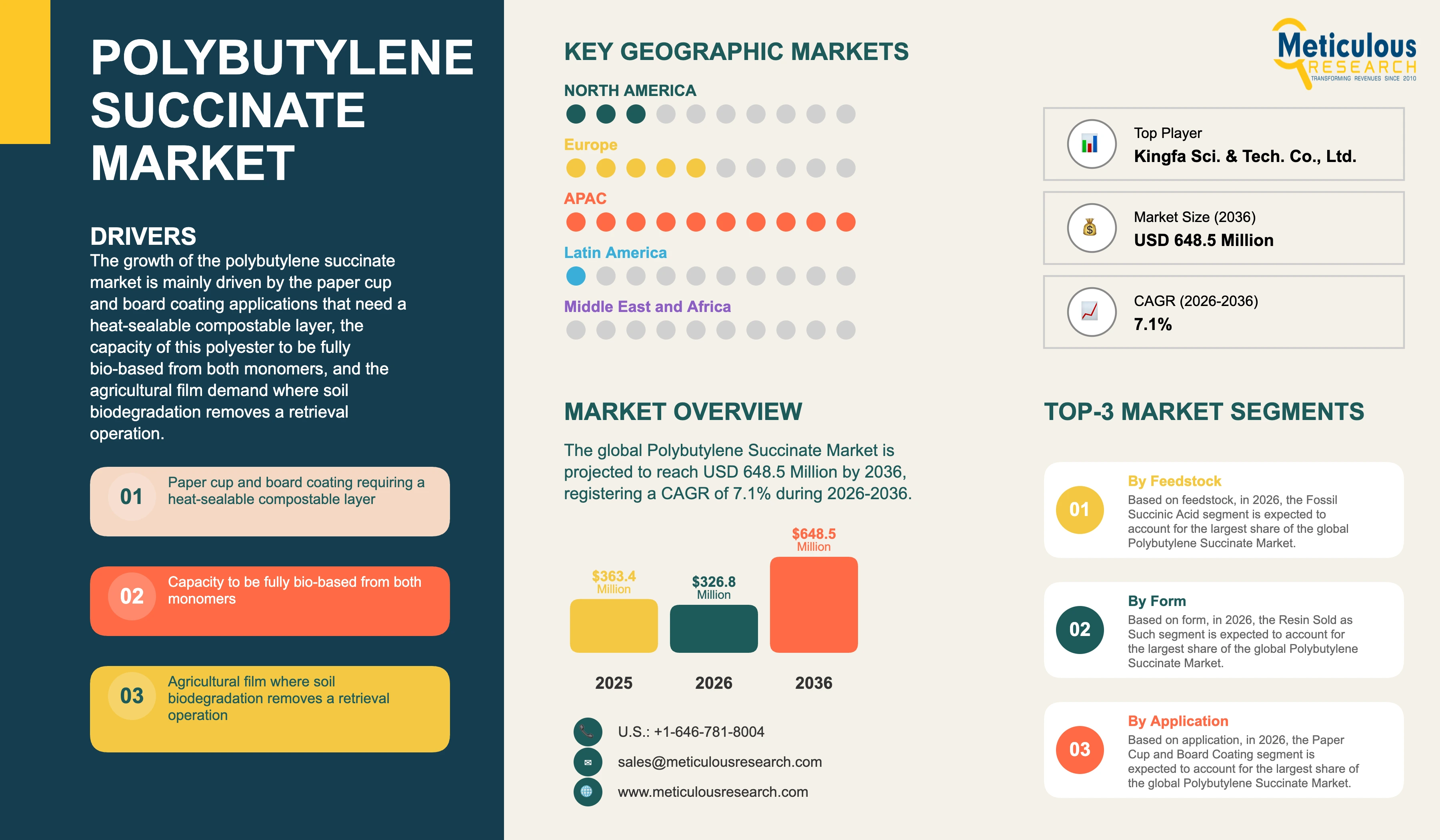
The global polybutylene succinate market was valued at USD 363.4 million in 2025. This market is expected to reach USD 648.5 million by 2036 from an estimated USD 326.8 million in 2026, registering a CAGR of 7.1% during the forecast period (2026-2036).
- Published
- Nov 2026
- Pages
- 253
- Format
- PDF + Excel
- Report ID
- MRCHM - 1042818
- Base year
- 2025
- 2025 · BASELINE
- $363.4M
- 2036
- $648.5M
- CAGR 2026–2036
- 7.1%
2025 baseline · 2026–2036 forecast at 7.1% CAGR · hover a bar for the value
Key highlights
The global polybutylene succinate market is estimated at USD 326.8 million in 2026 and is projected to reach USD 648.5 million by 2036.
Market volume is estimated at 86.00 kilotons in 2026 and is projected to reach 196.53 kilotons by 2036 at a CAGR of 8.6%, measured as resin supplied including resin supplied into compounds.
The 2026 estimate sits below the 2025 figure because of the capacity withdrawal described below, not because of any decline in demand.
The average selling price is estimated at USD 3.80 per kg in 2026 and is projected to reach USD 3.30 per kg by 2036 as Chinese capacity takes the volume previously served from Thailand.
Fossil-based succinic acid is expected to account for the largest feedstock share in 2026, while fully bio-based material is projected to register the highest CAGR of 18.0%.
Resin sold as such is expected to hold the largest form share in 2026, while resin supplied into compounds and blends is projected to grow fastest at a CAGR of 8.2%.
Paper cup and board coating is expected to be the largest application in 2026, while agricultural film is projected to register the highest CAGR of 11.0%.
Asia-Pacific is expected to hold the largest regional share in 2026, while Europe is projected to register the highest CAGR of 10.0%.
Mitsubishi Chemical Corporation issued a notice on 12 May 2026 regarding its withdrawal from the polybutylene succinate business at PTT MCC Biochem Co., Ltd., its equity-method affiliate in Bangkok jointly owned with PTT Global Chemical Public Company Limited.
The notice states that production at the plant in Rayong Province, Thailand ended in December 2025 and that sales will continue only until existing stock runs out.
The affiliate will dismantle its production facilities and then be dissolved and liquidated under applicable local laws.
The company attributed the decision to low profitability arising from several factors including market conditions that diverged from initial assumptions, concluding that achieving sustainable growth in this business would be difficult.
The affiliate began commercial production of BioPBS in 2017, and the notice cites paper cup coatings and coffee capsules as applications.
The notice describes BioPBS as a biodegradable plastic that breaks down into water and carbon dioxide through naturally occurring microorganisms.
The notice did not state the joint venture ownership percentages, the plant capacity, the date the withdrawal completes, any financial impact or loss figure, employee numbers, or any customer transition or alternative supply arrangement, and contained no quoted executive statements.
A producer exiting after nine years of commercial operation is the defining fact of this market, and it concentrates remaining supply in China.
This polyester can in principle be made entirely from renewable monomers, which distinguishes it from polybutylene adipate terephthalate, where the aromatic monomer remains fossil-derived.
This market covers polybutylene succinate and excludes polybutylene succinate adipate, polybutylene adipate terephthalate and polylactic acid blended with it.
Report summary
| Particulars | Details |
|---|---|
| Base Year | 2025 |
| Forecast Period | 2026-2036 |
| Market Size in 2025 | USD 363.4 million |
| Market Size in 2026 | USD 326.8 million |
| Market Size by 2036 | USD 648.5 million |
| Value CAGR (2026-2036) | 7.1% |
| Format | PDF, Excel & Cloud Portal · 253 pages |
| Volume in 2026 | 86.00 kilotons |
| Volume by 2036 | 196.53 kilotons |
| Volume CAGR (2026-2036) | 8.6% |
| Volume Basis | Resin supplied, including resin supplied into compounds but excluding the non-polyester components of those compounds |
| Average Selling Price in 2026 | USD 3.80 per kg |
| Average Selling Price by 2036 | USD 3.30 per kg |
| Price Direction | Average selling price falls across the forecast period as Chinese capacity takes the volume previously served from the closed Thai plant, rather than through any reduction in production cost |
| Note on the 2026 Estimate | The 2026 estimate sits below the 2025 figure because production at PTT MCC Biochem in Rayong Province ended in December 2025 and sales from it continue only until existing stock runs out, so the volume that plant served transfers to other suppliers over a period; the contraction reflects a capacity exit and not any decline in demand |
| Note on Unstated Capacity | The Mitsubishi Chemical notice of 12 May 2026 gives no plant capacity, no joint venture ownership percentages, no completion date for the withdrawal, no financial impact figure and no employee numbers, so the capacity leaving this market cannot be sized from the notice and is treated here as a known event of unstated magnitude rather than an inferred tonnage |
| Scope Definition Note | Polybutylene succinate adipate is excluded because the adipate comonomer changes the polymer rather than producing a grade of this one, and the non-polyester components of compounds are excluded so that polylactic acid and starch tonnage is not drawn into this market and double-counted |
| Measurement Basis | Polybutylene succinate resin made from fossil, partly bio-based and fully bio-based monomers, by feedstock, form, application and geography, and excluding polybutylene succinate adipate, polybutylene adipate terephthalate, polylactic acid and starch where blended with it, other biodegradable polyesters, and the coated cups, capsules, films and packaging into which the resin is converted |
| Relationship to Adjacent Markets | This market is not additive to the polybutylene adipate terephthalate market, which measures a different polyester made from different monomers, nor to the polylactic acid reports, since the polylactic acid blended into compounds here is excluded and counted there; a combined biodegradable plastics figure would merge polymers with distinct supply bases, price levels, melting behaviour and application boundaries |
| Largest Feedstock | Fossil succinic acid |
| Fastest-Growing Feedstock | Fully bio-based (CAGR 18.0%) |
| Largest Form | Resin sold as such |
| Fastest-Growing Form | Resin supplied into compounds and blends (CAGR 8.2%) |
| Largest Application | Paper cup and board coating |
| Fastest-Growing Application | Agricultural film (CAGR 11.0%) |
| Largest Region | Asia-Pacific |
| Fastest-Growing Region | Europe (CAGR 10.0%) |
| Segments Covered | Feedstock, Form, Application, and Geography |
| Geographies Covered | Asia-Pacific, Europe, North America, Latin America, and Middle East & Africa |
| Companies Profiled | 5 companies, including Mitsubishi Chemical Corporation, Kingfa Sci. & Tech. Co., Ltd., Xinjiang Blue Ridge Tunhe Chemical Industry Joint Stock Co., Ltd., Anqing Hexing Chemical Co., Ltd., and PTT Global Chemical Public Company Limited |
| Note on Profiled Share | The profiled share and the top-five share are the same figure because five companies are profiled, and the figure includes supply from remaining stock rather than from production in the case of the exiting participants; the balance sits with further Chinese producers whose registered legal names could not be established to the standard applied in this report |
Report overview
Segments covered: feedstock, form, application.
In volume terms, this market is estimated at 86.00 kilotons in 2026 and is projected to reach 196.53 kilotons by 2036, registering a CAGR of 8.6% during the same period, measured as resin supplied including resin supplied into compounds but excluding the non-polyester components of those compounds. The average selling price is estimated at USD 3.80 per kg in 2026 and is projected to fall to USD 3.30 per kg by 2036 as Chinese capacity takes the volume that the closed Thai plant previously served.
The estimate for 2026 is below the 2025 figure, which reflects the withdrawal described below rather than any weakening of demand. Production at the only large non-Chinese plant ended in December 2025, sales from it continue only until existing stock runs out, and the volume it served is being transferred to other suppliers over a period rather than instantly.
The growth of this market is mainly driven by the paper cup and board coating applications that need a heat-sealable compostable layer, the capacity to be fully bio-based which distinguishes this polyester from the alternatives, the agricultural film demand where soil biodegradation removes a retrieval operation, and the compostability mandates that specify a material property rather than permitting a choice. However, factors such as the withdrawal of the leading non-Chinese producer, the repeated commercial failure of bio-based succinic acid capacity, the competition from polybutylene adipate terephthalate at lower cost, and the dependence on composting infrastructure that most jurisdictions lack are expected to restrain the growth of this market to some extent.
Fossil-based succinic acid accounts for the largest share of this market because the bio-based routes to the monomer have not held commercial capacity. Fully bio-based material grows fastest because this polyester can in principle be made entirely from renewable monomers, which is a claim the competing biodegradable polyesters cannot make.
Polybutylene succinate is a biodegradable aliphatic polyester made by polycondensing succinic acid with 1,4-butanediol, and it is used where a flexible, heat-sealable plastic must break down in composting or soil conditions rather than persist. Market sizing in this report is on both a value basis in USD and a volume basis in kilotons measured as resin supplied, including resin supplied into compounds but excluding the non-polyester components of those compounds, with average selling price derived from the two. The measurement basis covers resin made from fossil, partly bio-based and fully bio-based monomers, and it excludes polybutylene succinate adipate, polybutylene adipate terephthalate, polylactic acid and starch where blended with it, other biodegradable polyesters, and the coated cups, capsules, films and packaging into which the resin is converted.
Excluding the non-polyester components of compounds keeps this market reconcilable with its neighbours, since much of the resin reaches an application blended with polylactic acid, starch or another polyester, and counting those compounds at total product mass would draw polylactic acid tonnage into this market and double-count it. Polybutylene succinate adipate is excluded for the same reason as polybutylene adipate terephthalate: the adipate comonomer changes the polymer rather than producing a grade of this one.
Mitsubishi Chemical Corporation issued a notice on 12 May 2026 regarding its withdrawal from the polybutylene succinate business at PTT MCC Biochem Co., Ltd., its equity-method affiliate in Bangkok jointly owned with PTT Global Chemical Public Company Limited. Production at the plant in Rayong Province, Thailand ended in December 2025, sales will continue only until existing stock runs out, and the affiliate will dismantle its production facilities before being dissolved and liquidated under applicable local laws. The company attributed the decision to low profitability arising from several factors including market conditions that diverged from initial assumptions, concluding that achieving sustainable growth in this business would be difficult.
A producer closing a plant nine years after starting it is the defining fact of this market, and the wording of the notice is worth taking at face value. The affiliate began commercial production of BioPBS in 2017, and the stated reason is not a technical failure, a feedstock problem or a loss of customers but market conditions that diverged from initial assumptions. The polymer works; the demand assumed when the plant was sanctioned did not arrive at the volume or the price the investment required.
What the notice does not say is as relevant as what it does. It gives no joint venture ownership percentages, no plant capacity, no date for completion of the withdrawal, no financial impact or loss figure, no employee numbers, and no customer transition or alternative supply arrangement, and it carries no quoted executive statements. A reader cannot therefore size the capacity leaving the market from the notice itself, and this report treats the exit as a known event of unstated magnitude rather than inferring a tonnage.
The consequence is a market that contracts before it grows. The 2026 estimate sits below the 2025 figure because production ended in December 2025 and the volume that plant served transfers to other suppliers over a period rather than immediately, with sales from remaining stock bridging part of the gap. Growth resumes from a lower base, and the price assumption falls across the forecast period as Chinese capacity takes the volume rather than as any new technology lowers cost.
Being capable of full bio-based content is what distinguishes this polyester from its closest competitor. Both of its monomers, succinic acid and 1,4-butanediol, can be produced by fermentation, so the polymer can in principle be made entirely from renewable carbon, whereas polybutylene adipate terephthalate retains a fossil-derived aromatic monomer. That is a genuine structural advantage, and it is the reason the fully bio-based segment grows fastest at 18.0% despite its small base.
The difficulty is that bio-based succinic acid has repeatedly failed to hold commercial capacity. Several dedicated fermentation ventures were built and subsequently wound down, so the renewable monomer that would deliver the advantage has not been reliably available at a price the polymer could carry. The potential has therefore remained potential, and fossil-based succinic acid accounts for the largest feedstock share throughout the period.
Paper cup and board coating is the application that suits the polymer best and the largest share of this market. A compostable cup needs a thin liquid-barrier layer that seals under heat and composts with the fibre rather than contaminating it, the melting behaviour of this polyester fits extrusion coating onto board, and the notice from May 2026 cites paper cup coatings as an application. Paper cup and board coating accordingly accounts for the largest application share.
Agricultural film is the fastest-growing application and the logic is the same as for other soil-biodegradable films. Conventional polyethylene mulch must be retrieved after harvest, which is labour-intensive and never complete, and the fragments left behind accumulate in soil, so a film that degrades in place removes an operation the grower already pays for. Agricultural film consequently registers the highest application CAGR at 11.0%.
Cost competition from polybutylene adipate terephthalate is the structural pressure on this market. That polyester is made at far larger scale, has considerably more installed capacity, and sells well below this one, so polybutylene succinate is specified where its higher melting point, better heat sealing or its potential bio-based content justify the difference. Where a formulation needs only flexibility and biodegradation, the cheaper polyester wins.
Composting infrastructure limits this market exactly as it limits the others. A certified compostable cup or capsule degrades as specified in an industrial facility and reaches landfill or incineration like any other plastic where organic collection does not exist, delivering nothing while its premium remains. Coffee capsules illustrate the dependency clearly, since the capsule reaches a consumer bin rather than a controlled waste stream.
This market is not additive to the polybutylene adipate terephthalate market, which measures a different polyester made from different monomers, nor to the polylactic acid reports, since the polylactic acid blended into compounds here is excluded and counted there. A combined biodegradable plastics figure would merge polymers with distinct supply bases, price levels, melting behaviour and application boundaries and would describe none of them accurately.
Asia-Pacific is expected to account for the largest share in 2026, on the resin capacity located there, which after the closure of the Rayong plant sits predominantly with Chinese producers, together with the converting base and agricultural film consumption. China is projected to grow at 6.6%, South Korea at 6.0% and Japan at 2.0%.
Europe is projected to register the highest CAGR of 10.0% during the forecast period, with Italy at 10.6%, Germany at 10.4% and France at 9.8%.
Europe is the fastest-growing region at a CAGR of 10.0%, on compostability requirements and single-use restrictions that specify the material property, the organic waste collection infrastructure that makes a compostable claim meaningful at end of life, and the food service operators and compounders established in the region.
The Middle East & Africa is projected to grow at a CAGR of 3.0% from a very small base. Latin America is projected to grow at a CAGR of 4.0%, with agricultural film carrying most of the consumption.
The companies profiled in this report together accounted for an estimated 52.4% of supply in 2026, which is also the top-five share since five companies are profiled, and the figure includes supply from remaining stock rather than production in the case of the exiting participants. The balance sits with further Chinese producers whose registered legal names could not be established to the standard applied in this report.
Report infographic
Market dynamics
15 factors across 5 forcesPaper Cup and Board Coating Requiring a Heat-Sealable Compostable Layer
A compostable cup needs a thin liquid-barrier layer that seals under heat and composts together with the fibre rather than contaminating it, the melting behaviour of this polyester suits extrusion coating onto board, and the Mitsubishi Chemical notice of 12 May 2026 cites paper cup coatings among the applications of the product.
Coated board also has a fibre recovery route as well as a composting one, which gives a converter a disposal path in jurisdictions with paper collection but without organic collection.
Cups and board packaging are also consumed and replaced continuously rather than held in an installed base, so a qualified coating generates recurring volume rather than a one-off fill, and the extrusion coating lines required are already installed at board converters.
Polyethylene-coated board cannot be composted and contaminates fibre recycling, so the substitution solves a disposal problem rather than only improving a material specification, which is a stronger argument with a food service operator than a resin comparison.
Capacity to Be Fully Bio-Based
Both monomers, succinic acid and 1,4-butanediol, can be produced by fermentation, so this polyester can in principle be made entirely from renewable carbon, which polybutylene adipate terephthalate cannot because its aromatic monomer remains fossil-derived.
That allows the material to answer a renewable content target directly rather than through mass-balance attribution, and the fully bio-based segment registers the highest feedstock CAGR at 18.0% from a small base.
The claim is also simpler to substantiate than an attributed one, since it rests on the origin of the monomers rather than on an allocation across a production system that a customer has to understand before it can rely on it.
Succinic acid is also one of the more tractable fermentation products, since the organism produces a diacid that can be recovered without the extreme purification some bio-based monomers require.
Agricultural Film Where Soil Biodegradation Removes a Retrieval Operation
Conventional polyethylene mulch must be lifted from the field after harvest, which is labour-intensive and never complete, and the fragments left behind accumulate in soil across seasons, so a film that degrades in place removes a cost the grower already bears rather than substituting one polymer for another.
Agricultural purchasing also runs on a seasonal cycle with short qualification, so adoption can spread faster than in regulated packaging, and the application registers the highest application CAGR at 11.0%.
Mulch film is also laid across large areas at thin gauge, so the tonnage consumed per hectare is substantial and adoption across a growing region moves meaningful volume in a single season.
A grower also sees the benefit within one season rather than over a product life, which shortens the decision considerably compared with a packaging qualification.
Compostability Mandates Specifying a Material Property
Rules requiring particular items to be compostable, and restrictions removing conventional single-use alternatives, specify a property rather than permitting a choice, which gives the polymer a position that does not depend on winning a cost comparison against conventional plastics.
Adoption therefore tracks regulation and organic waste collection rather than converting capability, which is why Europe registers the highest regional CAGR at 10.0%.
A mandate also removes the price comparison from the decision, since a converter supplying a regulated item must meet the specification whatever the resin costs, which gives the demand a floor that a performance argument alone would not provide.
Restrictions that remove a conventional alternative act in the same direction, since the converter must find a compliant material rather than choose between two on cost.
Taken together these four drivers rest on regulation and on operating cost avoided rather than on the polymer winning a price comparison, which is the position a specialty biodegradable polyester occupies.
Table of contents
11 chapters · 128 sections · 253 pages · click to expandSegmental analysis
| Segment | Largest share (2026) | Fastest growth (2026–2036) |
|---|---|---|
| By Feedstock | Fossil succinic acid | Fully bio-based |
| By Form | Resin sold as such | Resin supplied into compounds and blends |
| By Application | Paper cup and board coating | Agricultural film |
| Other segments | Resin sold as such | Resin supplied into compounds and blends |
By Feedstock
- Polybutylene Succinate Market Analysis by Feedstock
- The fossil succinic acid segment is expected to account for the largest share of the global polybutylene succinate market.
- The large share of this segment is mainly due to the bio-based routes to the monomer having repeatedly failed to hold commercial capacity, the maleic anhydride route to succinic acid being established and low-cost, and the installed polymer capacity having been built around that supply.
- However, the fully bio-based segment is projected to register the highest CAGR of 18.0% during the forecast period, from a small base.
- The rapid growth of this segment is attributed to both monomers being capable of production by fermentation, which allows a renewable content claim from the molecule rather than through certified attribution, a position the competing biodegradable polyesters cannot reach.
- Partly bio-based material, in which one of the two monomers is renewable, occupies the middle ground and is the form in which most renewable content currently reaches the market.
- This axis measures the origin of the carbon rather than any property of the polymer, since the resin is identical whichever route supplied its monomers, and it is included because the capacity to be fully bio-based is the main structural advantage this polyester holds.
- Feedstock also determines which customer targets the material can satisfy.
- Compostability is a property of the polymer and applies to every grade, while renewable content depends on where the monomers came from, so two physically identical resins answer different procurement questions.
- That is why the feedstock axis carries commercial meaning here rather than describing only process origin.
- Partly bio-based grades are also the practical route to a renewable claim today, since they require only one of the two monomers to be fermented.
- Fossil succinic acid is expected to account for the largest share in 2026, since the bio-based routes to the monomer have repeatedly failed to hold commercial capacity and the maleic anhydride route is established and low-cost.
- Fully bio-based material is projected to register the highest CAGR of 18.0% during the forecast period, from a small base.
By Form
- Polybutylene Succinate Market Analysis by Form
- The resin sold as such segment is expected to account for the largest share of the global polybutylene succinate market.
- The large share of this segment is mainly due to converters buying the polymer directly for extrusion coating and film, and to the coating applications requiring relatively simple formulations rather than engineered compounds.
- However, the resin supplied into compounds and blends segment is projected to register the highest CAGR of 8.2% during the forecast period.
- The rapid growth of this segment is attributed to blends with polylactic acid producing rigid compostable parts that neither polymer delivers alone, which is what serviceware and moulded items require.
- This axis divides at the point of sale rather than by chemistry, since the resin is identical either way, and the non-polyester components of the compounds are excluded from the measurement so that polylactic acid tonnage is not drawn into this market.
- Form therefore describes who carries the application engineering and holds the customer relationship, which after the Thai withdrawal also determines who controls the requalification of displaced volume.
- Form also determines who carries the cost of the withdrawal.
- A converter buying resin directly must requalify a new supplier itself, while one buying a compound can rely on the compounder to change its resin source within an unchanged compound specification, which is a materially easier path through the transition.
- Coating grades and film grades also differ in melt strength and crystallisation rate, so a producer serving both carries a wider grade slate than the tonnage would suggest.
- Melting point and heat sealing are the properties that justify the premium over the cheaper polyester, and they are strongest in the coating applications, so the grade mix and the application mix move together more closely here than in most polymer markets.
By Application
- Polybutylene Succinate Market Analysis by Application
- The paper cup and board coating segment is expected to account for the largest share of the global polybutylene succinate market.
- The large share of this segment is mainly due to compostable cups and board requiring a thin liquid-barrier layer that seals under heat and composts with the fibre rather than contaminating it, the suitability of the melting behaviour of this polyester to extrusion coating, and the citation of paper cup coatings as an application in the May 2026 notice.
- However, the agricultural film segment is projected to register the highest CAGR of 11.0% during the forecast period.
- The rapid growth of this segment is attributed to soil-biodegradable film removing the retrieval operation that conventional polyethylene mulch requires and the soil residue that incomplete retrieval leaves across successive seasons.
- Coffee capsules and food serviceware take the material where a compostable claim applies to the whole item, with capsules named in the May 2026 notice.
- Flexible packaging uses it where heat sealing and a higher melting point matter.
- Fibres and nonwovens draw on its spinnability.
- Application determines whether the biodegradability is realised or wasted, since a mulch film degrades where it is laid while a capsule depends on reaching a facility that composts it.
- Application also determines whether the biodegradability is realised or wasted, since a mulch film degrades in the soil where it is laid without any collection system while a coated cup or a capsule depends entirely on reaching a facility that composts it.
- The agricultural uses are therefore insulated from the infrastructure gap that limits the packaging ones.
- Coffee capsules sit at the difficult end of that spectrum, since the capsule reaches a consumer bin rather than a controlled commercial waste stream.
- Application therefore sets the realised value of the polymer rather more than its grade does, which is unusual for a polyester and specific to a material whose premium rests on end-of-life.
Other segments
- Resin sold as such is expected to hold the largest share in 2026, on converters buying the polymer directly for extrusion coating and film.
- Resin supplied into compounds and blends is projected to register the highest CAGR of 8.2% during the forecast period.
- Paper cup and board coating is expected to account for the largest share in 2026, on compostable cups requiring a thin heat-sealing barrier layer that composts with the fibre rather than contaminating it.
- Agricultural film is projected to register the highest CAGR of 11.0% during the forecast period.
Geographic analysis
Asia-Pacific
Largest shareIn 2026, Asia-Pacific is expected to account for the largest share of the global polybutylene succinate market. The large share of this region is mainly due to the resin capacity located there, which after the closure of the Rayong plant in Thailand sits predominantly with Chinese producers, together with the converting base for coated board, film and serviceware and the agricultural film consumption across large cultivated areas. China is projected to register a CAGR of 6.6%, South Korea a CAGR of 6.0% and Japan a CAGR of 2.0% during the forecast period, with Japan reflecting the withdrawal of domestic commercial interest in the polymer. Thailand remains in the geographic coverage of this report because stock from the closed plant is still being sold there and into export markets, but it adds no production from 2026 onward. Japan is projected to grow at only 2.0% for the same reason, since domestic commercial interest in the polymer has been withdrawn rather than redirected. Demand growth and remaining capacity therefore sit in different regions, which is a new feature of this market rather than a long-standing one.
Europe
Fastest growthHowever, Europe is projected to register the highest CAGR of 10.0% during the forecast period. The rapid growth of this region is attributed to compostability requirements and single-use restrictions that specify the material property rather than permitting a choice, the organic waste collection infrastructure that makes a compostable claim meaningful at end of life, the food service operators adopting compostable cups and serviceware, and the compounders established in the region. Italy is projected to register a CAGR of 10.6%, Germany a CAGR of 10.4% and France a CAGR of 9.8%.
North America
North America is projected to grow at 7.6%, with the United States at 7.6%, on compostable food service packaging and agricultural film, with adoption varying by state and municipality according to whether organic collection exists.
Latin America
Latin America is projected to grow at 4.0%, with agricultural film carrying most of the consumption.
Middle East & Africa
The Middle East & Africa is projected to grow at 3.0% from a very small base. The withdrawal in Thailand has changed the geography of this market rather than only its size. Supply that previously reached European, North American and Asian converters from a single non-Chinese plant must now be sourced predominantly from China, so buyers in the fastest-growing region are more dependent on one producing region than they were when they qualified the material. That dependence is a new feature of this market and it is not visible in the regional demand shares.
Competitive landscape
The global polybutylene succinate market has been reshaped by a withdrawal rather than by competition. Mitsubishi Chemical Corporation is exiting the business at PTT MCC Biochem, production at the Rayong plant ended in December 2025 and sales continue only until existing stock runs out, which leaves remaining capacity concentrated among Chinese producers. Competition among those producers is contested on cost and grade availability rather than on technology. The companies profiled in this report together accounted for an estimated 52.4% of supply in 2026, which is also the share held by the top five, since five companies are profiled.
That share includes supply from remaining stock rather than from production in the case of the exiting participants, and it is stated on that basis. The balance sits with further Chinese producers whose registered legal names could not be established to the standard applied in this report, and no attempt has been made to fill the gap with approximations. Producers of polybutylene succinate adipate and polybutylene adipate terephthalate are excluded, since those are separate polyesters with different comonomers rather than grades of this one.
Mitsubishi Chemical Corporation and PTT Global Chemical Public Company Limited are profiled as the exiting participants, because their remaining stock constitutes supply in 2026 and because the terms of the withdrawal determine where the displaced volume goes, while Kingfa Sci. & Tech. Co., Ltd., Xinjiang Blue Ridge Tunhe Chemical Industry Joint Stock Co., Ltd. and Anqing Hexing Chemical Co., Ltd. are the producers positioned to take it. The notice of 12 May 2026 states no customer transition or alternative supply arrangement, gives no joint venture ownership percentages, no plant capacity, no completion date, no financial impact figure and no employee numbers, and carries no quoted executive statements. Some of the key players operating in the polybutylene succinate market are Mitsubishi Chemical Corporation (Japan), Kingfa Sci. & Tech. Co., Ltd. (China), Xinjiang Blue Ridge Tunhe Chemical Industry Joint Stock Co., Ltd. (China), Anqing Hexing Chemical Co., Ltd. (China), and PTT Global Chemical Public Company Limited (Thailand), among others.
Grade availability rather than price is therefore what will decide where the displaced volume settles, and the producers holding the relevant specifications will take it.
- —
Mitsubishi Chemical Corporation issued a notice on 12 May 2026 regarding its withdrawal from the polybutylene succinate business at PTT MCC Biochem Co., Ltd., its equity-method affiliate in Bangkok jointly owned with PTT Global Chemical Public Company Limited. Production at the plant in Rayong Province, Thailand ended in December 2025, sales will continue only until existing stock runs out, and the affiliate will dismantle its production facilities before being dissolved and liquidated under applicable local laws. The company attributed the decision to low profitability arising from several factors including market conditions that diverged from initial assumptions, concluding that achieving sustainable growth in this business would be difficult. The affiliate had begun commercial production of BioPBS in 2017, and the notice cites paper cup coatings and coffee capsules as applications and describes the product as a biodegradable plastic that breaks down into water and carbon dioxide through naturally occurring microorganisms. The notice did not state the joint venture ownership percentages, the plant capacity, the date the withdrawal completes, any financial impact or loss figure, employee numbers, or any customer transition or alternative supply arrangement, and contained no quoted executive statements.
- Mitsubishi Chemical Corporation
- Kingfa Sci. & Tech. Co., Ltd.
- Anqing Hexing Chemical Co., Ltd.
- PTT Global Chemical Public Company Limited
Expert perspectives
Volume grows at 8.6% against 7.1% in value over the forecast period, and the average selling price falls from USD 3.80 per kg in 2026 to USD 3.30 per kg by 2036. The 2026 estimate of USD 326.8 million also sits below the USD 363.4 million recorded for 2025, which is a contraction caused by a capacity exit rather than by demand.
Mitsubishi Chemical Corporation stated on 12 May 2026 that it is withdrawing from the polybutylene succinate business at PTT MCC Biochem, that production at Rayong ended in December 2025, that sales continue only while stock lasts, and that the affiliate will dismantle its facilities before being dissolved and liquidated. The affiliate had been in commercial production since 2017.
The stated reason deserves to be read carefully, because it is not a technical one. The company cites low profitability arising from several factors including market conditions that diverged from initial assumptions, and concludes that sustainable growth would be difficult. The polymer performs as described; the demand assumed when the plant was sanctioned did not arrive at the volume or price the investment needed.
That is the second disappointment in this value chain rather than the first. Bio-based succinic acid capacity was built by several dedicated ventures and subsequently wound down, so the renewable monomer that would make this polyester fully bio-based has never been reliably available at a price it could carry. A polymer with a real structural advantage over its competitors has now lost capacity at both the monomer and the polymer stage.
The advantage itself is genuine and worth stating plainly. Both monomers can be fermented, so this polyester can be made entirely from renewable carbon, which polybutylene adipate terephthalate cannot because its aromatic monomer stays fossil-derived. Where a customer target is written as bio-based content rather than compostability, that distinction decides the specification, and the fully bio-based segment grows fastest at 18.0%.
For buyers the practical consequence is concentration. Supply that reached European, North American and Asian converters from one non-Chinese plant must now come predominantly from China, so a customer who qualified this material is holding a narrower and more regionally concentrated supplier base than the one it approved. The notice states no customer transition arrangement, which leaves that volume open rather than directed.
A market that contracts in the forecast base year and then compounds at 7.1% is unusual, and reading the 2026 figure as a demand signal rather than a supply event would misstate the position entirely.
Customer perspectives
A heat-sealable compostable coating that composts with the fibre rather than contaminating it is difficult to replace, and the withdrawal of a qualified supplier obliges converters to requalify an alternative rather than simply reorder.
Sales continuing only until existing stock runs out also sets the timetable for that work rather than leaving it to the converter.
Requalification also runs to the timetable set by the remaining stock rather than to the schedule a converter would choose.
Both monomers can be produced by fermentation, so renewable content can be claimed as a property of the material rather than as a certified allocation across a production system, which is a stronger position than attribution provides.
That distinction affects how a target is written as much as how a material is selected.
Polybutylene adipate terephthalate is produced at larger scale and sells below this polymer, so this material is specified where its higher melting point or heat sealing justify the difference, with remaining capacity now concentrated in one producing region.
Supply concentration in one producing region is the new exposure that accompanies that cost comparison.
Melting point rather than biodegradability is what the converter is paying for in those cases.
“We qualified the coating because it seals properly and composts with the board. Now we are requalifying on a different supplier, and that is months of work we had not planned for.”
“This is the one biodegradable polyester where we can say the carbon is renewable without invoking a mass balance certificate. That matters to how our target is written.”
“On price it loses to the cheaper polyester most of the time. We use it where we need the melting point, and now we also have to think about where it comes from.”
Frequently asked questions
This market was valued at USD 353.8 million in 2024 and USD 363.4 million in 2025, and is estimated at USD 326.8 million in 2026, the decline reflecting the capacity withdrawal in Thailand rather than demand. In volume terms it is estimated at 86.00 kilotons in 2026 as resin supplied including resin supplied into compounds.
This market is projected to reach USD 648.5 million by 2036 in value and 196.53 kilotons in volume.
This market is projected to register a value CAGR of 7.1% and a volume CAGR of 8.6% during the forecast period 2026-2036. The average selling price is projected to move from USD 3.80 per kg in 2026 to USD 3.30 per kg by 2036 as Chinese capacity takes the displaced volume.
Growth is driven by paper cup and board coating applications that need a heat-sealable compostable layer, the capacity of this polyester to be fully bio-based from both monomers, agricultural film demand where soil biodegradation removes a retrieval operation, and compostability mandates that specify a material property.
The leading non-Chinese producer is withdrawing, with production at Rayong ended in December 2025 and sales continuing only until stock runs out. Bio-based succinic acid capacity has repeatedly failed commercially, polybutylene adipate terephthalate is made at larger scale and sells below this polymer, and composting infrastructure is absent in most jurisdictions.
Fully bio-based grades answer renewable content targets from the molecule rather than by attribution, and replacing polyethylene coating on compostable board addresses a problem converters cannot otherwise solve. The volume displaced by the Thai closure is open rather than directed, and blends with polylactic acid produce rigid compostable parts neither polymer delivers alone.
Fossil succinic acid is expected to account for the largest share in 2026, since the bio-based routes to the monomer have repeatedly failed to hold commercial capacity and the maleic anhydride route is established and low-cost.
Fully bio-based material is projected to register the highest CAGR of 18.0% during the forecast period, from a small base.
Resin sold as such is expected to hold the largest share in 2026, on converters buying the polymer directly for extrusion coating and film.
Resin supplied into compounds and blends is projected to register the highest CAGR of 8.2% during the forecast period.
Paper cup and board coating is expected to account for the largest share in 2026, on compostable cups requiring a thin heat-sealing barrier layer that composts with the fibre rather than contaminating it.
Agricultural film is projected to register the highest CAGR of 11.0% during the forecast period.
Asia-Pacific is expected to account for the largest share in 2026, on the resin capacity located there, which after the closure of the Rayong plant sits predominantly with Chinese producers, together with the converting base and agricultural film consumption. China is projected to grow at 6.6%, South Korea at 6.0% and Japan at 2.0%.
Europe is projected to register the highest CAGR of 10.0% during the forecast period, with Italy at 10.6%, Germany at 10.4% and France at 9.8%.
Europe is the fastest-growing region at a CAGR of 10.0%, on compostability requirements and single-use restrictions that specify the material property, the organic waste collection infrastructure that makes a compostable claim meaningful at end of life, and the food service operators and compounders established in the region.
The Middle East & Africa is projected to grow at a CAGR of 3.0% from a very small base. Latin America is projected to grow at a CAGR of 4.0%, with agricultural film carrying most of the consumption.
The companies profiled in this report together accounted for an estimated 52.4% of supply in 2026, which is also the top-five share since five companies are profiled, and the figure includes supply from remaining stock rather than production in the case of the exiting participants. The balance sits with further Chinese producers whose registered legal names could not be established to the standard applied in this report.
Mitsubishi Chemical Corporation issued a notice on 12 May 2026 regarding its withdrawal from the polybutylene succinate business at PTT MCC Biochem Co., Ltd., with production at the Rayong plant in Thailand ended in December 2025 and sales continuing only until existing stock runs out. The affiliate will dismantle its production facilities before being dissolved and liquidated, and the company cited low profitability and market conditions that diverged from initial assumptions.
Cite this report
Meticulous Research. (2026). Polybutylene Succinate Market - Global Opportunity Analysis and Industry Forecast (2026-2036) (Report No. MRCHM - 1042818). Meticulous Market Research Pvt. Ltd. https://www.meticulousresearch.com/product/polybutylene-succinate-market-7501