Polybutylene Adipate Terephthalate Market (2026-2036)
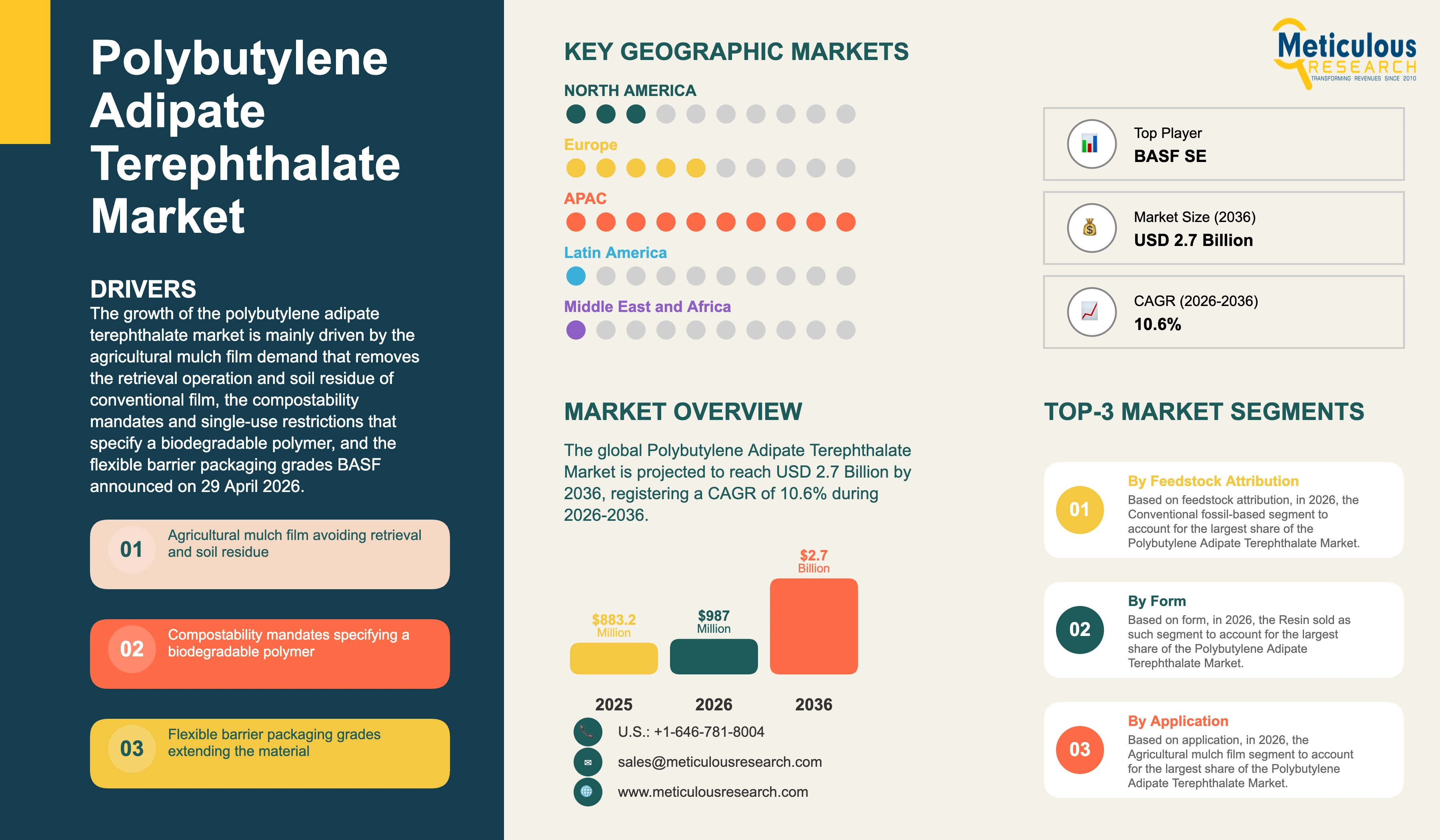
The global polybutylene adipate terephthalate market was valued at USD 883.2 million in 2025. This market is expected to reach USD 2.70 billion by 2036 from an estimated USD 987.0 million in 2026, registering a CAGR of 10.6% during the forecast period (2026-2036).
- Published
- Nov 2026
- Pages
- 248
- Format
- PDF + Excel
- Report ID
- MRCHM - 1042817
- Base year
- 2025
- 2025 · BASELINE
- $883.2M
- 2036
- $2.70B
- CAGR 2026–2036
- 10.6%
2025 baseline · 2026–2036 forecast at 10.6% CAGR · hover a bar for the value
Key highlights
The global polybutylene adipate terephthalate market is estimated at USD 987.0 million in 2026 and is projected to reach USD 2.70 billion by 2036.
Market volume is estimated at 420.00 kilotons in 2026 and is projected to reach 1, 069.73 kilotons by 2036 at a CAGR of 9.8%, measured as resin supplied including resin supplied into compounds.
The average selling price is estimated at USD 2.35 per kg in 2026 and is projected to reach USD 2.52 per kg by 2036 as capacity utilisation recovers.
Conventional fossil-based material is expected to account for the largest feedstock attribution share in 2026, while biomass-balanced material is projected to register the highest CAGR of 24.0%.
Resin sold as such is expected to hold the largest form share in 2026, while resin supplied into compounds and blends is projected to grow fastest at a CAGR of 12.0%.
Agricultural mulch film is expected to be the largest application in 2026, while flexible packaging is projected to register the highest CAGR of 14.0%.
Asia-Pacific is expected to hold the largest regional share in 2026, while Europe is projected to register the highest CAGR of 13.0%.
BASF introduced a biomass-balanced version of ecoflex on 11 June 2024, the grade ecoflex F Blend C1200 BMB, described by the company as an industry-first on the global biopolymers market.
In that approach part of the fossil feedstock used in the first steps of manufacturing is replaced with renewable feedstock from waste and residual biomass, and the renewable amount is attributed to specific products at the end of manufacturing through a third-party certified method with a chain of custody established.
The grade is certified under REDcert2 and ISCC PLUS and carries a Product Carbon Footprint 60% lower than the standard ecoflex F Blend C1200.
The company states the biomass-balanced grade has the same properties, performance, machine processability and biodegradation certificates as the standard grade, so customers need not requalify applications, reformulate compounds or invest in new processing lines.
That release describes conventional polybutylene adipate terephthalate as fossil-based and states that it is not yet possible to fully avoid the usage of fossil resources in its production.
The release did not name the certifying body, state the renewable feedstock percentage or mass-balance allocation rate, identify the specific waste or residual biomass used, or give the methodology behind the carbon footprint figure.
BASF expanded its certified compostable ecovio portfolio with new grades for flexible barrier packaging on 29 April 2026, under press release reference P-26-083.
Those grades offer adjustable mono- or multi-layer barriers against grease, oil, waxes and liquids together with high barriers against oxygen and moisture, act as a sealing layer, and run on existing manufacturing equipment.
Bio-based content in the new ecovio grades reaches up to 80% depending on grade, with some grades available as certified biomass-balanced material, and the lower bound of that range is not stated.
That release names neither polybutylene adipate terephthalate nor ecoflex, gives no grade names or codes, no numerical barrier or mechanical data, and names no certification standards or certifying bodies.
The material qualifies on end-of-life rather than on origin, so this market is one of biodegradable rather than inherently bio-based polymers, and bio-based content arrives through mass-balance attribution rather than from the molecule.
Report summary
| Particulars | Details |
|---|---|
| Base Year | 2025 |
| Forecast Period | 2026-2036 |
| Market Size in 2025 | USD 883.2 million |
| Market Size in 2026 | USD 987.0 million |
| Market Size by 2036 | USD 2.70 billion |
| Value CAGR (2026-2036) | 10.6% |
| Format | PDF, Excel & Cloud Portal · 248 pages |
| Volume in 2026 | 420.00 kilotons |
| Volume by 2036 | 1,069.73 kilotons |
| Volume CAGR (2026-2036) | 9.8% |
| Volume Basis | Resin supplied, including resin supplied into compounds but excluding the non-polyester components of those compounds |
| Average Selling Price in 2026 | USD 2.35 per kg |
| Average Selling Price by 2036 | USD 2.52 per kg |
| Price Direction | Average selling price rises modestly across the forecast period as capacity utilisation recovers from the oversupplied position created by plants commissioned ahead of demand, which is a recovery rather than any tightening of supply |
| Biodegradable Rather Than Bio-Based Note | The polymer is biodegradable but not inherently bio-based: BASF described the conventional product as fossil-based on 11 June 2024 and stated that it is not yet possible to fully avoid the usage of fossil resources in its production, so biodegradability derives from the ester linkages in the backbone rather than from the origin of the carbon, and renewable content is addressed through mass-balance attribution or through blending with a bio-based partner |
| Scope Definition Note | The non-polyester components of compounds are excluded so that polylactic acid and starch tonnage is not drawn into this market and double-counted against the polylactic acid reports; the basis follows the resin itself wherever it is sold, which is also how a producer measures its own output |
| Measurement Basis | Conventional, biomass-balanced and partially bio-based polybutylene adipate terephthalate resin, by feedstock attribution, form, application and geography, and excluding polylactic acid and starch where blended with it, polybutylene succinate and polybutylene succinate adipate, other biodegradable polyesters, oxo-degradable and conventional polyolefins, and the films, bags and packaging into which the resin is converted |
| Relationship to Adjacent Markets | This market is not additive to the polylactic acid reports, since the polylactic acid blended into compounds is excluded here and counted there, and it excludes polybutylene succinate and polybutylene succinate adipate as separate biodegradable polyesters with different monomers; a combined biodegradable plastics figure would merge polymers with distinct supply bases, price levels and application boundaries |
| Largest Feedstock Attribution | Conventional fossil-based |
| Fastest-Growing Feedstock Attribution | Biomass-balanced (CAGR 24.0%) |
| Largest Form | Resin sold as such |
| Fastest-Growing Form | Resin supplied into compounds and blends (CAGR 12.0%) |
| Largest Application | Agricultural mulch film |
| Fastest-Growing Application | Flexible packaging (CAGR 14.0%) |
| Largest Region | Asia-Pacific |
| Fastest-Growing Region | Europe (CAGR 13.0%) |
| Segments Covered | Feedstock Attribution, Form, Application, and Geography |
| Geographies Covered | Asia-Pacific, Europe, North America, Latin America, and Middle East & Africa |
| Companies Profiled | 5 companies, including BASF SE, Versalis S.p.A., Kingfa Sci. & Tech. Co., Ltd., Wanhua Chemical Group Co., Ltd., and Anhui BBCA Biochemical Co., Ltd. |
| Note on Profiled Share | The profiled share and the top-five share are the same figure because five companies are profiled; the balance of the market sits with further Chinese producers whose registered legal names could not be established to the standard applied in this report |
Report overview
Segments covered: feedstock attribution, form, application.
The growth of this market is mainly driven by the agricultural mulch film demand that avoids the retrieval and residue problem of conventional film, the compostability mandates and single-use restrictions that specify a biodegradable polymer rather than merely permit one, the flexible barrier packaging grades that extend the material beyond bags and film, and the mass-balance certification that allows renewable feedstock to be attributed to it. However, factors such as the capacity built ahead of demand that has depressed prices and utilisation, the dependence on industrial composting infrastructure that most jurisdictions lack, the fossil origin of the conventional polymer, and the mechanical properties that require blending for most applications are expected to restrain the growth of this market to some extent.
Polybutylene adipate terephthalate is a biodegradable aliphatic-aromatic copolyester made from 1,4-butanediol with adipic acid and terephthalic acid, and it is used where a flexible plastic must break down in a composting or soil environment rather than persist. Market sizing in this report is on both a value basis in USD and a volume basis in kilotons measured as resin supplied, including resin supplied into compounds but excluding the non-polyester components of those compounds, with average selling price derived from the two. The measurement basis covers conventional, biomass-balanced and partially bio-based resin, and it excludes polylactic acid and starch where blended with it, polybutylene succinate and polybutylene succinate adipate, other biodegradable polyesters, oxo-degradable and conventional polyolefins, and the films, bags and packaging into which the resin is converted.
Excluding the non-polyester components of compounds is the decision that makes this market reconcile with its neighbours. Most of this resin reaches an application blended with polylactic acid, starch or mineral filler, and counting those compounds at total product mass would pull polylactic acid tonnage into this market and double-count it against the polylactic acid reports. The basis therefore follows the resin itself wherever it is sold, which is also how a producer measures its own output.
The most important thing to state about this material is that it is biodegradable rather than bio-based. BASF, which introduced the polymer, described conventional polybutylene adipate terephthalate as fossil-based in its release of 11 June 2024 and stated that it is not yet possible to fully avoid the usage of fossil resources in its production. The monomers are petrochemical, the biodegradability comes from the ester linkages in the backbone rather than from the origin of the carbon, and a reader who assumes a biodegradable polymer is a renewable one will misread both the carbon footprint and the feedstock exposure of this market.
BASF introduced a biomass-balanced version on 11 June 2024, the grade ecoflex F Blend C1200 BMB, described as an industry-first on the global biopolymers market. Part of the fossil feedstock used in the first manufacturing steps is replaced with renewable feedstock from waste and residual biomass, and the renewable amount is attributed to specific products at the end of manufacturing through a third-party certified method with an established chain of custody. The grade is certified under REDcert2 and ISCC PLUS and carries a Product Carbon Footprint 60% lower than the standard grade, with the same properties, performance, machine processability and biodegradation certificates, so customers need not requalify applications, reformulate compounds or invest in new lines.
Mass balance is an accounting method rather than a change to the molecule, and that distinction matters commercially as well as technically. The product a customer receives is physically the same, which is why no requalification is needed, and the renewable content is a certified attribution across a production system rather than a measurable property of the pellet. The release did not state the renewable feedstock percentage or the allocation rate, name the certifying body, identify the specific waste or residual biomass, or give the methodology behind the 60% figure.
BASF expanded its certified compostable ecovio portfolio with new grades for flexible barrier packaging on 29 April 2026 under reference P-26-083, offering adjustable mono- or multi-layer barriers against grease, oil, waxes and liquids together with high barriers against oxygen and moisture, acting also as a sealing layer, suitable for extrusion coating, film and sheet extrusion and lamination on existing equipment, with bio-based content reaching up to 80% depending on grade and some grades available as certified biomass-balanced material. Applications named include pouches, sachets, trays and boxes for food and beverages, personal care, healthcare articles and pet food.
That release names neither polybutylene adipate terephthalate nor ecoflex, which is worth stating in a report on the resin. The ecovio products are compounds in which this polymer is a blend partner, so the up-to-80% bio-based figure is a compound figure that reflects the polylactic acid or starch in the formulation as much as any attribution to the polyester, and the lower bound of the range is not stated. No grade names, numerical barrier or mechanical data, certification standards or certifying bodies are given either.
Agricultural mulch film consumes the largest share and is the application where the material solves a problem rather than substituting for a cheaper one. Conventional polyethylene mulch has to be retrieved from the field after harvest, which is labour-intensive and never complete, and the fragments left behind accumulate in soil over successive seasons. A film that breaks down in the soil removes the retrieval operation entirely, so the comparison is against a cost the grower already bears rather than against the price of polyethylene alone.
Flexible packaging is the fastest-growing application and the barrier grades are what opened it. A bag or a mulch film asks little of a polymer beyond strength and degradation, while a pouch holding coffee, snacks or sauces needs oxygen and moisture barriers that a compostable material has historically not provided, which confined the material to carrier bags and organic waste liners. The grades announced in April 2026 address grease, oil, oxygen and moisture together. Flexible packaging consequently registers the highest application CAGR at 14.0%.
Capacity built ahead of demand is the condition this market has been working through. A large number of plants were commissioned in a short period on the expectation that single-use plastic restrictions would convert quickly into resin demand, the conversion proved slower than the capacity additions, and prices and utilisation fell as a result. The price assumption in this report rises modestly across the forecast period on that basis, recovering from an oversupplied position rather than reflecting any tightness.
Composting infrastructure is the limitation that policy has not resolved. A certified compostable package degrades as specified in an industrial composting facility, and in a jurisdiction without organic waste collection it reaches landfill or incineration like any other plastic, where its biodegradability delivers nothing. The material therefore performs where collection exists and merely costs more where it does not, which is why adoption varies so widely between jurisdictions with similar converting capability.
Mechanical properties require blending for most uses. The polymer is flexible and tough but soft, with low stiffness and modest barrier performance on its own, so it is almost always compounded with polylactic acid for rigidity, with starch for cost or with fillers for both, and the formulation rather than the resin determines whether a part performs. That is why resin supplied into compounds grows faster at 12.0% than resin sold as such.
This market excludes polylactic acid and starch where blended with the resin, so it is not additive to the polylactic acid reports, and it excludes polybutylene succinate and polybutylene succinate adipate, which are separate biodegradable polyesters with different monomers and different property profiles. A combined biodegradable plastics figure would merge polymers with distinct supply bases, price levels and application boundaries and would describe none of them accurately.
Asia-Pacific is expected to account for the largest share in 2026, on the resin capacity concentrated there, the agricultural film consumption, the converting base for bags and film, and the single-use plastic restrictions introduced across several markets. China is projected to grow at 10.2%, India at 12.4% and Japan at 7.0%.
Europe is projected to register the highest CAGR of 13.0% during the forecast period, with Italy at 13.8%, Germany at 13.4% and France at 13.0%.
Europe is the fastest-growing region at a CAGR of 13.0%, on compostability requirements and single-use restrictions that specify the material property rather than permitting a choice, the organic waste collection infrastructure that makes a compostable claim meaningful at end of life, and the resin and compound producers established in the region.
The Middle East & Africa is projected to grow at a CAGR of 8.0% from a small base, where agricultural film carries most of the consumption. Latin America is projected to grow at a CAGR of 9.0%, with Brazil at 9.0%, on agricultural film demand.
BASF SE, Versalis S.p.A., Kingfa Sci. & Tech. Co., Ltd., Wanhua Chemical Group Co., Ltd. and Anhui BBCA Biochemical Co., Ltd. together accounted for an estimated 44.6% of this market in 2026, which is also the profiled-company share since five companies are profiled. The balance sits with further Chinese producers whose registered legal names could not be established to the standard applied in this report.
Report infographic
Market dynamics
15 factors across 5 forcesAgricultural Mulch Film Avoiding Retrieval and Soil Residue
Conventional polyethylene mulch must be retrieved from the field after harvest, which is labour-intensive and never complete, and the fragments left behind accumulate in soil over successive seasons, so a film that degrades in soil removes the retrieval operation entirely rather than merely substituting one polymer for another. BASF states that its ecoflex and ecovio products are certified for biodegradability in agricultural soil as well as in commercial and home composting.
The comparison for a grower is therefore against labour and soil accumulation costs already being borne, which is a far stronger argument than a resin price comparison, and mulch film accordingly accounts for the largest application share.
Film laid on a field is also a thin-gauge, high-area application, so the tonnage consumed per hectare is substantial and a single season of adoption across a growing region moves meaningful volume.
Mulch film is also replaced every season rather than designed in once, so the application generates recurring volume on an annual cycle rather than a single qualification.
Compostability Mandates Specifying a Biodegradable Polymer
Rules that require particular items to be compostable, and restrictions that remove conventional single-use alternatives, specify a material property rather than permitting a choice, which gives this resin a position that does not depend on performance or cost comparison against conventional plastics.
Adoption consequently tracks regulation rather than converting capability, which is why Europe is projected to register the highest regional CAGR at 13.0% while Asia-Pacific holds the largest share.
A mandate also removes the price comparison from the decision, since a converter supplying a regulated item has to meet the specification whatever the resin costs, which gives the demand a floor that a performance argument would not provide.
Restrictions that remove a conventional alternative act in the same direction, since the converter must find a compliant material rather than choose between two.
Flexible Barrier Packaging Grades Extending the Material Beyond Film and Bags
BASF expanded its certified compostable ecovio portfolio on 29 April 2026 with grades offering adjustable mono- or multi-layer barriers against grease, oil, waxes and liquids together with high barriers against oxygen and moisture, acting also as a sealing layer and running on existing manufacturing equipment, for pouches, sachets, trays and boxes across food and beverages, personal care, healthcare articles and pet food.
Barrier performance is what had confined compostable materials to carrier bags and organic waste liners, so addressing it opens an application category rather than improving one, and flexible packaging registers the highest application CAGR at 14.0%.
Running on existing extrusion coating, film extrusion and lamination equipment also means a converter can enter the category without capital approval, which shortens the adoption decision to a material qualification.
The formats named run from pouches and sachets to trays and boxes across food, beverages, personal care, healthcare articles and pet food, which is a far wider base than the bag applications the material has historically served.
Mass-Balance Certification Attributing Renewable Feedstock
BASF introduced ecoflex F Blend C1200 BMB on 11 June 2024, replacing part of the fossil feedstock used in the first manufacturing steps with renewable feedstock from waste and residual biomass and attributing the renewable amount to specific products through a third-party certified method, certified under REDcert2 and ISCC PLUS with a Product Carbon Footprint 60% lower than the standard grade.
Because the grade has identical properties, performance, processability and biodegradation certificates, a customer can adopt it without requalifying applications, reformulating compounds or investing in new lines, which removes the usual barrier to a lower-footprint material.
Attribution also applies across an existing asset base rather than requiring new plants, so the improvement is available immediately rather than after a capacity cycle.
A customer can also adopt it mid-programme rather than at a redesign, because the biodegradation certificates carry over unchanged.
Table of contents
11 chapters · 129 sections · 248 pages · click to expandSegmental analysis
| Segment | Largest share (2026) | Fastest growth (2026–2036) |
|---|---|---|
| By Feedstock Attribution | Conventional fossil-based | Biomass-balanced |
| By Form | Resin sold as such | Resin supplied into compounds and blends |
| By Application | Agricultural mulch film | Flexible packaging |
| Other segments | Resin sold as such | Resin supplied into compounds and blends |
By Feedstock Attribution
- The conventional fossil-based segment is expected to account for the largest share of the global polybutylene adipate terephthalate market.
- The large share of this segment is mainly due to the monomers being petrochemical in origin, BASF stating that it is not yet possible to fully avoid the usage of fossil resources in production, and the installed capacity having been built on conventional feedstock.
- However, the biomass-balanced segment is projected to register the highest CAGR of 24.0% during the forecast period, from a small base.
- The rapid growth of this segment is attributed to mass-balance certification under schemes including REDcert2 and ISCC PLUS allowing renewable feedstock to be attributed to the product with identical properties, processing and biodegradation certificates, so a customer adopts it without requalification.
- Partially bio-based material, made using renewable 1,4-butanediol or renewable adipic acid, remains very small because those monomers are themselves produced in limited quantity.
- This axis measures how the carbon in the product is accounted for rather than any property of it, and it is included because the polymer is biodegradable rather than inherently bio-based, which makes feedstock attribution the only route by which it addresses a renewable content requirement.
- Attribution also separates the environmental claims the material can support.
- Compostability is a property of the polymer and applies to every grade, while renewable content is an accounting outcome that applies only to certified material, so two physically identical pellets can satisfy different customer targets.
- A producer therefore sells the same resin into two commercial propositions, and only one of them carries a premium.
- Partially bio-based routes would change the molecule origin rather than its accounting, but the renewable monomers they need are themselves produced in limited quantity, which is why that segment stays very small throughout the forecast period.
- Conventional fossil-based material is expected to account for the largest share in 2026, since the monomers are petrochemical and BASF states that it is not yet possible to fully avoid the usage of fossil resources in production.
- Biomass-balanced material is projected to register the highest CAGR of 24.0% during the forecast period, from a small base.
- Agricultural mulch film is expected to account for the largest share in 2026, on soil-biodegradable film removing the retrieval operation conventional polyethylene mulch requires and the soil residue that incomplete retrieval leaves.
By Form
- The resin sold as such segment is expected to account for the largest share of the global polybutylene adipate terephthalate market.
- The large share of this segment is mainly due to converters and compounders buying the polymer directly and blending it in their own processes, and to the mulch film and bag applications that take relatively simple formulations.
- However, the resin supplied into compounds and blends segment is projected to register the highest CAGR of 12.0% during the forecast period.
- The rapid growth of this segment is attributed to the polymer requiring blending with polylactic acid for rigidity, starch for cost or fillers for both in most applications, so the formulation rather than the resin determines performance and the compound carries the application position.
- This axis divides at the point of sale rather than by chemistry, since the resin is identical either way, and the non-polyester components of the compounds are excluded from the measurement so that polylactic acid tonnage is not drawn into this market.
- Form therefore describes who performs the application engineering and who holds the customer relationship, which is where much of the value in this market sits.
- Form also determines exposure to the polylactic acid market, since a compound blended for rigidity carries that polymer price into the finished product while neat resin does not, so a compounder manages two input markets where a resin seller manages one.
- That is part of why the compound channel commands application engineering value rather than only a conversion margin.
- Blend ratios also vary widely by application, from a few percent of a stiffening partner in film to roughly equal proportions in a rigid part, so the compound tonnage and the resin tonnage within it diverge considerably across this axis.
By Application
- The agricultural mulch film segment is expected to account for the largest share of the global polybutylene adipate terephthalate market.
- The large share of this segment is mainly due to soil-biodegradable film removing the retrieval operation that conventional polyethylene mulch requires, the soil residue that incomplete retrieval leaves behind, and certification for biodegradability in agricultural soil as well as in composting.
- However, the flexible packaging segment is projected to register the highest CAGR of 14.0% during the forecast period.
- The rapid growth of this segment is attributed to the barrier grades announced on 29 April 2026 addressing grease, oil, oxygen and moisture together with sealing, which is what had confined compostable materials to carrier bags and waste liners.
- Compostable carrier bags and organic waste bags remain a large application driven by collection schemes and single-use restrictions.
- Food serviceware and coatings take the material into cups, trays and paper coating where a compostable claim applies to the whole item.
- Application determines whether the material competes on regulation, on a cost already borne by the user, or on performance, and those are very different commercial positions within one market.
- Application also determines whether the biodegradability is used or wasted.
- Mulch film degrades in the soil where it is laid, so the property is realised without any collection system, while a compostable pouch depends entirely on reaching a facility that composts it.
- The agricultural applications are therefore insulated from the infrastructure gap that limits the packaging ones, which is the main reason mulch film remains the largest segment.
- Carrier bag and waste bag demand sits between the two, since those items are collected by the same schemes that compost them.
- Application therefore sets the realised value of the biodegradability as much as the grade does.
Other segments
- Resin sold as such is expected to hold the largest share in 2026, on converters and compounders buying the polymer directly and blending it in their own processes.
- Resin supplied into compounds and blends is projected to register the highest CAGR of 12.0% during the forecast period.
- Flexible packaging is projected to register the highest CAGR of 14.0% during the forecast period.
Geographic analysis
Asia-Pacific
Largest shareIn 2026, Asia-Pacific is expected to account for the largest share of the global polybutylene adipate terephthalate market. The large share of this region is mainly due to the resin capacity concentrated there, the agricultural film consumption across large areas of protected and field cultivation, the converting base for bags and film, and the single-use plastic restrictions introduced across several markets in the region. China is projected to register a CAGR of 10.2%, India a CAGR of 12.4% and Japan a CAGR of 7.0% during the forecast period. Capacity sits in Asia-Pacific while the fastest demand growth sits in Europe, so the resin moves between regions in a way the regional shares do not reveal. Resin moves from Asia-Pacific capacity into European demand as a result, so the regional shares describe consumption rather than where the material is made.
Europe
Fastest growthHowever, Europe is projected to register the highest CAGR of 13.0% during the forecast period. The rapid growth of this region is attributed to compostability requirements and single-use restrictions that specify the material property rather than permitting a choice, the organic waste collection infrastructure that makes a compostable claim meaningful at end of life, the brand owners and converters responding to those rules, and the resin and compound producers established in the region. Italy is projected to register a CAGR of 13.8%, Germany a CAGR of 13.4% and France a CAGR of 13.0%.
North America
North America is projected to grow at 9.4%, with the United States at 9.4%, on food service compostable serviceware and agricultural film, with adoption varying considerably by state and municipality according to whether organic collection exists. North American adoption varies by state and municipality according to whether organic collection exists, which makes it a collection of local markets rather than one national market. Capacity location and demand growth are consequently separated in this market, and the regional figures here measure where the resin is consumed rather than where it is produced.
Latin America
Latin America is projected to grow at 9.0%, with Brazil at 9.0%, on agricultural film demand.
Middle East & Africa
The Middle East & Africa is projected to grow at 8.0% from a small base, where agricultural film carries most of the consumption. What separates the regions here is organic waste collection rather than converting capability or resin availability, and that is unusual. A compostable package delivers its benefit only where it reaches a facility that composts it, so two jurisdictions with identical converting industries and identical resin access can show entirely different adoption depending on waste infrastructure.
Competitive landscape
The global polybutylene adipate terephthalate market is characterised by the European originator of the polymer holding the application development and certification position, an Italian compounder with a long-established biodegradable brand, and a large number of Chinese producers that built capacity in a short period. Competition is contested on compound formulation, certification and application support rather than on resin price, because the resin needs blending for most uses. BASF SE, Versalis S.p.A., Kingfa Sci. & Tech. Co., Ltd., Wanhua Chemical Group Co., Ltd. and Anhui BBCA Biochemical Co., Ltd. together accounted for an estimated 44.6% of this market in 2026, which is also the share held by the companies profiled in this report, since five companies are profiled.
That share is low for a market of this size, and the reason is stated rather than estimated around. The balance sits with further Chinese producers whose registered legal names could not be established to the standard applied in this report, and no attempt has been made to fill the gap with approximations. Producers of polybutylene succinate and polybutylene succinate adipate are excluded, since those are separate biodegradable polyesters with different monomers rather than grades of this one.
Grade development and certification rather than capacity addition accounted for most competitive activity through 2026, which is consistent with a market working through capacity built ahead of demand. BASF introduced the biomass-balanced ecoflex F Blend C1200 BMB on 11 June 2024 under REDcert2 and ISCC PLUS with a 60% lower Product Carbon Footprint and identical properties and biodegradation certificates, and expanded the certified compostable ecovio portfolio on 29 April 2026 with flexible barrier packaging grades offering grease, oil, oxygen and moisture barriers at up to 80% bio-based content depending on grade, in a release that names neither this polymer nor the ecoflex brand. Some of the key players operating in the polybutylene adipate terephthalate market are BASF SE (Germany), Versalis S.p.A. (Italy), Kingfa Sci. & Tech. Co., Ltd. (China), Wanhua Chemical Group Co., Ltd. (China), and Anhui BBCA Biochemical Co., Ltd. (China), among others.
Application support and certification rather than scale therefore determine competitive position, which is why the originator of the polymer retains a share disproportionate to its capacity.
- —
BASF introduced a biomass-balanced version of ecoflex on 11 June 2024, the grade ecoflex F Blend C1200 BMB, described as an industry-first on the global biopolymers market, in which part of the fossil feedstock used in the first manufacturing steps is replaced with renewable feedstock from waste and residual biomass and the renewable amount is attributed to specific products at the end of manufacturing through a third-party certified method with an established chain of custody, certified under REDcert2 and ISCC PLUS with a Product Carbon Footprint 60% lower than the standard grade and with the same properties, performance, machine processability and biodegradation certificates so that customers need not requalify applications, reformulate compounds or invest in new processing lines; that release described conventional polybutylene adipate terephthalate as fossil-based and stated that it is not yet possible to fully avoid the usage of fossil resources in its production, while not naming the certifying body, the renewable feedstock percentage or allocation rate, the specific waste or residual biomass, or the carbon footprint methodology. BASF expanded its certified compostable ecovio portfolio on 29 April 2026 under reference P-26-083 with new grades for flexible barrier packaging offering adjustable mono- or multi-layer barriers against grease, oil, waxes and liquids together with high barriers against oxygen and moisture, acting also as a sealing layer and running on existing manufacturing equipment, with bio-based content up to 80% depending on grade and some grades available as certified biomass-balanced material, for pouches, sachets, trays and boxes across food and beverages, personal care, healthcare articles and pet food; that release names neither polybutylene adipate terephthalate nor ecoflex, gives no grade names or codes, no numerical barrier or mechanical data, no certification standards or certifying bodies, and no lower bound for the bio-based content range.
- BASF SE
- Versalis S.p.A
- Kingfa Sci. & Tech. Co., Ltd.
- Wanhua Chemical Group Co., Ltd.
- Anhui BBCA Biochemical Co., Ltd
Expert perspectives
Value grows at 10.6% against 9.8% in volume over the forecast period, and the average selling price rises from USD 2.35 per kg in 2026 to USD 2.52 per kg by 2036. The price recovery is modest and it is a recovery, not a tightening: this market has been working through capacity commissioned ahead of the demand it was built for.
The single most useful thing to understand about this material is that it is biodegradable rather than bio-based. BASF, which introduced the polymer, described the conventional product as fossil-based on 11 June 2024 and stated that it is not yet possible to fully avoid the usage of fossil resources in its production. The biodegradability comes from the ester linkages in the backbone, not from the origin of the carbon.
That has a direct commercial consequence. Where a customer target is written as compostability the polymer answers it directly, and where the target is written as renewable content it answers only through mass-balance attribution or through blending with a bio-based partner. The biomass-balanced grade introduced under REDcert2 and ISCC PLUS, with a 60% lower Product Carbon Footprint and identical properties and certificates, exists to close exactly that gap.
Mass balance is accounting rather than chemistry, which is why no requalification is required and why the approach can spread quickly, and also why the disclosure matters: the release did not state the renewable feedstock percentage, the allocation rate, the certifying body, the specific waste or residual biomass, or the methodology behind the 60% figure. The attribution segment grows fastest at 24.0% on a small base for that reason.
The April 2026 barrier grades are the development most likely to change the shape of demand, and they arrive with a notable omission. Oxygen, moisture, grease and oil barriers together with sealing on existing equipment is what had kept compostable materials in carrier bags and waste liners, yet the release names neither this polymer nor the ecoflex brand, and the up-to-80% bio-based figure is a compound figure whose lower bound is not stated.
What limits adoption is not the material but the bin it ends up in. A certified compostable package delivers nothing in a jurisdiction without organic collection, which is why Europe grows fastest at 13.0% while capacity sits in Asia-Pacific, and why producers are now offering paper recycling as a second route. This market excludes polylactic acid and starch blended with the resin, so it is not additive to the polylactic acid reports.
Customer perspectives
“We stopped comparing it with the price of polyethylene. The real comparison is the labour of lifting film at the end of the season and the pieces we never get out of the soil.”
“Compostable was never the problem for us, barrier was. If a pouch cannot hold oxygen out, it does not matter what happens to it afterwards.”
“Our target is written as bio-based content, not compostability. That caught us out, because the biodegradable resin is made from fossil feedstock unless you buy the certified version.”
Frequently asked questions
This market was valued at USD 847.0 million in 2024 and USD 883.2 million in 2025, and is estimated at USD 987.0 million in 2026. In volume terms it is estimated at 420.00 kilotons in 2026 as resin supplied, including resin supplied into compounds.
This market is projected to reach USD 2.70 billion by 2036 in value and 1,069.73 kilotons in volume.
This market is projected to register a value CAGR of 10.6% and a volume CAGR of 9.8% during the forecast period 2026-2036. The average selling price is projected to move from USD 2.35 per kg in 2026 to USD 2.52 per kg by 2036 as capacity utilisation recovers.
Growth is driven by the agricultural mulch film demand that removes the retrieval operation and soil residue of conventional film, the compostability mandates and single-use restrictions that specify a biodegradable polymer, the flexible barrier packaging grades BASF announced on 29 April 2026, and the mass-balance certification introduced on 11 June 2024 that attributes renewable feedstock with a 60% lower Product Carbon Footprint.
Capacity commissioned ahead of demand has depressed prices and utilisation, and industrial composting infrastructure is absent in most jurisdictions. The conventional polymer is fossil-based and its mechanical properties require blending for most applications.
Barrier grades open flexible packaging categories that compostable materials could not serve, and biomass-balanced grades lower Product Carbon Footprint by 60% without requalification. Paper and board coating offers a paper recycling route alongside composting, and soil-biodegradable film extends beyond mulch to twine, clips, tree guards and silage film.
Conventional fossil-based material is expected to account for the largest share in 2026, since the monomers are petrochemical and BASF states that it is not yet possible to fully avoid the usage of fossil resources in production.
Biomass-balanced material is projected to register the highest CAGR of 24.0% during the forecast period, from a small base.
Resin sold as such is expected to hold the largest share in 2026, on converters and compounders buying the polymer directly and blending it in their own processes.
Resin supplied into compounds and blends is projected to register the highest CAGR of 12.0% during the forecast period.
Agricultural mulch film is expected to account for the largest share in 2026, on soil-biodegradable film removing the retrieval operation conventional polyethylene mulch requires and the soil residue that incomplete retrieval leaves.
Flexible packaging is projected to register the highest CAGR of 14.0% during the forecast period.
Asia-Pacific is expected to account for the largest share in 2026, on the resin capacity concentrated there, the agricultural film consumption, the converting base for bags and film, and single-use plastic restrictions. China is projected to grow at 10.2%, India at 12.4% and Japan at 7.0%.
Europe is projected to register the highest CAGR of 13.0% during the forecast period, with Italy at 13.8%, Germany at 13.4% and France at 13.0%.
Europe is the fastest-growing region at a CAGR of 13.0%, on compostability requirements and single-use restrictions that specify the material property, organic waste collection infrastructure, and the resin and compound producers established in the region.
The Middle East & Africa is projected to grow at a CAGR of 8.0% from a small base, where agricultural film carries most of the consumption. Latin America is projected to grow at a CAGR of 9.0%, with Brazil at 9.0%, on agricultural film demand.
BASF SE, Versalis S.p.A., Kingfa Sci. & Tech. Co., Ltd., Wanhua Chemical Group Co., Ltd. and Anhui BBCA Biochemical Co., Ltd. together accounted for an estimated 44.6% of this market in 2026. The balance sits with further Chinese producers whose registered legal names could not be established to the standard applied in this report.
BASF introduced the biomass-balanced ecoflex F Blend C1200 BMB on 11 June 2024, certified under REDcert2 and ISCC PLUS with a 60% lower Product Carbon Footprint and the same properties and biodegradation certificates. On 29 April 2026 BASF expanded its certified compostable ecovio portfolio with flexible barrier packaging grades with bio-based content up to 80% depending on grade.
Cite this report
Meticulous Research. (2026). Polybutylene Adipate Terephthalate Market - Global Opportunity Analysis and Industry Forecast (2026-2036) (Report No. MRCHM - 1042817). Meticulous Market Research Pvt. Ltd. https://www.meticulousresearch.com/product/polybutylene-adipate-terephthalate-market-7500