Pipeline Pigging Market (2026-2036)
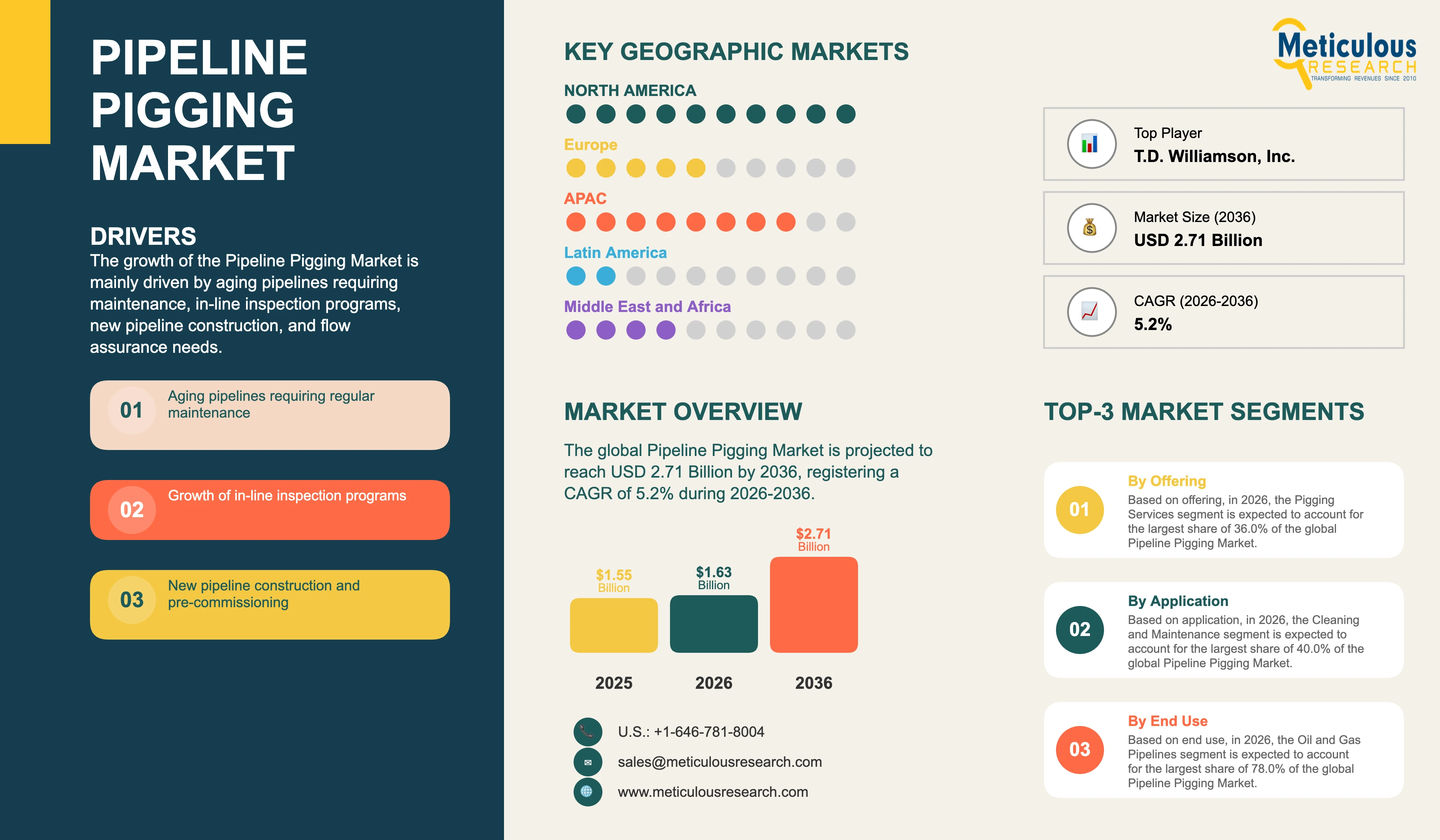
The global pipeline pigging market was valued at USD 1.55 billion in 2025. This market is expected to reach USD 2.71 billion by 2036 from an estimated USD 1.63 billion in 2026, registering a CAGR of 5.2% during the forecast period (2026-2036).
- Published
- Nov 2026
- Pages
- 252
- Format
- PDF + Excel
- Report ID
- MREP - 1042723
- Base year
- 2025
- 2025 · BASELINE
- $1.55B
- 2036
- $2.71B
- CAGR 2026–2036
- 5.2%
2025 baseline · 2026–2036 forecast at 5.2% CAGR · hover a bar for the value
Key highlights
The U.S. onshore energy pipeline network includes about 3.3 million miles of pipeline, including about 300,000 miles of gas transmission, 380,000 miles of gas gathering, and 230,000 miles of hazardous liquid pipelines, a large share of which are cleaned and maintained using utility pigs.
The U.S. Pipeline and Hazardous Materials Safety Administration's gas transmission rule requires devices on in-line inspection launcher and receiver facilities that can safely relieve pressure in the barrel before tools are inserted or removed, as well as devices that indicate whether the barrel is pressurized, which is driving upgrades of pig launchers, receivers, and closures.
According to Global Energy Monitor, about 206,000 kilometers of gas pipelines are in development worldwide, with China, Russia, and India together accounting for nearly half, and India alone has 19,635 kilometers of gas transmission pipelines in development.
Global Energy Monitor reported that about 15, 000 kilometers of crude oil and natural gas liquids pipelines were under construction globally in 2025, with an additional 27,000 kilometers proposed, and Asia accounts for over 60% of oil pipeline development activity.
The expansion of integrity assessment requirements under the U.S. gas transmission Mega Rule, and a January 2026 rule that requires in-line inspection capability for certain class location change segments, are increasing the number of in-line inspection runs, each of which requires utility cleaning and gauging runs and properly designed launchers and receivers.
Pre-commissioning of new pipelines typically involves several pigging operations, including cleaning, gauging, flooding, hydrotesting, dewatering, and drying, which makes new pipeline construction an important source of demand for pigging services and equipment.
T.D. Williamson, a leading pipeline solutions company with more than 35 locations worldwide, continued to expand its pipeline technology portfolio in 2026, including the launch of a new double independent isolation and bleed system and new in-line inspection capabilities.
By offering, pigging services account for the largest share of 36.0% in 2026, while pig tracking, signaling, and accessories register the highest CAGR.
By application, cleaning and maintenance accounts for the largest share of 40.0% in 2026, while pre-commissioning and commissioning registers the highest CAGR.
By end use, oil and gas pipelines account for the largest share in 2026, while chemicals, food and beverage, and other process industries register the highest CAGR.
By geography, North America accounts for the largest share of 34.0% in 2026, while Asia-Pacific registers the highest CAGR of 6.5%.
Report summary
| Particulars | Details |
|---|---|
| Forecast Period | 2026-2036 |
| Base Year | 2025 |
| Estimated Year | 2026 |
| CAGR (Value) | 5.2% |
| Format | PDF, Excel & Cloud Portal · 252 pages |
| Market Size (Value) in 2025 | USD 1.55 billion |
| Market Size (Value) in 2026 | USD 1.63 billion |
| Market Size (Value) in 2036 | USD 2.71 billion |
| Largest Segment by Offering (2026) | Pigging Services (36.0%) |
| Largest Segment by Application (2026) | Cleaning and Maintenance (40.0%) |
| Largest Region (2026) | North America (34.0%) |
| Fastest-Growing Region | Asia-Pacific (CAGR 6.5%) |
| Segments Covered | Offering, Application, End Use, Geography |
| Countries Covered | U.S., Canada, China, India, Australia, Indonesia, Malaysia, Rest of Asia-Pacific, Germany, U.K., Netherlands, Norway, Italy, Rest of Europe, Saudi Arabia, UAE, Qatar, Nigeria, Rest of Middle East & Africa, Brazil, Mexico, Argentina, Rest of Latin America |
| Key Companies | 12 companies and other companies |
Report overview
Segments covered: offering, application, end use.
The growth of this market is mainly driven by the large and aging global network of oil, gas, and products pipelines that require regular cleaning and maintenance, the growing number of in-line inspection runs, each of which requires cleaning and gauging runs beforehand, the construction of new gas, crude oil, and products pipelines, especially in Asia-Pacific and the Middle East, which require pre-commissioning pigging services, the need to manage flow assurance problems such as wax, scale, and liquids in gas lines, the adoption of pigging systems for product recovery in the chemical, food and beverage, and other process industries, and stricter safety regulations for pig launchers and receivers. However, factors such as the large number of unpiggable pipelines, the risk of stuck pigs and operational disruptions, fluctuations in oil and gas investment, and competition from low-cost pig manufacturers are expected to restrain the growth of this market to some extent.
Pipeline pigging is the practice of using devices known as pigs, which travel through a pipeline propelled by the product flow or by a driving fluid, to perform maintenance, cleaning, product separation, and other operations without stopping the flow of product. Pigs are inserted into the pipeline through a launcher and removed through a receiver, and they can be tracked using signalers and transmitters. Pigging is used throughout the life of a pipeline, from pre-commissioning activities such as cleaning, gauging, flooding, dewatering, and drying after construction, to routine operations such as removing wax, scale, and debris, removing liquids from gas lines, separating different products in multi-product pipelines, and applying corrosion inhibitors.
This report covers global revenue from pipeline pigging products and services, including utility pigs such as foam pigs, mandrel pigs, solid cast pigs, spheres, and specialty cleaning pigs, pig launchers, receivers, and closures, pig tracking, signaling, and accessories, and utility pigging services, including cleaning, gauging, pre-commissioning, commissioning, batching, and chemical application, for oil and gas pipelines, water and wastewater pipelines, and the chemical, food and beverage, and other process industries, including product recovery pigging systems. Intelligent in-line inspection services using smart pigs are excluded from the scope of this report, as they are covered in a separate study on pipeline inspection services, as are pipeline repair, hot tapping, plugging and isolation, hydrostatic testing services provided without pigging, and pipeline construction.
Utility pigs are the most widely used pigging products in oil, gas, and process pipelines. Foam pigs are low-cost and flexible, which makes them suitable for pipelines with bends and diameter changes, while mandrel pigs, which have a steel body with replaceable cups, discs, and brushes, are used for heavier cleaning and are reusable. Solid cast pigs, made of polyurethane, and spheres are used for batching and liquid removal. Specialty pigs include gel pigs, magnetic cleaning pigs, and pigs with gauging plates that confirm the internal diameter of the pipeline before in-line inspection or after construction.
Launchers and receivers are pressure vessels connected to the pipeline that allow pigs to be inserted and removed safely. They include quick-opening closures, valves, and pressure relief devices, and they must be designed to handle the operating pressure of the pipeline. Safety incidents involving launchers and receivers have led regulators to require pressure relief and pressure indicating devices, which is driving demand for upgraded equipment. Pig tracking and signaling equipment, such as intrusive and non-intrusive pig signalers and electromagnetic transmitters, allows operators to confirm the passage and location of pigs, which is critical for avoiding stuck pigs. Launchers and receivers range from small, simple traps for gathering lines to large, complex systems for transmission pipelines and offshore platforms, which may include automated handling systems for heavy in-line inspection tools.
Pigging services are provided by specialized companies and by pipeline service companies that offer cleaning, pre-commissioning, and commissioning services. Pre-commissioning services are particularly important for new pipelines, where pigs are used to clean, gauge, flood, hydrotest, dewater, and dry pipelines before they are placed in service. Offshore pre-commissioning services are often provided as part of subsea projects by specialized companies such as EnerMech, IKM Testing, and Baker Hughes.
Pigging is also widely used outside the oil and gas industry in many process and utility applications. In the chemical, food and beverage, cosmetics, paint, and pharmaceutical industries, product recovery pigging systems recover liquid product from pipelines at the end of a batch, which reduces waste, cleaning time, and the use of cleaning chemicals. Product recovery systems are also used to transfer multiple products through a single line, which reduces the number of pipelines needed in a plant. Water and wastewater utilities also use pigs to clean and maintain water mains and sewage force mains.
Over the forecast period, the market is expected to grow steadily, supported by pipeline maintenance, in-line inspection, new pipeline construction, and process industry adoption. Pigging services are expected to remain the largest offering, while pig tracking, signaling, and accessories grow fastest. Cleaning and maintenance are expected to remain the largest application, while pre-commissioning and commissioning grow fastest. North America is expected to remain the largest region, while Asia-Pacific is expected to grow fastest.
Report infographic
Market dynamics
16 factors across 5 forcesLarge and aging pipeline networks requiring regular maintenance
The global network of oil, gas, and products pipelines is very large and aging, and pipelines require regular pigging to maintain flow efficiency, remove deposits, and control internal corrosion. In the U.S. alone, there are about 300,000 miles of gas transmission pipelines, 380,000 miles of gas gathering lines, and 230,000 miles of hazardous liquid pipelines. Crude oil pipelines accumulate wax and sediment, gas pipelines accumulate liquids and debris, and products pipelines require batching and cleaning to maintain product quality.
Regular cleaning reduces pressure drop and energy consumption, improves throughput, and removes water and solids that can cause internal corrosion. As pipelines age, the need for regular maintenance pigging increases, as deposits build up and corrosion risks grow. This provides a stable, recurring source of demand for utility pigs and pigging services. Operators of gathering systems in shale basins, such as the Permian Basin, also pig their lines frequently to remove liquids and paraffin, which supports demand for utility pigs and launchers and receivers in North America. Many gathering lines are pigged weekly or even daily.
Growth of in-line inspection programs
Every in-line inspection run requires the pipeline to be prepared with cleaning runs to remove debris and deposits that could affect the quality of inspection data, and gauging runs to confirm that the pipeline is free of restrictions that could cause the inspection tool to become stuck. As regulators extend integrity assessment requirements, the number of in-line inspection runs is increasing, which drives demand for utility pigs and cleaning services.
In the U.S., the gas transmission Mega Rule has extended integrity assessments to pipelines outside high consequence areas, and a January 2026 rule requires in-line inspection capability for segments using an integrity management alternative for class location changes. These requirements increase the number of pipelines that must be made piggable and inspected, which requires new launchers and receivers, pipeline modifications, and pre-inspection cleaning programs. Operators are also increasingly running cleaning programs on a regular schedule to maintain inspection readiness and reduce the risk of poor-quality data.
Pipelines that have not been pigged for many years often require progressive cleaning programs, starting with soft foam pigs and moving to more aggressive cleaning pigs, before an inspection tool can be run safely. These programs can involve many pig runs and significant volumes of debris removal, which increases demand for utility pigs and cleaning services.
New pipeline construction and pre-commissioning demand
The construction of new pipelines creates demand for pre-commissioning and commissioning services, including cleaning, gauging, flooding, hydrotesting, dewatering, and drying, all of which use pigs. According to Global Energy Monitor, about 206,000 kilometers of gas pipelines are in development worldwide, and about 15,000 kilometers of crude oil and natural gas liquids pipelines were under construction in 2025. China, India, and Russia account for a large share of gas pipeline development, and Asia accounts for over 60% of oil pipeline development activity.
New pipelines also require launchers and receivers and pig tracking equipment, which creates demand for equipment manufacturers. Offshore pipelines and subsea developments in Brazil, Guyana, the Middle East, and other regions also require specialized pre-commissioning services, which are often provided as part of engineering, procurement, construction, and installation contracts.
Pre-commissioning of long pipelines can take several weeks or months and involves large volumes of water for hydrotesting, which must be treated and disposed of properly. Drying of gas pipelines and carbon dioxide pipelines to very low dew points requires specialized equipment and expertise, which increases the value of these services.
Flow assurance and operational efficiency
Flow assurance problems, such as wax deposition in crude oil pipelines, hydrates and liquid accumulation in gas pipelines, and scale and sand in production flowlines, can reduce throughput and cause blockages. Regular pigging is one of the most effective ways to manage these problems, and operators are increasingly adopting pigging programs to optimize pipeline efficiency and reduce energy costs.
Pigging also supports the application of corrosion inhibitors and other chemicals along the full length of the pipeline, which improves the effectiveness of corrosion control programs. In multi-product pipelines, batching pigs separate different products, which reduces product contamination and the volume of mixed product that must be reprocessed.
Effective pigging programs can also reduce the energy required to pump products through pipelines, which lowers operating costs and emissions. Operators are increasingly using pigging data and flow modeling to optimize the frequency of pigging runs and balance the cost of pigging against the benefits of improved flow efficiency.
Table of contents
11 chapters · 130 sections · 252 pages · click to expandSegmental analysis
| Segment | Largest share (2026) | Fastest growth (2026–2036) |
|---|---|---|
| By Offering | Pigging services | Accessories |
| By Application | Cleaning and maintenance | Pre-commissioning and commissioning |
| By End Use | Oil and gas pipelines | Other process industries |
| Other segments | Oil and gas pipelines | Other process industries |
By Offering
- Pipeline Pigging Market Analysis by Offering
- The pigging services segment is expected to account for the largest share of 36.0% of the global pipeline pigging market.
- The large share of this segment is mainly attributed to the high value of pre-commissioning, commissioning, and cleaning services for new and existing pipelines, the growing number of in-line inspection runs that require cleaning and gauging, and the preference of many operators to outsource pigging operations to specialized service providers.
- Pigging services include onshore and offshore pre-commissioning, commissioning, and decommissioning services, routine and progressive cleaning programs, inspection readiness programs, and specialized services such as nitrogen purging, drying to low dew points, and chemical cleaning.
- Pre-commissioning services for long transmission pipelines and offshore pipelines can be large contracts, and they are often awarded to specialized companies by engineering, procurement, and construction contractors.
- Cleaning services are often provided on a recurring basis under multi-year agreements with pipeline operators.
- This reflects rising demand for pre-commissioning, inspection readiness, and specialized cleaning programs, which require skilled personnel and engineering support that many operators prefer to outsource.
- However, the pig tracking, signaling, and accessories segment is projected to register the highest CAGR during the forecast period.
- The rapid growth of this segment is primarily driven by the need to prevent stuck pigs, the adoption of real-time tracking technologies, and the integration of pigging data into digital pipeline management systems.
- Intrusive signalers, which use a mechanical trigger, and non-intrusive signalers, which detect pigs magnetically or acoustically through the pipe wall, are installed at launchers, receivers, and key points along the pipeline.
- Electromagnetic transmitters attached to pigs allow technicians to locate pigs that become stuck.
- Tracking systems also improve safety by confirming that pigs have arrived in the receiver before it is opened, which reduces the risk of incidents.
- Meanwhile, the utility pigs and launchers, receivers, and closures segments are expected to witness steady growth, supported by the recurring replacement of foam pigs, cups, discs, and brushes, new pipeline construction, the conversion of pipelines to make them piggable, and the replacement of older closures to meet safety requirements.
By Application
- Pipeline Pigging Market Analysis by Application
- The cleaning and maintenance segment is expected to account for the largest share of 40.0% of the global pipeline pigging market.
- The large share of this segment is mainly attributed to the need for regular cleaning of oil, gas, and products pipelines to remove wax, scale, liquids, and debris, maintain flow efficiency, and prepare pipelines for in-line inspection.
- Cleaning pigs are used to remove wax from crude oil pipelines, black powder and liquids from gas pipelines, scale and sand from production flowlines, and debris from new pipelines.
- Cleaning frequency depends on the product, pipeline condition, and operating conditions, and ranges from daily pigging of some gathering lines to annual or less frequent pigging of transmission pipelines.
- Cleaning before in-line inspection is a growing share of this segment as inspection programs expand.
- However, the pre-commissioning and commissioning segment is projected to register the highest CAGR during the forecast period.
- The rapid growth of this segment is primarily driven by the construction of new gas, oil, and products pipelines in Asia-Pacific, the Middle East, and other regions, as well as hydrogen and carbon dioxide pipelines.
- Pre-commissioning and commissioning services are linked to the timing of pipeline construction, which means that demand can vary from year to year depending on project schedules.
- However, the large pipeline development pipeline in Asia-Pacific, the Middle East, and Africa, along with offshore developments in Brazil, Guyana, and other regions, is expected to support strong growth over the forecast period.
- Meanwhile, the process product recovery, batching and product separation, and chemical application and other segments are expected to witness steady growth, supported by multi-product pipelines that require batching pigs, product recovery systems in manufacturing plants, and inhibitor batching for internal corrosion control.
By End Use
- Pipeline Pigging Market Analysis by End Use
- The oil and gas pipelines segment is expected to account for the largest share of 78.0% of the global pipeline pigging market.
- The large share of this segment is mainly attributed to the very large length of oil, gas, and products pipelines worldwide, the need for regular cleaning and maintenance, and the growing number of in-line inspection runs.
- Within oil and gas, gas transmission and gathering pipelines account for a large share of demand, driven by liquid removal, cleaning, and in-line inspection preparation, while crude oil and products pipelines require regular cleaning and batching.
- Offshore pipelines and subsea flowlines also require pigging for flow assurance and inspection.
- However, the chemicals, food and beverage, and other process industries segment is projected to register the highest CAGR during the forecast period.
- The rapid growth of this segment is primarily driven by the adoption of product recovery pigging systems to reduce waste and improve efficiency.
- Process industries use pigging systems to recover products such as sauces, beverages, dairy products, cosmetics, paints, lubricants, and chemicals from pipelines, and payback periods can be short because of the value of recovered product and savings in cleaning and changeover time.
- Meanwhile, the water and wastewater segment is expected to witness steady growth, supported by the cleaning of water mains and force mains to restore hydraulic capacity and prepare pipelines for inspection and rehabilitation.
Other segments
- The oil and gas pipelines segment is expected to account for the largest share of the pipeline pigging market, while the chemicals, food and beverage, and other process industries segment is projected to register the highest CAGR during the forecast period.
Geographic analysis
North America
Largest shareIn 2026, North America is expected to account for the largest share of 34.0% of the global pipeline pigging market. The large share of this region is mainly due to the very large pipeline network in the U.S. and Canada, the frequent pigging of gathering systems in shale basins, strict integrity management regulations that drive in-line inspection and cleaning programs, and launcher and receiver safety requirements. Within North America, the U.S. is the largest country market, supported by its very large network of gas transmission, gathering, and hazardous liquid pipelines, frequent pigging of shale gathering systems in the Permian, Marcellus, and other basins, and in-line inspection programs under federal regulations. Canada is supported by large oil and gas pipeline networks and integrity management requirements.
Asia-Pacific
Asia-Pacific is the second-largest market and is projected to register the highest CAGR of 6.5% during the forecast period. The rapid growth of this region is mainly due to the construction of new gas and oil pipelines in China and India, pipeline development in Southeast Asia and Australia, and the adoption of pigging and in-line inspection programs as networks mature. In Asia-Pacific, China and India are building thousands of kilometers of new gas pipelines, and India alone has 19,635 kilometers of gas transmission pipelines in development, according to Global Energy Monitor.
Europe
Europe is the third-largest market, supported by aging gas and oil pipelines in Germany, the U.K., the Netherlands, and Norway that require regular maintenance, and hydrogen pipeline conversion projects are expected to create new demand later in the forecast period.
Middle East & Africa
The Middle East & Africa is expected to grow faster than the global average, supported by new pipelines in Saudi Arabia, the UAE, and Qatar, as well as pipeline projects in Africa. In the Middle East, Saudi Arabia, the UAE, and Qatar operate large pipeline networks and are building new pipelines for gas and products, which create demand for pre-commissioning and maintenance pigging. Africa's pipeline projects include gas lines in Nigeria and Mozambique, and Egypt is also investing in gas pipeline infrastructure.
Latin America
Latin America is a smaller market, supported by pipeline networks in Brazil, Mexico, and Argentina, where new pipelines from the Vaca Muerta shale region are creating demand for pre-commissioning services.
Competitive landscape
The global pipeline pigging market is fragmented, with the top five players estimated to account for about 35% of the market in 2025. The market includes global pipeline solutions companies, specialized pig manufacturers, pre-commissioning service providers, and process pigging system suppliers.
T.D. Williamson, ROSEN, and Baker Hughes offer broad portfolios of pigging products and services, as well as in-line inspection. Enduro Pipeline Services, Inline Services, Girard Industries, Pigs Unlimited International, and Apache Pipeline Products are leading manufacturers of utility pigs and related products, and Pipeline Engineering supplies pigs, launchers, receivers, and pigging systems. EnerMech and IKM Testing provide pre-commissioning and commissioning services, and HPS Product Recovery Solutions supplies product recovery pigging systems for process industries. Companies compete on product quality, range, engineering support, service capabilities, and price. Key strategies include product innovation, integrated pigging and inspection programs, expansion in growing regions, and service network development.
The market has moderate barriers to entry in standard utility pigs, where many small manufacturers compete, but higher barriers in engineered launchers and receivers, tracking systems, and pre-commissioning services, which require engineering expertise, safety certifications, and track records. Customer relationships are also important. Global companies such as T.D. Williamson, ROSEN, and Baker Hughes benefit from broad portfolios that combine pigging products, services, and in-line inspection, which allows them to offer integrated solutions to pipeline operators. Recent developments include T.D. Williamson's launch of new pipeline isolation and in-line inspection capabilities in 2026, continued investment in pig tracking technologies, and growing demand for product recovery systems in process industries.
Regional manufacturers and service companies play an important role in many markets, particularly in Asia-Pacific and the Middle East, where they compete on price, local presence, and responsiveness. Global suppliers often partner with local companies to meet local content requirements and serve national pipeline companies. In process industries, specialized suppliers of product recovery systems compete on hygienic design, automation, and the ability to integrate pigging systems into production lines. We expect the market to remain fragmented in standard products, while consolidation continues among service providers and suppliers of engineered systems as companies seek scale and broader portfolios.
Some of the key players operating in the pipeline pigging market are T.D. Williamson, Inc., ROSEN Group, Baker Hughes Company, Enduro Pipeline Services, Inc., Inline Services, Inc., Pipeline Engineering (CIRCOR International), Girard Industries, Pigs Unlimited International, LLC, Apache Pipeline Products, EnerMech Ltd., IKM Testing AS, and HPS Product Recovery Solutions, among others.
- —
T.D. Williamson launched new pipeline solutions in 2026, and U.S. regulations continue to drive launcher and receiver safety upgrades and in-line inspection programs that require utility pigging.
- T.D. Williamson, Inc.
- ROSEN Group
- Baker Hughes Company
- Enduro Pipeline Services, Inc.
- Inline Services, Inc.
- Pipeline Engineering (CIRCOR International)
- Girard Industries
- Pigs Unlimited International, LLC
- Apache Pipeline Products
- EnerMech Ltd.
- IKM Testing AS
- HPS Product Recovery Solutions
Expert perspectives
The pipeline pigging market is supported by stable recurring demand from pipeline maintenance and in-line inspection, along with growth from new pipeline construction and process industries. We expect steady growth over the forecast period.
Over the forecast period, the market is expected to grow at a CAGR of 5.2%, from USD 1.63 billion in 2026 to USD 2.71 billion in 2036. Growth will be supported by aging pipelines, in-line inspection programs, new construction, and flow assurance needs, while unpiggable pipelines, operational risks, and low-cost competition will moderate growth.
In terms of segments, pigging services remain the largest offering, while pig tracking, signaling, and accessories grow fastest. Cleaning and maintenance remain the largest application, while pre-commissioning and commissioning grow fastest. Oil and gas pipelines remain the largest end use, while process industries grow fastest. North America remains the largest region, while Asia-Pacific grows fastest at a CAGR of 6.5%.
For suppliers, the key priorities are to invest in tracking and digital technologies, expand service capabilities in growing regions, and offer integrated pigging and inspection solutions. We believe that integrated providers will gain share in the higher-value segments of the market.
We expect demand from pipeline maintenance and in-line inspection to remain stable and recurring, providing a solid base for the market, while new pipeline construction in Asia-Pacific, the Middle East, and other regions drives faster growth in pre-commissioning services and equipment. Our forecast assumes that pipeline construction continues at a pace broadly consistent with current development plans and that integrity regulations remain in place. A slowdown in pipeline construction or a reduction in maintenance budgets could slow growth, while faster growth in hydrogen and carbon dioxide pipelines or process industry adoption could add upside. In our view, suppliers that offer reliable products, strong engineering support, and integrated services will be best positioned. We also expect pricing pressure in standard utility pigs to continue, while higher-value segments such as tracking systems, engineered launchers and receivers, and pre-commissioning services offer better margins and growth prospects.
We see the integration of pigging with in-line inspection and digital pipeline management as an important long-term trend, as operators seek to manage pipeline integrity more efficiently. Suppliers that can provide data from pigging runs, such as debris volumes and pig wear, and integrate this information into integrity management systems will be able to offer more value to operators and differentiate themselves from low-cost competitors. We also believe the shift toward automation will reduce safety incidents and labor needs over time.
Customer perspectives
Buyers of pigging products and services include pipeline operators, gas utilities, oil and gas producers, engineering, procurement, and construction contractors, and process manufacturers. Their decisions depend mainly on reliability, safety, product quality, service capability, and cost.
Pipeline Maintenance Manager - Midstream operator, U.S.
We run cleaning and gauging pigs before every in-line inspection, and we have upgraded our launchers and receivers to meet the new safety requirements.
This comment explains why North America is the largest region and why launchers and receivers are in demand.
This comment explains why pre-commissioning and Asia-Pacific are growing fastest.
This comment explains why process industries are the fastest-growing end use.
Across all customer groups, reliability and safety are critical, as a stuck pig or a launcher incident can cause costly shutdowns and safety risks. Buyers increasingly prefer suppliers that can provide engineering support for pig selection and pigging program design, and many operators value long-term relationships with suppliers that understand their pipelines. EPC contractors focus on schedule and cost certainty for pre-commissioning, while process manufacturers focus on product recovery rates and hygiene. Water utilities, in turn, value low-cost cleaning solutions that restore capacity without excavation. Across all groups, buyers expect suppliers to provide clear documentation, training, and fast delivery of spare parts and consumables.
“Our new gas pipelines need full pre-commissioning, including cleaning, gauging, hydrotesting, dewatering, and drying, before handover.”
“Our product recovery pigging system recovers valuable product and cuts our cleaning time and water use.”
Frequently asked questions
The global pipeline pigging market was valued at USD 1.55 billion in 2025, up from USD 1.48 billion in 2024, and is estimated at USD 1.63 billion in 2026. The market includes pigging services, utility pigs, launchers, receivers, and closures, and pig tracking, signaling, and accessories.
The global pipeline pigging market is expected to reach USD 2.71 billion by 2036, supported by pipeline maintenance, in-line inspection, new construction, and process industry adoption.
The market is expected to register a CAGR of 5.2% from 2026 to 2036, with the fastest growth in pig tracking and accessories, pre-commissioning and commissioning, process industries, and Asia-Pacific.
Every in-line inspection run requires cleaning and gauging runs beforehand, and properly designed launchers and receivers, so the growth of in-line inspection programs under regulations such as the U.S. Mega Rule directly increases demand for utility pigs and pigging services.
Market growth is mainly driven by large and aging pipeline networks requiring regular maintenance, the growth of in-line inspection programs, new pipeline construction and pre-commissioning demand, and flow assurance and operational efficiency needs.
Unpiggable pipelines, operational risks, and fluctuations in oil and gas investment restrain growth, while competition from low-cost manufacturers and skilled labor and safety requirements are key challenges.
Key opportunities include smart pig tracking and digital pigging, process industry product recovery, hydrogen, carbon dioxide, and water pipelines, and expansion in Asia-Pacific and the Middle East.
Pigging services are expected to account for the largest share of 36.0% of the market in 2026, while pig tracking, signaling, and accessories are projected to register the highest CAGR.
Pre-commissioning and commissioning are projected to register the highest CAGR, while cleaning and maintenance account for the largest share of 40.0%.
North America is expected to account for the largest share of 34.0% of the market in 2026, mainly due to its very large pipeline network and strict integrity regulations.
Asia-Pacific is projected to register the highest CAGR of 6.5% during the forecast period, driven by pipeline construction in China, India, and Southeast Asia.
According to Global Energy Monitor, about 206,000 kilometers of gas pipelines are in development worldwide, and about 15,000 kilometers of crude oil and natural gas liquids pipelines were under construction in 2025.
The report profiles 12 companies, including T.D. Williamson, Inc., ROSEN Group, Baker Hughes Company, Enduro Pipeline Services, Inc., Inline Services, Inc., Pipeline Engineering (CIRCOR International), Girard Industries, Pigs Unlimited International, LLC, Apache Pipeline Products, EnerMech Ltd., IKM Testing AS, and HPS Product Recovery Solutions.
T.D. Williamson launched new pipeline solutions in 2026, and U.S. regulations continue to drive launcher and receiver safety upgrades and in-line inspection programs that require utility pigging.
In 2026, the oil and gas pipelines segment is expected to account for the largest share of the pipeline pigging market, while the chemicals, food and beverage, and other process industries segment is projected to register the highest CAGR during the forecast period.
Cite this report
Meticulous Research. (2026). Pipeline Pigging Market - Global Opportunity Analysis and Industry Forecast (2026-2036) (Report No. MREP - 1042723). Meticulous Market Research Pvt. Ltd. https://www.meticulousresearch.com/product/pipeline-pigging-market-7406