Natural Gas Transmission Pipelines Market (2026-2036)
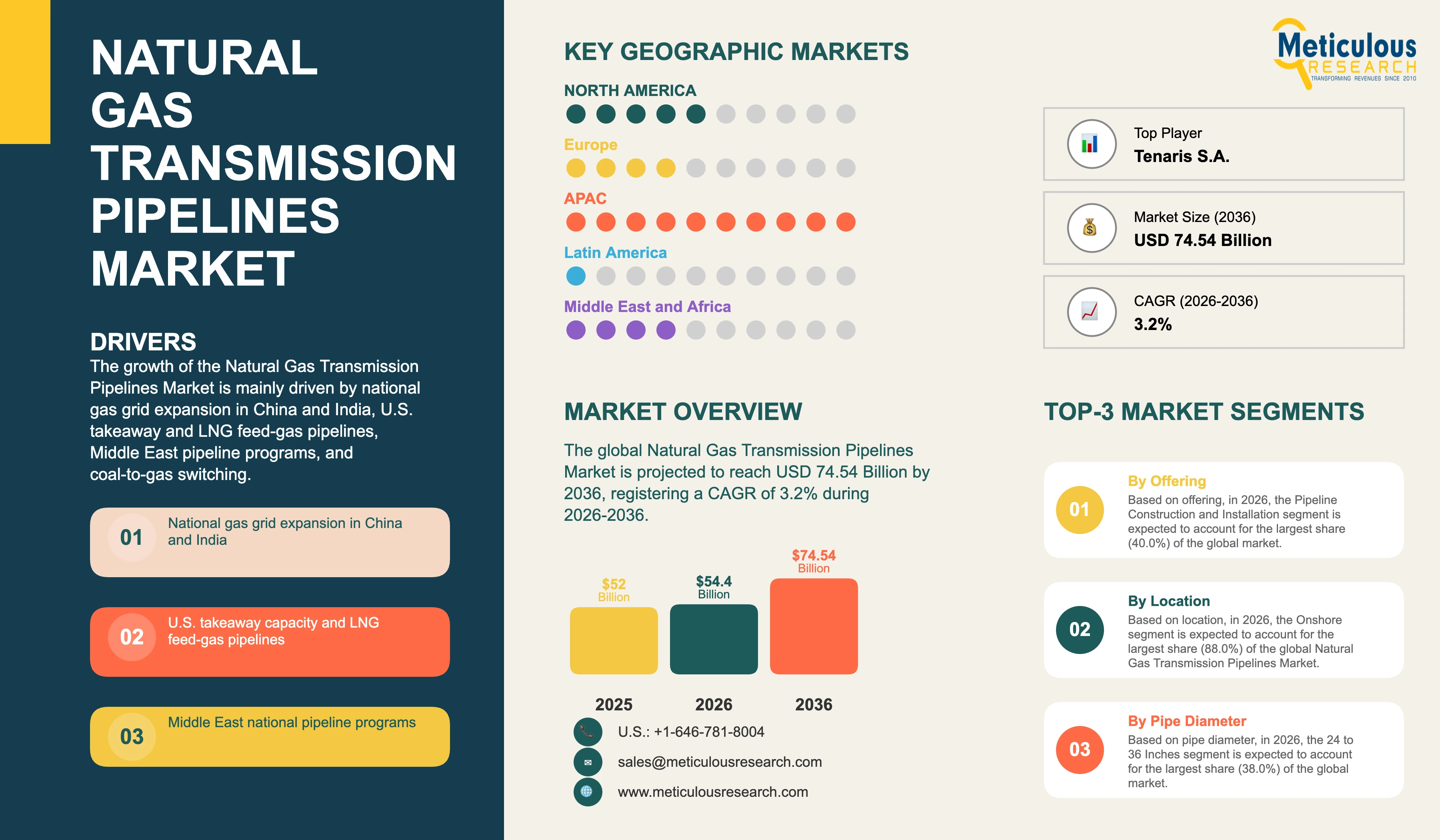
The global natural gas transmission pipelines market was valued at USD 52.00 billion in 2025. This market is expected to reach USD 74.54 billion by 2036 from an estimated USD 54.40 billion in 2026, registering a CAGR of 3.2% during the forecast period (2026-2036).
- Published
- Nov 2026
- Pages
- 253
- Format
- PDF + Excel
- Report ID
- MREP - 1042719
- Base year
- 2025
- 2025 · BASELINE
- $52.00B
- 2036
- $74.54B
- CAGR 2026–2036
- 3.2%
2025 baseline · 2026–2036 forecast at 3.2% CAGR · hover a bar for the value
Key highlights
According to Global Energy Monitor, about 69,700 kilometers of gas transmission pipelines were under construction worldwide at the end of 2023, an 18% increase over the previous year, at an estimated cost of USD 193.9 billion, with Asia accounting for 82% of the length under construction.
The U.S. Energy Information Administration reports that developers plan to bring about 44.9 billion cubic feet per day (Bcf/d) of new natural gas pipeline capacity online in the U.S. in 2026 and 2027, about 70% of which (31.6 Bcf/d) is already under construction. More than 66% of this capacity originates in Texas, providing takeaway from the Permian Basin and supplying LNG export terminals, power plants, and industry.
In the Permian Basin, the 366-mile, 42-inch Blackcomb Pipeline (2.5 Bcf/d) and Energy Transfer's USD 2.7 billion, 442-mile Hugh Brinson Pipeline are entering service in 2026. WhiteWater and its partners reached a final investment decision on the 2.5 Bcf/d Eiger Express in August 2025 and on the 4.5 Bcf/d Solitude system in 2026, which is expected to enter service from the second half of 2029.
Saudi Aramco awarded 15 lump-sum turnkey contracts worth about USD 8.8 billion for the third expansion phase of its Master Gas System, which will add about 4,000 kilometers of pipelines and 17 new gas compression trains and raise capacity by about 3.15 billion standard cubic feet per day by 2028.
Gazprom and China National Petroleum Corporation signed a memorandum in September 2025 to build the Power of Siberia 2 pipeline through Mongolia with capacity of 50 billion cubic meters per year, and China's 2026-2030 five-year plan includes preparatory work on the route, although China has not yet given final approval.
India's Petroleum and Natural Gas Regulatory Board reported that about 25, 000 kilometers of the country's authorized natural gas pipeline network were operational in early 2025, with the remainder scheduled for commissioning over the following two to three years under the national gas grid program.
By offering, pipeline construction and installation accounts for the largest share of 40.0% in 2026, while engineering, design, and project management registers the highest CAGR.
By location, onshore accounts for the larger share of 88.0% in 2026, while offshore registers the higher CAGR.
By pipe diameter, 24 to 36 inches account for the largest share in 2026, while above 36 inches register the highest CAGR.
By project type, new pipeline construction accounts for the largest share in 2026, while expansion and looping registers the highest CAGR.
By geography, Asia-Pacific accounts for the largest share of 42.0% in 2026, while Middle East & Africa registers the highest CAGR of 4.2%.
Report summary
| Particulars | Details |
|---|---|
| Forecast Period | 2026-2036 |
| Base Year | 2025 |
| Estimated Year | 2026 |
| CAGR (Value) | 3.2% |
| Format | PDF, Excel & Cloud Portal · 253 pages |
| Market Size (Value) in 2025 | USD 52.00 billion |
| Market Size (Value) in 2026 | USD 54.40 billion |
| Market Size (Value) in 2036 | USD 74.54 billion |
| Segments Covered | Offering, Location, Pipe Diameter, Project Type, Geography |
| Countries Covered | China, India, Indonesia, Australia, Pakistan, Bangladesh, Rest of Asia-Pacific, U.S., Canada, Mexico, Saudi Arabia, Iran, UAE, Qatar, Iraq, Nigeria, Egypt, Rest of Middle East & Africa, Russia, Turkey, Italy, Germany, Poland, Greece, Rest of Europe, Argentina, Brazil, Rest of Latin America |
| Key Companies | 14 companies and other companies |
| Largest Segment by Offering (2026) | Pipeline Construction and Installation (40.0%) |
| Largest Segment by Location (2026) | Onshore (88.0%) |
| Largest Region (2026) | Asia-Pacific (42.0%) |
| Fastest-Growing Region | Middle East & Africa (CAGR 4.2%) |
Report overview
Segments covered: offering, location, pipe diameter, project type.
The growth of this market is mainly driven by the continued build-out of national gas grids in China and India, the wave of new takeaway and LNG feed-gas pipelines in the U.S., especially from the Permian Basin to the Gulf Coast, rising gas demand for power generation, including power for data centers, large national pipeline programs in the Middle East such as Saudi Aramco's Master Gas System expansion, the replacement of coal and oil with gas in power and industry in Asia, the Middle East, and Africa, new cross-border import and export pipelines, and the replacement and rerouting of aging pipelines. However, factors such as long permitting and approval timelines, legal and environmental opposition to new pipelines in some countries, the risk that long-lived assets will be underused as countries decarbonize, volatile steel and construction costs, and declining investment in new gas pipelines in Europe are expected to restrain the growth of this market to some extent.
Natural gas transmission pipelines are large-diameter, high-pressure steel pipelines that carry natural gas over long distances from production fields, processing plants, LNG import terminals, and cross-border entry points to distribution networks, power plants, large industrial users, and LNG export terminals. They typically operate at pressures of about 40 to 150 bar or more, use pipes of about 16 to 56 inches in diameter, and form the backbone of national and regional gas systems. Transmission pipelines can be onshore or offshore and may cross several countries. They are usually owned and operated by national pipeline companies, midstream companies, or national oil and gas companies, and they are typically regulated by national energy regulators that approve routes, tariffs, and safety standards.
This report covers global revenue from the construction of natural gas transmission pipelines, including line pipe, pipeline construction and installation, engineering, design, and project management, pipeline coatings and field joint protection, and mainline valves and fittings, for new pipelines, expansions and looping, and replacement and rerouting projects. Compressor stations, metering and pressure regulation stations, pipeline inspection and pigging services, cathodic protection systems, LNG terminals, and gas distribution networks are excluded from the scope of this report, as they are covered in separate studies.
The global natural gas transmission network is very large and is still expanding in many regions. North America has by far the largest pipeline network, with more than 400,000 kilometers of transmission pipelines, and Europe and Russia also have extensive networks. Most new construction, however, is taking place in Asia, where China and India are building national gas grids, and in the Middle East, where countries such as Saudi Arabia and Iran are expanding domestic networks. Global Energy Monitor estimated that about 69,700 kilometers of gas transmission pipelines were under construction worldwide at the end of 2023, at a cost of USD 193.9 billion, with Asia accounting for 82% of the length under construction.
In the U.S., pipeline construction has accelerated again after several years of slower activity, driven by the growth of LNG exports, rising gas demand for power generation, and the need for more takeaway capacity from the Permian Basin. The U.S. Energy Information Administration reports that developers plan to add about 44.9 Bcf/d of new pipeline capacity in 2026 and 2027, much of it in Texas and Louisiana. Large new pipelines such as Blackcomb, Hugh Brinson, Eiger Express, and Solitude illustrate this trend.
Gas transmission pipeline construction is highly capital-intensive and involves several main cost components. Line pipe typically accounts for about a third or more of total pipeline cost, while construction and installation, including right-of-way preparation, trenching, welding, coating, lowering, backfilling, horizontal directional drilling at crossings, and testing, account for a similar or larger share. Engineering, design, project management, coatings, valves, and fittings account for the rest. Costs vary widely depending on terrain, diameter, wall thickness, labor costs, and regulatory requirements. Energy Transfer's 442-mile Hugh Brinson Pipeline, for example, is reported to cost about USD 2.7 billion, while pipelines in mountainous or urban areas can cost several times more per kilometer.
The market includes line pipe manufacturers, pipeline construction contractors, engineering and EPC companies, and suppliers of coatings, valves, and fittings. Leading companies include Tenaris, Nippon Steel, Welspun Corp, Jindal SAW, EUROPIPE, Saipem, McDermott, Larsen & Toubro, MasTec, Quanta Services, Primoris Services, Bonatti, Sicim, and China Petroleum Pipeline Engineering. Many national oil and gas companies and pipeline operators also have their own construction and engineering subsidiaries.
Over the forecast period, the natural gas transmission pipelines market is expected to grow moderately. Strong investment in the U.S., the Middle East, India, and parts of Africa and Asia will offset slower activity in Europe and slower growth in China as its national grid matures. The long-term role of gas in the energy transition, permitting reforms, and the pace of LNG export and gas power growth will be key factors shaping the market.
Gas is replacing coal and oil in power generation and industry in many countries in Asia, the Middle East, Africa, and Latin America, which requires new transmission pipelines to deliver gas from fields and LNG terminals to users. New cross-border pipelines are also being developed to connect producers with consumers, including potential new pipelines from Russia and Central Asia to China, pipelines in Africa such as the Ajaokuta-Kaduna-Kano pipeline in Nigeria, and pipelines in Latin America linking Argentina's Vaca Muerta gas to domestic and export markets. These cross-border and domestic projects support demand for large-diameter line pipe and construction services, although many cross-border projects face long development timelines and political and financing challenges.
Completing the national gas grid is essential for expanding gas use across the country. We need reliable domestic pipe supply and contractors who can work across very different terrains.
This comment explains why Asia-Pacific accounts for 42.0% of the market and why onshore pipelines account for 88.0% of the market.
Our national gas network expansion will connect new gas fields to power plants, desalination plants, and industrial cities. We are using large-diameter pipelines and experienced EPC contractors to deliver on schedule.
This comment shows why the Middle East & Africa is the fastest-growing region and why large-diameter pipelines above 36 inches are growing quickly. It also highlights the importance of experienced EPC contractors for national programs.
Asia-Pacific is expected to account for the largest share of 42.0% of the market in 2026, mainly due to national gas grid programs in China and India.
The Middle East & Africa is projected to register the highest CAGR of 4.2% during the forecast period, driven by Saudi Aramco's Master Gas System expansion and other national and cross-border pipeline programs.
The report profiles 14 companies, including Tenaris S.A., Nippon Steel Corporation, Welspun Corp Limited, Jindal SAW Ltd., EUROPIPE GmbH, Saipem S.p.A., McDermott International, Ltd., Larsen & Toubro Limited, MasTec, Inc., Quanta Services, Inc., Primoris Services Corporation, Bonatti S.p.A., Sicim S.p.A., and China Petroleum Pipeline Engineering Co., Ltd.
Report infographic
Market dynamics
14 factors across 5 forcesNational gas grid expansion in China and India
China and India have been the world's largest builders of gas transmission pipelines for several years, as they expand gas use to reduce coal consumption and air pollution and to supply growing cities and industries. China's national pipeline operator, PipeChina, continues to build trunk lines, interconnections, and regional networks, including new lines to bring gas from Central Asia, Russia, and domestic fields to eastern and southern China. China's 2026-2030 five-year plan includes preparatory work on a new central route pipeline from Russia, widely seen as Power of Siberia 2.
India's national gas grid program aims to connect all regions of the country and support the rapid expansion of city gas distribution networks. India's Petroleum and Natural Gas Regulatory Board reported that about 25,000 kilometers of the authorized pipeline network were operational in early 2025, with the remainder scheduled for commissioning over the following two to three years, and the government aims to raise the share of natural gas in the national energy mix to about 15%. Major projects include the Jagdishpur-Haldia-Bokaro-Dhamra pipeline in eastern India, the Indradhanush northeast gas grid, and the Mumbai-Nagpur-Jharsuguda pipeline. Together, these programs create large and sustained demand for line pipe, construction services, engineering, and coatings, and they support many domestic manufacturers and contractors in both countries.
U.S. takeaway capacity and LNG feed-gas pipelines
The U.S. is in the middle of a major pipeline construction cycle driven by rising associated gas production in the Permian Basin, the expansion of LNG export capacity on the Gulf Coast, and growing gas demand for power generation. The Energy Information Administration reports that about 44.9 Bcf/d of new pipeline capacity is planned to come online in 2026 and 2027, about 70% of which is already under construction, and more than 66% of the capacity originates in Texas.
Large Permian projects include the 2.5 Bcf/d Blackcomb Pipeline and Energy Transfer's 442-mile Hugh Brinson Pipeline, both entering service in 2026, the 2.5 Bcf/d Eiger Express, which reached a final investment decision in August 2025 and is scheduled for mid-2028, and the 4.5 Bcf/d Solitude system, which reached a final investment decision in 2026 and is expected to enter service from the second half of 2029. Pipelines to supply new LNG export terminals in Texas and Louisiana, such as the 4.5 Bcf/d Rio Bravo Pipeline, are also under construction. Rising electricity demand from data centers, manufacturing, and electrification is also increasing gas demand for power generation in the U.S., which supports new pipeline expansions in the Southeast, Midwest, and other regions.
Table of contents
12 chapters · 139 sections · 253 pages · click to expandSegmental analysis
| Segment | Largest share (2026) | Fastest growth (2026–2036) |
|---|---|---|
| By Offering | Pipeline construction and installation | Project management |
| By Location | Onshore | Offshore |
| By Pipe Diameter | 24 to 36 inches | Above 36 inches |
| By Project Type | New pipeline construction | Expansion and looping |
| Other segments | — | Pipes above 36 inches |
By Offering
- Natural Gas Transmission Pipelines Market Analysis by Offering
- The pipeline construction and installation segment is expected to account for the largest share of 40.0% of the global natural gas transmission pipelines market.
- The large share of this segment is mainly attributed to the labor- and equipment-intensive nature of pipeline construction, which includes right-of-way clearing, trenching, stringing, welding, coating of field joints, lowering, backfilling, horizontal directional drilling and other crossings, hydrostatic testing, and restoration, as well as the large number of projects under construction in China, India, the U.S., the Middle East, and other regions.
- Construction costs are especially high in difficult terrain, urban areas, and regions with high labor costs.
- Leading pipeline contractors include Saipem, McDermott, Larsen & Toubro, MasTec, Quanta Services, Primoris Services, Bonatti, Sicim, and China Petroleum Pipeline Engineering, along with many regional contractors.
- In the U.S., the large Permian and LNG feed-gas pipelines have kept major contractors busy, while in the Middle East, contractors are building large-diameter pipelines for Saudi Aramco's Master Gas System expansion.
- However, the engineering, design, and project management segment is projected to register the highest CAGR during the forecast period.
- The rapid growth of this segment is primarily driven by the increasing complexity of pipeline projects, stricter safety and environmental requirements, the use of digital design and construction management tools, hydrogen-ready design specifications, and the growing number of expansions and replacement projects that require detailed engineering.
- Operators increasingly rely on specialized engineering firms for route selection, integrity management planning, and regulatory approvals, which raises the value of front-end and project management work.
- Meanwhile, the line pipe, pipeline coatings and field joint protection, and mainline valves and fittings segments are expected to witness steady growth, supported by large-diameter pipeline projects in Asia, the Middle East, and North America, stricter integrity requirements, and the replacement of aging valves and coatings.
- The new pipeline construction segment is expected to account for the largest share of the natural gas transmission pipelines market, while the expansion and looping segment is projected to register the highest CAGR during the forecast period.
By Location
- Natural Gas Transmission Pipelines Market Analysis by Location
- The onshore segment is expected to account for the largest share of 88.0% of the global natural gas transmission pipelines market.
- The large share of this segment is mainly attributed to the fact that most gas transmission pipelines are built on land, including national gas grids in China and India, takeaway and LNG feed-gas pipelines in the U.S., national pipeline programs in the Middle East, and cross-border pipelines in Asia, Africa, and Latin America.
- Onshore pipelines also include most replacement and rerouting projects.
- Onshore pipeline construction is generally less expensive per kilometer than offshore construction, but large onshore programs involve thousands of kilometers of pipeline and large volumes of line pipe and construction work.
- However, the offshore segment is projected to register the highest CAGR during the forecast period.
- The rapid growth of this segment is primarily driven by new offshore gas field developments in the eastern Mediterranean, Africa, Asia, Brazil, and the Middle East, export pipelines from offshore fields to onshore processing plants and LNG terminals, and cross-border subsea pipelines.
- Offshore pipelines require specialized pipe-laying vessels, coatings, and engineering, and contractors such as Saipem and McDermott are leaders in this segment.
- Onshore pipelines are expected to account for the largest share of 88.0% of the market in 2026, while offshore pipelines are projected to register the highest CAGR.
By Pipe Diameter
- Natural Gas Transmission Pipelines Market Analysis by Pipe Diameter
- The 24 to 36 inches segment is expected to account for the largest share of the global natural gas transmission pipelines market.
- The large share of this segment is mainly attributed to the wide use of pipes in this diameter range for regional transmission lines, national grid expansions in India and China, laterals to power plants and industrial users, and many cross-border pipelines.
- Pipes in this range offer a balance between capacity and cost for many applications.
- However, the above 36 inches segment is projected to register the highest CAGR during the forecast period.
- The rapid growth of this segment is primarily driven by large, high-capacity pipelines such as the 42-inch Permian pipelines in Texas, the 56-inch pipelines in Saudi Aramco's Master Gas System expansion, and large trunk lines in China and Russia.
- Large-diameter pipelines offer lower transport costs per unit of gas and are preferred for high-volume corridors.
- Only a limited number of mills can produce pipe of these sizes, which gives established manufacturers an advantage.
- Meanwhile, the below 24 inches segment is expected to witness steady growth, supported by the expansion of city gas distribution networks in India, power plant laterals in the U.S., and smaller transmission lines in regions with lower gas demand.
By Project Type
- Natural Gas Transmission Pipelines Market Analysis by Project Type
- The new pipeline construction segment is expected to account for the largest share of the global natural gas transmission pipelines market.
- The large share of this segment is mainly attributed to the large number of new greenfield pipelines being built in China, India, the Middle East, and the U.S., including national grid trunk lines, Permian takeaway pipelines, LNG feed-gas pipelines, and new cross-border pipelines.
- New pipelines require the largest volumes of line pipe and construction work, and they include some of the largest infrastructure projects in the energy sector.
- Projects such as India's national gas grid lines, the Permian takeaway pipelines, and the Master Gas System expansion each involve hundreds or thousands of kilometers of new pipeline.
- However, the expansion and looping segment is projected to register the highest CAGR during the forecast period.
- The rapid growth of this segment is primarily driven by the need to increase capacity on existing systems quickly and at lower cost, easier permitting for projects in existing corridors, and strong demand for additional capacity in the U.S. and other mature markets.
- Looping, which adds a parallel pipeline along an existing route, and compression upgrades allow operators to add capacity within existing rights-of-way.
- Meanwhile, the replacement and rerouting segment is expected to witness steady growth, supported by pipeline safety regulations and aging infrastructure in North America, Europe, and Russia.
Other segments
- Pipes above 36 inches are projected to register the highest CAGR, driven by large, high-capacity pipelines in the Permian Basin, Saudi Arabia, China, and Russia.
Geographic analysis
Middle East & Africa
Fastest growthCountries in the Middle East are investing heavily in gas transmission pipelines to expand domestic gas use in power generation and industry, replace oil burned in power plants, and support new petrochemical and industrial projects. Saudi Aramco awarded 15 lump-sum turnkey contracts worth about USD 8.8 billion for the third expansion phase of its Master Gas System, which will add about 4,000 kilometers of pipelines and raise capacity by about 3.15 billion standard cubic feet per day by 2028, with contractors such as Larsen & Toubro, Sinopec, Nesma & Partners with Sicim, and Bin Quraya building packages of 46- and 56-inch pipelines. Iran is building the 1,200-kilometer IGAT 11 pipeline, while the UAE, Qatar, Oman, and Iraq are also expanding their gas networks. Regional security concerns, including disruptions around the Strait of Hormuz, have also increased interest in new pipelines that bypass maritime chokepoints, which could support further investment in the region. The Middle East & Africa is projected to register the highest CAGR of 4.2% during the forecast period. The rapid growth of this region is mainly due to large national pipeline programs such as Saudi Aramco's Master Gas System expansion, which will add about 4,000 kilometers of pipelines by 2028, Iran's IGAT 11 pipeline, gas network expansion in the UAE, Qatar, Oman, and Iraq, new pipelines in Africa such as Nigeria's Ajaokuta-Kaduna-Kano pipeline, and growing interest in pipelines that bypass maritime chokepoints. Africa offers additional long-term potential as countries such as Nigeria, Mozambique, and Tanzania develop domestic gas markets. Middle East national pipeline programs Geographic Analysis
Asia-Pacific
Largest shareIn 2026, Asia-Pacific is expected to account for the largest share of 42.0% of the global natural gas transmission pipelines market. The large share of this region is mainly due to the large national gas grid programs in China and India, which have been the world's largest builders of gas transmission pipelines for several years, coal-to-gas switching in power and industry, rapid growth in city gas distribution, new import pipelines from Central Asia and Russia, and the presence of large domestic line pipe manufacturers and contractors. Global Energy Monitor estimated that Asia accounted for 82% of the length of gas transmission pipelines under construction worldwide at the end of 2023. However, growth in the region is expected to slow over the forecast period as China's national grid matures, although India, Southeast Asia, and Pakistan continue to expand their networks.
North America
North America is the second-largest market, supported by the wave of new Permian takeaway pipelines, LNG feed-gas pipelines, and expansions to serve gas-fired power plants and data centers. The Energy Information Administration reports that about 44.9 Bcf/d of new pipeline capacity is planned in the U.S. in 2026 and 2027, and Canada and Mexico are also building new gas pipelines. Pipelines to supply LNG export projects on Canada's west coast and gas imports into Mexico are among the most important projects outside the U.S.
Europe
Europe accounts for a smaller and slowly growing share of the market, as gas demand has fallen and policy priorities have shifted to hydrogen and electricity, although projects continue in Southeastern Europe, the eastern Mediterranean, and Russia.
Latin America
Latin America accounts for a small share, with projects in Argentina and Brazil. Argentina's pipelines to move gas from the Vaca Muerta shale formation are the most important projects in the region.
Competitive landscape
The global natural gas transmission pipelines market is fragmented, with the top five players estimated to account for about 15% of the market in 2025. The market includes line pipe manufacturers, pipeline construction contractors, engineering and EPC companies, and suppliers of coatings, valves, and fittings, as well as many regional and national companies.
Tenaris, Nippon Steel, Welspun Corp, Jindal SAW, and EUROPIPE are among the world's leading suppliers of line pipe for gas transmission pipelines, while many Chinese mills supply pipe for China's domestic network and export markets. Saipem, McDermott, Larsen & Toubro, Bonatti, and Sicim are leading international pipeline EPC and construction contractors, and MasTec, Quanta Services, and Primoris Services are major contractors in North America.
China Petroleum Pipeline Engineering, part of the CNPC group, is a leading pipeline contractor in China and internationally, while national contractors in India, the Middle East, and other regions also play important roles. Pipeline operators such as PipeChina, GAIL, Saudi Aramco, Kinder Morgan, Energy Transfer, Williams, and TC Energy are major buyers. Many large operators use framework agreements with a small group of preferred contractors and pipe suppliers to secure capacity for multi-year programs. Suppliers of coatings, field joint systems, and mainline valves also play an important role, as these components must meet strict quality and safety standards.
Companies in this market compete on price, technical capabilities, project execution, safety record, local presence, and the ability to manage large and complex projects. Key strategies include expanding line pipe manufacturing capacity in key markets such as the U.S., India, and Saudi Arabia, developing hydrogen-ready pipe products, investing in automated welding and digital construction tools, forming joint ventures with local partners, and pursuing large EPC contracts in the Middle East, Asia, and Africa.
Over the forecast period, the competitive landscape is expected to remain fragmented, with strong regional players in China, India, North America, and the Middle East. International contractors with experience in large-diameter and offshore pipelines will remain well positioned for major cross-border and offshore projects. Chinese contractors are also expanding their presence in the Middle East, Africa, and Central Asia.
Some of the key players operating in the natural gas transmission pipelines market are Tenaris S.A., Nippon Steel Corporation, Welspun Corp Limited, Jindal SAW Ltd., EUROPIPE GmbH, Saipem S.p.A., McDermott International, Ltd., Larsen & Toubro Limited, MasTec, Inc., Quanta Services, Inc., Primoris Services Corporation, Bonatti S.p.A., Sicim S.p.A., and China Petroleum Pipeline Engineering Co., Ltd., among others.
- —
Blackcomb and Hugh Brinson pipelines began entering service in the Permian Basin in 2026, WhiteWater and partners reached final investment decisions on Eiger Express and Solitude, Saudi Aramco's Master Gas System expansion progressed with contractors completing pipeline sections, and Russia and China continued discussions on Power of Siberia 2.
- McDermott
- Larsen & Toubro
- Bonatti
- Sicim
Expert perspectives
The natural gas transmission pipelines market is in a period of steady, moderate growth, with a shift in activity between regions. We see the U.S., the Middle East, and India as the strongest growth markets over the next decade, while China remains the largest market but grows more slowly as its national grid matures, and Europe's role declines.
Over the forecast period, the market is expected to grow at a CAGR of 3.2%, from USD 54.40 billion in 2026 to USD 74.54 billion in 2036. Growth will be supported by national gas grid programs, U.S. takeaway and LNG feed-gas pipelines, gas demand from power generation and data centers, Middle East pipeline programs, and replacement of aging pipelines, while permitting challenges, energy transition risks, steel price volatility, and labor constraints will moderate growth.
In terms of segments, pipeline construction and installation clearly remains the largest offering, while engineering, design, and project management grows fastest. Onshore pipelines remain dominant, while offshore pipelines grow fastest. Pipes of 24 to 36 inches remain the largest diameter segment, while pipes above 36 inches grow fastest. New pipeline construction remains the largest project type, while expansion and looping grows fastest. Asia-Pacific remains the largest region, while the Middle East & Africa grows fastest at a CAGR of 4.2%.
For line pipe suppliers and pipeline contractors, the key priorities over the forecast period are to secure capacity for large-diameter pipe and skilled labor, to manage steel price and trade risks, to invest in automated welding and digital tools that improve productivity, and to position for large projects in the Middle East, India, and the U.S. Hydrogen-ready line pipe products and engineering capabilities will be increasingly important for winning projects in Europe and other regions with strong climate policies.
We expect the current U.S. pipeline construction cycle to remain strong through the end of the decade, driven by Permian production growth, LNG export expansion, and power demand. In our view, the main risks to the U.S. outlook are permitting delays for interstate pipelines and a slowdown in LNG project approvals, while in Asia, the pace of China's pipeline construction and the timing of Power of Siberia 2 are key uncertainties.
Over the longer term, we expect the market to shift gradually toward expansions, replacements, and hydrogen-ready designs as networks mature and as the energy transition progresses, which will change the mix of demand for pipe, construction, and engineering. We also expect the Middle East to remain an attractive market for international contractors.
Customer perspectives
Buyers of gas transmission pipeline products and construction services include national pipeline operators, midstream companies, national oil and gas companies, LNG developers, and utilities. Their decisions depend mainly on total installed cost, schedule certainty, contractor experience, pipe quality and availability, safety, and regulatory compliance.
Vice President of Projects - midstream company, U.S.
We are building large-diameter pipelines out of the Permian as fast as we can secure pipe and crews. Schedule certainty is critical because our shippers and LNG customers need the capacity on time.
This comment explains why pipeline construction and installation accounts for 40.0% of the market and why pipes above 36 inches are the fastest-growing diameter segment.
Frequently asked questions
The global natural gas transmission pipelines market was valued at USD 52.00 billion in 2025, up from USD 49.50 billion in 2024, and is estimated at USD 54.40 billion in 2026. The market includes line pipe, construction and installation, engineering, coatings, and mainline valves and fittings, and excludes compressor stations, metering stations, and distribution networks.
The global natural gas transmission pipelines market is expected to reach USD 74.54 billion by 2036, supported by national gas grid programs in Asia, U.S. takeaway and LNG pipelines, Middle East pipeline programs, and pipeline replacement.
The market is expected to register a CAGR of 3.2% from 2026 to 2036, reflecting moderate growth as strong activity in the U.S., the Middle East, and India offsets slower growth in China and Europe.
The U.S. Energy Information Administration reports that developers plan to bring about 44.9 Bcf/d of new natural gas pipeline capacity online in 2026 and 2027, about 70% of which is already under construction, mostly originating in Texas.
Market growth is mainly driven by national gas grid expansion in China and India, U.S. takeaway capacity and LNG feed-gas pipelines, Middle East national pipeline programs, and coal-to-gas switching and new import and export corridors.
Long permitting timelines, legal opposition, and energy transition and stranded asset risks restrain growth, while steel price volatility, trade measures, construction labor shortages, and execution risk are key challenges.
Key opportunities include gas demand from power generation and data centers, pipeline expansion, looping, and debottlenecking, replacement and modernization of aging pipelines, and hydrogen-ready and repurposable pipelines.
Pipeline construction and installation is expected to account for the largest share of 40.0% of the market in 2026, while engineering, design, and project management is projected to register the highest CAGR.
Onshore pipelines are expected to account for the largest share of 88.0% of the market in 2026, while offshore pipelines are projected to register the highest CAGR.
Pipes above 36 inches are projected to register the highest CAGR, driven by large, high-capacity pipelines in the Permian Basin, Saudi Arabia, China, and Russia.
Asia-Pacific is expected to account for the largest share of 42.0% of the market in 2026, mainly due to national gas grid programs in China and India.
The Middle East & Africa is projected to register the highest CAGR of 4.2% during the forecast period, driven by Saudi Aramco's Master Gas System expansion and other national and cross-border pipeline programs.
The report profiles 14 companies, including Tenaris S.A., Nippon Steel Corporation, Welspun Corp Limited, Jindal SAW Ltd., EUROPIPE GmbH, Saipem S.p.A., McDermott International, Ltd., Larsen & Toubro Limited, MasTec, Inc., Quanta Services, Inc., Primoris Services Corporation, Bonatti S.p.A., Sicim S.p.A., and China Petroleum Pipeline Engineering Co., Ltd.
Blackcomb and Hugh Brinson pipelines began entering service in the Permian Basin in 2026, WhiteWater and partners reached final investment decisions on Eiger Express and Solitude, Saudi Aramco's Master Gas System expansion progressed with contractors completing pipeline sections, and Russia and China continued discussions on Power of Siberia 2.
In 2026, the new pipeline construction segment is expected to account for the largest share of the natural gas transmission pipelines market, while the expansion and looping segment is projected to register the highest CAGR during the forecast period.
Cite this report
Meticulous Research. (2026). Natural Gas Transmission Pipelines Market - Global Opportunity Analysis and Industry Forecast (2026-2036) (Report No. MREP - 1042719). Meticulous Market Research Pvt. Ltd. https://www.meticulousresearch.com/product/natural-gas-transmission-pipelines-market-7402