Pipeline Inspection Services Market (2026-2036)
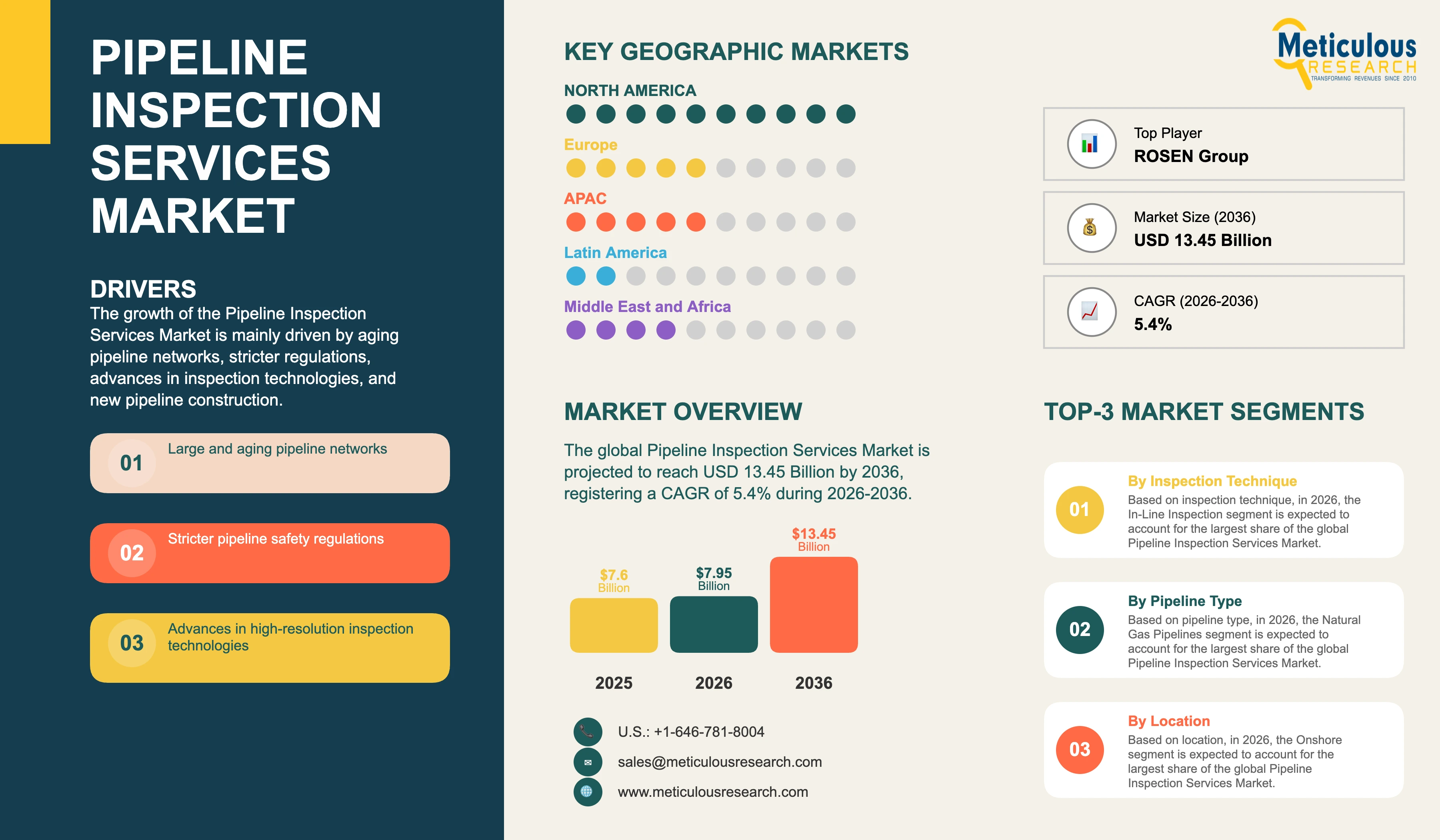
The global pipeline inspection services market was valued at USD 7.60 billion in 2025. This market is expected to reach USD 13.45 billion by 2036 from an estimated USD 7.95 billion in 2026, registering a CAGR of 5.4% during the forecast period (2026-2036).
- Published
- Nov 2026
- Pages
- 256
- Format
- PDF + Excel
- Report ID
- MREP - 1042722
- Base year
- 2025
- 2025 · BASELINE
- $7.60B
- 2036
- $13.45B
- CAGR 2026–2036
- 5.4%
2025 baseline · 2026–2036 forecast at 5.4% CAGR · hover a bar for the value
Key highlights
The U.S. onshore energy pipeline network includes about 3.3 million miles of pipeline, including about 300,000 miles of natural gas transmission pipelines, 380,000 miles of gas gathering lines, about 230,000 miles of hazardous liquid pipelines, and about 2.4 million miles of gas distribution mains and service lines, all of which are subject to federal or state pipeline safety regulations.
The U.S. Pipeline and Hazardous Materials Safety Administration's gas transmission Mega Rule, finalized in three parts between 2019 and 2022, requires operators to reconfirm the maximum allowable operating pressure of certain older pipelines and extends integrity assessment requirements to pipelines outside high consequence areas.
In January 2026, the Pipeline and Hazardous Materials Safety Administration published a final rule that allows gas transmission operators to manage certain class location changes through an integrity management alternative, which requires that eligible segments be capable of assessment with in-line inspection tools and includes recurring leak surveys and close-interval surveys.
NDT Global, a leading provider of ultrasonic and acoustic resonance in-line inspection, acquired Entegra, a U.S.-based specialist in ultra-high-resolution magnetic flux leakage in-line inspection, in July 2025 to expand its presence in the gas pipeline inspection market.
MISTRAS Group, a provider of nondestructive testing and pipeline inspection services, reported 2025 revenue of USD 724.0 million, with oil and gas remaining its largest end market, although oil and gas revenue declined 5.4% because of project timing.
The Pipeline and Hazardous Materials Safety Administration requires devices on in-line inspection launchers and receivers that can safely relieve pressure before tools are inserted or removed, and it requires operators to carry out integrity assessments on certain pipelines outside high consequence areas, which previously were required only in these areas.
Natural gas pipelines in the U.S. are aging, with a large share of gas transmission lines built before 1970, which increases the need for frequent integrity assessments, material verification, and maximum allowable operating pressure reconfirmation.
By inspection technique, in-line inspection accounts for the largest share of 38.0% in 2026, while leak detection and patrol surveys register the highest CAGR.
By pipeline type, natural gas pipelines account for the largest share of 54.0% in 2026, while carbon dioxide, hydrogen, and other pipelines register the highest CAGR.
By location, onshore accounts for the larger share in 2026, while offshore registers the higher CAGR.
By geography, North America accounts for the largest share of 40.0% in 2026, while Asia-Pacific registers the highest CAGR of 6.6%.
Report summary
| Particulars | Details |
|---|---|
| Base Year | 2025 |
| Estimated Year | 2026 |
| Forecast Period | 2026-2036 |
| Market Size in 2025 | USD 7.60 billion |
| Market Size in 2026 | USD 7.95 billion |
| Market Size by 2036 | USD 13.45 billion |
| CAGR (2026-2036) | 5.4% |
| Format | PDF, Excel & Cloud Portal · 256 pages |
| Largest Segment by Inspection Technique (2026) | In-Line Inspection (38.0%) |
| Largest Segment by Pipeline Type (2026) | Natural Gas Pipelines (54.0%) |
| Largest Region (2026) | North America (40.0%) |
| Fastest-Growing Region | Asia-Pacific (CAGR 6.6%) |
| Companies Profiled | 12 companies and other companies |
| Segments Covered | Inspection Technique, Pipeline Type, Location, Geography |
| Countries Covered | U.S., Canada, China, India, Australia, Malaysia, Indonesia, Rest of Asia-Pacific, Germany, U.K., Netherlands, Italy, Norway, Rest of Europe, Saudi Arabia, UAE, Qatar, Nigeria, Rest of Middle East & Africa, Brazil, Mexico, Argentina, Rest of Latin America |
Report overview
Segments covered: inspection technique, pipeline type, location.
The growth of this market is mainly driven by the large and aging global network of oil, gas, and refined products pipelines, stricter pipeline safety regulations, especially the expansion of integrity assessment requirements for gas transmission pipelines in the U.S., the growing use of high-resolution in-line inspection technologies, rising investment in new gas, LNG feed, and liquids pipelines in Asia-Pacific and the Middle East, the conversion and construction of pipelines for hydrogen and carbon dioxide, and the adoption of drones, satellites, and data analytics for leak detection and integrity management. However, factors such as the large share of pipelines that cannot be inspected with conventional in-line inspection tools, the high cost of inspection and pipeline modifications, the shortage of qualified inspection personnel, and the sensitivity of operator budgets to oil and gas prices are expected to restrain the growth of this market to some extent.
Pipeline inspection services are used to assess the condition of oil, gas, and other pipelines, detect defects such as corrosion, cracks, dents, and metal loss, identify leaks, and provide the data that operators need to manage pipeline integrity and comply with safety regulations. These services are an essential part of pipeline integrity management programs, which aim to prevent failures that could cause injuries, environmental damage, and supply disruptions. Inspection is required throughout the life of a pipeline, from baseline inspections after construction to periodic reassessments during operation and inspections before repurposing or abandonment.
This report covers global revenue from pipeline inspection services, including in-line inspection using intelligent pigs, external nondestructive testing such as ultrasonic, radiographic, and guided wave testing, leak detection and patrol surveys using ground, aerial, drone, and satellite methods, direct assessment and pressure testing, and integrity data analysis and engineering services. It covers natural gas, crude oil, refined products and natural gas liquids, and carbon dioxide, hydrogen, and other pipelines, both onshore and offshore. The sale of inspection tools and equipment to operators, utility pigging services such as cleaning and gauging, pipeline repair and rehabilitation, cathodic protection system installation and monitoring, and the inspection of in-plant piping at refineries and petrochemical plants are excluded from the scope of this report.
In-line inspection is the largest pipeline inspection technique by revenue in most regions of the world. In-line inspection tools, also known as intelligent or smart pigs, travel inside the pipeline with the product flow and use technologies such as magnetic flux leakage, ultrasonic testing, electromagnetic acoustic transducers, and geometry and mapping sensors to detect and size defects along the entire length of the pipeline. High-resolution tools can detect very small defects and provide detailed data that operators use to plan repairs and calculate safe operating pressures. In-line inspection is preferred by regulators and operators because it provides comprehensive coverage of the pipeline, but it requires pipelines to be piggable, with suitable launchers, receivers, bends, and valves.
For pipelines that cannot be inspected with conventional in-line inspection tools, operators use direct assessment methods, such as external corrosion direct assessment, which combines indirect surveys with excavations and direct examination, as well as pressure testing and specialized tools such as tethered and self-propelled in-line inspection robots. External nondestructive testing is used at excavation sites, above-ground sections, road and river crossings, and facilities. Leak detection and patrol surveys are used to identify leaks and threats such as unauthorized excavation along the right-of-way, and they are increasingly carried out using drones, aircraft with gas imaging sensors, and satellites.
Regulation is the main driver of pipeline inspection demand in the U.S., Canada, Europe, and many other countries. In the U.S., the Pipeline and Hazardous Materials Safety Administration requires operators of gas transmission and hazardous liquid pipelines to carry out integrity assessments, with reassessment intervals of up to seven years for gas transmission pipelines in high consequence areas, and the Mega Rule has extended assessment requirements to many pipelines outside these areas. In Canada, Europe, Australia, and other regions, regulators require similar integrity management programs. National oil companies and pipeline operators in the Middle East and Asia also follow international standards and carry out regular inspections of their pipeline networks.
The market includes specialized in-line inspection companies, such as ROSEN, NDT Global, T.D. Williamson, and Baker Hughes, as well as testing, inspection, and certification companies, such as Intertek, Applus+, SGS, Bureau Veritas, and MISTRAS, and specialized providers such as Enduro Pipeline Services and Onstream Pipeline Inspection. In-line inspection is a technology-intensive business with high barriers to entry, while external inspection and surveys are more fragmented, with many regional companies.
Over the forecast period, the market is expected to grow steadily, supported by aging pipelines, stricter regulations, new pipeline construction, and new technologies. In-line inspection is expected to remain the largest technique, while leak detection and patrol surveys grow fastest. Natural gas pipelines are expected to remain the largest pipeline type, while carbon dioxide, hydrogen, and other pipelines grow fastest. North America is expected to remain the largest region, while Asia-Pacific is expected to grow fastest.
Market growth is mainly driven by large and aging pipeline networks, stricter pipeline safety regulations, advances in high-resolution inspection technologies, and new pipeline construction, including hydrogen and carbon dioxide pipelines.
Unpiggable pipelines, high inspection costs, and budget sensitivity restrain growth, while personnel shortages and data quality and liability issues are key challenges.
Key opportunities include drones, satellites, and remote leak detection, inspection of unpiggable pipelines, hydrogen and carbon dioxide pipelines, and integrity data analytics and digital twins.
In-line inspection is expected to account for the largest share of 38.0% of the market in 2026, while leak detection and patrol surveys are projected to register the highest CAGR.
Carbon dioxide, hydrogen, and other pipelines are projected to register the highest CAGR, while natural gas pipelines account for the largest share of 54.0%.
North America is expected to account for the largest share of 40.0% of the market in 2026, mainly due to the very large U.S. and Canadian pipeline networks and strict regulations.
Asia-Pacific is projected to register the highest CAGR of 6.6% during the forecast period, driven by pipeline expansion in China, India, and Southeast Asia.
The U.S. onshore energy pipeline network includes about 3.3 million miles of pipeline, including about 300,000 miles of gas transmission, 380,000 miles of gas gathering, 230,000 miles of hazardous liquid pipelines, and 2.4 million miles of gas distribution mains and service lines.
The report profiles 12 companies, including ROSEN Group, NDT Global, T.D. Williamson, Inc., Baker Hughes Company, Intertek Group plc, Applus Services, S.A., SGS SA, Bureau Veritas SA, MISTRAS Group, Inc., Enduro Pipeline Services, Inc., Onstream Pipeline Inspection Services Inc., and TÜV Rheinland AG.
Report infographic
Market dynamics
16 factors across 5 forcesLarge and aging pipeline networks
The world's oil, gas, and refined products pipeline networks are very large, and many of their pipelines are aging. In the U.S. alone, there are about 3.3 million miles of onshore energy pipelines, including about 300,000 miles of gas transmission pipelines, a large share of which were built before 1970. Many pipelines in Europe, Russia, the Middle East, and Latin America were also built several decades ago. As pipelines age, they become more vulnerable to corrosion, cracking, and other threats, which increases the frequency and complexity of inspections required to keep them safe.
Older pipelines also often lack complete construction and material records, which requires additional inspection, testing, and material verification to confirm their safe operating pressures. This creates demand for high-resolution in-line inspection, material property tools, and engineering assessments. Operators are increasingly using inspection data to extend the life of existing pipelines rather than replacing them, which further increases the value of inspection. Inspection also supports decisions on pipeline uprating, repurposing, and abandonment. Pipeline failures can cause fatalities, environmental damage, and large financial losses, as shown by high-profile incidents in several countries, which reinforces the importance of regular inspection. In many developing countries, pipelines have been operated for decades with limited inspection, and operators are now introducing integrity management programs, which creates new demand for baseline inspections and engineering assessments.
Stricter pipeline safety regulations
Pipeline safety regulations have become significantly stricter in the U.S. and many other countries over the past decade. In the U.S., the Mega Rule requires operators to reconfirm the maximum allowable operating pressure of certain gas transmission pipelines that lack adequate records, extends integrity assessments to pipelines outside high consequence areas, and requires inspection after extreme weather events. The rule also requires safety devices on in-line inspection launchers and receivers. These requirements have significantly increased the number of miles that operators must inspect and the amount of engineering analysis they must perform.
In January 2026, the Pipeline and Hazardous Materials Safety Administration published a final rule that allows operators to manage certain class location changes through an integrity management alternative rather than reducing pressure or replacing pipe. To use this alternative, segments must be capable of assessment with in-line inspection tools, and operators must carry out baseline assessments and recurring surveys, which is expected to increase demand for inspection services. Regulators in Canada, Europe, and other regions have also strengthened integrity management requirements.
Advances in high-resolution inspection technologies
In-line inspection technologies have advanced significantly, with ultra-high-resolution magnetic flux leakage, phased array ultrasonic, electromagnetic acoustic transducer, and multi-technology tools that can detect and size smaller defects, cracks, and dents more accurately. These technologies allow operators to identify threats earlier and to avoid unnecessary excavations, which reduces costs and improves safety. NDT Global's acquisition of Entegra in 2025 combined ultrasonic, acoustic resonance, and ultra-high-resolution magnetic flux leakage technologies to offer a broader portfolio.
New tools are also making it possible to inspect pipelines that were previously considered unpiggable, such as pipelines with tight bends, multiple diameters, or low flow. Tethered tools, self-propelled robots, and free-swimming tools for low-pressure pipelines are expanding the share of pipelines that can be inspected with in-line methods.
Advances in data analytics, machine learning, and integrity software are also helping operators combine inspection data from multiple runs and sources to predict defect growth and optimize reassessment intervals. These tools help operators prioritize repairs and reduce unnecessary excavations. They also support regulatory reporting. Operators can share results with regulators more easily.
New pipeline construction and energy transition pipelines
New oil, gas, and refined products pipelines are being built in Asia-Pacific, the Middle East, Africa, and North America to support rising energy demand, LNG export projects, and new production. Each new pipeline requires baseline inspection after construction and periodic inspections throughout its life. In addition, pipelines are being built or converted to carry carbon dioxide for carbon capture and storage and hydrogen, which require inspection to confirm their suitability and to manage new integrity threats such as hydrogen embrittlement. The U.S. already operates about 1,600 miles of dedicated hydrogen pipelines, and carbon dioxide pipeline networks are expanding in North America and Europe. These pipelines are expected to be the fastest-growing pipeline type for inspection services over the forecast period.
Table of contents
11 chapters · 130 sections · 256 pages · click to expandSegmental analysis
| Segment | Largest share (2026) | Fastest growth (2026–2036) |
|---|---|---|
| By Inspection Technique | In-line inspection | Leak detection and patrol surveys |
By Inspection Technique
- The onshore segment is expected to account for the larger share of the pipeline inspection services market, while the offshore segment is projected to register the higher CAGR during the forecast period.
Geographic analysis
North America
Largest shareIn 2026, North America is expected to account for the largest share of 40.0% of the global pipeline inspection services market. The large share of this region is mainly due to the very large pipeline network in the U.S. and Canada, the strict integrity management requirements of the Pipeline and Hazardous Materials Safety Administration and the Canada Energy Regulator, including the Mega Rule, and the presence of leading inspection companies. Within North America, the U.S. is the largest country market, supported by the Mega Rule, hazardous liquid integrity management rules, and the very large length of gas transmission, gathering, and hazardous liquid pipelines. Texas alone has more than 400,000 miles of intrastate pipelines regulated by the Railroad Commission of Texas. Canada is supported by the Canada Energy Regulator's integrity management requirements for federally regulated pipelines and by large oil and gas pipeline networks in Alberta and British Columbia. Mexico's aging pipeline network also requires increasing inspection. The U.S. Mega Rule requires operators to reconfirm the maximum allowable operating pressure of certain gas transmission pipelines and extends integrity assessments outside high consequence areas, while a January 2026 rule allows an integrity management alternative for class location changes that requires in-line inspection capability.
Asia-Pacific
Asia-Pacific is the second-largest market and is projected to register the highest CAGR of 6.6% during the forecast period. The rapid growth of this region is mainly due to the rapid expansion of gas transmission and distribution networks in China and India, new pipelines in Southeast Asia and Australia, and the growing adoption of integrity management practices by national oil companies and pipeline operators. In Asia-Pacific, China has been expanding its national gas pipeline network rapidly, and India is building gas transmission pipelines to support its goal of increasing the share of natural gas in its energy mix. Australia has a large network of gas transmission pipelines and strict integrity requirements. Malaysia and Indonesia are also expanding their gas networks.
Europe
Europe is the third-largest market, supported by aging pipeline networks, the European Union's methane regulation, and hydrogen and carbon dioxide pipeline projects.
Middle East & Africa
The Middle East & Africa is supported by large pipeline networks operated by national oil companies, and Latin America is supported by Brazil, Mexico, and Argentina. In the Middle East, Saudi Aramco, ADNOC, and other national oil companies operate large pipeline networks and carry out regular in-line inspection programs.
Latin America
Latin America is a smaller market, supported by pipeline networks in Brazil, Mexico, Argentina, and Colombia, where national oil companies and private operators are increasing investment in integrity management. Brazil's growing gas pipeline network and Argentina's new pipelines from the Vaca Muerta shale region are expected to support demand.
Competitive landscape
The global pipeline inspection services market is moderately fragmented, with the top five players estimated to account for about 35% of the market in 2025. In-line inspection is concentrated among a small number of specialized technology companies, while external inspection and surveys are more fragmented.
ROSEN, NDT Global, T.D. Williamson, and Baker Hughes are leading in-line inspection providers with proprietary tools and data analysis capabilities. NDT Global expanded its gas pipeline capabilities through the acquisition of Entegra, and Baker Hughes offers in-line inspection and integrity services through its pipeline services business. Enduro Pipeline Services and Onstream Pipeline Inspection are specialized in-line inspection providers. Intertek, Applus+, SGS, Bureau Veritas, and MISTRAS provide external nondestructive testing, integrity engineering, and other inspection services, with MISTRAS reporting 2025 revenue of USD 724.0 million across its industries. Companies compete on technology, data accuracy, reliability, safety, geographic coverage, and price. Key strategies include acquisitions, development of new tools for unpiggable pipelines and new pipeline types, integration of data analytics and integrity management, and long-term service agreements with operators.
In-line inspection companies typically develop and manufacture their own tools and offer inspection as a service, which gives them control over technology and data quality. Barriers to entry are high because of the cost of developing and maintaining tool fleets for many pipeline diameters, the need for proven data accuracy, and the long-term relationships required with operators. In contrast, external inspection and leak survey services have lower barriers to entry, and many regional companies compete in these segments. Recent developments include NDT Global's acquisition of Entegra, the growth of drone and satellite leak detection services, and the expansion of inspection companies into integrity management software and engineering. We expect consolidation to continue as companies seek scale and broader technology portfolios.
Testing, inspection, and certification companies such as Intertek, Applus+, SGS, and Bureau Veritas benefit from global networks and broad service portfolios across many industries, while specialized in-line inspection companies benefit from proprietary technology and deep pipeline expertise. Regional specialists compete strongly on price and response time in local markets, particularly for leak surveys and excavation inspection work.
Some of the key players operating in the pipeline inspection services market are ROSEN Group, NDT Global, T.D. Williamson, Inc., Baker Hughes Company, Intertek Group plc, Applus Services, S.A., SGS SA, Bureau Veritas SA, MISTRAS Group, Inc., Enduro Pipeline Services, Inc., Onstream Pipeline Inspection Services Inc., and TÜV Rheinland AG, among others.
- —
NDT Global acquired Entegra to expand its ultra-high-resolution magnetic flux leakage capabilities, and the Pipeline and Hazardous Materials Safety Administration published a new rule on class location changes that requires in-line inspection capability.
- ROSEN Group
- NDT Global
- T.D. Williamson, Inc.
- Baker Hughes Company
- Intertek Group plc
- Applus Services, S.A.
- SGS SA
- Bureau Veritas SA
- MISTRAS Group, Inc.
- Enduro Pipeline Services, Inc.
- Onstream Pipeline Inspection Services Inc.
- TÜV Rheinland AG
Expert perspectives
The pipeline inspection services market is supported by long-term structural drivers, including aging pipelines, stricter regulations, and new technologies. We expect steady growth over the forecast period, with regulation remaining the main driver of demand in mature markets and new pipeline construction driving growth in emerging markets.
Over the forecast period, the market is expected to grow at a CAGR of 5.4%, from USD 7.95 billion in 2026 to USD 13.45 billion in 2036. Growth will be supported by aging networks, regulations, technology advances, and new pipelines, while unpiggable pipelines, high costs, and personnel shortages will moderate growth.
In terms of segments, in-line inspection remains the largest technique, while leak detection and patrol surveys grow fastest. Natural gas pipelines remain the largest pipeline type, while carbon dioxide, hydrogen, and other pipelines grow fastest. Onshore remains the largest location, while offshore grows fastest. North America remains the largest region, while Asia-Pacific grows fastest at a CAGR of 6.6%.
For inspection companies, the key priorities are to invest in new tools and data analytics, expand into unpiggable pipelines and energy transition pipelines, and address personnel shortages through automation and training. We believe that integrated providers combining inspection, data analytics, and integrity engineering will gain market share.
We expect the U.S. market to remain strong as operators continue to comply with the Mega Rule and the new class location rule, while methane regulations drive growth in leak detection services in the U.S., Canada, and Europe. In Asia-Pacific and the Middle East, the expansion of pipeline networks and the adoption of integrity management practices are expected to drive faster growth. Our forecast assumes that regulatory requirements remain broadly stable or become stricter and that pipeline operators maintain integrity budgets even during periods of low oil and gas prices. A relaxation of regulations or a prolonged period of low prices could slow growth, while faster growth in hydrogen and carbon dioxide pipelines could add upside. In our view, the market will increasingly reward providers that can inspect a wider share of pipelines, including unpiggable and new pipeline types, and that can turn inspection data into actionable integrity decisions for operators.
We also expect pricing for in-line inspection to remain stable or rise modestly as demand grows and tool capacity remains limited for some diameters and technologies. Providers that invest in larger tool fleets will be best positioned to meet rising demand. Labor availability will also shape growth, as the industry must train more technicians and analysts to keep pace with rising inspection volumes.
Customer perspectives
Buyers of pipeline inspection services include pipeline operators, gas utilities, oil and gas producers, national oil companies, and midstream companies. Their decisions depend mainly on data accuracy, tool capability, regulatory compliance, reliability, and cost.
Integrity Manager - Gas transmission operator, U.S.
The Mega Rule has significantly increased the number of miles we must assess and the records we must verify, so we rely on high-resolution in-line inspection and material property tools.
This comment explains why North America is the largest region and why in-line inspection is the largest technique.
This comment explains why leak detection and patrol surveys are growing fastest.
This comment explains why Asia-Pacific is the fastest-growing region.
Across all customer groups, data accuracy and regulatory compliance are the most important selection criteria, as inspection results directly affect safety, repair budgets, and regulatory audits. Operators increasingly prefer long-term relationships with inspection providers that can support their full integrity management programs, from inspection to data analysis and engineering. National oil companies also value local presence and the ability to transfer knowledge to their own staff, which favors providers with regional operations and training programs. Operators facing immediate repair conditions need inspection partners that can mobilize crews and deliver results quickly.
“We are using drones and aircraft with gas imaging sensors to meet methane leak detection requirements across our network.”
“Our new gas pipelines require baseline inspections and long-term integrity programs, and we are adopting international best practices.”
Frequently asked questions
The global pipeline inspection services market was valued at USD 7.60 billion in 2025, up from USD 7.30 billion in 2024, and is estimated at USD 7.95 billion in 2026. The market includes in-line inspection, external nondestructive testing, leak detection and patrol surveys, direct assessment and pressure testing, and integrity data analysis and engineering.
The global pipeline inspection services market is expected to reach USD 13.45 billion by 2036, supported by aging pipelines, stricter regulations, new technologies, and new pipeline construction.
The market is expected to register a CAGR of 5.4% from 2026 to 2036, with the fastest growth in leak detection and patrol surveys, carbon dioxide, hydrogen, and other pipelines, offshore, and Asia-Pacific.
The U.S. Mega Rule requires operators to reconfirm the maximum allowable operating pressure of certain gas transmission pipelines and extends integrity assessments outside high consequence areas, while a January 2026 rule allows an integrity management alternative for class location changes that requires in-line inspection capability.
Market growth is mainly driven by large and aging pipeline networks, stricter pipeline safety regulations, advances in high-resolution inspection technologies, and new pipeline construction, including hydrogen and carbon dioxide pipelines.
Unpiggable pipelines, high inspection costs, and budget sensitivity restrain growth, while personnel shortages and data quality and liability issues are key challenges.
Key opportunities include drones, satellites, and remote leak detection, inspection of unpiggable pipelines, hydrogen and carbon dioxide pipelines, and integrity data analytics and digital twins.
In-line inspection is expected to account for the largest share of 38.0% of the market in 2026, while leak detection and patrol surveys are projected to register the highest CAGR.
Carbon dioxide, hydrogen, and other pipelines are projected to register the highest CAGR, while natural gas pipelines account for the largest share of 54.0%.
North America is expected to account for the largest share of 40.0% of the market in 2026, mainly due to the very large U.S. and Canadian pipeline networks and strict regulations.
Asia-Pacific is projected to register the highest CAGR of 6.6% during the forecast period, driven by pipeline expansion in China, India, and Southeast Asia.
The U.S. onshore energy pipeline network includes about 3.3 million miles of pipeline, including about 300,000 miles of gas transmission, 380,000 miles of gas gathering, 230,000 miles of hazardous liquid pipelines, and 2.4 million miles of gas distribution mains and service lines.
The report profiles 12 companies, including ROSEN Group, NDT Global, T.D. Williamson, Inc., Baker Hughes Company, Intertek Group plc, Applus Services, S.A., SGS SA, Bureau Veritas SA, MISTRAS Group, Inc., Enduro Pipeline Services, Inc., Onstream Pipeline Inspection Services Inc., and TÜV Rheinland AG.
NDT Global acquired Entegra to expand its ultra-high-resolution magnetic flux leakage capabilities, and the Pipeline and Hazardous Materials Safety Administration published a new rule on class location changes that requires in-line inspection capability.
In 2026, the onshore segment is expected to account for the larger share of the pipeline inspection services market, while the offshore segment is projected to register the higher CAGR during the forecast period.
Cite this report
Meticulous Research. (2026). Pipeline Inspection Services Market - Global Opportunity Analysis and Industry Forecast (2026-2036) (Report No. MREP - 1042722). Meticulous Market Research Pvt. Ltd. https://www.meticulousresearch.com/product/pipeline-inspection-services-market-7405