Hydrogen Pipelines Market (2026-2036)
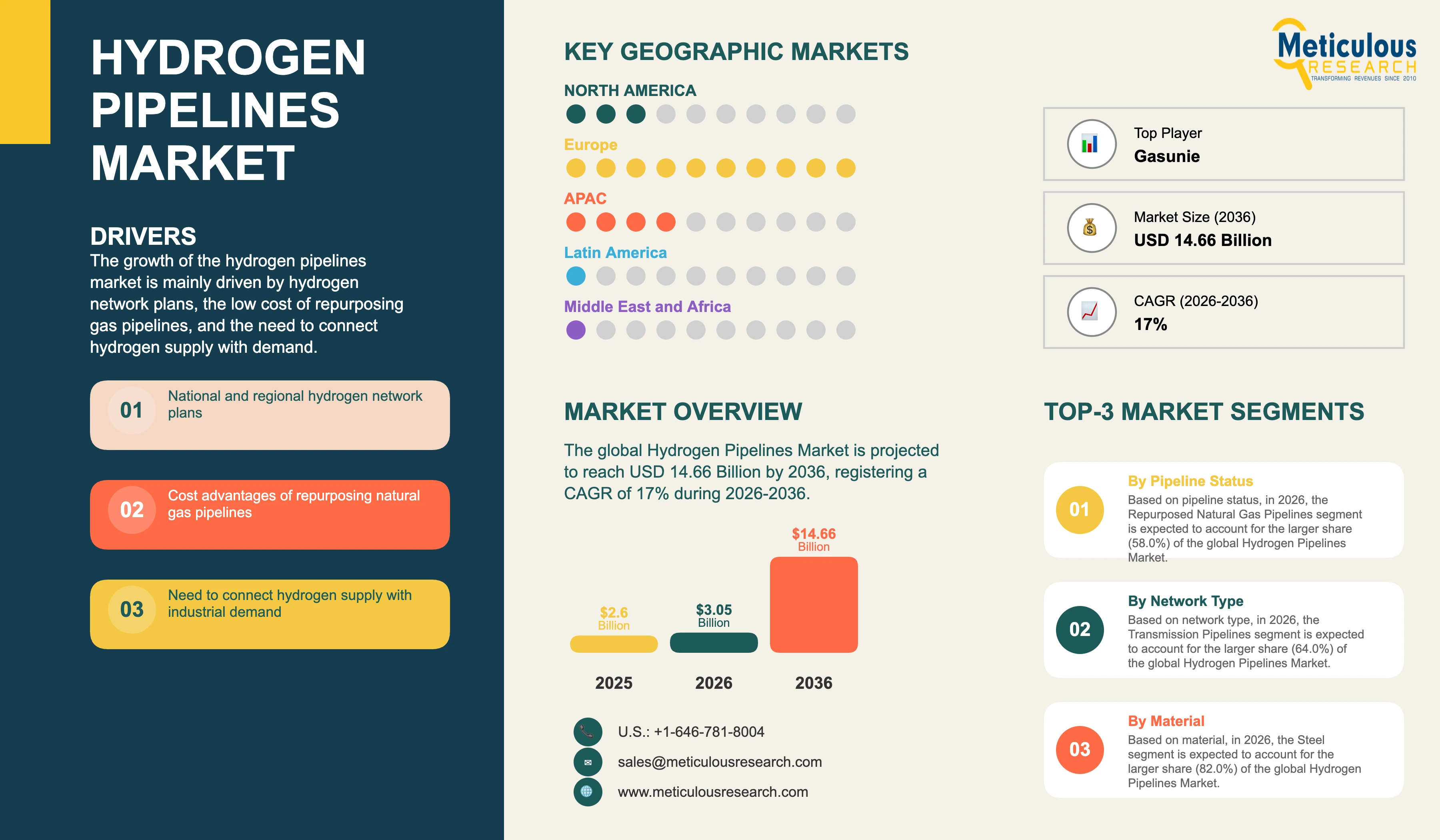
The global hydrogen pipelines market was valued at USD 2.60 billion in 2025. This market is expected to reach USD 14.66 billion by 2036 from an estimated USD 3.05 billion in 2026, registering a CAGR of 17.0% during the forecast period (2026-2036).
- Published
- Nov 2026
- Pages
- 275
- Format
- PDF + Excel
- Report ID
- MREP - 1042577
- Base year
- 2025
- 2025 · BASELINE
- $2.60B
- 2036
- $14.66B
- CAGR 2026–2036
- 17.0%
2025 baseline · 2026–2036 forecast at 17.0% CAGR · hover a bar for the value
Key highlights
Germany's Federal Network Agency approved a 9, 040-kilometre national hydrogen core network on October 22, 2024, with expected investment costs of about EUR 18.9 billion and completion planned by 2032, and the German transmission system operators' association FNB Gas reported in October 2026 that about 537 kilometres of hydrogen pipelines were in operation, with a further roughly 900 kilometres due by the end of 2027.
Companies were able to reserve transport capacities in the German hydrogen core network for the first time on March 19, 2026, and in August 2026 RWE announced that renewable hydrogen produced at Lingen had reached the Marl Chemical Park through the network, one of the first deliveries of renewable hydrogen to an industrial customer through Germany's new hydrogen pipelines.
China's oil and gas development plan for 2026-2030, released in August 2026, calls for a 1,200-kilometre hydrogen pipeline connecting Ulanqab in Inner Mongolia with the Beijing-Tianjin-Hebei region, with a transport capacity of 500,000 tonnes per year, and Sinopec's Inner Mongolia section of the Ulanqab hydrogen pipeline was approved in June 2025 with construction scheduled from November 2025 to December 2027.
Gascade put about 400 kilometres of converted natural gas pipelines into hydrogen service in December 2025 as part of its Flow project, Gasunie has converted more than 170 kilometres of pipeline for its Hyperlink project to connect the German core network with the Dutch hydrogen network, and Hy24 acquired Uniper's 20% stake in the 470-kilometre OPAL pipeline, which is being converted for hydrogen, in September 2026.
The European Network of Transmission System Operators for Gas (ENTSOG) reduced its 2030 hydrogen demand assumption from 620 TWh to 335 TWh in its October 2026 draft assessment, and Germany's Federal Ministry for Economic Affairs and Energy presented a 10-point plan on October 19, 2026 to advance the country's slow-moving hydrogen market, showing that demand growth remains the key uncertainty for pipeline investment.
By pipeline status, repurposed natural gas pipelines account for the larger share of 58.0% in 2026, while new-build hydrogen pipelines register the higher CAGR.
By network type, transmission pipelines account for the larger share in 2026 and also register the higher CAGR.
By material, steel accounts for the larger share in 2026, while composite and plastic registers the higher CAGR.
By end use, refining and chemicals account for the largest share of 44.0% in 2026, while steel and heavy industry registers the highest CAGR.
By geography, Europe accounts for the largest share of 52.0% in 2026, while Asia-Pacific registers the highest CAGR of 21.2%.
Report summary
| Particulars | Details |
|---|---|
| Base Year | 2025 |
| Estimated Year | 2026 |
| Forecast Period | 2026-2036 |
| Market Size in 2025 | USD 2.60 billion |
| Market Size in 2026 | USD 3.05 billion |
| Market Size by 2036 | USD 14.66 billion |
| CAGR (2026-2036) | 17.0% |
| Format | PDF, Excel & Cloud Portal · 275 pages |
| Largest Segment by Pipeline Status (2026) | Repurposed Natural Gas Pipelines (58.0%) |
| Largest Segment by End Use (2026) | Refining and Chemicals (44.0%) |
| Largest Region (2026) | Europe (52.0%) |
| Fastest-Growing Region | Asia-Pacific (CAGR 21.2%) |
| Companies Profiled | 16 companies and other companies |
| Segments Covered | Pipeline Status, Network Type, Material, End Use, Geography |
| Countries Covered | Germany, Netherlands, Belgium, Denmark, France, Spain, Italy, Austria, U.K., Sweden, Poland, Rest of Europe, China, Japan, South Korea, India, Australia, Rest of Asia-Pacific, U.S., Canada, Saudi Arabia, U.A.E., Oman, Egypt, Morocco, Rest of Middle East & Africa, Chile, Brazil, Mexico, Rest of Latin America |
Report overview
Segments covered: pipeline status, network type, material, end use.
The growth of this market is mainly driven by national and regional plans to build hydrogen transmission networks, such as Germany's hydrogen core network and the European Hydrogen Backbone, the low cost of repurposing existing natural gas pipelines for hydrogen, the need to connect large-scale low-carbon hydrogen production with industrial demand centers, ports, and storage sites, decarbonization targets for refining, chemicals, steel, and other heavy industries, and China's plans for long-distance pure hydrogen pipelines. However, factors such as uncertain hydrogen demand and slow offtake commitments, high capital costs of new pipelines, technical challenges related to hydrogen embrittlement and pipeline integrity, and regulatory and financing uncertainties are expected to restrain the growth of this market to some extent.
Hydrogen pipelines are pipelines used to transport gaseous hydrogen from production sites, import terminals, and storage facilities to industrial users, power plants, refueling stations, and other consumers. They include long-distance transmission pipelines operated at high pressure, regional distribution and industrial cluster pipelines, and connections to underground storage and ports. Hydrogen pipelines can be newly built or converted from existing natural gas pipelines, and they are made mainly from steel, with composite and plastic pipes used in some lower-pressure and distribution applications. This report covers spending on the planning, engineering, construction, and conversion of hydrogen pipelines, including line pipe, compressors, valves, metering, monitoring, and installation services. The transport of hydrogen by truck, ship, or other means, hydrogen blending in natural gas distribution networks without dedicated hydrogen pipelines, and the operation of hydrogen networks are analyzed in separate reports. The market is measured on a revenue basis.
Pipelines have been used to transport hydrogen for decades, mainly by industrial gas companies such as Air Products, Air Liquide, and Linde, which operate private pipeline networks to supply refineries and chemical plants in industrial clusters along the U.S. Gulf Coast, in Belgium, the Netherlands, France, and Germany, and in other regions. The Congressional Research Service has reported that the U.S. had about 1,600 miles of hydrogen pipelines, located mainly along the Gulf Coast. These networks transport hydrogen produced from natural gas and serve a relatively small number of large industrial customers.
The energy transition is fundamentally changing the role and scale of hydrogen pipelines worldwide. Governments in Europe, Asia, and other regions plan to use low-carbon hydrogen to decarbonize refining, chemicals, steel, and other industries, power generation, and heavy transport, and they recognize that large volumes of hydrogen will need to be transported from regions with low-cost renewable energy or carbon storage to demand centers. Pipelines are the lowest-cost option for transporting large volumes of hydrogen over land, and converting existing natural gas pipelines can reduce costs significantly compared with building new pipelines.
Europe is leading the development of public hydrogen networks with third-party access. Germany's hydrogen core network, approved in 2024, will cover 9,040 kilometres by 2032, with much of the network based on converted natural gas pipelines, and it is intended to form part of the European Hydrogen Backbone, a planned pan-European network developed by gas transmission system operators. The Netherlands is building a national hydrogen network operated by Gasunie, and projects such as H2Med, which would connect the Iberian Peninsula with France and Germany, and corridors connecting the Nordic and Baltic countries with Germany are under development. The EU's hydrogen and decarbonized gas market package establishes rules for hydrogen network operation and regulation.
China is also planning long-distance hydrogen pipelines to transport renewable hydrogen from its northern and western regions, where wind and solar resources are abundant, to industrial centers in the east. Sinopec's pipeline from Ulanqab in Inner Mongolia to the Beijing-Tianjin-Hebei region is China's first cross-provincial long-distance hydrogen pipeline, and China's oil and gas development plan for 2026-2030 identifies a 1,200-kilometre pipeline with a capacity of 500,000 tonnes per year as a priority project.
Repurposed natural gas pipelines account for the larger share of the market by pipeline status, since conversion is the main approach used in Germany and the Netherlands, while new-build hydrogen pipelines are the faster-growing segment, supported by new corridors, Chinese projects, and connections to industrial sites. Transmission pipelines account for the larger share by network type, and refining and chemicals is the largest end use, reflecting existing industrial hydrogen demand. Europe is the largest regional market, while Asia-Pacific is the fastest-growing region.
The market faces significant uncertainty about the timing and scale of hydrogen demand growth. Hydrogen demand has grown more slowly than many governments expected, and ENTSOG reduced its 2030 hydrogen demand assumption for Europe from 620 TWh to 335 TWh in its October 2026 draft assessment. Some completed pipeline sections have few connected suppliers and customers, and investment decisions for hydrogen production and industrial use have been delayed in many cases. As a result, the pace of pipeline construction will depend on how quickly hydrogen supply and demand projects reach final investment decisions.
Over the forecast period, the hydrogen pipelines market is expected to grow strongly from a small base, supported by network plans in Europe and China, pipeline conversions, industrial decarbonization, and hydrogen import and storage projects. At the same time, demand uncertainty, financing, and technical and regulatory issues will influence the timing and scale of investment.
Converting our existing gas pipelines lets us build the hydrogen network at a fraction of the cost of new lines. The challenge now is to connect enough producers and industrial customers to fill the capacity.
This comment explains why repurposed natural gas pipelines account for 58.0% of the market and why uncertain demand is a key restraint.
Our sites already use large volumes of hydrogen, and a pipeline connection is the only realistic way to replace fossil hydrogen with renewable hydrogen at scale.
This comment explains why refining and chemicals account for 44.0% of the market and why Europe is the largest region.
Our renewable hydrogen is produced in the north, far from the industrial users in the east, so long-distance pure hydrogen pipelines are a priority for us.
This comment explains why new-build hydrogen pipelines are growing faster and why Asia-Pacific is the fastest-growing region. It also highlights the importance of government support in China. State planning gives such projects long-term visibility.
Refining and chemicals is expected to account for the largest share of 44.0% of the market in 2026, while steel and heavy industry is projected to register the highest CAGR.
Europe is expected to account for the largest share of 52.0% of the market in 2026, mainly due to Germany's hydrogen core network, the Dutch national hydrogen network, the European Hydrogen Backbone initiative, and EU support for hydrogen infrastructure.
Asia-Pacific is projected to register the highest CAGR of 21.2% during the forecast period, driven by China's long-distance hydrogen pipeline plans, rapid growth of renewable hydrogen production, and industrial hydrogen network plans in Japan, South Korea, India, and Australia.
The report profiles 16 companies, including Gasunie, Open Grid Europe, Gascade, ONTRAS, Snam, Enagás, Fluxys, NaTran, Sinopec, Air Products, Air Liquide, Linde, Tenaris, Salzgitter, Cenergy Holdings, and SoluForce.
Converting existing natural gas pipelines to hydrogen service can cost significantly less and take less time than building new pipelines, and many European corridors have parallel gas pipelines that can be released for hydrogen while others continue to carry natural gas.
Report infographic
Market dynamics
18 factors across 5 forcesNational and regional hydrogen network plans
Several governments have adopted plans for national and regional hydrogen transmission networks, which provide a strong foundation for pipeline investment. Germany's hydrogen core network, approved in October 2024, covers 9,040 kilometres with expected investment of about EUR 18.9 billion and is financed through a regulated model with an intertemporal cost allocation mechanism and a state-backed amortization account, which reduces risks for network operators. The Netherlands is developing a national hydrogen network through Gasunie with government support, and other European countries, including Denmark, Belgium, France, Spain, Italy, Austria, and the Nordic and Baltic countries, are planning hydrogen networks and cross-border corridors as part of the European Hydrogen Backbone.
The EU supports hydrogen infrastructure through projects of common interest and projects of mutual interest, Important Projects of Common European Interest, and funding programs, and its hydrogen and decarbonized gas market package sets rules for hydrogen network regulation, unbundling, and third-party access. China's 2026-2030 oil and gas development plan includes a 1,200-kilometre hydrogen pipeline as a priority project, which signals strong government support for hydrogen pipelines in China.
These plans give pipeline operators, contractors, and suppliers visibility of future projects and encourage investment in engineering capabilities, materials, and equipment for hydrogen service.
Cost advantages of repurposing natural gas pipelines
Many countries have extensive natural gas transmission networks, and some pipelines are becoming available for other uses as natural gas demand declines or supply routes change. Converting existing natural gas pipelines to hydrogen service can cost significantly less than building new pipelines, since it avoids most of the cost of new pipe, rights of way, and construction, and it can be completed more quickly. Germany's core network is based largely on converted pipelines, and operators such as Gascade, Open Grid Europe, ONTRAS, Thyssengas, and Gasunie have already converted hundreds of kilometres of pipelines, including Gascade's roughly 400-kilometre Flow pipeline, which entered hydrogen service in December 2025.
Conversion requires assessments of pipeline materials and condition, replacement of some components such as valves and compressors, and in some cases modification of operating pressures, which creates demand for engineering, inspection, and equipment.
The availability of parallel pipelines in many European corridors allows operators to convert one line to hydrogen while keeping others in natural gas service, which supports a gradual transition.
Need to connect hydrogen supply with industrial demand
Low-cost renewable and low-carbon hydrogen is often produced far from the industrial sites that use hydrogen, for example in regions with abundant wind and solar resources, near offshore wind farms, at import terminals, or near carbon storage sites. Pipelines are needed to connect these supply sources with refineries, chemical plants, steel mills, and other industrial users, and to connect underground hydrogen storage in salt caverns, which is essential for balancing variable renewable production. RWE's delivery of renewable hydrogen from Lingen to the Marl Chemical Park through the German network in August 2026 shows how pipelines can link production and industrial demand.
Hydrogen import plans, including imports of hydrogen and derivatives through ports in the Netherlands, Germany, and Belgium and pipeline imports from Southern Europe, North Africa, and the Nordic countries, also require pipeline connections to inland demand centers.
Industrial decarbonization targets
Governments and companies have set targets to reduce carbon emissions from heavy industry, including refining, ammonia and chemicals production, steel, and cement. Replacing hydrogen produced from natural gas without carbon capture with renewable or low-carbon hydrogen is a key decarbonization option for refineries and chemical plants, and hydrogen-based direct reduction of iron is a key option for steel production. EU regulations, including renewable fuel of non-biological origin targets for industry and transport, and carbon pricing under the EU Emissions Trading System, create incentives to use low-carbon hydrogen, which in turn requires transport infrastructure.
Steel companies such as thyssenkrupp, Salzgitter, and ArcelorMittal have planned hydrogen-based steelmaking projects in Germany and other countries, although several have delayed or reconsidered these projects due to cost and hydrogen availability, and their eventual demand would require pipeline connections.
Long-distance hydrogen pipelines in China
China is the world's largest producer and consumer of hydrogen, and it is rapidly expanding renewable hydrogen production in Inner Mongolia, Xinjiang, Jilin, and other northern and western regions with abundant renewable resources. Transporting this hydrogen to industrial centers in eastern China requires long-distance pipelines, and Sinopec, China National Petroleum Corporation, and other state-owned companies are developing pure hydrogen pipeline projects. The Ulanqab to Beijing-Tianjin-Hebei pipeline, with a near-term capacity of 100,000 tonnes per year and a long-term capacity of 500,000 tonnes per year, is the most prominent example, and China's new five-year plan supports its development.
China's ability to build large infrastructure projects quickly and its strong government support are expected to make it one of the fastest-growing markets for hydrogen pipelines.
Table of contents
12 chapters · 147 sections · 275 pages · click to expandSegmental analysis
| Segment | Largest share (2026) | Fastest growth (2026–2036) |
|---|---|---|
| By Pipeline Status | — | Rapid growth of this |
| By Network Type | — | Rapid growth of this |
| By Material | — | Rapid growth of this |
| By End Use | Refining and chemicals | Steel and heavy industry |
By Pipeline Status
- Hydrogen Pipelines Market Analysis by Pipeline Status
- The repurposed natural gas pipelines segment is expected to account for the larger share of 58.0% of the global hydrogen pipelines market.
- The large share of this segment is mainly due to the central role of pipeline conversion in Germany's hydrogen core network and the Dutch hydrogen network, the lower cost and shorter construction time of converting existing pipelines compared with building new pipelines, the availability of parallel natural gas pipelines in many European corridors, and recent conversion projects such as Gascade's Flow pipeline, Gasunie's Hyperlink, and the OPAL pipeline.
- Conversion projects involve engineering assessments, inspection, component replacement, and installation of new compressors and metering.
- Conversion is expected to remain the dominant approach in Europe throughout the forecast period, since much of the planned European Hydrogen Backbone is based on existing gas pipelines, and it helps reduce the costs that must be recovered from early hydrogen network users.
- Pipeline operators are also developing standardized methods and tools for assessing the suitability of existing pipelines for hydrogen, which will help accelerate conversion projects as more sections of the network are developed.
- However, the new-build hydrogen pipelines segment is projected to register the higher CAGR during the forecast period.
- The rapid growth of this segment is driven by long-distance pure hydrogen pipelines in China, new pipeline sections in Germany and other European networks where no suitable gas pipelines are available, connections to industrial sites, ports, and storage, cross-border corridors, and offshore pipelines connecting future offshore hydrogen production.
- New pipelines can be designed specifically for hydrogen service, using suitable steels or composite materials and higher operating pressures.
- New-build pipelines are typically more expensive per kilometre than conversions, but they avoid the uncertainties of assessing older pipelines and can be optimized for hydrogen flows.
- Repurposed natural gas pipelines are expected to account for the larger share of 58.0% of the market in 2026, while new-build hydrogen pipelines are projected to register the higher CAGR.
By Network Type
- Hydrogen Pipelines Market Analysis by Network Type
- The transmission pipelines segment is expected to account for the larger share of the global hydrogen pipelines market.
- The large share of this segment is mainly due to the focus of national and regional network plans on high-pressure, long-distance transmission pipelines that connect supply regions, ports, and storage with industrial demand centers, the large investment required for these pipelines, and projects such as Germany's core network, the Dutch national network, and China's Ulanqab pipeline.
- Transmission pipelines form the backbone of hydrogen networks, and their development is the first step toward a hydrogen transport market, which is why they account for most current investment.
- This segment is also projected to register the higher CAGR during the forecast period.
- The rapid growth of this segment is driven by the continued construction of national networks and cross-border corridors in Europe, long-distance pipelines in China, and the connection of large-scale production and storage.
- The distribution and industrial cluster pipelines segment, which includes regional networks within industrial clusters, connections to individual industrial users, and local pipelines supplying refueling stations and urban users, accounts for the remaining share and will grow as transmission networks reach industrial regions.
- Many existing private hydrogen pipelines operated by industrial gas companies in industrial clusters also fall into the distribution and industrial cluster category, and these networks may be expanded or connected to public transmission networks.
- Local distribution pipelines for hydrogen refueling stations and urban users are expected to remain a small part of the market during the forecast period.
- The transmission pipelines segment is expected to account for the larger share of the hydrogen pipelines market, and it is also projected to register the higher CAGR during the forecast period.
By Material
- Hydrogen Pipelines Market Analysis by Material
- The steel segment is expected to account for the larger share of the global hydrogen pipelines market.
- The large share of this segment is mainly due to the use of steel in almost all high-pressure transmission pipelines, including both converted natural gas pipelines and new hydrogen pipelines, the availability of steel line pipe grades qualified for hydrogen service from suppliers such as Tenaris, Salzgitter, and Cenergy Holdings, and the long experience of the industry with steel pipelines.
- Steel suppliers are developing and testing line pipe and welding procedures specifically for hydrogen service to address embrittlement concerns, and certification of steels for hydrogen is becoming an important competitive factor.
- However, the composite and plastic segment is projected to register the higher CAGR during the forecast period.
- The rapid growth of this segment is driven by the resistance of composite and reinforced thermoplastic pipes to hydrogen embrittlement, their fast installation in long continuous lengths, their suitability for distribution, industrial, and lower-pressure applications, and their growing qualification for hydrogen service by suppliers such as SoluForce.
- Composite liners for existing pipelines are also being developed as a conversion option.
- Composite pipes are particularly suited to connecting industrial users and renewable hydrogen production sites over short and medium distances.
- The steel segment is expected to account for the larger share of the hydrogen pipelines market, while the composite and plastic segment is projected to register the higher CAGR during the forecast period.
By End Use
- Hydrogen Pipelines Market Analysis by End Use
- The refining and chemicals segment is expected to account for the largest share of 44.0% of the global hydrogen pipelines market.
- The large share of this segment is mainly due to the large existing hydrogen demand from refineries and ammonia, methanol, and other chemical plants, which are the main customers for current hydrogen pipelines, the use of pipelines in industrial clusters along the U.S. Gulf Coast and in Northwest Europe, and the planned replacement of fossil-based hydrogen in refineries and chemical plants with renewable or low-carbon hydrogen.
- Many of the first customers connected to new hydrogen networks, such as the Marl Chemical Park in Germany and Sinopec's Yanshan petrochemical complex in Beijing, are chemical and refining sites.
- EU targets for renewable hydrogen use in industry and transport fuels support demand from refineries and chemical plants, and these users are likely to remain the largest group of pipeline customers in the near term.
- Industrial gas companies also continue to invest in their own pipeline networks to serve refining and chemical customers, which supports demand in this segment outside public network programs.
- However, the steel and heavy industry segment is projected to register the highest CAGR during the forecast period.
- The rapid growth of this segment is driven by plans for hydrogen-based direct reduction of iron in Germany, Sweden, and other countries, decarbonization targets for heavy industry, and the need for large and reliable hydrogen supplies, which require pipeline connections.
- Power generation forms the third-largest segment, supported by plans for hydrogen-ready gas power plants, while storage, export, and other uses and mobility and refueling account for the remaining share.
Geographic analysis
Europe
Largest shareIn 2026, Europe is expected to account for the largest share of 52.0% of the global hydrogen pipelines market. The large share of this region is mainly due to Germany's 9,040-kilometre hydrogen core network, the Dutch national hydrogen network, the European Hydrogen Backbone initiative, EU support for hydrogen infrastructure through projects of common and mutual interest, and the hydrogen and decarbonized gas market package, which sets rules for hydrogen networks. Germany is the largest market in the region, followed by the Netherlands, Belgium, Denmark, France, Spain, Italy, and Austria. Leading pipeline operators include Gasunie, Open Grid Europe, Gascade, ONTRAS, Thyssengas, Fluxys, Snam, Enagás, and NaTran, formerly GRTgaz. The U.K. is also planning regional hydrogen pipelines to connect industrial clusters such as HyNet in the northwest of England.
Asia-Pacific
Fastest growthAsia-Pacific is projected to register the highest CAGR of 21.2% during the forecast period. The rapid growth of this region is mainly driven by China's plans for long-distance hydrogen pipelines, including the 1,200-kilometre Ulanqab to Beijing-Tianjin-Hebei pipeline identified as a priority project in the 2026-2030 oil and gas development plan, rapid growth of renewable hydrogen production in northern and western China, and hydrogen network plans in industrial clusters in Japan, South Korea, India, and Australia. China is the largest market in the region, followed by Japan, South Korea, India, and Australia. Australia's planned hydrogen hubs and Japan's industrial decarbonization programs could also create demand for regional pipelines.
North America
North America accounts for a significant share of the global market, supported by existing hydrogen pipeline networks along the Gulf Coast in Texas and Louisiana operated by Air Products, Air Liquide, and Linde, which are among the largest in the world, and by potential expansion to serve low-carbon hydrogen and ammonia projects. However, changes in U.S. federal policy have reduced support for some hydrogen projects, which may slow new pipeline investment, while Canada is exploring hydrogen projects in Alberta and the Atlantic provinces. The U.S. is the largest market in the region, followed by Canada.
Latin America
The Middle East & Africa and Latin America account for smaller shares of the market but are expected to grow strongly, supported by large renewable hydrogen and ammonia export projects in Saudi Arabia, the U.A.E., Oman, Egypt, Morocco, and Chile, and plans for pipeline connections between North Africa and Europe, such as the South Hydrogen Corridor and H2Med.
Competitive landscape
The global hydrogen pipelines market is fragmented, with the top five players estimated to account for about 30% of the market in 2025. The market includes gas transmission system operators that develop and operate hydrogen networks, industrial gas companies that operate private hydrogen pipelines, state-owned energy companies, line pipe and composite pipe manufacturers, and engineering, construction, and equipment suppliers.
In Europe, gas transmission system operators such as Gasunie, Open Grid Europe, Gascade, ONTRAS, Fluxys, Snam, Enagás, and NaTran are the main developers of public hydrogen networks, while industrial gas companies Air Products, Air Liquide, and Linde operate the largest private hydrogen pipeline networks in Europe and North America. Sinopec is leading China's long-distance hydrogen pipeline development. Tenaris, Salzgitter, and Cenergy Holdings supply steel line pipe qualified for hydrogen service, and SoluForce supplies reinforced thermoplastic pipes for hydrogen.
Companies in this market compete on technical expertise in hydrogen pipeline design and conversion, materials qualification, regulatory approvals, financing capabilities, project execution, safety, and cost. Key strategies include conversion of existing natural gas pipelines, development of cross-border corridors, partnerships between network operators and hydrogen producers and users, qualification of materials for hydrogen service, and participation in EU funding programs and projects of common interest.
Network operators benefit from existing pipeline assets, rights of way, and regulatory frameworks, which give them a strong position in converting pipelines to hydrogen. Industrial gas companies have long experience in operating hydrogen pipelines and established customer relationships in industrial clusters, while steel and composite pipe manufacturers compete on certified products for hydrogen service. Engineering and inspection companies also play an important role in assessing pipelines for conversion.
We expect partnerships among network operators, hydrogen producers, industrial users, and investors to become more important, as projects require coordinated investment along the value chain. Infrastructure and hydrogen funds, such as Hy24, are also expected to play a growing role in financing pipelines. Chinese state-owned companies are expected to dominate pipeline development in China. International companies may participate mainly as suppliers of equipment and technology. Local content will matter there.
Some of the key players operating in the hydrogen pipelines market are N.V. Nederlandse Gasunie, Open Grid Europe GmbH, GASCADE Gastransport GmbH, ONTRAS Gastransport GmbH, Snam S.p.A., Enagás, S.A., Fluxys Belgium SA, NaTran (formerly GRTgaz), China Petroleum & Chemical Corporation (Sinopec), Air Products and Chemicals, Inc., Air Liquide S.A., Linde plc, Tenaris S.A., Salzgitter AG, Cenergy Holdings SA, and SoluForce B.V., among others.
- —
FNB Gas reported in October 2026 that about 537 kilometres of Germany's hydrogen core network were in operation, capacity bookings opened in March 2026, RWE delivered renewable hydrogen to the Marl Chemical Park through the network in August 2026, and China's 2026-2030 plan prioritized a 1,200-kilometre hydrogen pipeline.
- Gasunie
- Open Grid Europe
- Gascade
- ONTRAS
- Fluxys
- Snam
- Enagás
- NaTran
Expert perspectives
Hydrogen pipelines are a critical enabler of the hydrogen economy, since large-scale use of low-carbon hydrogen in industry and power requires efficient transport from production and import sites to users. The market is at an early stage, with the first sections of public hydrogen networks now operating in Germany and the Netherlands and long-distance pipelines under development in China, but it has strong long-term growth potential from a small base.
Over the forecast period, the market is expected to grow at a CAGR of 17.0%, from USD 3.05 billion in 2026 to USD 14.66 billion in 2036. Growth will be supported by national and regional network plans, pipeline conversions, the need to connect supply with demand, industrial decarbonization, and long-distance pipelines in China.
Among the market segments, repurposed natural gas pipelines are the larger pipeline status segment, while new-build hydrogen pipelines grow faster. Transmission pipelines are the larger and faster-growing network type, steel is the larger material, while composite and plastic pipes grow faster, and refining and chemicals is the largest end use, while steel and heavy industry grows fastest. Europe is the largest region, and Asia-Pacific is the fastest-growing region at a CAGR of 21.2%.
In our view, the key question for this market is not whether hydrogen pipelines will be built, but how quickly demand will develop to justify them. Europe has committed to building a hydrogen network ahead of demand, which provides near-term investment, but slower-than-expected demand growth, as reflected in ENTSOG's revised demand assumptions, could delay later phases. Projects that connect confirmed industrial users, storage, and ports will be prioritized.
China is likely to become an increasingly important market, given its large renewable hydrogen production plans, strong government support, and ability to build infrastructure quickly. We expect Chinese long-distance hydrogen pipelines to account for a growing share of new-build investment during the forecast period.
Technical issues related to hydrogen embrittlement and pipeline integrity are being addressed through research, standards, and material qualification, and we expect these issues to become less of a barrier over time.
We also expect financing models to evolve, with regulated network models in Europe, state investment in China, and growing participation by infrastructure funds.
Overall, we believe the hydrogen pipelines market will grow strongly but unevenly, with the pace of growth closely linked to the development of hydrogen supply and demand. Companies that build flexibility into their plans will be best placed to benefit as the market develops. Pipeline operators that secure early anchor customers will have the strongest positions.
Customer perspectives
Buyers, developers, and users of hydrogen pipeline infrastructure include gas transmission system operators, industrial gas companies, hydrogen producers, refineries, chemical companies, steel producers, power generators, port authorities, storage operators, and governments. Their decisions depend mainly on hydrogen supply and demand outlooks, regulatory frameworks and cost recovery, capital and operating costs, technical suitability of existing pipelines, safety and integrity, availability of qualified materials and equipment, and financing and public support.
Frequently asked questions
The global hydrogen pipelines market was valued at USD 2.60 billion in 2025, up from USD 2.15 billion in 2024, and is estimated at USD 3.05 billion in 2026. The market includes spending on the engineering, construction, and conversion of hydrogen transmission and distribution pipelines, including line pipe, compressors, valves, metering, and monitoring.
Cite this report
Meticulous Research. (2026). Hydrogen Pipelines Market - Global Opportunity Analysis and Industry Forecast (2026-2036) (Report No. MREP - 1042577). Meticulous Market Research Pvt. Ltd. https://www.meticulousresearch.com/product/hydrogen-pipelines-market-7260