Pipeline Coatings Market (2026-2036)
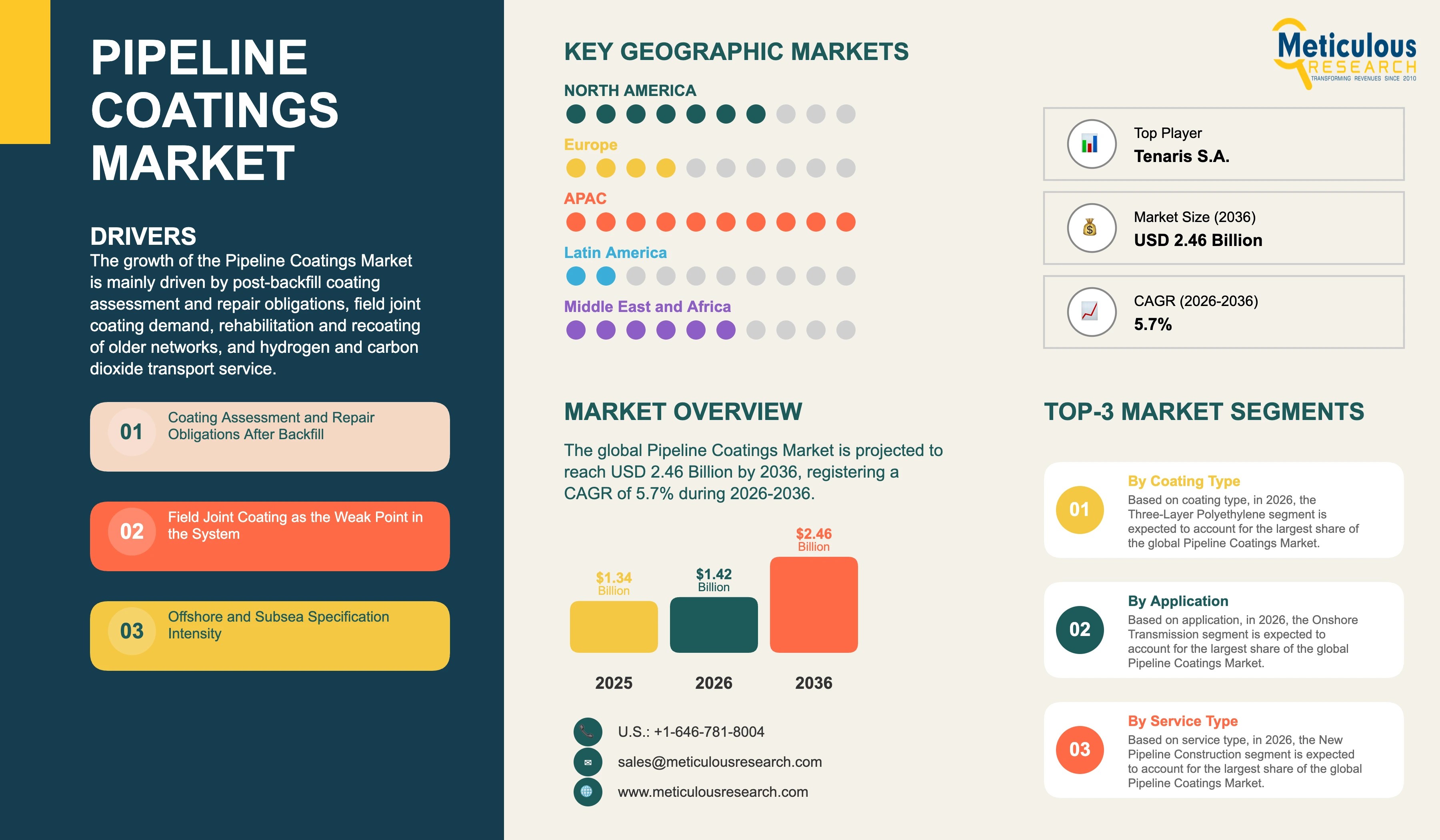
The global Pipeline Coatings Market was valued at USD 1.34 billion in 2025. This market is expected to reach USD 2.46 billion by 2036 from an estimated USD 1.42 billion in 2026, registering a CAGR of 5.7% during the forecast period (2026-2036).
- Published
- Nov 2026
- Pages
- 267
- Format
- PDF + Excel
- Report ID
- MRCHM - 1042786
- Base year
- 2025
- 2025 · BASELINE
- $1.34B
- 2036
- $2.46B
- CAGR 2026–2036
- 5.7%
2025 baseline · 2026–2036 forecast at 5.7% CAGR · hover a bar for the value
Key highlights
The global Pipeline Coatings Market is projected to reach USD 2.46 billion by 2036, driven by post-backfill coating assessment obligations, field joint coating demand, rehabilitation and recoating, and hydrogen and carbon dioxide service.
Asia-Pacific is expected to account for the largest market share in 2026 and is also projected to register the fastest growth during the forecast period, supported by the concentration of new transmission construction in the region together with the largest installed base of pipe coating plants.
By coating type, Three-Layer Polyethylene systems are expected to account for the largest market share, whereas Field Joint Coatings are projected to witness the fastest growth through 2036.
By application, Onshore Transmission are expected to account for the largest market share, whereas Offshore and Subsea are projected to witness the fastest growth through 2036.
By service type, New Pipeline Construction are expected to account for the largest market share, whereas Rehabilitation and Recoating are projected to witness the fastest growth through 2036.
United States transmission rules require any external protective coating used for corrosion control to be applied to a properly prepared surface, to adhere well enough to resist underfilm migration of moisture, to be ductile enough to resist cracking, to withstand handling and soil stress, and to be compatible with any supplemental cathodic protection.
Electrically insulating coatings must additionally have low moisture absorption and high electrical resistance, and the coating has to be inspected just before the pipe is lowered into the ditch, with any damage repaired that could impair effective corrosion control.
Coating integrity obligations now continue after construction, with onshore steel transmission pipelines requiring a coating damage and integrity assessment promptly after backfill and no later than six months, wherever a repair or replacement leaves 1,000 feet or more of backfilled ditch.
That assessment is made by direct current or alternating current voltage gradient survey, or by other technology providing comparable information with 90 days of advance notification to the regulator.
A remedial action plan is required within six months of the assessment, severe coating damage must be repaired within six months of the assessment or of permit receipt, and records must be kept for the life of the pipeline.
Severe damage is defined by survey threshold rather than by inspection judgment, at a direct current voltage gradient drop greater than 60% or an alternating current voltage gradient reading greater than 70 decibels relative to a microvolt.
Coating systems are specified against long-established standards, with Three-Layer Polyethylene built to DIN 30670, Three-Layer Polypropylene to DIN 30678, and Fusion-Bonded Epoxy to CAN/CSA Z245.20 and NACE RP 0394, while internal flow coating follows API RP 5L and ISO 15741 and internal solvent-free liquid epoxy follows AWWA C210.
The applicator layer has consolidated into pipe manufacture, with the pipe coating business of a listed coating group sold to a line pipe producer in a transaction completed on 30 November 2023 for total proceeds of USD 182.6 million and effective proceeds of USD 165.7 million, that group having renamed itself in June 2023 and completed its legal name change on 8 January 2024.
Report summary
| Particulars | Details |
|---|---|
| Forecast Period | 2026-2036 |
| Base Year | 2025 |
| Estimated Year | 2026 |
| CAGR (Value) | 5.7% |
| Format | PDF, Excel & Cloud Portal · 267 pages |
| CAGR (Volume) | 3.7% |
| Market Size (Value) in 2026 | USD 1.42 billion |
| Market Size (Value) in 2036 | USD 2.46 billion |
| Market Size (Volume) in 2026 | 92.00 million square meters of pipe surface coated |
| Market Size (Volume) in 2036 | 132.00 million square meters |
| Average Selling Price, 2026 | USD 15.43 per square meter |
| Average Selling Price, 2036 | USD 18.64 per square meter |
| Segments Covered | By Coating Type: Three-Layer Polyethylene, Fusion-Bonded Epoxy, Three-Layer Polypropylene, Liquid Epoxy and Polyurethane, Field Joint Coatings, Internal Flow and Lining Coatings. By Application: Onshore Transmission, Offshore and Subsea, Distribution and Gathering. By Service Type: New Pipeline Construction, Rehabilitation and Recoating, Maintenance and Repair Coating. By Product Transported: Natural Gas, Crude Oil and Refined Products, Water and Slurry, Hydrogen and Carbon Dioxide. |
| Countries Covered | China; India; Australia; South Korea; U.S.; Canada; Saudi Arabia; U.A.E.; Germany; U.K.; Brazil; Mexico |
| Key Companies | Tenaris S.A., Akzo Nobel N.V., The Sherwin-Williams Company, PPG Industries, Inc., Jotun A/S, Hempel A/S, Welspun Corp Limited, and Jindal SAW Limited |
Report overview
Segments covered: coating type, application, service type, product transported.
In volume terms, the market is estimated at 92.00 million square meters of pipe surface coated in 2026 and is expected to reach 132.00 million square meters by 2036, registering a CAGR of 3.7% during the forecast period. The average selling price is estimated at USD 15.43 per square meter in 2026 and USD 18.64 per square meter in 2036.
The growth of this market is mainly driven by coating assessment and repair obligations that now follow backfill on transmission pipelines, field joint coating demand growing at 7.4%, rehabilitation and recoating growing at 7.4%, and hydrogen and carbon dioxide service growing at 10.4%. However, factors such as mainline coating volume following pipeline construction kilometers rather than integrity spending, coating requirements written as performance duties rather than as material specifications, long-established coating standards that limit differentiation, and a coating plant layer now owned by pipe makers are expected to restrain the growth of this market to some extent.
Among service types, New Pipeline Construction are expected to account for the largest market share in 2026, while Rehabilitation and Recoating are projected to register the highest CAGR during the forecast period. Geographically, Asia-Pacific is expected to account for the largest share of this market in 2026 and is also expected to register the highest CAGR during the forecast period.
The Pipeline Coatings Market comprises external and internal pipeline coatings as delivered to the pipe, covering mill and plant-applied systems, field joint coatings and rehabilitation coatings, with volume expressed as pipe surface area coated. The market includes Three-Layer Polyethylene, Fusion-Bonded Epoxy, Three-Layer Polypropylene, Liquid Epoxy and Polyurethane, Field Joint Coatings and Internal Flow and Lining Coatings, applied for onshore transmission, offshore and subsea, and distribution and gathering service, across new construction, rehabilitation and maintenance work, for pipelines carrying natural gas, crude oil and refined products, water and slurry, and hydrogen and carbon dioxide. Concrete weight coating, thermal and wet insulation systems, cathodic protection anodes and rectifiers, the line pipe itself and coating application equipment fall outside the scope.
A buried transmission pipeline is protected by a coating and a cathodic protection system working together, with the coating providing the barrier and the cathodic protection reaching the steel wherever that barrier is broken. Neither is specified independently of the other. United States transmission rules put the relationship into the coating requirement itself, demanding adhesion sufficient to resist underfilm migration of moisture, ductility sufficient to resist cracking, strength to withstand transportation, installation, boring, backfilling and soil stress, and compatibility with any supplemental cathodic protection.
Coating is the only part of that system applied once and expected to last the life of the line, since cathodic protection can be adjusted, monitored and re-energized while a buried coating cannot be reached without excavation. That asymmetry is what gives the coating specification its weight on a project, and it is the reason the regulator requires inspection immediately before the pipe is lowered into the ditch with repair of any damage that could impair effective corrosion control.
The obligation now extends past construction. Onshore steel transmission pipelines require a coating damage and integrity assessment promptly after backfill and no later than six months wherever a repair or replacement leaves 1,000 feet or more of backfilled ditch, carried out by direct current or alternating current voltage gradient survey or by comparable technology with 90 days of advance notification. A remedial action plan follows within six months, severe damage must be repaired within six months of the assessment or of permit receipt, and records are kept for the life of the pipeline. Severe damage is defined by survey threshold rather than by judgment, at a direct current voltage gradient drop greater than 60% or an alternating current voltage gradient reading above 70 decibels relative to a microvolt.
Material selection is governed by standards that have been in place for decades, with Three-Layer Polyethylene built to DIN 30670, Three-Layer Polypropylene to DIN 30678 and Fusion-Bonded Epoxy to CAN/CSA Z245.20 and NACE RP 0394, while internal flow coating is specified to API RP 5L and ISO 15741 and internal solvent-free liquid epoxy to AWWA C210 alongside national specifications. Because the requirements are written as performance duties against established standards rather than as proprietary specifications, differentiation on the mainline system is limited.
A three-layer system is a composite built from an epoxy primer, an adhesive tie layer and a polyolefin topcoat, so the coating plant rather than the material supplier controls delivered performance. Dual-layer fusion-bonded epoxy and internal flow coating sit in the same plants, so a coater qualifies several systems and tenders them against one another. That structure places the margin in the application step, and it has drawn the plant layer into pipe manufacture: the pipe coating business of a listed coating group was sold to a line pipe producer in a transaction completed on 30 November 2023 for total proceeds of USD 182.6 million and effective proceeds of USD 165.7 million, with that group renaming itself in June 2023 and completing its legal name change on 8 January 2024.
Value grows ahead of volume throughout the forecast period, at 5.7% against 3.7%, because coated surface area follows construction kilometers while the mix moves toward field joint, rehabilitation and subsea systems. Field Joint Coatings are projected to record the highest coating type CAGR at 7.4% from a 10.0% share in 2026, Rehabilitation and Recoating the highest service type CAGR at 7.4% from a 20.0% share, and Hydrogen and Carbon Dioxide the highest growth by product transported at 10.4% from an 8.0% share.
A disbonded coating that shields cathodic protection current is more dangerous than an exposed holiday, because the protection system reads as adequate while the steel beneath the disbondment corrodes unprotected. Coating systems and field joint products that fail in a non-shielding manner address a failure mode the operator cannot otherwise detect, and the voltage gradient survey thresholds now written into the rules give operators a measured basis for selecting them.
Recoating work is performed in the field or at local facilities rather than in a pipe mill, which makes proximity to the asset the determining commercial factor. Rehabilitation and Recoating growing at 7.4% in regions with the oldest networks favors regional applicators and coating suppliers with local technical service over the mill-based plant layer, and it is the part of the market least affected by the consolidation of coating plants into pipe manufacture.
Asia-Pacific is expected to account for the largest share of this market in 2026 at 34.0%, supported by the largest volume of new transmission construction and by coating plants installed alongside regional pipe mills.
Europe accounts for 14.0% of this market in 2026 and is projected to grow at 4.4%, the slowest regional rate. New transmission construction is limited and demand is weighted toward rehabilitation of networks coated decades ago and toward repurposing lines for hydrogen service. Germany is projected to be the slowest-growing country at 3.2%, where the network is extensive and mature. Hydrogen network development across the region is where the regional qualification work is concentrated.
The Middle East & Africa region holds 21.0% of this market in 2026 with projected growth of 6.2%, with Saudi Arabia and the United Arab Emirates accounting for most volume on gas and crude transmission programs supported by domestic pipe manufacture. Latin America holds 7.0% with projected growth of 5.0%, with Brazil carrying offshore and subsea work on pre-salt production infrastructure and Mexican demand weighted toward gas transmission and distribution.
Some of the key players operating in the pipeline coatings market are Tenaris S.A., Akzo Nobel N.V., The Sherwin-Williams Company, PPG Industries, Inc., Jotun A/S, Hempel A/S, Welspun Corp Limited, and Jindal SAW Limited, among others.
Key strategies include acquiring or building coating plant capacity adjacent to pipe manufacture, qualifying field joint systems as matched pairs with named mainline coatings, developing coatings for hydrogen and carbon dioxide service ahead of standardization, extending rehabilitation and recoating capability close to older networks, and supplying application equipment and crew training alongside field joint materials.
Report infographic
Market dynamics
22 factors across 5 forcesCoating Assessment and Repair Obligations After Backfill
Integrity obligations that once ended at the ditch now continue after construction. Onshore steel transmission pipelines require a coating damage and integrity assessment promptly after backfill and no later than six months wherever a repair or replacement leaves 1,000 feet or more of backfilled ditch, performed by direct current or alternating current voltage gradient survey or by comparable technology with 90 days of advance notification to the regulator. A remedial action plan follows within six months and severe damage must be repaired within six months of the assessment or of permit receipt. Because severe damage is defined by survey threshold rather than by inspection judgment, at a direct current voltage gradient drop greater than 60% or an alternating current voltage gradient reading above 70 decibels relative to a microvolt, the repair volume is determined by measurement and is not discretionary. Rehabilitation and Recoating is accordingly projected to grow at 7.4%, ahead of the market as a whole.
Field Joint Coating as the Weak Point in the System
Mainline coating is applied in a plant under controlled conditions while the girth weld between two joints of pipe is coated in the field, in the trench, under weather and schedule pressure. Every kilometer of pipeline carries a field joint approximately every twelve meters, and the joint coating must match the mainline system for adhesion, cathodic disbondment resistance and soil stress tolerance while being applied by hand. Field Joint Coatings hold a 10.0% share of this market in 2026 and are projected to record the highest coating type CAGR at 7.4%. The growth reflects both the volume of construction and a shift toward qualified systems supplied with application equipment and trained crews rather than tapes and sleeves applied to a general specification.
Offshore and Subsea Specification Intensity
Subsea pipelines carry the same corrosion requirement with added mechanical and thermal demands from laying, reeling and seabed contact, and the cost of intervention after installation is an order above an onshore excavation. Three-Layer Polypropylene built to DIN 30678 is specified where service temperature and mechanical loading exceed what polyethylene systems tolerate, and coating thickness, holiday limits and disbondment testing are tightened. Offshore and Subsea is projected to be the fastest-growing application in this market at 6.8%, against 62.0% of 2026 volume in Onshore Transmission. The segment contributes disproportionately to value because the per-square-meter realization on a subsea system is well above a buried onshore line.
Hydrogen and Carbon Dioxide Transport Networks
Networks being built or repurposed for hydrogen and for captured carbon dioxide introduce service conditions the installed coating base was not specified for, including hydrogen permeation at the steel interface and the presence of water with carbon dioxide in a corrosive combination. Qualification is being carried out against the same performance duties, which means coating selection and testing are project-specific rather than standardized. Hydrogen and Carbon Dioxide is projected to record the highest growth by product transported in this market at 10.4% from an 8.0% share in 2026, against 5.4% for Natural Gas on the largest share at 46.0%. The volumes are small but the specification work establishes which systems become the reference for the networks that follow.
Rehabilitation of Older Networks
Large parts of the transmission network in North America and Europe were coated with systems installed decades ago, and disbondment on those systems shields the steel from cathodic protection current rather than simply exposing it. Where that occurs the pipeline carries corrosion risk that the protection system cannot address, and recoating rather than monitoring is the remedy. Rehabilitation and Recoating holds a 20.0% share of this market in 2026 and is projected to grow at 7.4%, the highest service type rate. The work is driven by assessed condition rather than by construction budgets, which makes it the more stable part of the demand base through construction cycles.
Table of contents
12 chapters · 132 sections · 267 pages · click to expandSegmental analysis
| Segment | Largest share (2026) | Fastest growth (2026–2036) |
|---|---|---|
| By Coating Type | Three-Layer Polyethylene systems | Field Joint Coatings |
| By Application | Onshore Transmission | Offshore and Subsea |
| By Service Type | New Pipeline Construction | Rehabilitation and Recoating |
| By Product Transported | Natural Gas pipelines | Hydrogen and Carbon Dioxide pipelines |
| Other segments | Onshore Transmission | Hydrogen and Carbon Dioxide pipelines |
By Coating Type
- Pipeline Coatings Market Analysis by Coating Type
- Three-Layer Polyethylene systems are expected to account for the largest share of the global Pipeline Coatings Market.
- The large share of this segment is mainly due to the combination of mechanical protection, moisture resistance and installed cost it delivers on buried onshore transmission lines, together with the maturity of DIN 30670 qualification across the coating plant base.
- However, Field Joint Coatings are projected to register the highest CAGR during the forecast period.
- The rapid growth of this segment is attributed to the volume of girth welds that every kilometer of pipeline carries, the movement toward systems qualified as matched pairs with the named mainline coating, and the concentration of coating failures at the joint rather than along the pipe body.
- Three-Layer Polyethylene systems are expected to account for the largest market share in 2026.
- Field Joint Coatings are projected to register the highest CAGR during the forecast period, owing to the volume of girth welds that every kilometer of pipeline carries, the movement toward systems qualified as matched pairs with the named mainline coating, and the concentration of coating failures at the joint rather than along the pipe body.
- Offshore and Subsea are projected to register the highest CAGR during the forecast period, owing to the added mechanical and thermal demands of laying, reeling and seabed service, the cost of intervention after installation, and the higher realization per square meter that subsea specifications carry.
- Rehabilitation and Recoating are projected to register the highest CAGR during the forecast period, owing to the obligation to assess coating damage promptly after backfill and no later than six months, the definition of severe damage by survey threshold rather than judgment, and disbondment on systems installed decades ago that shields cathodic protection current.
By Application
- Pipeline Coatings Market Analysis by Application
- Onshore Transmission are expected to account for the largest market share.
- The large share of this segment is mainly due to the share of total pipeline length that is buried onshore transmission, where the regulatory coating duties and the post-backfill assessment obligations apply in full.
- However, Offshore and Subsea are projected to register the highest CAGR during the forecast period.
- The rapid growth of this segment is attributed to the added mechanical and thermal demands of laying, reeling and seabed service, the cost of intervention after installation, and the higher realization per square meter that subsea specifications carry.
By Service Type
- Pipeline Coatings Market Analysis by Service Type
- New Pipeline Construction are expected to account for the largest market share.
- The large share of this segment is mainly due to the volume of plant-applied mainline coating consumed on new build, where coated surface area follows construction kilometers.
- However, Rehabilitation and Recoating are projected to register the highest CAGR during the forecast period.
- The rapid growth of this segment is attributed to the obligation to assess coating damage promptly after backfill and no later than six months, the definition of severe damage by survey threshold rather than judgment, and disbondment on systems installed decades ago that shields cathodic protection current.
By Product Transported
- Pipeline Coatings Market Analysis by Product Transported
- Natural Gas pipelines are expected to account for the largest market share.
- The large share of this segment is mainly due to the length of gas transmission network in service and under construction, and the additional specification of internal flow coating on gas lines for compression efficiency.
- However, Hydrogen and Carbon Dioxide pipelines are projected to register the highest CAGR during the forecast period.
- The rapid growth of this segment is attributed to the construction and repurposing of networks for hydrogen and captured carbon dioxide, where the installed coating base was not specified for the service conditions and qualification is carried out project by project.
Other segments
- Onshore Transmission are expected to account for the largest market share in 2026.
- New Pipeline Construction are expected to account for the largest market share in 2026.
- Natural Gas pipelines are expected to account for the largest market share in 2026.
- Hydrogen and Carbon Dioxide pipelines are projected to register the highest CAGR during the forecast period, owing to the construction and repurposing of networks for hydrogen and captured carbon dioxide, where the installed coating base was not specified for the service conditions and qualification is carried out project by project.
Geographic analysis
Asia-Pacific
Fastest growthAsia-Pacific holds 34.0% of this market in 2026 and is projected to grow at 6.4%, the fastest regional rate, with India projected to be the fastest-growing country at 8.2%. Asia-Pacific holds the largest share of this market in 2026 at 34.0% and is projected to be the fastest-growing region at 6.4%. The region carries the largest volume of new transmission construction, with gas networks being extended in China and India and coating plants installed alongside pipe mills to serve them. India is projected to be the fastest-growing country in this market at 8.2%, reflecting a national gas grid build-out that generates mainline, field joint and internal coating demand together. Australian demand is weighted toward offshore and subsea work on gas export infrastructure, and South Korean demand sits largely with pipe manufacture for export rather than with domestic installation. Asia-Pacific is also projected to register the highest CAGR at 6.4%, with India projected to be the fastest-growing country at 8.2% on a national gas grid build-out that generates mainline, field joint and internal coating demand together. Asia-Pacific and Middle East Construction Programs
Middle East & Africa
The Middle East & Africa region holds 21.0% with growth of 6.2%. New transmission construction in both regions generates mainline, field joint and internal coating demand simultaneously, and coating plants built alongside pipe mills capture the work for the life of the program. Saudi Arabia and the United Arab Emirates account for most regional volume, with gas and crude transmission programs supported by domestic pipe manufacture and coating capacity. Coating specifications in the region follow the established international standards, and the scale of individual projects favors suppliers able to commit plant capacity and field joint crews for multi-year programs. Carbon dioxide transport projects tied to regional capture schemes are beginning to enter specification. Geographic Analysis
North America
North America accounts for 24.0% of this market in 2026 with projected growth of 5.2%. The region is where the post-backfill coating assessment obligations apply most directly, with onshore steel transmission pipelines requiring assessment within six months wherever a repair or replacement leaves 1,000 feet or more of backfilled ditch, a remedial action plan within six months and repair of severe damage within six months of assessment or permit receipt. That makes Rehabilitation and Recoating a larger share of regional demand than elsewhere. New construction is concentrated in gas gathering and takeaway capacity in the United States and in Canadian export infrastructure.
Europe
Europe represents 14.0% of this market in 2026 with projected growth of 4.4%, the slowest regional rate. New transmission construction is limited, and demand is weighted toward rehabilitation of networks coated decades ago and toward repurposing lines for hydrogen service. Germany is projected to be the slowest-growing country in this market at 3.2%, where the network is extensive and mature. The hydrogen networks under development across the region are where the regional qualification work is concentrated, and the volumes involved are small relative to the installed base being assessed.
Latin America
Latin America accounts for 7.0% of this market in 2026 and is projected to grow at 5.0%. Brazil holds most of the regional volume, with offshore and subsea work on pre-salt production infrastructure carrying the higher-specification systems and onshore gas transmission adding mainline volume. Mexican demand is weighted toward gas transmission and distribution. Regional coating capacity is concentrated in a small number of plants, so project scheduling rather than material availability determines delivery.
Competitive landscape
The global Pipeline Coatings Market is moderately fragmented, with competition among line pipe manufacturers with captive coating plants, global coatings groups supplying materials, and specialist field joint and rehabilitation coating suppliers. Market participants compete primarily on coating plant capacity and proximity to pipe mills and projects, qualification against the governing coating standards, field joint system performance at the interface with the mainline coating, and the ability to supply application equipment and trained crews.
acquiring or building coating plant capacity adjacent to pipe manufacture, qualifying field joint systems as matched pairs with named mainline coatings, developing systems for hydrogen and carbon dioxide service ahead of standardization, and extending rehabilitation and recoating service capability close to older networks
The report provides a comprehensive competitive assessment of the leading companies operating in the global Pipeline Coatings Market. The key players profiled in the report include Tenaris S.A. (Luxembourg), Akzo Nobel N.V. (Netherlands), The Sherwin-Williams Company (U.S.), PPG Industries, Inc. (U.S.), Jotun A/S (Norway), Hempel A/S (Denmark), Welspun Corp Limited (India), and Jindal SAW Limited (India).
- Tenaris S.A.
- Akzo Nobel N.V.
- Sherwin-Williams Company
- PPG Industries, Inc.
- Jotun A/S
- Hempel A/S
- Welspun Corp Limited
- Jindal SAW Limited
Expert perspectives
The growth in this market is in the work that measurement creates, not in the work that construction creates. Mainline volume follows kilometers laid and grows at 3.7% in surface area, while value grows at 5.7% because the mix moves to field joint, rehabilitation and subsea systems. The post-backfill assessment obligation, with severe damage defined at a direct current voltage gradient drop above 60% or an alternating current reading above 70 decibels relative to a microvolt, converts coating condition into a scheduled repair program with fixed deadlines. That demand is generated by survey equipment rather than by capital budgets.
Ownership of the coating plant has become the commercial question in new construction. With the largest independent coating network absorbed into line pipe manufacture in the transaction completed on 30 November 2023, coated pipe is increasingly procured as one item from the mill and the independent coating tender disappears with it. A materials supplier selling into that structure is selling to a competitor in the application step, which is why the defensible material positions sit in field joint and rehabilitation work that no pipe mill performs.
Differentiation is available only where the specification is still open. The governing standards for three-layer and fusion-bonded epoxy systems are long established and widely qualified against, so improved mainline performance has no route to a price. Hydrogen and Carbon Dioxide service growing at 10.4%, subsea systems growing at 6.8% and non-shielding failure behavior are the three places where an operator is still deciding what to specify, and the systems qualified there now will be the reference for the networks built over the next decade.
Customer perspectives
This reflects a shift in which coating repair volumes are set by survey thresholds and fixed deadlines rather than by discretionary integrity budgets, making rehabilitation demand more predictable than construction demand.
This indicates that specification risk concentrates at the field joint interface, and that qualification of the joint system against the named mainline coating is what transfers that risk away from the contractor.
This points to the procurement of coated pipe as a single item closing the route to market for mainline materials suppliers while leaving field joint, internal and rehabilitation coatings as the remaining direct sale.
“The assessment rule changed how we plan. Once a repair leaves a thousand feet of backfilled ditch we are on a clock, and the survey tells us what counts as severe, not our inspector. We budget recoating now the way we budget inspection, because the deadline is the same whether or not the money was in the plan.”
“The pipe arrives coated and we have never had a problem with the body of the pipe. Every issue we have had has been at a girth weld, applied by hand, in a ditch, often in the rain. If the joint system has been tested against that exact mainline coating we can defend it. If it has not, we are the ones holding the risk.”
“We buy coated pipe now, one line item from the mill. It removes a tender and a schedule interface. The consequence is that a coating company cannot sell us anything on the mainline any more, because the mill makes that choice. Where they still talk to us is field joints, internal flow coating and anything we are recoating.”
Frequently asked questions
The global Pipeline Coatings Market is estimated at USD 1.42 billion in 2026.
The market is projected to reach USD 2.46 billion by 2036.
The market is expected to grow at a CAGR of 5.7% during 2026-2036.
Growth is driven by post-backfill coating assessment and repair obligations on onshore steel transmission pipelines, field joint coatings growing at 7.4%, rehabilitation and recoating growing at 7.4%, and hydrogen and carbon dioxide service growing at 10.4%.
United States transmission rules require any external protective coating used for corrosion control to be applied to a properly prepared surface, to adhere well enough to resist underfilm migration of moisture, to be ductile enough to resist cracking, to withstand handling and soil stress, and to be compatible with any supplemental cathodic protection. The coating must be inspected just before the pipe is lowered into the ditch, with repair of any damage that could impair effective corrosion control.
Onshore steel transmission pipelines require a coating damage and integrity assessment promptly after backfill and no later than six months wherever a repair or replacement leaves 1,000 feet or more of backfilled ditch. A remedial action plan is required within six months of the assessment, and severe coating damage must be repaired within six months of the assessment or of permit receipt.
Three-Layer Polyethylene is built to DIN 30670, Three-Layer Polypropylene to DIN 30678, and Fusion-Bonded Epoxy to CAN/CSA Z245.20 and NACE RP 0394. Internal flow coating is specified to API RP 5L and ISO 15741, and internal solvent-free liquid epoxy to AWWA C210.
The principal challenges are mainline coating volume following construction kilometers rather than integrity spending, coating requirements written as performance duties that limit differentiation, and the consolidation of coating plants into line pipe manufacture. Field joint application in trench conditions outside plant control and long-established standards also limit pricing for improved performance.
Emerging technologies include field joint systems qualified as matched pairs with named mainline coatings, coating systems selected for non-shielding behavior when disbonded, and internal flow coating to reduce compression energy on gas transmission. Coating systems qualified for hydrogen and captured carbon dioxide service are also emerging.
Requirements center on the United States transmission coating duties covering surface preparation, adhesion, ductility, soil stress resistance and cathodic protection compatibility, plus the post-backfill assessment regime with survey, remedial action plan, repair deadlines and life-of-pipeline records. Material qualification follows DIN 30670, DIN 30678, CAN/CSA Z245.20, NACE RP 0394, API RP 5L, ISO 15741 and AWWA C210.
Three-Layer Polyethylene systems are expected to account for the largest market share in 2026.
Field Joint Coatings are projected to register the highest CAGR during the forecast period, owing to the volume of girth welds, the movement toward matched qualified systems, and the concentration of coating failures at the joint.
Onshore Transmission are expected to account for the largest market share in 2026.
Offshore and Subsea are projected to register the highest CAGR during the forecast period, owing to the added mechanical and thermal demands of laying, reeling and seabed service, the cost of intervention after installation, and higher realization per square meter.
New Pipeline Construction are expected to account for the largest market share in 2026.
Rehabilitation and Recoating are projected to register the highest CAGR during the forecast period, owing to the obligation to assess coating damage after backfill, the definition of severe damage by survey threshold, and disbondment on older systems that shields cathodic protection current.
Natural Gas pipelines are expected to account for the largest market share in 2026.
Hydrogen and Carbon Dioxide pipelines are projected to register the highest CAGR during the forecast period, owing to the construction and repurposing of networks for hydrogen and captured carbon dioxide where qualification is carried out project by project.
Asia-Pacific is expected to account for the largest share of this market in 2026 at 34.0%, supported by the largest volume of new transmission construction and by coating plants installed alongside regional pipe mills.
Asia-Pacific is also projected to register the highest CAGR at 6.4%, with India projected to be the fastest-growing country at 8.2%.
Europe accounts for 14.0% of this market in 2026 and is projected to grow at 4.4%, the slowest regional rate. Demand is weighted toward rehabilitation of older networks and repurposing lines for hydrogen service, and Germany is projected to be the slowest-growing country at 3.2%.
The Middle East & Africa region holds 21.0% of this market in 2026 with projected growth of 6.2%, led by Saudi Arabia and the United Arab Emirates. Latin America holds 7.0% with projected growth of 5.0%, with Brazil carrying offshore and subsea pre-salt work.
Some of the key players are Tenaris S.A., Akzo Nobel N.V., The Sherwin-Williams Company, PPG Industries, Inc., Jotun A/S, Hempel A/S, Welspun Corp Limited, and Jindal SAW Limited, among others.
Key strategies include acquiring or building coating plant capacity adjacent to pipe manufacture, qualifying field joint systems as matched pairs with named mainline coatings, and developing coatings for hydrogen and carbon dioxide service ahead of standardization. Companies are also extending rehabilitation capability close to older networks and supplying application equipment and crew training.
Cite this report
Meticulous Research. (2026). Pipeline Coatings Market - Global Opportunity Analysis and Industry Forecast (2026-2036) (Report No. MRCHM - 1042786). Meticulous Market Research Pvt. Ltd. https://www.meticulousresearch.com/product/pipeline-coatings-market-7469