Performic Acid Market (2026-2036)
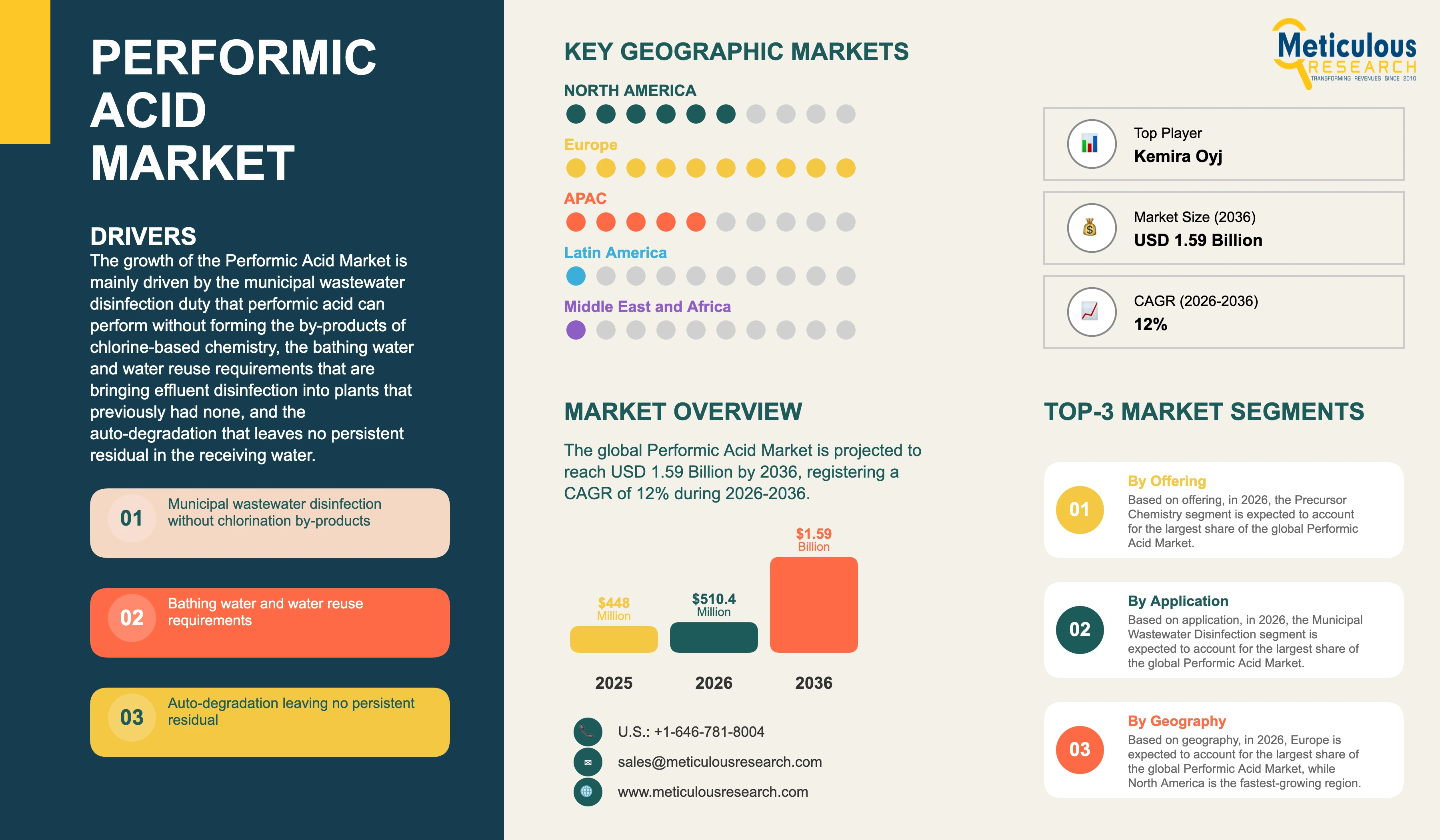
The global performic acid market was valued at USD 448.0 million in 2025. This market is expected to reach USD 1.59 billion by 2036 from an estimated USD 510.4 million in 2026, registering a CAGR of 12.0% during the forecast period (2026-2036).
- Published
- Nov 2026
- Pages
- 249
- Format
- PDF + Excel
- Report ID
- MRCHM - 1042815
- Base year
- 2025
- 2025 · BASELINE
- $448.0M
- 2036
- $1.59B
- CAGR 2026–2036
- 12.0%
2025 baseline · 2026–2036 forecast at 12.0% CAGR · hover a bar for the value
Key highlights
The global performic acid market is estimated at USD 510.4 million in 2026 and is projected to reach USD 1.59 billion by 2036.
Market volume is estimated at 44.00 kilotons in 2026 and is projected to reach 118.34 kilotons by 2036 at a CAGR of 10.4%, measured as performic acid generated on a 100% active basis.
Performic acid is never shipped, so value here covers precursor chemistry, generation equipment and the service layer, and the average selling price is a delivered cost per kilogram generated.
The average selling price is estimated at USD 11.60 per kg in 2026 and is projected to reach USD 13.40 per kg by 2036 as the service, monitoring and dosing layer takes a larger share of delivered value.
Precursor chemistry is expected to account for the largest offering share in 2026, while service, monitoring and digital dosing is projected to register the highest CAGR of 15.0%.
Municipal wastewater disinfection is expected to hold the largest application share in 2026 and is also projected to grow fastest at a CAGR of 14.0%.
Europe is expected to hold the largest regional share in 2026, while North America is projected to register the highest CAGR of 16.0%.
Kemira announced on 28 May 2025 that FennoSurf 600, the precursor ingredient from which performic acid is generated in its KemConnect DEX solution, had been registered with the US Environmental Protection Agency as EPA Reg. 9386-51, approved as of 5 May 2025.
That release states the US products are intended for non-public health microbial control, that state registrations were in progress and had to be confirmed before any offer for sale, and that Canadian registration was also in progress.
Kemira announced on 31 March 2026 that it had completed the first full-scale US trial of KemConnect DEX, a one-month trial at Capital Region Water, an advanced wastewater treatment facility serving Harrisburg, Pennsylvania and surrounding municipalities.
The company states the trial was completed within eight months of the EPA registration of the core ingredient.
Both releases describe performic acid qualitatively only, reporting that it reduces bacteria at low doses and auto-degrades within minutes into readily biodegradable compounds, with no dose figures, bacteria counts, percentage reductions, indicator organisms, permit limits or plant flow given.
The May 2025 release states that performic acid has been available in Europe for over a decade and was added as an extra treatment step at Seine Amont, described as the second-largest wastewater treatment plant in Europe, processing over 500,000 cubic metres daily.
Under Commission Implementing Decision (EU) 2020/1036 of 15 July 2020, performic acid generated from formic acid and hydrogen peroxide was not approved for product types 3, 5 and 6.
That non-approval rests on procedural grounds rather than on any safety finding, the Decision citing the timely withdrawal of all participants or the absence of a notification to take over the participant role.
In the Annex to that Decision the substance carries no EC number and no CAS number, both shown as not applicable, because it is generated in situ and has no identity as a supplied chemical.
In both the European Union and the United States the regulated article is therefore the precursor rather than the acid, which is why the US registration names FennoSurf 600 and not performic acid.
Report summary
| Particulars | Details |
|---|---|
| Base Year | 2025 |
| Forecast Period | 2026-2036 |
| Market Size in 2025 | USD 448.0 million |
| Market Size in 2026 | USD 510.4 million |
| Market Size by 2036 | USD 1.59 billion |
| Value CAGR (2026-2036) | 12.0% |
| Format | PDF, Excel & Cloud Portal · 249 pages |
| Volume in 2026 | 44.00 kilotons |
| Volume by 2036 | 118.34 kilotons |
| Volume CAGR (2026-2036) | 10.4% |
| Volume Basis | Performic acid generated on a 100% active basis |
| Average Selling Price in 2026 | USD 11.60 per kg |
| Average Selling Price by 2036 | USD 13.40 per kg |
| Price Direction | The delivered cost per kilogram of acid generated rises across the forecast period as the service, monitoring and digital dosing layer takes a larger share of delivered value, rather than through any constraint on formic acid or hydrogen peroxide supply |
| Volume Basis Note | Performic acid is never shipped, stored or sold as itself, so the value measured here is supplier revenue from the precursor chemistry, the on-site generation equipment and the dosing, monitoring and service layer taken together, and the average selling price is a delivered cost per kilogram of acid generated and not a chemical price; a reader comparing it with a quoted formic acid or hydrogen peroxide price will not reconcile the two, because only part of the reagent mass becomes acid and the measure carries the generator, the control system and the service alongside the reagents |
| Regulatory Basis Note | In the Annex to Commission Implementing Decision (EU) 2020/1036 of 15 July 2020 the substance appears as performic acid generated from formic acid and hydrogen peroxide with no EC number and no CAS number, both shown as not applicable, because an in-situ generated active has no identity as a supplied chemical; the regulated article in both the European Union and the United States is therefore the precursor formulation, which is why the US registration names FennoSurf 600 rather than performic acid |
| Measurement Basis | Performic acid generated on site from formic acid and hydrogen peroxide for disinfection duties, by offering, application, generation and supply model, and geography, measured as acid generated against supplier revenue from precursor chemistry, generation equipment and service, and excluding customer-side civil works, the receiving plant and any downstream treatment |
| Relationship to Adjacent Markets | This market is not additive to the chlorine dioxide generation systems market, which is measured in units of equipment with precursor chemicals excluded, so the two are built on different bases even though both describe on-site generated oxidant disinfection; it also sits outside the preservative markets entirely, since a substance that degrades within minutes cannot perform a preservative function, a point the European non-approval for product type 6 confirms directly |
| Note on Supplier Disclosure | No participant publishes revenue for performic acid separately from its wider water or peroxygen business, and the two Kemira releases reviewed for this report give no dose figures or units, no bacteria counts or percentage reductions, no indicator organism, no permit limits or confirmation that they were met, no plant flow or capacity, no equipment or installation cost, no comparative data against chlorine or ultraviolet, and no statement of whether the facility adopted the solution after the trial, so the sizing here is built from installed base and application demand rather than from disclosed sales |
| Largest Application | Municipal wastewater disinfection |
| Fastest-Growing Application | Municipal wastewater disinfection (CAGR 14.0%) |
| Largest Offering | Precursor chemistry |
| Fastest-Growing Offering | Service, monitoring and digital dosing (CAGR 15.0%) |
| Largest Region | Europe |
| Fastest-Growing Region | North America (CAGR 16.0%) |
| Segments Covered | Offering, Application, Generation and Supply Model, and Geography |
| Geographies Covered | Europe, North America, Asia-Pacific, Latin America, and Middle East & Africa |
| Companies Profiled | 6 companies, including Kemira Oyj, Solvay SA, Evonik Industries AG, Ecolab Inc., Enviro Tech Chemical Services, Inc., and Hydrite Chemical Co. |
Report overview
Segments covered: offering, application.
In volume terms, this market is estimated at 44.00 kilotons in 2026 and is projected to reach 118.34 kilotons by 2036, registering a CAGR of 10.4% during the same period, measured as performic acid generated on a 100% active basis. Performic acid is never shipped as a product, so the value measured here is supplier revenue from the precursor chemistry, the on-site generation equipment and the dosing, monitoring and service layer taken together, and the average selling price is accordingly a delivered cost per kilogram of acid generated rather than a chemical price. It is estimated at USD 11.60 per kg in 2026 and is projected to rise to USD 13.40 per kg by 2036.
The growth of this market is mainly driven by the municipal wastewater disinfection duty that performic acid can perform without forming the by-products of chlorine-based chemistry, the bathing water and water reuse requirements that are bringing effluent disinfection into plants that previously had none, the auto-degradation that leaves no persistent residual in the receiving water, and the on-site generation that avoids the capital cost of ultraviolet and chlorine installations. However, factors such as the on-site generator that every installation requires, the regulatory approvals that must be held separately in each jurisdiction and for each use, the handling of the precursor chemicals, and the short life of the acid that rules out any storage are expected to restrain the growth of this market to some extent.
Municipal wastewater disinfection accounts for the largest share of this market and is also the fastest-growing, because it is both the largest volume duty and the one where the properties of performic acid matter most, and because the supplier push behind the chemistry is directed at it.
Performic acid is a peroxy acid generated on site from formic acid and hydrogen peroxide and used as an oxidising disinfectant, principally for municipal wastewater effluent and for process and food industry water. Market sizing in this report is on both a value basis in USD and a volume basis in kilotons measured as performic acid generated on a 100% active basis. Because the acid is never shipped, the value basis covers supplier revenue from the precursor chemistry, the on-site generation equipment and the dosing, monitoring and service layer taken together, and excludes the customer-side civil works, the receiving plant and any downstream treatment.
The average selling price derived from those two bases is consequently a delivered cost per kilogram of acid generated and not a price for a chemical. A reader comparing it with the quoted price of formic acid or hydrogen peroxide will not reconcile the two, because the measure here carries the generator, the control system and the service alongside the reagents, and because only part of the reagent mass becomes acid.
Kemira announced on 28 May 2025 that FennoSurf 600, the precursor ingredient from which performic acid is generated in its KemConnect DEX solution, had been registered with the US Environmental Protection Agency as EPA Reg. 9386-51, approved as of 5 May 2025. The release states that the US products are intended for non-public health microbial control, that state registrations were in progress and had to be confirmed before any offer for sale, and that Canadian registration was also in progress. It describes a compact on-site generator that measures influent flow and residual acid, with a digital platform and a proprietary algorithm optimising dose.
The company announced on 31 March 2026 that it had completed the first full-scale US trial of the solution, a one-month trial at Capital Region Water, an advanced wastewater treatment facility serving Harrisburg, Pennsylvania and surrounding municipalities, and states that this was achieved within eight months of the EPA registration of the core ingredient. The release reports that the solution reduces bacteria levels quickly even at low doses and auto-degrades into readily biodegradable compounds with low environmental persistence, and that on-site installation avoids the costs often required by chlorine-based and ultraviolet alternatives.
Neither release carries a single performance number. There are no dose figures or units, no bacteria counts or percentage reductions, no indicator organism named, no permit limits or statement of whether they were met, no plant flow or capacity, no equipment or installation cost, no comparative data against chlorine or ultraviolet, and no statement of whether the facility adopted the solution after the trial. The claims are qualitative, and they are reported as such here rather than converted into figures.
The regulatory position of this chemistry is unusual and it shapes the market more than its performance does. Under Commission Implementing Decision (EU) 2020/1036 of 15 July 2020, performic acid generated from formic acid and hydrogen peroxide was not approved for product types 3, 5 and 6. The Decision states the grounds as the timely withdrawal of all participants, or the absence of a notification to take over the participant role, so this is a procedural outcome and not a finding against the substance.
In the Annex to that Decision the substance carries no EC number and no CAS number, both shown as not applicable. That is the whole regulatory character of the chemistry in one line: an in-situ generated active has no identity as a supplied chemical, so it cannot be registered, shipped, stored or sold as itself. What is registered instead is the precursor, which is why the US approval names FennoSurf 600 and not performic acid.
The consequence for a supplier is that approvals must be held per jurisdiction and per use, and each one attaches to a precursor formulation rather than to the acid. The eight-month interval between the EPA registration of the ingredient and the first full-scale trial, which Kemira presents as rapid, indicates how much of the commercial timetable in this market is set by that sequence rather than by demand.
Municipal wastewater disinfection is the largest application and the fastest-growing, and the reason is that the properties of this chemistry answer the specific objection to the alternatives. Chlorine-based disinfection of effluent forms by-products that pass into the receiving water, ultraviolet requires capital and performs poorly on turbid or variable flow, and performic acid degrades within minutes, so the residual that would be objectionable is gone before the effluent reaches the river.
Water reuse and bathing water are the two requirements pulling that demand forward. A plant discharging to a watercourse used for bathing, or supplying effluent for reuse, has a bacterial limit where previously it had none, and retrofitting disinfection into an existing works is where the avoided capital cost of an on-site generator matters most. The reported use at Seine Amont, which Kemira describes as the second-largest wastewater treatment plant in Europe, processing over 500,000 cubic metres daily, was an added treatment step rather than a new plant.
Variable flow is the other reason this chemistry suits the duty. Storm flow and weather change both the volume and the quality of what reaches a works, and a system that measures flow and residual and adjusts dose continuously can hold a bacterial limit through that variation, where a fixed ultraviolet installation is sized for a design condition. That is why the dosing and monitoring layer rather than the reagent is where suppliers are differentiating.
The shortest-lived property of this chemistry is also its commercial foundation. Because the acid cannot be stored, every installation needs a generator, a precursor supply contract and a control system, which means the supplier holds a position at the site that a commodity chemical supplier would not. It also means the market cannot be served by spot supply, and growth arrives installation by installation rather than through rising consumption at existing customers.
This market is not additive to the chlorine dioxide generation systems market, which is measured in units of equipment with precursor chemicals excluded, so the two are built on different bases and measure different things even though both describe on-site generated oxidant disinfection. It is also outside the preservative markets entirely, since a substance that degrades within minutes cannot perform a preservative function, a point the European non-approval for product type 6 confirms directly.
Effluent supplied for irrigation, industrial make-up or aquifer recharge carries a bacterial specification that most works were not built to meet, and the disinfection step has to be added to an existing plant rather than designed into a new one.
That is the condition in which an on-site generator competes best, because the comparison is against the installed capital of an ultraviolet train rather than against an operating chemical cost.
Overflow events are intermittent, high in volume and poor in quality, which suits a system that can be dosed on demand and adjusted against measured flow and residual rather than one sized for a steady design condition.
Kemira describes flexible feed-rate capability and automated dosing on real-time data as allowing operators to meet bacterial limits despite weather-driven changes in flow and water quality.
Because the dose has to track flow and residual continuously, the control system and the data behind it carry more of the value than the reagent does, and that part of the offering is where suppliers can hold a position that a chemical supply contract alone would not give them.
Service, monitoring and digital dosing is projected to register the highest offering CAGR at 15.0%, against precursor chemistry holding the largest share.
These four opportunities divide into two kinds, and they will not arrive on the same timetable. North American retrofits and the service layer are extensions of a business that already exists, requiring only that approvals complete and that installations follow; water reuse and overflow treatment are new duties that have to be created by regulation before any supplier can address them.
The North American position is the clearest because the sequence is documented. A federal registration of the precursor was approved as of 5 May 2025, the first full-scale trial at a municipal works followed within eight months, and Kemira states that state registrations remained in progress and had to be confirmed before any offer for sale. The constraint on that opportunity is administrative rather than technical or commercial.
Overflow treatment is the most distinctive of the four because it suits properties no alternative shares. An overflow event is intermittent, brief, high in volume and poor in quality, which is the worst case for an installation sized to a design flow and the best case for a system dosed on demand against measured conditions. It is also a duty that regulators have begun to address only recently.
The service and monitoring layer is the opportunity that changes supplier economics rather than market size. Because the precursor chemistry is not differentiated, a supplier competing on reagent alone has little to defend, whereas the control system, the residual measurement and the algorithms that connect them are specific to the supplier and are what the utility is relying on to hold a permit condition.
A fifth route sits alongside them and is not yet material. Industrial effluent discharged to sewer or to a watercourse carries bacterial conditions in some permits, and the duty there is the same as at a municipal works with a smaller flow, which suits a compact generator without the procurement cycle a utility imposes.
Europe is expected to account for the largest share in 2026, on the chemistry having been available there for over a decade, the bathing water requirements driving effluent disinfection, and the reported installation at Seine Amont. France is projected to grow at 11.0%, Italy at 10.6% and Germany at 10.0%.
North America is projected to register the highest CAGR of 16.0% during the forecast period, with the United States at 16.4% and Canada at 13.0%, following the US registration of the precursor and the first full-scale trial at Capital Region Water in Harrisburg, Pennsylvania.
Europe holds the largest share, with France growing at 11.0% and Italy at 10.6%, on more than a decade of availability, the bathing water requirements that have driven effluent disinfection at coastal and riverside works, the reported added treatment step at Seine Amont, and the suppliers based in the region.
The Middle East & Africa is projected to grow at a CAGR of 8.0%, where water reuse is the operative requirement but the installed treatment base is smaller. Latin America is projected to grow at a CAGR of 10.0%, with Brazil at 10.0%.
Kemira Oyj, Solvay SA, Evonik Industries AG, Ecolab Inc. and Enviro Tech Chemical Services, Inc. together accounted for an estimated 62.8% of this market in 2026. The 6 companies profiled in this report together accounted for an estimated 68.6%.
Report infographic
Market dynamics
11 factors across 4 forcesMunicipal Wastewater Disinfection Without Chlorination By-Products
Chlorine-based disinfection of treated effluent forms by-products that pass into the receiving water, which is the principal objection to it, while performic acid oxidises and then degrades within minutes into readily biodegradable compounds.
Kemira describes its solution as reducing bacteria levels quickly even at low doses with low environmental persistence, and positions it against chlorine-based chemistry on exactly that ground, though it publishes no comparative data.
Bathing Water and Water Reuse Requirements
A plant discharging to a watercourse used for bathing, or supplying effluent for reuse, carries a bacterial limit where previously it had none, which creates a disinfection duty at works that were never built for one.
Kemira reports that performic acid was added as an extra treatment step at Seine Amont, described as the second-largest wastewater treatment plant in Europe at over 500,000 cubic metres daily, in work tied to the 2024 Paris swimming events.
Auto-Degradation Leaving No Persistent Residual
The acid breaks down within minutes, so the residual that would be objectionable in a receiving water is gone before the effluent arrives, which removes the need for a dechlorination step and the monitoring that accompanies it.
That property is also what rules the chemistry out of any preserving duty, and the European non-approval for product type 6 reflects the same fact from the regulatory side.
On-Site Generation Avoiding Installed Capital
A compact generator fed with precursor chemistry can be installed at an existing works without the civil and electrical work an ultraviolet train or a chlorination and dechlorination system requires.
Kemira states that on-site installation avoids the considerable costs and investment often required by chlorine-based solutions and ultraviolet alternatives, without quantifying either side of that comparison.
These four drivers are not independent reasons to adopt the chemistry but stages of one argument, and the order is what makes it persuasive to a utility. The bathing water or reuse requirement creates a bacterial limit where none existed; the absence of a by-product and of a persistent residual is what makes the chemistry acceptable to the regulator and to the environmental objection that would be raised against chlorination; and the on-site generator is what makes it affordable at a plant with no space or budget for a new treatment train.
Remove any one of those and the case falls. A works with no bacterial limit has no reason to dose at all, a chemistry leaving a residual would face the same objection as chlorine, and a solution requiring a constructed installation would be compared with ultraviolet on capital terms where it has no particular advantage. That is why demand in this market appears where regulation and plant age coincide rather than wherever wastewater is treated.
The variability of what reaches a works is the fourth element and it is the one suppliers emphasise most. Storm flow changes both volume and quality within hours, and Kemira describes automated dosing on real-time data with flexible feed-rate capability as allowing operators to meet bacterial limits through weather-driven changes in flow and water quality, which is a claim about control rather than about the chemistry.
What none of these drivers rests on is a cost advantage in the reagent. Formic acid and hydrogen peroxide are not cheap inputs and only part of their mass becomes acid, so the delivered cost per kilogram of acid generated is high against the chemical cost of hypochlorite. The adoption argument is about avoided capital, avoided by-products and avoided residual, and a reader looking for a reagent cost saving will not find one.
Each of the four accordingly answers a different objection rather than reinforcing a single claim, and a supplier presenting them has to establish all four at the same works.
Table of contents
11 chapters · 131 sections · 249 pages · click to expandSegmental analysis
| Segment | Largest share (2026) | Fastest growth (2026–2036) |
|---|---|---|
| By Application | Municipal wastewater disinfection | Municipal wastewater disinfection |
| By Offering | Precursor chemistry | Service, monitoring and digital dosing |
| Other segments | A supplier that commissions an installation | Municipal wastewater disinfection |
By Application
- The municipal wastewater disinfection segment is expected to account for the largest share of the global performic acid market and is also projected to register the highest CAGR of 14.0% during the forecast period.
- The large share and rapid growth of this segment are attributed to effluent disinfection being the largest volume duty available to this chemistry, to the degradation within minutes that removes the by-product and residual objection to chlorine-based alternatives, and to the bathing water and reuse requirements that are creating bacterial limits at plants built without a disinfection stage.
- Food and beverage processing uses the chemistry in clean-in-place and process water duties where a rapid oxidant with no residual suits a wash-down and rinse cycle.
- Pulp and paper applies it in process water and slime control.
- Aquaculture and agriculture use it in water treatment where persistence would be harmful to the stock or the crop.
- Other industrial water covers cooling and process circuits.
- What separates the applications is not efficacy but how the absence of a residual is valued.
- In effluent going to a watercourse it is the whole point, in a food plant it removes a rinse step, and in a cooling circuit where a lasting residual would be useful it is a disadvantage.
- That is why the duty rather than the industry determines where this chemistry wins.
- Municipal wastewater disinfection is expected to account for the largest share in 2026, on it being the largest volume duty available to this chemistry and on degradation within minutes removing the by-product and residual objection to chlorine-based alternatives.
- Municipal wastewater disinfection is also projected to register the highest CAGR of 14.0% during the forecast period, holding both the largest share and the fastest growth.
By Offering
- The precursor chemistry segment is expected to account for the largest share of the global performic acid market.
- The large share of this segment is mainly due to every installation consuming precursor continuously once commissioned, while the generator is bought once, and to the chemistry being the part of the offering that scales directly with the volume of water treated.
- However, the service, monitoring and digital dosing segment is projected to register the highest CAGR of 15.0% during the forecast period.
- The rapid growth of this segment is attributed to the dose having to track measured flow and residual continuously rather than being set once, and to the control system and the data behind it being where suppliers differentiate, since the precursor chemistry itself is not differentiated.
- Generation equipment holds the balance and grows with the number of installations rather than with the volume treated at each.
- Reading the three together is necessary because the offering mix is what makes the delivered cost per kilogram of acid generated rise over the period, and a reader taking that figure for a chemical price will misread both the direction and the cause.
- Precursor chemistry is expected to hold the largest share in 2026, since every installation consumes precursor continuously once commissioned while the generator is bought once.
- Service, monitoring and digital dosing is projected to register the highest CAGR of 15.0% during the forecast period, as the dose has to track measured flow and residual continuously and the control system is where suppliers differentiate.
Other segments
- Performic Acid Analysis by Generation and Supply Model
- Most volume in this market is supplied under an arrangement in which the supplier places and maintains the generator and contracts the precursor supply alongside it, rather than selling equipment and chemistry separately.
- That follows from the chemistry: the acid cannot be stored, so the customer cannot switch reagent supplier without reconfiguring the generation and control system.
- The commercial consequence is a market of defended site positions rather than contested annual supply tenders.
- A supplier that commissions an installation holds the chemistry demand behind it for as long as the equipment runs, which is why competition is concentrated at the point of installation and why the approval position in a jurisdiction matters more than price.
- The three axes answer different questions and are not alternative cuts of the same number.
- Offering says where delivered value sits and why the price line rises; application says which duty the chemistry is performing and how the absence of a residual is valued in it; and the generation and supply model says who owns the equipment and therefore how contestable the chemistry demand behind it is.
- The second of those is the one most often misread.
- Performic acid is not a better disinfectant in every duty; it is the right one where no residual is wanted and the wrong one where a lasting residual is part of the requirement.
- In a cooling or process circuit that has to stay protected between treatments, degradation within minutes is a disadvantage, which is why this chemistry has concentrated in effluent and in wash-down duties rather than spreading across industrial water generally.
- The highest growth sits where the regulatory duty and the retrofit condition meet.
- Municipal wastewater disinfection grows fastest among applications at 14.0% because the bacterial limits are new and the plants are old, while service, monitoring and digital dosing grows fastest among offerings at 15.0% because that is the part of the delivered solution a supplier can both differentiate and charge for.
- One axis is deliberately absent, and that is a split by precursor chemistry.
- Essentially all volume in this market is generated from formic acid and hydrogen peroxide, which is how the substance is identified in the Annex to Implementing Decision (EU) 2020/1036, so a chemistry split would produce one segment holding almost the whole market and a residual carrying nothing useful.
- The three axes used here divide the market where decisions are actually made.
- Reading the axes together also explains an apparent contradiction in the figures.
- Volume grows at 10.4% while value grows at 12.0%, and nothing in the reagent market accounts for the difference.
- It comes entirely from the offering mix, as monitoring and service grow faster than the chemistry they control, which is a change in what is sold rather than in what anything costs.
- The fastest-growing position in this market, read across all three axes, is a supplier-operated installation performing municipal effluent disinfection with the monitoring and dosing layer included in the contract, and it is that combination rather than any one of its parts that is winning the retrofits now being let.
Geographic analysis
North America
Largest shareThe registration of FennoSurf 600 as EPA Reg. 9386-51, approved as of 5 May 2025, opened a market that had been served in Europe for over a decade, and the first full-scale US trial followed at Capital Region Water in Harrisburg, Pennsylvania within eight months. North America is projected to register the highest regional CAGR at 16.0%, with the United States at 16.4% and Canada at 13.0%, against Europe holding the largest share. However, North America is projected to register the highest CAGR of 16.0% during the forecast period. The rapid growth of this region is attributed to the registration of the precursor with the US Environmental Protection Agency as EPA Reg. 9386-51, approved as of 5 May 2025, which opened a market previously served only in Europe, and to the first full-scale US trial following at Capital Region Water in Harrisburg, Pennsylvania within eight months. The United States is projected to register a CAGR of 16.4% and Canada a CAGR of 13.0%. North America grows fastest from a small base because a federal registration was granted and state registrations are still being completed, while Europe grows more slowly from the largest base because the approvals and the installations are already in place. A region without an approval for the precursor has no market at all, whatever its disinfection requirement. Country rates within each region spread more widely than the regional figures suggest, and they follow approval and requirement rather than treatment spending: the United States at 16.4% and Canada at 13.0% within North America, and France at 11.0% against Germany at 10.0% within Europe. The absence of an approval is therefore a harder regional constraint than the absence of a treatment requirement, since a requirement can be met by an alternative technology while an unapproved precursor cannot be sold at all. North American Municipal Retrofits Following Federal Registration Geographic Analysis
Europe
In 2026, Europe is expected to account for the largest share of the global performic acid market. The large share of this region is mainly due to the chemistry having been available there for over a decade, the bathing water requirements that have driven effluent disinfection at coastal and riverside works, the reported installation at Seine Amont as an added treatment step at a plant processing over 500,000 cubic metres daily, and the suppliers based in the region. France is projected to register a CAGR of 11.0%, Italy a CAGR of 10.6% and Germany a CAGR of 10.0% during the forecast period.
Asia-Pacific
Asia-Pacific is projected to grow at 11.6%, with China at 12.0% and Japan at 9.6%, on wastewater treatment capacity being added and on reuse schemes in water-scarce areas.
Latin America
Latin America is projected to grow at 10.0%, with Brazil at 10.0%.
Middle East & Africa
The Middle East & Africa is projected to grow at 8.0%, where reuse is the operative requirement but the installed treatment base is smaller. Regional growth here tracks approval status more closely than it tracks water treatment spending, which is unusual.
Competitive landscape
The global performic acid market is concentrated, and more so than the peroxygen chemicals business from which its reagents come, because a position is held at an installed site rather than won in an annual supply tender. Competition is contested on approvals held in a jurisdiction, on the control and monitoring system, and on the ability to commission and maintain generation equipment at a utility, rather than on reagent price. Kemira Oyj, Solvay SA, Evonik Industries AG, Ecolab Inc. and Enviro Tech Chemical Services, Inc. together accounted for an estimated 62.8% of this market in 2026, while the companies profiled in this report together accounted for an estimated 68.6%.
Kemira holds the leading position in municipal wastewater disinfection with KemConnect DEX. The company announced on 28 May 2025 that the precursor ingredient FennoSurf 600 had been registered with the US Environmental Protection Agency as EPA Reg. 9386-51, approved as of 5 May 2025, with state and Canadian registrations in progress and the US products intended for non-public health microbial control. It announced on 31 March 2026 the completion of the first full-scale US trial, a one-month trial at Capital Region Water serving Harrisburg, Pennsylvania, within eight months of that registration.
Neither announcement carries performance figures, plant flow, dose rates, permit limits or any statement of whether the facility adopted the solution after the trial, and no participant in this market publishes revenue for performic acid separately from its wider water or peroxygen business. Shares here are therefore built from installed base and application demand rather than from disclosed sales. Some of the key players operating in the performic acid market are Kemira Oyj (Finland), Solvay SA (Belgium), Evonik Industries AG (Germany), Ecolab Inc. (U.S.), Enviro Tech Chemical Services, Inc. (U.S.), and Hydrite Chemical Co. (U.S.), among others.
Competition at the point of installation is therefore what decides share over the forecast period, and the contest is unusually narrow. A supplier can only bid where it holds an approval for its own precursor formulation in that jurisdiction and for that use, which eliminates most participants from most opportunities before price is discussed.
- —
Kemira announced on 28 May 2025 that FennoSurf 600, the precursor ingredient from which performic acid is generated in its KemConnect DEX solution, had been registered with the US Environmental Protection Agency as EPA Reg. 9386-51, approved as of 5 May 2025, with US state registrations in progress and required to be confirmed before any offer for sale, Canadian registration also in progress, and the US products intended for non-public health microbial control. That release describes a compact on-site generator measuring influent flow and residual acid, with a digital platform and a proprietary algorithm optimising dose, states that the chemistry has been available in Europe for over a decade, and reports its addition as an extra treatment step at Seine Amont, described as the second-largest wastewater treatment plant in Europe at over 500,000 cubic metres daily. The company announced on 31 March 2026 the completion of the first full-scale US trial of the solution, a one-month trial at Capital Region Water, an advanced wastewater treatment facility serving Harrisburg, Pennsylvania and surrounding municipalities, achieved within eight months of that registration. Separately, under Commission Implementing Decision (EU) 2020/1036 of 15 July 2020, performic acid generated from formic acid and hydrogen peroxide was not approved for product types 3, 5 and 6, on the procedural grounds of participant withdrawal or the absence of a notification rather than any safety finding, and the Annex shows the substance with no EC number and no CAS number.
- Kemira Oyj
- Solvay SA
- Evonik Industries AG
- Ecolab Inc.
- Enviro Tech Chemical Services, Inc.
- Hydrite Chemical Co
Expert perspectives
Value grows at 12.0% against 10.4% in volume over the forecast period, and the delivered cost per kilogram of acid generated rises from USD 11.60 per kg in 2026 to USD 13.40 per kg by 2036. That gap is the service, monitoring and dosing layer growing faster than the reagent, not a tightening of supply in formic acid or hydrogen peroxide.
The measurement basis matters more in this market than in most and should be read before any figure in it. Performic acid is never shipped, so there is no price for it and no tonnage of it in trade statistics. What is measured here is the acid generated on a 100% basis, against supplier revenue from precursor chemistry, generation equipment and service taken together, which is why the price line is a delivered cost and will not reconcile with a quoted reagent price.
The regulatory character of an in-situ active is the structural fact in this market. The Annex to Commission Implementing Decision (EU) 2020/1036 of 15 July 2020 shows performic acid generated from formic acid and hydrogen peroxide with no EC number and no CAS number, both not applicable, and records its non-approval for product types 3, 5 and 6 on procedural grounds, the Decision citing withdrawal of participants or no notification rather than any safety finding.
Because the active has no identity as a chemical, approvals attach to a formulated precursor and must be held jurisdiction by jurisdiction and use by use. The US registration names FennoSurf 600 rather than performic acid, and Kemira states that state registrations remained in progress after the federal approval and that the products are for non-public health microbial control. That is why regional growth here tracks approval status rather than water treatment spending.
What the supplier disclosure does not contain should temper any reading of the technology. The two Kemira releases give no dose figures, no bacteria counts or percentage reductions, no indicator organism, no permit limits or confirmation they were met, no plant flow, no equipment or installation cost, no comparison data against chlorine or ultraviolet, and no statement of adoption after the trial. The claims are qualitative and are reported here as such.
The commercial model follows from the chemistry having no shelf life. Every site needs a generator, a precursor contract and a control system, so a commissioned installation is a defended position and growth arrives site by site. This market is not additive to the chlorine dioxide generation systems market, which is measured in equipment units with precursors excluded, and it sits outside the preservative markets, as the product type 6 non-approval confirms.
Customer perspectives
Storm flow changes both the volume and the quality of what reaches a works, and a dosing system that adjusts against measured flow and residual can hold a bacterial limit through that variation where a fixed installation is sized for a design condition.
That is why the control and monitoring layer rather than the reagent is where suppliers in this market are differentiating.
Bathing water and reuse requirements are creating disinfection duties at plants built without a disinfection stage, so the alternative to an on-site generator is installed capital rather than another operating chemical.
The acid lasts minutes, so there is no inventory anywhere in the chain and no buffer against a generator fault or a precursor delivery failure, which has to be answered with redundancy in the generation and dosing equipment.
What these three accounts share is that none of them is about disinfection performance. The utility is buying a way to meet a new bacterial limit in an old plant without building anything, the capital manager is comparing a generator against a construction project, and the food plant is weighing the convenience of no residual against having no inventory to fall back on.
“Our limit is bacterial and our flow triples in a storm. A system that measures and doses against what is actually arriving is worth more to us than one sized for a design day.”
“The comparison was never chemical cost against chemical cost. It was a generator in the existing building against building an ultraviolet train.”
“It works and it leaves nothing behind, which is the attraction. But there is no drum in the store if the unit stops, and that changes how you plan maintenance.”
Frequently asked questions
This market was valued at USD 397.9 million in 2024 and USD 448.0 million in 2025, and is estimated at USD 510.4 million in 2026. In volume terms it is estimated at 44.00 kilotons in 2026, measured as performic acid generated on a 100% active basis.
This market is projected to reach USD 1.59 billion by 2036 in value and 118.34 kilotons in volume.
This market is projected to register a value CAGR of 12.0% and a volume CAGR of 10.4% during the forecast period 2026-2036. The delivered cost per kilogram of acid generated is projected to move from USD 11.60 per kg in 2026 to USD 13.40 per kg by 2036 as the service layer takes a larger share.
Growth is driven by municipal wastewater disinfection without chlorination by-products, the bathing water and water reuse requirements creating bacterial limits at works built without a disinfection stage, the auto-degradation that leaves no persistent residual, and on-site generation that avoids installed capital.
Every installation requires a generator, so growth arrives site by site, and approvals attach to the precursor and must be held per jurisdiction and per use. The precursor chemicals require careful handling, and the acid lasts minutes, so there is no inventory or buffer against failure.
North American municipal retrofits follow the registration of the precursor as EPA Reg. 9386-51, approved as of 5 May 2025. Water reuse schemes, storm and combined sewer overflow treatment, and the service and monitoring layer are further opportunities.
Municipal wastewater disinfection is expected to account for the largest share in 2026, as the largest volume duty for this chemistry and because degradation within minutes removes the by-product and residual objection to chlorine-based alternatives.
Municipal wastewater disinfection is also projected to register the highest CAGR of 14.0% during the forecast period, holding both the largest share and the fastest growth.
Precursor chemistry is expected to hold the largest share in 2026, since every installation consumes precursor continuously once commissioned while the generator is bought once.
Service, monitoring and digital dosing is projected to register the highest CAGR of 15.0% during the forecast period, as the dose has to track measured flow and residual continuously and the control system is where suppliers differentiate.
Europe is expected to account for the largest share in 2026, on the chemistry having been available there for over a decade, the bathing water requirements, and the reported installation at Seine Amont. France is projected to grow at 11.0%, Italy at 10.6% and Germany at 10.0%.
North America is projected to register the highest CAGR of 16.0% during the forecast period, with the United States at 16.4% and Canada at 13.0%, following the US registration of the precursor and the first full-scale trial at Capital Region Water in Harrisburg, Pennsylvania.
Europe holds the largest share, with France growing at 11.0% and Italy at 10.6%, on more than a decade of availability, bathing water requirements, the added treatment step at Seine Amont, and the suppliers based in the region.
The Middle East & Africa is projected to grow at a CAGR of 8.0%, where water reuse is the operative requirement but the installed treatment base is smaller. Latin America is projected to grow at a CAGR of 10.0%, with Brazil at 10.0%.
Kemira Oyj, Solvay SA, Evonik Industries AG, Ecolab Inc. and Enviro Tech Chemical Services, Inc. together accounted for an estimated 62.8% of this market in 2026. The 6 companies profiled in this report together accounted for an estimated 68.6%.
Kemira announced on 28 May 2025 that FennoSurf 600 had been registered with the US EPA as EPA Reg. 9386-51, and on 31 March 2026 that it completed the first full-scale US trial of KemConnect DEX at Capital Region Water in Harrisburg, Pennsylvania. Separately, Commission Implementing Decision (EU) 2020/1036 of 15 July 2020 did not approve performic acid for product types 3, 5 and 6, on procedural grounds rather than any safety finding.
Cite this report
Meticulous Research. (2026). Performic Acid Market - Global Opportunity Analysis and Industry Forecast (2026-2036) (Report No. MRCHM - 1042815). Meticulous Market Research Pvt. Ltd. https://www.meticulousresearch.com/product/performic-acid-market-7498