Chlorine Dioxide Generation Systems Market (2026-2036)
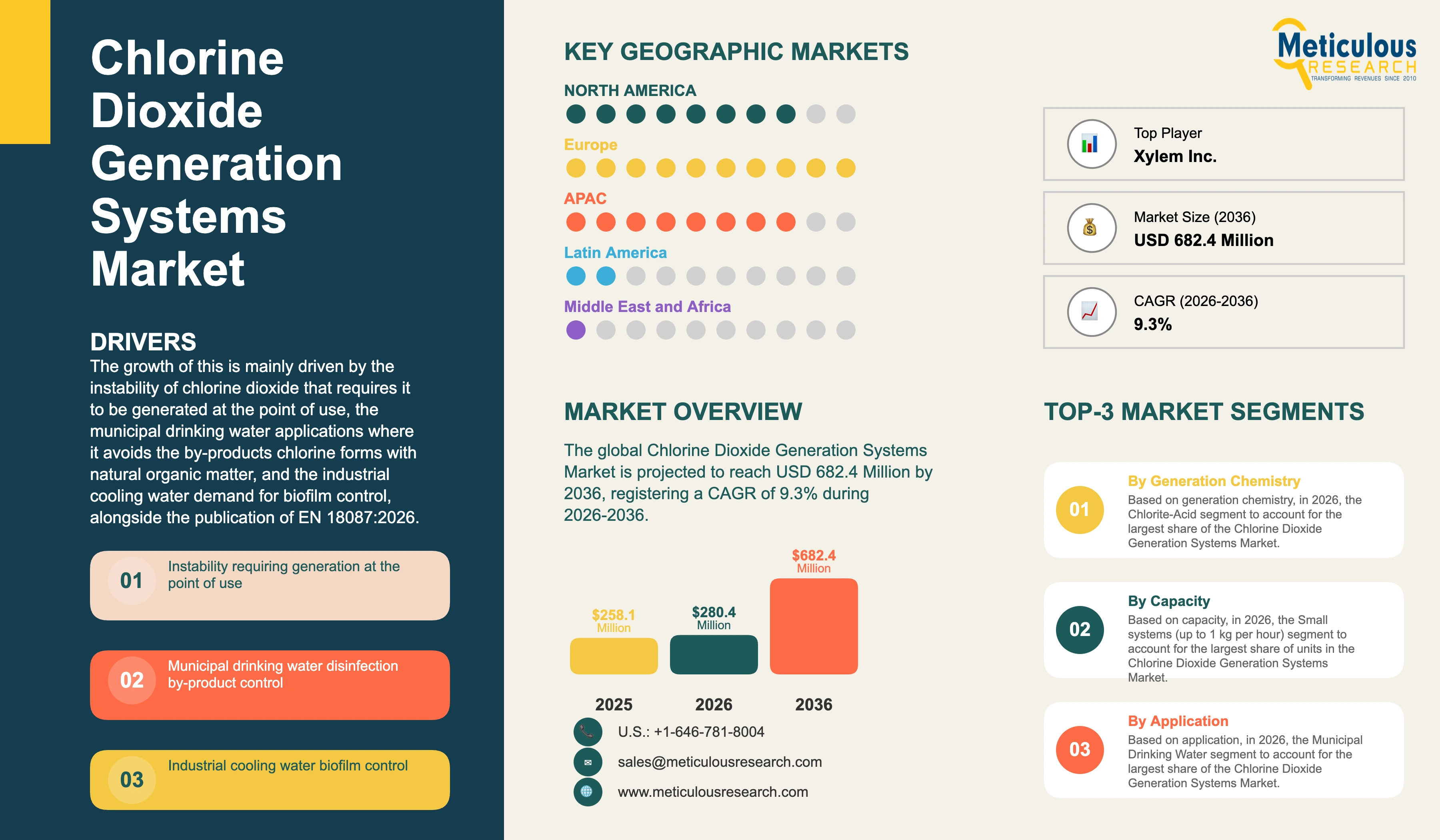
The global chlorine dioxide generation systems market was valued at USD 258.1 million in 2025. This market is expected to reach USD 682.4 million by 2036 from an estimated USD 280.4 million in 2026, registering a CAGR of 9.3% during the forecast period (2026-2036).
- Published
- Nov 2026
- Pages
- 263
- Format
- PDF + Excel
- Report ID
- MRCHM - 1042799
- Base year
- 2025
- 2025 · BASELINE
- $258.1M
- 2036
- $682.4M
- CAGR 2026–2036
- 9.3%
2025 baseline · 2026–2036 forecast at 9.3% CAGR · hover a bar for the value
Key highlights
The global chlorine dioxide generation systems market is estimated at USD 280.4 million in 2026 and is projected to reach USD 682.4 million by 2036.
Market volume is estimated at 11, 400 units in 2026 and is projected to reach 20,804 units by 2036 at a CAGR of 6.2%, measured as generation systems supplied.
The average selling price is estimated at USD 24, 600 per unit in 2026 and is projected to reach USD 32,800 per unit by 2036 as the mix shifts toward larger capacities and integrated control.
Chlorite-acid systems are expected to account for the largest generation chemistry share in 2026, while chlorate-peroxide systems are projected to register the highest CAGR of 13.0%.
Small systems up to 1 kg per hour are expected to hold the largest capacity share by units in 2026, while large systems above 20 kg per hour are projected to grow fastest at a CAGR of 12.0%.
Municipal drinking water is expected to be the largest application in 2026, while industrial cooling water is projected to register the highest CAGR of 11.4%.
Europe is expected to hold the largest regional share in 2026, while Asia-Pacific is projected to register the highest CAGR of 12.0%.
EN 18087:2026, titled Devices for in-situ generation of biocides - Chlorine dioxide generated from sodium chlorite by acidification or oxidation, was published on 20 January 2026, having been approved by CEN on 7 December 2025.
The standard was prepared by CEN/TC 164 Water supply, with the secretariat held by AFNOR and drafting by working group CEN/TC 164/WG 16.
Its European foreword requires national standards bodies to give it status and conflicting national standards to be withdrawn by July 2026.
The standard specifies requirements for dosing systems for chlorine dioxide generation, with the gas produced on site by automated mixing of chemical precursors for disinfection and oxidation of substances in water.
It covers three processes: the chlorite-acid process using sodium chlorite with hydrochloric acid in excess, the chlorite-chlorine gas process using chlorine gas or hypochlorous acid, and the chlorite-sodium peroxodisulphate process.
The text notes that sulphuric acid can be used in place of hydrochloric acid in the chlorite-acid process, with lower yield and more chlorate formation expected.
Its scope refers to EN 12671 for the suitability of chlorine dioxide in treating water intended for human consumption, and its introduction also names swimming pool filter rinse water, wastewater, air treatment and surface disinfection.
The standard addresses only generation from sodium chlorite, so the chlorate-based route used at larger industrial scale falls outside its scope, and it refers readers to the Biocidal Products Regulation for product authorisation requirements.
Ecolab describes its PURATE system as generating chlorine dioxide on site from a stabilised solution of about 40 weight per cent sodium chlorate and up to 8 weight per cent hydrogen peroxide, reduced under acidic conditions using sulfuric acid in an SVP-Pure generator.
That source states no chlorine gas is used or produced in the process, cites steel making, chemical production, power generation and pulp and paper among its applications, and describes distribution to up to four application points.
That source gives no yield, purity, conversion or capacity figures, no costs, and no dates other than a 2026 copyright notice.
This market measures the generation equipment and excludes the precursor chemicals it consumes, which account for most of the lifetime cost of ownership.
Report summary
| Particulars | Details |
|---|---|
| Base Year | 2025 |
| Forecast Period | 2026-2036 |
| Market Size in 2025 | USD 258.1 million |
| Market Size in 2026 | USD 280.4 million |
| Market Size by 2036 | USD 682.4 million |
| Value CAGR (2026-2036) | 9.3% |
| Format | PDF, Excel & Cloud Portal · 263 pages |
| Volume in 2026 | 11,400 units |
| Volume by 2036 | 20,804 units |
| Volume CAGR (2026-2036) | 6.2% |
| Volume Basis | Generation systems supplied, counted as units rather than as installed generation capacity |
| Average Selling Price in 2026 | USD 24,600 per unit |
| Average Selling Price by 2036 | USD 32,800 per unit |
| Price Direction | Average selling price rises across the forecast period because larger capacities and systems carrying integrated control, monitoring and multi-point distribution account for an increasing share of value, which is a mix shift rather than inflation in equipment prices |
| Unit Basis Note | Capacities in this market span three orders of magnitude, so a unit count weights the small end heavily while the value basis weights the large end; the two measures should be read together, since either alone gives a different view of where growth sits |
| Scope Definition Note | The precursor chemicals are excluded even though their cumulative cost over a service life exceeds the cost of the equipment at any meaningful duty, which is why the choice of generation chemistry is an operating cost decision taken ahead of the capital decision; those chemicals are counted in the markets for those materials |
| Measurement Basis | Chlorite-acid, chlorite-chlorine and hypochlorite, chlorite-peroxodisulphate, chlorate-peroxide and electrochemical generation systems, comprising the generator, precursor dosing and control and monitoring equipment, by generation chemistry, capacity, application and geography, and excluding the precursor chemicals consumed, stabilised chlorine dioxide solutions sold as liquid product, chlorine and hypochlorite generation equipment, and service and maintenance contracts |
| Relationship to Adjacent Markets | This market is not additive to the sodium chlorite, sodium chlorate or hydrogen peroxide markets, which measure the precursor chemicals the equipment consumes, nor to biocide active substance markets, since the active here is generated on site rather than supplied; adding equipment and precursor figures together would combine a capital market with a consumables market that turns over many times during the life of one installation |
| Standards Note | EN 18087:2026, Devices for in-situ generation of biocides - Chlorine dioxide generated from sodium chlorite by acidification or oxidation, was published on 20 January 2026 after CEN approval on 7 December 2025, prepared by CEN/TC 164 Water supply with drafting by CEN/TC 164/WG 16, and covers the chlorite-acid, chlorite-chlorine gas and chlorite-sodium peroxodisulphate processes; national standards bodies are required to give it status and withdraw conflicting national standards by July 2026, and because it addresses generation from sodium chlorite only, the chlorate-based route falls outside its scope |
| Largest Generation Chemistry | Chlorite-acid |
| Fastest-Growing Generation Chemistry | Chlorate-peroxide (CAGR 13.0%) |
| Largest Capacity | Small systems up to 1 kg per hour |
| Fastest-Growing Capacity | Large systems above 20 kg per hour (CAGR 12.0%) |
| Largest Application | Municipal drinking water |
| Fastest-Growing Application | Industrial cooling water (CAGR 11.4%) |
| Largest Region | Europe |
| Fastest-Growing Region | Asia-Pacific (CAGR 12.0%) |
| Segments Covered | Generation Chemistry, Capacity, Application, and Geography |
| Geographies Covered | Europe, Asia-Pacific, North America, Latin America, and Middle East & Africa |
| Companies Profiled | 6 companies, including Xylem Inc., Ecolab Inc., Industrie De Nora S.p.A., Grundfos Holding A/S, ProMinent GmbH, and Solenis LLC |
Report overview
Segments covered: generation chemistry, capacity, application.
In unit terms, this market is estimated at 11,400 units in 2026 and is projected to reach 20,804 units by 2036, registering a CAGR of 6.2% during the same period, measured as generation systems supplied rather than as installed generation capacity. The average selling price is estimated at USD 24,600 per unit in 2026 and is projected to rise to USD 32,800 per unit by 2036 as the mix shifts toward larger capacities and toward systems carrying integrated control and monitoring.
The growth of this market is mainly driven by the instability of chlorine dioxide that requires it to be generated at the point of use, the municipal drinking water applications where it controls disinfection by-product formation that chlorine does not, the industrial cooling water demand where biofilm control is the operating requirement, and the new European device standard that has formalised equipment requirements for the chlorite routes. However, factors such as the hazard classification and handling requirements of the precursor chemicals, the chlorate by-product limits that constrain process design in drinking water, the capital cost against simpler hypochlorite dosing, and the operator competence a generation system requires are expected to restrain the growth of this market to some extent.
Chlorite-acid systems account for the largest share of this market because the route is the simplest to operate at the small capacities that dominate unit numbers. Chlorate-peroxide systems grow fastest because starting from sodium chlorate rather than sodium chlorite changes the precursor economics at the larger capacities where chemical consumption dominates lifetime cost.
Chlorine dioxide generation systems are the on-site installations that produce chlorine dioxide from precursor chemicals at the point of use, comprising the reactor or generator, the precursor dosing and metering equipment, and the control, monitoring and safety systems around them. Market sizing in this report is on both a value basis in USD and a unit basis measured as generation systems supplied, with average selling price derived from the two. The measurement basis covers chlorite-acid, chlorite-chlorine and hypochlorite, chlorite-peroxodisulphate, chlorate-peroxide and electrochemical systems, and it excludes the precursor chemicals consumed, stabilised chlorine dioxide solutions sold as liquid product, chlorine and hypochlorite generation equipment, and service and maintenance contracts.
Counting systems rather than installed capacity is a deliberate choice and it has a consequence worth stating. Capacities in this market span three orders of magnitude, from a small unit dosing a building water system to an installation serving a pulp mill, so a unit count weights the small end heavily while the value basis weights the large end. Reading the two together rather than either alone is what describes this market accurately, and the rising average selling price across the forecast period reflects a shift in that mix rather than inflation in equipment prices.
Excluding the precursor chemicals matters more here than in most equipment markets. A generation system consumes sodium chlorite or sodium chlorate continuously for its service life, and the cumulative cost of those chemicals exceeds the cost of the equipment by a wide margin at any meaningful duty, which is why the choice of generation chemistry is an operating cost decision dressed as a capital one. The chemicals are counted in the markets for those materials rather than here.
EN 18087:2026, titled Devices for in-situ generation of biocides - Chlorine dioxide generated from sodium chlorite by acidification or oxidation, was published on 20 January 2026 after CEN approved the text on 7 December 2025. It was prepared by CEN/TC 164 Water supply, with the secretariat held by AFNOR and drafting by CEN/TC 164/WG 16, and its European foreword requires national standards bodies to give it status and conflicting national standards to be withdrawn by July 2026. It specifies requirements for dosing systems for chlorine dioxide generation, with the gas produced on site by automated mixing of chemical precursors for disinfection and oxidation of substances in water.
The standard covers three processes and their titles describe the boundary of this market precisely. The chlorite-acid process reacts sodium chlorite with hydrochloric acid in excess, the chlorite-chlorine gas process reacts sodium chlorite with chlorine gas or hypochlorous acid or alternatively with sodium hypochlorite and hydrochloric acid, and the chlorite-sodium peroxodisulphate process reacts sodium chlorite with sodium peroxodisulphate. Its scope refers to EN 12671 for the suitability of chlorine dioxide in water intended for human consumption, and its introduction also names swimming pool filter rinse water, wastewater, air treatment and surface disinfection.
What the title excludes is as significant as what it covers. The standard addresses generation from sodium chlorite only, so the chlorate-based route used at larger industrial scale sits outside its scope entirely, and European device requirements therefore formalise one side of this market while leaving the other to company specification and application-specific rules. A buyer comparing a chlorite and a chlorate system in 2026 is comparing one against a published European standard and one against neither.
Ecolab describes its PURATE system as producing chlorine dioxide on site from a stabilised solution of about 40 weight per cent sodium chlorate with up to 8 weight per cent hydrogen peroxide, reduced under acidic conditions with sulfuric acid in an SVP-Pure generator, stating that no chlorine gas is used or produced and that distribution reaches up to four application points. Applications named include steel making, chemical production, power generation and pulp and paper. That source gives no yield, purity, conversion or capacity figures, no costs, and no dates other than a 2026 copyright notice, and offers only a qualitative economic comparison with the chlorite route.
Instability is the reason this market exists at all. Chlorine dioxide decomposes and cannot be compressed, shipped or stored in concentrated form the way chlorine or hypochlorite can, so a user wanting the oxidant has to buy a plant rather than a drum, and the equipment decision is inseparable from the chemistry decision. That is an unusual structure in water treatment, where most oxidants are delivered rather than made.
Municipal drinking water is the largest application because the oxidant solves a problem chlorine creates. Chlorine reacts with natural organic matter to form trihalomethanes and haloacetic acids that are regulated in treated water, chlorine dioxide does not form them in the same way, and it holds activity across a wider pH range, which matters in systems where chlorine performs poorly. Municipal drinking water accordingly accounts for the largest application share throughout the period.
Chlorate is the by-product that constrains how a drinking water system can be designed and operated. The standard itself notes that substituting sulphuric acid for hydrochloric acid in the chlorite-acid process gives lower yield and more chlorate formation, and because chlorate is itself subject to limits in treated water, the acid choice is a water quality decision rather than a procurement preference. Yield and by-product formation are therefore design parameters with regulatory consequence.
Industrial cooling water is the fastest-growing application and it buys for a different reason. Biofilm in a cooling circuit reduces heat transfer and shelters corrosion, chlorine dioxide penetrates biofilm more effectively than chlorine at the concentrations used, and it is less consumed by ammonia and organic load in recirculating water. The applications Ecolab names, from steel making to power generation, are the large continuous duties where that advantage compounds. Industrial cooling water consequently registers the highest application CAGR at 11.4%.
Precursor handling is the restraint a buyer weighs against the performance. Sodium chlorite and sodium chlorate are oxidising agents with their own storage, segregation and incompatibility requirements, the chlorite-chlorine route involves chlorine gas or hypochlorite, and a generation system therefore brings a chemical hazard inventory onto a site that a delivered oxidant would not. The chlorate-peroxide route is positioned against that, with no chlorine gas used or produced.
This market is not additive to the markets for sodium chlorite, sodium chlorate or hydrogen peroxide, which measure the precursor chemicals the equipment consumes rather than the equipment itself, and it is not additive to biocide active substance markets, since the active here is generated on site rather than supplied. Adding equipment and precursor figures together would combine a capital market with a consumables market that turns over many times during the life of a single installation.
Europe is expected to account for the largest share in 2026, on the established use of chlorine dioxide in municipal drinking water, the equipment suppliers based there, legionella control requirements, and the device standardisation work that produced EN 18087:2026. Germany is projected to grow at 8.6%, Italy at 8.4% and France at 8.0%.
Asia-Pacific is projected to register the highest CAGR of 12.0% during the forecast period, with India at 13.6% and China at 12.4%.
Europe holds the largest share, with Germany growing at 8.6%, on established municipal use, resident equipment suppliers, legionella control requirements in building water systems, and the publication of EN 18087:2026 through CEN/TC 164, which allows procurement against a common European device requirement.
The Middle East & Africa is projected to grow at a CAGR of 8.0%, with Saudi Arabia at 8.4%, on industrial water and desalination-related duties. Latin America is projected to grow at a CAGR of 9.0%, with Brazil at 9.0%, on pulp capacity and municipal investment.
Xylem Inc., Ecolab Inc., Industrie De Nora S.p.A., Grundfos Holding A/S and ProMinent GmbH together accounted for an estimated 54.2% of this market in 2026. The 6 companies profiled in this report together accounted for an estimated 61.8%.
Report infographic
Market dynamics
14 factors across 5 forcesInstability Requiring Generation at the Point of Use
Chlorine dioxide decomposes and cannot be compressed, shipped or stored in concentrated form, so a user wanting the oxidant must install a plant rather than take delivery of a drum, and EN 18087:2026 describes the gas as produced on site by automated mixing of chemical precursors.
That makes the equipment decision inseparable from the chemistry decision and gives this market a structural position that most water treatment oxidants, which are delivered rather than made, do not create.
It also means a buyer acquires an operating liability alongside an asset, since the plant must run whenever the oxidant is wanted, which ties equipment reliability directly to treatment compliance.
No competing oxidant shares that constraint, so the equipment requirement is intrinsic to the chemistry rather than a feature of how the market happens to be organised.
Municipal Drinking Water Applications Controlling Disinfection By-Products
Chlorine reacts with natural organic matter to form trihalomethanes and haloacetic acids that are regulated in treated water, chlorine dioxide does not form them in the same way, and it retains activity across a wider pH range than chlorine, which matters in systems where chlorine performs poorly.
EN 18087:2026 refers in its scope to EN 12671 for the suitability of chlorine dioxide in treating water intended for human consumption, and municipal drinking water accordingly holds the largest application share.
Residual stability in distribution is a further advantage, since the oxidant persists through a network without the taste and odour complaints that chlorine generates at comparable residuals.
Activity against the organisms implicated in legionella control is a further reason building water systems adopt it, which accounts for a large share of the small-capacity unit numbers.
Industrial Cooling Water Biofilm Control
Biofilm in a cooling circuit reduces heat transfer and shelters corrosion beneath it, chlorine dioxide penetrates biofilm more effectively than chlorine at the concentrations used, and it is less consumed by ammonia and organic load in recirculating water, which is why Ecolab names steel making, chemical production, power generation and pulp and paper among the duties its system serves.
Those are large continuous applications where the performance advantage compounds over a year of operation, and industrial cooling water registers the highest application CAGR at 11.4%.
Cooling duties also run continuously and at large water volumes, so the oxidant demand per site is high and the installation is sized accordingly, which is why this application carries a disproportionate share of value relative to its unit count.
Avoided downtime from fouling is also easy for an operator to quantify, which makes the business case simpler than it is for a municipal compliance duty.
A Published European Device Standard for the Chlorite Routes
EN 18087:2026 was published on 20 January 2026 after CEN approval on 7 December 2025, prepared by CEN/TC 164 Water supply with drafting by CEN/TC 164/WG 16, and its foreword requires national standards bodies to give it status and conflicting national standards to be withdrawn by July 2026.
A published device standard lets a utility specify equipment against a common requirement rather than against a supplier description, which lowers the procurement burden and favours suppliers able to demonstrate conformity.
A common reference also reduces the technical evaluation each utility must perform independently, which shortens procurement cycles across the region it applies in.
Having a published requirement also gives a supplier a defined target to design against rather than anticipating what each national authority may expect.
All four drivers rest on the oxidant doing something chlorine cannot, or on the equipment requirement that follows from its instability, rather than on cost.
Each also acts independently of the others, so the market does not depend on any single application or regulatory driver continuing.
Table of contents
11 chapters · 135 sections · 263 pages · click to expandSegmental analysis
| Segment | Largest share (2026) | Fastest growth (2026–2036) |
|---|---|---|
| By Generation Chemistry | Chlorite-acid | Chlorate-peroxide |
| By Capacity | Capacity | Large systems segment above 20 kg per hour |
| By Application | Municipal drinking water | Industrial cooling water |
| Other segments | Small systems up to 1 kg per hour | Large systems above 20 kg per hour |
By Generation Chemistry
- Chlorine Dioxide Generation Systems Analysis by Generation Chemistry
- The chlorite-acid segment is expected to account for the largest share of the global chlorine dioxide generation systems market.
- The large share of this segment is mainly due to the simplicity of reacting sodium chlorite with hydrochloric acid at the small capacities that dominate unit numbers, the wide installed base in building water and municipal applications, and its inclusion as the first of the three processes specified in EN 18087:2026.
- However, the chlorate-peroxide segment is projected to register the highest CAGR of 13.0% during the forecast period.
- The rapid growth of this segment is attributed to sodium chlorate reduced by hydrogen peroxide changing the precursor cost structure at larger duties where chemical consumption dominates lifetime cost, and to the route using and producing no chlorine gas.
- Chlorite-chlorine and hypochlorite systems deliver higher yield at larger capacities but introduce chlorine gas or hypochlorite handling.
- Chlorite-peroxodisulphate systems serve duties where acid handling is to be avoided.
- Electrochemical systems remain small.
- Generation chemistry determines the precursor inventory a site must hold, the by-product profile it must manage and whether the equipment falls within the new European standard, so the axis carries regulatory as well as technical meaning.
- Generation chemistry also determines the precursor supply relationship a site must maintain, since sodium chlorite and sodium chlorate are produced by different manufacturers with different logistics and different price behaviour.
- A route choice is therefore a decision about which chemical market to be exposed to for the life of the installation, which is part of why it is taken ahead of the equipment selection rather than alongside it.
- Yield differences between the routes also translate directly into precursor consumption per unit of oxidant delivered, which compounds over a service life.
- Chlorite-acid systems are expected to account for the largest share in 2026, on the simplicity of reacting sodium chlorite with hydrochloric acid at the small capacities that dominate unit numbers.
- Chlorate-peroxide systems are projected to register the highest CAGR of 13.0% during the forecast period.
By Capacity
- Chlorine Dioxide Generation Systems Analysis by Capacity
- The small systems segment up to 1 kg per hour is expected to account for the largest share of units in the global chlorine dioxide generation systems market.
- The large share of this segment is mainly due to the number of building water systems, small municipal works, food processing lines and legionella control duties served by modest output, each requiring its own generator.
- However, the large systems segment above 20 kg per hour is projected to register the highest CAGR of 12.0% during the forecast period.
- The rapid growth of this segment is attributed to industrial cooling water and pulp bleaching duties where a single installation serves a whole plant, and where the operating cost advantage of chlorine dioxide is large enough in absolute terms to justify the capital.
- Medium systems between 1 and 20 kg per hour serve larger municipal works and mid-sized industrial duties.
- Capacity is where the unit basis and the value basis diverge most sharply in this market, since small systems dominate the count while large systems carry a disproportionate share of value, and a reader taking either measure alone would form a different view of where growth sits.
- Capacity also determines the commercial model, since small systems are sold as catalogue equipment through distribution while large installations are engineered, specified and tendered individually alongside a chemical supply arrangement.
- Those are different businesses with different margins and different sales cycles, which is why suppliers tend to be strong at one end of this axis rather than across it.
- Turndown matters as much as rated output, since a system serving a variable duty must hold conversion at part load rather than only at design point.
By Application
- Chlorine Dioxide Generation Systems Analysis by Application
- The municipal drinking water segment is expected to account for the largest share of the global chlorine dioxide generation systems market.
- The large share of this segment is mainly due to chlorine dioxide not forming the trihalomethanes and haloacetic acids that chlorine produces with natural organic matter, its activity across a wider pH range, and the reference in EN 18087:2026 to EN 12671 for water intended for human consumption.
- However, the industrial cooling water segment is projected to register the highest CAGR of 11.4% during the forecast period.
- The rapid growth of this segment is attributed to chlorine dioxide penetrating biofilm more effectively than chlorine at the concentrations used and being less consumed by ammonia and organic load in recirculating water, across the steel, chemical, power and pulp duties named by suppliers.
- Pulp and paper bleaching consumes the largest tonnage of the oxidant but through a small number of very large installations.
- Food and beverage processing uses it in process and rinse water.
- Wastewater, oil and gas, and air and surface disinfection make up the balance, the last two named in the introduction to EN 18087:2026.
- Application determines the capacity required and therefore which chemistry is economic, which is why these three axes cannot be read independently.
- Application also determines how the oxidant is valued.
- A municipal utility buys compliance with a by-product limit, an industrial operator buys heat transfer efficiency and avoided corrosion, and a food processor buys a rinse that leaves no residue, so three buyers of the same equipment justify it against three unrelated benefits and respond to entirely different arguments.
- Pulp bleaching sits apart again, consuming the largest tonnage of oxidant through the smallest number of installations.
- Reading the three axes together is what identifies a given opportunity, since the application sets the capacity, the capacity sets which chemistry is economic, and the chemistry determines whether the equipment falls within the European standard.
Other segments
- Small systems up to 1 kg per hour are expected to hold the largest share of units in 2026, on the number of building water, small municipal, food processing and legionella control duties served by modest output.
- Large systems above 20 kg per hour are projected to register the highest CAGR of 12.0% during the forecast period.
- Municipal drinking water is expected to account for the largest share in 2026, since chlorine dioxide does not form the trihalomethanes and haloacetic acids that chlorine produces with natural organic matter and holds activity across a wider pH range.
- Industrial cooling water is projected to register the highest CAGR of 11.4% during the forecast period.
Geographic analysis
Asia-Pacific
Largest shareMunicipal water treatment capacity and industrial cooling duty are both expanding faster in Asia-Pacific than in the mature regions, and a new installation can specify chlorine dioxide from the outset rather than retrofitting it into a plant designed around chlorine. Asia-Pacific is accordingly projected to register the highest regional CAGR at 12.0%, with India at 13.6% and China at 12.4%, against Europe holding the largest share. Industrial cooling duty in steel, chemical and power generation is also expanding in the region, so a supplier can serve municipal and industrial customers from the same position. New works can also size chemical storage and segregation into the layout from the start, which avoids the retrofit constraint that limits conversions at existing plants. Three of these four openings raise value per installation rather than unit numbers, which is why value grows at half again the unit rate across the forecast period. Only the fourth would raise unit numbers materially, and it depends on where water infrastructure is being built rather than on anything a supplier controls. However, Asia-Pacific is projected to register the highest CAGR of 12.0% during the forecast period. The rapid growth of this region is attributed to municipal water treatment capacity being added rather than replaced, so chlorine dioxide can be specified from the outset rather than retrofitted into plants designed around chlorine, together with industrial cooling duty in steel, chemical and power generation and a growing pulp industry. India is projected to register a CAGR of 13.6% and China a CAGR of 12.4%. Asia-Pacific Municipal and Industrial Water Investment Geographic Analysis
Europe
In 2026, Europe is expected to account for the largest share of the global chlorine dioxide generation systems market. The large share of this region is mainly due to the established use of chlorine dioxide in municipal drinking water treatment, the equipment suppliers based there, the legionella control requirements applied to building water systems, and the device standardisation work that produced EN 18087:2026 through CEN/TC 164 with the secretariat held by AFNOR. Germany is projected to register a CAGR of 8.6%, Italy a CAGR of 8.4% and France a CAGR of 8.0% during the forecast period.
North America
North America is projected to grow at 8.0%, with the United States at 8.0%, on municipal disinfection by-product management, industrial cooling water and pulp bleaching, under its own regulatory framework rather than the European standard described here. North America operates under its own registration and drinking water framework rather than the European standard, so conformity arguments do not transfer between the two regions. Capacity being added rather than replaced is therefore the single best indicator of where this market grows, and it is also why Asia-Pacific outpaces the regions with the larger installed base.
Latin America
Latin America is projected to grow at 9.0%, with Brazil at 9.0%, on pulp capacity and municipal investment.
Middle East & Africa
Fastest growthThe Middle East & Africa is projected to grow at 8.0%, with Saudi Arabia at 8.4%, on industrial water and desalination-related duties. Regional differences in this market are driven by whether plants are being built or maintained rather than by equipment availability. A new treatment works can be designed around chlorine dioxide and size its chemical storage accordingly, while an existing works converting from chlorine must fit a generator and a precursor inventory into a site laid out for something else. That is why the fastest growth sits where capacity is being added and the largest installed base sits where it already exists. Replacement of an existing installation is also a different sale from a first installation, since the precursor route and site layout are already fixed, which favours the incumbent supplier.
Competitive landscape
The global chlorine dioxide generation systems market is characterised by water technology groups supplying municipal and industrial equipment, dosing specialists holding the small-capacity positions, and chemical service companies selling generation as part of a treatment programme. Competition is contested on precursor economics, control capability and conformity to device requirements rather than on equipment price, because the chemicals consumed over a service life cost more than the generator. Xylem Inc., Ecolab Inc., Industrie De Nora S.p.A., Grundfos Holding A/S and ProMinent GmbH together accounted for an estimated 54.2% of this market in 2026, while the companies profiled in this report together accounted for an estimated 61.8%.
Standardisation rather than capacity accounted for the significant development through 2026. EN 18087:2026 was published on 20 January 2026 after CEN approval on 7 December 2025, prepared by CEN/TC 164 Water supply with drafting by CEN/TC 164/WG 16, specifying requirements for dosing systems across the chlorite-acid, chlorite-chlorine gas and chlorite-sodium peroxodisulphate processes, with national standards bodies required to give it status and conflicting national standards withdrawn by July 2026. Because the standard addresses generation from sodium chlorite only, chlorate-based systems fall outside its scope.
Ecolab describes its PURATE programme as generating the oxidant from a stabilised solution of about 40 weight per cent sodium chlorate with up to 8 weight per cent hydrogen peroxide, reduced with sulfuric acid in an SVP-Pure generator, with no chlorine gas used or produced and distribution to up to four application points, while giving no yield, conversion, capacity or cost figures. Xylem Inc. holds the Evoqua water technologies businesses it acquired, and Industrie De Nora S.p.A. supplies under the Capital Controls brand. Some of the key players operating in the chlorine dioxide generation systems market are Xylem Inc. (U.S.), Ecolab Inc. (U.S.), Industrie De Nora S.p.A. (Italy), Grundfos Holding A/S (Denmark), ProMinent GmbH (Germany), and Solenis LLC (U.S.), among others.
Service capability also weighs heavily in the award even though maintenance contracts fall outside the scope measured here, because the equipment makes a hazardous oxidant continuously.
Replacement of an installed system is also a narrower contest than a first installation, since the precursor route and the site layout are already fixed and favour whoever supplied the original plant.
- —
EN 18087:2026, titled Devices for in-situ generation of biocides - Chlorine dioxide generated from sodium chlorite by acidification or oxidation, was published on 20 January 2026 after CEN approved the text on 7 December 2025. It was prepared by CEN/TC 164 Water supply with the secretariat held by AFNOR and drafting by CEN/TC 164/WG 16, and its European foreword requires national standards bodies to give it status and conflicting national standards to be withdrawn by July 2026. The standard specifies requirements for dosing systems for chlorine dioxide generation, with the gas produced on site by automated mixing of chemical precursors for disinfection and oxidation of substances in water, and covers the chlorite-acid process using sodium chlorite with hydrochloric acid in excess, the chlorite-chlorine gas process using chlorine gas or hypochlorous acid or alternatively sodium hypochlorite with hydrochloric acid, and the chlorite-sodium peroxodisulphate process; the text notes that sulphuric acid can replace hydrochloric acid with lower yield and more chlorate formation expected. Its scope refers to EN 12671 for the suitability of chlorine dioxide in water intended for human consumption, its introduction also names swimming pool filter rinse water, wastewater, air treatment and surface disinfection, it refers readers to the Biocidal Products Regulation for product authorisation, and because it addresses generation from sodium chlorite only, the chlorate-based route used at larger industrial scale falls outside its scope. Ecolab describes its PURATE system as generating the oxidant on site from a stabilised solution of about 40 weight per cent sodium chlorate and up to 8 weight per cent hydrogen peroxide reduced under acidic conditions with sulfuric acid in an SVP-Pure generator, states that no chlorine gas is used or produced, names steel making, chemical production, power generation and pulp and paper among its applications and describes distribution to up to four application points, while giving no yield, purity, conversion or capacity figures, no costs, and no dates other than a 2026 copyright notice.
- Xylem Inc.
- Ecolab Inc.
- Industrie De Nora S.p.A
- Grundfos Holding A/S
- ProMinent GmbH
- Solenis LLC
Expert perspectives
Value grows at 9.3% against 6.2% in units over the forecast period, and the average selling price rises from USD 24,600 per unit in 2026 to USD 32,800 per unit by 2036. That gap is a mix shift rather than price inflation: larger capacities and more instrumentation account for an increasing share of value while unit numbers remain dominated by small systems.
The development that matters most in 2026 is the arrival of a published European device standard. EN 18087:2026 appeared on 20 January 2026 after CEN approval on 7 December 2025, and its foreword requires national standards bodies to give it status with conflicting national standards withdrawn by July 2026, which replaces a patchwork of national documents with one reference a utility can specify against.
Its title also draws a line through this market. The standard addresses chlorine dioxide generated from sodium chlorite by acidification or oxidation, and covers three processes on that basis, so the chlorate route used at larger industrial scale falls outside its scope. A buyer in 2026 comparing a chlorite and a chlorate system is comparing one against a published European standard and one against company specification.
That split matters commercially because the two routes compete on different ground. At small duties the chlorite-acid process is simplest and dominates unit numbers; at larger duties chemical consumption exceeds equipment cost by a wide margin, which is where sodium chlorate reduced by hydrogen peroxide competes on operating economics, and why chlorate-peroxide systems grow fastest at 13.0% while chlorite-acid holds the largest share.
The technical detail with the most regulatory weight is a note in the standard itself: substituting sulphuric acid for hydrochloric acid in the chlorite-acid process gives lower yield and more chlorate formation. Since chlorate is subject to limits in treated drinking water, the acid choice is a water quality decision, and yield and by-product formation become design parameters rather than efficiency preferences.
For a supplier the implication is that the generator is the smaller part of the sale. Chemicals consumed over a service life outweigh the equipment, control and data capability is where equipment value is added around an unchanged reaction, and conformity is becoming a procurement requirement. This market measures the equipment and is not additive to the sodium chlorite, sodium chlorate or hydrogen peroxide markets it consumes.
Reading the unit and value measures together is therefore essential in this market, since the two point to different segments as the source of growth.
Customer perspectives
Chlorine dioxide does not form the trihalomethanes and haloacetic acids that chlorine produces with natural organic matter, while chlorate formed in the generation process is itself subject to limits in treated water, so process configuration carries water quality consequence.
EN 18087:2026 notes that sulphuric acid in place of hydrochloric acid gives lower yield and more chlorate formation.
Acid selection therefore sits with the water quality team rather than with procurement, which is unusual for what appears to be a consumable choice.
Precursor chemical consumption over a service life exceeds the cost of the equipment by a wide margin at continuous industrial duty, so the generation chemistry is an operating cost decision taken ahead of the equipment selection.
A supplier offering chemistry and equipment as one programme is consequently negotiating against ten years of consumption rather than a capital line.
EN 18087:2026 specifies requirements for dosing systems across three chlorite processes, with conflicting national standards to be withdrawn by July 2026, which allows procurement against a common reference rather than against supplier descriptions.
Equipment whose process falls outside the three the standard specifies has to be justified separately in such a tender.
Procurement against a common document also allows a smaller supplier to compete on conformity rather than on reputation.
“We moved to it because of by-product limits, not because it disinfects better. Then we discovered the chlorate we generate is regulated too, so the acid we choose is a compliance decision.”
“The generator is a rounding error next to ten years of chemical. That is what we actually negotiate, and it is why the precursor route decides the tender.”
“Until now every supplier described its own device its own way. A European standard means we can write a specification and compare like with like.”
Frequently asked questions
This market was valued at USD 236.6 million in 2024 and USD 258.1 million in 2025, and is estimated at USD 280.4 million in 2026. In unit terms it is estimated at 11,400 units in 2026 as generation systems supplied.
This market is projected to reach USD 682.4 million by 2036 in value and 20,804 units in units.
This market is projected to register a value CAGR of 9.3% and a unit CAGR of 6.2% during the forecast period 2026-2036. The average selling price is projected to move from USD 24,600 per unit in 2026 to USD 32,800 per unit by 2036 as the capacity and content mix shifts.
Growth is driven by the instability of chlorine dioxide that requires generation at the point of use, the municipal drinking water applications where it avoids the by-products chlorine forms with natural organic matter, the industrial cooling water demand for biofilm control, and the publication of EN 18087:2026 on 20 January 2026 as a European device standard for the chlorite routes.
Sodium chlorite and sodium chlorate are oxidising agents with their own handling requirements, and the chlorite-chlorine route adds chlorine gas or hypochlorite. Chlorate formed in generation is subject to limits in treated drinking water, capital cost exceeds hypochlorite dosing, and a generation system requires operator competence.
Chlorate-peroxide systems compete on precursor economics at larger capacities, and conformity to EN 18087:2026 becomes a procurement advantage as conflicting national standards are withdrawn by July 2026. Integrated control, monitoring and multi-point distribution add equipment value, and Asia-Pacific water investment allows specification from the outset.
Chlorite-acid systems are expected to account for the largest share in 2026, on the simplicity of reacting sodium chlorite with hydrochloric acid at the small capacities that dominate unit numbers.
Chlorate-peroxide systems are projected to register the highest CAGR of 13.0% during the forecast period.
Small systems up to 1 kg per hour are expected to hold the largest share of units in 2026, on the number of building water, small municipal, food processing and legionella control duties served by modest output.
Large systems above 20 kg per hour are projected to register the highest CAGR of 12.0% during the forecast period.
Municipal drinking water is expected to account for the largest share in 2026, since chlorine dioxide does not form the trihalomethanes and haloacetic acids that chlorine produces with natural organic matter and holds activity across a wider pH range.
Industrial cooling water is projected to register the highest CAGR of 11.4% during the forecast period.
Europe is expected to account for the largest share in 2026, on the established use of chlorine dioxide in municipal drinking water, the equipment suppliers based there, legionella control requirements, and the device standardisation work that produced EN 18087:2026. Germany is projected to grow at 8.6%, Italy at 8.4% and France at 8.0%.
Asia-Pacific is projected to register the highest CAGR of 12.0% during the forecast period, with India at 13.6% and China at 12.4%.
Europe holds the largest share, with Germany growing at 8.6%, on established municipal use, resident equipment suppliers, legionella control requirements in building water systems, and the publication of EN 18087:2026 through CEN/TC 164, which allows procurement against a common European device requirement.
The Middle East & Africa is projected to grow at a CAGR of 8.0%, with Saudi Arabia at 8.4%, on industrial water and desalination-related duties. Latin America is projected to grow at a CAGR of 9.0%, with Brazil at 9.0%, on pulp capacity and municipal investment.
Xylem Inc., Ecolab Inc., Industrie De Nora S.p.A., Grundfos Holding A/S and ProMinent GmbH together accounted for an estimated 54.2% of this market in 2026. The 6 companies profiled in this report together accounted for an estimated 61.8%.
EN 18087:2026, a European standard for devices for in-situ generation of chlorine dioxide from sodium chlorite, was published on 20 January 2026 after CEN approval on 7 December 2025. National standards bodies must give it status and withdraw conflicting national standards by July 2026, and the chlorate-based route falls outside its scope.
Cite this report
Meticulous Research. (2026). Chlorine Dioxide Generation Systems Market - Global Opportunity Analysis and Industry Forecast (2026-2036) (Report No. MRCHM - 1042799). Meticulous Market Research Pvt. Ltd. https://www.meticulousresearch.com/product/chlorine-dioxide-generation-systems-market-7482