High Heat Polylactic Acid Market (2026-2036)
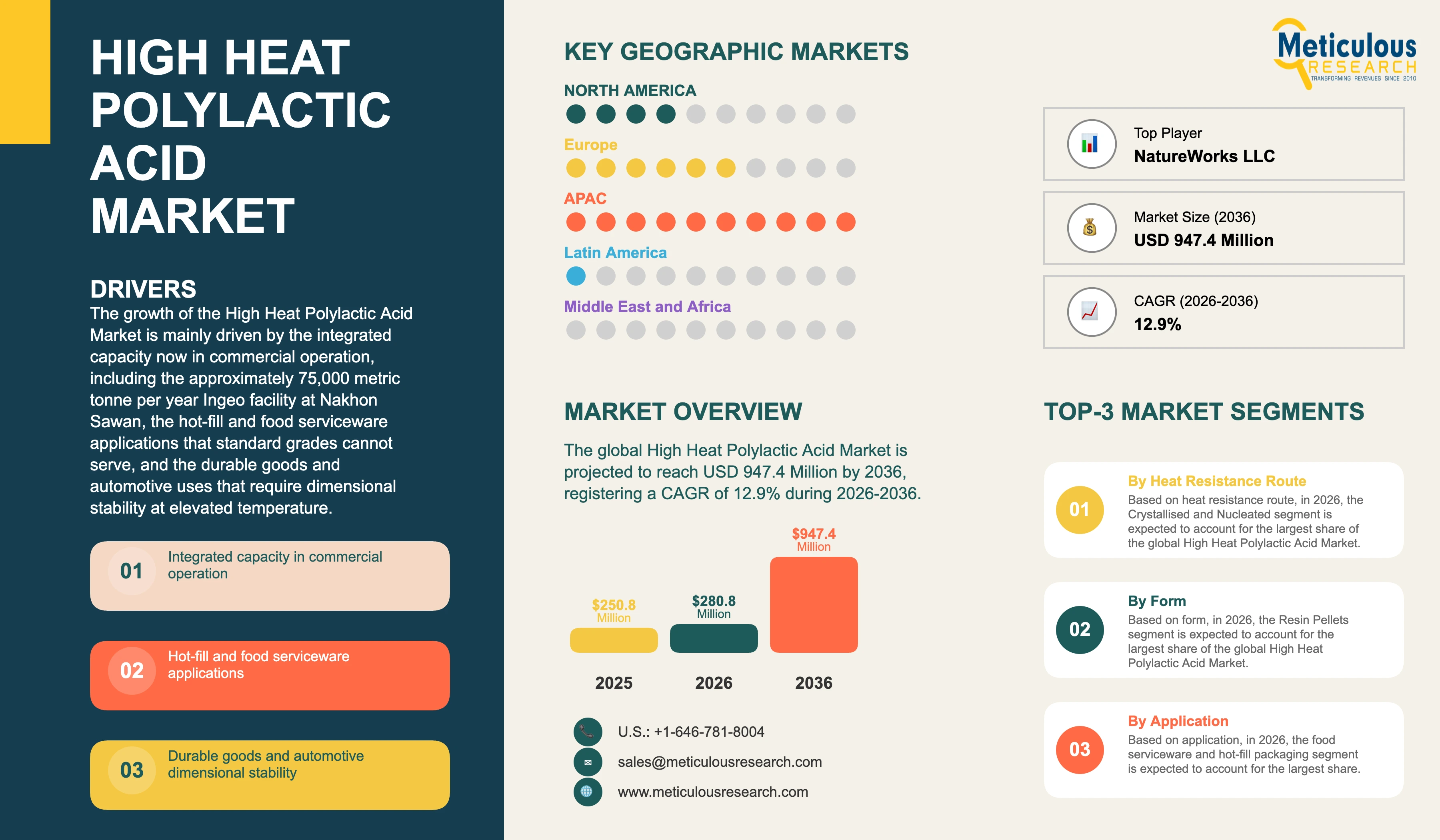
The global high heat polylactic acid market was valued at USD 250.8 million in 2025. This market is expected to reach USD 947.4 million by 2036 from an estimated USD 280.8 million in 2026, registering a CAGR of 12.9% during the forecast period (2026-2036).
- Published
- Nov 2026
- Pages
- 273
- Format
- PDF + Excel
- Report ID
- MRCHM - 1042690
- Base year
- 2025
- 2025 · BASELINE
- $250.8M
- 2036
- $947.4M
- CAGR 2026–2036
- 12.9%
2025 baseline · 2026–2036 forecast at 12.9% CAGR · hover a bar for the value
Key highlights
The global high heat polylactic acid market is estimated at USD 280.8 million in 2026 and is projected to reach USD 947.4 million by 2036.
Market volume is estimated at 78.00 kilotons in 2026 and is projected to reach 326.70 kilotons by 2036 at a CAGR of 15.4%, measured as resin and compound supplied.
The average selling price is estimated at USD 3.60 per kg in 2026 and is projected to reach USD 2.90 per kg by 2036 as the premium over standard grades narrows.
Crystallised and nucleated grades are expected to account for the largest heat resistance route share in 2026, while stereocomplex polylactic acid is projected to register the highest CAGR of 24.0%.
Resin pellets are expected to hold the largest form share in 2026, while compounds and masterbatch are projected to grow fastest at a CAGR of 14.4%.
Food serviceware and hot-fill packaging are expected to be the largest application in 2026, while automotive interior components are projected to register the highest CAGR of 20.0%.
Asia-Pacific is expected to hold the largest regional share in 2026, while Europe is projected to register the highest CAGR of 15.0%.
NatureWorks LLC announced the grand opening of a fully integrated Ingeo biopolymer manufacturing facility at Nakhon Sawan in Thailand, within the Nakhon Sawan BioComplex.
The facility has a capacity of approximately 75, 000 metric tons per year of Ingeo biopolymer and is designed to produce the full range of Ingeo grades.
Full integration at the site combines lactic acid production, lactide monomer production and polymer manufacturing in one complex.
Lactic acid at the site is made from locally sourced sugarcane, and the company states that the carbon in the polymer comes from annually renewable resources.
The company states that the polymer has a carbon-neutral to net-negative profile based on life cycle assessment data.
Markets named include flexible packaging, compostable food serviceware, nonwoven fibres and 3D printing, alongside broader packaging, fibre and consumer uses.
NatureWorks LLC is jointly owned by PTT Global Chemical and Cargill, and the grand opening ceremony marked the start of full commercial operations.
The release does not state the investment amount, the number of jobs created, the construction timeline or the exact start date of operations.
The release names no high heat or performance grade specifically, referring only to the full portfolio of Ingeo grades.
This market is a fraction of the total polylactic acid market rather than an addition to it, and is not additive to the lactic acid and lactide markets upstream.
Report summary
| Particulars | Details |
|---|---|
| Base Year | 2025 |
| Forecast Period | 2026-2036 |
| Market Size in 2025 | USD 250.8 million |
| Market Size in 2026 | USD 280.8 million |
| Market Size by 2036 | USD 947.4 million |
| Value CAGR (2026-2036) | 12.9% |
| Format | PDF, Excel & Cloud Portal · 273 pages |
| Volume in 2026 | 78.00 kilotons |
| Volume by 2036 | 326.70 kilotons |
| Volume CAGR (2026-2036) | 15.4% |
| Volume Basis | High heat polylactic acid resin and compound supplied |
| Average Selling Price in 2026 | USD 3.60 per kg |
| Average Selling Price by 2036 | USD 2.90 per kg |
| Price Direction | Average selling price declines across the forecast period as integrated capacity expands and the premium over standard polylactic acid grades narrows, rather than through any change in grade specification |
| Scope Definition Note | The boundary is set by specified service temperature rather than by chemistry, because the same resin performs very differently crystallised and quenched, so the measure follows grades sold for elevated-temperature use and the compounds formulated for them rather than every tonne of polymer that could in principle be crystallised |
| Measurement Basis | Polylactic acid grades and compounds specified for elevated-temperature service by heat resistance route, form and application, and excluding standard and amorphous polylactic acid, lactic acid and lactide sold as such, polyhydroxyalkanoates and other biopolymers, blends in which polylactic acid is a minor component, and the finished cups, trays, filaments and mouldings into which the material is converted |
| Relationship to Adjacent Markets | This market is a fraction of the total polylactic acid market rather than an addition to it, and is not additive to the lactic acid and lactide markets upstream or the converted article markets downstream; reading a total polylactic acid capacity figure as available high heat supply would overstate this segment substantially, because grade capability rather than tonnage constrains it |
| Largest Heat Resistance Route | Crystallised and nucleated |
| Fastest-Growing Heat Resistance Route | Stereocomplex polylactic acid (CAGR 24.0%) |
| Largest Form | Resin pellets |
| Fastest-Growing Form | Compounds and masterbatch (CAGR 14.4%) |
| Largest Application | Food serviceware and hot-fill packaging |
| Fastest-Growing Application | Automotive interior components (CAGR 20.0%) |
| Largest Region | Asia-Pacific |
| Fastest-Growing Region | Europe (CAGR 15.0%) |
| Segments Covered | Heat Resistance Route, Form, Application, and Geography |
| Geographies Covered | Asia-Pacific, Europe, North America, Latin America, and Middle East & Africa |
| Companies Profiled | 7 companies, including NatureWorks LLC, TotalEnergies Corbion bv, Zhejiang Hisun Biomaterials Co., Ltd., Anhui BBCA Biochemical Co., Ltd., Futerro S.A., and Avient Corporation |
Report overview
Segments covered: heat resistance route, form, application.
In volume terms, this market is estimated at 78.00 kilotons in 2026 and is projected to reach 326.70 kilotons by 2036, registering a CAGR of 15.4% during the same period, measured as high heat polylactic acid resin and compound supplied. The average selling price is estimated at USD 3.60 per kg in 2026 and is projected to decline to USD 2.90 per kg by 2036 as integrated capacity expands and the premium over standard grades narrows.
The growth of this market is mainly driven by the integrated capacity now in commercial operation, including the approximately 75,000 metric tonne per year Ingeo facility at Nakhon Sawan whose grand opening NatureWorks LLC announced on 29 April 2026, the hot-fill and food serviceware applications that standard polylactic acid cannot serve, the durable goods and automotive interior uses that require dimensional stability at elevated temperature, and the compostability and renewable content positioning that the polymer carries into regulated packaging. However, factors such as the crystallisation and annealing step that adds cycle time and cost in converting, the stereocomplex route that remains expensive and limited in supply, the moisture and hydrolysis sensitivity that constrains service life, and the competition from conventional polyolefins and polyester at lower cost are expected to restrain the growth of this market to some extent.
Crystallised and nucleated grades account for the largest share of this market because raising crystallinity with a nucleating agent and a controlled thermal cycle is the route available on existing converting equipment. Stereocomplex polylactic acid grows fastest because blending poly L-lactide with poly D-lactide raises the melting point far above what crystallisation alone achieves, which is what the most demanding applications require.
High heat polylactic acid is polylactic acid engineered to hold its dimensions and mechanical properties above the temperature at which standard grades soften, achieved by raising crystallinity, by blending poly L-lactide with poly D-lactide to form a stereocomplex, or by reinforcing with minerals and fibres. Market sizing in this report is on both a value basis in USD and a volume basis in kilotons measured as resin and compound supplied, with average selling price derived from the two. The measurement basis covers grades and compounds specified for elevated-temperature service, and it excludes standard and amorphous polylactic acid, lactic acid and lactide where sold as such, polyhydroxyalkanoates and other biopolymers, blends in which polylactic acid is a minor component, and the finished cups, trays, filaments and mouldings into which the material is converted.
Defining the boundary by specified service temperature rather than by chemistry matters because the same resin can be a standard grade or a high heat grade depending on how it is processed. A nucleated resin crystallised in the mould performs far above the same polymer quenched to an amorphous state, so the heat performance is a property of the resin and the thermal cycle together. The measure here therefore follows the grade a producer sells for elevated-temperature use and the compounds formulated for it, not every tonne of polymer that could in principle be crystallised.
NatureWorks LLC announced the grand opening of a fully integrated Ingeo biopolymer manufacturing facility at Nakhon Sawan in Thailand, within the Nakhon Sawan BioComplex, with a capacity of approximately 75,000 metric tons per year designed to produce the full range of Ingeo grades, combining lactic acid production, lactide monomer production and polymer manufacturing in one complex. Lactic acid is made from locally sourced sugarcane, the company states that the carbon in the polymer comes from annually renewable resources and that the polymer has a carbon-neutral to net-negative profile based on life cycle assessment data, and the ceremony marked the start of full commercial operations. The company is jointly owned by PTT Global Chemical and Cargill.
Full integration on one site is the feature of that plant that matters most to this market. Lactide is the awkward intermediate in the polylactic acid chain, difficult to purify, sensitive to moisture and expensive to ship, and the optical purity of the lactide determines whether a producer can make the high D-content or high L-content polymer that high heat grades require. A complex that makes its own lactic acid and its own lactide controls that purity directly, which is what allows a full grade range rather than a commodity slate. The release does not state the investment amount, the jobs created, the construction timeline or the exact start date of operations.
The release also names no high heat or performance grade specifically, referring only to the full portfolio, and that absence is worth stating plainly in a report on this segment. A reader looking for confirmation that the new capacity is directed at elevated-temperature grades will not find it in the announcement, which lists flexible packaging, compostable food serviceware, nonwoven fibres and 3D printing among its markets. What the announcement does establish is that integrated capacity able to control lactide optical purity has entered commercial operation, which is the precondition for high heat grades being supplied at scale.
Heat resistance is the single property that has kept polylactic acid out of most durable applications. Standard amorphous grades soften close to the glass transition temperature, which places them below the temperature of a hot drink, a dishwasher cycle, a car interior in summer or a transport container, so the polymer has been confined to cold food packaging, films and fibres. Raising the usable service temperature does not improve the material incrementally, it opens application categories that were closed entirely, which is why this segment grows at several times the rate of polylactic acid overall.
Crystallisation is the route most converters can use, and its cost falls in the mould rather than in the resin. Adding a nucleating agent and holding the part at an elevated mould temperature for long enough to crystallise raises the heat deflection temperature substantially, but it lengthens cycle time, which reduces output per machine and raises the cost per part by more than the resin premium does. A converter therefore weighs a resin price against a throughput penalty. Crystallised and nucleated grades nonetheless hold the largest share because the equipment is already in place.
Stereocomplex polylactic acid is the route that reaches genuinely high temperatures and it remains expensive. Blending poly L-lactide with poly D-lactide produces a stereocomplex crystal with a melting point far above either homopolymer, which brings the polymer into the range where engineering applications become possible, but poly D-lactide is made in small quantities by few producers and costs a multiple of the L-polymer. Supply rather than performance limits the route. Stereocomplex polylactic acid consequently registers the highest heat resistance route CAGR at 24.0%.
Reinforcement is the pragmatic middle path and it is why compounds grow faster than resin. Talc, calcium carbonate, natural fibres and glass raise stiffness and heat deflection temperature together at modest cost, and a compounder can tune the balance to a customer part rather than selling a standard grade, which is work a resin producer does not do. The trade is lower transparency and reduced compostability where filler content is high. Compounds and masterbatch consequently register the highest form CAGR at 14.4%.
Hot-fill and food serviceware are the applications that created this segment. A cup that holds hot coffee, a tray that goes through a reheat cycle, a lid that survives a dishwasher and a container filled above ambient temperature all fail in standard polylactic acid and succeed in a crystallised grade, and the compostability argument that drove adoption of the polymer in cold applications applies equally here. Food serviceware and hot-fill packaging therefore account for the largest application share throughout the period.
Automotive interiors are the fastest-growing application and the reason is temperature rather than sustainability. A parked vehicle interior reaches temperatures that eliminate standard polylactic acid from consideration, so every renewable content target a vehicle manufacturer sets for interior trim depends on a heat-resistant grade existing, and the volumes per vehicle are substantial where it does. Qualification is slow and demanding, including odour, fogging and long-term ageing requirements. Automotive interior components consequently register the highest application CAGR at 20.0%.
Hydrolysis sensitivity is the limitation that no heat resistance route removes. Polylactic acid degrades by hydrolysis of the ester backbone, and the reaction accelerates with temperature and humidity, so a grade that holds its shape at elevated temperature may still lose molecular weight and toughness over time in a warm humid service environment. That is acceptable in single-use serviceware and problematic in a durable part expected to last years. The property that makes the polymer compostable is the same one that limits its service life.
This market is a fraction of the polylactic acid market rather than an addition to it, since every tonne counted here is polylactic acid specified for elevated-temperature use rather than additional polymer, and it is not additive to the lactic acid and lactide markets upstream or to the converted article markets downstream. Reading a total polylactic acid capacity figure as available high heat supply would overstate this segment substantially, because grade capability rather than tonnage is what constrains it.
Asia-Pacific is expected to account for the largest share in 2026, on the integrated capacity located there including the Nakhon Sawan facility in Thailand and on the regional converting base. Thailand is projected to grow at 16.0%, China at 13.0% and Japan at 11.0%.
Europe is projected to register the highest CAGR of 15.0% during the forecast period, with Italy at 16.6%, Germany at 15.4% and France at 15.0%.
Europe is the fastest-growing region at a CAGR of 15.0%, on packaging rules setting compostability requirements for food contact items and renewable content targets for consumer packaging, the brand owners and food service operators that respond to them, the automotive manufacturers setting interior renewable content targets, and the compounders established in the region.
The Middle East & Africa is projected to grow at a CAGR of 11.0% from a small base. Latin America is projected to grow at a CAGR of 12.0%, with Brazil at 12.0%, on sugarcane feedstock availability and food service demand.
NatureWorks LLC, TotalEnergies Corbion bv, Zhejiang Hisun Biomaterials Co., Ltd., Anhui BBCA Biochemical Co., Ltd. and Futerro S.A. together accounted for an estimated 68.4% of this market in 2026. The 7 companies profiled in this report together accounted for an estimated 78.6%.
Report infographic
Market dynamics
15 factors across 5 forcesIntegrated Capacity in Commercial Operation
NatureWorks LLC announced the grand opening of a fully integrated Ingeo facility at Nakhon Sawan in Thailand with approximately 75,000 metric tons per year of capacity designed to produce the full range of Ingeo grades, combining lactic acid, lactide and polymer manufacturing on one site with lactic acid from locally sourced sugarcane, jointly owned by PTT Global Chemical and Cargill. Controlling lactide optical purity on site is the precondition for a full grade range rather than a commodity slate. The driver acts on grade availability rather than on tonnage alone.
A second integrated complex also removes the single-site dependence that has made converters cautious about designing around the polymer, since a qualified grade available from more than one location is a far easier specification to defend internally.
The cost of lactide purification also falls where it is made alongside the polymer, since the monomer does not have to be stabilised, packaged and shipped before use, and that saving is what makes a high-purity grade commercially viable rather than merely feasible. Integration therefore widens the grade range and lowers the cost of the grades at the demanding end of it at the same time.
Hot-Fill and Food Serviceware Applications Standard Grades Cannot Serve
A cup holding hot coffee, a tray going through a reheat cycle, a lid surviving a dishwasher and a container filled above ambient temperature all fail in standard polylactic acid and succeed in a crystallised grade, while the compostability and renewable content arguments that drove adoption in cold applications apply unchanged. The heat requirement therefore converts an existing customer base rather than requiring a new one. Food serviceware and hot-fill packaging account for the largest application share throughout the forecast period.
Food service operators adopting compostable serviceware also buy the hot and the cold items together, so a crystallised grade does not have to win a category on its own; it completes a range the operator has already committed to, and the purchasing decision is made once for both. That removes the separate business case a wholly new application would require.
Durable Goods and Automotive Requiring Dimensional Stability
A parked vehicle interior reaches temperatures that eliminate standard polylactic acid from consideration, and the same applies to electronics housings, appliance components and consumer durables exposed to warm service conditions, so every renewable content target set for those parts depends on a heat-resistant grade existing at all. The volumes per part are substantial where qualification succeeds. Automotive interior components register the highest application CAGR at 20.0%.
Interior trim is also a comparatively forgiving structural duty, since the parts carry little load and are not exposed to weather, so heat resistance and surface quality rather than strength decide whether the material is usable. That is why interiors rather than structural components are where renewable polymers enter a vehicle first.
Compostability and Renewable Content in Regulated Packaging
Packaging rules that set compostability requirements for food contact items and renewable content targets for consumer packaging both favour a polymer derived from annually renewable resources, with NatureWorks LLC stating a carbon-neutral to net-negative profile based on life cycle assessment data. Heat-resistant grades extend that regulatory advantage from cold packaging into hot-fill and serviceware. The driver is policy rather than cost, which is why Europe registers the highest regional CAGR at 15.0%.
Compostability rules also act on the article rather than the resin, so a converter must demonstrate that the finished cup or tray meets the standard rather than that the polymer does, which favours grades whose crystallised and filled behaviour has already been certified in that form. The regulatory driver therefore rewards suppliers that carry the certification work rather than those that only supply the polymer.
Table of contents
11 chapters · 132 sections · 273 pages · click to expandSegmental analysis
| Segment | Largest share (2026) | Fastest growth (2026–2036) |
|---|---|---|
| By Heat Resistance Route | Crystallised and nucleated grades | Stereocomplex polylactic acid |
| Other segments | — | Compounds and masterbatch |
By Heat Resistance Route
- Crystallised and nucleated grades are expected to account for the largest share in 2026, on the route being available on existing converting equipment with a thermal cycle adjustment.
- Stereocomplex polylactic acid is projected to register the highest CAGR of 24.0% during the forecast period, from a small base limited by poly D-lactide availability.
- Resin pellets are expected to hold the largest share in 2026, on converters buying nucleated grades directly and crystallising in their own process.
- Food serviceware and hot-fill packaging are expected to account for the largest share in 2026, on hot cups, lids, trays and reheatable containers failing in standard grades and succeeding in crystallised ones.
Other segments
- Compounds and masterbatch are projected to register the highest CAGR of 14.4% during the forecast period.
- Automotive interior components are projected to register the highest CAGR of 20.0% during the forecast period.
Geographic analysis
Asia-Pacific
Largest shareIn 2026, Asia-Pacific is expected to account for the largest share of the global high heat polylactic acid market. The large share of this region is mainly due to the integrated capacity located there including the approximately 75,000 metric tonne per year facility at Nakhon Sawan in Thailand, the Chinese polylactic acid producers serving domestic and export demand, the converting base for serviceware, packaging and consumer goods, and the sugarcane and starch feedstock available locally. Thailand is projected to register a CAGR of 16.0%, China a CAGR of 13.0% and Japan a CAGR of 11.0% during the forecast period.
Europe
Fastest growthHowever, Europe is projected to register the highest CAGR of 15.0% during the forecast period. The rapid growth of this region is attributed to packaging rules setting compostability requirements for food contact items and renewable content targets for consumer packaging, the brand owners and food service operators that respond to them, the automotive manufacturers setting interior renewable content targets, and the compounders established in the region. Italy is projected to register a CAGR of 16.6%, Germany a CAGR of 15.4% and France a CAGR of 15.0%.
North America
North America is projected to grow at 11.4%, with the United States at 11.4%, on food service operators adopting compostable serviceware and on the resin and compound supply base located there, with adoption varying considerably by state and municipality.
Latin America
Latin America is projected to grow at 12.0%, with Brazil at 12.0%, on sugarcane feedstock and food service demand.
Middle East & Africa
The Middle East & Africa is projected to grow at 11.0% from a small base. Demand in this market follows disposal regulation and brand commitment rather than industrial capacity, which is why Europe grows fastest while Asia-Pacific holds the capacity and the largest share. A jurisdiction that requires compostable serviceware or sets renewable content targets converts a share of its packaging to this material, while one that does not leaves conventional polymers in place on cost. Regional share therefore reflects policy and food service practice rather than converting capability. Capacity location and demand location also diverge in this market. The integrated plants sit where feedstock sugar and conversion costs are lowest, which is Asia-Pacific and Latin America, while the willingness to pay a premium for a compostable or renewable article sits where regulation requires it, which is Europe and parts of North America. Material therefore moves across regions in a way that regional demand shares alone do not reveal.
Competitive landscape
The global high heat polylactic acid market is characterised by a small number of integrated resin producers controlling lactide purity and therefore grade range, Chinese producers building capacity for domestic and export demand, and compounders holding the application positions in reinforced and tuned grades. Competition is contested on grade capability and application support rather than on resin price, because heat performance depends on the resin and the thermal cycle together. NatureWorks LLC, TotalEnergies Corbion bv, Zhejiang Hisun Biomaterials Co., Ltd., Anhui BBCA Biochemical Co., Ltd. and Futerro S.A. together accounted for an estimated 68.4% of this market in 2026, while the companies profiled in this report together accounted for an estimated 78.6%.
NatureWorks LLC announced the grand opening of a fully integrated Ingeo biopolymer manufacturing facility at Nakhon Sawan in Thailand with approximately 75,000 metric tons per year of capacity designed to produce the full range of Ingeo grades, combining lactic acid, lactide and polymer manufacturing on one site with lactic acid from locally sourced sugarcane, and stated a carbon-neutral to net-negative profile based on life cycle assessment data, with the company jointly owned by PTT Global Chemical and Cargill and the ceremony marking the start of full commercial operations. Expansion of integrated lactide capacity, development of stereocomplex and reinforced grades, and automotive and serviceware qualification accounted for most competitive activity through 2026.
Lactide control rather than polymer capacity separates the competitors, because the optical purity of the monomer determines which heat-resistant grades a producer can make at all. NatureWorks LLC and TotalEnergies Corbion bv compete from integrated lactic acid, lactide and polymer positions with full grade ranges, Zhejiang Hisun Biomaterials Co., Ltd., Anhui BBCA Biochemical Co., Ltd. and Futerro S.A. from integrated capacity serving regional demand, and Toray Industries, Inc. and Avient Corporation from compounding and application engineering into fibre, automotive and durable goods customers. Some of the key players operating in the high heat polylactic acid market are NatureWorks LLC (U.S.), TotalEnergies Corbion bv (Netherlands), Zhejiang Hisun Biomaterials Co., Ltd. (China), Anhui BBCA Biochemical Co., Ltd. (China), Futerro S.A. (Belgium), Toray Industries, Inc. (Japan), and Avient Corporation (U.S.), among others.
- —
NatureWorks LLC announced the grand opening of a fully integrated Ingeo biopolymer manufacturing facility at Nakhon Sawan in Thailand, within the Nakhon Sawan BioComplex, with a capacity of approximately 75,000 metric tons per year of Ingeo biopolymer designed to produce the full range of Ingeo grades. Full integration at the site combines lactic acid production, lactide monomer production and polymer manufacturing in one complex, with lactic acid made from locally sourced sugarcane and the company stating that the carbon in the polymer comes from annually renewable resources and that the polymer has a carbon-neutral to net-negative profile based on life cycle assessment data. Markets named include flexible packaging, compostable food serviceware, nonwoven fibres and 3D printing, alongside broader packaging, fibre and consumer uses. The company is jointly owned by PTT Global Chemical and Cargill, and the grand opening ceremony marked the start of full commercial operations. The release does not state the investment amount, the number of jobs created, the construction timeline or the exact start date of operations, and it names no high heat or performance grade specifically, referring only to the full portfolio of Ingeo grades.
- NatureWorks LLC
- TotalEnergies Corbion bv
- Zhejiang Hisun Biomaterials Co., Ltd.
- Anhui BBCA Biochemical Co., Ltd.
- Futerro S.A.
- Avient Corporation
Expert perspectives
Volume grows at 15.4% against 12.9% in value over the forecast period, and the average selling price falls from USD 3.60 per kg in 2026 to USD 2.90 per kg by 2036 as integrated capacity expands and the premium over standard grades narrows. The gap between the two rates is the premium compressing rather than the segment weakening.
The Nakhon Sawan opening matters for integration rather than tonnage. Approximately 75,000 metric tons per year combining lactic acid, lactide and polymer manufacturing on one site, with lactic acid from locally sourced sugarcane, gives a producer direct control of lactide optical purity, and that purity is what determines whether high heat grades can be made at all. A full grade range follows from integration, not from scale.
What the release does not say is worth noting in a report on this segment. It names no high heat or performance grade specifically, referring only to the full portfolio of Ingeo grades, and lists flexible packaging, compostable serviceware, nonwoven fibres and 3D printing among its markets. It also gives no investment amount, no job number, no construction timeline and no exact start date for operations.
Heat resistance is not an incremental improvement in this polymer, it is a gate. Standard grades soften below the temperature of a hot drink, a dishwasher cycle or a parked car, so raising the usable service temperature opens application categories that were closed entirely rather than improving performance in existing ones. That is why this segment grows at several times the rate of polylactic acid overall and why automotive interiors grow at 20.0%.
The cost a converter actually faces is cycle time rather than resin price. Crystallising a part requires a nucleating agent and a hold at elevated mould temperature, which cuts output per machine and raises cost per part by more than the resin premium, and the penalty is worst on high-volume thin-wall items. A resin price comparison therefore understates the cost of adoption, and compounds grow faster at 14.4% because the compounder absorbs part of that engineering.
The limitation no route removes is hydrolysis. The ester backbone degrades at a rate that rises with temperature and humidity, so a grade that holds its shape hot may still lose toughness over months in a warm humid service environment, which is tolerable in single-use serviceware and a genuine problem in a durable part. The property that makes the polymer compostable is the one that caps its service life, and this market is a fraction of the polylactic acid market rather than an addition to it.
Customer perspectives
Crystallisation requires a hold at elevated mould temperature that reduces output per machine, so the cost of adoption falls on throughput rather than on resin price and is understated by a materials comparison.
The adoption decision is therefore made on cost per part rather than cost per kilogram, and a converter with fully loaded machines faces a higher effective premium than one with spare capacity.
Parked cabin temperatures exclude standard polylactic acid, so renewable content targets for interior trim depend on heat-resistant grades, with odour, fogging and long-term ageing requirements making qualification slow.
Interior qualification is consequently slow and the resulting supply position durable, since a grade cleared into a platform is rarely revisited during the model life.
Hydrolysis of the ester backbone accelerates with temperature and humidity, so long-term property retention in warm humid service remains the constraint on durable applications even where heat resistance is achieved.
Durable applications therefore tend to adopt the material in components rather than whole products, limiting volume per programme even where the heat requirement is met.
“The resin premium is manageable. What hurts is the cycle time, because holding the tool hot long enough to crystallise costs us output on every machine, and that is the number our plant manager looks at.”
“A cabin in summer rules out standard grades before we start, so our renewable content target for trim depends entirely on whether a heat-resistant version exists. Then we still have odour, fogging and ageing to clear.”
“It holds its shape hot, which we needed. The question nobody answers well is what it looks like after three years in a humid climate, and that is why we are still using it in parts rather than whole products.”
Frequently asked questions
This market was valued at USD 221.2 million in 2024 and USD 250.8 million in 2025, and is estimated at USD 280.8 million in 2026. In volume terms it is estimated at 78.00 kilotons in 2026 as resin and compound supplied.
This market is projected to reach USD 947.4 million by 2036 in value and 326.70 kilotons in volume.
This market is projected to register a value CAGR of 12.9% and a volume CAGR of 15.4% during the forecast period 2026-2036. The average selling price is projected to move from USD 3.60 per kg in 2026 to USD 2.90 per kg by 2036 as the premium over standard grades narrows.
Growth is driven by the integrated capacity now in commercial operation, including the approximately 75,000 metric tonne per year Ingeo facility at Nakhon Sawan whose grand opening NatureWorks LLC announced on 29 April 2026, the hot-fill and food serviceware applications that standard grades cannot serve, the durable goods and automotive uses requiring dimensional stability at elevated temperature, and the compostability and renewable content positioning in regulated packaging.
Crystallisation lengthens cycle time and reduces output per machine, so cost per part rises by more than the resin premium. Stereocomplex supply is limited by poly D-lactide availability, hydrolysis limits durable service life, and conventional polyolefins and polyester meet the same temperature requirements at substantially lower cost.
Stereocomplex grades reach engineering temperatures no other route in this polymer achieves. Reinforced compounds can be tuned to specific customer parts, automotive interior qualification secures a position for the model life, and replacing polystyrene and polypropylene in hot serviceware is the largest single volume opportunity.
Crystallised and nucleated grades are expected to account for the largest share in 2026, on the route being available on existing converting equipment with a thermal cycle adjustment.
Stereocomplex polylactic acid is projected to register the highest CAGR of 24.0% during the forecast period, from a small base limited by poly D-lactide availability.
Resin pellets are expected to hold the largest share in 2026, on converters buying nucleated grades directly and crystallising in their own process.
Compounds and masterbatch are projected to register the highest CAGR of 14.4% during the forecast period.
Food serviceware and hot-fill packaging are expected to account for the largest share in 2026, on hot cups, lids, trays and reheatable containers failing in standard grades and succeeding in crystallised ones.
Automotive interior components are projected to register the highest CAGR of 20.0% during the forecast period.
Asia-Pacific is expected to account for the largest share in 2026, on the integrated capacity located there including the Nakhon Sawan facility in Thailand and on the regional converting base. Thailand is projected to grow at 16.0%, China at 13.0% and Japan at 11.0%.
Europe is projected to register the highest CAGR of 15.0% during the forecast period, with Italy at 16.6%, Germany at 15.4% and France at 15.0%.
Europe is the fastest-growing region at a CAGR of 15.0%, on packaging rules setting compostability requirements for food contact items and renewable content targets for consumer packaging, the brand owners and food service operators that respond to them, the automotive manufacturers setting interior renewable content targets, and the compounders established in the region.
The Middle East & Africa is projected to grow at a CAGR of 11.0% from a small base. Latin America is projected to grow at a CAGR of 12.0%, with Brazil at 12.0%, on sugarcane feedstock availability and food service demand.
NatureWorks LLC, TotalEnergies Corbion bv, Zhejiang Hisun Biomaterials Co., Ltd., Anhui BBCA Biochemical Co., Ltd. and Futerro S.A. together accounted for an estimated 68.4% of this market in 2026. The 7 companies profiled in this report together accounted for an estimated 78.6%.
NatureWorks LLC announced the grand opening of a fully integrated Ingeo biopolymer manufacturing facility at Nakhon Sawan in Thailand, with a capacity of approximately 75,000 metric tons per year designed to produce the full range of Ingeo grades. The site combines lactic acid, lactide monomer and polymer manufacturing, and the ceremony marked the start of full commercial operations.
Cite this report
Meticulous Research. (2026). High Heat Polylactic Acid Market - Global Opportunity Analysis and Industry Forecast (2026-2036) (Report No. MRCHM - 1042690). Meticulous Market Research Pvt. Ltd. https://www.meticulousresearch.com/product/high-heat-polylactic-acid-market-7373