Itaconic Acid Market (2026-2036)
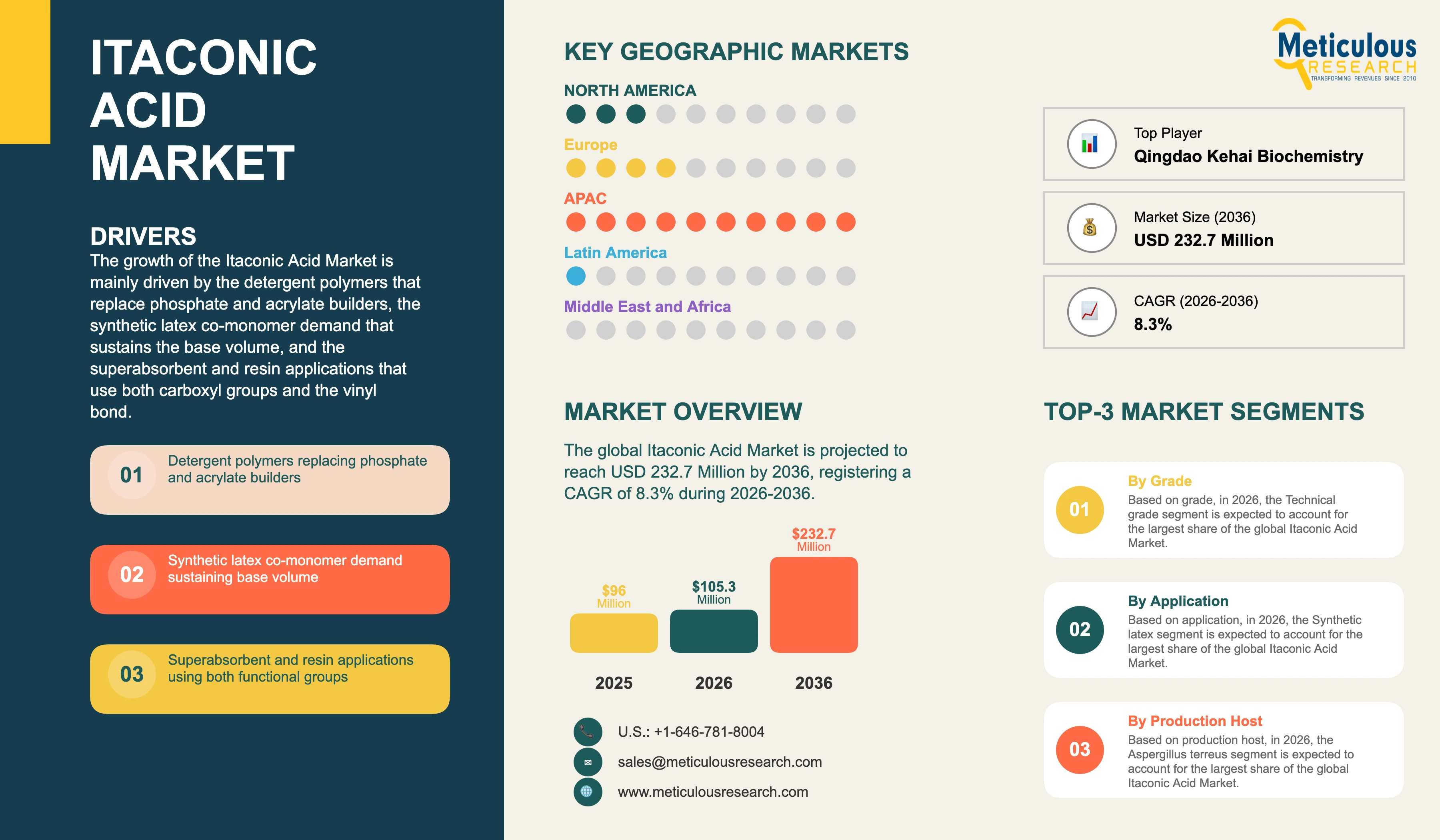
The global itaconic acid market was valued at USD 96.0 million in 2025. This market is expected to reach USD 232.7 million by 2036 from an estimated USD 105.3 million in 2026, registering a CAGR of 8.3% during the forecast period (2026-2036).
- Published
- Nov 2026
- Pages
- 258
- Format
- PDF + Excel
- Report ID
- MRCHM - 1042809
- Base year
- 2025
- 2025 · BASELINE
- $96.0M
- 2036
- $232.7M
- CAGR 2026–2036
- 8.3%
2025 baseline · 2026–2036 forecast at 8.3% CAGR · hover a bar for the value
Key highlights
The global itaconic acid market is estimated at USD 105.3 million in 2026 and is projected to reach USD 232.7 million by 2036.
Market volume is estimated at 54.00 kilotons in 2026 and is projected to reach 108.23 kilotons by 2036 at a CAGR of 7.2%, measured as acid and direct derivatives supplied to third parties.
The average selling price is estimated at USD 1.95 per kg in 2026 and is projected to reach USD 2.15 per kg by 2036 as the grade mix tightens.
Technical grade is expected to account for the largest grade share in 2026, while polymer grade is projected to register the highest CAGR of 10.4%.
Synthetic latex is expected to be the largest application in 2026, while detergents and cleaning products are projected to grow fastest at a CAGR of 11.6%.
Aspergillus terreus is expected to account for the largest production host share in 2026, while Ustilago species are projected to register the highest CAGR of 24.0% from a very small base.
Asia-Pacific is expected to hold the largest regional share in 2026, while Europe is projected to register the highest CAGR of 10.4%.
Itaconix plc reported half year results for the period ended 30 June 2026 on 8 September 2026, with total revenue of USD 8.3 million against USD 4.8 million, an increase of 72%, described as a record first half and a fourth consecutive half of growth.
Itaconix Performance Ingredients revenue rose 104% to USD 6.7 million, representing 81% of group revenue at a 41% gross margin, while SPARX Formulated Solutions revenue rose 3% to USD 1.6 million at a 12% gross margin.
Group gross profit rose 74% to USD 3.0 million at a 35.6% margin, adjusted EBITDA reached break-even against a USD 0.2 million loss, and net cash and investments stood at USD 5.1 million.
The company upgraded full year 2026 revenue guidance to at least USD 14.8 million with a small positive EBITDA expected, against full year 2025 revenue of USD 10.5 million, and stated a medium-term goal of USD 30 million mainly from detergent markets.
Growth came from existing customers reordering higher volumes together with one major new detergent customer in EMEA and one new large detergent customer in North America, neither named.
The release did not state whether Itaconix plc produces its own itaconic acid or purchases it, and did not name the feedstock, production facility locations or capacity.
A study published in Biotechnology for Biofuels and Bioproducts on 27 March 2026 reported reactive extraction coupled to fermentation with a genetically modified Ustilago cynodontis NBRC 9727 strain.
That study reported total itaconic acid production 26% higher and productivity 21% higher than extended-batch fermentation after 233 hours, with yield 5% higher and byproduct formation reduced 72% through an improved feeding profile.
The study described Aspergillus terreus as the typical production host, requiring substrate pretreatment to prevent filamentous growth and classed at biosafety level 2, and noted that Ustilago cynodontis ferments at pH 3.6, reducing acid and base consumption downstream.
The study cited an operational cost estimate of EUR 1.42 per kg for a Ustilago cynodontis process against a market price of about EUR 1.08 to EUR 1.82 per kg, and global production of about 40,000 tonnes per year in 2018, mostly for synthetic latex.
All experiments in that study were at laboratory scale, with no pilot or industrial demonstration reported and no final titre stated for the integrated process.
This market measures the acid and its direct derivatives and excludes the itaconic polymers made from it, which are a separate downstream market.
Report summary
| Particulars | Details |
|---|---|
| Base Year | 2025 |
| Forecast Period | 2026-2036 |
| Market Size in 2025 | USD 96.0 million |
| Market Size in 2026 | USD 105.3 million |
| Market Size by 2036 | USD 232.7 million |
| Value CAGR (2026-2036) | 8.3% |
| Format | PDF, Excel & Cloud Portal · 258 pages |
| Volume in 2026 | 54.00 kilotons |
| Volume by 2036 | 108.23 kilotons |
| Volume CAGR (2026-2036) | 7.2% |
| Volume Basis | Itaconic acid and direct derivatives supplied to third parties |
| Average Selling Price in 2026 | USD 1.95 per kg |
| Average Selling Price by 2036 | USD 2.15 per kg |
| Price Direction | Average selling price rises across the forecast period as the grade mix shifts toward polymer and pharmaceutical specifications requiring controlled impurity profiles, rather than through any change in the underlying molecule or a constraint on supply |
| Scope Definition Note | The boundary is set at the acid rather than at the polymers made from it, because an itaconic polymer sells at several times the price of its input acid and belongs to a separate downstream market; combining the two would attribute polymer revenue to the molecule that is only its feedstock and would overstate this market by a wide margin |
| Measurement Basis | Itaconic acid together with itaconic anhydride, the esters and the salts supplied as such, by grade, application, production host and geography, and excluding the itaconic polymers and copolymers made from the acid, the citraconic and mesaconic isomers, methylsuccinic acid, acid converted captively into polymers by the producing company, and the finished detergents, latices, resins and absorbents into which the material is formulated |
| Relationship to Adjacent Markets | This market stands separately from the other bio-based acids rather than within an aggregate of them, since furandicarboxylic acid is made by dehydrating hexose sugars for polyester use while itaconic acid is a fermentation product directed at vinyl polymerisation, sharing a renewable feedstock and nothing in the process or end use; it is also not additive to the glucose and starch feedstock upstream or to the polymer markets downstream |
| Largest Grade | Technical grade |
| Fastest-Growing Grade | Polymer grade (CAGR 10.4%) |
| Largest Application | Synthetic latex |
| Fastest-Growing Application | Detergents and cleaning products (CAGR 11.6%) |
| Largest Production Host | Aspergillus terreus |
| Fastest-Growing Production Host | Ustilago species (CAGR 24.0%) |
| Largest Region | Asia-Pacific |
| Fastest-Growing Region | Europe (CAGR 10.4%) |
| Segments Covered | Grade, Application, Production Host, and Geography |
| Geographies Covered | Asia-Pacific, Europe, North America, Latin America, and Middle East & Africa |
| Companies Profiled | 4 companies, including Qingdao Kehai Biochemistry Co., Ltd., Jinan Huaming Biochemistry Co., Ltd., Zhejiang Guoguang Biochemistry Co., Ltd., and Itaconix plc |
| Note on Profiled Share | The profiled share covers acid producers only, since Itaconix plc is a downstream polymer producer and the 8 September 2026 release did not state whether it produces its own itaconic acid or purchases it; the balance of the market sits with further Chinese fermentation producers whose registered legal names could not be established to the standard applied in this report |
Report overview
Segments covered: grade, application, production host.
In volume terms, this market is estimated at 54.00 kilotons in 2026 and is projected to reach 108.23 kilotons by 2036, registering a CAGR of 7.2% during the same period, measured as acid and direct derivatives supplied to third parties. The average selling price is estimated at USD 1.95 per kg in 2026 and is projected to rise to USD 2.15 per kg by 2036 as the mix shifts toward polymer and pharmaceutical grades that carry tighter specifications.
The growth of this market is mainly driven by the detergent polymers that use the acid to replace phosphate and acrylate builders, the synthetic latex co-monomer demand that has consumed most of the output for decades, the superabsorbent and resin applications that draw on the two carboxyl groups and the vinyl bond, and the fermentation process improvements that are lowering production cost. However, factors such as the production cost that sits inside the prevailing price range, the product inhibition that limits fermentation titre, the competition from petrochemical acrylic acid and maleic anhydride at lower cost, and the concentration of supply in a small number of Chinese fermentation producers are expected to restrain the growth of this market to some extent.
Technical grade accounts for the largest share of this market because the synthetic latex application that consumes most of the volume does not require tight purity. Polymer grade grows fastest because the detergent and superabsorbent polymers that are driving new demand need controlled impurity profiles to polymerise reproducibly.
Itaconic acid is an unsaturated five-carbon dicarboxylic acid produced by fungal fermentation of sugars, and it is used as a co-monomer and chemical intermediate wherever two carboxyl groups and a polymerisable vinyl bond are wanted on a biologically derived molecule. Market sizing in this report is on both a value basis in USD and a volume basis in kilotons measured as acid and direct derivatives supplied to third parties, with average selling price derived from the two. The measurement basis covers itaconic acid together with itaconic anhydride, the esters and the salts supplied as such, and it excludes the itaconic polymers and copolymers made from the acid, the citraconic and mesaconic isomers, methylsuccinic acid, acid converted captively into polymers by the producing company, and the finished detergents, latices, resins and absorbents into which the material is formulated.
Separating the acid from the polymers made from it is the decision that governs the size of this market. A polymer sells at several times the price of the acid it is made from and is counted in a different market, so a report that mixed the two would overstate the acid by a wide margin and would attribute polymer revenue to a molecule that is only its input. The volume basis follows the acid as supplied, which is also the basis on which fermentation capacity and production cost are reported.
Itaconix plc reported half year results for the period ended 30 June 2026 on 8 September 2026, with total revenue of USD 8.3 million against USD 4.8 million, an increase of 72%, described as a record first half and a fourth consecutive half of growth. Itaconix Performance Ingredients revenue rose 104% to USD 6.7 million at a 41% gross margin and 81% of group revenue, with the products described as plant-based polymers acting as multi-functional scale inhibitors and odour neutralisers in solid unit-dose detergent markets in EMEA and North America. Group gross profit rose 74% to USD 3.0 million, adjusted EBITDA reached break-even and full year guidance was upgraded to at least USD 14.8 million, with a medium-term goal of USD 30 million mainly from detergents.
What that evidence establishes is demand pull rather than acid supply, and the distinction matters for reading it. The revenue reported is polymer revenue, and the release did not state whether the company produces its own itaconic acid or purchases it, nor name the feedstock, production facility locations or capacity. A reader cannot therefore take the figures as a measure of this market, but can take them as the clearest dated evidence available that the detergent application is growing quickly enough to absorb additional acid.
A study published in Biotechnology for Biofuels and Bioproducts on 27 March 2026 by researchers including Andreas Jupke of the Institute for Bio- and Geosciences at Forschungszentrum Jülich reported reactive extraction with trioctylamine coupled to fermentation with a genetically modified Ustilago cynodontis NBRC 9727 strain in a perfusion bioreactor. After 233 hours, total itaconic acid production was 26% higher and productivity 21% higher than extended-batch fermentation, with yield 5% higher and byproduct formation reduced 72% through an improved feeding profile. All experiments were at laboratory scale, with no pilot or industrial demonstration reported and no final titre stated for the integrated process.
The cost figures that study cites explain why this market has stayed small. It quotes an operational cost estimate of EUR 1.42 per kg for a Ustilago cynodontis process against a market price of about EUR 1.08 to EUR 1.82 per kg, which places the estimated cost inside the price range rather than below it. At the lower end of that range a producer on those economics would not cover operating cost, and at the upper end the margin is thin. A molecule repeatedly identified as a priority bio-based building block has therefore not attracted the capacity that designation implies.
Product inhibition is the technical reason the cost is where it is. Itaconic acid is toxic to the organism producing it at concentrations well below the maximum titre reported in the literature, so a fermentation stops accumulating product long before the vessel is used efficiently, and reported Ustilago cynodontis yields of 0.38 to 0.48 grams per gram of glucose reflect that limit rather than any shortage of substrate. Removing the acid as it forms is the direct response, which is what the reactive extraction work addresses.
The choice of organism carries consequences beyond titre. Aspergillus terreus, described in that study as the typical production host, requires substrate pretreatment to prevent filamentous growth and is classed at biosafety level 2, which the authors identify as a regulatory hurdle, and its product is purified by evaporation and multiple crystallisation steps with a correspondingly high carbon footprint. Ustilago cynodontis ferments at pH 3.6, which reduces the acid and base consumed in downstream processing. Aspergillus terreus nonetheless accounts for the largest production host share.
Synthetic latex has consumed most of the output for decades and still does. Adding a small proportion of the acid to a styrene-butadiene or acrylic latex improves adhesion, mechanical stability and colloidal stability, and the application is established in carpet backing, paper coating and adhesives at addition levels low enough that the acid price has limited effect on the finished product. The study cited notes that the roughly 40,000 tonnes produced globally in 2018 went mostly to synthetic latex. Synthetic latex accordingly accounts for the largest application share.
Detergent polymers are the fastest-growing application and the reason is substitution rather than any new performance requirement. Polymers built on itaconic acid can perform the scale inhibition, dispersancy and anti-redeposition duties that phosphates and polyacrylates have carried, while being derived from a renewable feedstock and showing better biodegradability than the acrylate incumbents, which is what regulated European markets and reformulating brands are looking for. Detergents and cleaning products consequently register the highest application CAGR at 11.6%.
Cost competition comes from two established petrochemical acids rather than from other bio-based routes. Acrylic acid supplies the carboxyl function and the vinyl bond at a fraction of the price, and maleic anhydride supplies two carboxyl groups cheaply, so itaconic acid is chosen where the renewable origin, the biodegradability of the resulting polymer or the specific geometry of the molecule justifies the difference. Where a formulation needs only a carboxyl group, the cheaper acid wins.
Supply concentration is the structural feature a buyer has to plan around. Most capacity sits with a small number of Chinese fermentation producers, with no large integrated chemical group operating a merchant itaconic acid business, so a formulator qualifying the acid into a product is accepting a narrow supply base from the outset. That is a material consideration for a detergent or latex programme sized in thousands of tonnes.
This market stands separately from the other bio-based acids rather than alongside them in an aggregate. Furandicarboxylic acid is made by dehydrating hexose sugars and is directed at polyester, while itaconic acid is a fermentation product directed at vinyl polymerisation, so the two share a renewable feedstock and nothing in the process or the end use. Adding them into a bio-based acids total would combine a long-established latex co-monomer with a start-up polyester monomer and describe neither accurately.
Asia-Pacific is expected to account for the largest share in 2026, on the Chinese fermentation producers that hold most of the global capacity, the glucose and starch feedstock available to them, and the latex and paper coating industries that consume technical grade output. India is projected to grow at 9.4%, China at 7.6% and Japan at 5.0%.
Europe is projected to register the highest CAGR of 10.4% during the forecast period, with Germany at 10.6%, the United Kingdom at 10.4% and France at 10.0%.
Europe is the fastest-growing region at a CAGR of 10.4%, on detergent rules and brand commitments on biodegradability and renewable content that have pushed formulators away from phosphates and polyacrylates, the detergent manufacturers established in the region, and the research base working on alternative production hosts and separation.
The Middle East & Africa is projected to grow at a CAGR of 6.0% from a very small base. Latin America is projected to grow at a CAGR of 7.0%, with Brazil at 7.0%, on sugar feedstock availability and latex demand.
Qingdao Kehai Biochemistry Co., Ltd., Jinan Huaming Biochemistry Co., Ltd. and Zhejiang Guoguang Biochemistry Co., Ltd. together accounted for an estimated 38.4% of this market in 2026, which is also the share held by the acid producers profiled in this report. Itaconix plc is profiled as the leading downstream participant and excluded from that calculation, because its revenue is polymer revenue and the 8 September 2026 release did not state whether it produces its own acid. The balance sits with further Chinese fermentation producers whose registered legal names could not be established to the standard applied in this report.
Report infographic
Market dynamics
15 factors across 5 forcesDetergent Polymers Replacing Phosphate and Acrylate Builders
Polymers built on itaconic acid can carry the scale inhibition, dispersancy and anti-redeposition duties that phosphates and polyacrylates have performed, while deriving from a renewable feedstock and showing better biodegradability than the acrylate incumbents, and Itaconix plc reported Performance Ingredients revenue up 104% to USD 6.7 million in the half year to 30 June 2026 from multi-functional scale inhibitors and odour neutralisers in solid unit-dose detergents in EMEA and North America.
That growth came from existing customers reordering higher volumes together with one major new detergent customer in EMEA and one new large detergent customer in North America, which indicates adoption spreading across accounts rather than one programme scaling.
Solid unit-dose formats also favour a polymeric builder over a liquid one, because a tablet or sachet has to hold its form and dissolve on contact, and the company reported introducing a plastic-free 8-gram tablet in February 2026 alongside the account growth.
Synthetic Latex Co-Monomer Demand Sustaining the Base Volume
Adding a small proportion of the acid to a styrene-butadiene or acrylic latex improves adhesion, mechanical stability and colloidal stability, and the application is established in carpet backing, paper coating and adhesives, with the 27 March 2026 study noting that the roughly 40,000 tonnes produced globally in 2018 went mostly to synthetic latex. The addition level is low enough that the acid price has limited effect on finished product cost.
That insensitivity to price is what has kept the application stable through periods when the acid was expensive relative to petrochemical alternatives, and it gives this market a base volume that does not depend on the newer applications succeeding.
Carpet backing, paper coating and adhesive latices are also replaced rather than reformulated, so the volume recurs with the production of those goods and does not require a fresh specification decision each cycle.
Superabsorbent and Resin Applications Using Both Functional Groups
The two carboxyl groups and the polymerisable vinyl bond on one small molecule allow it to act as a crosslinking co-monomer in superabsorbent polymers and as an unsaturated acid in polyester resins and coatings, which is a combination that neither acrylic acid nor maleic anhydride provides on its own.
Those applications also take polymer grade rather than technical grade, which is why polymer grade registers the highest grade CAGR at 10.4% while the technical grade latex application grows more slowly.
Crosslinking in a superabsorbent also consumes the acid at higher addition levels than a latex co-monomer does, so a successful qualification in that application moves more tonnage per account than the established use.
Fermentation Process Improvements Lowering Production Cost
The study published on 27 March 2026 reported total itaconic acid production 26% higher and productivity 21% higher than extended-batch fermentation after 233 hours using reactive extraction with trioctylamine coupled to a genetically modified Ustilago cynodontis strain, with byproduct formation reduced 72% through an improved feeding profile.
Because the cited operational cost estimate of EUR 1.42 per kg sits inside rather than below the quoted market price range of about EUR 1.08 to EUR 1.82 per kg, improvements of that order change whether a route is viable rather than merely improving a margin.
A byproduct reduction of that size also matters beyond yield, since the impurities removed are what the crystallisation steps exist to take out, and fewer of them shortens the purification that delivers polymer grade.
Process gains of this kind also arrive without new capacity, since they raise output from an existing fermentation volume, which is the cheapest form of supply growth available to this market.
The approach is also transferable rather than proprietary to one organism, so a gain demonstrated on one host informs the others.
Table of contents
11 chapters · 127 sections · 258 pages · click to expandSegmental analysis
| Segment | Largest share (2026) | Fastest growth (2026–2036) |
|---|---|---|
| By Grade | Technical grade | Polymer grade |
| By Application | Synthetic latex | Detergents and cleaning products |
| By Production Host | Aspergillus terreus | Ustilago species |
| Other segments | Synthetic latex | Detergents and cleaning products |
By Grade
- The technical grade segment is expected to account for the largest share of the global itaconic acid market.
- The large share of this segment is mainly due to the synthetic latex application consuming most of the global volume at addition levels that do not require tight purity, and to the established position of that application in carpet backing, paper coating and adhesives.
- However, the polymer grade segment is projected to register the highest CAGR of 10.4% during the forecast period.
- The rapid growth of this segment is attributed to the detergent, superabsorbent and resin applications requiring controlled impurity profiles so that polymerisation proceeds reproducibly, which is a tighter specification than the latex co-monomer use has imposed.
- Pharmaceutical and cosmetic grade serves small volumes at considerably higher prices where documentation and impurity control rather than performance decide the purchase.
- Grade determines the purification burden a producer carries, since the crystallisation steps that deliver higher purity are where much of the production cost sits, so value share and volume share diverge across this axis more than the physical differences between grades suggest.
- Grade also determines which producers can serve a customer at all.
- A fermentation plant built for the latex application can supply technical grade from its existing crystallisation train, while polymer and pharmaceutical grades require additional purification stages and the documentation to support them, so a grade shift in demand does not translate into a proportional shift in available supply.
- That is part of why polymer grade commands a premium rather than tracking the technical grade price.
- The purification burden is also what separates the realised price from the quoted one, since the crystallisation stages that deliver a polymer specification consume energy and lose yield, so a producer selling a higher grade earns a higher price against a higher cost rather than a clean margin gain.
- Technical grade is expected to account for the largest share in 2026, on the synthetic latex application consuming most of the global volume at addition levels that do not require tight purity.
- Polymer grade is projected to register the highest CAGR of 10.4% during the forecast period.
By Application
- Itaconic Acid Market Analysis by Application
- The synthetic latex segment is expected to account for the largest share of the global itaconic acid market.
- The large share of this segment is mainly due to the acid improving adhesion, mechanical stability and colloidal stability in styrene-butadiene and acrylic latices, the long qualification history of that use, and the low addition level that keeps the acid price from affecting finished product cost, with the 27 March 2026 study noting that global production in 2018 went mostly to synthetic latex.
- However, the detergents and cleaning products segment is projected to register the highest CAGR of 11.6% during the forecast period.
- The rapid growth of this segment is attributed to itaconic polymers carrying the scale inhibition, dispersancy and anti-redeposition duties of phosphates and polyacrylates while deriving from a renewable feedstock and biodegrading better than the acrylate incumbents.
- Superabsorbent polymers use the acid as a crosslinking co-monomer, and resins and coatings use it as an unsaturated acid in unsaturated polyester systems.
- Construction admixtures use itaconic polymers as dispersants in cement systems.
- Agriculture and personal care remain small, with Itaconix plc reporting field trials of a nutrient uptake product in United States row crops.
- Application determines the grade required and therefore the price realised, which is why value and volume grow at different rates here.
- Application also sets how exposed each use is to substitution.
- Latex and resin applications can often be served by maleic anhydride or acrylic acid at lower cost, so they persist on inertia and qualification history rather than on necessity, while the detergent and superabsorbent uses are chosen for biodegradability and renewable content that the petrochemical acids cannot supply.
- The newer applications are therefore more defensible than the larger ones.
- Addition level is the other variable the application sets, running from a few percent in a latex to substantially more in a crosslinked absorbent, so two applications of similar finished-product value can consume very different tonnages of acid.
By Production Host
- Itaconic Acid Market Analysis by Production Host
- The Aspergillus terreus segment is expected to account for the largest share of the global itaconic acid market.
- The large share of this segment is mainly due to it being the typical production host as described in the 27 March 2026 study, with the installed Chinese fermentation capacity built around it and decades of operating experience behind the process.
- However, the Ustilago species segment is projected to register the highest CAGR of 24.0% during the forecast period, from a very small base.
- The rapid growth of this segment is attributed to fermentation at pH 3.6 reducing acid and base consumption downstream, and to avoiding the substrate pretreatment and the biosafety level 2 classification that the study attributes to Aspergillus terreus.
- Other engineered hosts cover the yeasts and bacteria into which the biosynthetic pathway has been introduced, which remain at research scale.
- This axis measures where production sits rather than what the customer buys, since the finished acid is chemically identical whichever organism made it, and it is included because the host determines production cost, downstream processing and the regulatory burden, which together decide whether capacity gets built.
- The host also determines the carbon footprint claim a customer can make, since the 27 March 2026 study attributes a high footprint to the evaporation and multiple crystallisation steps the Aspergillus terreus route requires.
- For an application adopted specifically for environmental reasons, that is a material consideration rather than a process detail, and it is why the host axis bears on commercial outcomes despite the product being chemically identical.
- Host change is also slow, because an existing plant is built around its organism and the switch is a rebuild rather than a substitution, which is why the share shift over the forecast period is modest despite the growth rate.
Other segments
- Synthetic latex is expected to account for the largest share in 2026, on the acid improving adhesion, mechanical stability and colloidal stability in styrene-butadiene and acrylic latices, with the 27 March 2026 study noting that global production in 2018 went mostly to synthetic latex.
- Detergents and cleaning products are projected to register the highest CAGR of 11.6% during the forecast period.
- Aspergillus terreus is expected to hold the largest share in 2026, described in the 27 March 2026 study as the typical production host, with the installed Chinese fermentation capacity built around it.
- Ustilago species are projected to register the highest CAGR of 24.0% during the forecast period, from a very small base.
Geographic analysis
Asia-Pacific
Largest shareIn 2026, Asia-Pacific is expected to account for the largest share of the global itaconic acid market. The large share of this region is mainly due to the Chinese fermentation producers that hold most of the global capacity, the glucose and starch feedstock available to them, the synthetic latex and paper coating industries that consume the technical grade output, and the cost position that has allowed those producers to supply export markets. India is projected to register a CAGR of 9.4%, China a CAGR of 7.6% and Japan a CAGR of 5.0% during the forecast period. Capacity sits in Asia-Pacific while the fastest-growing demand sits in Europe and North America, so the acid is shipped to the formulators that use it and the growth regions depend on imported material for applications that are being adopted for regulatory reasons.
Europe
Fastest growthHowever, Europe is projected to register the highest CAGR of 10.4% during the forecast period. The rapid growth of this region is attributed to detergent rules and brand commitments on biodegradability and renewable content that have pushed formulators away from phosphates and polyacrylates, to the detergent manufacturers established in the region, and to the research base working on alternative production hosts and separation. Germany is projected to register a CAGR of 10.6%, the United Kingdom a CAGR of 10.4% and France a CAGR of 10.0%. A buyer in Europe is therefore exposed both to the narrow supply base and to the freight and trade conditions between the two. Regional growth here reflects where reformulation is required rather than where the acid can be made, since fermentation capacity could in principle be built anywhere sugar is available. What separates Europe from Asia-Pacific is the regulatory pressure on detergent formulations and the brand commitments that accompany it, neither of which depends on local production.
North America
North America is projected to grow at 9.0%, with the United States at 9.0%, on detergent reformulation and on the solid unit-dose format that Itaconix plc reported growing through its SPARX business with contract manufacturers in the region. North America sits between the two, with reformulation underway and the solid unit-dose format developing through contract manufacturers rather than brand-owned plants.
Latin America
Latin America is projected to grow at 7.0%, with Brazil at 7.0%, on sugar feedstock availability and latex demand.
Middle East & Africa
The Middle East & Africa is projected to grow at 6.0% from a very small base. Production and consumption are separated in this market in a way the regional shares do not reveal.
Competitive landscape
The global itaconic acid market is characterised by a small number of Chinese fermentation producers holding most of the capacity, no large integrated chemical group operating a merchant business, and a separate group of downstream polymer producers that create most of the demand growth. Competition among acid producers is contested on cost and grade consistency rather than on technology, since the finished acid is chemically identical whichever organism made it. Qingdao Kehai Biochemistry Co., Ltd., Jinan Huaming Biochemistry Co., Ltd. and Zhejiang Guoguang Biochemistry Co., Ltd. together accounted for an estimated 38.4% of this market in 2026, which is also the share held by the acid producers profiled in this report.
That profiled share is low for a market of this size, and the reason is stated rather than estimated around. The balance sits with further Chinese fermentation producers whose registered legal names could not be established to the standard applied in this report, and no attempt has been made to fill the gap with approximations. Itaconix plc is profiled as the leading downstream participant and is excluded from the share calculation, because its revenue is polymer revenue and the 8 September 2026 release did not state whether the company produces its own itaconic acid or purchases it.
Downstream commercial progress rather than capacity addition accounted for most activity through 2026. Itaconix plc reported half year revenue up 72% to USD 8.3 million with Performance Ingredients up 104% to USD 6.7 million, adjusted EBITDA at break-even, net cash and investments of USD 5.1 million, full year guidance upgraded to at least USD 14.8 million against USD 10.5 million in 2025, a plastic-free 8-gram tablet introduced in February 2026, new patents filed for paint and unit-dose dish detergent formulations, and a successful challenge to an EU detergent formulation patent that overlapped one of its own. Some of the key players operating in the itaconic acid market are Qingdao Kehai Biochemistry Co., Ltd. (China), Jinan Huaming Biochemistry Co., Ltd. (China), Zhejiang Guoguang Biochemistry Co., Ltd. (China), and Itaconix plc (U.K.), among others.
Grade consistency rather than price is where an acid producer can differentiate, since a polymer customer qualifying a feedstock is concerned with batch-to-batch impurity variation that would affect polymerisation, and a producer that holds that consistency retains the account through price cycles.
- —
Itaconix plc reported half year results for the period ended 30 June 2026 on 8 September 2026, with total revenue of USD 8.3 million against USD 4.8 million, an increase of 72% described as a record first half and a fourth consecutive half of growth. Itaconix Performance Ingredients revenue rose 104% to USD 6.7 million at a 41% gross margin and 81% of group revenue, SPARX Formulated Solutions revenue rose 3% to USD 1.6 million at a 12% gross margin, group gross profit rose 74% to USD 3.0 million at a 35.6% margin, adjusted EBITDA reached break-even against a USD 0.2 million loss, and net cash and investments stood at USD 5.1 million. Full year 2026 guidance was upgraded to at least USD 14.8 million against USD 10.5 million in 2025, with a medium-term goal of USD 30 million mainly from detergents. The release did not state whether the company produces its own itaconic acid or purchases it, and did not name the feedstock, production facility locations or capacity. A study published in Biotechnology for Biofuels and Bioproducts on 27 March 2026 reported reactive extraction with trioctylamine coupled to fermentation with a genetically modified Ustilago cynodontis NBRC 9727 strain, with total itaconic acid production 26% higher and productivity 21% higher than extended-batch fermentation after 233 hours, yield 5% higher and byproduct formation reduced 72%, all at laboratory scale with no pilot or industrial demonstration reported.
- Qingdao Kehai Biochemistry Co., Ltd.
- Jinan Huaming Biochemistry Co., Ltd.
- Zhejiang Guoguang Biochemistry Co., Ltd.
- Itaconix plc
Expert perspectives
Value grows at 8.3% against 7.2% in volume over the forecast period, and the average selling price rises from USD 1.95 per kg in 2026 to USD 2.15 per kg by 2036 as the grade mix tightens toward polymer specifications. The molecule is unchanged; what rises is the purity the newer applications require.
The cost figures cited in the 27 March 2026 study are the most useful numbers available on this market. An operational cost estimate of EUR 1.42 per kg against a market price of about EUR 1.08 to EUR 1.82 per kg places the estimated cost inside the price range, which means a producer on those economics fails to cover operating cost at the low end and earns little at the high end.
That is the answer to why a molecule repeatedly identified as a priority bio-based building block has global production of roughly 40,000 tonnes a year as of the 2018 figure the study cites. The constraint has never been demand or chemistry; it has been that the fermentation does not deliver the acid cheaply enough for the applications that would consume it in volume.
Product toxicity rather than metabolic limitation is what holds the titre down, which is why research attention has moved from strain engineering to separation. The 27 March 2026 work reported 26% more total product and 21% higher productivity than extended-batch operation after 233 hours, but all experiments were at laboratory scale with no pilot or industrial demonstration and no final titre stated for the integrated process.
The Itaconix plc results are evidence of demand rather than of this market. Revenue up 72% to USD 8.3 million with Performance Ingredients up 104% is polymer revenue, and the release did not state whether the company makes its own acid or buys it, nor name the feedstock or any facility. Read correctly, it shows the detergent application growing fast enough to absorb additional acid, which is the condition a capacity decision would need.
Growth here therefore depends on two separate things happening: formulators continuing to replace phosphates and polyacrylates for regulatory and biodegradability reasons, and a production route reaching a cost below rather than inside the price range. The first is underway and visible. The second has been demonstrated at laboratory scale only, and this market excludes the itaconic polymers that would carry most of the value if both occur.
Customer perspectives
Reformulation in detergents is driven by rule and brand commitment on biodegradability and renewable content rather than by any performance deficiency, which is the condition under which an itaconic polymer displaces an incumbent chemistry.
Programmes of that kind also run to a published commitment date, which gives the substitution a timetable that a technical improvement would not have.
A substitution driven by commitment rather than performance also tends not to reverse on a price movement, which gives the demand it creates more durability than a cost-led switch.
The low addition level in latex keeps the application insensitive to the acid price, while the concentration of capacity in a small number of fermentation producers makes availability rather than cost the exposure a buyer manages.
Qualification history also holds the application in place, since requalifying a latex recipe is costly relative to the value of the acid in it.
Fermentation titre is limited by product inhibition rather than substrate availability, so in situ product removal addresses the constraint at its cause, and the reported work on reactive extraction remains at laboratory scale.
That is why the published work has moved toward separation and downstream integration rather than toward further strain engineering.
“We are replacing acrylates because of the biodegradability position, not because the performance was failing. Once that is the reason, the renewable acid is the one that answers both questions at once.”
“It is a small percentage of our formulation, so the price does not move our cost much. What does worry me is how few places we can get it from if one of them has a problem.”
“The organism stops because the product poisons it, not because it runs out of sugar. Until someone takes the acid out as it forms at full scale, the cost will not come down enough.”
Frequently asked questions
This market was valued at USD 88.4 million in 2024 and USD 96.0 million in 2025, and is estimated at USD 105.3 million in 2026. In volume terms it is estimated at 54.00 kilotons in 2026 as acid and direct derivatives supplied to third parties.
This market is projected to reach USD 232.7 million by 2036 in value and 108.23 kilotons in volume.
This market is projected to register a value CAGR of 8.3% and a volume CAGR of 7.2% during the forecast period 2026-2036. The average selling price is projected to move from USD 1.95 per kg in 2026 to USD 2.15 per kg by 2036 as the grade mix tightens toward polymer specifications.
Growth is driven by detergent polymers replacing phosphate and acrylate builders, synthetic latex co-monomer demand that sustains the base volume, superabsorbent and resin applications that use both carboxyl groups and the vinyl bond, and fermentation process improvements that lower production cost.
The 27 March 2026 study cites an operational cost estimate of EUR 1.42 per kg against a market price of about EUR 1.08 to EUR 1.82 per kg, placing cost inside the price range. Product inhibition limits fermentation titre, acrylic acid and maleic anhydride compete at lower cost, and supply is concentrated in a small number of Chinese fermentation producers.
Regulated detergent reformulation in Europe, in situ product removal that addresses the titre limit at its cause, and alternative production hosts fermenting at pH 3.6 are key opportunities. Agriculture and paint applications are under development but carry no stated revenue timing.
Technical grade is expected to account for the largest share in 2026, on the synthetic latex application consuming most of the global volume at addition levels that do not require tight purity.
Polymer grade is projected to register the highest CAGR of 10.4% during the forecast period.
Synthetic latex is expected to account for the largest share in 2026, on the acid improving adhesion, mechanical stability and colloidal stability in styrene-butadiene and acrylic latices.
Detergents and cleaning products are projected to register the highest CAGR of 11.6% during the forecast period.
Aspergillus terreus is expected to hold the largest share in 2026, described in the 27 March 2026 study as the typical production host, with the installed Chinese fermentation capacity built around it.
Ustilago species are projected to register the highest CAGR of 24.0% during the forecast period, from a very small base.
Asia-Pacific is expected to account for the largest share in 2026, on the Chinese fermentation producers that hold most of the global capacity and the latex and paper coating industries that consume technical grade output. India is projected to grow at 9.4%, China at 7.6% and Japan at 5.0%.
Europe is projected to register the highest CAGR of 10.4% during the forecast period, with Germany at 10.6%, the United Kingdom at 10.4% and France at 10.0%.
Europe is the fastest-growing region at a CAGR of 10.4%, on detergent rules and brand commitments on biodegradability and renewable content that have pushed formulators away from phosphates and polyacrylates, plus the region's detergent manufacturers and research base.
The Middle East & Africa is projected to grow at a CAGR of 6.0% from a very small base. Latin America is projected to grow at a CAGR of 7.0%, with Brazil at 7.0%, on sugar feedstock availability and latex demand.
Qingdao Kehai Biochemistry Co., Ltd., Jinan Huaming Biochemistry Co., Ltd. and Zhejiang Guoguang Biochemistry Co., Ltd. together accounted for an estimated 38.4% of this market in 2026. Itaconix plc is profiled as the leading downstream participant and is excluded from that calculation.
Itaconix plc reported half year results to 30 June 2026 with revenue up 72% to USD 8.3 million, and upgraded full year 2026 guidance to at least USD 14.8 million. A study published on 27 March 2026 reported reactive extraction coupled to Ustilago cynodontis fermentation with 26% higher total production and 21% higher productivity, at laboratory scale only.
Cite this report
Meticulous Research. (2026). Itaconic Acid Market - Global Opportunity Analysis and Industry Forecast (2026-2036) (Report No. MRCHM - 1042809). Meticulous Market Research Pvt. Ltd. https://www.meticulousresearch.com/product/itaconic-acid-market-7492