Bio Based Acrylic Acid Market (2026-2036)
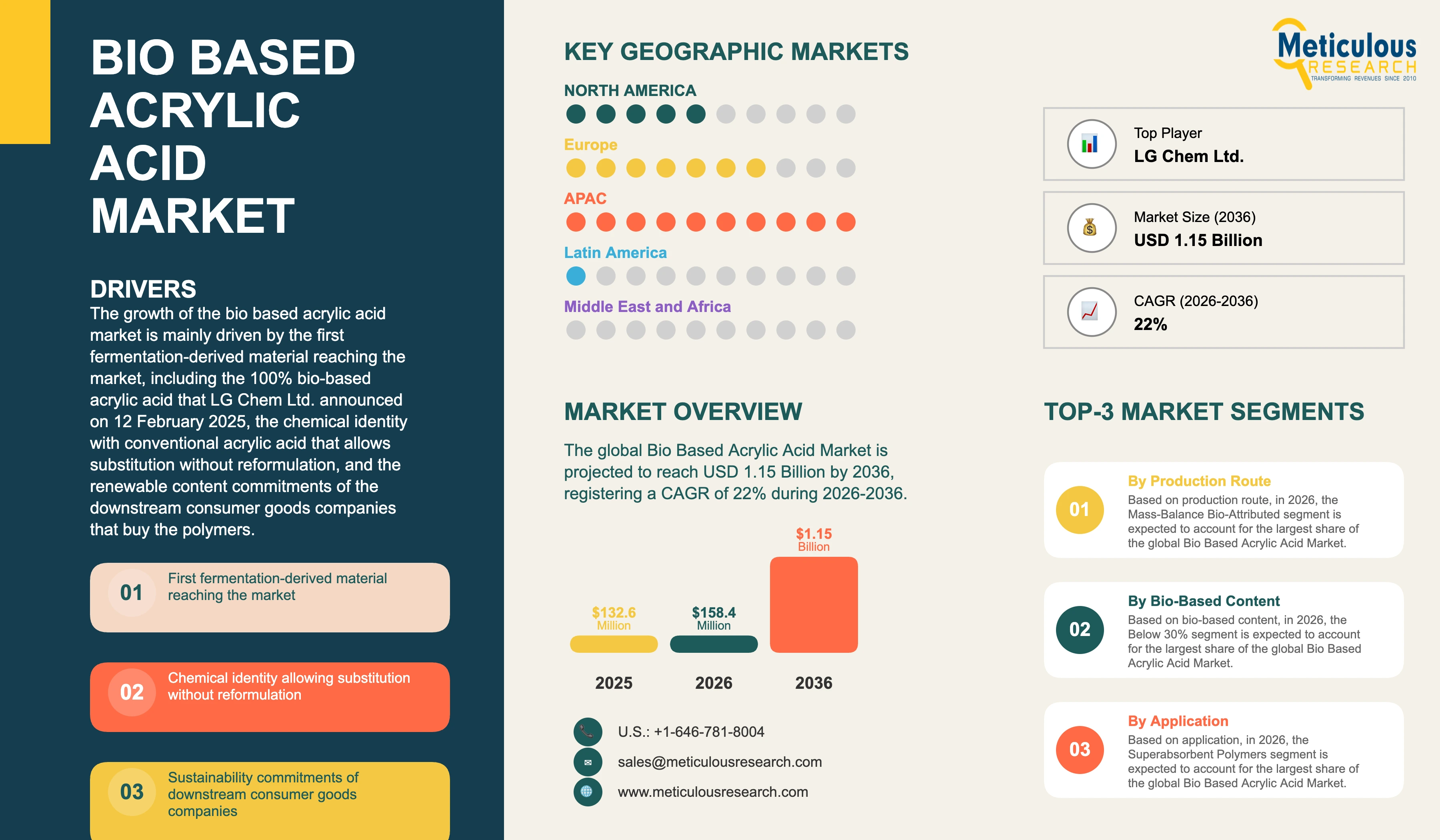
The global bio based acrylic acid market was valued at USD 132.6 million in 2025. This market is expected to reach USD 1.15 billion by 2036 from an estimated USD 158.4 million in 2026, registering a CAGR of 22.0% during the forecast period (2026-2036).
- Published
- Nov 2026
- Pages
- 258
- Format
- PDF + Excel
- Report ID
- MRCHM - 1042681
- Base year
- 2025
- 2025 · BASELINE
- $132.6M
- 2036
- $1.15B
- CAGR 2026–2036
- 22.0%
2025 baseline · 2026–2036 forecast at 22.0% CAGR · hover a bar for the value
Key highlights
The global bio based acrylic acid market is estimated at USD 158.4 million in 2026 and is projected to reach USD 1.15 billion by 2036.
Market volume is estimated at 44.00 kilotons in 2026 and is projected to reach 443.63 kilotons by 2036 at a CAGR of 26.0%, measured as acrylic acid supplied with certified bio-based content.
The average selling price is estimated at USD 3.60 per kg in 2026 and is projected to reach USD 2.60 per kg by 2036 as the premium over fossil acrylic acid narrows.
Mass-balance bio-attributed material is expected to account for the largest production route share in 2026, while 3-hydroxypropionic acid fermentation is projected to register the highest CAGR of 44.0%.
Material with below 30% bio-based content is expected to hold the largest content share in 2026, while material above 70% including fully bio-based grades is projected to grow fastest at a CAGR of 31.0%.
Superabsorbent polymers are expected to be the largest application in 2026, while personal care and cosmetics is projected to register the highest CAGR of 32.0%.
Asia-Pacific is expected to hold the largest regional share in 2026, while Europe is projected to register the highest CAGR of 26.0%.
LG Chem Ltd. announced on 12 February 2025 the launch of 100% bio-based acrylic acid, stating that attempts to develop the product had been made worldwide without reaching commercialisation before this.
The product is made from 3-hydroxypropionic acid produced by microbial fermentation of plant-based feedstock, with the strain and fermentation process developed in-house and no outside partners named.
The company states that the product has the same molecular structure and properties as conventional acrylic acid.
Production begins in the second quarter of 2025, with output ramping to 100 metric tons per year, described in the release as prototype volume.
The release headline refers to commercial production while the body describes the initial output as prototype production, and no plant location is named.
The company states it is considering expansion if demand grows.
The product received the USDA Certified Biobased Product label under the BioPreferred programme in 2024, confirming 100% bio-based content.
The release describes the raw materials as derived from vegetable oils in one place and as plant-based elsewhere, without specifying the exact feedstock.
Listed applications include skin-contact cosmetic ingredients, superabsorbent polymers for diapers, adhesives for electronics and vehicles, coatings and paints, with cosmetics expected to be a key market.
The company plans to promote the product to sustainability-focused companies in North America and Europe.
The release gives no product-specific carbon reduction figure, citing only corporate targets of carbon neutral growth by 2030 and net-zero emissions by 2050.
LG Chem Ltd. reported consolidated revenue of KRW 48.9 trillion, stated as USD 33.6 billion, for 2024.
Report summary
| Particulars | Details |
|---|---|
| Base Year | 2025 |
| Forecast Period | 2026-2036 |
| Market Size in 2025 | USD 132.6 million |
| Market Size in 2026 | USD 158.4 million |
| Market Size by 2036 | USD 1.15 billion |
| Value CAGR (2026-2036) | 22.0% |
| Format | PDF, Excel & Cloud Portal · 258 pages |
| Volume in 2026 | 44.00 kilotons |
| Volume by 2036 | 443.63 kilotons |
| Volume CAGR (2026-2036) | 26.0% |
| Volume Basis | Acrylic acid supplied with certified bio-based content, on a product-mass basis rather than on the mass of bio-based carbon contained |
| Average Selling Price in 2026 | USD 3.60 per kg |
| Average Selling Price by 2036 | USD 2.60 per kg |
| Commercialisation Status | Mass-balance bio-attributed material is supplied commercially from existing acrylic acid plants, while fermentation-derived fully bio-based material entered production from the second quarter of 2025 at a stated 100 metric tons per year described as prototype volume |
| Measurement Basis | Acrylic acid carrying certified renewable carbon, covering mass-balance bio-attributed material and material from 3-hydroxypropionic acid fermentation, lactic acid dehydration, glycerol and other renewable routes, and excluding fossil acrylic acid without a certified claim, acrylate esters and superabsorbent polymers as finished products, methacrylic acid and its esters, bio-based propylene supplied as a monomer, and the 3-hydroxypropionic acid or lactic acid intermediates where sold as such |
| Relationship to Adjacent Markets | This market is a fraction of the total acrylic acid market rather than an addition to it, since every tonne counted here substitutes for a tonne of fossil acrylic acid, and it is not additive to the superabsorbent polymer or acrylate ester markets downstream of it |
| Largest Production Route | Mass-balance bio-attributed |
| Fastest-Growing Production Route | 3-hydroxypropionic acid fermentation (CAGR 44.0%) |
| Largest Bio-Based Content Band | Below 30% |
| Fastest-Growing Bio-Based Content Band | Above 70%, including fully bio-based grades (CAGR 31.0%) |
| Largest Application | Superabsorbent polymers |
| Fastest-Growing Application | Personal care and cosmetics (CAGR 32.0%) |
| Largest Region | Asia-Pacific |
| Fastest-Growing Region | Europe (CAGR 26.0%) |
| Segments Covered | Production Route, Bio-Based Content, Application, and Geography |
| Geographies Covered | Asia-Pacific, Europe, North America, Latin America, and Middle East & Africa |
| Companies Profiled | 10 companies, including LG Chem Ltd., BASF SE, Arkema S.A., Nippon Shokubai Co., Ltd., Dow Inc., and Låkril Technologies, Inc. |
Report overview
Segments covered: production route, bio-based content, application.
In volume terms, this market is estimated at 44.00 kilotons in 2026 and is projected to reach 443.63 kilotons by 2036, registering a CAGR of 26.0% during the same period, measured as acrylic acid supplied with certified bio-based content on a product-mass basis rather than on the mass of bio-based carbon it contains. The average selling price is estimated at USD 3.60 per kg in 2026 and is projected to decline to USD 2.60 per kg by 2036 as the premium over fossil acrylic acid narrows with supply and as fermentation routes move beyond prototype quantities.
The growth of this market is mainly driven by the first fermentation-derived material reaching the market, including the 100% bio-based acrylic acid that LG Chem Ltd. announced on 12 February 2025 for production from the second quarter of 2025, the chemical identity of the product with conventional acrylic acid that allows substitution without reformulation, the sustainability commitments of consumer goods and personal care companies that buy the downstream polymers, and the certification schemes that make a bio-based claim verifiable. However, factors such as the prototype scale of fermentation capacity against a global acrylic acid industry measured in millions of tonnes, the price premium over propylene oxidation, the dependence of mass-balance supply on allocation rules rather than on dedicated plants, and the feedstock competition with food and fuel uses are expected to restrain the growth of this market to some extent.
Mass-balance bio-attributed material accounts for the largest share of this market because it is produced in existing acrylic acid plants with a certified allocation of renewable feedstock at the cracker, requiring no new process and no new asset. Fermentation-derived material from 3-hydroxypropionic acid grows fastest because it delivers fully bio-based content that attribution cannot, which is what buyers seeking a physical rather than accounting claim require.
Bio based acrylic acid is acrylic acid carrying certified renewable carbon, whether produced by fermentation of plant feedstock or supplied from a conventional plant under a certified mass-balance allocation of renewable feedstock. Market sizing in this report is on both a value basis in USD and a volume basis in kilotons measured as acrylic acid supplied with certified bio-based content on a product-mass basis, with average selling price derived from the two. The measurement basis covers mass-balance bio-attributed material and material from 3-hydroxypropionic acid fermentation, lactic acid dehydration, glycerol and other renewable routes, and it excludes fossil acrylic acid without a certified claim, acrylate esters and superabsorbent polymers as finished products, methacrylic acid and its esters, bio-based propylene supplied as a monomer, and the 3-hydroxypropionic acid or lactic acid intermediates where they are sold as such.
Measuring on product mass rather than on bio-based carbon mass matters because the two differ by a large factor for partially bio-based material. A tonne of acrylic acid certified at 30% bio-based content contains 300 kilograms of renewable carbon on a mass-balance accounting, and reporting that as 0.3 tonnes of market would describe neither what is bought nor what is shipped. The product-mass basis reflects how the material is contracted, with bio-based content stated as an attribute rather than as the quantity.
LG Chem Ltd. announced on 12 February 2025 the launch of 100% bio-based acrylic acid made from 3-hydroxypropionic acid produced by microbial fermentation of plant-based feedstock, with the strain and fermentation process developed in-house, stating that the product has the same molecular structure and properties as conventional acrylic acid and that attempts to develop bio-acrylic acid had been made worldwide without reaching commercialisation before this. Production begins in the second quarter of 2025 and ramps to 100 metric tons per year, described in the release as prototype volume, with the company considering expansion if demand grows. The product received the USDA Certified Biobased Product label under the BioPreferred programme in 2024, confirming 100% bio-based content.
The scale in that announcement is the fact to hold onto. One hundred tonnes a year is a prototype quantity against a global acrylic acid industry measured in millions of tonnes, the release headline refers to commercial production while its body describes prototype production, and no plant location is named. What the announcement establishes is that a fermentation route has produced certified fully bio-based acrylic acid at all, which no producer had previously done, and that an established acrylates and superabsorbent polymer business is prepared to put its own strain and process behind it. Volume is not what it demonstrates.
Chemical identity with the fossil product is what makes this market possible and also what limits what a producer can charge. Because the molecule is the same, a converter can substitute bio-based material without reformulating, requalifying a polymer or changing equipment, which removes the technical barrier that slows most bio-based substitutions. It also means the material competes only on the certified claim it carries, since it offers no performance advantage whatever. The premium therefore depends entirely on what a downstream brand will pay for the claim.
Mass balance is where the volume is and it is an accounting method rather than a process. A cracker fed with a certified quantity of bio-naphtha or bio-based feedstock allocates the renewable content across its outputs under a certification scheme, so the acrylic acid delivered is physically identical to fossil material while carrying a verified attribution. That requires no new plant and no new chemistry, which is why it supplies the largest share. Buyers who require renewable carbon physically present in the molecule cannot use it, which is the opening that fermentation routes address.
Superabsorbent polymers are the largest application because they are the largest use of acrylic acid generally, and the diaper and hygiene brands that buy them carry public commitments on renewable content that reach down the chain. The volumes involved are also what make the arithmetic difficult: a single hygiene brand consumes more acrylic acid in a year than all current fermentation capacity could produce in a century at prototype scale. Substitution therefore proceeds through mass balance in that application while fermentation material goes elsewhere first.
Personal care and cosmetics is where fermentation material is likely to be sold first, and the LG Chem release points in that direction by listing skin-contact cosmetic ingredients first among applications and naming cosmetics as a key market. The reasoning is price rather than performance: a thickener or rheology modifier is a small fraction of the cost of a finished cosmetic, so a large premium on the raw material is absorbed easily, while the renewable claim carries weight with the end consumer. Personal care and cosmetics consequently registers the highest application CAGR at 32.0%.
Feedstock choice carries a question the release does not settle. The raw materials are described as derived from vegetable oils in one place and as plant-based elsewhere without the exact feedstock being specified, and vegetable oil, sugar and glycerol routes differ in cost, in land use and in their competition with food and fuel markets. A buyer purchasing the material for a sustainability claim will eventually ask which feedstock, because the answer determines whether the claim survives scrutiny. Feedstock disclosure is therefore likely to become part of the specification.
Certification rather than chemistry is what a buyer is actually verifying, and the schemes differ in what they assert. The USDA Certified Biobased Product label under the BioPreferred programme states a bio-based content percentage determined by radiocarbon measurement of the product itself, which is a physical test, while mass-balance certification asserts a bookkeeping allocation that a radiocarbon test would not detect. Both are legitimate and they answer different questions. A procurement specification that names a percentage without naming the scheme is therefore ambiguous.
This market is a fraction of the acrylic acid market rather than an addition to it, which matters for anyone reading the two together. Every tonne counted here is a tonne of acrylic acid that would otherwise have been supplied as fossil material, so the bio-based market grows by substitution within a total that is set by downstream polymer demand. It is also not additive to the superabsorbent polymer or acrylate ester markets downstream of it.
Asia-Pacific is expected to account for the largest share in 2026, on the concentration of acrylic acid and superabsorbent polymer capacity across China, Japan and South Korea and the fermentation-derived material produced in the region. South Korea is projected to grow at 23.0%, Japan at 20.0% and China at 18.0%.
Europe is projected to register the highest CAGR of 26.0% during the forecast period, with France at 27.0% and Germany at 26.6%.
Europe is the fastest-growing region at a CAGR of 26.0%, on the renewable content commitments of the consumer goods, personal care and coatings companies headquartered there, the established mass-balance certification infrastructure, and the regulatory attention to substantiating environmental claims that makes verified material necessary rather than optional.
The Middle East & Africa is projected to grow at a CAGR of 18.0% from a negligible base. Latin America is projected to grow at a CAGR of 20.0%, with Brazil at 21.0%, on sugar and glycerol feedstock availability rather than on acrylic acid capacity.
LG Chem Ltd., BASF SE, Arkema S.A., Nippon Shokubai Co., Ltd. and Dow Inc. together accounted for an estimated 54.2% of this market in 2026. The 10 companies profiled in this report together accounted for an estimated 76.8%.
Report infographic
Market dynamics
15 factors across 5 forcesFirst Fermentation-Derived Material Reaching the Market
LG Chem Ltd. announced on 12 February 2025 the launch of 100% bio-based acrylic acid from 3-hydroxypropionic acid produced by microbial fermentation, with production from the second quarter of 2025 ramping to 100 metric tons per year, stating that worldwide attempts had not previously reached commercialisation. A route that has produced certified material changes the question facing a buyer from whether fully bio-based acrylic acid exists to how much of it can be bought. The driver acts on credibility and specification rather than on volume, which remains at prototype scale.
The announcement also obliges competitors to respond. An established acrylates and superabsorbent polymer producer putting its own strain and process behind a fully bio-based grade sets a reference that other suppliers of the same downstream polymers now have to answer in their own sustainability disclosures.
A first mover in a market this small also sets the certification reference that later entrants are measured against, which is worth more to it than the volume it sells.
Chemical Identity Allowing Substitution Without Reformulation
Because the molecule is identical to conventional acrylic acid, a converter can substitute bio-based material without reformulating a polymer, requalifying a product or changing equipment, which removes the technical barrier that slows most bio-based substitutions and makes adoption a procurement decision rather than a development project. Substitution can therefore happen at the speed of contract renewal. It also means the material carries no performance advantage, so the decision rests entirely on the value of the claim.
That is an unusual position for a chemical producer, because the product cannot be improved to win share, so the commercial work is about certification, availability and contract terms rather than about specification.
Sustainability Commitments of Downstream Consumer Goods Companies
The hygiene, personal care, coatings and adhesives companies that consume acrylic acid through its polymers carry public renewable content and emissions commitments that reach back through their supply chains, and LG Chem Ltd. states that it plans to promote the product to sustainability-focused companies in North America and Europe. Demand in this market is consequently created by brand commitments rather than by regulation or cost. The buyer is often the brand rather than the direct customer, which changes how the material is sold.
A producer frequently has to persuade a brand several steps removed from its own customer, which then specifies the material through its converter, so the selling effort and the purchase order sit in different places.
Certification Schemes Making a Bio-Based Claim Verifiable
The USDA Certified Biobased Product label under the BioPreferred programme, which LG Chem Ltd. received in 2024 confirming 100% bio-based content, and the mass-balance schemes that certify feedstock allocation together give a buyer something auditable to put behind a marketing claim. Without verification a renewable claim carries legal and reputational risk that most brands will not accept. Certification therefore converts a production method into a purchasable attribute, which is what allows a premium to be charged at all.
The schemes also set the pace of adoption, since a buyer cannot commit to a renewable content target faster than it can obtain certificates its auditors will accept.
Demand in this market is therefore created by commitments rather than by regulation or cost, which makes it responsive to brand strategy and vulnerable to a change in it. A producer reads customer sustainability reports as closely as it reads order books, because a revised target changes the forecast more than any process improvement would.
Verification itself is becoming a driver rather than only an enabler, because a brand that has published a renewable content figure needs evidence it can defend to an auditor and increasingly to a regulator, and a supplier that can produce that evidence is preferred over one offering an equivalent molecule without it.
Table of contents
11 chapters · 132 sections · 258 pages · click to expandSegmental analysis
| Segment | Largest share (2026) | Fastest growth (2026–2036) |
|---|---|---|
| By Production Route | Mass-balance bio-attributed | 3-hydroxypropionic acid fermentation |
| By Bio-Based Content | Below 30% | Above 70% |
| By Application | Superabsorbent polymers | Personal care and cosmetics |
| Other segments | Material with below 30% bio-based content | Material above 70% bio-based content |
By Production Route
- Bio Based Acrylic Acid Analysis by Production Route
- The mass-balance bio-attributed segment is expected to account for the largest share of the global bio based acrylic acid market.
- The large share of this segment is mainly due to production in existing acrylic acid plants under a certified allocation of renewable feedstock at the cracker, which requires no new process, no new asset and no downstream qualification, and to the scale at which those plants already operate.
- However, the 3-hydroxypropionic acid fermentation segment is projected to register the highest CAGR of 44.0% during the forecast period.
- The rapid growth of this segment is attributed to the delivery of fully bio-based content that attribution cannot provide, the first certified material reaching the market from the second quarter of 2025, and the position of the intermediate as a platform chemical with uses beyond acrylic acid that improve plant economics.
- Lactic acid dehydration draws on fermentation capacity built for polylactic acid and is attractive where that capacity already exists, though the dehydration step has historically suffered selectivity losses.
- Glycerol-based routes use a by-product of biodiesel production rather than a grown feedstock, which removes the food competition argument at the cost of exposure to biodiesel output.
- Route selection therefore follows feedstock position and the kind of claim a buyer requires rather than cost alone, which is why several routes advance in parallel.
- Route also determines whether a producer can serve a buyer who insists on renewable carbon physically present, since mass balance cannot satisfy that requirement at any content percentage.
- Route also determines whether a producer can serve a buyer who insists on renewable carbon physically present in the molecule, since mass balance cannot satisfy that requirement at any content percentage, which is why the two routes are not substitutes for one another commercially.
- Mass-balance bio-attributed material is expected to account for the largest share in 2026, on production in existing plants under a certified feedstock allocation requiring no new process or asset.
- 3-hydroxypropionic acid fermentation is projected to register the highest CAGR of 44.0% during the forecast period.
By Bio-Based Content
- Bio Based Acrylic Acid Analysis by Bio-Based Content
- The below 30% segment is expected to account for the largest share of the global bio based acrylic acid market.
- The large share of this segment is mainly due to mass-balance allocation typically producing modest certified percentages across a plant output, the ability of a modest percentage to satisfy many brand commitments at low cost, and the large volumes that can be supplied at that content level without new capacity.
- However, the above 70% segment, including fully bio-based grades, is projected to register the highest CAGR of 31.0% during the forecast period.
- The rapid growth of this segment is attributed to buyers who require renewable carbon physically present in the molecule rather than allocated to it, together with the certified 100% bio-based material now available from fermentation and the credibility that a radiocarbon-verifiable claim carries.
- The 30% to 70% range serves buyers with quantified renewable content targets that a low percentage will not meet and a fully bio-based grade would overshoot at unnecessary cost, and it is supplied by blending and by higher mass-balance allocations.
- Content level is a commercial setting rather than a technical property, since the molecule is identical at every level, which makes this axis a description of what buyers are willing to pay for rather than of what the material does.
- Content level also determines which certification scheme is relevant, because a fully bio-based grade can be verified on the product by radiocarbon while a low allocated percentage can only be evidenced by certificates, so the two bands are audited in entirely different ways.
- Content level also determines which certification scheme is relevant, because a fully bio-based grade can be verified on the product by radiocarbon while a low allocated percentage can only be evidenced by certificates, so the two bands are audited in entirely different ways.
By Application
- Bio Based Acrylic Acid Analysis by Application
- The superabsorbent polymers segment is expected to account for the largest share of the global bio based acrylic acid market.
- The large share of this segment is mainly due to superabsorbent polymers being the largest use of acrylic acid generally, the public renewable content commitments of the diaper and hygiene brands that consume them, and the suitability of mass-balance supply to volumes of that scale.
- However, the personal care and cosmetics segment is projected to register the highest CAGR of 32.0% during the forecast period.
- The rapid growth of this segment is attributed to a thickener or rheology modifier representing a small fraction of finished cosmetic cost so that a large raw material premium is absorbed easily, together with the weight a renewable claim carries with the end consumer, and LG Chem Ltd. names cosmetics as a key market for its fermentation-derived grade.
- Adhesives and sealants take bio-based acrylic acid where electronics and automotive customers carry their own renewable content requirements, and paints and coatings where architectural and decorative brands market environmental attributes directly.
- Water treatment and other applications cover dispersants, detergent polymers and scale inhibitors.
- Application mix in this market inverts the application mix of acrylic acid generally, because early fermentation material goes where the premium is absorbed rather than where the tonnage is.
- The applications also differ in how long a qualification takes.
- Cosmetics and coatings can adopt an identical molecule almost immediately, while hygiene converters run longer validation on polymer performance, so application mix reflects qualification speed as well as price tolerance.
- Content band selection also varies by region, since European buyers more often hold quantified percentage targets while North American buyers more often cite a federal label, which pulls the two regions toward different parts of the content range.
Other segments
- Material with below 30% bio-based content is expected to hold the largest share in 2026, since mass-balance allocation typically produces modest certified percentages and those percentages satisfy many brand commitments at low cost.
- Material above 70% bio-based content, including fully bio-based grades, is projected to register the highest CAGR of 31.0% during the forecast period.
- Superabsorbent polymers are expected to account for the largest share in 2026, on being the largest use of acrylic acid generally and on the renewable content commitments of the hygiene brands that consume them.
- Personal care and cosmetics is projected to register the highest CAGR of 32.0% during the forecast period.
Geographic analysis
Asia-Pacific
Largest shareIn 2026, Asia-Pacific is expected to account for the largest share of the global bio based acrylic acid market. The large share of this region is mainly due to the concentration of acrylic acid and superabsorbent polymer capacity in China, Japan and South Korea, the fermentation-derived material that LG Chem Ltd. began producing from the second quarter of 2025, and the vegetable oil and sugar feedstock available across the region. South Korea is projected to register a CAGR of 23.0%, Japan a CAGR of 20.0% and China a CAGR of 18.0% during the forecast period.
Europe
Fastest growthHowever, Europe is projected to register the highest CAGR of 26.0% during the forecast period. The rapid growth of this region is attributed to the renewable content commitments of the consumer goods, personal care and coatings companies headquartered there, the established mass-balance certification infrastructure and recognition of those schemes, and the regulatory attention to substantiating environmental claims that makes verified material necessary rather than optional. France is projected to register a CAGR of 27.0% and Germany a CAGR of 26.6%.
North America
North America is projected to grow at 22.6%, with the United States at 22.8%, on the hygiene and personal care brands based there, on the USDA Certified Biobased Product label that gives a federal basis for a content claim, and on the sustainability-focused customers LG Chem Ltd. states it will approach.
Latin America
Latin America is projected to grow at 20.0%, with Brazil at 21.0%, on sugar and glycerol feedstock availability.
Middle East & Africa
The Middle East & Africa is projected to grow at 18.0% from a negligible base. Demand and production sit in different places in this market, and the gap is wider than in most chemicals. Acrylic acid capacity and the first fermentation material are in Asia-Pacific, while the brands whose commitments create the demand are concentrated in Europe and North America, so material is made in one region against claims made in another. Regional share therefore describes where the acid is supplied rather than where the commitment driving the purchase originates. That also means a European growth rate describes demand created by brands in the region rather than capacity built there, and the material behind it is likely to have been made in Asia-Pacific. A European growth rate therefore describes demand created by brands in the region rather than capacity built there, and the material behind it is likely to have been produced in Asia-Pacific. Qualification speed also differs by application and shapes where early volume lands. A cosmetics or coatings buyer can adopt an identical molecule within one development cycle, while a hygiene converter runs longer validation on finished polymer performance, so the first tonnes go to the applications that can take them quickly as well as to those that can pay.
Competitive landscape
The global bio based acrylic acid market is characterised by the presence of large acrylic acid and superabsorbent polymer producers offering mass-balance bio-attributed grades from existing plants, one producer supplying certified fully bio-based material from fermentation at prototype scale, and development-stage companies commercialising alternative renewable routes. Competition is contested on the certification scheme and content percentage a producer can supply rather than on product performance, because the molecule is identical to conventional acrylic acid and offers no technical advantage. LG Chem Ltd., BASF SE, Arkema S.A., Nippon Shokubai Co., Ltd. and Dow Inc. together accounted for an estimated 54.2% of this market in 2026, while the companies profiled in this report together accounted for an estimated 76.8%.
LG Chem Ltd. announced on 12 February 2025 the launch of 100% bio-based acrylic acid made from 3-hydroxypropionic acid by microbial fermentation of plant-based feedstock, with an in-house strain and process, production from the second quarter of 2025 ramping to 100 metric tons per year described as prototype volume, the USDA Certified Biobased Product label received in 2024 confirming 100% bio-based content, and cosmetics named as a key market. Extension of mass-balance certification across acrylates portfolios, scale-up of fermentation routes, and qualification of glycerol and lactic acid feedstocks accounted for most competitive activity through 2026.
Certification position rather than process capability separates the competitors at present, because a buyer is purchasing an auditable claim and the material behind it performs identically whoever makes it. BASF SE, Arkema S.A., Nippon Shokubai Co., Ltd., Dow Inc., Mitsubishi Chemical Group Corporation, Sumitomo Seika Chemicals Company, Limited and Formosa Plastics Corporation compete from existing acrylic acid and superabsorbent polymer capacity under mass-balance schemes, LG Chem Ltd. from the only certified fully bio-based fermentation material, and Cargill, Incorporated and Låkril Technologies, Inc. from renewable feedstock and process positions under development. Some of the key players operating in the bio based acrylic acid market are LG Chem Ltd. (South Korea), BASF SE (Germany), Arkema S.A. (France), Nippon Shokubai Co., Ltd. (Japan), Dow Inc. (U.S.), Mitsubishi Chemical Group Corporation (Japan), Sumitomo Seika Chemicals Company, Limited (Japan), Formosa Plastics Corporation (Taiwan), Cargill, Incorporated (U.S.), and Låkril Technologies, Inc. (U.S.), among others.
- —
LG Chem Ltd. announced on 12 February 2025 the launch of 100% bio-based acrylic acid made from 3-hydroxypropionic acid produced by microbial fermentation of plant-based feedstock, with the strain and fermentation process developed in-house and no outside partners named, stating that the product has the same molecular structure and properties as conventional acrylic acid and that attempts to develop bio-acrylic acid had been made worldwide without previously reaching commercialisation. Production begins in the second quarter of 2025 and ramps to 100 metric tons per year, described in the release as prototype volume, with no plant location named and expansion under consideration if demand grows. The product received the USDA Certified Biobased Product label under the BioPreferred programme in 2024, confirming 100% bio-based content. Listed applications include skin-contact cosmetic ingredients, superabsorbent polymers for diapers, adhesives for electronics and vehicles, coatings and paints, with cosmetics expected to be a key market and promotion planned to sustainability-focused companies in North America and Europe. The release describes the raw materials as derived from vegetable oils in one place and as plant-based elsewhere without specifying the exact feedstock, gives no product-specific carbon reduction figure, and cites corporate targets of carbon neutral growth by 2030 and net-zero emissions by 2050. The company reported consolidated revenue of KRW 48.9 trillion, stated as USD 33.6 billion, for 2024.
- LG Chem Ltd.
- BASF SE
- Arkema S.A.
- Nippon Shokubai Co., Ltd.
- Dow Inc.
- Låkril Technologies, Inc
Expert perspectives
Volume grows at 26.0% against 22.0% in value over the forecast period, and the average selling price falls from USD 3.60 per kg in 2026 to USD 2.60 per kg by 2036 as the premium over fossil acrylic acid narrows with supply. The 2026 figure of USD 158.4 million is small, and percentage growth and absolute quantity are separate facts in a market at this stage.
The LG Chem announcement should be read for what it proves rather than for what it supplies. One hundred metric tons a year, described in the release itself as prototype volume, is negligible against an acrylic acid industry measured in millions of tonnes, and the headline says commercial production while the body says prototype. What it establishes is that certified fully bio-based acrylic acid has been produced by fermentation at all, which the company states no one had achieved before.
Chemical identity cuts both ways and is the defining feature of this market. Because the molecule is the same, substitution needs no reformulation or requalification and can happen at contract renewal, which is why adoption could move quickly once supply exists. It also means the material has no performance advantage, so the entire price premium rests on what a downstream brand will pay for a verified claim.
Mass balance and fermentation are answering different questions and should not be compared on volume. Attribution supplies superabsorbent polymer and coatings tonnage today without a new asset, while fermentation supplies renewable carbon physically present in the molecule at prototype scale. A buyer specifying a percentage without naming the scheme has not specified anything, since one claim is radiocarbon-verifiable on the product and the other is not.
The application mix inverts what the acrylic acid market looks like, and that is rational rather than odd. Fermentation material goes first to cosmetics, personal care and specialty adhesives where the acid is a small fraction of finished cost and a large premium is absorbed, rather than to the superabsorbent polymer volumes that dominate consumption, which is why personal care grows at 32.0% from a small base.
The risk to the forecast sits in certification rules rather than in chemistry or demand. Mass balance carries most of the volume and rests on how schemes permit renewable feedstock to be allocated, so a change in those rules or in regulatory recognition of them would alter supply without any change in physical production. This market is also a fraction of the acrylic acid market rather than an addition to it, and not additive to the superabsorbent polymer or acrylate ester markets downstream.
Customer perspectives
Mass-balance certification meets quantified renewable content commitments at the volumes hygiene brands consume, while a claim about renewable carbon physically present would require fermentation capacity far beyond what exists.
In personal care the acid represents a very small share of finished product cost while the molecule is identical to conventional material, so a large premium is absorbed without any reformulation or requalification work.
Short qualification is itself part of the commercial case, since a formulator can adopt the material within one development cycle rather than planning a substitution programme around it.
Because certification schemes assert different things and feedstocks differ in land use and food competition, buyers are specifying the scheme and the feedstock origin alongside the bio-based content percentage.
Buyers are consequently treating a percentage stated without its scheme and its feedstock as an incomplete offer rather than as a comparable one, which is changing how this material is tendered.
Across these perspectives the common point is that this material is bought as a verified claim rather than as a chemical, so the scheme, the feedstock and the availability decide the sale.
“Our commitment is a percentage of renewable content across a category, and mass balance satisfies our auditors today. If we move to a claim about what is physically in the product, our volume requirement is a thousand times what anyone can currently make.”
“The thickener is a fraction of a per cent of our cost of goods, so we can pay a serious premium for a label we can stand behind. And because the molecule is identical, our stability testing does not change at all.”
“We ask two questions now: which scheme, and which feedstock. A percentage on its own does not tell us whether the claim will hold up when somebody challenges it.”
Frequently asked questions
This market was valued at USD 109.2 million in 2024 and USD 132.6 million in 2025, and is estimated at USD 158.4 million in 2026. In volume terms it is estimated at 44.00 kilotons in 2026 as acrylic acid supplied with certified bio-based content.
This market is projected to reach USD 1.15 billion by 2036 in value and 443.63 kilotons in volume.
This market is projected to register a value CAGR of 22.0% and a volume CAGR of 26.0% during the forecast period 2026-2036. The average selling price is projected to move from USD 3.60 per kg in 2026 to USD 2.60 per kg by 2036 as the premium over fossil acrylic acid narrows.
Growth is driven by the first fermentation-derived material reaching the market, including the 100% bio-based acrylic acid that LG Chem Ltd. announced on 12 February 2025, and by chemical identity with conventional acrylic acid that allows substitution without reformulation. Renewable content commitments of downstream consumer goods companies and certification schemes that make a bio-based claim verifiable also drive growth.
Fermentation capacity is at prototype scale, stated at 100 metric tons per year, against an acrylic acid industry measured in millions of tonnes, and the price premium over propylene oxidation is wide. Mass-balance volume depends on certification allocation rules, and feedstocks compete with food, feed and biofuel markets.
Personal care and cosmetics absorb a large premium because the acid is a small fraction of finished cost, and mass balance supplies large applications without new assets. Scale-up of 3-hydroxypropionic acid fermentation is an engineering question rather than a research one, and residue and by-product feedstocks such as glycerol protect the claim as well as the cost base.
Mass-balance bio-attributed material is expected to account for the largest share in 2026, on production in existing plants under a certified feedstock allocation requiring no new process or asset.
3-hydroxypropionic acid fermentation is projected to register the highest CAGR of 44.0% during the forecast period.
Material with below 30% bio-based content is expected to hold the largest share in 2026, since mass-balance allocation typically produces modest certified percentages and those percentages satisfy many brand commitments at low cost.
Material above 70% bio-based content, including fully bio-based grades, is projected to register the highest CAGR of 31.0% during the forecast period.
Superabsorbent polymers are expected to account for the largest share in 2026, on being the largest use of acrylic acid generally and on the renewable content commitments of the hygiene brands that consume them.
Personal care and cosmetics is projected to register the highest CAGR of 32.0% during the forecast period.
Asia-Pacific is expected to account for the largest share in 2026, on the concentration of acrylic acid and superabsorbent polymer capacity across China, Japan and South Korea and the fermentation-derived material produced in the region. South Korea is projected to grow at 23.0%, Japan at 20.0% and China at 18.0%.
Europe is projected to register the highest CAGR of 26.0% during the forecast period, with France at 27.0% and Germany at 26.6%.
Europe is the fastest-growing region at a CAGR of 26.0%, on the renewable content commitments of the consumer goods, personal care and coatings companies headquartered there and the established mass-balance certification infrastructure. Regulatory attention to substantiating environmental claims also makes verified material necessary rather than optional.
The Middle East & Africa is projected to grow at a CAGR of 18.0% from a negligible base. Latin America is projected to grow at a CAGR of 20.0%, with Brazil at 21.0%, on sugar and glycerol feedstock availability rather than on acrylic acid capacity.
LG Chem Ltd., BASF SE, Arkema S.A., Nippon Shokubai Co., Ltd. and Dow Inc. together accounted for an estimated 54.2% of this market in 2026. The 10 companies profiled in this report together accounted for an estimated 76.8%.
LG Chem Ltd. announced on 12 February 2025 the launch of 100% bio-based acrylic acid made from 3-hydroxypropionic acid produced by microbial fermentation of plant-based feedstock, with production beginning in the second quarter of 2025 and ramping to 100 metric tons per year, described as prototype volume. The product received the USDA Certified Biobased Product label under the BioPreferred programme in 2024, with cosmetics expected to be a key market.
Cite this report
Meticulous Research. (2026). Bio Based Acrylic Acid Market - Global Opportunity Analysis and Industry Forecast (2026-2036) (Report No. MRCHM - 1042681). Meticulous Market Research Pvt. Ltd. https://www.meticulousresearch.com/product/bio-based-acrylic-acid-market-7364