Menopause Supplements Market (2026-2036)
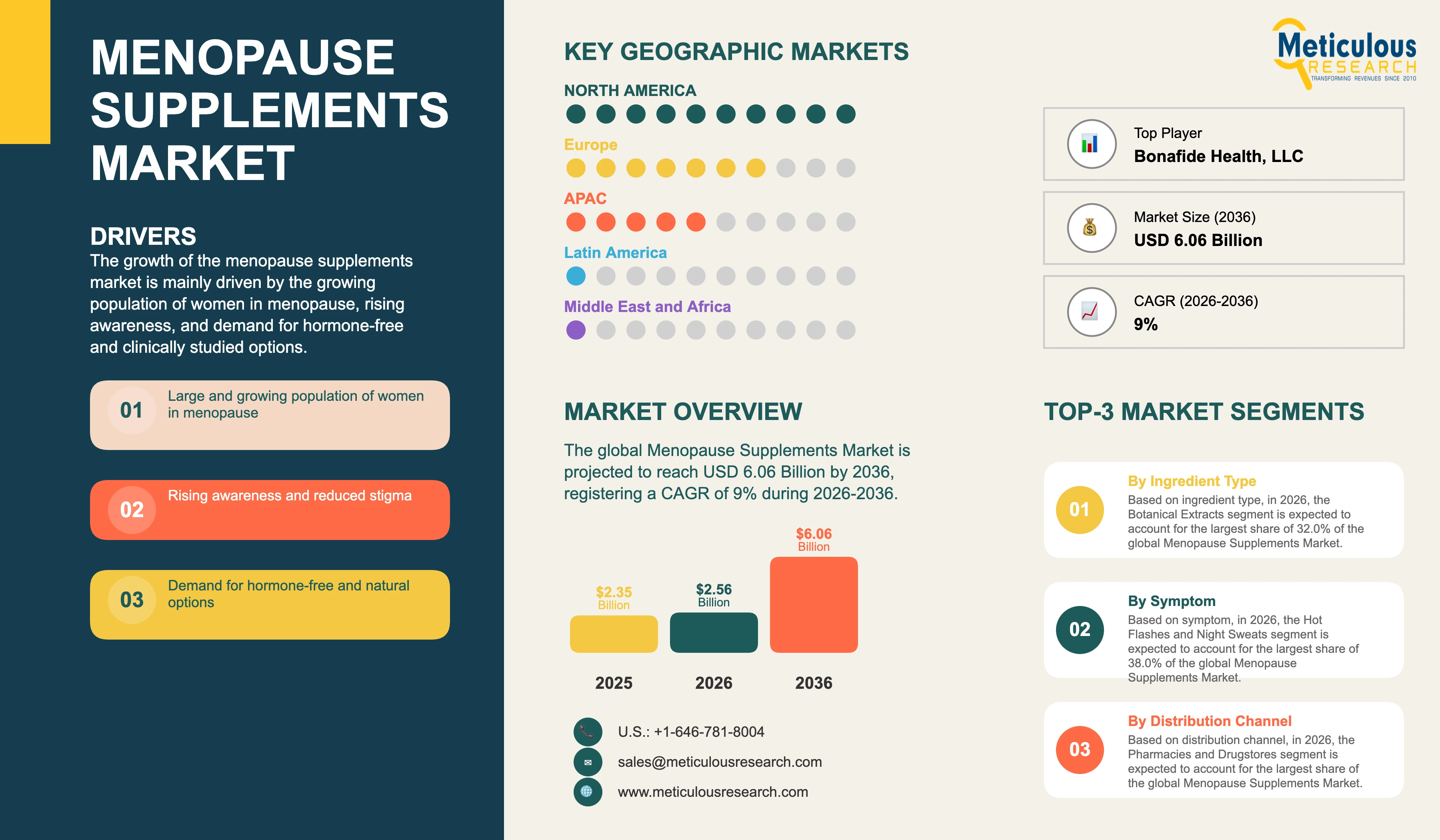
The global menopause supplements market was valued at USD 2.35 billion in 2025. This market is expected to reach USD 6.06 billion by 2036 from an estimated USD 2.56 billion in 2026, registering a CAGR of 9.0% during the forecast period (2026-2036).
- Published
- Nov 2026
- Pages
- 235
- Format
- PDF + Excel
- Report ID
- MRHC - 1042569
- Base year
- 2025
- 2025 · BASELINE
- $2.35B
- 2036
- $6.06B
- CAGR 2026–2036
- 9.0%
2025 baseline · 2026–2036 forecast at 9.0% CAGR · hover a bar for the value
Key highlights
On February 19, 2026, Bonafide Health, a menopause-focused brand owned by Pharmavite, which is part of Japan's Otsuka Pharmaceutical, launched Noctera, a hormone-free and melatonin-free supplement designed to improve sleep quality and duration affected by hormonal changes, and the company brought Noctera and its Serenol supplement into more than 1,700 Target stores across the U.S. on April 12, 2026.
Bonafide Health first expanded from direct-to-consumer and physician-led sales into retail with a launch in more than 1,800 Target stores and on Target.com, and its State of Menopause research found that 72% of U.S. women would try hormone-free options if they could find them, while a June 2026 national survey of 600 gynecologists named several Bonafide products as the most recommended in their categories.
Winona, a physician-led telehealth company focused on menopause care and hormone therapy, launched a branded supplement line in July 2026, including a prebiotic and probiotic blend, a magnesium blend, a multivitamin, and a calcium formula with vitamins D3, K2, and B12, designed to complement hormone therapy or provide nonhormonal support.
TopGum launched a women's gummy line in April 2026 featuring shatavari and other targeted botanicals, reflecting the growth of gummy formats and the use of newly studied botanical ingredients, such as shatavari, in menopause supplements, and Nutritional Outlook reported in May 2026 that the menopause nutraceutical category is becoming more evidence-driven through clinical research and targeted innovation.
Bonafide has also introduced Thermella, which it describes as a hormone-free, prescription-free neurokinin 3 receptor (NK3R) antagonist supplement for hot flashes and night sweats, supported by research presented at The Menopause Society's annual meeting, showing how supplement brands are drawing on the same biological pathways targeted by new prescription treatments for menopause symptoms.
By ingredient type, botanical extracts account for the largest share of 32.0% in 2026, while probiotics and other ingredients register the highest CAGR.
By symptom, hot flashes and night sweats account for the largest share of 38.0% in 2026, while sleep and mood registers the highest CAGR.
By form, capsules and tablets account for the largest share in 2026, while gummies and chewables register the highest CAGR.
By distribution channel, pharmacies and drugstores account for the largest share in 2026, while online and direct-to-consumer registers the highest CAGR.
By geography, North America accounts for the largest share of 42.0% in 2026, while Asia-Pacific registers the highest CAGR of 11.0%.
Report summary
| Particulars | Details |
|---|---|
| Base Year | 2025 |
| Estimated Year | 2026 |
| Forecast Period | 2026-2036 |
| Market Size in 2025 | USD 2.35 billion |
| Market Size in 2026 | USD 2.56 billion |
| Market Size by 2036 | USD 6.06 billion |
| CAGR (2026-2036) | 9.0% |
| Format | PDF, Excel & Cloud Portal · 235 pages |
| Largest Segment by Ingredient Type (2026) | Botanical Extracts (32.0%) |
| Largest Segment by Symptom (2026) | Hot Flashes and Night Sweats (38.0%) |
| Largest Region (2026) | North America (42.0%) |
| Fastest-Growing Region | Asia-Pacific (CAGR 11.0%) |
| Companies Profiled | 13 companies and other companies |
| Segments Covered | Ingredient Type, Symptom, Form, Distribution Channel, Geography |
| Countries Covered | U.S., Canada, U.K., Germany, France, Italy, Spain, Netherlands, Sweden, Norway, Denmark, Switzerland, Poland, Ireland, Belgium, Rest of Europe, China, Japan, India, South Korea, Australia, Indonesia, Thailand, Malaysia, Singapore, Rest of Asia-Pacific, Brazil, Mexico, Argentina, Chile, Colombia, Rest of Latin America, Israel, Saudi Arabia, U.A.E., Turkey, South Africa, Rest of Middle East & Africa |
Report overview
Segments covered: ingredient type, symptom, form, distribution channel.
The growth of this market is mainly driven by the large and growing number of women in perimenopause and menopause worldwide, rising awareness and open discussion of menopause symptoms, strong demand for hormone-free and natural options among women who cannot or prefer not to use hormone therapy, the growing number of clinically studied supplement ingredients and products, the mainstreaming of menopause products in major retail chains, and the growth of women's health brands and telehealth platforms that offer supplements alongside medical care. However, factors such as mixed scientific evidence for some ingredients, limited regulation and quality concerns in the supplement industry, competition from prescription treatments, and the stigma that still surrounds menopause in some markets are expected to restrain the growth of this market to some extent.
Menopause is the stage in a woman's life when menstrual periods stop permanently, usually between the ages of 45 and 55, and it is preceded by perimenopause, a transition period that can last several years. During this time, falling levels of estrogen and other hormones can cause a range of symptoms, including hot flashes, night sweats, sleep problems, mood changes, anxiety, brain fog, weight gain, joint pain, vaginal dryness, and reduced bone density. Menopause supplements are dietary supplements formulated to help relieve these symptoms or support health during and after menopause. This report covers botanical extracts, phytoestrogens and isoflavones, vitamins and minerals, omega-3 and specialty nutrients, and probiotics and other ingredients, sold in capsules, tablets, gummies, powders, drinks, and other forms through all distribution channels, and the market is measured on a sales value basis.
Hundreds of millions of women worldwide are in perimenopause or menopause at any time, and this number is growing as populations age. Many women experience symptoms that affect their sleep, work, relationships, and quality of life, yet menopause has historically received little attention in medicine, research, and consumer products. This has changed significantly in recent years, as public figures, media, employers, and women's health companies have raised awareness, and menopause has become a mainstream topic of conversation in the U.S., the U.K., Australia, and other countries.
Hormone therapy is the most effective treatment for many menopause symptoms, but many women cannot use it because of medical conditions, such as a history of breast cancer, or prefer not to use it because of concerns about risks. In addition, many women experience symptoms but do not seek medical help or have difficulty accessing knowledgeable doctors. As a result, a large share of women look for nonhormonal options, including lifestyle changes and supplements. Bonafide's research has found that most U.S. women would try hormone-free options if they could find them.
Menopause supplements use a wide range of ingredients, and botanical extracts, such as black cohosh, sage, maca, ashwagandha, shatavari, and pollen extracts, are widely used for hot flashes, mood, and sleep. Phytoestrogens, such as soy isoflavones and red clover isoflavones, are plant compounds with weak estrogen-like effects. Vitamins and minerals, such as calcium, vitamin D, magnesium, and B vitamins, support bone health, energy, and sleep, while omega-3 fatty acids, collagen, probiotics, and other ingredients address heart health, skin, gut health, and other needs. Clinical evidence varies by ingredient, and brands increasingly emphasize clinically studied formulations.
The market has evolved from a small number of traditional products, such as black cohosh supplements sold in pharmacies, to a broad and growing range of products from specialized women's health brands, mainstream supplement companies, and telehealth platforms. Brands such as Bonafide, Estroven, Menopace, Remifemin, Amberen, and Femarelle have established positions, while new direct-to-consumer brands and telehealth companies, such as Winona, have entered the market. Retailers such as Target, Walgreens, CVS, Boots, and others have expanded their menopause sections.
Formats are also changing, as capsules and tablets remain the most common, but gummies, powders, drinks, and functional foods are growing, as brands seek to make products more enjoyable and convenient. Products are increasingly designed for specific symptoms, such as sleep, mood, hot flashes, or vaginal health, rather than general menopause support, and some brands offer personalized supplement plans based on symptom assessments.
The market includes specialized women's health supplement brands, large dietary supplement companies, pharmaceutical and consumer health companies, and telehealth platforms. Leading companies include Bonafide Health (Pharmavite), i-Health (Estroven), Vitabiotics, A.Vogel, Schaper & Brümmer, Lunada Biomedical, Se-cure Pharmaceuticals, Bayer, Nestlé Health Science, Unilever (Nutrafol), Winona, H&H Group (Swisse), and Himalaya Wellness.
Over the forecast period, the menopause supplements market is expected to grow strongly, as awareness continues to rise, as more women seek nonhormonal and complementary options, as clinically studied products gain credibility with doctors and consumers, and as the market expands in Asia-Pacific, Latin America, and other regions where menopause care is less developed.
Women in our markets are only now starting to talk about menopause openly, and gummies and products with familiar herbal ingredients are growing fastest online, especially among women in their forties.
North America is expected to account for the largest share of 42.0% of the market in 2026, mainly due to high awareness, high supplement spending, leading brands, and the expansion of menopause products in major U.S. retailers.
Asia-Pacific is projected to register the highest CAGR of 11.0% during the forecast period, driven by large aging female populations, rising awareness, and strong herbal traditions in China, Japan, India, and South Korea.
The report profiles 13 leading companies, including Bonafide Health (Pharmavite), i-Health (Estroven), Vitabiotics, A.Vogel, Schaper & Brümmer, Lunada Biomedical, Se-cure Pharmaceuticals, Bayer, Nestlé Health Science, Unilever (Nutrafol), Winona, H&H Group (Swisse), and Himalaya Wellness.
Report infographic
Market dynamics
16 factors across 5 forcesLarge and growing population of women in menopause
The number of women in perimenopause and menopause is very large and growing, as populations age and life expectancy increases. In many countries, women now spend more than a third of their lives after menopause, and the generation of women entering menopause in the coming decade is larger, more health-conscious, and more willing to spend on wellness products than previous generations. Many of these women are working, active, and expect solutions that allow them to maintain their quality of life.
Menopause symptoms are common and can be long-lasting, since hot flashes and night sweats can continue for several years, and sleep problems, mood changes, and joint pain are widely reported. As more women seek help for these symptoms, demand for supplements and other solutions continues to grow. The growing population of postmenopausal women also increases demand for products that support long-term health, such as bone, heart, and brain health.
Women in perimenopause, who may experience symptoms for years before their periods stop, are a particularly important and growing group of consumers, as awareness of perimenopause has increased.
Many women in this age group also have high purchasing power and are established buyers of vitamins and supplements, which makes them receptive to products designed for their life stage. Employers increasingly recognize the impact of menopause on the workforce, since women in their late forties and fifties often hold senior positions, and some companies now offer menopause benefits that include education and access to care.
Rising awareness and reduced stigma
Menopause has moved from a taboo subject to a mainstream topic of public conversation. Celebrities, media, books, podcasts, and social media have raised awareness of menopause symptoms and treatment options, and governments and employers in the U.K., Australia, the U.S., and other countries have introduced menopause policies and support programs. Healthcare organizations are also improving education for doctors on menopause.
This increased awareness has encouraged more women to recognize their symptoms, seek information, and try solutions, including supplements. Retailers are giving menopause products more prominent space, and brands are investing in education and marketing. Bonafide's expansion from direct-to-consumer sales into Target stores, and its statement that menopause is now mainstream, reflect this change.
Online communities, podcasts, and social media accounts focused on menopause have also created spaces where women share experiences and product recommendations, which helps new brands reach consumers and encourages women to try supplements. Books and documentaries on menopause have reached large audiences in the U.S., the U.K., and Australia, further reducing stigma.
Demand for hormone-free and natural options
Many women cannot or prefer not to use hormone therapy, either because of medical reasons, such as a history of hormone-sensitive cancers or blood clots, or because of concerns about risks that arose from earlier studies. Others have mild to moderate symptoms that they prefer to manage without prescription medicines, or they want to complement hormone therapy with additional support. These women represent a large market for hormone-free supplements.
Consumer preference for natural and plant-based products also supports demand for botanical and nutrient-based menopause supplements. Brands are responding with hormone-free formulations, clinically studied botanical ingredients, and products targeting specific symptoms, and they are emphasizing safety, quality, and scientific evidence to build trust.
Women who stop hormone therapy, or who are waiting to see a doctor, also often use supplements as a bridge or alternative, and women who use hormone therapy may add supplements for symptoms that hormones do not fully address, such as joint pain, sleep, or mood, which expands the potential user base beyond women who avoid hormones.
Growth of clinically studied products and women's health brands
The menopause supplement market is becoming more evidence-driven, as brands invest in clinical studies, present research at scientific meetings, and work with doctors to recommend their products. Bonafide, for example, presents research at The Menopause Society's annual meeting and reports that its products are recommended by many gynecologists. Clinically studied ingredients, such as specific pollen extracts, pine bark extracts, shatavari extracts, and others, are gaining popularity.
The growth of women's health companies, including telehealth platforms that provide menopause care, such as Winona and others, also supports the market, as these companies increasingly offer supplements alongside prescription treatments. Investment in women's health and femtech has grown, bringing new brands, products, and marketing to the menopause category.
Large consumer health and supplement companies have also entered the category through acquisitions and new product lines, as shown by Pharmavite's acquisition of Bonafide in 2023. Their investment in marketing, retail distribution, and research is helping the category grow and gain credibility with retailers and healthcare professionals.
Table of contents
12 chapters · 159 sections · 235 pages · click to expandSegmental analysis
| Segment | Largest share (2026) | Fastest growth (2026–2036) |
|---|---|---|
| By Ingredient Type | Botanical extracts | Probiotics and other ingredients |
| By Symptom | Hot flashes and night sweats | Sleep and mood |
| By Form | Capsules and tablets | Gummies and chewables |
| By Distribution Channel | Pharmacies and drugstores | Online and direct-to-consumer |
| Other segments | Capsules and tablets | Gummies and chewables |
By Ingredient Type
- Menopause Supplements Market Analysis by Ingredient Type
- The botanical extracts segment is expected to account for the largest share of 32.0% of the global menopause supplements market.
- The large share of this segment is mainly due to the widespread and long-standing use of botanical ingredients, such as black cohosh, sage, maca, ashwagandha, shatavari, and pollen extracts, to relieve hot flashes, mood changes, and sleep problems, strong consumer preference for natural and plant-based remedies, the large number of products and brands built on botanical ingredients, and growing clinical research on specific branded botanical extracts.
- Black cohosh, used in products such as Remifemin, is one of the most studied botanicals for menopause.
- Botanical products are popular across all regions and channels, and they are particularly important in markets with strong herbal traditions, such as Germany, China, India, and Japan.
- Brands are increasingly using standardized and clinically studied branded extracts, such as specific pollen extracts and pine bark extracts, to differentiate their products and build trust with consumers and healthcare professionals.
- Combination products that pair botanicals with vitamins, minerals, or other ingredients for multiple symptoms are also common.
- However, the probiotics and other ingredients segment is projected to register the highest CAGR during the forecast period.
- The rapid growth of this segment is driven by growing research on the role of the gut microbiome and vaginal microbiome in menopause symptoms, metabolism, and bone health, the launch of probiotic products designed for menopausal women, and interest in new ingredients such as collagen, creatine, and specialized amino acids.
- Phytoestrogens and isoflavones account for a large share, especially in Asia-Pacific where soy-based products are traditional, vitamins and minerals support bone health and energy, and omega-3 and specialty nutrients address heart, brain, and skin health.
By Symptom
- Menopause Supplements Market Analysis by Symptom
- The hot flashes and night sweats segment is expected to account for the largest share of 38.0% of the global menopause supplements market.
- The large share of this segment is mainly due to the high prevalence of vasomotor symptoms, which affect a large majority of women during the menopause transition, their significant impact on sleep, work, and quality of life, the long history of supplements targeting hot flashes, such as black cohosh, soy isoflavones, and pollen extracts, and the focus of many leading brands on vasomotor symptom relief.
- Hot flashes and night sweats are the most recognized menopause symptoms and the most common reason women seek help from doctors or look for products in stores.
- Many supplement brands, including Bonafide, Estroven, Remifemin, and Menopace, offer products specifically for these symptoms, and new products, such as those targeting the neurokinin pathway, aim to provide stronger relief.
- Hot flash products are often the first menopause supplement that women try, which makes this segment an important entry point for brands that later offer products for other symptoms.
- However, the sleep and mood segment is projected to register the highest CAGR during the forecast period.
- The rapid growth of this segment is driven by the high prevalence of sleep problems, anxiety, and mood changes during perimenopause and menopause, growing recognition of these symptoms, the launch of hormone-free sleep and mood products, such as Bonafide's Noctera, and the use of magnesium, botanicals, and amino acids for sleep and stress.
- Bone and joint health, vaginal and urinary health, and weight, metabolism, energy, and other symptoms also account for significant shares, and interest in weight and metabolism support is rising as women seek help with midlife weight gain.
- Hot flashes and night sweats are expected to account for the largest share of 38.0% of the market in 2026, while sleep and mood is projected to register the highest CAGR as hormone-free sleep products grow.
By Form
- Menopause Supplements Market Analysis by Form
- The capsules and tablets segment is expected to account for the largest share of the global menopause supplements market.
- The large share of this segment is mainly due to their long-established use in the supplement industry, their ability to deliver precise doses of botanical extracts, vitamins, and minerals, their stability and long shelf life, and the use of capsules and tablets by most leading menopause brands.
- Capsules and tablets are also generally preferred for products that require high doses or combinations of multiple ingredients.
- Capsules and tablets are widely available in pharmacies, supermarkets, and online, and they are familiar to consumers and healthcare professionals, who often prefer them for their consistent dosing.
- Softgel capsules are commonly used for oil-based ingredients such as omega-3 fatty acids, and many brands offer once-daily formulations to make daily use easier and improve compliance.
- However, the gummies and chewables segment is projected to register the highest CAGR during the forecast period.
- The rapid growth of this segment is driven by consumer preference for enjoyable and easy-to-take formats, the launch of women's health gummy lines by supplement and gummy manufacturers, and the appeal of gummies to women who dislike swallowing pills.
- Powders and drinks are also growing as brands launch menopause beverages, protein powders, and drink mixes, while liquids and other forms serve specific needs.
By Distribution Channel
- Menopause Supplements Market Analysis by Distribution Channel
- The pharmacies and drugstores segment is expected to account for the largest share of the global menopause supplements market.
- The large share of this segment is mainly due to the trust consumers place in pharmacies for health products, the availability of advice from pharmacists, the strong presence of menopause supplements in pharmacy chains in Europe, North America, and Asia-Pacific, and the expansion of menopause sections in major drugstore chains.
- In many European countries, menopause supplements are sold mainly through pharmacies.
- Pharmacies are a particularly important channel for brands with medical positioning and clinically studied products, and pharmacists often recommend products for specific symptoms, which supports sales of clinically positioned brands.
- Pharmacy chains are giving more space to menopause products as awareness grows, and some are training pharmacists to provide menopause advice, offering private consultation services, and launching their own private-label ranges.
- However, the online and direct-to-consumer segment is projected to register the highest CAGR during the forecast period.
- The rapid growth of this segment is driven by the convenience and privacy of buying menopause products online, the growth of direct-to-consumer women's health brands and telehealth platforms, subscription models, and the use of online education, symptom quizzes, and community to engage women.
- Supermarkets and mass merchandisers, such as Target, are growing quickly as menopause becomes mainstream, while practitioner and specialty channels serve women seeking professional advice.
Other segments
- The capsules and tablets segment is expected to account for the largest share of the menopause supplements market, while the gummies and chewables segment is projected to register the highest CAGR during the forecast period.
- The pharmacies and drugstores segment is expected to account for the largest share of the menopause supplements market, while the online and direct-to-consumer segment is projected to register the highest CAGR during the forecast period.
Geographic analysis
North America
Largest shareIn 2026, North America is expected to account for the largest share of 42.0% of the global menopause supplements market. The large share of this region is mainly due to the large population of women in menopause in the U.S., high awareness and open discussion of menopause, high spending on dietary supplements, the presence of leading brands such as Bonafide, Estroven, and Amberen, the growth of women's health and telehealth companies, and the expansion of menopause products in major retailers such as Target, Walgreens, and CVS. Canada also has a well-developed market for natural health products, with a national licensing system that requires evidence for product claims.
Europe
Europe is the second-largest market, supported by strong demand in the U.K., where menopause awareness has risen sharply, Germany, where herbal products such as Remifemin are widely used, France, Italy, Spain, the Netherlands, the Nordic countries, Switzerland, and Poland, and the presence of brands such as Menopace, A.Vogel, and Remifemin. EU restrictions on health claims limit marketing, but pharmacy channels are strong. Ireland and Belgium are also important markets. In the U.K., government and employer initiatives on menopause, along with media coverage, have made it one of the most active menopause markets in the world.
Asia-Pacific
Fastest growthAsia-Pacific is projected to register the highest CAGR of 11.0% during the forecast period. The rapid growth of this region is mainly driven by large and aging female populations in China, Japan, India, South Korea, and Southeast Asia, rising awareness of menopause, the strong tradition of herbal and soy-based remedies, rising incomes, and the expansion of international and local supplement brands. Australia has a well-developed and highly regulated market with brands such as Swisse, while Japan has a large market for soy isoflavone and equol products. India is an emerging market where Ayurvedic brands and new women's health startups are building awareness of menopause through online channels.
Latin America
Latin America and the Middle East & Africa account for smaller shares of the market. Brazil and Mexico are the largest markets in Latin America, supported by growing awareness, large pharmacy chains, and e-commerce, while Argentina, Chile, and Colombia are emerging markets with growing interest in women's health.
Middle East & Africa
In the Middle East & Africa, Israel, Saudi Arabia, the U.A.E., Turkey, and South Africa have growing demand supported by pharmacies and e-commerce, although stigma limits awareness in some markets.
Competitive landscape
The global menopause supplements market is fragmented, with the top five players estimated to account for about 30% of the market in 2025. The market includes specialized women's health brands, large dietary supplement companies, pharmaceutical and consumer health companies, and telehealth platforms.
Bonafide Health, part of Pharmavite and Otsuka, is one of the leading menopause supplement brands in the U.S., with a range of hormone-free products for specific symptoms and a strong focus on clinical research and physician recommendations. i-Health's Estroven is another leading and long-established U.S. brand, while Lunada Biomedical's Amberen is also well known among U.S. consumers. In Europe, Vitabiotics' Menopace, A.Vogel, and Schaper & Brümmer's Remifemin are leading brands with long histories in pharmacies, while Se-cure Pharmaceuticals' Femarelle is sold in many countries.
Bayer offers menopause multivitamins under its One A Day brand, Nestlé Health Science offers products through its supplement brands, Unilever's Nutrafol offers hair growth supplements for women in menopause, H&H Group's Swisse is a leading brand in Australia and China, and Himalaya Wellness offers Ayurvedic women's health products. Telehealth companies, such as Winona, and many direct-to-consumer brands have entered the market.
The market is highly fragmented because women use many different ingredients and products for different symptoms, and because brand preferences vary widely between countries. In each region, a few established brands lead in pharmacies, while new direct-to-consumer brands compete online with modern positioning, education, influencer partnerships, and community-building.
Companies in this market compete on clinical evidence, ingredient quality, symptom focus, brand trust, healthcare professional recommendations, retail distribution, price, and marketing. Key strategies adopted by these companies include product launches for specific symptoms, clinical research, retail expansion, partnerships with healthcare providers and telehealth companies, acquisitions of women's health brands, and expansion into new regions.
We expect continued consolidation over the forecast period, as large supplement and consumer health companies acquire specialized menopause brands, following Pharmavite's acquisition of Bonafide, and increasing competition as new brands and telehealth companies enter the market. Brands with clinical evidence, quality certifications, and strong relationships with healthcare professionals are likely to gain share over the forecast period.
Some of the key players operating in the menopause supplements market are Bonafide Health, LLC (Pharmavite LLC), i-Health, Inc. (Estroven), Vitabiotics Ltd., A.Vogel AG, Schaper & Brümmer GmbH & Co. KG, Lunada Biomedical (Amberen), Se-cure Pharmaceuticals Ltd. (Femarelle), Bayer AG, Nestlé Health Science, Unilever PLC (Nutrafol), Winona, H&H Group (Swisse), and Himalaya Wellness Company, among others.
- —
Bonafide launched Noctera in February 2026 and expanded Noctera and Serenol into more than 1,700 Target stores, Winona launched a menopause supplement line in July 2026, and TopGum launched a women's gummy line with shatavari in April 2026, reflecting growth in hormone-free, symptom-specific, and gummy products.
- Bonafide Health, LLC (Pharmavite LLC)
- Vitabiotics Ltd.
- A.Vogel AG
- Schaper & Brümmer GmbH & Co. KG
- Lunada Biomedical · Amberen
- Se-cure Pharmaceuticals Ltd. · Femarelle
- Bayer AG
- Nestlé Health Science
- Unilever PLC · Nutrafol
- Winona
- H&H Group · Swisse
- Himalaya Wellness Company
Expert perspectives
The menopause supplements market is benefiting from one of the most significant shifts in women's health in decades, as menopause moves from a hidden topic to a mainstream health and wellness category. The large population of women in midlife, rising awareness, and demand for hormone-free options create strong and lasting demand that is likely to continue throughout the forecast period.
Over the forecast period, the market is expected to grow at a CAGR of 9.0%, from USD 2.56 billion in 2026 to USD 6.06 billion in 2036. Growth will be supported by rising awareness, demand for hormone-free options, clinically studied products, retail and telehealth expansion, and growth in Asia-Pacific.
Botanical extracts remain the largest ingredient type, while probiotics and other ingredients grow fastest. Hot flashes and night sweats are the largest symptom segment, while sleep and mood grows fastest. Capsules and tablets remain the largest form, while gummies and chewables grow fastest. Pharmacies and drugstores are the largest channel, while online and direct-to-consumer grows fastest. North America remains the largest region, and Asia-Pacific is the fastest-growing region at a CAGR of 11.0%.
We believe the market will increasingly reward brands that invest in clinical evidence, quality, and healthcare professional relationships. As awareness grows, women and their doctors are becoming more discerning, and products without credible evidence may struggle. The growth of prescription treatments, including hormone therapy and new nonhormonal medicines, will not eliminate demand for supplements, since many women prefer or need nonprescription options or use supplements alongside prescriptions for symptoms that persist.
For brands, the key priorities over the forecast period are to develop symptom-specific, evidence-based products, build trust through quality and transparency, expand retail and online distribution, and educate women and healthcare professionals. Telehealth partnerships and personalized approaches are important growth paths.
We also expect the boundary between supplements and medical care to blur, as telehealth companies offer both prescriptions and supplements, and as supplement brands build relationships with doctors and pharmacists. This convergence could increase the credibility of evidence-based supplements while putting pressure on products without clinical support.
In terms of formats and channels, we expect gummies, powders, and online and direct-to-consumer sales to keep gaining share, while pharmacies remain important for women who want professional advice. Brands that combine strong online engagement with retail and pharmacy presence will be best positioned to reach women at every stage of menopause.
We expect Asia-Pacific to become an increasingly important market, as awareness of menopause rises in China, India, and other countries, and as local and international brands adapt products to local preferences, traditions, and price points, and as e-commerce makes products easier to buy discreetly.
Customer perspectives
Woman in perimenopause, 49 - U.S.
My hot flashes and poor sleep were affecting my work, but I did not want hormones. I looked for a hormone-free product with clinical studies that my gynecologist had heard of, and I was glad to find it in a store I already shop at every week.
Pharmacist - community pharmacy chain, U.K.
Menopause questions at our counters have increased dramatically over the last few years. Women ask for herbal products and for magnesium and vitamin D, and we now have a dedicated menopause section.
Frequently asked questions
The global menopause supplements market was valued at USD 2.35 billion in 2025, up from USD 2.16 billion in 2024, and is estimated to reach USD 2.56 billion in 2026. The market includes all botanical, phytoestrogen, vitamin and mineral, specialty nutrient, and probiotic supplements for perimenopause and menopause.
The global menopause supplements market is expected to reach USD 6.06 billion by 2036, supported by rising awareness, demand for hormone-free options, clinically studied products, retail and telehealth expansion, and growth in Asia-Pacific.
The market is expected to register a CAGR of 9.0% from 2026 to 2036.
Menopause supplements are dietary supplements formulated to help relieve symptoms of perimenopause and menopause, such as hot flashes, night sweats, sleep problems, and mood changes, or to support bone, heart, and overall health during and after menopause.
Market growth is mainly driven by the large and growing population of women in menopause, rising awareness and reduced stigma, demand for hormone-free and natural options, and the growth of clinically studied products and women's health brands.
Mixed scientific evidence, quality concerns, and competition from prescription treatments restrain growth, while regulatory restrictions on claims and persistent stigma in some regions are key challenges.
Key growth opportunities include symptom-specific and clinically backed formulations, integration with telehealth and medical menopause care, expansion in Asia-Pacific and emerging markets, and new formats and functional foods.
Botanical extracts are expected to account for the largest share of 32.0% of the market in 2026, while probiotics and other ingredients are projected to register the highest CAGR.
Hot flashes and night sweats are expected to account for the largest share of 38.0% of the market in 2026, while sleep and mood is projected to register the highest CAGR as hormone-free sleep products grow.
In 2026, the capsules and tablets segment is expected to account for the largest share of the menopause supplements market, while the gummies and chewables segment is projected to register the highest CAGR during the forecast period.
In 2026, the pharmacies and drugstores segment is expected to account for the largest share of the menopause supplements market, while the online and direct-to-consumer segment is projected to register the highest CAGR during the forecast period.
North America is expected to account for the largest share of 42.0% of the market in 2026, mainly due to high awareness, high supplement spending, leading brands, and the expansion of menopause products in major U.S. retailers.
Asia-Pacific is projected to register the highest CAGR of 11.0% during the forecast period, driven by large aging female populations, rising awareness, and strong herbal traditions in China, Japan, India, and South Korea.
The report profiles 13 leading companies, including Bonafide Health (Pharmavite), i-Health (Estroven), Vitabiotics, A.Vogel, Schaper & Brümmer, Lunada Biomedical, Se-cure Pharmaceuticals, Bayer, Nestlé Health Science, Unilever (Nutrafol), Winona, H&H Group (Swisse), and Himalaya Wellness.
Bonafide launched Noctera in February 2026 and expanded Noctera and Serenol into more than 1,700 Target stores, Winona launched a menopause supplement line in July 2026, and TopGum launched a women's gummy line with shatavari in April 2026, reflecting growth in hormone-free, symptom-specific, and gummy products.
Cite this report
Meticulous Research. (2026). Menopause Supplements Market - Global Opportunity Analysis and Industry Forecast (2026-2036) (Report No. MRHC - 1042569). Meticulous Market Research Pvt. Ltd. https://www.meticulousresearch.com/product/menopause-supplements-market-7252