AI in Clinical Trials Market (2026-2036)
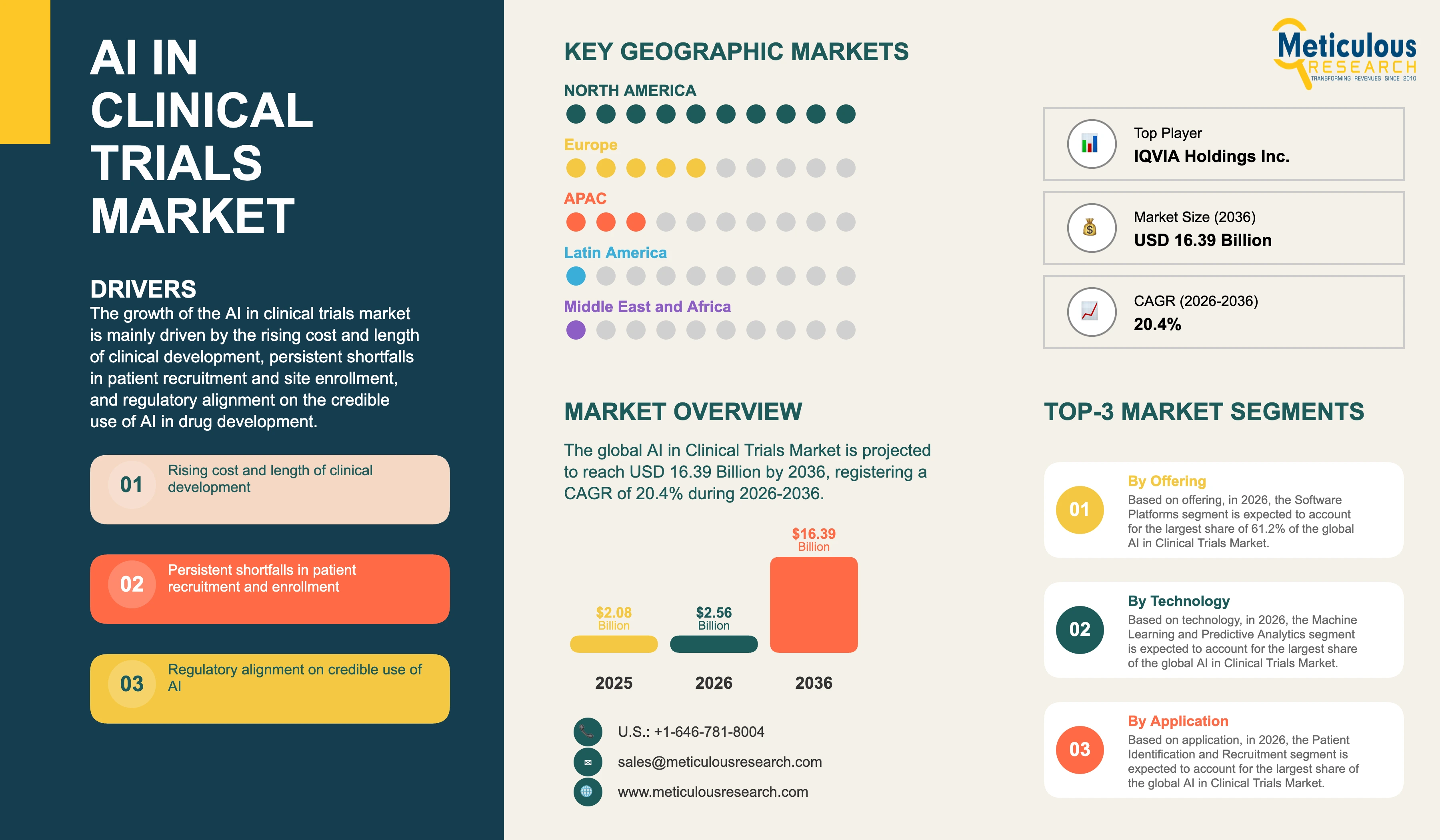
The global AI in clinical trials market was valued at USD 2.08 billion in 2025. This market is expected to reach USD 16.39 billion by 2036 from an estimated USD 2.56 billion in 2026, registering a CAGR of 20.4% during the forecast period (2026-2036).
- Published
- Nov 2026
- Pages
- 267
- Format
- PDF + Excel
- Report ID
- MRHC - 1042507
- Base year
- 2025
- 2025 · BASELINE
- $2.08B
- 2036
- $16.39B
- CAGR 2026–2036
- 20.4%
2025 baseline · 2026–2036 forecast at 20.4% CAGR · hover a bar for the value
Key highlights
The FDA and the EMA published ten joint Guiding Principles of Good AI Practice in Drug Development on 14 January 2026, covering AI used to generate or analyze evidence from early research and clinical trials through manufacturing and safety monitoring.
The FDA draft guidance on the use of AI to support regulatory decision-making for drugs and biological products, issued in January 2025, sets out a risk-based, seven-step credibility framework built around the model's context of use; the FDA reports that it has received more than 500 drug and biologic submissions with AI components since 2016.
ICH E6(R3) Good Clinical Practice (Principles and Annex 1) took effect in the EU on 23 July 2025, and the FDA published its final E6(R3) guidance in September 2025, formalizing risk-based quality management and central monitoring that AI tools are built to support.
PathAI's AIM-MASH AI Assist became the first AI-based tool qualified by both the EMA (2025) and the FDA (December 2025) for use in MASH clinical trials, for biopsy-based enrollment and endpoint assessment.
IQVIA launched IQVIA.ai, a unified agentic AI platform built with NVIDIA, on 16 March 2026, with 19 of the top 20 pharmaceutical companies already integrating IQVIA agents, and Medidata launched Medidata Plus, a clinical AI layer across its platform, on 23 July 2026.
Generative and agentic AI is the fastest-growing technology, and regulatory documentation and medical writing is the fastest-growing application, as large language models take over drafting and multi-step trial workflows.
By offering, software platforms account for the largest share of 61.2% in 2026 and also register the higher CAGR.
By technology, machine learning and predictive analytics account for the largest share in 2026, while generative and agentic AI registers the highest CAGR.
By application, patient identification and recruitment accounts for the largest share in 2026, while regulatory documentation and medical writing registers the highest CAGR.
By trial phase, Phase III accounts for the largest share in 2026, while Phase II registers the highest CAGR.
By therapeutic area, oncology accounts for the largest share in 2026, while cardiovascular and metabolic diseases register the highest CAGR.
By end user, pharmaceutical and biotechnology companies account for the largest share of 62.8% in 2026, while contract research organizations register the highest CAGR.
By geography, North America accounts for the largest share of 51.5% in 2026, while Asia-Pacific registers the highest CAGR of 24.7%.
Report summary
| Particulars | Details |
|---|---|
| Base Year | 2025 |
| Estimated Year | 2026 |
| Forecast Period | 2026-2036 |
| Market Size in 2025 | USD 2.08 billion |
| Market Size in 2026 | USD 2.56 billion |
| Market Size by 2036 | USD 16.39 billion |
| CAGR (2026-2036) | 20.4% |
| Format | PDF, Excel & Cloud Portal · 267 pages |
| Largest Segment by Offering (2026) | Software Platforms (61.2%) |
| Largest Segment by End User (2026) | Pharmaceutical and Biotechnology Companies (62.8%) |
| Largest Region (2026) | North America (51.5%) |
| Fastest-Growing Region | Asia-Pacific (CAGR 24.7%) |
| Companies Profiled | 17 companies and other companies |
| Segments Covered | Offering, Technology, Application, Trial Phase, Therapeutic Area, End User, Geography |
| Countries Covered | U.S., Canada, Germany, U.K., France, Switzerland, Spain, Italy, Netherlands, Belgium, Denmark, Rest of Europe, China, Japan, India, South Korea, Australia, Singapore, Rest of Asia-Pacific, Brazil, Mexico, Argentina, Rest of Latin America, Israel, Saudi Arabia, U.A.E., South Africa, Rest of Middle East & Africa |
Report overview
Segments covered: offering, technology, application, trial phase, therapeutic area, end user.
The growth of this market is mainly driven by the rising cost and length of clinical development and the pressure on sponsors to shorten it, persistent shortfalls in patient recruitment and site enrollment, the alignment of the FDA and the EMA on how AI can credibly support evidence used in regulatory decisions, and the embedding of agentic AI into the eClinical platforms that sponsors and CROs already run. However, factors such as restricted access to interoperable patient-level data under privacy rules, and the validation and GxP documentation burden for AI used in regulated trial processes, are expected to restrain the growth of this market to some extent.
AI in clinical trials covers software and services that use machine learning, natural language processing, computer vision, and generative and agentic AI to plan, run, monitor, and report clinical studies. The main uses are protocol and endpoint design, site selection and feasibility, patient identification and recruitment, data review and cleaning, risk-based monitoring, imaging and digital endpoint reads, and the drafting of protocols, clinical study reports, and regulatory documents. Sponsors buy these tools mainly to save time and reduce risk, because every month saved in development brings product revenue forward and every avoided protocol amendment or failed site cuts direct cost.
Adoption is taking place at a time when clinical development is becoming slower and more expensive. The IQVIA Institute's Global R&D Trends 2026 report found that end-to-end development timelines increased again in 2025, while biopharma funding and large-pharma R&D spending slowed from 2024 levels. Research by the Tufts Center for the Study of Drug Development has shown that more than three-quarters of protocols need at least one major amendment and that about one in ten activated sites fails to enroll a single patient. AI is being bought to reduce these specific losses, and vendors now increasingly price their products against measured savings in trial time rather than against user licences.
Regulators have also given sponsors a clearer path for using AI, starting with the FDA's January 2025 draft guidance on the use of AI to support regulatory decisions for drugs and biological products, which sets out a seven-step, risk-based process for showing that a model is reliable for its intended use. On 14 January 2026, the FDA and the EMA published ten joint Guiding Principles of Good AI Practice in Drug Development, covering a risk-based approach, GxP standards, data governance, performance checks, and life cycle management. With these documents in place, sponsors know how to document AI that affects regulated evidence, which removes one of the main reasons for limiting AI to back-office tasks.
The first formal approvals of AI tools for use in trials have now been granted. PathAI's AIM-MASH AI Assist received an EMA qualification opinion in 2025 and FDA qualification as a drug development tool in December 2025, which allows sponsors to use it for liver biopsy scoring at enrollment and for endpoint assessment in Phase II and III MASH trials without validating it again for each submission. Unlearn's method of using digital twins to adjust trial analyses had earlier received an EMA qualification opinion for Phase II and III trials. These approvals matter commercially because once a tool is qualified for a specific use, every sponsor working in that disease can adopt it with much less validation work.
The revised Good Clinical Practice guideline, ICH E6(R3), has also widened the use of AI within running trials. The guideline took effect in the EU on 23 July 2025, and the FDA issued it as final guidance in September 2025. It makes quality by design, risk-based monitoring, and central data review the expected way of running trials. Central monitoring, detecting unusual data patterns across sites, and automated data review are tasks where machine learning performs better than manual checking, so the guideline has created new demand for AI during trial conduct and not only during planning.
On the supply side, Medidata (Dassault Systèmes), IQVIA, Veeva Systems, and Oracle run the core systems that hold trial data and operations, and they are now building AI agents into these systems. This lowers the cost of adoption for sponsors that already use their platforms. Specialist companies such as Tempus AI, ConcertAI, Saama, Unlearn, QuantHealth, Phesi, PathAI, and Paradigm Health compete on their own data, disease-specific models, and regulatory track record. Access to large real-world patient data networks has become a key advantage, because patient matching, feasibility planning, and external comparison groups all depend on patient-level data that the large platform vendors do not hold on their own.
Our margins depend on how many reviewers it takes to get to database lock. Automated data review lets the same team handle more studies, and sponsors now ask about it when we bid for work.
CROs are adopting AI to protect their margins and win outsourced work. This is why contract research organizations are the fastest-growing end user and why clinical data management and review is one of the largest applications in this market.
Director of Clinical Development - emerging neurology biotech, U.S.
In ALS, recruiting a full placebo arm can add a year. Using digital twins to strengthen a smaller control arm is the only way our Phase II readout arrives before we need to raise money again.
Trials in small patient populations depend on digital twins and external comparison data to produce clear results with fewer patients. This supports the fast growth of the Phase II segment and the above-market growth of neurology and rare diseases.
Oncology is expected to account for the largest share of the market in 2026, while cardiovascular and metabolic diseases are projected to register the highest CAGR.
North America is expected to account for the largest share of 51.5% of the market in 2026.
Asia-Pacific is projected to register the highest CAGR of 24.7% during the forecast period, led by China, Japan, South Korea, and Australia.
The report profiles 17 companies, including IQVIA Holdings Inc., Dassault Systèmes SE (Medidata), Veeva Systems Inc., Oracle Corporation, Tempus AI, Inc., ConcertAI, LLC, and Saama Technologies, LLC. The top five players account for an estimated 34.8% of the market in 2025.
Report infographic
Market dynamics
15 factors across 5 forcesRising cost and length of clinical development and pressure to shorten it
Clinical trials take up the largest share of biopharmaceutical R&D spending, and the IQVIA Institute reports that development timelines became longer in 2025 while funding growth slowed. Sponsors facing patent expiry and investor pressure are therefore buying tools that save time at specific steps, including better protocol design to avoid amendments, feasibility models to choose productive sites, recruitment tools to find eligible patients faster, and automated data review to reach database lock sooner. Each of these delivers a clear saving on programs where a single Phase III trial can cost tens of millions of dollars.
Vendors have also begun to back their claims with measured results, as IQVIA reports that its clinical data review agent has cut data review time from about seven weeks to as little as two, and Medidata states that its AI has supported more than 500 clinical studies, including over 120 studies started in 2025. Results like these move AI spending from small innovation budgets into core operating budgets, where contracts are larger and renewals are more likely.
Persistent shortfalls in patient recruitment and site enrollment
Recruitment remains the most common cause of delay in clinical trials, and Tufts CSDD research has found that 11% of activated sites typically fail to enroll a single patient and more than a third enroll fewer patients than planned. Meeting enrollment targets often means extending the original timeline by a wide margin. Eligibility criteria have also become narrower as precision medicine has advanced, so the number of qualifying patients in any one hospital is small and hard to find through doctor referrals and advertising alone.
AI helps by reading both structured and unstructured medical record data, such as doctor notes, pathology reports, and genetic test results, to match patients to trials in near real time. Tempus AI's acquisition of Deep 6 AI in March 2025 added a network of more than 750 provider sites and over 30 million patients to its trial-matching business, and Paradigm Health's acquisition of Flatiron Health's clinical research business in December 2025 gave it what it describes as the largest oncology research network in the U.S. Recruitment is the largest application in this market because it addresses the most expensive delay that sponsors face.
Regulatory alignment on credible use of AI in drug development
Sponsors were long unwilling to let AI influence any part of a trial that could be questioned during an inspection or a regulatory review. The FDA's 2025 draft guidance, the joint FDA and EMA principles of January 2026, and the EMA's 2024 reflection paper on AI in the medicine life cycle now give sponsors a clear method for defining, validating, and monitoring AI models based on how they are used. The qualification of AIM-MASH by both agencies has also shown that an AI tool can be accepted for enrollment and endpoint assessment in late-stage trials.
This clarity shortens internal approval of AI projects within quality and regulatory teams, which had been the slowest step in adoption at large sponsors. It also favors vendors that work closely with regulators and can supply ready validation packages, since most sponsors would rather buy a model with proven documentation than build that evidence themselves.
Embedding of agentic AI into established eClinical platforms
The companies that already run sponsors' data capture, trial management, and document systems are now adding AI directly to these systems. IQVIA launched IQVIA.ai in March 2026 with a catalog of AI agents for clinical and commercial work, Medidata launched Medidata Plus in July 2026 as a single AI layer across its platform, and Veeva Systems scheduled its clinical operations agents for August 2026 and its clinical data agents for December 2026. Worldwide Clinical Trials became the first CRO to adopt Medidata Plus in April 2026.
Built-in AI removes the separate integration project that slowed earlier standalone tools and lets sponsors use AI inside systems that are already validated. Usage-based pricing, which Veeva has adopted for its AI agents, also lowers the cost of getting started. As a result, the buyer base is widening from large sponsors with in-house data science teams to mid-sized biopharma companies and CROs that access AI through their existing platform vendor.
Table of contents
14 chapters · 162 sections · 267 pages · click to expandSegmental analysis
| Segment | Largest share (2026) | Fastest growth (2026–2036) |
|---|---|---|
| By Offering | Software platforms | Generative and agentic AI |
| Other segments | — | Regulatory documentation and medical writing |
By Offering
- Software platforms are expected to account for the larger share of 61.2% of the market in 2026.
- Generative and agentic AI is projected to register the highest CAGR during the forecast period, while machine learning and predictive analytics hold the largest share in 2026.
- Patient identification and recruitment is expected to account for the largest share of the market in 2026.
- Phase III is expected to account for the largest share of the market in 2026, while Phase II is projected to register the highest CAGR.
- Contract research organizations are projected to register the highest CAGR, while pharmaceutical and biotechnology companies account for the largest share of 62.8% in 2026.
Other segments
- Regulatory documentation and medical writing is projected to register the highest CAGR during the forecast period.
Geographic analysis
North America
Largest shareIn 2026, North America is expected to account for the largest share of 51.5% of the global AI in clinical trials market. The large share of this region is mainly due to the large number of pharmaceutical sponsors and well-funded emerging biopharma companies in the U.S., the U.S. base of most AI-focused clinical trial vendors, and access to large, connected medical record and real-world data networks for finding patients. The FDA's draft guidance and its qualification of AIM-MASH as a drug development tool have also given U.S. sponsors the clearest regulatory reference points. Canada is a smaller market supported by academic trial networks and government investment in AI research.
Asia-Pacific
Fastest growthAsia-Pacific is projected to register the highest CAGR of 24.7% during the forecast period. Growth is led by China, where new industry-sponsored trials more than doubled between 2019 and 2025 and AI pilots in clinical development are spreading quickly, and by Japan, South Korea, and Australia, which are taking larger roles in global trials. India adds a large patient pool and a growing base of clinical data and technology service providers. Sponsors in the region are building new digital trial systems rather than replacing older ones, which favors cloud-based and AI-based platforms.
Europe
In Europe, adoption is supported by the region's role as the most used location for global trial sites, the EU-wide use of ICH E6(R3) since July 2025, and the EMA's experience in qualifying AI tools. Germany, the U.K., France, Switzerland, and Spain have the largest sponsor and site bases. Data protection under the GDPR and the high-risk rules of the EU AI Act also shape how vendors handle data access and documentation in Europe, although the EU's Digital Omnibus on AI has delayed these high-risk rules to December 2027 for standalone systems and August 2028 for AI built into regulated products.
Latin America
Latin America and the Middle East & Africa account for smaller shares of the market. Brazil, Mexico, and Argentina are established locations for global trials, so AI demand in Latin America comes mainly from CROs and sponsors using recruitment and feasibility tools for these trials.
Middle East & Africa
In the Middle East & Africa, Israel combines strong health data systems with a group of AI clinical trial companies, while Saudi Arabia and the U.A.E. are investing in clinical research capacity as part of their national life sciences plans.
Competitive landscape
Companies that hold trial data and run trial workflows have the strongest position in this market. These include Medidata (Dassault Systèmes), IQVIA, Veeva Systems, and Oracle, which run the main systems for trial data capture, trial management, and documents and are now adding AI agents directly to them. Their main advantage is reach, as sponsors can switch on AI within validated systems they already use, without a separate purchase, integration, and validation project. IQVIA also benefits from the scale of its clinical research business and healthcare data, and Medidata draws on historical data from more than 38,000 trials.
Specialist AI companies compete on their own data, disease-specific models, and regulatory track record. Tempus AI and ConcertAI combine real-world and genetic cancer data with trial matching and design tools, Paradigm Health runs a provider network that brings trials into community care settings, and Saama focuses on AI-based clinical data management and analytics. Unlearn and QuantHealth specialize in digital twins and trial simulation, PathAI in AI-assisted pathology with approvals from both the FDA and the EMA, Clario in AI-based endpoint and imaging data, and Phesi and H1 in data-based site selection and feasibility, with H1 launching its AI-based Site Network Suite in April 2026. Certara uses modeling and simulation for trial design, Owkin applies AI to biomarker discovery and trial design, and AiCure uses computer vision to track medication adherence and digital biomarkers.
The market is also seeing a steady stream of acquisitions, including Tempus AI's purchase of Deep 6 AI in March 2025, which added more than 750 provider sites to its trial network. Since Deep 6 AI is now part of Tempus, it is not profiled separately in this report. Paradigm Health acquired Flatiron Health's clinical research business in December 2025, and Hippocratic AI acquired Grove AI in January 2026. Platform owners and data-rich specialists are buying smaller companies to fill gaps in their offerings, and the top five players are estimated to account for 34.8% of the market in 2025, leaving a large and fragmented group of specialists competing for the rest.
Some of the key players operating in the AI in clinical trials market are IQVIA Holdings Inc., Dassault Systèmes SE (Medidata), Veeva Systems Inc., Oracle Corporation, Tempus AI, Inc., ConcertAI, LLC, Saama Technologies, LLC, Clario, Certara, Inc., PathAI, Inc., Unlearn.AI, Inc., Paradigm Health, Inc., QuantHealth Ltd., Phesi, Inc., AiCure, LLC, Owkin, Inc., and H1 Insights, Inc., among others.
- —
The FDA and the EMA published joint Guiding Principles of Good AI Practice in Drug Development on 14 January 2026. IQVIA launched IQVIA.ai in March 2026, Medidata launched Medidata Plus in July 2026, and the FDA qualified PathAI's AIM-MASH AI Assist in December 2025 as the first AI-based drug development tool for MASH trials.
- Medidata (Dassault Systèmes)
- IQVIA
- Veeva Systems
- Oracle
Expert perspectives
Spending in this market is driven by the cost of trial delays more than by interest in the technology itself. Sponsors buy AI where a month saved or an amendment avoided can be clearly measured, which is why recruitment, data review, and document drafting lead adoption, while AI that changes endpoints or patient eligibility is adopted more slowly. With the FDA's draft guidance, the joint FDA and EMA principles, and the first AI tool approved by both agencies now in place, the question for sponsors is no longer whether AI can be used but how its use should be documented.
Buying is shifting toward the platforms that already hold trial data, because AI agents built into Medidata, IQVIA, and Veeva systems can be switched on within validated environments. This is drawing budget away from standalone tools. Specialist vendors keep an advantage where their value comes from their own data or regulatory approvals, such as real-world cancer data networks, disease-specific digital twin models, and approved imaging and pathology tools, which platform vendors cannot easily copy, so these specialists are more likely to be acquired than replaced.
Generative and agentic AI is the fastest-growing technology and is expected to become the largest technology segment by 2036, because it takes over work now done by separate tools and by people. Regulatory documentation and medical writing grows fastest among applications for the same reason, and because AI drafts are reviewed by qualified writers, this is the easiest regulated use for sponsors to approve. Patient identification and recruitment remains the largest application throughout the forecast period, but its growth is limited more by access to patient data than by demand.
Asia-Pacific is the fastest-growing region at a CAGR of 24.7%, led by the rise in domestic trial activity in China and the readiness of sponsors there to adopt cloud-based AI platforms. North America remains the largest regional market through 2036, as most sponsor headquarters, vendor headquarters, and large connected health data networks are located there. The biggest uncertainty is sponsor R&D spending, as a recovery in trial starts would speed up market growth more than any technology change, while continued budget pressure would favor vendors that can show verified results.
Overall, growth in this market rests on a clear cost that sponsors cannot ignore and on a regulatory path that is now well defined. Vendors that combine large data assets with validation evidence and offer AI within existing workflows are expected to gain the largest share of this growth.
Customer perspectives
Vice President, Clinical Operations - top-20 biopharmaceutical company, U.S.
We stopped buying AI as separate pilots. If it doesn't run inside the systems our study teams already use and come with a validation package, quality won't sign it off and the study teams won't adopt it.
Built-in AI removes the separate integration and validation work that slowed earlier adoption. This is why software platforms hold 61.2% of the market and why launches such as IQVIA.ai, Medidata Plus, and Veeva AI have shifted budgets toward established platform vendors.
Frequently asked questions
The market was valued at USD 2.08 billion in 2025 and USD 1.71 billion in 2024, and is estimated at USD 2.56 billion in 2026.
Cite this report
Meticulous Research. (2026). AI in Clinical Trials Market - Global Opportunity Analysis and Industry Forecast (2026-2036) (Report No. MRHC - 1042507). Meticulous Market Research Pvt. Ltd. https://www.meticulousresearch.com/product/ai-in-clinical-trials-market-7190