Sleep Supplements Market (2026-2036)
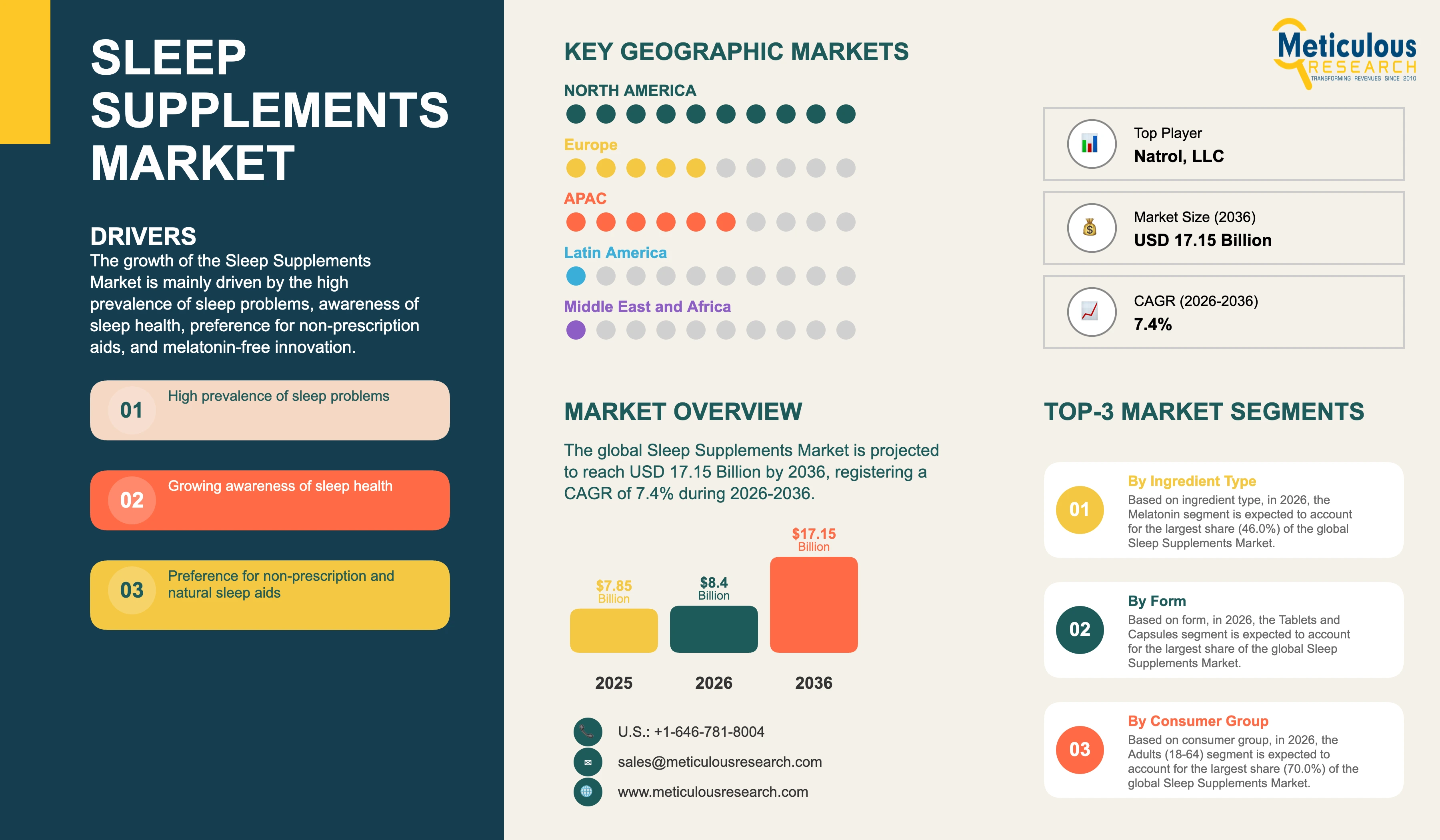
The global sleep supplements market was valued at USD 7.85 billion in 2025. This market is expected to reach USD 17.15 billion by 2036 from an estimated USD 8.40 billion in 2026, registering a CAGR of 7.4% during the forecast period (2026-2036).
- Published
- Nov 2026
- Pages
- 255
- Format
- PDF + Excel
- Report ID
- MRHC - 1042561
- Base year
- 2025
- 2025 · BASELINE
- $7.85B
- 2036
- $17.15B
- CAGR 2026–2036
- 7.4%
2025 baseline · 2026–2036 forecast at 7.4% CAGR · hover a bar for the value
Key highlights
Natrol, one of the leading U.S. sleep supplement brands, introduced Ultra Sleep in 2026, a three-part formula combining melatonin, GABA, and a blend of botanicals including tart cherry, lemon balm, and chamomile, alongside a new Ultra Energy product, as reported by NutraIngredients in October 2026, reflecting the shift toward multi-ingredient sleep formulas.
On February 19, 2026, Bonafide Health launched Noctera, a hormone-free and melatonin-free supplement designed to improve sleep quality and duration affected by hormonal changes in women, and expanded it into more than 1,700 Target stores in April 2026, showing the growth of sleep products targeted at specific consumer groups.
SPINS data cited by Nutraceuticals World showed magnesium sales growing by 33.5%, as innovation in the sleep and mood category shifts toward ingredients that support relaxation and recovery rather than sedation alone, and Modern Retail reported in February 2026 that magnesium has become one of the stars of the U.S. supplement aisle, with brands launching magnesium combinations for sleep and stress.
A U.S. CDC report published in 2022 found that pediatric melatonin ingestions reported to poison control centers increased by 530% between 2012 and 2021, and a 2023 study published in JAMA found that the actual melatonin content of many U.S. melatonin gummy products differed widely from their labels, leading the Council for Responsible Nutrition to issue voluntary guidelines on melatonin packaging, labeling, and dosing for its members.
Melatonin is regulated very differently around the world: it is sold as a dietary supplement in the U.S. and some other countries, but it is available only on prescription or as a medicine in the U.K. and many European countries, which shapes the ingredient mix, product formats, and growth of the sleep supplements market in each region and creates opportunities for melatonin-free products.
By ingredient type, melatonin accounts for the largest share of 46.0% in 2026, while magnesium registers the highest CAGR.
By form, tablets and capsules account for the largest share in 2026, while gummies register the highest CAGR.
By consumer group, adults (18-64) accounts for the largest share of 70.0% in 2026, while older adults (65 and above) registers the highest CAGR.
By distribution channel, pharmacies and drugstores account for the largest share in 2026, while online retail registers the highest CAGR.
By geography, North America accounts for the largest share of 44.0% in 2026, while Asia-Pacific registers the highest CAGR of 9.3%.
Report summary
| Particulars | Details |
|---|---|
| Forecast Period | 2026-2036 |
| Base Year | 2025 |
| Estimated Year | 2026 |
| CAGR (Value) | 7.4% |
| Format | PDF, Excel & Cloud Portal · 255 pages |
| Market Size (Value) in 2025 | USD 7.85 billion |
| Market Size (Value) in 2026 | USD 8.40 billion |
| Market Size (Value) by 2036 | USD 17.15 billion |
| Largest Segment by Ingredient Type (2026) | Melatonin (46.0%) |
| Largest Segment by Consumer Group (2026) | Adults (18-64) (70.0%) |
| Largest Region (2026) | North America (44.0%) |
| Fastest-Growing Region | Asia-Pacific (CAGR 9.3%) |
| Segments Covered | Ingredient Type, Form, Consumer Group, Distribution Channel, Geography |
| Countries Covered | U.S., Canada, Germany, U.K., France, Italy, Spain, Netherlands, Sweden, Norway, Denmark, Switzerland, Poland, Belgium, Austria, Rest of Europe, China, Japan, South Korea, Australia, India, Singapore, Taiwan, Thailand, Indonesia, Malaysia, Rest of Asia-Pacific, Brazil, Mexico, Argentina, Chile, Colombia, Rest of Latin America, Saudi Arabia, U.A.E., Israel, Turkey, South Africa, Rest of Middle East & Africa |
| Key Companies | 15 companies and other companies |
Report overview
Segments covered: ingredient type, form, consumer group, distribution channel.
The growth of this market is mainly driven by the high and rising prevalence of sleep problems linked to stress, long working hours, screen use, shift work, and aging, growing consumer awareness of the importance of sleep for physical and mental health, preference for non-prescription and natural sleep aids over prescription sleeping pills, the shift from melatonin-only products toward magnesium, botanical, and amino acid formulations that support relaxation without morning grogginess, the popularity of gummies and other enjoyable formats, and the growth of e-commerce and sleep-tracking technologies that increase attention to sleep quality. However, factors such as concerns about melatonin use, especially among children, mislabeling and quality issues, strict regulation of melatonin in many countries, and mixed scientific evidence for some ingredients are expected to restrain the growth of this market to some extent.
Sleep supplements are dietary supplements and natural health products that are intended to help people fall asleep faster, stay asleep longer, improve sleep quality, or relax before bed. This report covers melatonin, magnesium, herbal and botanical ingredients, amino acids and neurotransmitter precursors, and other ingredients, sold as tablets and capsules, gummies, powders and drinks, and liquids, sprays, and other forms, for adults, older adults, and children, through all distribution channels. Prescription sleep medicines are not included, and the market is measured on a sales value basis.
Sleep problems are very common worldwide, and many adults report that they do not get enough sleep or have difficulty falling or staying asleep, and chronic insomnia affects a significant share of the population. Stress, anxiety, long working hours, shift work, late-night screen use, caffeine, and irregular schedules all contribute to poor sleep, and sleep problems become more common with age. At the same time, research has shown that poor sleep is linked to obesity, diabetes, heart disease, depression, and reduced cognitive performance, which has increased public awareness of the importance of sleep.
Many people with sleep problems prefer not to use prescription sleeping pills, which can cause dependence, side effects, and next-day drowsiness. Sleep supplements offer an accessible, non-prescription option that consumers see as more natural and gentler. Melatonin, a hormone that regulates the sleep-wake cycle, is the most widely used sleep supplement in the U.S., where it is sold over the counter as a dietary supplement. Magnesium, herbal ingredients such as valerian, chamomile, lavender, passionflower, ashwagandha, and tart cherry, and amino acids such as L-theanine, GABA, glycine, and 5-HTP are also widely used.
The market is changing in several ways, as consumers are increasingly looking for products that help them relax and sleep without feeling groggy the next morning, which has led to strong growth in melatonin-free and low-dose melatonin products and in magnesium-based formulations. Multi-ingredient products that combine melatonin, magnesium, botanicals, and amino acids are common, and brands are developing products for specific needs, such as stress-related sleep problems, jet lag, shift work, and menopause-related sleep disturbances.
Formats are also changing, and gummies have become one of the most popular formats, especially in the U.S., because they are easy and pleasant to take. Powders and drinks, such as magnesium sleep drinks and nighttime teas, are growing, as are sprays and dissolving strips. These formats make sleep supplements part of evening routines and wellness rituals, and they help brands reach younger consumers.
Regulation plays a major role in shaping the market, since in the U.S. and Canada, melatonin is widely available as a supplement, while in the U.K., most of the EU, Australia, and Japan, melatonin is classified as a medicine or prescription product, or is restricted to low doses. As a result, melatonin accounts for a large share of the market in North America, while herbal, magnesium, and amino acid products dominate in many other regions.
Quality and safety concerns have also received attention, as studies have found that the melatonin content of some products differs significantly from their labels, and accidental ingestions of melatonin gummies by children have increased sharply. Industry groups have issued guidelines on child-resistant packaging, labeling, and dosing, and regulators continue to monitor the market. Brands that invest in third-party testing and transparent labeling are using quality as a point of difference.
The market includes large consumer health and supplement companies, specialized sleep brands, and private-label manufacturers. Leading companies include Natrol, Pharmavite (Nature Made), Unilever (OLLY), Nestlé Health Science, Procter & Gamble (ZzzQuil Pure Zzzs), Church & Dwight (Vitafusion), Jamieson Wellness, NOW Foods, Nature's Way, Herbalife, Amway, Goli Nutrition, By-health, H&H Group (Swisse), and Haleon.
Over the forecast period, the sleep supplements market is expected to grow steadily, as sleep problems remain common, as awareness of sleep health grows, as consumers shift toward non-melatonin and multi-ingredient products, and as the market expands in Asia-Pacific and other regions.
Sleep is one of our fastest-growing categories online, and young professionals buy gummies and drinks with GABA and L-theanine after long and stressful workdays, often through livestream shopping.
Adults aged 18 to 64 are expected to account for the largest share of 70.0% of the market in 2026, while older adults aged 65 and above are projected to register the highest CAGR as populations age.
North America is expected to account for the largest share of 44.0% of the market in 2026, mainly due to the very large over-the-counter melatonin market in the U.S., high supplement spending, and leading brands.
Asia-Pacific is projected to register the highest CAGR of 9.3% during the forecast period, driven by high stress and long working hours, rising awareness of sleep health, and strong e-commerce growth in China, Japan, and South Korea.
The report profiles 15 leading companies, including Natrol, Pharmavite, Unilever (OLLY), Nestlé Health Science, Procter & Gamble, Church & Dwight, Jamieson Wellness, NOW Foods, Nature's Way, Herbalife, Amway, Goli Nutrition, By-health, H&H Group (Swisse), and Haleon.
Report infographic
Market dynamics
16 factors across 5 forcesHigh prevalence of sleep problems
Sleep problems are widespread across all age groups and regions, driven by stress, anxiety, long and irregular working hours, shift work, frequent travel, late-night use of phones and screens, and lifestyle factors such as caffeine and alcohol consumption. Many adults report regular difficulty falling asleep or staying asleep, and chronic insomnia affects a significant share of the population. The COVID-19 pandemic increased stress and disrupted routines for many people, and sleep problems have remained high since then.
Sleep problems are particularly common among older adults, women in perimenopause and menopause, people with anxiety or depression, shift workers, and people with chronic pain. As populations age and work patterns become more demanding, the number of people seeking help with sleep is expected to remain high, which supports steady demand for sleep supplements.
Many people with occasional sleep problems do not see a doctor, and they look for over-the-counter solutions in pharmacies, supermarkets, and online, which makes sleep supplements one of the largest categories in the supplement industry.
Shift work is another important factor, since millions of people in healthcare, manufacturing, transportation, and services work at night or on rotating schedules, which disrupts their natural sleep cycles. International travel and jet lag also create regular demand for melatonin and other sleep aids.
Growing awareness of sleep health
Public awareness of the importance of sleep for health has increased significantly. Research linking poor sleep to obesity, diabetes, heart disease, mental health problems, and reduced performance has received wide media coverage, and sleep has become a central part of the wellness movement alongside diet and exercise. Books, podcasts, and social media have popularized sleep optimization, and many consumers now see good sleep as essential for productivity, mood, and longevity.
Sleep-tracking technology, such as smartwatches, rings, and apps, has also increased attention to sleep quality, as consumers can now measure their sleep and look for ways to improve it. This has encouraged experimentation with supplements, sleep routines, and other products, and brands are partnering with digital health platforms to integrate supplements with sleep tracking.
Employers and health insurers are also paying more attention to sleep, since poor sleep reduces productivity and increases health costs, and some workplace wellness programs now include sleep education. Sleep clinics and sleep coaches have become more common, and they often recommend lifestyle changes alongside supplements such as magnesium.
Preference for non-prescription and natural sleep aids
Many consumers prefer not to use prescription sleeping pills because of concerns about dependence, side effects, and next-day drowsiness, and healthcare guidelines recommend limiting the use of some prescription sleep medicines. Sleep supplements offer an accessible alternative that consumers see as more natural and safer. Consumers are also seeking products with natural, plant-based, and clean-label ingredients.
This preference supports demand for melatonin in markets where it is available as a supplement, and for magnesium, herbal, and amino acid products in all markets. Brands are responding with melatonin-free and low-dose formulations, products with clinically studied botanicals, and clean-label products without artificial colors or sweeteners.
Pharmacists and doctors also often suggest trying supplements before prescription medicines for mild or occasional sleep problems, which supports demand in pharmacy channels. In some countries, government guidance on limiting the use of certain prescription sleep medicines, especially in older adults, has increased interest in alternatives.
Shift to multi-ingredient and melatonin-free formulations
Consumers are increasingly looking for products that help them relax and sleep naturally without feeling groggy in the morning, and many are concerned about using melatonin, a hormone, every night. This has led to strong growth in melatonin-free and low-dose melatonin products and in multi-ingredient formulas that combine magnesium, botanicals, and amino acids. SPINS data show strong growth in magnesium, and brands such as Natrol are launching multi-ingredient sleep formulas.
Multi-ingredient products allow brands to differentiate, address multiple causes of poor sleep, such as stress and muscle tension, and command higher prices. They also appeal to consumers who want to use sleep supplements every night as part of a routine rather than occasionally.
Brands are also combining sleep ingredients with other benefits, such as stress relief, muscle recovery, and next-morning energy, as shown by Natrol's paired Ultra Sleep and Ultra Energy launches, which encourages consumers to use more than one product from the same brand.
Table of contents
12 chapters · 164 sections · 255 pages · click to expandSegmental analysis
| Segment | Largest share (2026) | Fastest growth (2026–2036) |
|---|---|---|
| By Ingredient Type | Tablets and capsules | Gummies |
By Ingredient Type
- The tablets and capsules segment is expected to account for the largest share of the sleep supplements market, while the gummies segment is projected to register the highest CAGR during the forecast period.
- The pharmacies and drugstores segment is expected to account for the largest share of the sleep supplements market, while the online retail segment is projected to register the highest CAGR during the forecast period.
Geographic analysis
North America
Largest shareIn 2026, North America is expected to account for the largest share of 44.0% of the global sleep supplements market. The large share of this region is mainly due to the very large market for melatonin supplements in the U.S., where melatonin is sold over the counter, high consumer spending on dietary supplements, high awareness of sleep health, the popularity of gummies, and the presence of leading brands such as Natrol, Nature Made, OLLY, Nature's Bounty, Vitafusion, and ZzzQuil Pure Zzzs. Canada also has a large market for melatonin and natural sleep products, regulated under its natural health products framework.
Europe
Europe accounts for a significant share of the market, supported by strong demand for herbal sleep products, such as valerian, lemon balm, and passionflower, in Germany, the U.K., France, Italy, Spain, the Netherlands, the Nordic countries, Switzerland, and Poland, and growing demand for magnesium and amino acid products. Melatonin is restricted in many European countries, which shapes the market toward non-melatonin products sold in pharmacies and health stores. Belgium and Austria are also important markets, and Germany has a long tradition of herbal sleep remedies sold in pharmacies.
Asia-Pacific
Fastest growthAsia-Pacific is projected to register the highest CAGR of 9.3% during the forecast period. The rapid growth of this region is mainly driven by high levels of stress and long working hours in China, Japan, and South Korea, growing awareness of sleep health, rising incomes, the expansion of e-commerce, and the growth of local brands such as By-health in China and international brands such as Swisse. China has a large and fast-growing market for sleep health products, while Japan and South Korea have growing markets for functional foods and supplements for sleep, including products with glycine, GABA, and L-theanine. Australia, India, Singapore, Taiwan, and Thailand are also growing markets for sleep supplements.
Latin America
Latin America and the Middle East & Africa account for smaller shares of the market. Brazil and Mexico are the largest markets in Latin America, supported by large pharmacy chains, e-commerce, and growing awareness of sleep health, while Argentina, Chile, and Colombia are emerging markets with growing interest in natural sleep aids.
Middle East & Africa
In the Middle East & Africa, Saudi Arabia, the U.A.E., Israel, Turkey, and South Africa have growing demand for sleep supplements, supported by pharmacy chains, e-commerce, and rising awareness of sleep health among urban consumers.
Competitive landscape
The global sleep supplements market is fragmented, with the top five players estimated to account for about 30% of the market in 2025. The market includes large consumer health and supplement companies, specialized sleep brands, and private-label manufacturers.
Natrol is one of the leading and most recognized sleep supplement brands in the U.S., with a broad range of melatonin and melatonin-free products, including time-release tablets and gummies, and recent launches such as Ultra Sleep. Pharmavite's Nature Made, Unilever's OLLY, Nestlé Health Science's Nature's Bounty and Pure Encapsulations, Procter & Gamble's ZzzQuil Pure Zzzs, and Church & Dwight's Vitafusion are other leading brands in North America. Jamieson Wellness is a market leader in Canada, while NOW Foods and Nature's Way offer a wide range of sleep supplements in natural and specialty channels.
Herbalife and Amway sell sleep supplements through their large global direct selling networks, Goli Nutrition offers ashwagandha and sleep gummies, By-health is a leading supplement company in China, H&H Group's Swisse is a leading brand in Australia and China, and Haleon offers consumer health products in multiple markets. Many private-label and smaller brands compete in all regions.
The market is fragmented because sleep supplements are sold in many forms and ingredients, through many channels, and under many brands, and because barriers to entry are relatively low, especially for gummies and online brands. Large companies benefit from distribution, brand recognition, and quality systems, while smaller brands compete through innovation, targeted products, and online marketing.
Companies in this market compete on ingredient effectiveness, clinical evidence, format, taste, quality, brand trust, price, and distribution. Key strategies include launches of melatonin-free and multi-ingredient products, expansion into gummies, drinks, and new formats, clinical research, partnerships with retailers and digital health platforms, acquisitions, and expansion in Asia-Pacific.
We expect continued competition and innovation, as brands differentiate through ingredients, formats, and targeted products, and as private-label products gain share in mature categories such as melatonin. Quality and safety are likely to become more important competitive factors as regulators and consumers pay more attention to labeling accuracy.
Some of the key players operating in the sleep supplements market are Natrol, LLC, Pharmavite LLC (Nature Made), Unilever PLC (OLLY), Nestlé Health Science, The Procter & Gamble Company, Church & Dwight Co., Inc., Jamieson Wellness Inc., NOW Foods, Nature's Way Brands, LLC, Herbalife Ltd., Amway Corp., Goli Nutrition Inc., By-health Co., Ltd., H&H Group (Swisse), and Haleon plc, among others.
- —
Natrol launched its multi-ingredient Ultra Sleep formula in 2026, Bonafide launched the melatonin-free Noctera for menopause-related sleep problems, and magnesium sleep products grew strongly as brands shifted toward melatonin-free and multi-ingredient formulations and adopted child-safe packaging.
- Natrol, LLC
- Pharmavite LLC · Nature Made
- Unilever PLC (OLLY)
- Nestlé Health Science
- Procter & Gamble Company
- Church & Dwight Co., Inc.
- Jamieson Wellness Inc.
- NOW Foods
- Nature's Way Brands, LLC
- Herbalife Ltd.
- Amway Corp.
- Goli Nutrition Inc.
- H&H Group · Swisse
- Haleon plc
Expert perspectives
The global sleep supplements market benefits from a large and persistent need, as sleep problems affect a significant share of the population and consumers are increasingly aware of the importance of sleep for health. The market is evolving from a melatonin-dominated category toward a broader and more diverse range of ingredients and formats.
Over the forecast period, the market is expected to grow at a CAGR of 7.4%, from USD 8.40 billion in 2026 to USD 17.15 billion in 2036. Growth will be supported by the prevalence of sleep problems, awareness of sleep health, preference for non-prescription options, magnesium and botanical innovation, and growth in Asia-Pacific.
Melatonin remains the largest ingredient type, while magnesium grows fastest, and tablets and capsules are the largest form, while gummies grow fastest. Adults aged 18 to 64 are the largest consumer group, while older adults grow fastest. Pharmacies and drugstores are the largest channel, while online retail grows fastest. North America remains the largest region, and Asia-Pacific is the fastest-growing region at a CAGR of 9.3%.
We expect melatonin to remain important in North America, but its share of the global market will decline as magnesium, botanical, and amino acid products grow faster and as concerns about nightly and pediatric melatonin use continue. Regulatory changes to melatonin in the U.S. could significantly affect the market and are an important risk to monitor over the forecast period.
We see magnesium and botanical products as the main growth engines, supported by consumer interest in gentle, non-hormonal sleep support and by growing clinical evidence for specific extracts. Gummies, drinks, and other enjoyable formats will continue to gain share, and online channels will become increasingly important for discovery and repeat purchases.
For brands, the key priorities over the forecast period are to develop effective melatonin-free and multi-ingredient products, invest in quality and clinical evidence, adopt responsible packaging and labeling, and target specific consumer groups and needs. Integration with sleep technology and personalization are important opportunities.
We also expect leading brands to place more emphasis on responsible marketing, including clear dosing guidance, child-resistant packaging, and advice to seek medical help for persistent sleep problems. Brands that lead in these areas are likely to build stronger trust with retailers, healthcare professionals, and consumers.
Asia-Pacific offers the strongest long-term growth potential, and brands that adapt products to local regulations, preferences, and traditional ingredients will be best positioned in the region, especially in China, Japan, South Korea, and Southeast Asia where online sales are growing quickly.
Customer perspectives
Office worker, 38 - U.S.
I used melatonin for years, but I woke up groggy, so now I take a magnesium and L-theanine gummy most nights, and I track my sleep on my watch to see what works.
“Melatonin is a prescription item here, so most customers ask for herbal sleep products or magnesium. Older customers want something gentle that will not interact with their other medicines.”
Frequently asked questions
The global sleep supplements market was valued at USD 7.85 billion in 2025, up from USD 7.31 billion in 2024, and is estimated to reach USD 8.40 billion in 2026 on steady demand. The market includes all melatonin, magnesium, herbal and botanical, amino acid, and other sleep supplements sold through all channels.
Cite this report
Meticulous Research. (2026). Sleep Supplements Market - Global Opportunity Analysis and Industry Forecast (2026-2036) (Report No. MRHC - 1042561). Meticulous Market Research Pvt. Ltd. https://www.meticulousresearch.com/product/sleep-supplements-market-7244